Berossus in Apollodorus: the ten kings before the flood and the fish-men Annedotoi (George Syncellus)
Introduction
Berossus was a priest of Bel at Babylon who, around 290-278 BCE, wrote a history of his country in Greek for the Seleucid king Antiochus I. His three books ran from the creation of the world through the ten kings who reigned before the flood to the Neo-Babylonian kings. The work is lost. Its fullest remains reached the Byzantine chronicler George Syncellus (c. 800 AD) through a chain of excerpts: Alexander Polyhistor (1st c. BCE) summarized Berossus, Eusebius of Caesarea quoted Polyhistor, and Syncellus copied Eusebius into his Ecloga chronographica.
The manuscript shown is Paris, Bibliothèque nationale de France, grec 1711, an 11th-century copy of Syncellus' chronicle, the oldest and principal witness to the text. The images are the library's black-and-white microfilm, published on Gallica. Each section points at the page that carries it; the line numbers in the notes were counted on the images.
Syncellus also quotes Apollodorus of Athens (2nd c. BCE), who gave Berossus' list of the ten kings before the flood with the length of each reign in sars, and the creatures, part fish and part man, who came up from the Red Sea under some of them: Oannes, the four Annedotoi and Odakon. The list corresponds to the antediluvian section of the cuneiform Sumerian King List.
Not included: the summaries of Berossus that survive only in the Armenian translation of Eusebius' Chronicle (no Greek), Syncellus' own remarks on Berossus' chronology (no public-domain English translation), and the short testimonia in other authors.
How was this verified? (Provenance)
Where on the image
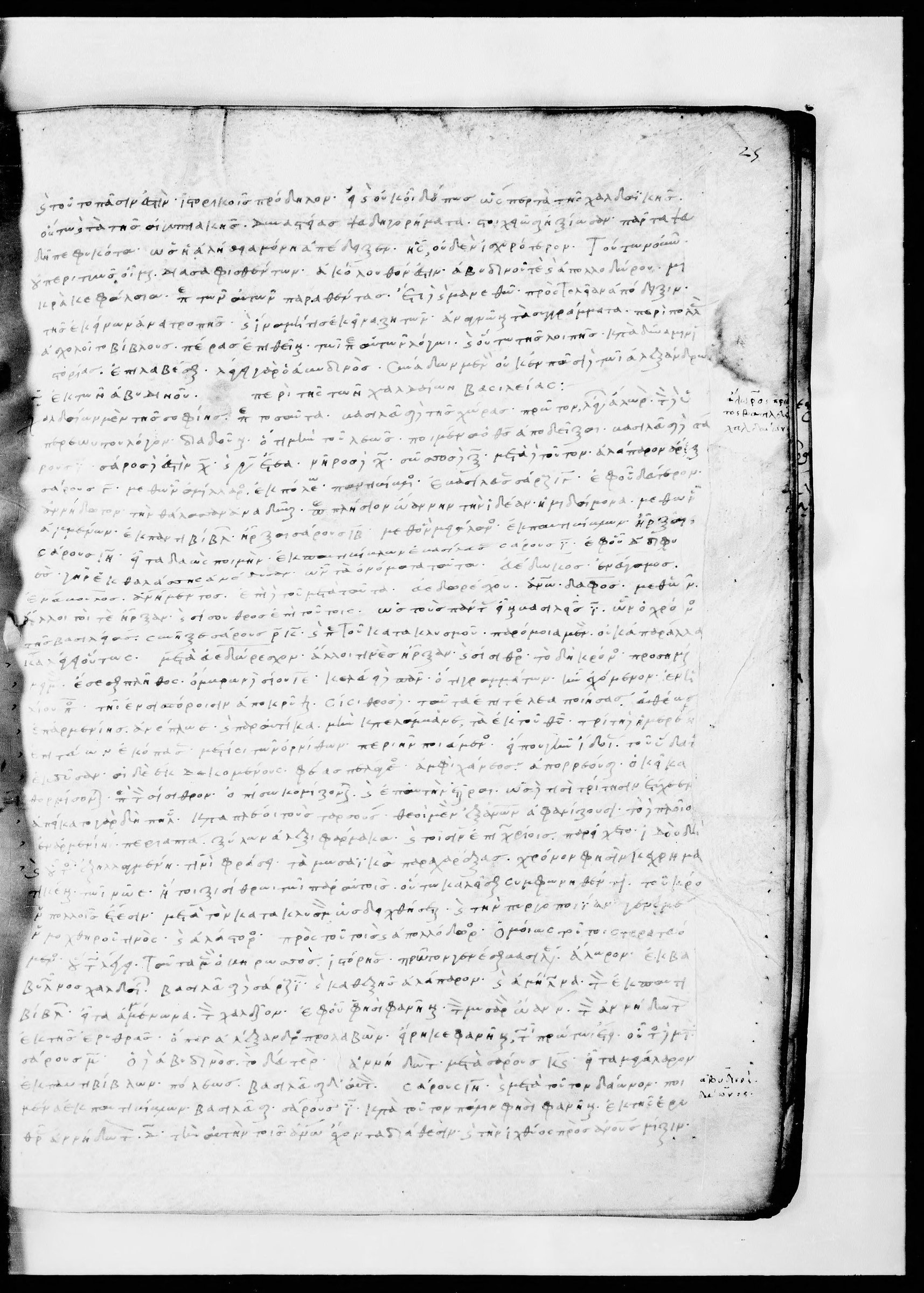
Paris gr. 1711, p. 25 (Gallica image f26, right page of the opening; microfilm). Syncellus introduces the extract on line 33 'πρὸς τούτοις καὶ Ἀπολλόδωρος ὁμοίως τούτοις τερατευό-|μενος οὕτω λέγει'; line 34 'ταῦτα μὲν ὁ Βήρωσσος ἱστόρησε· πρῶτον γενέσθαι βασιλέα Ἄλωρον'; the page ends on line 41 '...καὶ τὴν ἰχθύος πρὸς ἀνθρώπους μίξιν'. A marginal note beside line 38 names Abydenus. Checked on the image. Viewer: https://gallica.bnf.fr/ark:/12148/btv1b10723005g/f26.item The Greek shown is Müller's edited text; the copyist's wording on the page differs in places (for example the manuscript reads Κορκυραίων where Müller prints Κορδυαίων).
Πρὸς τούτοις καὶ Ἀπολλόδωρος ὁμοίως τούτοις τερατευόμενος οὕτω λέγει· «Ταῦτα μὲν ὁ Βήρωσσος ἱστόρησε, πρῶτον γενέσθαι βασιλέα Ἄλωρον ἐκ Βαβυλῶνος Χαλδαῖον· βασιλεῦσαι δὲ σάρους δέκα, καὶ καθεξῆς Ἀλάπαρον καὶ Ἀμήλωνα τὸν ἐκ Παντιβίβλων· εἶτα Ἀμμένωνα τὸν Χαλδαῖον, ἐφ’ οὗ φησι φανῆναι τὸν μυσαρὸν Ὠάννην, τὸν Ἀννήδωτον, ἐκ τῆς Ἐρυθρᾶς· [ὅπερ Ἀλέξανδρος προλαβὼν εἴρηκε φανῆναι τῷ πρώτῳ ἔτει· οὗτος δὲ μετὰ σάρους τεσσαράκοντα· ὁ δὲ Ἀβυδηνὸς τὸν δεύτερον Ἀννήδωτον μετὰ σάρους εἴκοσιν ἕξ·] εἶτα Μεγάλαρον ἐκ Παντιβίβλων πόλεως, βασιλεῦσαι δ’ αὐτὸν σάρους ὀκτωκαίδεκα· καὶ μετὰ τοῦτον Δάωνον ποιμένα ἐκ Παντιβίβλων βασιλεῦσαι σάρους δέκα. Κατὰ τοῦτον πάλιν φησὶ φανῆναι ἐκ τῆς Ἐρυθρᾶς Ἀννήδωτον τέταρτον τὴν αὐτὴν τοῖς ἄνω ἔχοντα διάθεσιν καὶ τὴν ἰχθύος πρὸς ἀνθρώπους μίξιν.
BEROSSUS: FROM APOLLODORUS. OF THE CHALDÆAN KINGS. THIS is the history which Berossus has transmitted to us. He tells us that the first king was Alorus of Babylon, a Chaldæan: he reigned ten sari: and afterwards Alaparus, and Amelon who came from Pantibiblon: then Ammenon the Chaldæan, in whose time appeared the Musarus Oannes the Annedotus from the Erythræan sea. (But Alexander Polyhistor anticipating the event, has said that he appeared in the first year; but Apollodorus says that it was after forty sari; Abydenus, however, makes the second Annedotus appear after twenty-six sari.) Then succeeded Megalarus from the city of Pantibiblon; and he reigned eighteen sari: and after him Daonus the shepherd from Pantibiblon reigned ten sari; in his time (he says) appeared again from the Erythræan sea a fourth Annedotus, having the same form with those above, the shape of a fish blended with that of a man.
Where on the image
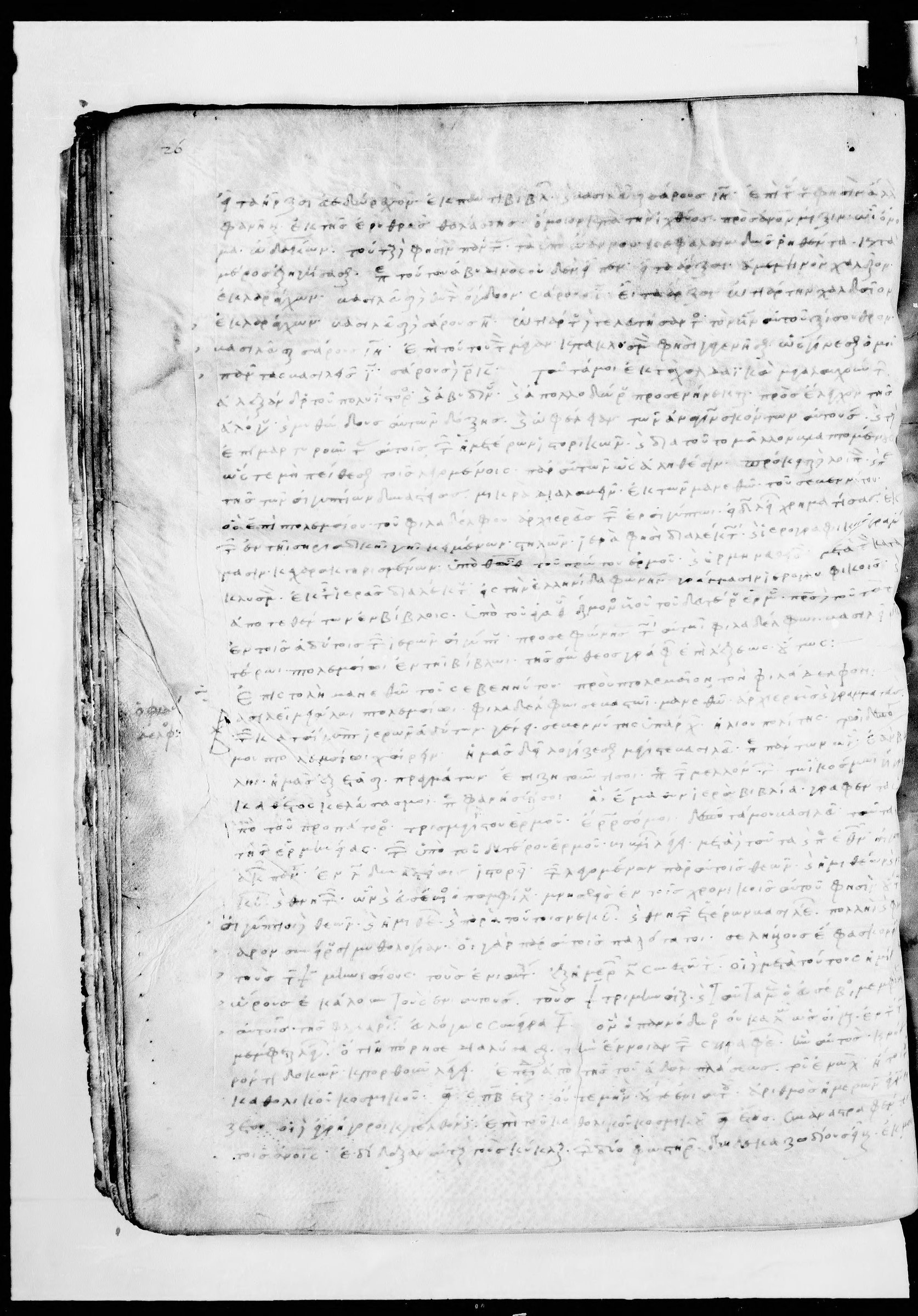
Paris gr. 1711, p. 26 (Gallica image f27, left page of the opening; microfilm). p. 26 begins 'εἶτα ἄρξαι Εὐεδώραχον ἐκ Παντιβίβλων'; line 4 'περὶ τούτου Ἀβυδηνὸς οὐδὲν εἶπεν'; the extract ends on line 8 'πάντας βασιλεῖς ι´ σάρους δὲ ρκ´'. Checked on the image. Viewer: https://gallica.bnf.fr/ark:/12148/btv1b10723005g/f27.item The Greek shown is Müller's edited text; the copyist's wording on the page differs in places (for example the manuscript reads Κορκυραίων where Müller prints Κορδυαίων).
Εἶτα ἄρξαι Εὐεδώραχον ἐκ Παντιβίβλων, καὶ βασιλεῦσαι σάρους ὀκτωκαίδεκα. Ἐπὶ τούτου φησὶν ἄλλον φανῆναι ἐκ τῆς Ἐρυθρᾶς θαλάσσης ὅμοιον κατὰ τὴν ἰχθύος πρὸς ἄνθρωπον μίξιν, ᾧ ὄνομα Ὠδάκων. Τούτους δέ φησι πάντας τὰ ὑπὸ Ὠάννου κεφαλαιωδῶς ῥηθέντα κατὰ μέρος ἐξηγήσασθαι. [Περὶ τούτου Ἀβυδηνὸς οὐδὲν εἶπεν.] Εἶτα ἄρξαι Ἀμεμψινὸν Χαλδαῖον ἐκ Λαράγχων· βασιλεῦσαι δὲ αὐτὸν ὄγδοον σάρους δέκα. Εἶτα ἄρξαι Ὠτιάρτην Χαλδαῖον ἐκ Λαράγχων, βασιλεῦσαι δὲ σάρους ηʹ. Ὠτιάρτου δὲ τελευτήσαντος τὸν υἱὸν αὐτοῦ Ξίσουθρον βασιλεῦσαι σάρους ὀκτωκαίδεκα. Ἐπὶ τούτου τὸν μέγαν κατακλυσμόν φησι γεγενῆσθαι. Ὡς γίνεσθαι ὁμοῦ πάντας βασιλεῖς δέκα, σάρους δὲ ἑκατὸν εἴκοσι.»
Then reigned Euedorachus from Pantibiblon, for the term of eighteen sari; in his days there appeared another personage from the Erythræan sea like the former, having the same complicated form between a fish and a man, whose name was Odacon. (All these, says Apollodorus, related particularly and circumstantially whatever Oannes had informed them of: concerning these Abydenus has made no mention.) Then reigned Amempsinus, a Chaldæan from Laranchæ: and he being the eighth in order reigned ten sari. Then reigned Otiartes, a Chaldæan, from Laranchæ; and he reigned eight sari. And upon the death of Otiartes, his son Xisuthrus reigned eighteen sari: in his time happened the great deluge. So that the sum of all the kings is ten; and the term which they collectively reigned an hundred and twenty sari.
Notes
- Greek: C. Müller, Fragmenta Historicorum Graecorum (1848-1851), text taken from the Digital Fragmenta Historicorum Graecorum and proofread against Müller's printed pages. Müller's notes on variant readings, printed in parentheses inside the text, are left out; his square brackets mark words he took to be additions by the excerptors.
- English: I. P. Cory, Ancient Fragments (2nd ed., 1832). Cory sometimes follows readings of the Armenian translation of Eusebius or older editors rather than the Greek printed here, so a few phrases differ from the Greek. His footnotes and source references are omitted. The capitalized heading at the start of the English is Cory's own heading; Syncellus' Greek heading is not translated by Cory.
- The manuscript's wording differs from Müller's edited text in small details. The Greek is the edition, not a transcription of the page.
- Cory's English does not translate Syncellus' introductory clause 'Πρὸς τούτοις καὶ Ἀπολλόδωρος ὁμοίως τούτοις τερατευόμενος οὕτω λέγει'. The words in square brackets are Syncellus' (or Eusebius') comments inside the quotation; Cory prints them in parentheses.
Cite
Sources
- Source: Paris gr. 1711 (George Syncellus, 11th c.) via Gallica + Greek of C. Müller, FHG (DFHG, proofread) + English of I. P. Cory, Ancient Fragments (1832) (holding institution)
- Critical edition: C. Müller, FHG II and IV (via DFHG, proofread); B. Niese 1889 (Perseus)
← previous · → next · v cycle view · l back to library