The tower of Babel in Alexander Polyhistor (the Sibyl) and Abydenus (George Syncellus)
Introduction
Berossus was a priest of Bel at Babylon who, around 290-278 BCE, wrote a history of his country in Greek for the Seleucid king Antiochus I. His three books ran from the creation of the world through the ten kings who reigned before the flood to the Neo-Babylonian kings. The work is lost. Its fullest remains reached the Byzantine chronicler George Syncellus (c. 800 AD) through a chain of excerpts: Alexander Polyhistor (1st c. BCE) summarized Berossus, Eusebius of Caesarea quoted Polyhistor, and Syncellus copied Eusebius into his Ecloga chronographica.
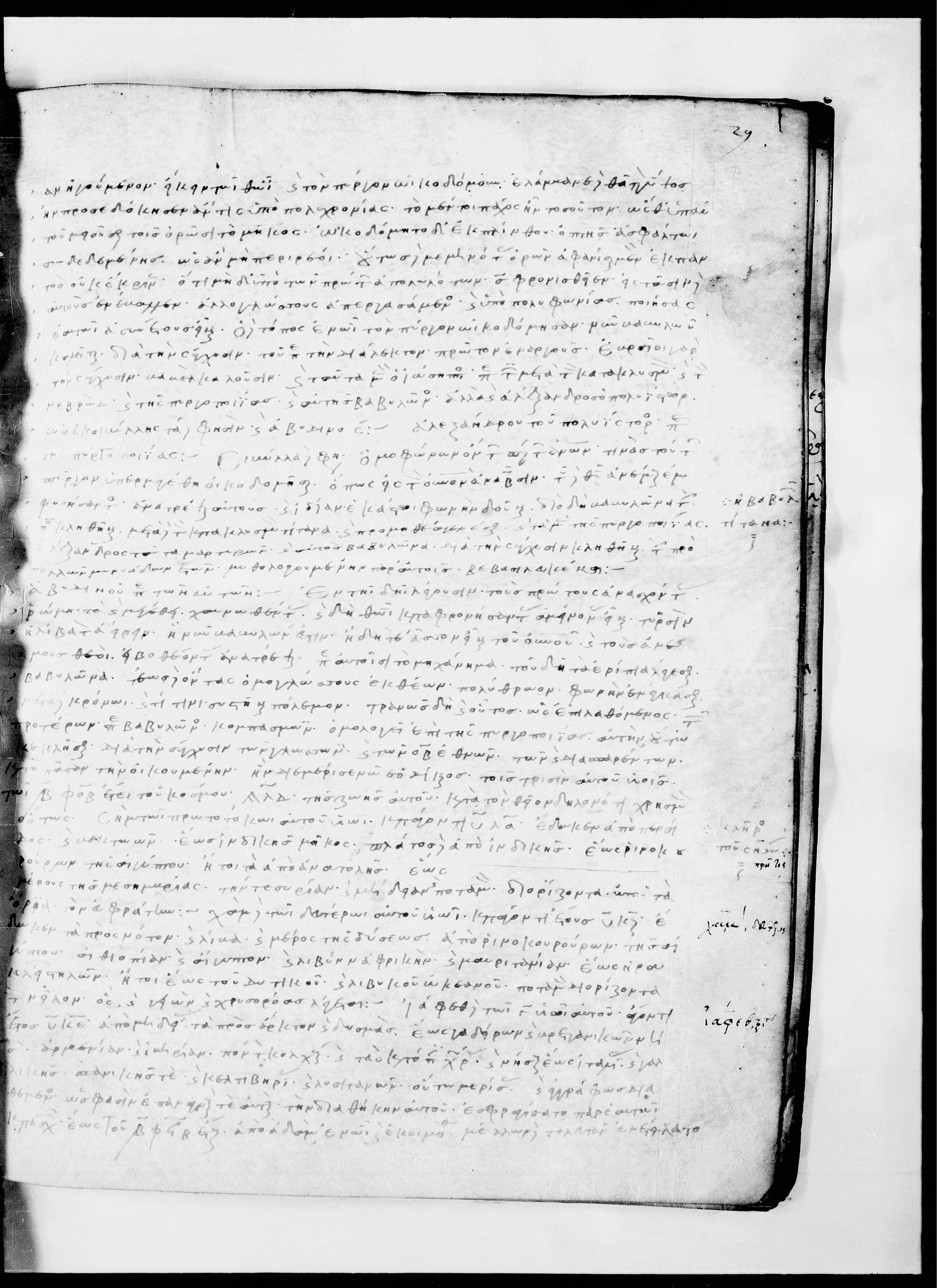
The manuscript shown is Paris, Bibliothèque nationale de France, grec 1711, an 11th-century copy of Syncellus' chronicle, the oldest and principal witness to the text. The images are the library's black-and-white microfilm, published on Gallica. Each section points at the page that carries it; the line numbers in the notes were counted on the images.
After the flood Syncellus turns to the tower of Babel and copies two Greek witnesses that came down from the Babylonian tradition: Alexander Polyhistor, who quotes a Sibylline oracle on a single language, a tower built to climb to heaven and overthrown by the winds, and the confusion of tongues that gave Babylon its name; and Abydenus, whose account of the tower ends with a war between Kronos and Titan.
Not included: the summaries of Berossus that survive only in the Armenian translation of Eusebius' Chronicle (no Greek), Syncellus' own remarks on Berossus' chronology (no public-domain English translation), and the short testimonia in other authors.
How was this verified? (Provenance)
Where on the image
Paris gr. 1711, p. 29 (Gallica image f28, right page of the opening; microfilm). At the end of line 11 stands Syncellus' heading 'ἀλεξάνδρου τοῦ πολυΐστορος περὶ | τῆς πυργοποιίας'; line 12 continues 'Σίβυλλα δέ φησιν ὁμοφώνων ὄντων πάντων ἀνθρώπων'; the quotation ends on line 15 '...μετὰ δὲ τὸν κατακλυσμὸν Τιτᾶνα καὶ Προμηθέα γενέσθαι', followed by Syncellus' comment to line 17 '...βεβασιλευκέναι' (not included). The last clause of Cory's English, 'when Titan undertook a war against Cronus', translates the Armenian version of Eusebius and is not in this Greek. Checked on the image. Viewer: https://gallica.bnf.fr/ark:/12148/btv1b10723005g/f28.item The Greek shown is Müller's edited text; the copyist's wording on the page differs in places (for example the manuscript reads Κορκυραίων where Müller prints Κορδυαίων).
Ἀλεξάνδρου τοῦ Πολυΐστορος περὶ τῆς πυργοποιίας· «Σίβυλλα δέ φησιν, ὁμοφώνων ὄντων πάντων ἀνθρώπων, τινὰς τούτων πύργον ὑπερμεγέθη οἰκοδομῆσαι, ὅπως εἰς τὸν οὐρανὸν ἀναβῶσι. Τοῦ δὲ θεοῦ ἀνέμους ἐμφυσήσαντος ἀνατρέψαι αὐτοὺς, καὶ ἰδίαν ἑκάστῳ φωνὴν δοῦναι, διὸ δὴ Βαβυλῶνα τὴν πόλιν κληθῆναι· μετὰ δὲ τὸν κατακλυσμὸν Τιτᾶνα καὶ Προμηθέα γενέσθαι.»
OF THE TOWER OF BABEL: FROM ALEXANDER POLYHISTOR. THE Sibyl says: That when all men formerly spoke the same language; some among them undertook to erect a large and lofty tower, that they might climb up into heaven. But God sending forth a whirlwind, confounded their design, and gave to each tribe a particular language of its own: which is the reason that the name of that city is Babylon. After the deluge lived Titan and Prometheus; when Titan undertook a war against Cronus.
Where on the image
Paris gr. 1711, p. 29 (Gallica image f28, right page of the opening; microfilm). Line 18 opens with the heading 'Ἀβυδηνοῦ περὶ τῶν αὐτῶν' followed by 'Ἐντὶ δ’ οἳ λέγουσι τοὺς πρώτους ἀνασχόντας'; the extract ends on line 23 '...μετὰ δὲ Κρόνῳ καὶ Τιτῆνι συστῆναι πόλεμον'. The last sentence of Cory's English ('The place in which they built the tower is now called Babylon ... called Babel') translates the longer text of the same fragment in Eusebius, Praeparatio evangelica 9.14, which is not on this page. Checked on the image. Viewer: https://gallica.bnf.fr/ark:/12148/btv1b10723005g/f28.item The Greek shown is Müller's edited text; the copyist's wording on the page differs in places (for example the manuscript reads Κορκυραίων where Müller prints Κορδυαίων).
Ἐντὶ δ’ οἳ λέγουσι τοὺς πρώτους ἀνασχόντας ῥώμῃ τε καὶ μεγέθει χαυνωθέντας καὶ δὴ θεῶν καταφρονήσαντας ἀμείνονας εἶναι τύρσιν ἠλίβατον ἀείρειν, ἣ νῦν Βαβυλών ἐστιν· ἤδη τε ἆσσον εἶναι τοῦ οὐρανοῦ, καὶ τοὺς ἀνέμους θεοῖσι βωθέοντας ἀνατρέψαι περὶ αὐτοῖσι τὸ μηχάνημα· τοῦ δὴ τὰ ἐρείπια λέγεσθαι Βαβυλῶνα. Τέως δὲ ὄντας ὁμογλώσσους ἐκ θεῶν πολύθροον φωνὴν ἐνέγκασθαι· μετὰ δὲ Κρόνῳ καὶ Τιτῆνι συστῆναι πόλεμον.
BEROSSUS: FROM ABYDENUS. THE TOWER OF BABEL. They say that the first inhabitants of the earth, glorying in their own strength and size, and despising the gods, undertook to raise a tower whose top should reach the sky, in the place in which Babylon now stands: but when it approached the heaven, the winds assisted the gods, and overthrew the work upon its contrivers: and its ruins are said to be still at Babylon: and the gods introduced a diversity of tongues among men, who till that time had all spoken the same language: and a war arose between Cronus and Titan. The place in which they built the tower is now called Babylon, on account of the confusion of the tongues; for confusion is by the Hebrews called Babel.
Notes
- Greek: C. Müller, Fragmenta Historicorum Graecorum (1848-1851), text taken from the Digital Fragmenta Historicorum Graecorum and proofread against Müller's printed pages. Müller's notes on variant readings, printed in parentheses inside the text, are left out; his square brackets mark words he took to be additions by the excerptors.
- English: I. P. Cory, Ancient Fragments (2nd ed., 1832). Cory sometimes follows readings of the Armenian translation of Eusebius or older editors rather than the Greek printed here, so a few phrases differ from the Greek. His footnotes and source references are omitted. The capitalized heading at the start of the English is Cory's own heading; Syncellus' Greek heading is not translated by Cory.
- The manuscript's wording differs from Müller's edited text in small details. The Greek is the edition, not a transcription of the page.
- Polyhistor's quotation of the Sibyl and Abydenus' account stand one after the other on the same page; Syncellus places them in his discussion of the tower of Babel and Nimrod.
- Abydenus writes in the Ionic dialect (τύρσιν, θεοῖσι, ἐνέγκασθαι).
Cite
Sources
- Source: Paris gr. 1711 (George Syncellus, 11th c.) via Gallica + Greek of C. Müller, FHG (DFHG, proofread) + English of I. P. Cory, Ancient Fragments (1832) (holding institution)
- Critical edition: C. Müller, FHG II and IV (via DFHG, proofread); B. Niese 1889 (Perseus)
← previous · → next · v cycle view · l back to library