Bhagavad Gita, Chapter 8: The Yoga of the Indestructible Supreme Eternal
Introduction
The Bhagavad Gita ("Song of the Lord") is a dialogue of 700 verses between the prince Arjuna and Krishna, set on the battlefield of Kurukshetra in book 6 (Bhishmaparvan) of the Mahabharata. Its date of composition is debated; many scholars place it in the last centuries BCE. This is chapter 8, The Yoga of the Indestructible Supreme Eternal (28 verses as numbered in the manuscript and in Besant's edition).
The pages shown are from a complete Sanskrit manuscript of the Gita at the University of Pennsylvania (Penn Ms. Coll. 390 Item 559), 90 paper leaves of 7 lines in Devanagari, with speaker headings, colophons and verse-end marks in red. Its final colophon (fol. 90r) dates the copy to Saṃvat 1851, the third day of the bright half of Caitra (1794 CE). Chapter 8 runs from fol. 40v to the chapter colophon on fol. 44r.
Each section below is one manuscript page: the verses whose text ends on that page, located by reading the scribe's verse numbers and the first and last words on the image. When a verse begins at the foot of one page and ends on the next, both pages are shown. The Sanskrit and English are from Annie Besant's edition and translation (4th edition, 1922), which prints each verse in Devanagari with its English; the manuscript's spelling differs from the printed text in small details.
How was this verified? (Provenance)
Where on the image
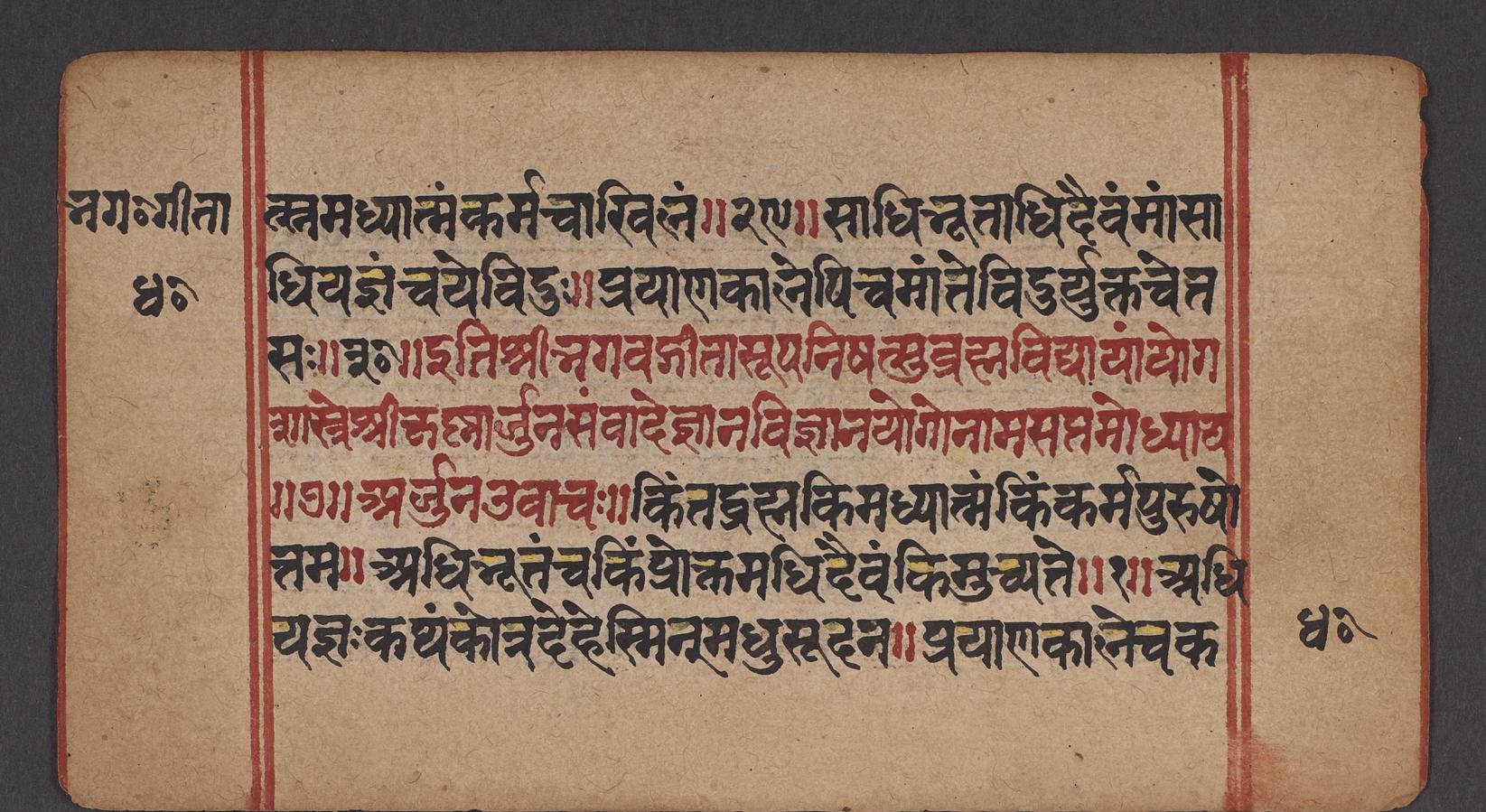
fol. 40v, OPenn image 6555_0040 (upper leaf). Checked on the image: ||29|| line 1, ||30|| line 3; colophon lines 3-5 '... jñānavijñānayogo nāma saptamo 'dhyāyaḥ ||7||'; arjuna uvāca line 5; 8.1 ends line 6 (||1||), 8.2 begins line 6.
1अर्जुन उवाच ।
किं तद्ब्रह्म किमध्यात्मं किं कर्म पुरुषोत्तम ।
अधिभूतं च किं प्रोक्तमधिदैवं किमुच्यते ॥ १ ॥
1Arjuna said:
What is that Eternal, what Self-knowledge, what Action, O Purushottama? And what is declared to be the knowledge of the Elements, what is called the knowledge of the Shining Ones?
Where on the image
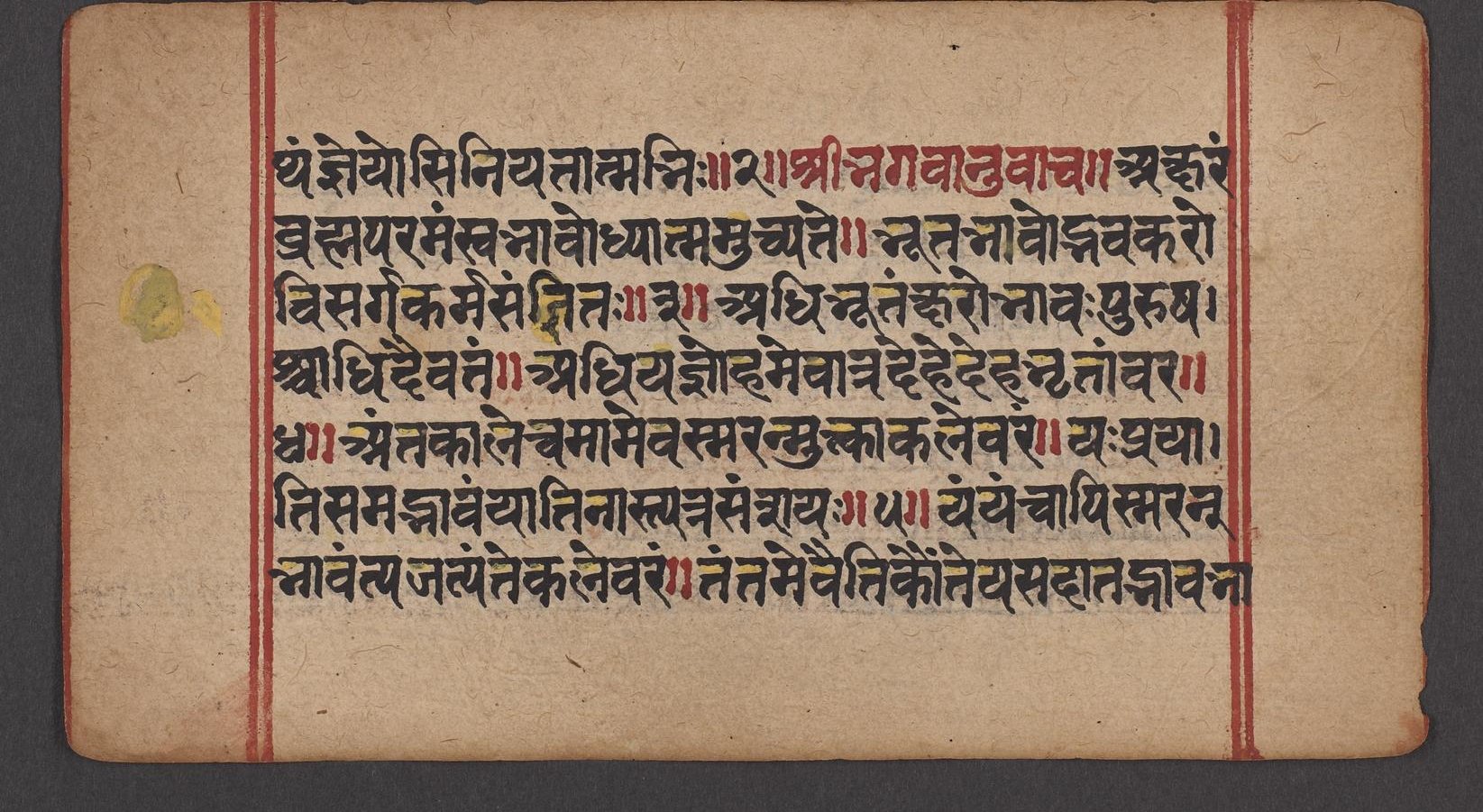
fol. 41r, OPenn image 6555_0040 (lower leaf). Checked on the image: ||2|| line 1 ... ||5|| line 6. Verse 8.2 begins on the previous page, fol. 40v, so both pages are shown.
2अधियज्ञः कथं कोऽत्र देहेऽस्मिन्मधुसूदन ।
प्रयाणकाले च कथं ज्ञेयोऽसि नियतात्मभिः ॥ २ ॥
3श्रीभगवानुवाच ।
अक्षरं ब्रह्म परमं स्वभावोऽध्यात्ममुच्यते ।
भूतभावोद्भवकरो विसर्गः कर्मसंज्ञितः ॥ ३ ॥
4अधिभूतं क्षरो भावः पुरुषश्चाधिदैवतम् ।
अधियज्ञोऽहमेवात्र देहे देहभृतां वर ॥ ४ ॥
5अन्तकाले च मामेव स्मरन्मुक्त्वा कलेवरम् ।
यः प्रयाति स मद्भावं याति नास्त्यत्र संशयः ॥ ५ ॥
2What is the knowledge of Sacrifice in this body, and how, O, Madhusûdana? And how, at the time of forthgoing art Thou known by the Self-controlled?
3The Blessed Lord said:
The indestructible, the supreme is the Eternal; His essential nature is called Self-knowledge; the emanation that causes the birth of beings is named Action;
4Knowledge of the Elements concerns My perishable nature, and knowledge of the Shining Ones concerns the life-giving energy; the knowledge of Sacrifice tells of Me, as wearing the body, O best of living beings.
5And he who, casting off the body, goeth forth thinking upon Me only at the time of the end, he entereth into My being: there is no doubt of that.
Where on the image
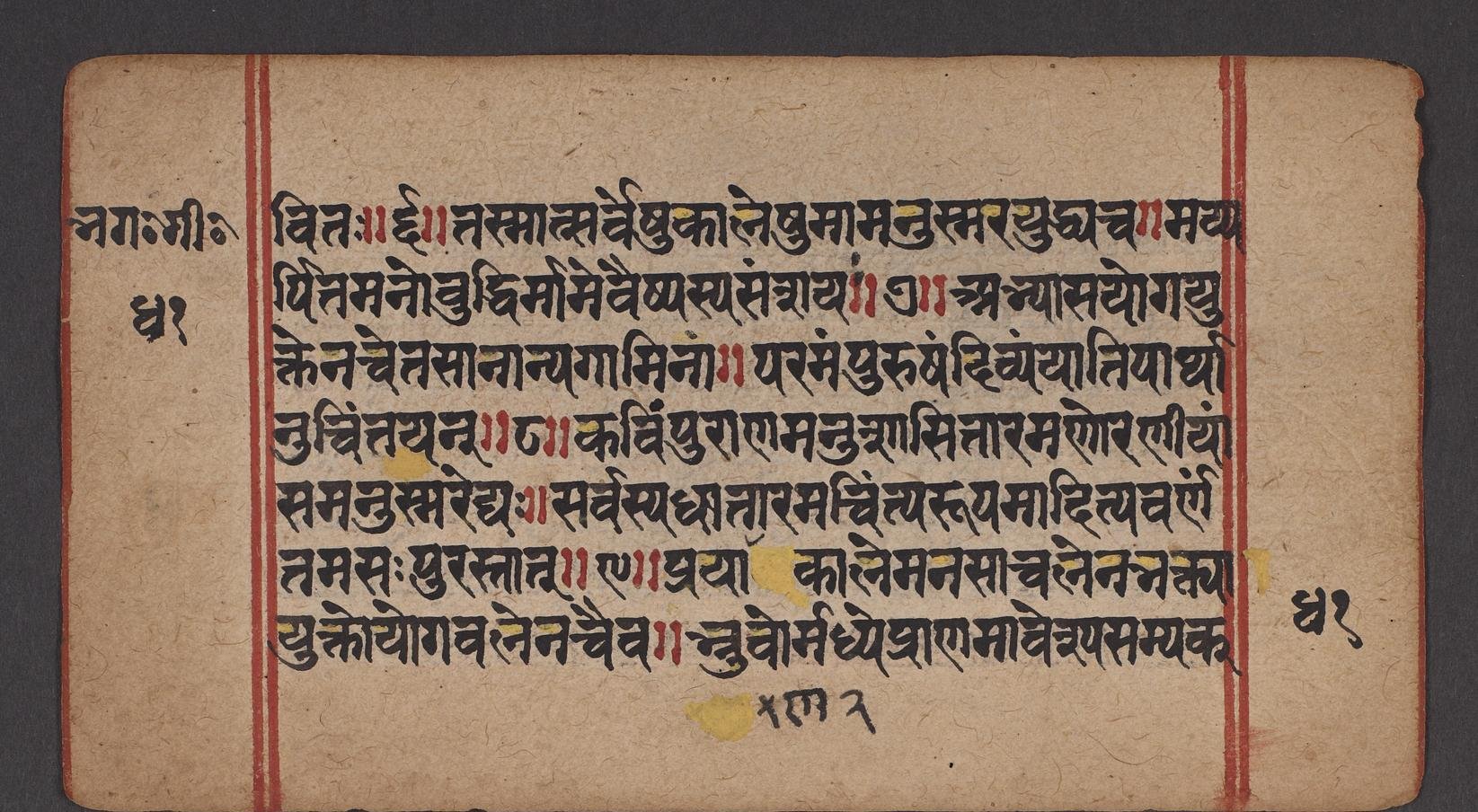
fol. 41v, OPenn image 6555_0041 (upper leaf). Checked on the image: ||6|| line 1 ... ||9|| line 7 (8.9 ends line 7, 8.10 begins line 7). Verse 8.6 begins on the previous page, fol. 41r, so both pages are shown.
6यं यं वापि स्मरन्भावं त्यजत्यन्ते कलेवरम् ।
तं तमेवैति कौन्तेय सदा तद्भावभावितः ॥ ६ ॥
7तस्मात्सर्वेषु कालेषु मामनुस्मर युध्य च ।
मय्यर्पितमनोबुद्धिर्मामेवैष्यस्यसंशयम् ॥ ७ ॥
8अभ्यासयोगयुक्तेन चेतसा नान्यगामिना ।
परमं पुरुषं दिव्यं याति पार्थानुचिन्तयन् ॥ ८ ॥
9कविं पुराणमनुशासितारमणोरणीयांसमनुस्मरेद्यः ।
सर्वस्य धातारमचिन्त्यरूपमादित्यवर्णं तमसः परस्तात् ॥ ९ ॥
6Whosoever at the end abandoneth the body, thinking upon any being, to that being only he goeth, O Kaunteya, ever to that conformed in nature.
7Therefore at all times think upon Me only and fight. With mind and Reason set on Me, without doubt thou shalt come to Me.
8With the mind not wandering after aught else, harmonised by continual practice, constantly meditating, O Pârtha, one goeth to the Spirit supreme, divine.
9He who thinketh upon the Ancient, the Omniscient, the All-Ruler, minuter than the minute, the supporter of all, of form unimaginable, refulgent as the sun beyond the darkness,
Where on the image
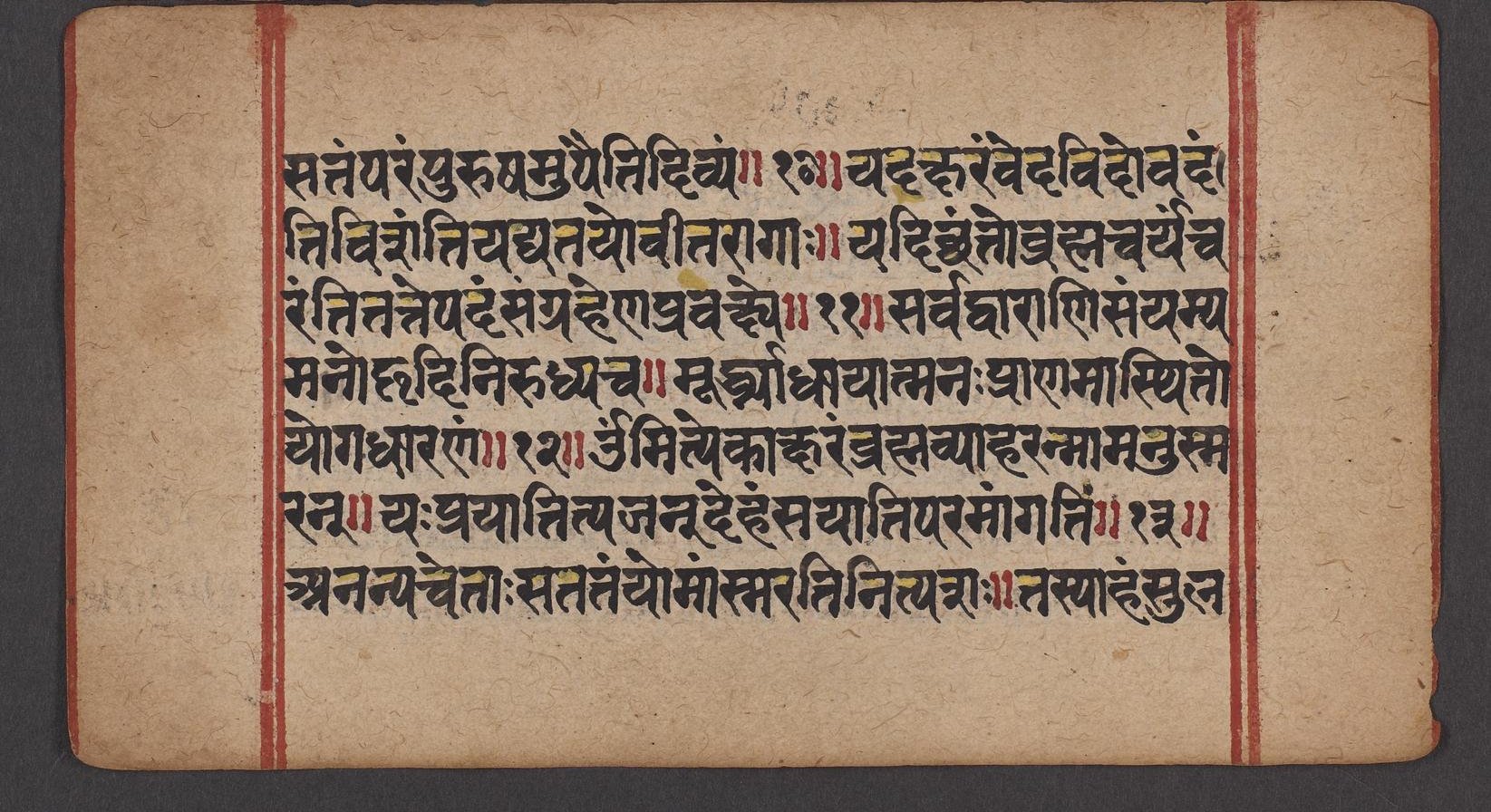
fol. 42r (catalogue label 41r =42r; the scribe repeated folio number 41), OPenn image 6555_0041 (lower leaf). Checked on the image: TEI label '41r (=42r)' (scribe repeated folio number 41); ||10|| line 1 ... ||13|| line 6. Verse 8.10 begins on the previous page, fol. 41v, so both pages are shown.
10प्रयाणकाले मनसाऽचलेन भक्त्या युक्तो योगबलेन चैव ।
भ्रुवोर्मध्ये प्राणमावेश्य सम्यक् स तं परं पुरुषमुपैति दिव्यम् ॥ १० ॥
11यदक्षरं वेदविदो वदन्ति विशन्ति यद्यतयो वीतरागाः ।
यदिच्छन्तो ब्रह्मचर्यं चरन्ति तत्ते पदं सङ्ग्रहेण प्रवक्ष्ये ॥ ११ ॥
12सर्वद्वाराणि संयम्य मनो हृदि निरुध्य च ।
मूर्ध्न्याधायात्मनः प्राणमास्थितो योगधारणाम् ॥ १२ ॥
13ओमित्येकाक्षरं ब्रह्म व्याहरन्मामनुस्मरन् ।
यः प्रयाति त्यजन्देहं स याति परमां गतिम् ॥ १३ ॥
10In the time of forthgoing, with unshaken mind, fixed in devotion, by the power of yoga drawing together his life-breath in the centre of the two eyebrows, he goeth to this Spirit, supreme, divine.
11That which is declared indestructible by the Veda-knowers, that which the controlled and passion-free enter, that desiring which Brahmacharya is performed, that path I will declare to thee with brevity.
12All the gates closed, the mind confined in the heart, the life-breath fixed in his own head, concentrated by yoga,
13"Aum!" the one syllabled Eternal, reciting, thinking upon Me, he who goeth forth, abandoning the body, he goeth on the highest path.
Where on the image
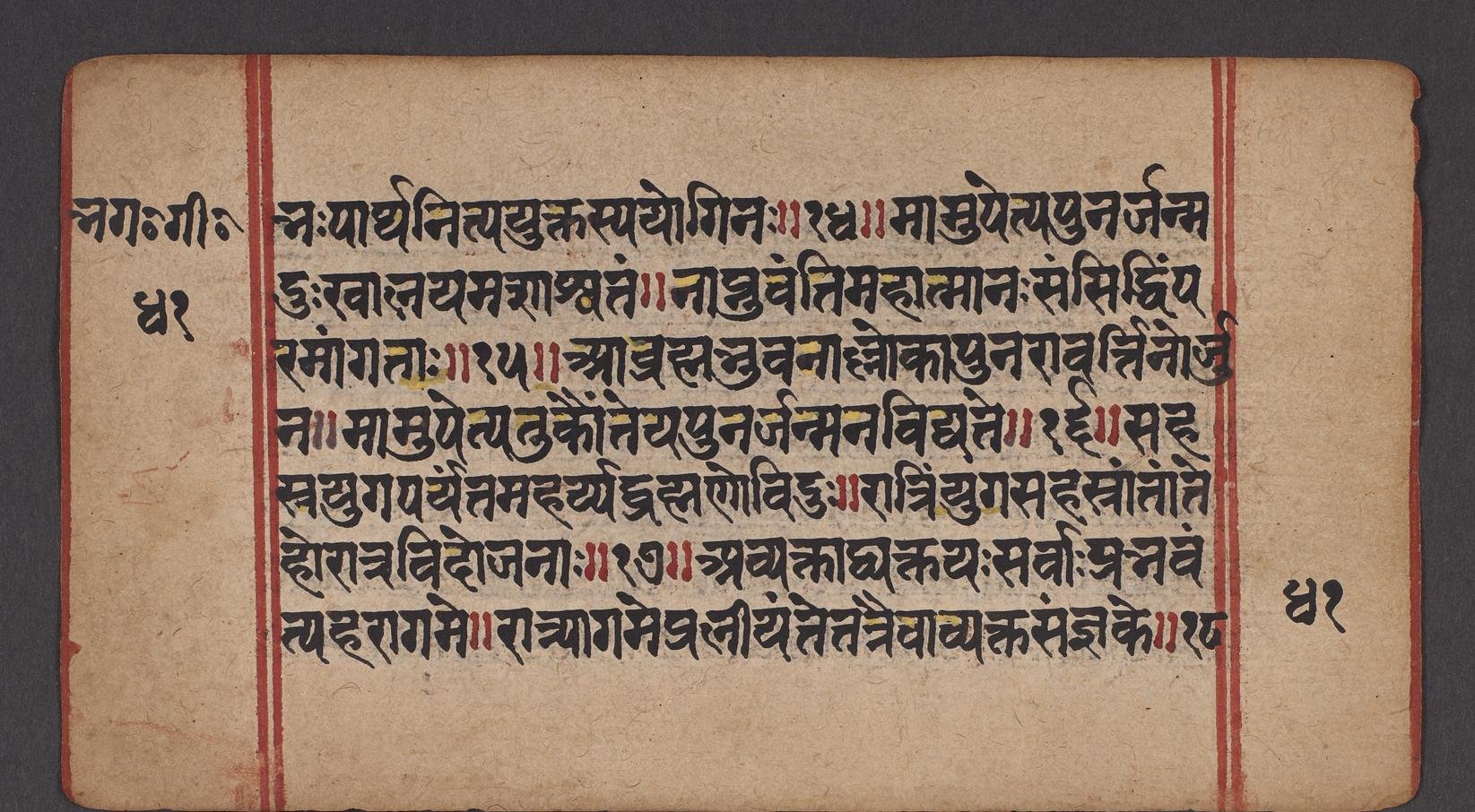
fol. 42v (catalogue label 41v =42v; the scribe repeated folio number 41), OPenn image 6555_0042 (upper leaf). Checked on the image: TEI label '41v (=42v)'; ||14|| line 1 ... ||18|| end of line 7. Verse 8.14 begins on the previous page, fol. 42r, so both pages are shown.
14अनन्यचेताः सततं यो मां स्मरति नित्यशः ।
तस्याहं सुलभः पार्थ नित्ययुक्तस्य योगिनः ॥ १४ ॥
15मामुपेत्य पुनर्जन्म दुःखालयमशाश्वतम् ।
नाप्नुवन्ति महात्मानः संसिद्धिं परमां गताः ॥ १५ ॥
16आब्रह्मभुवनाल्लोकाः पुनरावर्तिनोऽर्जुन ।
मामुपेत्य तु कौन्तेय पुनर्जन्म न विद्यते ॥ १६ ॥
17सहस्रयुगपर्यन्तमहर्यद्ब्रह्मणो विदुः ।
रात्रिं युगसहस्रान्तां तेऽहोरात्रविदो जनाः ॥ १७ ॥
18अव्यक्ताद्व्यक्तयः सर्वाः प्रभवन्त्यहरागमे ।
रात्र्यागमे प्रलीयन्ते तत्रैवाव्यक्तसंज्ञके ॥ १८ ॥
14He who constantly thinketh upon Me, not thinking ever of another, of him I am easily reached, O Pârtha, of this ever-harmonised Yogî.
15Having come to Me, these Mahâtmâs come not again to birth, the place of pain, non-eternal; they have gone to the highest bliss.
16The worlds, beginning with the world of Brahmâ, they come and go, O Arjuna; but he who cometh unto Me, O Kaunteya, he knoweth birth no more.
17The people who know the day of Brahmâ, a thousand ages in duration, and the night a thousand ages in ending, they know day and night.
18From the unmanifested all the manifested stream forth at the coming of day; at the coming of night they dissolve, even in That called the unmanifested.
Where on the image
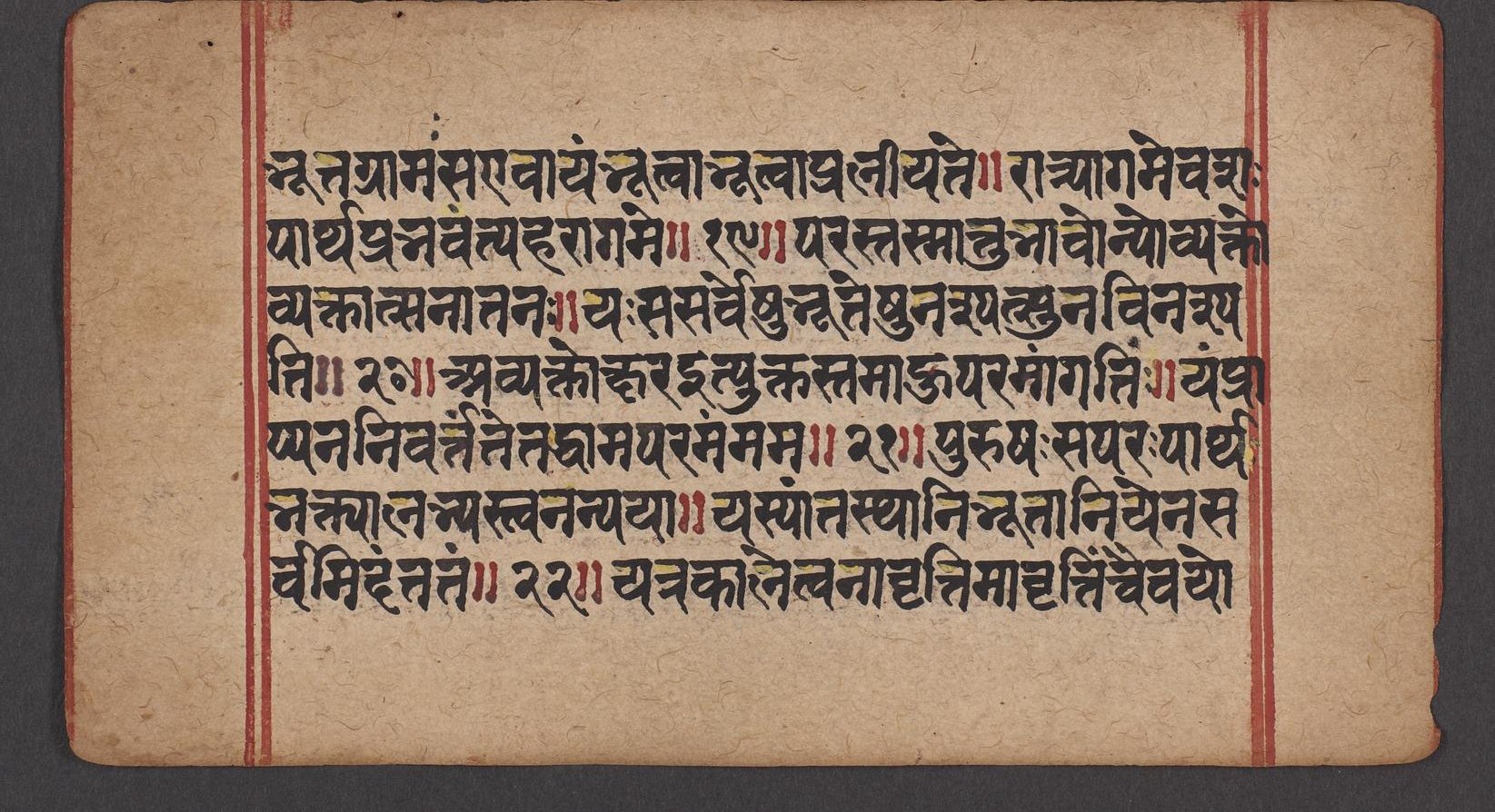
fol. 43r (catalogue label 42r =43r; the scribe repeated folio number 41), OPenn image 6555_0042 (lower leaf). Checked on the image: TEI label '42r (=43r)'; ||19|| line 2 ... ||22|| line 7.
19भूतग्रामः स एवायं भूत्वा भूत्वा प्रलीयते ।
रात्र्यागमेऽवशः पार्थ प्रभवत्यहरागमे ॥ १९ ॥
20परस्तस्मात्तु भावोऽन्योऽव्यक्तोऽव्यक्तात्सनातनः ।
यः स सर्वेषु भूतेषु नश्यत्सु न विनश्यति ॥ २० ॥
21अव्यक्तोऽक्षर इत्युक्तस्तमाहुः परमां गतिम् ।
यं प्राप्य न निवर्तन्ते तद्धाम परमं मम ॥ २१ ॥
22पुरुषः स परः पार्थ भक्त्या लभ्यस्त्वनन्यया ।
यस्यान्तःस्थानि भूतानि येन सर्वमिदं ततम् ॥ २२ ॥
19This multitude of beings, going forth repeatedly, is dissolved at the coming of night: by ordination, O Pârtha, it streams forth at the coming of day.
20Therefore verily there existeth, higher than that unmanifested, another unmanifested, eternal, which in the destroying of all beings, is not destroyed.
21That unmanifested, "the Indestructible," It is called; It is named the highest Path. They who reach It return not. That is My supreme abode.
22He, the highest Spirit, O Pârtha, may be reached by unswerving devotion to Him alone, in whom all beings abide, by whom all This is pervaded.
Where on the image
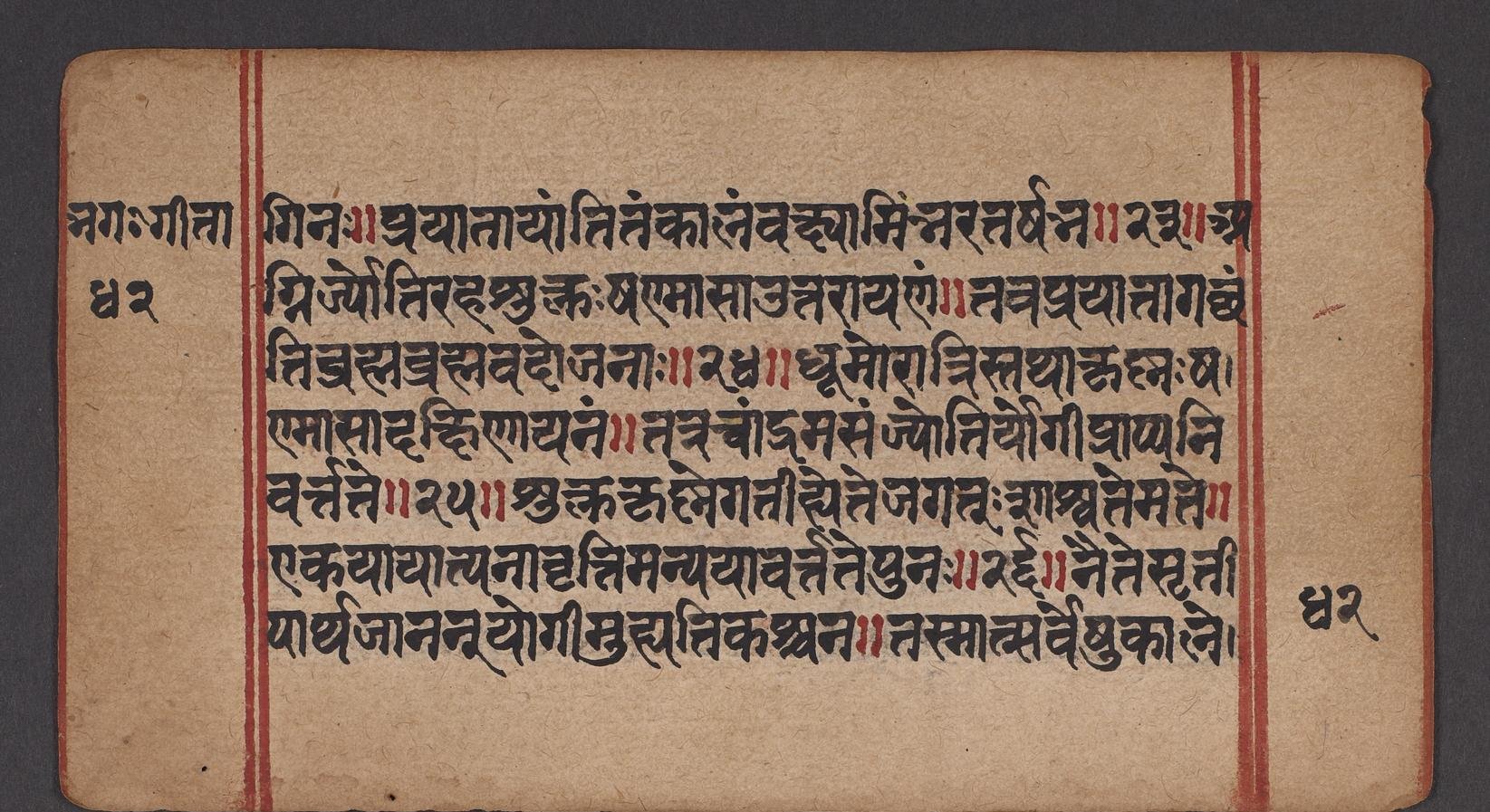
fol. 43v (catalogue label 42v =43v; the scribe repeated folio number 41), OPenn image 6555_0043 (upper leaf). Checked on the image: TEI '42v (=43v)'; ||23|| line 1 ... ||26|| line 6. Verse 8.23 begins on the previous page, fol. 43r, so both pages are shown.
23यत्र काले त्वनावृत्तिमावृत्तिं चैव योगिनः ।
प्रयाता यान्ति तं कालं वक्ष्यामि भरतर्षभ ॥ २३ ॥
24अग्निर्ज्योतिरहः शुक्लः षण्मासा उत्तरायणम् ।
तत्र प्रयाता गच्छन्ति ब्रह्म ब्रह्मविदो जनाः ॥ २४ ॥
25धूमो रात्रिस्तथा कृष्णः षण्मासा दक्षिणायनम् ।
तत्र चान्द्रमसं ज्योतिर्योगी प्राप्य निवर्तते ॥ २५ ॥
26शुक्लकृष्णे गती ह्येते जगतः शाश्वते मते ।
एकया यात्यनावृत्तिमन्ययाऽऽवर्तते पुनः ॥ २६ ॥
23That time wherein going forth Yogîs return not, and also that wherein going forth they return, that time shall I declare to thee, O prince of the Bhâratas.
24Fire, light, day-time, the bright fortnight, the six months of the northern path—then, going forth, the men who know the Eternal go to the Eternal.
25Smoke, night-time, the dark fortnight also, the six months of the southern path—then the Yogî, obtaining the moonlight, returneth.
26Light and darkness, these are thought to be the world's everlasting paths; by the one he goeth who returneth not, by the other he who returneth again.
Where on the image
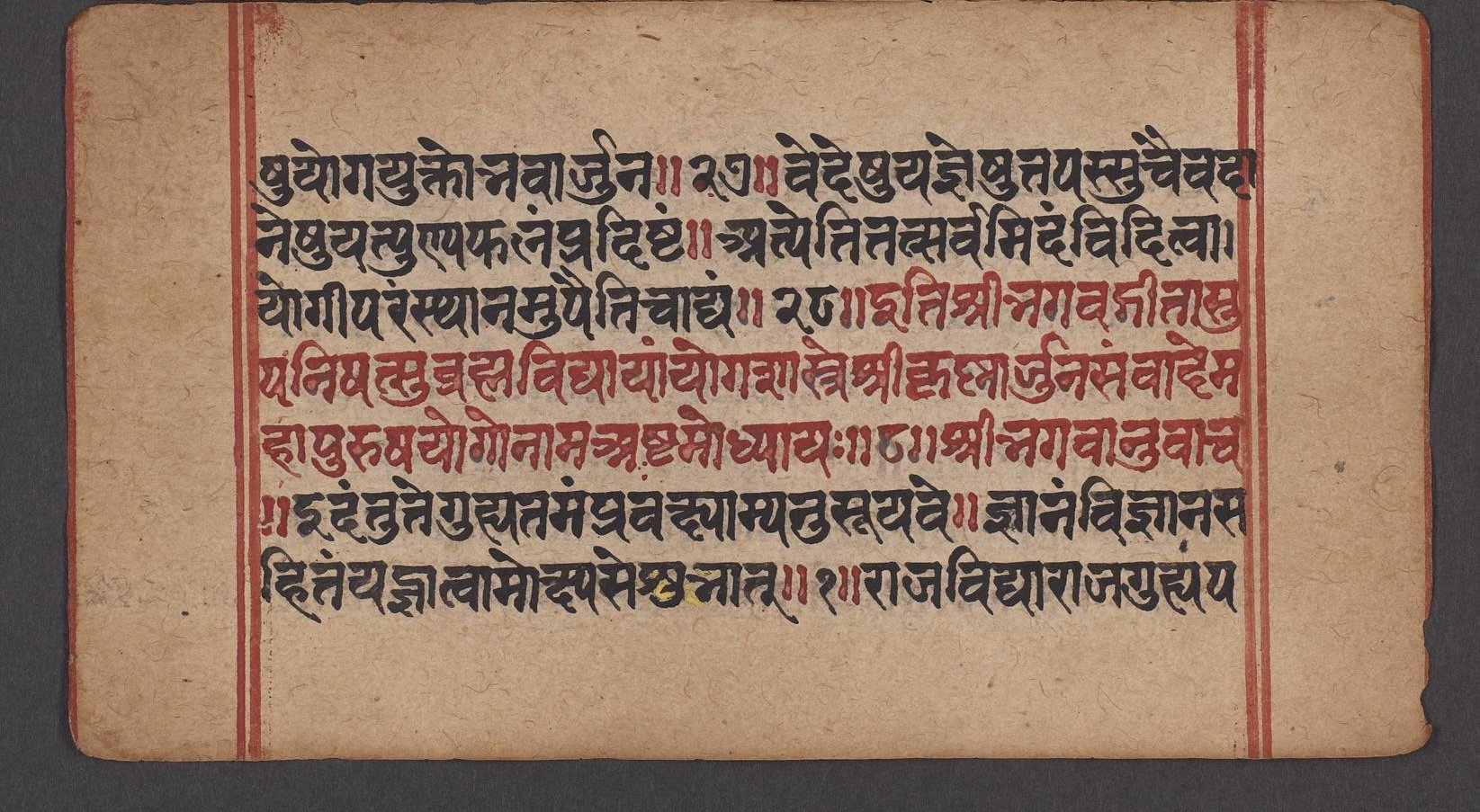
fol. 44r (catalogue label 43r =44r; the scribe repeated folio number 41), OPenn image 6555_0043 (lower leaf). Checked on the image: TEI '43r (=44r)'; ||27|| line 1, ||28|| line 3; colophon lines 3-5 '... mahāpuruṣayogo nāma aṣṭamo 'dhyāyaḥ ||8||'; śrībhagavān uvāca; 9.1 ends line 7 (||1||), 9.2 begins line 7. Verse 8.27 begins on the previous page, fol. 43v, so both pages are shown.
27नैते सृती पार्थ जानन्योगी मुह्यति कश्चन ।
तस्मात्सर्वेषु कालेषु योगयुक्तो भवार्जुन ॥ २७ ॥
28वेदेषु यज्ञेषु तपःसु चैव दानेषु यत्पुण्यफलं प्रदिष्टम् ।
अत्येति तत्सर्वमिदं विदित्वा योगी परं स्थानमुपैति चाद्यम् ॥ २८ ॥
27Knowing these paths, O Pârtha, the Yogi is nowise perplexed. Therefore in all times be firm in yoga, O Arjuna.
28The fruit of meritorious deeds, attached in the Vedas to sacrifices, to austerities, and also to almsgiving, the Yogî passeth all these by having known this, and goeth to the supreme and ancient Seat.
Where on the image
fol. 44r (catalogue label 43r =44r; the scribe repeated folio number 41): TEI '43r (=44r)'; ||27|| line 1, ||28|| line 3; colophon lines 3-5 '... mahāpuruṣayogo nāma aṣṭamo 'dhyāyaḥ ||8||'; śrībhagavān uvāca; 9.1 ends line 7 (||1||), 9.2 begins line 7. The manuscript names the chapter mahāpuruṣayoga; the Sanskrit and English shown are the colophon printed in Besant's edition, whose wording differs in places from the manuscript's.
इति श्रीमद्भगवद्गीता॰ योगशास्त्रेऽक्षरब्रह्मयोगो नामाष्टमोऽध्यायः ।
Thus in the glorious Upanishads of the Bhagavad-Gita, the science of the Eternal, the scripture of Yoga, the dialogue between Shrî Krishna and Arjuna, the eighth discourse, entitled: THE YOGA OF THE INDESCTRUCTIBLE SUPREME ETERNAL.
Notes
- Sanskrit and English: Annie Besant, The Bhagavad-Gita, 4th edition (Madras: G. A. Natesan, 1922), transcription validated on English Wikisource. Besant's footnotes are not reproduced.
- Verse numbers follow Besant and the manuscript, which agree throughout: chapter 13 counts Arjuna's opening question ('prakṛtiṃ puruṣaṃ caiva...') as verse 1, so it has 35 verses and the whole text 701.
- K. T. Telang's translation (Sacred Books of the East 8, 1882) was the first choice for the English, but it is continuous prose without verse divisions, so it cannot be matched to manuscript pages verse by verse; Besant's verse-numbered translation is used instead.
- The last section of each chapter is the chapter colophon. Besant prints most Sanskrit colophons in shortened form (marked with ॰) while her English gives the full formula; the manuscript writes the colophon out in full, and its chapter names differ in places from Besant's (see the scan note).
- Besant's English colophon for this chapter reads 'INDESCTRUCTIBLE', reproduced as transcribed.
Cite
Sources
- Source: Penn Ms. Coll. 390 Item 559 (dated 1794) via OPenn + Sanskrit and English of Annie Besant, The Bhagavad-Gita (4th ed. 1922), Wikisource (holding institution)
- Critical edition: Annie Besant, The Bhagavad-Gita, 4th ed. (1922), Sanskrit text, via Wikisource
← previous · → next · v cycle view · l back to library