Book of the Dead, Spell 15: Hymns to the rising and setting sun (papyrus of Iuefankh)
Introduction
The Book of the Dead, in Egyptian the spells for going forth by day, is a collection of funerary spells written on papyrus rolls and placed in burials from the New Kingdom to the Roman period. Each roll was made for one person, with spells taken from a large repertoire and illustrated with drawings (vignettes). This library gives one complete roll: the papyrus of Iuefankh in the Museo Egizio, Turin (Cat. 1791), written in the Ptolemaic period (332-30 BCE) and coming from Thebes. Richard Lepsius published it in 1842 and divided it into 165 chapters; his numbering is still the standard numbering of the spells, and it is used here.
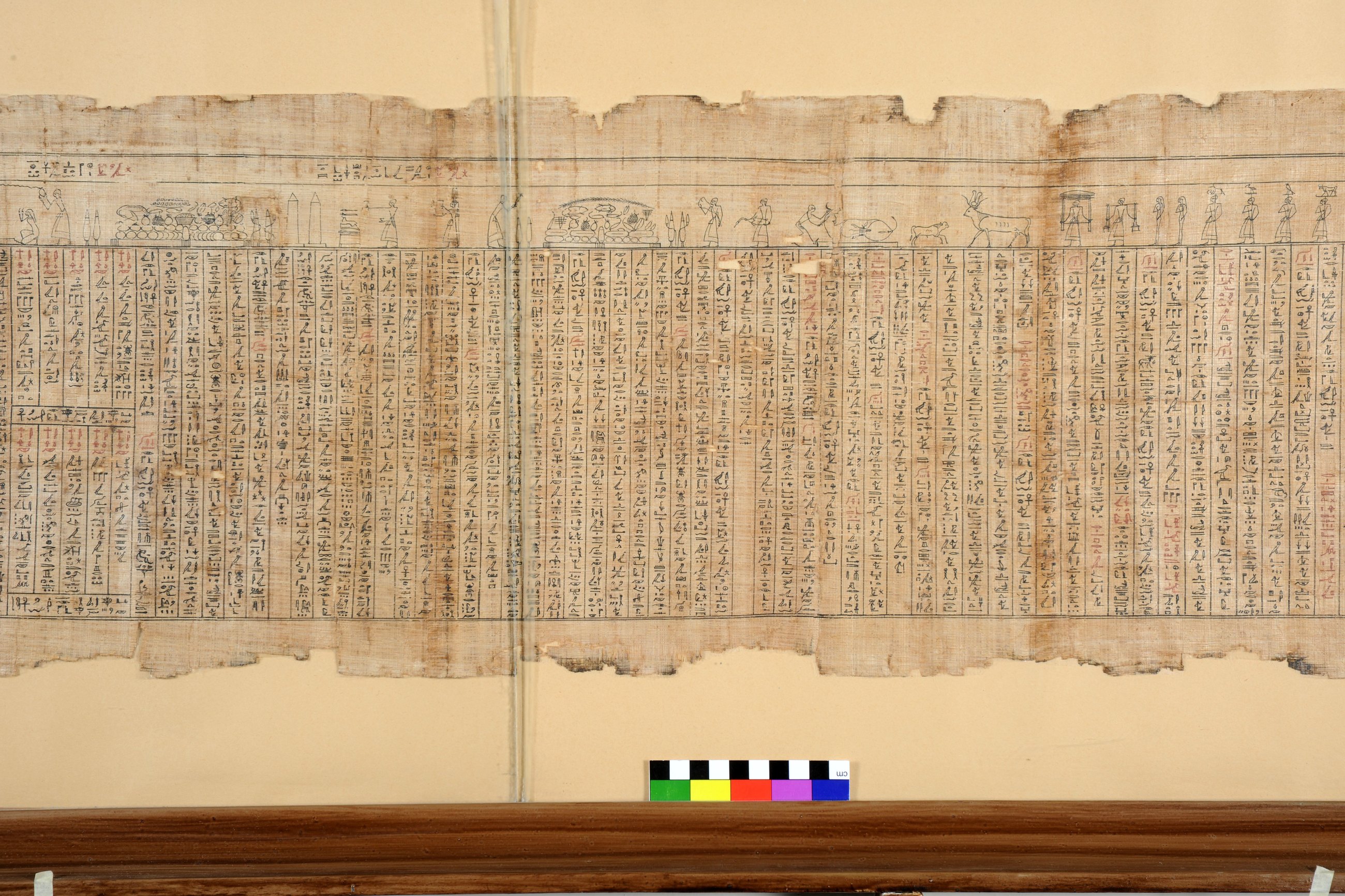
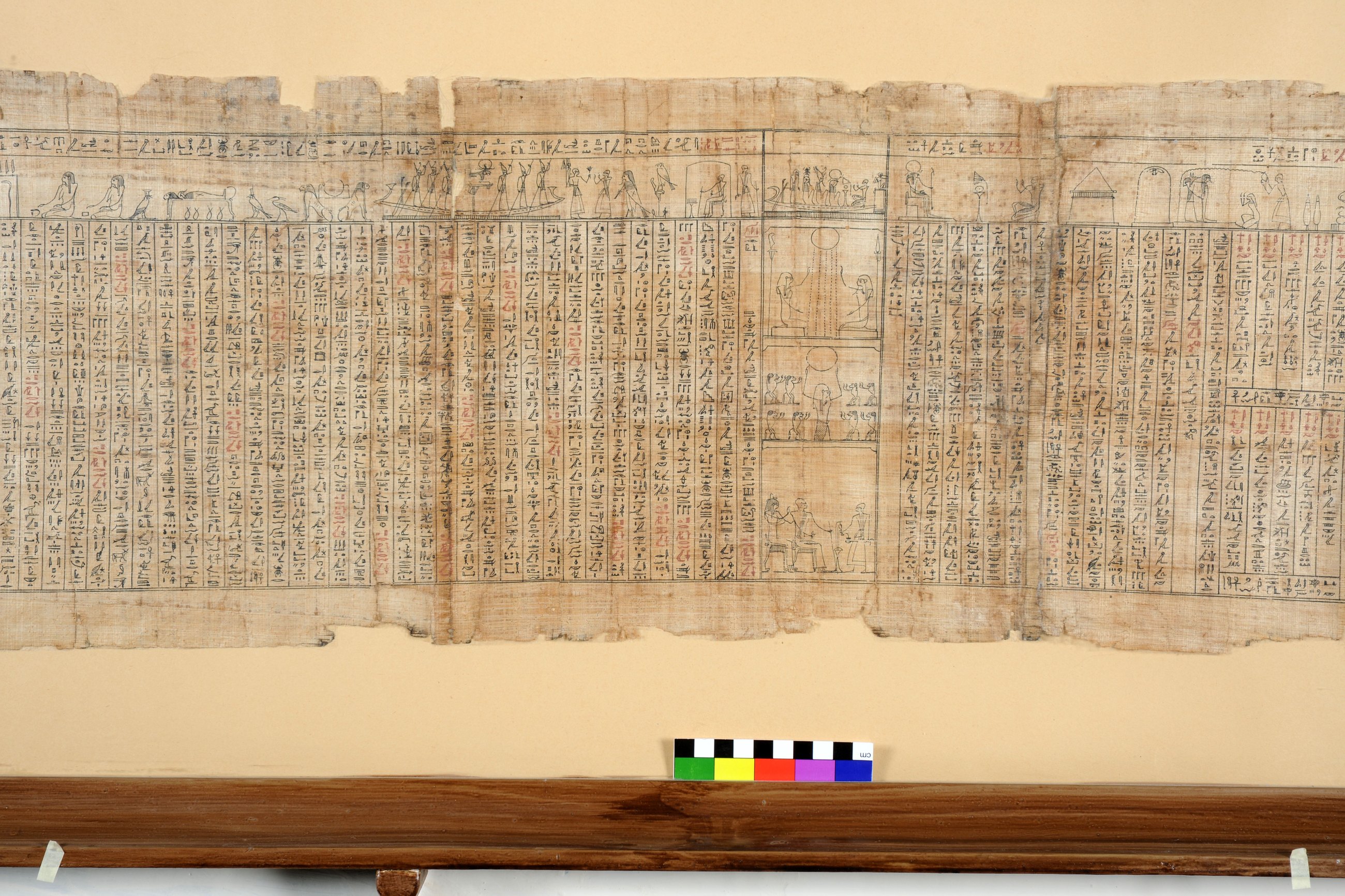
Spell 15 (Birch: 'Hail, Sun, Lord of Sunbeams! shine thou in the face of the Osiris. He has been adored in the Gateway, he has sat at the twilight. His Soul comes forth with thee [the Sun] to the heaven, proceeding in the cabin, towed in the Ark. It moves as the never-resting Gods in the heaven.') is on Lepsius's plates IV-VI and on photographs 2, 3 of the 31 Museo Egizio photographs of the roll. Spell 15 is a series of hymns to the sun; the TLA divides it into nine parts (a-i) with continuous column numbers, given here together because Birch's English is not divided in the same way.
The Egyptian is the transliteration of the Thesaurus Linguae Aegyptiae (edition by Burkhard Backes), with the column number of the spell before each column; the numbers are those of Lepsius's plates. On the papyrus the text runs in vertical columns of cursive hieroglyphs from right to left along the roll; titles and some words are written in red. Signs restored by the editor are in square brackets, signs the scribe left out in angle brackets, superfluous signs in braces and damaged signs in half brackets. The English is the translation by Samuel Birch, published in 1867 and made from Lepsius's copy of this papyrus, so the English and the Egyptian come from the same manuscript. It was the first complete English translation of the Book of the Dead; many passages are now understood differently. Birch's own square brackets give his alternatives and explanations. The photographs are by the Museo Egizio; each shows a stretch of the roll, and the note of each section says where the spell stands on it.
How was this verified? (Provenance)
Where on the image
Turin 1791, Spell 15 (TLA Tb 015 a, Tb 015 b, Tb 015 c, Tb 015 d, Tb 015 e, Tb 015 f, Tb 015 g, Tb 015 h, Tb 015 i: title line, columns 1-49; Lepsius 1842, pl. IV-VI). Photograph 2 of 31 (Commons Book_of_the_Dead_of_Iuefankh,_papyrus_-_Museo_Egizio_Turin_C_1791_p033.jpg): the hymns of Spell 15 fill the left part of the photograph under the vignette of obelisks, the offering table and the kneeling worshipper (Lepsius pl. IV-V), with the red heading of its seventh hymn at 2-10%; they continue on photograph 3. Photograph 3 of 31 (Commons Book_of_the_Dead_of_Iuefankh,_papyrus_-_Museo_Egizio_Turin_C_1791_p032.jpg): the last hymns of Spell 15 fill the right part (60-100%) under the vignette of the shrine, the pyramid, the kneeling man and the enthroned god (Lepsius pl. V-VI). Checked by eye: the photographs were matched to Lepsius's plates by their vignettes, red titles and framed compartments, and the overlapping edges of neighbouring photographs were compared.
1ḏd-mdw jn Wsjr […] mꜣꜥ-ḫrw j Rꜥ,w nb st〈w,t〉 psḏ =k m ḥr n Wsjr […] mꜣꜥ-ḫrw dwꜣ =f ṯw m dwꜣ,w sḥtp =f
2ṯw m-mšr,w pri̯ bꜣ =f r-ḥnꜥ =k r p,t wḏi̯〈.w〉 m mꜥ〈n〉ḏ,t mnj m sk,t{j}〈t〉 ꜣbḫ =f m jḫm.pl-wrḏ m p,t
3Wsjr […] mꜣꜥ-ḫrw ḏd =f m swꜣš nb-nḥḥ j:nḏ-ḥr =k Rꜥ,w-Ḥr,w-ꜣḫ,tj Ḫprj jri̯ ḏs =f nfr ,wj wbn =k m ꜣḫ,t sḥḏ
4Tꜣ,du m st{j}〈w,t〉 =k nṯr.pl nb〈.w〉 m ḥꜥꜥ〈,wt〉 mꜣꜣ =sn nswt n p,t nb,t wnw,t mn⸢.tj⸣ m tp =k šmꜥ-s〈j〉 mḥw-s〈j〉 mn⸢.tj⸣ m wp,t =k jri̯{.t} =s
5m ḥꜣ,t =k jꜣ,w{j} mnḫ〈.w〉 m ḥꜣ,t wjꜣ ḥr szwn n =k ḫftj.pl =k nb〈.w〉 jm,j-dꜣ,t pri̯ m ḫsf ḥm =k 〈r〉 mꜣꜣ sšm =k
6pwy nfr jy.n =j ḫr =k jw =j r-ḥnꜥ =k r mꜣꜣ jtn =k rꜥ,w-nb nn ḫnj wj nn šnꜥ wj mꜣwj ḥꜥ =j
7m dgꜣ nfr,pl =k mj ḥzi̯,pl =k nb〈.w〉 ḥr-n,tj jnk wꜥ,w m nn n špsi̯.n =k ḥr-tp tꜣ jw pḥ.n =j tꜣ nḥḥ ẖnm.n =j tꜣ n ḏ,t ntk js wḏ{.t} s〈j〉 n =j Rꜥ,w ḫr nṯr nb
8Wsjr […] mꜣꜥ-ḫrw ḏd =f j:nḏ-ḥr =k wbn m ꜣḫ,t m hrw ḏꜣi̯ n =k p,t m-ḥtp ḥr smꜣꜥ-ḫrw ḥr-nb ḥꜥꜥ! n mꜣꜣ =k šmi̯ m
9jmn.tw =f m-ꜥ =sn ḏi̯! =k ṯw m dwꜣ,w n〈.t〉 rꜥ,w-nb rwḏ{.tw} qd,wt!! ẖr ḥm =k st{j}〈w,t〉 =k m ḥr =sn nn rḫ =tw ḏꜥm nn smj =tw jmy =k
10Tꜣ.du n.w nṯr.pl mꜣꜣ.n =w zẖꜣ,pl nb.w n.w Pwn,t jw sjp =tw jmn.pl m-ḥr =sn jri̯.n =k ṯw wꜥ〈,w〉 m wnn r ḫpr,w =k tp nw,w jmm!
11šmi̯ =j mj,tt jw šmi̯ =j nn jri̯ =j jꜣb mj ḥm =k Rꜥ,w jw,tj ḥqꜣ wr wꜣi̯ ṯw m jtr〈,w〉 ḥḥ.pl ḥfn.pl ꜣ,t š{r}j jri̯ =k st ḥtp =k
12km =k wnw,t.pl ky-ḏd hrw.pl grḥ.pl mj,tt gsgs.n =k st km.n =k mj ntꜥ =k ḥḏ-tꜣ ḏi̯! =k ṯw ꜥ.du m Rꜥ,w wbn =k m ꜣḫ,t
titledwꜣ Rꜥ,w-Ḥr,w-ꜣḫ,tj wbn =f m ꜣḫ,t jꜣb,t〈j〉.t n.t p,t
13Wsjr […] mꜣꜥ-ḫrw ḏd =f m dwꜣ{.tw} =f 〈ṯw〉 m dwꜣ Rꜥ,w m psḏ =k ḏd =f n =k m wbn m dwꜣ,t sqꜣi̯〈.t〉 ḫpr,w =k
14ḫꜥi̯ ky-ḏd ꜥꜣi̯ m nfr,pl =k pfj ⸢ḥwi̯⸣ nbj.w =k ḥꜥ =k msi̯ sw jw,tj msi̯.tw =f m ꜣḫ,t wbn m ḥr,t jmi̯ pḥ{.n} =j ḥr,t n.t 〈n〉ḥḥ
15ḥr jꜣ,t n.t ḥz,pl =k zmꜣ =j m ꜣḫ.w jz.pl jqr n.w ẖr,t-nṯr pri̯ =j ḥnꜥ =sn r mꜣꜣ nfr,pl =k m wbn =k
16m-mšr,w nm{m}tj =k mw,t =k Nw,t ḏi̯! =k ḥr =k r jmn,tt ꜥ.wj =j m jꜣ,w n ḥtp =k m ꜥnḫ,t ntk js
17jrj nḥḥ dwꜣ.tw m-ḥtp m nw,w ḏi̯! =k ṯw m jb =k jw,tj bꜣgi̯.t nṯri̯ =k sw r nṯr.pl
18Wsjr […] mꜣꜥ-ḫrw ḏd =f jꜣ,w n =k wbn m nw,w sḥḏ tꜣ,du m hrw ms,wt =f msi̯ ṯw mw,t =k ḥr ḏr,t.du =s sḥḏ.n =k nṯri̯.n =k sw
19sḥḏ wbn m nw,w ṯz mhꜣw =f m {j}〈ḥ〉bb =k sḥb spꜣ,t.pl nʾ,t.pl nb rʾ.pl-pr,w.pl nb ḫwꜣ ṯw m nfr,pl =k ṯz kꜣ.w ḥwj
20ḏf〈ꜣ〉.w s{ꜥ}nrjw sḫm sḫm,pl dr s,t =f nb〈.t〉 r jzf,t ꜥꜣ ḫꜥi̯ m sk,tj wr fꜣ.w m mꜥnḏ,t ꜣḫ =k Wsjr
21[…] mꜣꜥ-ḫrw m ẖr,t-nṯr ḏi̯! =k wnn =f r jmn,tt sm〈⸢ꜣ⸣〉 ḏw mkḥꜣ jzf,t ḏi̯! =k sw m jmꜣḫ,w.pl šps.pl
22ẖnm{.n} =f n bꜣ,pl m ẖr,t-nṯr sqdi̯ =f m sḫ,t-jꜣr,w ḥr-sꜣ wḏ.t m ꜣw,t-jb
23Wsjr […] mꜣꜥ-ḫrw ḏd =f pri̯ =j r p,t ḏꜣi̯ =j bjꜣ šnb =j m-ꜥ sbꜣ.pl jri̯ =tw n =j ḥkn,w m wjꜣ njs =tw
24n =j m 〈m〉ꜥ〈n〉ḏ〈,t〉 dgꜣ =j Rꜥ,w m-ẖnw k〈ꜣ〉r{jw,t} m sḥtp.n =j jtn =f rꜥ,w-nb mꜣꜣ =j jn,t m ḫpr〈,w〉 ⸢tp,j⸣ bꜥbꜥ
25pri̯ m mfk〈ꜣ,t〉 mꜣꜣ =j ꜣbḏ〈,w〉 zp =f ḫpr〈.w〉 ḏw-qd ḫr ḫft sr.n =f ḥsq =j m šꜥd m ṯz wn =j
26n =k Rꜥ,w m mꜣꜥ〈,w〉 nfr sk,tj sk{tj}i̯ =s pḥ{,tt}.pl jz,{y}〈t〉 Rꜥ,w m ḥꜥꜥ〈,wt〉 mꜣꜣ =sn sw nb-ꜥnḫ jb =f nḏm〈.w〉 sḫr.n =s
27ḫfti̯.pl =f nb js mꜣꜣ =j Ḥr,w ḥr nfr,y〈t〉 Ḏḥw,tj mꜣꜥ,t ḥr ꜥ.wj =f nṯr.pl nb 〈m〉 ḥꜥꜥ〈,wt〉 mꜣꜣ =sn sw jy.tw m-ḥtp sꜣḫ jb.pl n ꜣḫ.w
28jw Wsjr […] mꜣꜥ-ḫrw ḥnꜥ =sn r jmn,tt jb =f nḏm〈.w〉
titledwꜣ Rꜥ,w ḥtp =f m ꜥnḫ,t
28ḏd-mdw jn […] Wsjr mꜣꜥ-ḫrw
29,1j:nḏ-ḥr =k jwi̯.tw m Jtm,w ḫpr.tw m qmꜣ psḏ,t
30,1j:nḏ-ḥr =k jwi̯.tw m bꜣ bꜣ.pl ḏsr m jmn,tt
31,1j:nḏ-ḥr =k ḥr,j nṯr.pl sḥḏ dꜣ,t m nfr,pl =f
32,1j:nḏ-ḥr =k nꜥj.w jꜣḫ,w sqdi̯{.t} m jtn =f
33,1j:nḏ-ḥr =k ꜥꜣ r nṯr.pl nb.w ḫꜥi̯ m p,t ḥqꜣ m dꜣ,t
lineḏi̯! =k ṯꜣw nḏm n mḥ,〈y〉t n Wsjr […]
29,2j:nḏ-ḥr =k wbꜣ dꜣ,t sšmi̯ ꜥꜣ.wj nb.w
30,2j:nḏ-ḥr =k m-m nṯr.pl wḏꜥ-md,t m ẖr,t-nṯr
31,2j:nḏ-ḥr =k jm,j sštꜣ zš =f qmꜣ dꜣ,t m ꜣḫ,w =f
32,2j:nḏ-ḥr =k wr〈r〉.tw ꜥꜣi̯.tw ḫfti̯.pl =k ḫr〈.w〉 m nm,t =sn
33,2j:nḏ-ḥr =k bḥn.w n =k sb〈j〉.w sḥtm n =k ꜥ〈ꜣ〉pp
lineḏi̯! =k ṯꜣw nḏm n mḥ,〈y〉t n Wsjr […] mꜣꜥ-ḫrw
34wn n Ḥr,w-wr ꜥꜣ wpi̯ tꜣ ꜥꜣ ḥtp m ḏw jmn,tt sḥḏ dꜣ,t m jꜣḫ,w =f bꜣ.pl m štꜣ,t =sn ḥꜣy ḫnt qr〈r〉,t =sn
35wdi̯ ḏw m n〈j〉k{j},w sḥtm n =k ḫfti̯
36Wsjr […] mꜣꜥ-ḫrw ḏd =f m dwꜣ Rꜥ,w-Ḥr,w-ꜣḫ,tj ḫft ḥtp =f m ꜥnḫ,t jꜣ,w n =k Rꜥ,w jꜣ,w n =k Jtm,w m jwi̯ =k
37nfr.tw ḫꜥi̯.t〈j〉 sḫm.tw ḏꜣi̯.n =k p,t sꜣḥ =k tꜣ ẖnm =k ḥr〈,t〉 m ꜥnḏ jt{w}r,tj n =k m ks〈w〉 ḏi̯! =sn n =k jꜣ,w ḥꜥꜥ! nṯr.pl
38jmn,tj.w m nfr,pl =k dwꜣ ṯw štꜣ〈,pl〉-s,tpl 〈j〉ꜥb n =k wr.pl qmꜣ =sn n =k zꜣ-tꜣ ẖn{tj}i̯ ṯw jm,j.w-ꜣḫ,t sqdi̯ ṯw jm,j.w sk,tj
39ḏd =sn jꜣ,w m ḫsf ḥm =k jy,tj zp-2 spr.tw m-ḥtp jw n =k hꜣ,y nb{,t}-p,t ḥqꜣ jgr,t jnq ṯw mw,t =k Nw,t
40mꜣꜣ zꜣ =s jm =k m nb{,t} snḏ ꜥꜣ šf,y〈t〉 ḥtp m ꜥnḫ,t ⸢m⸣ ⸢wn〈n〉⸣ =⸢s⸣ šsꜣ〈,t〉 ṯzi̯ ṯw jti̯ =k Tꜣ-〈ṯ〉nn s{ꜣ}bḫ ṯw ꜥ.wj =f
41ḥꜣ =k ḫpr.tw nṯri̯.tw m tꜣ jw rḏi̯.{t}n =f n =k jmꜣḫ ḫr Wsjr […] mꜣꜥ-ḫrw m-ḥtp zp-2 Rꜥ,w ḏs =f ḏd-md,t ḫft Rꜥ,w ḥtp =f
42m ꜥnḫ,t ꜥ.wj =f ḫꜣm〈.w〉
titledwꜣ Jtm,w ḥtp =f m ꜥnḫ,t
43Wsjr […] mꜣꜥ-ḫrw ḏd =f m dwꜣ Jtm,w ḥtp =f m ꜥnḫ,t m ⸢jmm⸣ jꜣḫ,w n dꜣ,t j:nḏ-ḥr =k ḥtp m ꜥnḫ,t
44jti̯ nṯr.pl ẖnm =k mw,t =k m mꜣn,w šzp ṯw ꜥ.wj =s rꜥ,w-nb tj,t ḥm =k m-ẖnw Zkr ḥꜥꜥ! =tw m mr,wt wn n =k ꜥꜣ.du m
45ꜣḫ,t ḥtp =k m ḏw jmn,tt mꜣw〈,t〉 =k hbi̯ =sn tꜣ r ḥḏ tꜣ,du jmn,tjw jm,j.w ḥkn,w nḥi̯ wdi̯{.t} mꜣꜣ =k rꜥ,w-nb ⸢jmi̯⸣ ḥtp
46nṯr.pl m tꜣ šms〈,w〉 =k pw wn〈n〉.w m-ḫt.pl =k bꜣ ḏsr wtṯ nṯr.pl ꜥpr sw m jrw =f nn mtr smsm pw ꜥꜣ
47m štꜣ,w ḥtp ḥr =k nfr n Wsjr […] mꜣꜥ-ḫrw Ḫprj jti̯ nṯr.pl nn ski̯〈.t〉 jw ḏ,t m šfd〈,w〉 pn sḏdi̯ =k wj ḥr =f
48jw ḏd spẖr.n =f sw ḥr =f ḥtp〈.w〉 ḥr fqꜣ.w rḏi̯{.t} n =j qꜥḥ{,w} m tʾ ḥ〈n〉q,t zmꜣ =j ḥnꜥ šfd〈,w〉 m-ḫt ꜥḥꜥ〈,w〉
49spẖr sw m ḥtp〈,w〉 jb ꜥꜣ
XV. Hail, Sun, Lord of Sunbeams! shine thou in the face of the Osiris. He has been adored in the Gateway, he has sat at the twilight. His Soul comes forth with thee [the Sun] to the heaven, proceeding in the cabin, towed in the Ark. It moves as the never-resting Gods in the heaven.
The Osiris says, in worshiping the Lord of the Age: Hail, oh Sun, creator, self-created! Perfect is thy light in the horizon, illuminating the world with thy rays. All the Gods rejoice when they see the King of the Heaven. The Lady of the Hours is placed upon thy head, the upper and lower crown are placed on thy brow: she is placed before thee; coining figured in the forepart of the Boat, tormenting thy enemies in the Gate who come to stop thy person, looking at this thy good form. I have come to thee, I am with thee beholding thy disk daily. Do not dissipate me, do not turn me away, my substance subsists so that I may see thy perfections like all thy subjects, because I am one of thy great types on earth. I have followed the Land of the Age. I have reached the Land of the Age, when thou hast ordered every God, oh Sun!
Hail, shining in the horizon on the day thou hast traversed the heaven in peace, justifying all faces who rejoice to see thee walking from the hidden to them! Thou hast been placed at the Empyreal Gate every day grown and formed under thy form. Thy rays are in their faces. Unknown is thy gold, indescribable is thy colour, in the Region of the Gods [say] we are beholding all the colours of Pant. It has been ex-amined, hidden on their faces. Thou hast been made the one alone in his being, in thy transformation in the ether. May I go as I have gone? I do not dance like thy form, oh Sun! not being the Great Ruler borne along in the river of millions and billions of moments. Young thou makest them pass, thou settest, thou darkenest the hours, or the days, and nights, like as thou hast heaped them; thou hast darkened thy colours, illuminating the world; thy arms have been made strong by the Sun, thou shinest in the heaven.
He has adored in the Gate at thy setting. He speaks to thee when rising, in adoration. Prolong thy transformation, risen, or great in thy perfections, smiting and gilding thyself, producing them, not born in the horizon, shining above. May I have reached the upper part of ages in the abode of thy servants! I combine with the noble Spirits, the wise of the Hades. I come forth with them to see thy perfections. Thou shinest at dawn, thou followest thy mother Nu, directing thy face to the West. My hands adore thy setting, thou settest from the Land of Life. Then thou art making an age, adored in peace in the Nu [firmament], placed in thy heart, invincible are thy divine years, they are made to all Gods.
Glory to thee, shining in the firmament, illuminating the world on the day when he has been born, produced by thy mother out of her hands! Thou hast shone, thou hast rendered it divine. The great light shining in the heaven, supporting its adorers by thy stream, making festive all countries, cities, gates, and houses daily supported by thy goodness, preparing food, things, supplies, giving victory, prevailer of prevailers [first of the first], obliterating every place for faults, the great one crowned in the cabin, the great one capped in the Ark. Thou illuminatest the Osiris in Hades, thou lettest him be in the West, smiting the evil, placing him out of sin, letting him to be with the great blessed. He has followed the Spirits from the Hades, he has been conducted from the fields of the Aahenru [Elysium] after proceeding in joy.
I proceed to the heaven, I go over the clods, I kneel [I bend] as [or in] the stars. Adoration has been made to me in the Bark. I have been addressed in the cabin. I saw the Sun in the midst of his box when I hailed his disk daily. I see the Perch in his transformations in the waters coming forth in splendour. I see the Silurus(?) each time when he afflicts his enemies. He has felt my blows cutting his back. I open to thee, oh Sun! a good sail [wind]; it destroys, it breaks. The ministers of the Sun rejoice to see him the Living Lord; his heart rejoices, he has overthrown all his enemies. When I see Horus at the ropes, Thoth at its [the Boat’s] hands: all the Gods rejoice when they see him coming in peace, animating the heart of Spirits. The Osiris is with them, his heart is delighted.
Hail, coming as Tum, created by the creator of the Gods! Hail, thou piercing the Gateway, traversing all doors! Hail, thou who hast come as the Soul of souls reserved in the West! Hail, thou judge [?] of the Gods, weighing words in the Hades! Hail, thou over the Gods, illuminating the Gateway with his perfections! Hail, thou in the nest, making the Gateway by his intelligence! Hail, thou descending light formed in his disk! Hail, thou magnified and enlarged, thy enemies fall on their blocks! Hail, thou greater than the Gods, rising in the heaven, ruling in the Gate! Hail, thou who hast cut in pieces the Scorner and strangled the Apophis! Give thou the sweet breath of the North wind to the Osiris!
Haroeris, the great guide of the world, at peace in the Hill of the Amenti, illuminating the Gateway with his light, the Souls in their secret places, the Light dwelling in the horizons, putting forth evil against the wicked, has opened. Thou, hast strangled thy enemies.
Adoration to Tum who sets from the Land of Life,
The Osiris says, in adoring the Sun, the Horus of the two horizons, when he sets from the Land of Life: Glory to thee, oh Sun! Glory to thee, oh Tum, in thy course perfected, crowned, prevailing! Thou hast traversed the heaven, thou hast perambulated the earth, thou hast followed above in yellow, thou hast lodged dancing. The Gods of the West give thee glory, they rejoice at thy perfections. Adored are [thy] secret places. Thou hast purified the Chiefs, thou hast created the life of the earth for them, conducted by those in the horizon, towed by those belonging to the cabin. They say: Glory to thee! arresting thy person “coming, approaching in peace.” Thou hast been addressed as the Lord of Heaven, Ruler of Hades, clasped [by] thy mother Nu. Seeing in thee her son the Lord of Terror, greatest of the terrible, setting from the Land of Life, she became obscure. Thy father Tann, the Lord of the Earth, has been transported, his arms have been whirled behind thee: transformed and made a God upon earth, he has placed thee among the blessed. For the Osiris justified in peace is the Sun himself.
Said when the Sun sets from the Land of Life, his hands drooping.
Globy to thee, oh Tum, setting from the Land of Life, in the colours of the Gate! Hail, thou, setting from the Land of Life, Father of the Gods! Thy mother accompanies thee from Ma nu, her arms receive thee daily. Thy person is typified [?] in Socharis, having re-joiced as thou wishedst. The doors in the horizon have opened to thee, thou settest from the hill of the West. Thy splendours! they reach the earth and illumine the earth; those attached to the West and the adorers come forth to see thee daily. The Gods give thee welcome from earth. Thy servant is “Being” [I]. In thy following is the reserved Soul, the engendered of the Gods who provided him with his shapes. Inexplicable is the semsem [genesis], it is the greatest of secrets. Thou art the good Peace of the Osiris. Oh Creator! Father of the Gods, incorruptible! What is in this book is eternal. I establish myself through it, I have said what has been disposed in it, at peace through the abundance. Loaded is my shoulder with food and drink. I combine [agree, do] as the book, arranging it in great peace.
Notes
- Birch's English was taken from three scans of Bunsen's Egypt's Place in Universal History, vol. V (1867), on the Internet Archive. The three OCR texts were aligned word by word and each word was settled by their agreement; running heads, page numbers, footnote markers and footnotes were removed. Some OCR errors may remain, chiefly in proper names.
- Birch uses the terms and name forms of his time: Hades, Aahlu (Elysium), Tum for Atum, Seb for Geb, Anup for Anubis, Phoenix or Bennu for the heron.
- Labels such as 'title line' or 'gate 1' before a line of the Egyptian translate the position labels of the TLA.
- The TLA has no hieroglyphic encoding for these texts, so only the transliteration is shown.
Cite
Sources
- Source: Papyrus of Iuefankh, Turin, Museo Egizio Cat. 1791 (Museo Egizio photographs, CC0) + TLA transliteration (ed. B. Backes, CC BY-SA 4.0) + English of Samuel Birch (1867, public domain) (holding institution)
- Critical edition: Thesaurus Linguae Aegyptiae, ed. Burkhard Backes (2018 data, AED-TEI)
← previous · → next · v cycle view · l back to library