Book of the Dead, Spell 17: The great spell of going forth by day (papyrus of Iuefankh)
Introduction
The Book of the Dead, in Egyptian the spells for going forth by day, is a collection of funerary spells written on papyrus rolls and placed in burials from the New Kingdom to the Roman period. Each roll was made for one person, with spells taken from a large repertoire and illustrated with drawings (vignettes). This library gives one complete roll: the papyrus of Iuefankh in the Museo Egizio, Turin (Cat. 1791), written in the Ptolemaic period (332-30 BCE) and coming from Thebes. Richard Lepsius published it in 1842 and divided it into 165 chapters; his numbering is still the standard numbering of the spells, and it is used here.
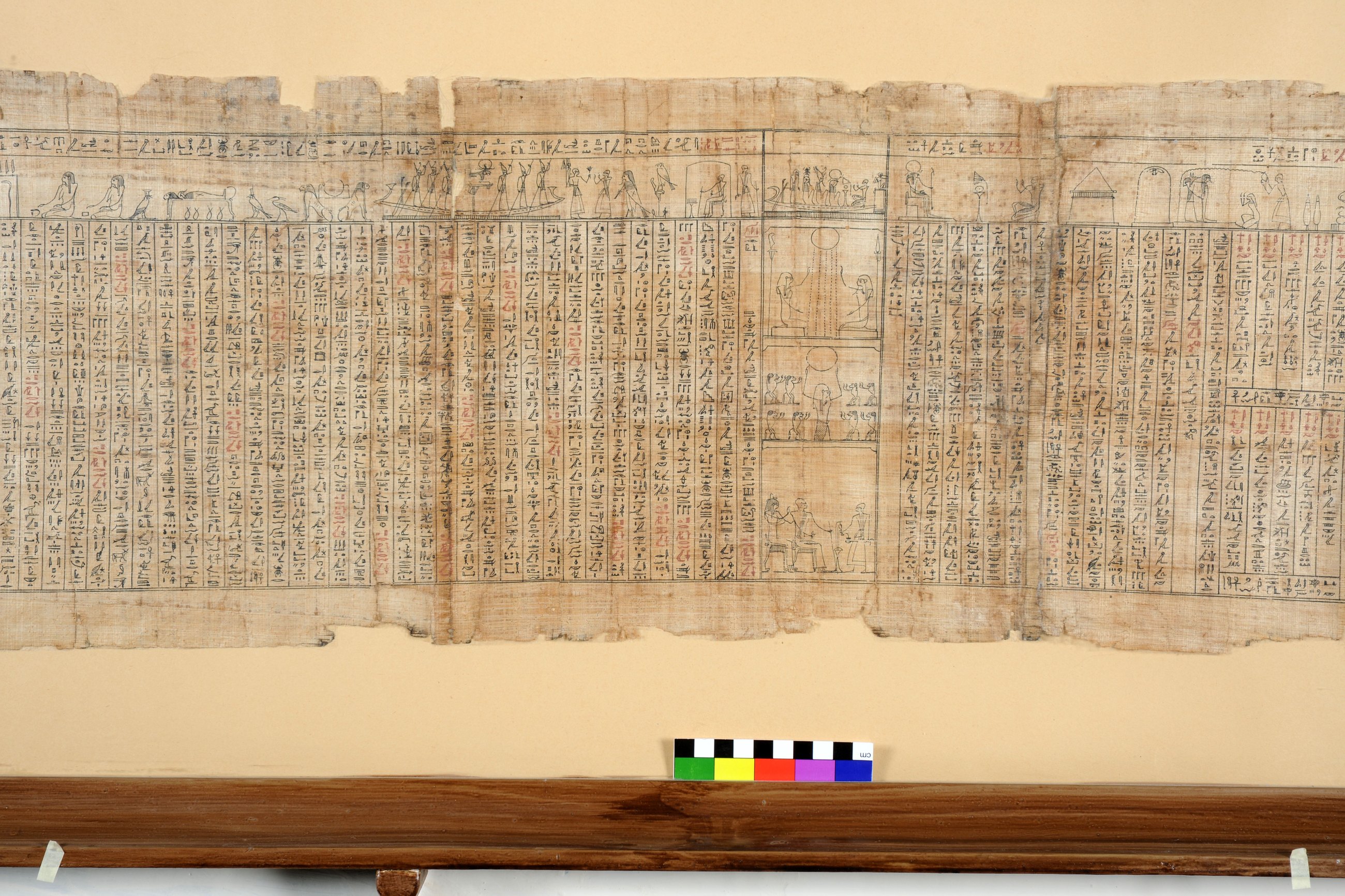
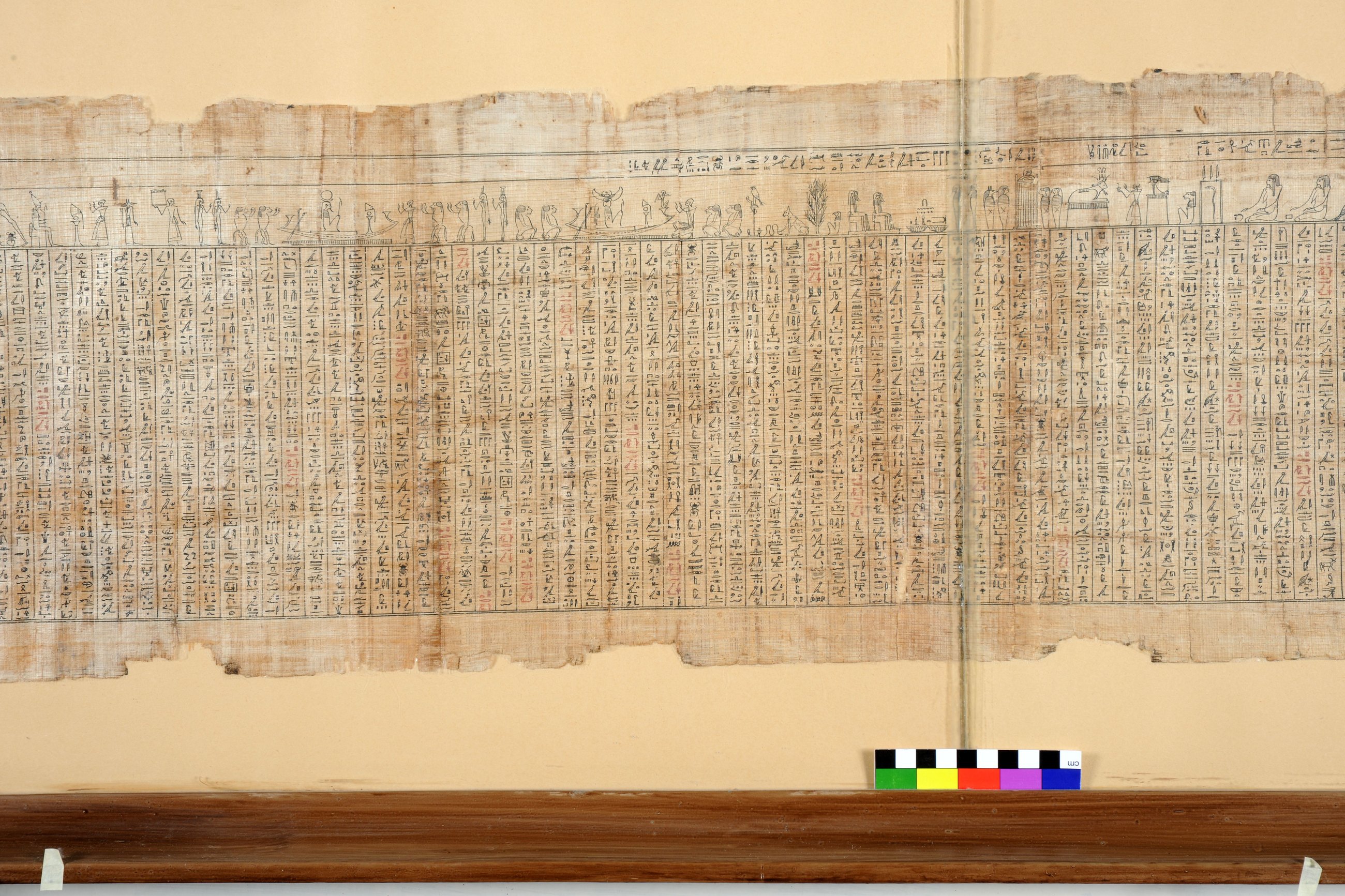
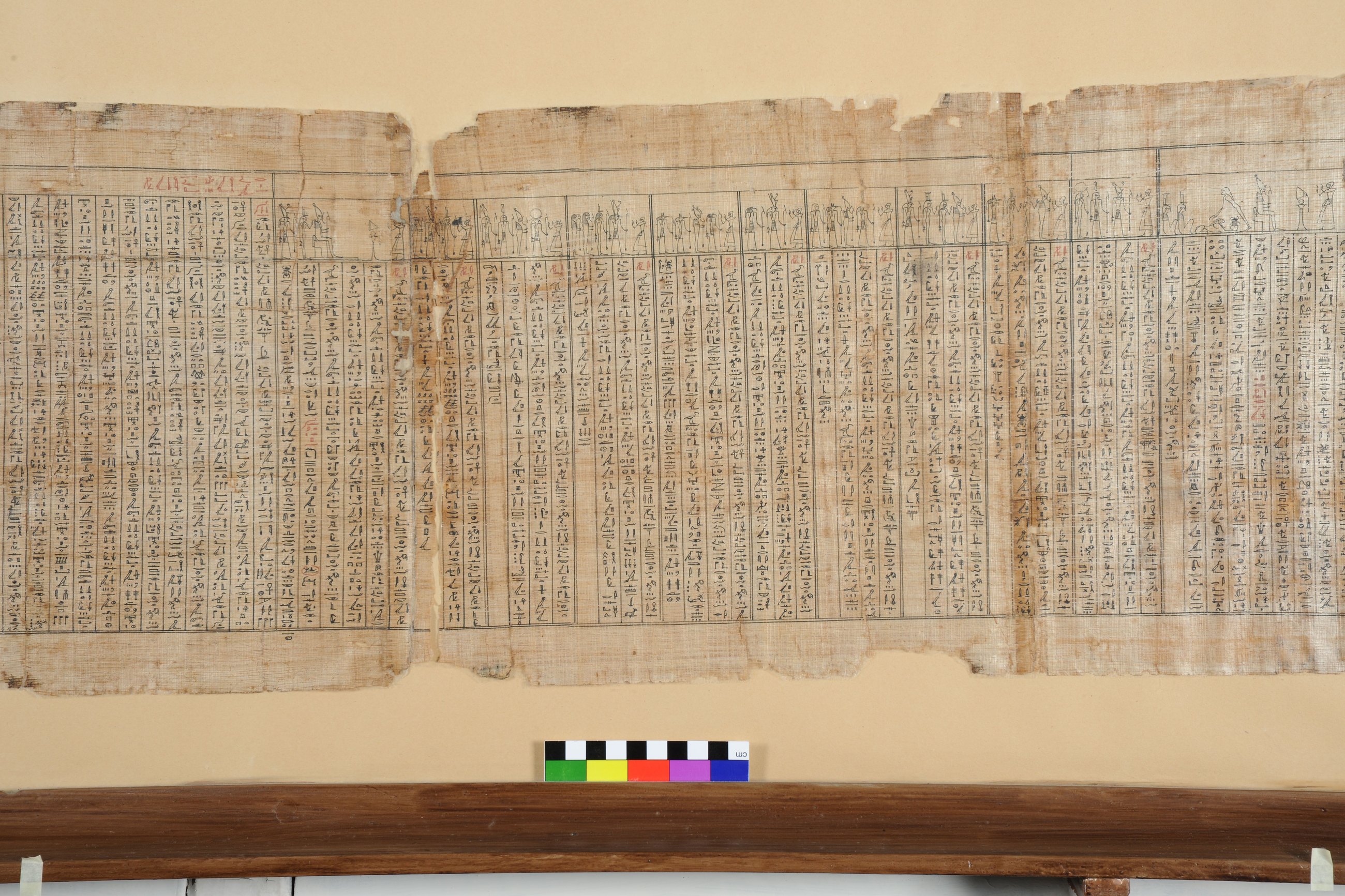
Spell 17 (Birch: 'The chapter of Conducting the Spirit [Dead], of coming in and going from the Hades, and being among the Servants of the Osiris fed with the Food of Osiris, the good being, the justified, coming forth from the Day, making all the Transformations he has wished to transform himself into, ploughing with a Plough [?], being [seated] in the Hall a living Soul, as the blessed by the Great Gods of the West, after he has been laid to rest. The glory of doing it on earth is for mortals to declare.') is on Lepsius's plates VII-XI and on photographs 3, 4, 5 of the 31 Museo Egizio photographs of the roll. Spell 17 is the longest spell of the roll (95 columns): a statement of the dead man's identity with the creator god, with explanations ('What is that?') added to almost every sentence. It runs over three photographs.
The Egyptian is the transliteration of the Thesaurus Linguae Aegyptiae (edition by Burkhard Backes), with the column number of the spell before each column; the numbers are those of Lepsius's plates. On the papyrus the text runs in vertical columns of cursive hieroglyphs from right to left along the roll; titles and some words are written in red. Signs restored by the editor are in square brackets, signs the scribe left out in angle brackets, superfluous signs in braces and damaged signs in half brackets. The English is the translation by Samuel Birch, published in 1867 and made from Lepsius's copy of this papyrus, so the English and the Egyptian come from the same manuscript. It was the first complete English translation of the Book of the Dead; many passages are now understood differently. Birch's own square brackets give his alternatives and explanations. The photographs are by the Museo Egizio; each shows a stretch of the roll, and the note of each section says where the spell stands on it.
How was this verified? (Provenance)
Where on the image
Turin 1791, Spell 17 (TLA Tb 017: title line, columns 1-95; Lepsius 1842, pl. VII-XI). Photograph 3 of 31 (Commons Book_of_the_Dead_of_Iuefankh,_papyrus_-_Museo_Egizio_Turin_C_1791_p032.jpg): begins at 56% with the red end of its title line, the god in a shrine, the falcon and the boat of the gods (Lepsius pl. VII); its columns run to the left-hand edge and on to photographs 4 and 5. Photograph 4 of 31 (Commons Book_of_the_Dead_of_Iuefankh,_papyrus_-_Museo_Egizio_Turin_C_1791_p031.jpg): the whole photograph is filled by the columns of Spell 17 under its continuous vignette band (the two kneeling women, the mummy on its bier, the boat of the sun, seated gods; Lepsius pl. VIII-XI). Photograph 5 of 31 (Commons Book_of_the_Dead_of_Iuefankh,_papyrus_-_Museo_Egizio_Turin_C_1791_p030.jpg): its last columns are at the right-hand edge (85-100%), under the vignette of the enthroned god with the kneeling figures, which also stands at the left-hand edge of photograph 4. Checked by eye: the photographs were matched to Lepsius's plates by their vignettes, red titles and framed compartments, and the overlapping edges of neighbouring photographs were compared.
titlerʾ.pl n.w sṯz,w.pl sꜣḫ,w.pl pri̯〈.t〉 h〈ꜣi̯.t〉 m ẖr,t-nṯr wn〈n〉 m šms,w n Wsjr ḥtp m šb,w Wnn-nfr〈,w〉 mꜣꜥ-ḫrw pri̯〈.t〉 m hrw jri̯〈.t〉-ḫpr,w.pl nb n mr,wt =f ḫpr jm =f ḥꜥb.y znj,t wn〈n〉 m zḥ bꜣ ꜥnḫ Wsjr […] mꜣꜥ-ḫrw jmꜣḫ,w ḫr psḏ,t-ꜥꜣ,t jm,j〈.t〉 jmn,tt m-ḫt mnj.t =f jw ꜣḫ{,w} n jri̯ s〈j〉 tp tꜣ ḫpr md,t tmm
1ḏd-mdw jn Wsjr […] mꜣꜥ-ḫrw jnk Jtm,w m wnn =j wꜥi̯.〈k〉w m nw,w jnk Rꜥ,w m ḫꜥi̯〈.t〉 =f šꜣꜥ ḥqꜣ =f jri̯.n =f ptr rf sw
2Rꜥ,w pw m ḫꜥi̯ =f m šꜣꜥ ḥqꜣ =f jri̯.n =f šꜣꜥ Rꜥ,w pw ḫꜥi̯ m Ḥw,t-Nn-nsw,t m wnn ḫpr sṯz Nw,w jw =f ḥr qꜣꜣ
3jm,j-Ḫmn,w ḥtm.n =f ms.pl-bdš.pl ḥr qꜣꜣ jm,j-Ḫmn,w jnk nṯr-ꜥꜣ ḫpr ḏs =f mw pw Nw,w pw jti̯
4nṯr.pl ptr rf sw Rꜥ,w pw qmꜣ ḥꜥ =f ḫpr nn n nṯr.pl jm,j.w-ḫt Rꜥ,w jnk jw,tj ḫsf =f m nṯr.pl ptr rf sw Jtm,w m
5jtn =f ky-ḏd Rꜥ,w pw jm,j-jtn≡f wbn =f m ꜣḫ,t jꜣb,t〈j〉.t n.t p,t jnk sf jw =j rḫ.kw dwꜣ,w ptr rf sw jr sf
6Wsjr pw jr dwꜣ,w Rꜥ,w pw hrw pfy n ḥtm{.t} sbj〈.pl〉 n.w nb-〈r-〉ḏr jm =f ḥnꜥ sjp{.t}.ntw =f zꜣ =f Ḥr,w ky-ḏd hrw p〈w〉 n jw≡n-mn
7dhn =f q{r}js〈,t〉 pw n.t Wsjr jn jti̯ =f Rꜥ,w jri̯ n =f ꜥḥꜣ-ꜥ nṯr.pl ḫft wḏ,t =f Wsjr nb ḏw jmn,tt ptr rf sw jmn,tt
8pw jri̯.tn{tw} =sn bꜣ.pl nṯr.pl ḫft wḏ,t =f Wsjr nb ḏw jmn,tt ky-ḏd jmn,tt pw nw pw rḏi̯.n Rꜥ,w hꜣi̯ nṯr nb r =s ꜥḥꜥ,n ꜥḥꜣ.n =f ḥr =s jw =j
9rḫ.kw nṯr pwy ꜥꜣ n,tj jm =s ptr rf sw Wsjr pw ky-ḏd ḥkn,w pw n Rꜥ,w rn =f bꜣ pw n Rꜥ,w rn =f nk =f jm =f ḏs =f jnk
10bn,w pwy ꜥꜣ n,tj m Jwn,w jnk sjp n n,tj wnn{.tj} ptr rf sw jr bn,w Wsjr pw n,tj m Jwn,w jr sjp
11n n,tj wnn{,t} ẖꜣ,t =f pw ky-ḏd nḥḥ pw ḥnꜥ ḏ,t jr nḥḥ hrw pw jr ḏ,t grḥ jnk Mn,w m pr,t{j} =f jw rḏi̯ n =f
12šw,t.du =f m tp =f ptr rf sw jr Mn,w Ḥr,w pw nḏ-ḥr-jti̯≡f Wsjr jr pr,w =f ms,wt =f pw jr šw,t.du =f m tp =f šmi̯ ꜣs,t ḥnꜥ
13Nb,t-ḥw,t rḏi̯.n =sn ḥꜣ =f m wnn =sn m ḏr,t.du js s{w}〈n〉 ḥr mn m tp =f ky-ḏd ꜥrꜥ,t.du pw wr.pl ꜥꜣ.pl jm,j〈.t〉 ḥꜣ,t jti̯ =f Jtm,w
14ky-ḏd jr,t.du =f pw šw,t.du =f m tp =f wnn =j m tꜣ jy.n =j m nʾ,t ptr rf sw ꜣḫ,t pw n〈.t〉 jti̯ =f Jtm,w jw ḫsr
15ḏw ptr rf sw šꜥd =tw šptj pw Wsjr […] mꜣꜥ-ḫrw sḥrj.w ḏw nb jr,j =〈j〉 ptr rf sw
16wꜥb Wsjr […] mꜣꜥ-ḫrw hrw ms,wt =f m zš wr{.t} ꜥꜣ{.t} n,tj m Nn-nsw,t hrw ꜥb,w rḫ,yt n nṯr pwy ꜥꜣ n,tj
17jm =s ptr rf sw sšmi̯ ḥḥ.pl rn n wꜥ,w wꜣḏ-wr rn n ky š pw n ḥzmn ḥnꜥ š pw n mꜥꜣ ky-ḏd wtṯ ḥḥ.pl rn n wꜥ,w
18wꜣḏ-wr rn n ky jr gr nṯr pfy ꜥꜣ n,tj jm =s Rꜥ,w pw ḏs =f šmi̯ =〈j〉 ḥr wꜣ,t rḫ.〈t〉n =j tp-n š mꜣꜥ〈,t〉du ptr rf sw
19jr Rʾ-sṯꜣ,w sbꜣ pw rsj n N-jr≡f sbꜣ pw mḥ,t〈j〉 jꜣ,t Wsjr jr gꜣ š mꜣꜥ〈,t〉du ꜣbḏ,w pw ky-ḏd wꜣ,t pw šmi̯
20jti̯ =f Jtm,w ḥr =s ḫft wḏꜣ =f r sḫ,t-jꜣl spr =〈j〉 r tꜣ ꜣḫ,t ꜥq =j m sbꜣ{,t} ḏsr,t ptr rf sw sḫ,t-jꜣl
21pw msi̯ ḏf〈ꜣ〉 nṯr.pl ḥꜣ〈,j.w〉 kꜣ{r}jw jr sbꜣ{,t} ḏsr,t sbꜣ{,t} p{ft}w n sṯz〈,w〉-Šw jr sbꜣ mḥ,t〈j〉 sbꜣ pw
22n dꜣ,t ky-ḏd ꜥꜣ.du rʾ pw{y} n,t〈j〉 wḏꜣ jti̯ =f Jtm,w ḥr =f ḫft wḏꜣ =f r ꜣḫ,t jꜣb,t〈j〉.t n.t p,t jm,j.w-bꜣḥ jmi̯ n =j ꜥ.wj =ṯn
23jnk pw ḫpr jm =ṯn ptr rf sw znf pw hꜣi̯ m ḥnn n Rꜥ,w m-ḫt wꜣi̯ =f r šꜥd =f ḏs =f ꜥḥꜥ〈,n〉 =w ḫpr〈.w〉
24m nṯr.pl jm,j.w-bꜣḥ Rꜥ,w pw Ḥw Sjꜣ pw wnn.w m-ḫt jti̯ =w Jtm,w m-ẖr〈,t〉-hrw n.t rꜥ,w-nb jw mḥ.n Wsjr […] mꜣꜥ-ḫrw
25pn wḏꜣ,t m-ḫt hbi̯ =s hrw pwy n ꜥḥꜣ rḥ,wj ptr rf sw hrw pfj n ꜥḥꜣ⸢{-r}〈ꜥ〉⸣ Ḥr,w ḥnꜥ Stš m wdi̯ =f
26sṯꜣ,t n Ḥr,w m jṯi̯.n Ḥr,w ẖr,wdu n Stš jr gr Ḏḥwtj jri̯ nn m ḏbꜥ.pl =f ḏs =f jw ṯzi̯.n Wsjr […] mꜣꜥ-ḫrw
27šn〈j〉 =f m wḏꜣ,t m tr n nš〈n〉j ptr rf sw jr,t twy wnmi̯〈.t〉 n.t Rꜥ,w m nšnj =s r =f m-ḫt h〈ꜣ〉b =f s{w}〈j〉 jn gr Ḏḥwtj
28ṯzi̯ šn〈j〉.pl =f jni̯ n =f s〈j〉 ꜥnḫ-〈w〉ḏꜣ-s〈nb〉〈.tj〉 nn b〈ꜣ〉gi̯ =s r nb =s k〈y〉-ḏd wn〈n〉.jn jr,t =f pw mr =s m wnn =s ḥr rmi̯〈.t〉 sn,nw =s ꜥḥꜥ,n Ḏḥwtj ḥr
29pg{ꜣ}s =s jw mꜣꜣ.n Wsjr […] mꜣꜥ-ḫrw pn Rꜥ,w pw msi̯ m sf r ḫpd.w n Mḥ〈,t〉-wr〈,t〉 wḏꜣ Wsjr […] mꜣꜥ-ḫrw
30wḏꜣ =f ṯz-pẖr ptr rf sw nw pw nwy n{.t} p,t ky-ḏd twt pw n jr,t-Rꜥ,w dꜣ,t msi̯.tw =f rꜥ,w-nb jr gr〈,t〉 Mḥ〈,t〉-wr〈,t〉 wḏꜣ,t
31pw n〈.t〉 Rꜥ,w ḥr-n,tj wꜥ,w m nn n nṯr.pl jm,j.w-ḫt Ḥr,w md{,t}wi̯ =f ḥr-tp mri̯,y nb =f ptr rf sw Jms,tj Ḥpy Dwꜣ-mw,t≡f
32Qbḥ-sn,pl≡f j:nḏ-ḥr =ṯn nb.w-mꜣꜥ〈,t〉 ḏꜣḏꜣ,t ḥꜣ〈,j.t〉 Wsjr ḏḏ! šꜥ{d}〈,t〉 m jzf,t〈j〉.pl jm,j.w-ḫt Ḥtp≡s-ḫwi̯≡s
33m =ṯn wj jy.kw ḫr =ṯn nn ḏw nb jr,j =j mj nn n jri̯ =ṯn n {j}ꜣḫ.w 7 jpw jm,j.w-šms nb =sn S{j}p{j}〈ꜣ〉
34jri̯.{t}n Jnp〈,w〉 s,t =sn hrw pfj n mi̯ r =k n =n ptr rf sw jr nn n nṯr.pl nb.w-mꜣꜥ〈,t〉 Ḏḥwtj pw ḥnꜥ Jsdz nb{,t}-jmn,tt
35jr ḏꜣḏꜣ,t ḥꜣ〈,j.t〉 Wsjr Jms,tj Ḥpy Dwꜣ-mw,t≡f Qbḥ-sn,pl≡f nn pw n,tj〈.w〉 m-sꜣ pꜣ ḫpš n p,t mḥ,t〈j.t〉 jr
36ḏḏ! šꜥ{d}〈,t〉 m jzf,t〈j〉.pl jm,j.w-ḫt Ḥtp≡s-ḫwi̯≡s Sbk.pl pw jm,j.w mw jr Ḥtp≡s-ḫwi̯≡s jr,t twy n.t Rꜥ,w ky-ḏd nsr,t
37pw jm,j{.w}〈.t〉-ḫt Wsjr ḥr sꜣ〈m〉 bꜣ.pl n.w ḫfti̯.pl =f jr g{ꜣ}〈r,t〉 ḏw nb jr,j =j jri̯.t =f m-m nb.w-nḥḥ ḏr hꜣi̯ =f m
38ẖ,t n〈.t〉 mw,t =f jr g{ꜣ}〈r,t〉 ꜣḫ.w 7 jpw Jms,tj Ḥpy Dwꜣ-mw,t≡f Qbḥ-sn,pl≡f Mꜣꜣ-jti̯≡f H̱r〈,j〉-b〈ꜣ〉q≡f Ḥr,w ḫnti̯-n-jr,tdu rḏi̯{.t}
39sn Jnp,w m-ḥr.pl-n q{r}js〈,t〉 n.t Wsjr ky-ḏd m-sꜣ wꜥb,t n.t Wsjr ky-ḏd jr {j}ꜣḫ.w 7 jpw Ḥḏḥḏ Qdqd
40Kꜣ-n-rḏi̯-n≡f-nbj,t-ḫnt,j{t}-hh≡f ꜥq-ḥr-jm,j-wnw,t≡f Dšr-jr,tdu-jm,j{.w}-ḫt-ḥw,t-jns,j ꜣsb-ḥr-prr!-m-ḫtḫt
41Mꜣꜣ-m-grḥ-jnn!≡f-m-hrw jr ḏꜣḏꜣ,t n.t N-jr≡f wr =f n jti̯ =f Rꜥ,w jr hrw
42pfj n mi̯ r =k n =n ḏd jn Wsjr pw n Rꜥ,w mi̯ r =k mꜣꜣ wj ⸢ḫrw-fj⸣ sw Rꜥ,w m jmn,tt jnk bꜣ ḥr〈,j〉-jb zꜣ,du =f ptr rf sw Wsjr ꜥq =f
43r Ḏd,w gmi̯.n =f bꜣ n Rꜥ,w jm ꜥḥꜥ,n ḥpt ky ky jm ꜥḥꜥ,n ḫpr〈.w〉 m bꜣ =f m zꜣ,du =f Ḥr,w pw nḏ-ḥr-jti̯≡f ḥnꜥ Ḥr,w
44ḫnt,j-n-jr,tdu ky-ḏd jr bꜣ ḥr〈,j〉-jb zꜣ,du =f bꜣ pw n Rꜥ,w ḥnꜥ bꜣ pw n Wsjr bꜣ pw n Šw ḥnꜥ bꜣ pw n Tfn,t bꜣ.pl pw jm,j.w
45Ḏd,w jnk mjw pfy ꜥꜣ n,tj ḥr pš.t jšd r-gs =f m Jwn,w grḥ pfy n ꜥḥꜣ-ꜥ jri̯.t zꜣw〈,t〉 sbj.w
46hrw pfy n ḥtm.t ḫfti̯.pl n.w nb-〈r-〉ḏr jm =f ptr rf sw jr mjw pfj ꜥꜣ n,tj ḥr pš.t
47jšd r-gs =f m Jwn,w Rꜥ,w pw ḏs =f ḏd =tw mjw r =f m ḏd Sjꜣ mj sw m nn jri̯.n =f ḫpr rn =f pw n mjw
48ky-ḏd wn.jn Šw pw ḥr jri̯〈.t〉 jm,j-pr,w n Gbb Wsjr jr gr〈,t〉 n,tj ḥr pš.t jšd r-gs =f m Jwn,w wnn ms,pl-bdš〈,t〉.pl
49pw ḥr mꜣꜥ jri̯〈.t〉 =sn jr grḥ pfj n ꜥḥꜣ-ꜥ ꜥq =sn pw m jꜣb,tt n.t p,t ꜥḥꜥ,n ꜥḥꜣ-ꜥ ḫpr〈.w〉 m p,t m tꜣ
50〈r-〉ḏr =f j Rꜥ,w m-swḥ,t≡f psḏ =f m jtn =f wbn =f m ꜣḫ,t =f nbj.w ḥr bjꜣ =f bw,t =f jzf,t sqdi̯⸢{,wt}⸣ ⸢ḥr⸣ ⸢sṯz〈,w〉⸣-Šw
51jw,tj sn,nw =f m nṯr.pl ḏi̯! ṯꜣw n hh n rʾ =f sḥḏ Tꜣ,du m 〈j〉ꜣḫ,pl =f nḥm =k Wsjr […] mꜣꜥ-ḫrw m-ꜥ nṯr pfj štꜣ-jr,w =f
52wnn jnḥ.wdu =f m rmn.du mḫꜣ,y grḥ{.w} n ḥsb ꜥwꜣ,yt ptr rf sw jni̯-ꜥ≡f pw jr grḥ
53pfy n ḥsb ꜥwꜣ,yt grḥ p{fj}〈w〉 n nsr,t m ḫry.pl ḏi̯! spḥ,w n jzf,t〈j〉.pl r nm,t =f dr bꜣ.pl
54ptr rf sw Šzm,w pw s〈j〉ꜣṯ,j pw n Wsjr ky-ḏd Zp pw wnn =f m-tp wꜥ,w ẖr〈,j〉 mꜣꜥ,t ky-ḏd bjk pw wnn =f m tp.pl
55wnn wꜥ,w ẖr mꜣꜥ,t ky ẖr jzf,t rḏi̯.n =f jzf,t n jri̯.t =s mꜣꜥ,t n jy ẖr =s ky-ḏd Ḥr,w pw ḫnt,j-{z}Ḫm ky-ḏd Ḏḥwtj pw Nfr-tm pw
56zꜣ Bꜣs,tt ḏꜣḏꜣ,t pw ḫsf 〈j〉ḫ,t r ḫfti̯.pl n.w nb-r-ḏr nḥm =ṯn Wsjr […] mꜣꜥ-ḫrw m-ꜥ nw jr,j.pl
57sṯꜣ〈,w〉.pl mnḥ,y.pl spd.ypl mr ḥsq jw,tj〈.w〉 pri̯〈.t〉 m zꜣw〈,t〉 =sn jm,j.w-ḫt Wsjr nn sḫm =sn jm =j
58nn hꜣi̯ =j r kt{ꜣ}w,t =sn ḥr-n,tj twy rḫ.k〈w〉 sw rḫ.kw rn n Mḏd pfj jm,j =sn m pr,w Wsjr sti̯ m ḏr,t =f n mꜣꜣ.tw =f
59pẖr m tꜣ m nsr,t {m}〈n.t〉 rʾ =f smj.n =f Ḥꜥpi̯ nn mꜣꜣ.tw =f Wsjr […] mꜣꜥ-ḫrw wḏꜣ〈.w〉 tp tꜣ ḫr Rꜥ,w mnj nfr,t ḫr Wsjr nn
60ḫpr ꜥb〈w〉 n =j jm n ḥr,j.pl ꜥḫ.w =sn ḥr-n,tj sw šms〈,w〉 n nb-r-ḏr m zẖꜣ,w Ḫprj ꜥḫi̯.w Wsjr
61[…] mꜣꜥ-ḫrw m bjk ng{ꜣ}g{ꜣ} =f m smn nn ski̯ =f r-nḥḥ mj Nḥb,w-kꜣ ptr rf sw Jnp,w
62pw Ḥr,w pw ḫnt,j-n-jr,tdu ky-ḏd Ḥr,w n šny,t ky-ḏd ḏꜣḏꜣ,t n,tj ḫsf ḫfti̯.pl n.w nb-〈r-〉ḏr jm =f ky-ḏd wr-z〈w〉n,w pw
63n šny,t nn dnd〈n〉 =sn jm =〈j〉 nn hꜣi̯ =j r k{ꜣ}t{j}〈w,t〉 =sn ptr rf sw nw pw ḥr,j.w ꜥḫ.w =sn twt pw
64n Rꜥ,w ḥnꜥ twt pw n jr,t-Ḥr,w j nb ḥw,t-ꜥꜣ,t jty nṯr.pl nḥm =k Wsjr […] mꜣꜥ-ḫrw m-ꜥ nṯr pfj n,tj ḥr =f m ṯzm
65jnḥ.wdu =f m r〈m〉ṯ.pl ꜥnḫ =f m ḫr,y〈t〉 jr〈,j〉 qꜣb pw n š nsr,t ꜥm ẖꜣ,t m ḫnp ḥꜣ,tj.pl wdi̯
66ẖꜣ,t.pl nn mꜣꜣ.ntw =f ptr rf sw ꜥm ḥḥ.pl rn =f wnn =f m š n Pwn,t jr gr〈,t〉 š n sḏ,t p〈ꜣ〉 n,tj m 〈N-ꜣ〉r≡f r šny,t
67ḫnd nb ḥr =f sꜣ{w}〈t〉.〈w〉 ḫr =f n šꜥ{d}〈,t〉 ky-ḏd Mds rn =f jr,j-ꜥꜣ pw{y} n jmn,tt ky-ḏd Bꜣbꜣ rn =f ntf zꜣw
68qꜣb pwy n jmn,tt ky-ḏd ḥr,j zp =f rn =f j nb-n{r}jw ḥr〈,j〉-tp Tꜣ,du nb dšr wḏ nm{mj},t ꜥnḫ m bsk.pl ptr rf sw
69ḥꜣ,tj pw{y} n Wsjr ntf pw jm,j šꜥd nb rḏi̯.y n =f wrr〈,t〉 ꜣw,t-jb m ḫnt,j Nn-nsw,t ptr rf sw jr rḏi̯.y n =f
70wrr〈,t〉 ꜣw〈,t〉-jb m ḫnt,j Nn-nsw,t Wsjr pw wḏ n =f ḥqꜣ〈,t〉 m nṯr.pl hrw pfy n smn Tꜣ,du m-bꜣḥ-ꜥ nb-〈r-〉ḏr ptr
71rf sw wḏ ={j} rn =f ḥqꜣ m nṯr.pl Ḥr,w pw zꜣ Wsjr sḥqꜣ.n =f m s,t n〈.t〉 jti̯ =f Wsjr jr hrw pwy n smn Tꜣ,du dmḏ Tꜣ,du pw
72q{r}js Wsjr bꜣ mnḫ m Nn-nsw,t ḏi̯! kꜣ.pl dr jzf,t sšmi̯ n =f wꜣ,t nḥḥ ptr rf sw Rꜥ,w pw ḏs =f
73nḥm =k Wsjr […] mꜣꜥ-ḫrw m-ꜥ nṯr pfj ṯꜣi̯ bꜣ.pl nsb.w ḥꜣ,tj.pl ꜥnḫ m ḥwꜣ〈ꜣ,t〉 jr〈,j〉 kk,w jm,j Zkr
74snḏ n =f jm,j-bꜣgi̯ ptr rf sw Stš pw ky-ḏd jr smꜣ Ḥr,w pw zꜣ n Gbb j Ḫprj ḥr〈,j〉-jb wjꜣ =f
75pꜣw,tj.w ḏ,t =f ḏs =f ky-ḏd ḏ,t nḥm =k Wsjr […] mꜣꜥ-ḫrw m-ꜥ nw jr,j.pl-sjp
76rḏi̯ n =sn nb ꜣḫ,pl n-mr,y r zꜣw〈.t〉 ḫfti̯.pl =f ḏi̯! =f šꜥd m jꜣṯ〈,w〉 jw,tj pri̯〈.t〉 m zꜣu̯〈.t〉 =w nn hꜣi̯ =j m-ꜥ ds =sn
77nn ꜥq =j r nm,t =sn nn wrḏ =j m-ẖnw smꜣ,t =sn nn hꜣi̯ =j m-ẖnw nm,t =sn nn ḥmsi̯ =j m-ẖnw ḥꜣd.pl =sn
78nn jri̯ =tw n =j 〈j〉ḫ,t m nw bw,t nṯr.pl ḥr-n,tj jnk 〈j〉r〈,j〉-pꜥ,t m wsḫ,t ꜥꜣ.t Wsjr […] mꜣꜥ-ḫrw pn
79swꜣ wꜥb〈.w〉 ḥr-jb ms〈q〉,t rḏi̯ n =f ms,y〈t〉 n ṯḥn〈,t〉 jm,j.t Ṯnn,t ptr rf sw jr Ḫprj ḥr〈,j〉-jb wjꜣ =f Rꜥ,w-Ḥr,w-ꜣḫ,tj pw ḏs =f
80jr nw jr,j.pl-sjp bn,tj pw ꜣs,t pw Nb,t-ḥw,t pw jr nw bw,t nṯr.pl ḥsb pw grg =f pw jr
81swꜣ wꜥb〈.w〉 ḥr-jb msq,t Jnp,w pw jw =f m-sꜣ ꜥfḏ,t n,tj ẖr jm,j-ẖ,t Wsjr jr rḏi̯.y n =f ms,y n ṯḥn〈,t〉 m Ṯnn,t
82Wsjr pw ky-ḏd jr ms,y n ṯḥn〈,t〉 m Ṯnn,t p,t pw tꜣ pw ky-ḏd qnqn Šw Tꜣ,du pw m Nn-nsw,t
83jr ṯḥn〈,t〉 jr,t-Ḥr,w pw jr Ṯnn,t smꜣ,t pw n.t Wsjr qd =tw pr,w =k Jtm,w snṯj =tw ḥw,t =k Rw,tj p{t}ḥrr
84ṯw nw twr Ḥr,w nṯri̯ Stš ṯz-pẖr jy.n Wsjr […] mꜣꜥ-ḫrw m tꜣ pn jṯi̯.n =f m rd.du =f ntf Jtm,w
85jw =f m nʾ,t =f ḥꜣ =k rw ḥḏ rʾ pds tp ḥmi̯ n pḥ〈,tj〉 n Wsjr […] mꜣꜥ-ḫrw ky-ḏd ḥmi̯ n pḥ〈,tj〉 =k Wsjr jri̯ zꜣw〈,t〉 nn mꜣꜣ.ntw =f
86m ⸢zꜣ,w〈t〉⸣ j.n Wsjr […] mꜣꜥ-ḫrw ntf ꜣs,t gmi̯.n =k sw pḫd.n =f šnj =f ḥr =f tḫtḫ.n =f r rʾ n wꜣ,t =f ky-ḏd wp,t =f
87jwr =〈f〉 m ꜣs,t bnn =f m Nb,t-ḥw,t ꜣs,t dr =s ḏw =f Nb,t-ḥw,t bḥn.n =s {ḫ}〈ẖ〉nnj =f n{r}jw m-ḫt =〈j〉 šf,t
88tp-ꜥ,wj =j qꜥḥ.w n =j ḥḥ.pl rmn =sn spr n =j rḫ,y〈t〉 sḫbḫ{b} n =j wnḏw.w ḫfti̯.pl =k kfꜣ
89n =j skm,ypl ꜥ.du =sn rḏi̯ =k snsn b{j}nr qmꜣ n =j jm,j.w H̱r,j-ꜥḥꜣ jm,j.w Jwn,w nṯr nb ẖr snḏ n wr n{r}jw =〈j〉
90n ꜥꜣ n šf,t =〈j〉 nḏ.n =j nṯr nb m-ꜥ sḥwr sw stj.n =j r pr〈,w〉 =f ꜥnḫ =j r mri̯.y =j jnk Wꜣḏ,t
91nb〈,t〉 wnm,〈yt〉 jꜥr =sn n =j ꜥnḏ jm =sn ptr rf sw štꜣ.pl-jr,w.pl m ḏḏ! Jmn rn ḥꜣd mꜣꜣ jni̯.t =f ḥr-ꜥ
92rn k{r}jw ky-ḏd rn n ḫn{w}〈r〉,t jr rw ḥḏ r〈ʾ〉 pds tp ḥnn pw n Wsjr ky-ḏd ḥnn pw n Rꜥ,w jr pḫt =f šnj =f ḥr =f
93tḫtḫ〈.w〉 r rʾ n wꜣ,t =f wnn ꜣs,t pw ḥr štꜣ =s ꜥḥꜥ,n zjn =s šnj =s ḥr =s jr Wꜣḏ,t 〈nb,t〉 wnm,〈yt〉 jr,t-Rꜥ,w pw jr jꜥr =sn
94n =j ꜥnḏ jm =sn wnn zmꜣ,ypl Swtj pw ḥr tkn jm =sn ḏr-n,tj tkn pw ꜣm rḏi̯.tw n =f
95m sjp n jm,j.w Ḏd,t sẖ{ꜣ} bꜣ.pl n.w ḫfti̯.pl =f
XVII. The chapter of Conducting the Spirit [Dead], of coming in and going from the Hades, and being among the Servants of the Osiris fed with the Food of Osiris, the good being, the justified, coming forth from the Day, making all the Transformations he has wished to transform himself into, ploughing with a Plough [?], being [seated] in the Hall a living Soul, as the blessed by the Great Gods of the West, after he has been laid to rest. The glory of doing it on earth is for mortals to declare.
Vignette. -—The Deceased in a Hall, — the Boat of the Ram rowed by the King. — the Deceased and Khem, the Wet, Horizon and Lion, — Bennu,— — filler of Osiris, Nile, Abode with Snake, —Eye, — Cow, &c.}
I am Tum, the only being in Nu [the firmament]. I am the Sun when he rises. His rule commences when he has done so. Let him explain it. The Sun is in his rising when the rule which he has made begins, the Sun begins, rising in Suten Khen [Bubastis]; being in existence, Nu elevates firmament; he is on the floor which is in Sesennu [Hermopolis]. He has strangled the children of wickedness on the floor of those in Sesen [Hermopolis].
I am the Great God creating himself. It is Water, or Nu, who is the father of the Gods. Let him explain it. The Sun is the creator of his body, the engenderer of the Gods who are the successors of the Sun.
I am [the one] never stopped by the Gods. Let him explain it. Tum or the Sun in his disk, when he shines from the Eastern horizon of heaven.
I am Yesterday. I know the Morning. Let him explain it. Yesterday is Osiris, the Morning the Sun the day on which are strangled the deriders of the Universal Lord, when his son Horus has been invested; or the day is the Victory of his arms, when the chest of Osiris has been confronted by his father the Sun.
He has given battle for the Gods, when Osiris, Lord of the hill of the West, ordered him. Let him explain it. The West is what the Souls of the Gods have had made for them, when Osiris, the Lord of the West, orders [it]; or the West is the Future, it is where the Sun has made every God go to, when he has fought there.
I know the Great God who is in it [the West]. Let him explain it. He is Osiris, or Adorer of the Sun is his name, Soul of the Sun is his name, Begotten by himself is his name.
I the great Phoenix which is in Annu [Heliopolis]. I am the Former of beings and existences. Let him explain it. The Bennu [Phenix] is Osiris who is in Annu [Heliopolis]. The Creator of beings and existences is his body; or it is Eternity and Ages. The Age [Aion] is the day; Eternity is the night.
I am Khem in his two manifestations, on whose head are placed two plumes. Let him explain it. Khem Horus is the sustainer of his father Osiris. His manifestation is his birth. The plumes on his head are Isis and Nephthys, walking to place themselves behind him, when they are mourners [birds], then they are placed on his head; or the plumes are the great asps before his father Tum, or his eyes are the plumes on his head.
I am from earth, I have come from the city. Let him explain it. That is the horizon of his father Tum.
Evil destroying evil. Let him explain it. What has been cut away is the corruption of the Osiris. Scraped away is all the evil he retains. Let him explain it.
Clean is the Osiris the day he was born in the great nest of the great one who is in Suten-khen [Bubastis].
The day when the Spirits of that Great God, who is in it, are pure. Let him explain it. Passer of Years is one name, Ocean is another name. The Pool of Natron and the Pool of Salt [?], or Generator of Years is one name, Ocean is another name. For there is a Great God in it. It is the Sun himself.
Going on the way, I knew the head of the Pool of the two Truths. Let him explain it. Rusta is the Southern Gateway, Anrutf is the Northern Gateway [of] the abode of Osiris. For the Pool of the two Truths is Abydos, or it is the path by which his father Tum goes when he goes forth to the fields of the Aahenru, approaching to the Region of the Horizon.
I go from the Gate of the Taser [Hill]. Let him explain it. The Aahenru is the producer of grain for the Gods behind the chest. The Gate of the Taser, it is the Gate of the transit of Shu. There is the North Gate, it is the Gate of the doorway; or they are the doors through which his father Tum goes forth when he goes forth to the Eastern horizon of the heaven [saying] to those who belong to his race.
Give me your arm, I am made as ye. Let him explain it. The blood is that which proceeds from the member of the Sun, after he goes along cutting himself. Those Gods who are made attached to the generation of the Sun are Hu [taste], Ka [touch]: they are followers of their father Tum daily.
The Osiris has filled the Eye after he sent and woke it the day of contending of the two Lion-Gods. Let him explain it. It is the day of the battle between Horus and Set, when [Set] he puts forth the ropes against Horus, when Horus has [not] taken the gemelli of Set. Thoth did the same with his own fingers.
The Osiris has bound his hair to the Eye at the time of battle. Let him explain it. It is the left Eye of the Sun when it sheds blood after he sends it, for Thoth is the binder of his hair, he brings it sound, not fallen down, to its Lord; or, for the Eye wastes when it weeps. The second time Thoth was wiping it [?].
The Osiris has seen the Sun who is born in the star [morn] at the thigh of the Great Water [Cow]. The Osiris goes forth, he goes forth in turn. Let him explain it. Nu [water] is the Water of the heaven; or, the image of the Eye of the Sun is the Gate in which he has been born daily. The Great Water [Cow] is the Eye of the Sun, because it is one of the Gods who belong to Horus; whose words exceed the wish of his Lord. Let him explain it. [They are] Amset, Hapi, Tuautmutf, Kabhsenuf.
Hail, ye Lords of Truth, Chiefs behind Osiris, smiting for faults, Followers of Her whose peace is sure [Heptskhes]! Let me to come to you without fault. I do as ye do to the Seven Great Spirits in the service of their Lord, the Creator [or Judgment]. Anup made their places on that day [they answer] of our coming to you. Let him explain it. The Gods, Lords of Truth, are Thoth and Astes Lord of the West; the Chiefs behind Osiris are Amset, Hapi, Tuautmutf, and Kabhsenuf. These same are behind the constellation of the Thigh [Ursa major] of the Northern heaven. The Givers of blows for sins, the Followers of Heptskhes, are crocodiles in the water. Heptskhes is the Eye of the Sun or Fire, the Followers of Osiris burning the wicked souls of his enemies. For if there is evil I guard his Eye from the Lords of the Age, whilst he proceeds from the belly of his mother. These Seven Spirits are Amset, Hapi, Tuautmutf, and Kabhsenuf, Maaentefef, Karbukef, Harkhent S’Khem. Anup places them for the protection of the coffin of Osiris, behind the washhouse of Osiris; or, These Seven Spirits are Het-het, Ket-ket, The Bull who never made smoke to dwell in his flames, Going eating his hour, Red-eyes, Follower of the House of Ans, Hissing to come forth and turn back, seeing at night and bringing at day. The Chiefs are of Anrutf the eldest is of his father the Sun. It is the day when we come to you. Says Osiris to the Sun: Come, behold me! The Sun stops himself in the West.
I am the Soul in his two halves. Let him explain it. Osiris goes into Tattu, he finds the soul of the Sun there. One and the other are united. He is transformed into his soul from his two halves, who are Horus the sustainer of his father, and Horus who dwells in the shrine; or, The soul in his two halves is the soul of the Sun and the soul of Osiris, the soul of Shu, the soul of Tefnu, the souls who belong to Tattu.
I am the Great Cat which is in the Pool of Persea, which is at Annu [Heliopolis], the night of the battle made to bind the wicked, the day of strangling the enemies of the Universal Lord there. Let him explain it. The Great Cat which is in Tattu, at the Pool of the Persea, placed in Annu [Heliopolis], is the Sun himself, called a cat. For he has been called cat [by name] Ka, for it is like what he hs done, he has made his transformation into a cat; or it is Shu making the likeness [?] of Seb and Osiris. For those who are in the Pool of the Persea, which is in Annu [Heliopolis], are those born wicked justifying what they do. For the night of the battle their march is from the East of the heaven. The battle is made in heaven and on the whole earth.
Oh Sun in his egg, gleaming in orb, shining from his horizon, floating in his clouds, who hates sins, forced along by the conducting of Shu, without an equal among the Gods, who gives blasts of flame from his mouth, illuminating the world with his splendour! Save thou the Osiris from that God whose forms are mystic. His eyebrows are the arms of the Balance, the night of reckoning Theft. Let him explain it. He is Arm-bringer. The night of Theft-reckoning is the night [sending] of flame against the fallen. The causer of the sinful to be dragged to his block, punishing souls. Let him explain it. It is Maget, it is the annihilater of Osiris; or, It is Sap, he is with a head bearing Truth; or, It is the Hawk, who is with heads, one is having [or supporting] Truth, another has Sin, he has made the one having Sin to cause Truth to come under [bearing] it; or, It is Har who dwells in S’Khem; or, It is Thoth; or, It is Nefer Tum son of Bast. Oh Chiefs who return things to the enemies of the Universal Lord. Save ye the Osiris from the chief con-due tors, and the inferior executioners. The weak and in-j ured does not escape from their custody. Those attached to Osiris do not prevail over me. I do not proceed to their brasiers, because I know them. I know the name of Maget, who belongs to them in the House of Osiris. His bow is in his hand; he is invisible, going round in that region, with flame in his mouth, to Hapi he gives orders. He is invisible. The Osiris lived sound on earth like 11a; he had a good sleep like Osiris. I have made no opposition to those who are over their [lamps] censers, because they are the servants of the Universal Lord [or] Khepra in the pictures. The Osiris flies as a hawk and cackles as a goose; he does not perish for an age like Nahab. Let him explain it. It is Anup, it is Horus, it is he who dwells in S’Khem; or, It is Horus of the place of turning back; or, It is the Chiefs stopping the enemies of the Universal Lord there; or, It is the Great Opener of the place of Rejection. They do not exult there. I do not proceed to their brasiers. Let him explain it. The images there over their censers are the image of the Sun, and the image of the Eye of Horus.
Oh, Lord of the Great Abode, Chief of the Gods! save thou the Osiris from the God whose face is in [shape of] a dog, with the eyebrows of men; he lives off the fallen at the angle of the Pool of Fire, eating the body and digesting the heart, spitting out the bodies. He is invisible. Let him explain it. Eater of Millions is his name. He is in the Pool of Pant [Red Sea]. For there is the Pool of Fire, which is in the Region of Anrutf at the Place of the Rejection. Every one who treads in it deficient falls to his blows; or, Hardness [Sword] is his name, he who is the doorkeeper of the West; or, Beba is his name, he who is the watcher of the angle of the West; or, He who is over Time is his name.
Oh, victorious Lord, presiding over the earth, Lord of Gore, ordering the block, living off hearts! Let him explain it. The heart is of Osiris. He is the one devouring all the smitten. He has placed his crown rejoicing as he who dwells in Suten-khen [Bubastis]. Let him explain it. He who has taken his crown rejoicing in Suten-khen [Bubastis] is Osiris. He has been ordered to rule over the Gods the day of preparing the earth before the Universal Lord. Let him explain it. [The one] ordering his name to rule the Gods is Horus the son of Osiris, who has made himself a ruler in the place of his father Osiris. The day of establishing the earth and completing the earth is the burial of Osiris, the soul created in Suten-khen [Bubastis], giver of food [or existence], obliterater of sins, who has traversed the eternal path. Let him explain it. It is the Sun himself. Save thou the Osiris from the God, stealer of souls, annihilater of hearts living off filth. Let him explain it. The darkness is of Socharis; he has terrified by prostrating. Let him explain it. It is Set; it is the Slayer. He is Horus the son of Seb.
Oh Creator, dwelling in his bark, forming his own body, or forming his body eternally! save thou the Osiris from those who are the Guardians and Judges placed by the Lord of Spirits as he wishes to guard his enemies. He gives annihilating blows [to those], none escape from the Guardians. I do not fall beneath their swords, nor go to their block. I do not rest in the midst of their assemblages, I do not go to their blocks. I do not sit in fear [the nets] of them. Nothing of a nature hateful to the Gods has been done to [by] me, because I am the Lord in the Great Hall. The Osiris goes purified in the Place of Birth, he has been steeped in resin in the Place of Preservation. Let him explain it. Khepra in his boat is the Sun himself. The Gods, Guardians, Judges, are the Apes, Isis, and Nephthys. Things of a nature hateful to the Gods are trick and craft. The Clean Crosser over the Place of Birth is Anup [Anubis]. He is behind the bier which holds the bowels of Osiris. He who has been steeped in resin in the Place of Preservation is Osiris; or, it is the Heaven and Earth; or, it is Shu the conqueror of the world in Suten-khen [Bubastis]. The resin, tahn, is the Eye of Horus; the Place of Preparation is the place of reuniting of Osiris.
Tum has built thy house, the two Lion-Gods have founded thy abode. Ptah going round thee, divine Horus purifies thee, the God Set does so in turn. The Osiris has come from the earth. He has taken his legs; he is Tum. He is from his city. Behind thee is a white lion to claw the head. The Osiris has turned back; or, Osiris has turned thee back, to guard thee. It is invisible to the Guardians, [said] by the Osiris. It is Isis whom thou hast seen. He has stroked his locks for him. He has directed his face to the mouth of his road or its horn. [He is] conceived by Isis, engendered by Nephthys. Isis corrects his crimes, Nephthys cuts away his failings. Victory and Terror are in my hand. Millions of arms touch me, pure Spirits approach me, evildoers and all enemies avoid me, the arms of the Blackeners come after me. I place the two dear sisters. I have made those belonging to Kar and Annu [Heliopolis] Every God in terror of the greatly victorious, the greatest of terrifiers. I have sustained every God against the insulter [Sahuur]. I shot at him as he came out. I live as I wished. I am Uat, mistress of heat. I have touched the worst of them. Let him explain it. The Embodied Mysteries of the gift of Concealment [Amen] is my name. Fearing to look at what he has brought in his Hand is my name. The box, or the name of the... place. The white lion clawing the head is the phallus of Osiris, or the phallus of the Sun. He who plaits his hair and directs his face to the gate of his path is Isis in her mystery. She is coiling her hair there. The burning Uat is the Eye of the Sun. The worst of them whom I have touched are the associates of Set. It accompanying them. For the accompanying is the heat which has been made to him at the judgment [creation] of those in Tattu, annihilating the souls of his enemies.
Notes
- Birch's English was taken from three scans of Bunsen's Egypt's Place in Universal History, vol. V (1867), on the Internet Archive. The three OCR texts were aligned word by word and each word was settled by their agreement; running heads, page numbers, footnote markers and footnotes were removed. Some OCR errors may remain, chiefly in proper names.
- Birch uses the terms and name forms of his time: Hades, Aahlu (Elysium), Tum for Atum, Seb for Geb, Anup for Anubis, Phoenix or Bennu for the heron.
- Labels such as 'title line' or 'gate 1' before a line of the Egyptian translate the position labels of the TLA.
- The TLA has no hieroglyphic encoding for these texts, so only the transliteration is shown.
Cite
Sources
- Source: Papyrus of Iuefankh, Turin, Museo Egizio Cat. 1791 (Museo Egizio photographs, CC0) + TLA transliteration (ed. B. Backes, CC BY-SA 4.0) + English of Samuel Birch (1867, public domain) (holding institution)
- Critical edition: Thesaurus Linguae Aegyptiae, ed. Burkhard Backes (2018 data, AED-TEI)
← previous · → next · v cycle view · l back to library