Book of the Dead, Spell 19: The Crown of Justification (papyrus of Iuefankh)
Introduction
The Book of the Dead, in Egyptian the spells for going forth by day, is a collection of funerary spells written on papyrus rolls and placed in burials from the New Kingdom to the Roman period. Each roll was made for one person, with spells taken from a large repertoire and illustrated with drawings (vignettes). This library gives one complete roll: the papyrus of Iuefankh in the Museo Egizio, Turin (Cat. 1791), written in the Ptolemaic period (332-30 BCE) and coming from Thebes. Richard Lepsius published it in 1842 and divided it into 165 chapters; his numbering is still the standard numbering of the spells, and it is used here.
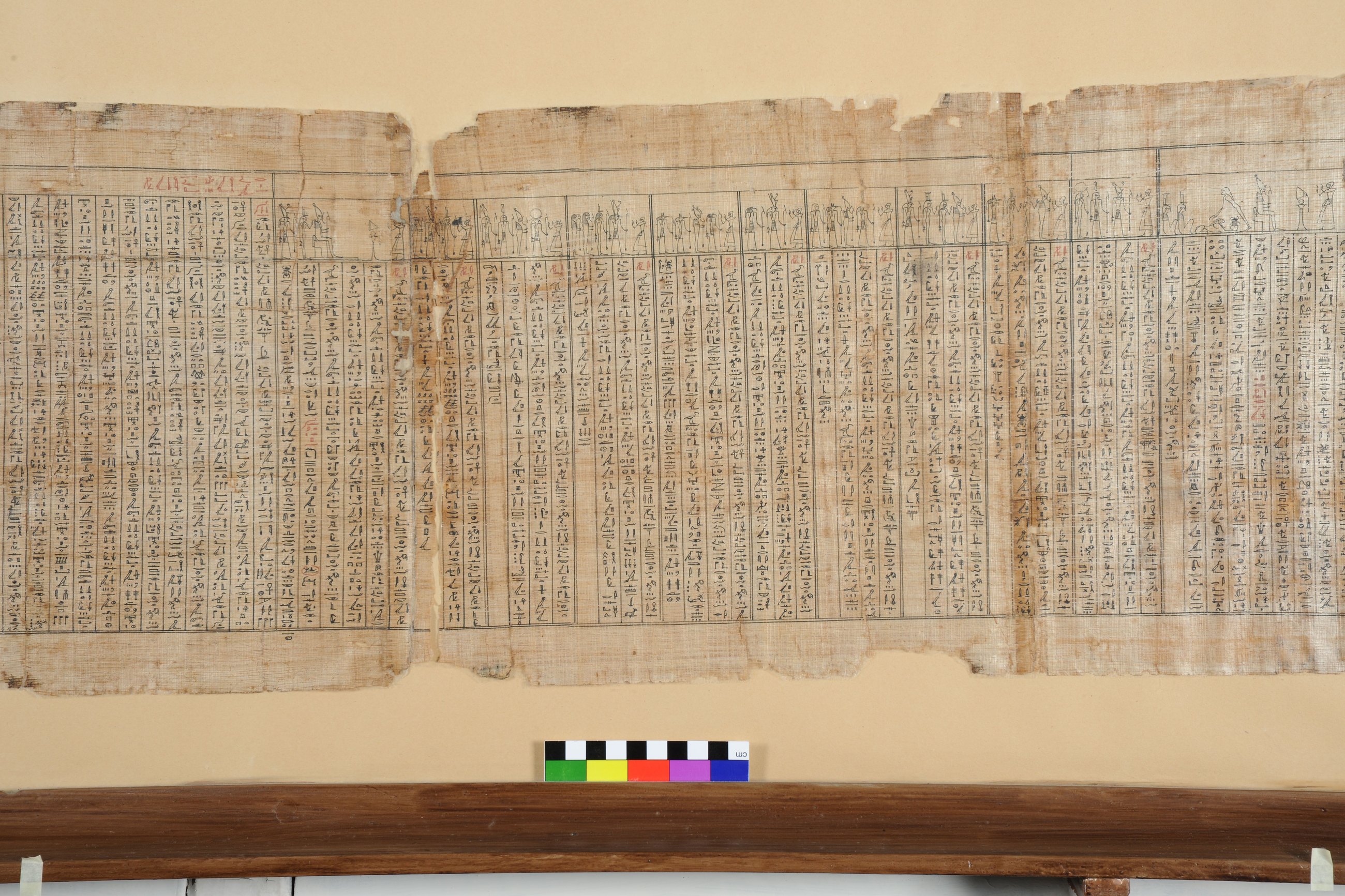
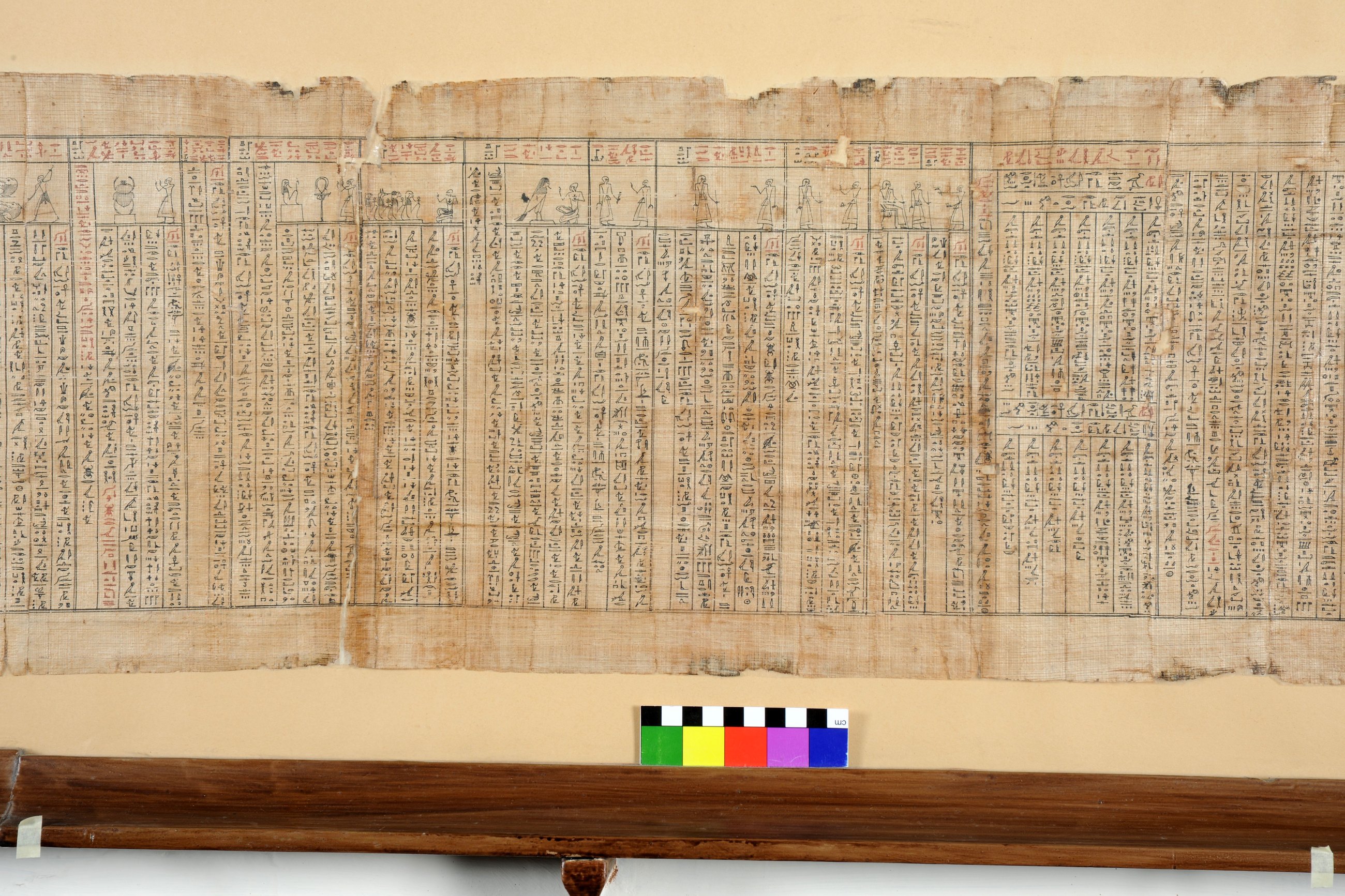
Spell 19 (Birch: 'The chapter of the Crown of Justification.') is on Lepsius's plate XIII and on photographs 5, 6 of the 31 Museo Egizio photographs of the roll.
The Egyptian is the transliteration of the Thesaurus Linguae Aegyptiae (edition by Burkhard Backes), with the column number of the spell before each column; the numbers are those of Lepsius's plates. On the papyrus the text runs in vertical columns of cursive hieroglyphs from right to left along the roll; titles and some words are written in red. Signs restored by the editor are in square brackets, signs the scribe left out in angle brackets, superfluous signs in braces and damaged signs in half brackets. The English is the translation by Samuel Birch, published in 1867 and made from Lepsius's copy of this papyrus, so the English and the Egyptian come from the same manuscript. It was the first complete English translation of the Book of the Dead; many passages are now understood differently. Birch's own square brackets give his alternatives and explanations. The photographs are by the Museo Egizio; each shows a stretch of the roll, and the note of each section says where the spell stands on it.
How was this verified? (Provenance)
Where on the image
Turin 1791, Spell 19 (TLA Tb 019: title line, columns 1-16; Lepsius 1842, pl. XIII). Photograph 5 of 31 (Commons Book_of_the_Dead_of_Iuefankh,_papyrus_-_Museo_Egizio_Turin_C_1791_p030.jpg): red title at 10-20%; its columns run to the left-hand edge and on to photograph 6. Photograph 6 of 31 (Commons Book_of_the_Dead_of_Iuefankh,_papyrus_-_Museo_Egizio_Turin_C_1791_p029.jpg): its last columns are at the right-hand edge (86-100%). Checked by eye: the photographs were matched to Lepsius's plates by their vignettes, red titles and framed compartments, and the overlapping edges of neighbouring photographs were compared.
titlerʾ n mꜣḥ.w mꜣꜥ-ḫrw
1ḏd-mdw jn Wsjr […] mꜣꜥ-ḫrw ṯz n =k jti̯ =k Jtm,w m〈ꜣ〉ḥ pfy nfr n mꜣꜥ-ḫrw m ḥꜣ,t twy ꜥnḫ mr,y nṯr.pl
2ꜥnḫ =k ḏ,t smꜣꜥ Wsjr-ḫnt,j-jmn,tt ḫrw =k r ḫfti̯.pl =k jw wḏ n =k jti̯ =k Gbb jwꜥ{ꜥ} =f nb mj ḥkn.w r =k m mꜣꜥ-ḫrw Ḥr,w zꜣ ꜣs,t zꜣ Wsjr ḥr ns,t
3jti̯ =k Rꜥ,w ḥr sḫr ḫfti̯.pl =k jw wḏ =f n =k Tꜣ,du tm.du jw wḏ.n{t} Jtm,w jw wḥm.n psḏ,t {ꜥꜥwj}〈jwꜥ,w〉 nfr n mꜣꜥ-ḫrw Ḥr,w zꜣ ꜣs,t zꜣ Wsjr ḏ,t
4nḥḥ Wsjr […] mꜣꜥ-ḫrw ḏ,t nḥḥ jw Wsjr-ḫnt,j-jmn,tt jt{w}r,tj dmḏ.tw nṯr nb nṯr,t nb〈.t〉 n,tj m p,t n,tj m tꜣ ḥr smꜣꜥ-ḫrw Ḥr,w zꜣ ꜣs,t zꜣ Wsjr r ḫfti̯.pl =f m-bꜣḥ
5Wsjr-ḫnt,j-jmn,tt ḥr smꜣꜥ-ḫrw Wsjr […] mꜣꜥ-ḫrw r ḫfti̯.pl =f m-bꜣḥ Wsjr-ḫnt,j-jmn,tt wnn-nfr,w zꜣ Nw,t hrw pfj n smꜣꜥ-ḫrw =f r Stš ḥnꜥ zmꜣ,ypl =f m-bꜣḥ
6ḏꜣḏꜣ,t ꜥꜣ.t jm,j.w Jwn,w grḥ n ꜥḥꜣ-ꜥ sḫr sbj pf m-bꜣḥ ḏꜣḏꜣ,t ꜥꜣ.t jm,j.w Ꜣbḏ,w grḥ pfj n smꜣꜥ-ḫrw Wsjr r ḫfti̯.pl =f
7smꜣꜥ-ḫrw Wsjr […] mꜣꜥ-ḫrw r ḫfti̯.pl =f m-bꜣḥ ḏꜣḏꜣ,t ꜥꜣ.t jm,j.w ꜣḫ,t jmn,t〈j〉.t grḥ pfj n ḥ〈ꜣ〉b h〈ꜣ〉kr m-bꜣḥ ḏꜣḏꜣ,t ꜥꜣ.t jm,j.w Ḏd,w grḥ
8pfy n sꜥḥꜥ ḏd jm,j Ḏd,w m-bꜣḥ ḏꜣḏꜣ,t ꜥꜣ.t jm,j.w wꜣ,t.pl mt.pl grḥ pfj n sjp m jw,tj =sn m-bꜣḥ ḏꜣḏꜣ,t ꜥꜣ.t jm,j.w Ḫm
9grḥ pfy n 〈j〉ḫ,t-{ḥr-}ḫꜣpl m Ḫm m-bꜣḥ ḏꜣḏꜣ,t ꜥꜣ.t jm,j.w Pi̯ Dp grḥ pfj n smn jwꜥ{ꜥ} n Ḥr,w m 〈j〉ḫ,t jti̯ =f Wsjr m-bꜣḥ ḏꜣḏꜣ,t ꜥꜣ.t
10jm,j.w ḫbs-tꜣ ꜥꜣ{.t} jm,j Ḏd,w ky-ḏd Ꜣbḏ,w grḥ pfj n wḏꜥ-md,t ky-ḏd wḏꜥ snm{m} m-bꜣḥ ḏꜣḏꜣ,t ꜥꜣ.t jm,j.w N-jr≡f ḥr s,t =f grḥ pfj n šzp Ḥr,w msḫn nṯr.pl
11m-bꜣḥ ḏꜣḏꜣ,t ꜥꜣ.t jm,j.w jdb,pl-rḫt,j grḥ pfy n sḏr Ꜣs,t rs.tw ḥr jri̯〈.t〉 j〈ꜣ〉kb ḥr sn =s m-bꜣḥ ḏꜣḏꜣ,t ꜥꜣ.t jm,j.w Rʾ-sṯꜣ,w grḥ pfj n smꜣꜥ-ḫrw Wsjr r ḫfti̯.pl =f
12nb〈.w〉 jw wḥm.n Ḥr,w ḥkn,w zp-4 jw ḫfti̯.pl =f nb〈.w〉 ḫr〈.w〉 sḫr.pl bḥn〈.w〉 jw wḥm.n Wsjr […] mꜣꜥ-ḫrw ḥkn,w zp-4 jw ḫfti̯.pl =f nb〈.w〉 ḫr〈.w〉
13sḫr.pl bḥn〈.w〉 jw wḥm.n Ḥr,w zꜣ ꜣs,t zꜣ Wsjr ḥḥ.pl n ḥbs jw ḫfti̯.pl =f nb〈.w〉 ḫr〈.w〉 sḫr.pl bḥn〈.w〉 ḏꜣi̯ s,t jm =sn r ḫb,t n.t jꜣb,tt ḥsq tp.pl =sn
14dr nḥb,t =sn stp ḫpš =sn ḏi̯! =sn n ḥtm wr jm,j jn,t nn pri̯ =sn ẖr zꜣw〈,t〉 Gbb ḏ,t ḏd =tw rʾ pn ḥr mꜣḥ,w
15n nṯr,t rḏi̯〈.w〉 m tp n z js rḏi̯.n =k snṯr ḥr sḏ,t n Wsjr […] mꜣꜥ-ḫrw mꜣꜥ-ḫrw =f r ḫfti̯.pl =f
16m mt m ꜥnḫ wnn =f m šms,pl Wsjr jw ḏḏ! n =f ⸢tʾ⸣ ds pzn m-bꜣḥ nṯr pn ḏd ḥr =k m dwꜣ,w zp-2 mk,t ꜥꜣ.t pw m šs-mꜣꜥ{.t} ḥḥ n zp
XIX. The chapter of the Crown of Justification.
Said to [by] the Osiris. Thy father Tum has bound thee with this good crown of justification, with that living forepart [frontlet]; beloved of the Gods, thou livest for ever. Osiris, who dwells in the West, has justified thy word against thy enemies. Thy father Seb has ordered to thee all his issue. Mayest thou beseech with justification Horus the son of Isis, the son of Osiris, on the throne of thy father the Sun, to overthrow all thy enemies! Turn has ordered to thee the earth [twice]. The Gods have repeated the good fact [hand] of the justification of Horus the son of Isis, son of Osiris, for ever and ever, the Osiris for ever and ever. Osiris, who dwells in the West, has collected together every God and Goddess who is in heaven or on earth to justify Horus the son of Isis, the son of Osiris, against his enemies, — before Osiris, who dwells r ells in the West, to justify Osiris against his enemies, — before Osiris, who is Lord of the West, the Good Being, son of Nu, the day, he is justified against Set and his associates,
— before the Great Chiefs of Gods in Annu [Heliopolis], the night of the battle to overthrow the profane, before the Great Chiefs in Abydos, the night of justifying Osiris against his enemies, justifying the Osiris against his enemies, before the Great Chiefs in the Western horizon, the day of the festival of the haker [dawn], — before the Great Chiefs in Tattu, the night of setting up Tat in Tattu, before the Great Chiefs in the Roads of the Head, the night of the judgment of those who are not, — before the Great Chiefs in S’khem, the night of [placing] the things on the altars in S’khem,
— before the Great Chiefs of the [Hill of] Tep, the night of setting up the issue of Horus in place of his father Osiris, before the Great Chiefs of the great festival of sacrifice in Tattu or in Abydos, the night of weighing words, or of weighing a hair, — before the Great Chiefs of Anrutf in his place, the night when Horus receives the birthplace of the Gods,— before the Great Chiefs in. . ., the night of the laying out [the dead Osiris] by Isis, arisen to make a wail for her brother — before the Great Chiefs in the Rusta, the night of justifying Osiris against his enemies. Horus has repeated the address four times. All his enemies have fallen down, stabbed. The Osiris repeats this four times, all his enemies fall down stabbed. Horus, the son of Osiris, repeats this millions of times; all his enemies fall down stabbed. He drags them, throwing them down from the place where they are, to the blocks of the East; he cuts off their heads, breaks their necks, and Die cuts off their thighs, giving them to the Great Strangler in the valley. They do not escape the custody of Seb for ever.
If this chapter is said over a divine crown placed on the head of a person, after thou hast given fuming incense to the Osiris, it makes him justified against his enemies whether dead or alive, he is one of the servants of Osiris; drink and food are given to him before that God. It is to be said by thee praying. It is great protection in pure clothes [safety], for millions of times.
Notes
- Birch's English was taken from three scans of Bunsen's Egypt's Place in Universal History, vol. V (1867), on the Internet Archive. The three OCR texts were aligned word by word and each word was settled by their agreement; running heads, page numbers, footnote markers and footnotes were removed. Some OCR errors may remain, chiefly in proper names.
- Birch uses the terms and name forms of his time: Hades, Aahlu (Elysium), Tum for Atum, Seb for Geb, Anup for Anubis, Phoenix or Bennu for the heron.
- Labels such as 'title line' or 'gate 1' before a line of the Egyptian translate the position labels of the TLA.
- The TLA has no hieroglyphic encoding for these texts, so only the transliteration is shown.
Cite
Sources
- Source: Papyrus of Iuefankh, Turin, Museo Egizio Cat. 1791 (Museo Egizio photographs, CC0) + TLA transliteration (ed. B. Backes, CC BY-SA 4.0) + English of Samuel Birch (1867, public domain) (holding institution)
- Critical edition: Thesaurus Linguae Aegyptiae, ed. Burkhard Backes (2018 data, AED-TEI)
← previous · → next · v cycle view · l back to library