Book of the Dead, Spell 85: Making the Transformation into the Soul, of not going to the Block, and of ... (papyrus of Iuefankh)
Introduction
The Book of the Dead, in Egyptian the spells for going forth by day, is a collection of funerary spells written on papyrus rolls and placed in burials from the New Kingdom to the Roman period. Each roll was made for one person, with spells taken from a large repertoire and illustrated with drawings (vignettes). This library gives one complete roll: the papyrus of Iuefankh in the Museo Egizio, Turin (Cat. 1791), written in the Ptolemaic period (332-30 BCE) and coming from Thebes. Richard Lepsius published it in 1842 and divided it into 165 chapters; his numbering is still the standard numbering of the spells, and it is used here.
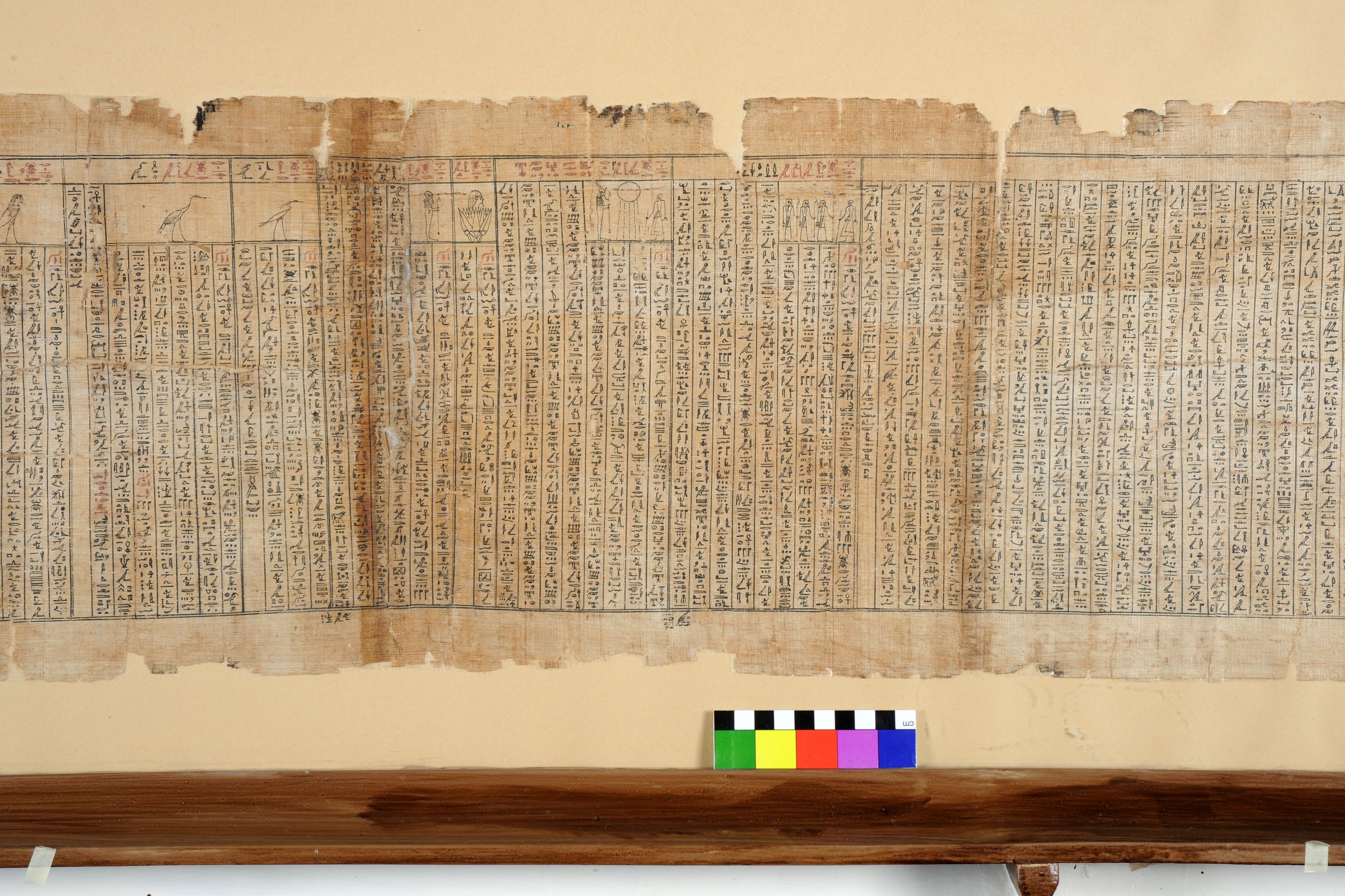
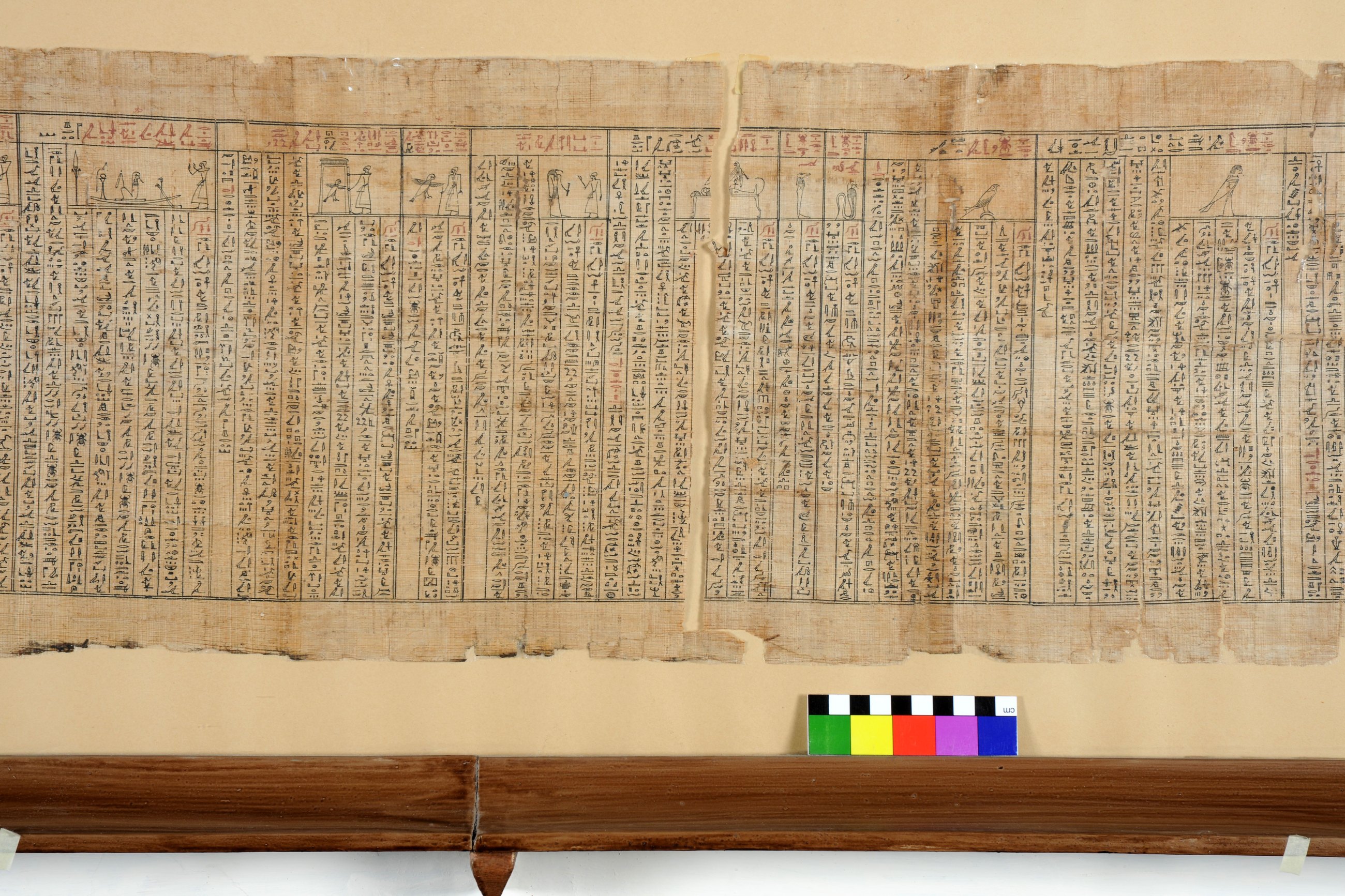
Spell 85 (Birch: 'The chapter of Making the Transformation into the Soul, of not going to the Block, and of not being destroyed though knowing it.') is on Lepsius's plate XXXII and on photographs 12, 13 of the 31 Museo Egizio photographs of the roll.
The Egyptian is the transliteration of the Thesaurus Linguae Aegyptiae (edition by Burkhard Backes), with the column number of the spell before each column; the numbers are those of Lepsius's plates. On the papyrus the text runs in vertical columns of cursive hieroglyphs from right to left along the roll; titles and some words are written in red. Signs restored by the editor are in square brackets, signs the scribe left out in angle brackets, superfluous signs in braces and damaged signs in half brackets. The English is the translation by Samuel Birch, published in 1867 and made from Lepsius's copy of this papyrus, so the English and the Egyptian come from the same manuscript. It was the first complete English translation of the Book of the Dead; many passages are now understood differently. Birch's own square brackets give his alternatives and explanations. The photographs are by the Museo Egizio; each shows a stretch of the roll, and the note of each section says where the spell stands on it.
How was this verified? (Provenance)
Where on the image
Turin 1791, Spell 85 (TLA Tb 085: title line, columns 1-11; Lepsius 1842, pl. XXXII). Photograph 12 of 31 (Commons Book_of_the_Dead_of_Iuefankh,_papyrus_-_Museo_Egizio_Turin_C_1791_p023.jpg): begins at the left-hand edge (0-8%) and continues on photograph 13. Photograph 13 of 31 (Commons Book_of_the_Dead_of_Iuefankh,_papyrus_-_Museo_Egizio_Turin_C_1791_p022.jpg): the walking figure and its red title at 88-91%. Checked by eye: the photographs were matched to Lepsius's plates by their vignettes, red titles and framed compartments, and the overlapping edges of neighbouring photographs were compared.
titlerʾ n jri̯.t-ḫpr,w m bꜣ tm ꜥq r ḫb,t nn ski̯.n rḫ sw
1ḏd-mdw jn Wsjr […] mꜣꜥ-ḫrw jnk Rꜥ,w pri̯ m Nw,w bꜣ =j pw nṯr jnk qmꜣ ḥw bw,t 〈=j〉 pw jzf,t nn mꜣꜣ =j
2sw jnk nb-mꜣꜥ,t ꜥnḫ =j jm =s jnk Ḥw jw,tj ski̯ =f m rn =j pwy n bꜣ ḫpr.n =j ḏs =j ḥnꜥ Nw,w m
3rn =j pwy n ḫpr,w ḫpr.n =j jm =f n rꜥ,w-nb jnk sšp bw,t =j pw mnj.w nn ꜥq =j r ḫb,t dꜣ,t nn jri̯.tw n =j 〈j〉ḫ,t m
4nw bw,t nṯr.pl ḥr-n,tj jnk jri̯ ꜣḫ,pl n Wsjr sḥtp.n =j jb n nb,pl-jḫ,t 〈r〉 mr,wt =j ḏi̯! =sn snḏ =j qmꜣ =sn šf,〈y〉t =j 〈⸢ḫr⸣〉 jm,j.w
5pꜣw,t{jw} =sn jsk tw =j qꜣi̯.kw ḥr jꜣ,t =j ḥr s,t =j pn!! jnk Nw,w nn ḫmi̯ wj jrr.pl jzf,t jnk
6sms,w pꜣw,tj.w bꜣ,w =〈j〉 pw bꜣ,w nṯr.pl nḥḥ jnk qmꜣ kk,w jri̯-s,t =f m-ḏr,w ḥr,t jy.n bꜣ 〈=j〉 ꜥꜣ jꜣwi̯〈.w〉 jri̯.n =j kk,w m-ḏr,w
7ḥr,t mri̯{,wt} =j pḥ =j ḥr ḏr,w =sn šmi̯ =j ḥr rd.du =j ḫrp =〈j〉 jꜣ,t =j ḏꜣi̯ =j bjꜣ jri̯.yw mḥ dr =j kk,w fntj
8jmn-rn sḥrj.w =j nmt,t r nb ḥꜥꜥ,w bꜣ bꜣ =j pw jꜥrꜥ,t.pl ḫpr〈,w〉 =j pw nḥḥ nb-rnp,tpl ḥqꜣ-ḏ,t jnk qꜣi̯ nb tꜣ-dbw hbj
9m nʾ,t jꜣd m sḫ,t rn =j pw nn ski̯ =f jnk bꜣ qmꜣ Nw,w jri̯{.t}〈.w〉 m s,t =f m ẖr,t-nṯr nn mꜣꜣ.tw zš =j nn sḏ.tw swḥ,t jnk nb{,t}
10qꜣꜣ jri̯.{t}〈n〉 =j zš =j m-ḏr,w ḥr,t h〈ꜣ〉i̯ =j r tꜣ Gbb dr =j ḏw =j ky-ḏd nb mšr,w sn Wsjr […] mꜣꜥ-ḫrw ḏ,t =f m Jwn,w ḥn =j
11jm,j.w wḫ jꜣ,t jmn,t〈j〉.t hbi̯
LXXXV. The chapter of Making the Transformation into the Soul, of not going to the Block, and of not being destroyed though knowing it.
Vignette. — The Soul.]
I am the Sun who proceeds from Nu. My Soul is the God. I am the creator of perception; hateful is idleness, I do not look at it. I am the Lord of Truth, living in it [daily]. I am Perception, who never perishes under the name of the Soul. I made myself with the Nu over the Gate, under my name of transformations 1 am created in it daily. I am the orb, what I hate is repose. I do not go to the block. I do not do anything of a nature hateful to the Gods, because I am the ruling spirit of Osiris, welcoming the heart of the Lords of Things, who love me, who give me my shape [terror], who make my shape [fear] in their society, I hail and address in my place, in this my seat. I the Nu; no doers of evil break me. I am the oldest of the Daimons, the Souls of the Gods, the Souls of eternity. I the creator of darkness, making his place above everywhere. The Great Soul has come along the noble road, making his path above as I have wished. I have made the darkness everywhere above as wished. I have pursued on their road. I walk on my feet. I show my place. I pass through Substances, making them full. I pierce the darkness. Hidden Reptile is my name.. 1 have cleared the paths for all, the Lord of Joy. The Soul of my body is a uraeus. created for ever, Lord of Years, Eternal ruler. I am Kau, Rebu, or Tebu, Lord of the Earth. I have been young in the earth, young in the fields, in my name which is Incorruptible. I am the Soul making Nu; taking its place in Hades. Invisible is my nest, never has my egg been touched. I am the Lord of the Floor [or steps]. I make my nest in the upper regions. I stand at the earth as Seb. I probe my sins as Lord of the Evening: the Osiris breathes, his body is Annu [Heliopolis]. I return as the Ibis among the Spirits to the Western place.
Notes
- Birch's English was taken from three scans of Bunsen's Egypt's Place in Universal History, vol. V (1867), on the Internet Archive. The three OCR texts were aligned word by word and each word was settled by their agreement; running heads, page numbers, footnote markers and footnotes were removed. Some OCR errors may remain, chiefly in proper names.
- Birch uses the terms and name forms of his time: Hades, Aahlu (Elysium), Tum for Atum, Seb for Geb, Anup for Anubis, Phoenix or Bennu for the heron.
- Labels such as 'title line' or 'gate 1' before a line of the Egyptian translate the position labels of the TLA.
- The TLA has no hieroglyphic encoding for these texts, so only the transliteration is shown.
Cite
Sources
- Source: Papyrus of Iuefankh, Turin, Museo Egizio Cat. 1791 (Museo Egizio photographs, CC0) + TLA transliteration (ed. B. Backes, CC BY-SA 4.0) + English of Samuel Birch (1867, public domain) (holding institution)
- Critical edition: Thesaurus Linguae Aegyptiae, ed. Burkhard Backes (2018 data, AED-TEI)
← previous · → next · v cycle view · l back to library