Book of the Dead, Spell 86: Transforming into a Swallow (papyrus of Iuefankh)
Introduction
The Book of the Dead, in Egyptian the spells for going forth by day, is a collection of funerary spells written on papyrus rolls and placed in burials from the New Kingdom to the Roman period. Each roll was made for one person, with spells taken from a large repertoire and illustrated with drawings (vignettes). This library gives one complete roll: the papyrus of Iuefankh in the Museo Egizio, Turin (Cat. 1791), written in the Ptolemaic period (332-30 BCE) and coming from Thebes. Richard Lepsius published it in 1842 and divided it into 165 chapters; his numbering is still the standard numbering of the spells, and it is used here.
Spell 86 (Birch: 'The chapter of Transforming into a Swallow.') is on Lepsius's plate XXXII and on photograph 13 of the 31 Museo Egizio photographs of the roll.
The Egyptian is the transliteration of the Thesaurus Linguae Aegyptiae (edition by Burkhard Backes), with the column number of the spell before each column; the numbers are those of Lepsius's plates. On the papyrus the text runs in vertical columns of cursive hieroglyphs from right to left along the roll; titles and some words are written in red. Signs restored by the editor are in square brackets, signs the scribe left out in angle brackets, superfluous signs in braces and damaged signs in half brackets. The English is the translation by Samuel Birch, published in 1867 and made from Lepsius's copy of this papyrus, so the English and the Egyptian come from the same manuscript. It was the first complete English translation of the Book of the Dead; many passages are now understood differently. Birch's own square brackets give his alternatives and explanations. The photographs are by the Museo Egizio; each shows a stretch of the roll, and the note of each section says where the spell stands on it.
How was this verified? (Provenance)
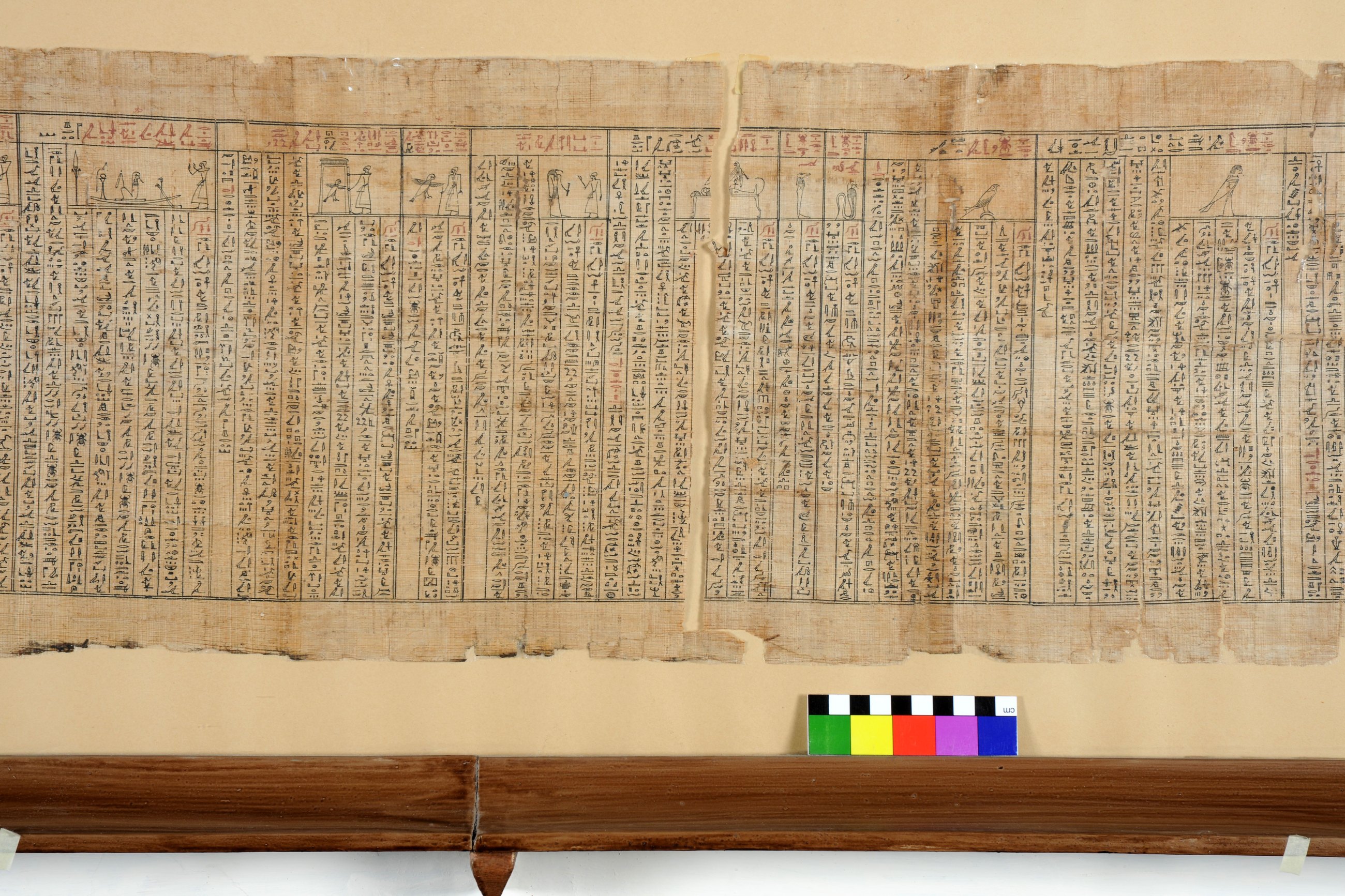
Where on the image
Turin 1791, Spell 86 (TLA Tb 086: title line, columns 1-8; Lepsius 1842, pl. XXXII). Photograph 13 of 31 (Commons Book_of_the_Dead_of_Iuefankh,_papyrus_-_Museo_Egizio_Turin_C_1791_p022.jpg): the swallow on a pedestal at 71-74% (Lepsius pl. XXXII). Checked by eye: the photographs were matched to Lepsius's plates by their vignettes, red titles and framed compartments, and the overlapping edges of neighbouring photographs were compared.
titlerʾ n jri̯.t-ḫpr,w m mn,t
1ḏd-mdw jn Wsjr […] mꜣꜥ-ḫrw jnk mn,t zp-2 jnk rf Ḥḏḏ〈,t〉 zꜣ,t Rꜥ,w j nṯr.pl nḏm ,wj sṯi̯ =ṯn nsr,t pri̯〈.t〉 m ꜣḫ,t j n,tj m nʾ,t
2jni̯ n =j zꜣw{ꜣw} qꜣb jmm! n =j ꜥ =k wrš =j m mr-nsr,t šmi̯ =j m wp〈,t〉 jy.n =j ẖr smj wn
3n =j jḫ ḏd =j mꜣꜣ.n =j jw Ḥr,w m ḫrp n wjꜣ jw rḏi̯ n =f ns,t jti̯ =f jw Stš pwy zꜣ Nw,t m jntj jri̯ =f r =f jw sjp.n =j
4n,tj m Ḫm qꜥḥw.n =j ꜥ.wj =j n Wsjr šmi̯ =j m wp〈,t〉 =j jy.n =j r ḏd jmm! zni̯ =j smj =j jnk ꜥq jp〈.w〉
5pri̯ ṯnw〈.w〉 ḥr sbꜣ pwy n nb-〈r-〉ḏr wꜥb =j ḥr wꜥr,t {j}〈twy〉 ꜥꜣ.t dr.n =j ḏw =j ḫmi̯.n =j jzf,t ḫsr =j
6ḏw jr,j =j r tꜣ jr,j-ꜥꜣ.pl jri̯ n =j wꜣ,t jnk js mj,tt =ṯn pri̯.n =j m hrw jy =j šmi̯ =j ḥr rd.du =j sḫm.kw m nmt,t jꜣḫ,w jw =j rḫ.kw
7wꜣ,t.pl štꜣ.pl m sbꜣ.pl n.w sḫ,t-jꜣl wnn =j jm m =k wj ={k} jy.kw sḫr.pl ḫfti̯.pl =j ḥr-tp tꜣ ẖꜣ,t =j q{r}js.tw =s
8jr rḫ mḏꜣ,t tn jw =f pri̯ =f m hrw m ẖr,t-nṯr ꜥq =f m-ḫt pri̯ =f jr ḫmi̯ rʾ pn nn ꜥq =f m-ḫt pri̯ =f ḫmi̯〈.w〉 pri̯ m hrw
LXXXVI. The chapter of Transforming into a Swallow.
[Vignette. — A Swallow.]
I am the Swallow. I am the Swallow. I am the Scorpion, the daughter of the Sun. Oh Gods! delicious is the smell of your fire which comes out of the horizon. Oh [thou who art] in the plate Guardian of the corner, lead me. Give me thy arm. I keep a watch in the Pool of Fire. I come by [my] efforts. I have come, having the writing. I open; what do say I have seen? It is Horus steering the bark, giving place to his father. It is Seth, the son of Nu, undoing all he has done. I have examined that which is in the sealed place. I have laid my arm on [shook hands with] Osiris. I go by my efforts. I have come speaking. Let me open the writing. I am the reckoning which goes in [or I go in judged] and the account which goes [or how do I go] out of the Gate of the Universal Lord. I am washed on my leg. Oh Great One! I have dissipated my sins. I have destroyed my failings, for I have got rid of the sins which detained me on earth. Oh Door-keepers! I have made roads. It is then I am like you. I have come out of the day. I have walked on my feet, I prevail with my steps. I have known the secret roads in the Gates of the fields of the Aahlu. Let me overthrow my oppressors. On earth my body is embalmed.
If this book is known he will come out from the day from the Hades. lie goes in and he comes out. Without this chapter he does not go in nor come out, he does not come out of the day [light].
Notes
- Birch's English was taken from three scans of Bunsen's Egypt's Place in Universal History, vol. V (1867), on the Internet Archive. The three OCR texts were aligned word by word and each word was settled by their agreement; running heads, page numbers, footnote markers and footnotes were removed. Some OCR errors may remain, chiefly in proper names.
- Birch uses the terms and name forms of his time: Hades, Aahlu (Elysium), Tum for Atum, Seb for Geb, Anup for Anubis, Phoenix or Bennu for the heron.
- Labels such as 'title line' or 'gate 1' before a line of the Egyptian translate the position labels of the TLA.
- The TLA has no hieroglyphic encoding for these texts, so only the transliteration is shown.
Cite
Sources
- Source: Papyrus of Iuefankh, Turin, Museo Egizio Cat. 1791 (Museo Egizio photographs, CC0) + TLA transliteration (ed. B. Backes, CC BY-SA 4.0) + English of Samuel Birch (1867, public domain) (holding institution)
- Critical edition: Thesaurus Linguae Aegyptiae, ed. Burkhard Backes (2018 data, AED-TEI)
← previous · → next · v cycle view · l back to library