Book of the Dead, Spell 109: Knowing the Spirits of the East (papyrus of Iuefankh)
Introduction
The Book of the Dead, in Egyptian the spells for going forth by day, is a collection of funerary spells written on papyrus rolls and placed in burials from the New Kingdom to the Roman period. Each roll was made for one person, with spells taken from a large repertoire and illustrated with drawings (vignettes). This library gives one complete roll: the papyrus of Iuefankh in the Museo Egizio, Turin (Cat. 1791), written in the Ptolemaic period (332-30 BCE) and coming from Thebes. Richard Lepsius published it in 1842 and divided it into 165 chapters; his numbering is still the standard numbering of the spells, and it is used here.
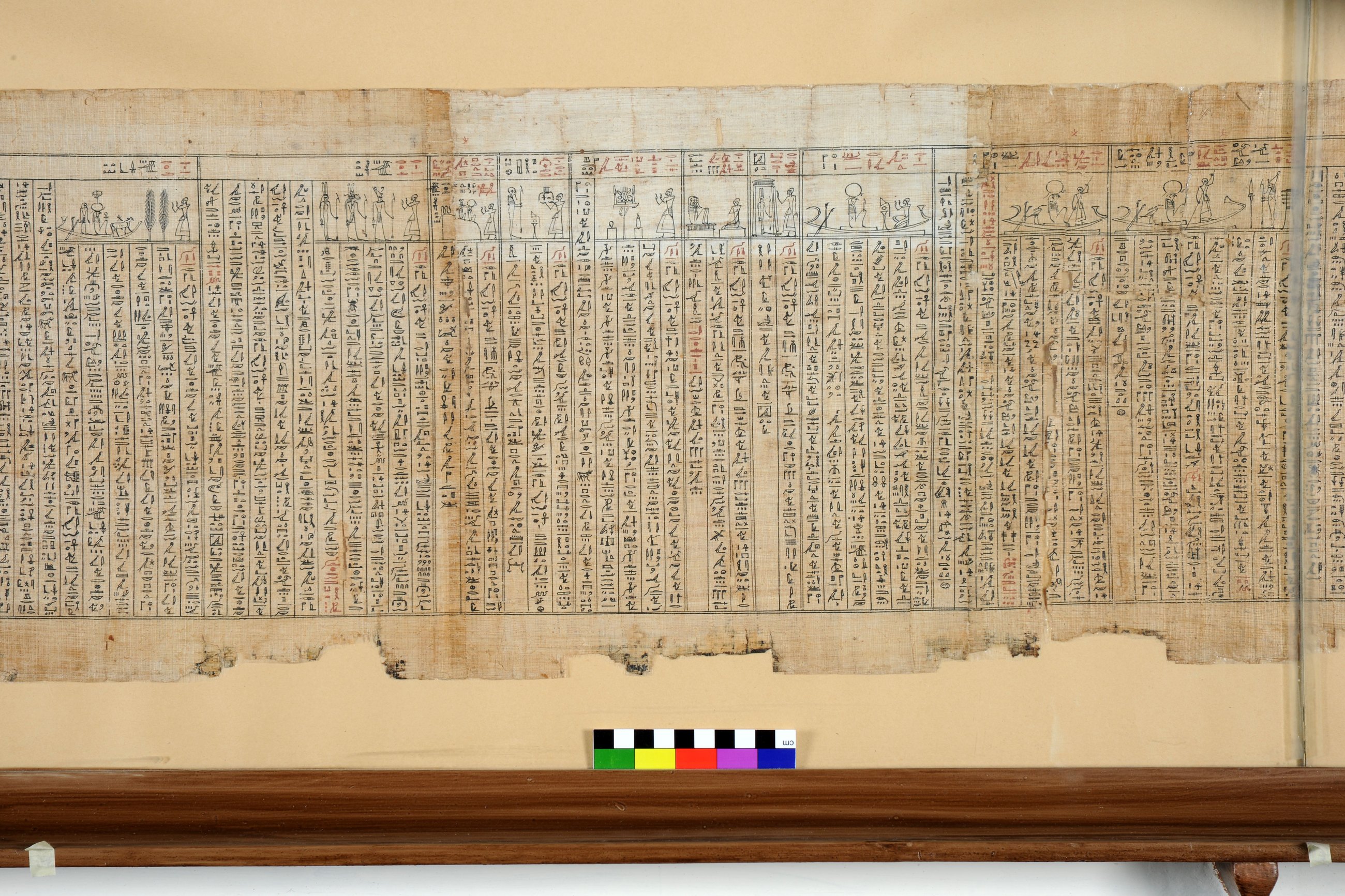
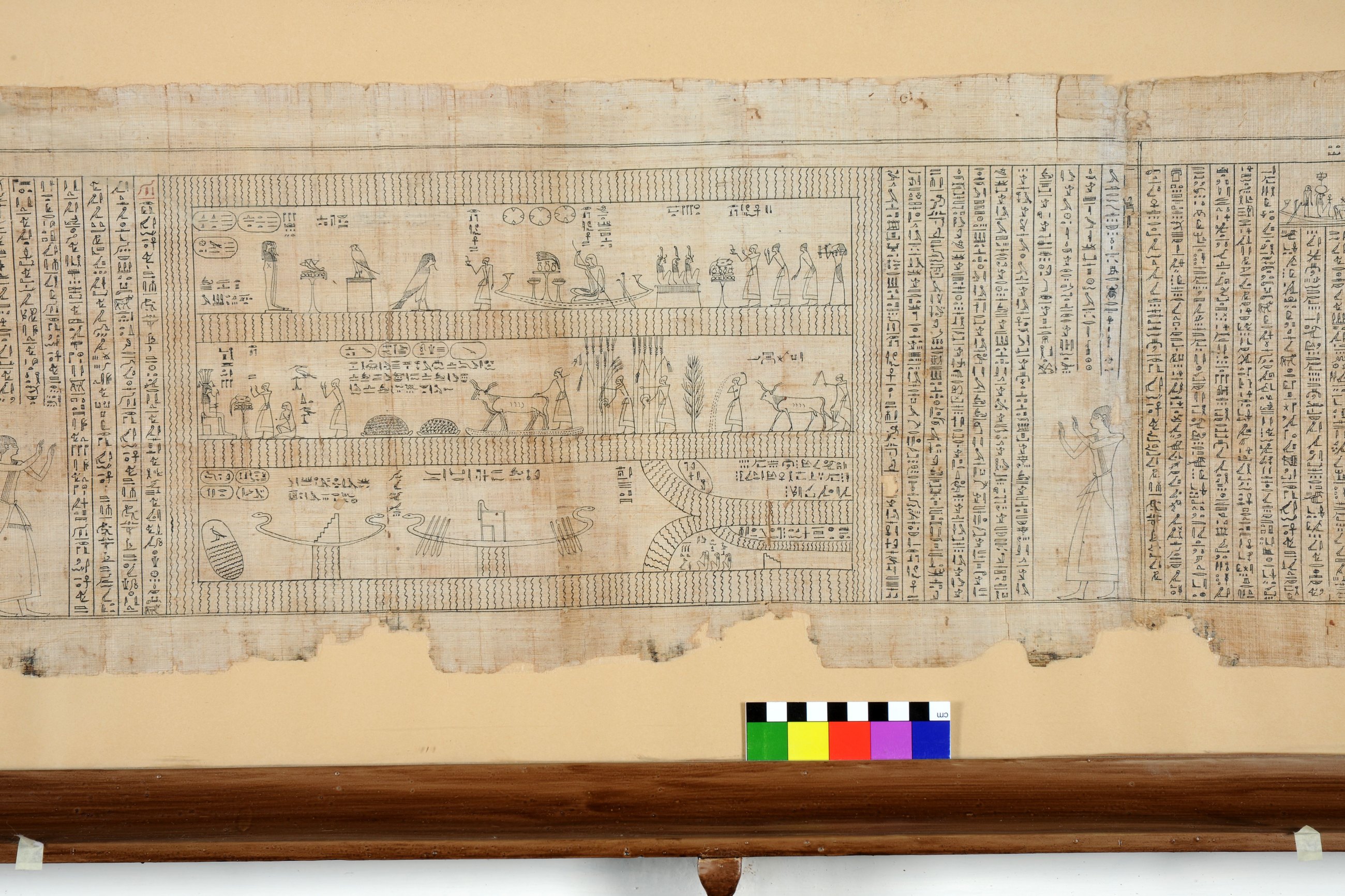
Spell 109 (Birch: 'The chapter of Knowing the Spirits of the East.') is on Lepsius's plates XXXIX-XL and on photographs 15, 16 of the 31 Museo Egizio photographs of the roll.
The Egyptian is the transliteration of the Thesaurus Linguae Aegyptiae (edition by Burkhard Backes), with the column number of the spell before each column; the numbers are those of Lepsius's plates. On the papyrus the text runs in vertical columns of cursive hieroglyphs from right to left along the roll; titles and some words are written in red. Signs restored by the editor are in square brackets, signs the scribe left out in angle brackets, superfluous signs in braces and damaged signs in half brackets. The English is the translation by Samuel Birch, published in 1867 and made from Lepsius's copy of this papyrus, so the English and the Egyptian come from the same manuscript. It was the first complete English translation of the Book of the Dead; many passages are now understood differently. Birch's own square brackets give his alternatives and explanations. The photographs are by the Museo Egizio; each shows a stretch of the roll, and the note of each section says where the spell stands on it.
How was this verified? (Provenance)
Where on the image
Turin 1791, Spell 109 (TLA Tb 109: title line, columns 1-12; Lepsius 1842, pl. XXXIX-XL). Photograph 15 of 31 (Commons Book_of_the_Dead_of_Iuefankh,_papyrus_-_Museo_Egizio_Turin_C_1791_p020.jpg): red title at 8-15% over the boat, the two plants and the man; it continues on photograph 16. Photograph 16 of 31 (Commons Book_of_the_Dead_of_Iuefankh,_papyrus_-_Museo_Egizio_Turin_C_1791_p019.jpg): its last columns at 85-100%. Checked by eye: the photographs were matched to Lepsius's plates by their vignettes, red titles and framed compartments, and the overlapping edges of neighbouring photographs were compared.
titlerʾ n〈,j〉 rḫ bꜣ.pl jꜣb,tt
1ḏd-mdw jn Wsjr […] mꜣꜥ-ḫrw jw =j rḫ.kw ḏw pfj jꜣb,t〈j〉{.t} n〈,j〉 p,t rs,j =f m š ḫꜣr.pl mḥ,t =f m nw rʾ.pl
2m b〈w〉 sqdi̯{.t} Rꜥ,w jm m ṯꜣw n〈,j〉 ẖnn,w jnk smy.w m dp,t-nṯr jnk ẖni̯.w nn wrḏ.n =f m wjꜣ-n-Rꜥ,w jw =j
3rḫ.kw nh,t twy n〈,j〉.t mfk〈ꜣ,t〉 pri̯ Rꜥ,w jm,j-tw =s šmi̯〈.w〉 ḥr sṯz,w-Šw jw =j rḫ.kw sbꜣ nb pri̯ Rꜥ,w
4jm =f jw =j rḫ.kw sḫ,t-jꜣl twy n,tj jnb =s m bjꜣ jw qꜣ,w n〈,j〉 bd,t =s m mḥ 7 jw wšm.pl =s m mḥ
53 jw mꜣw〈,t〉.pl =f m mḥ 4 jn ꜣḫ.w m mḥ 8 m ꜣw wꜥ nb jm ꜣzḫ sn r-gs bꜣ.pl jꜣb,tj.w jw =j rḫ.kw
6bꜣ.pl jꜣb,tj.w Ḥr,w-ꜣḫ,tj pw bḥz,w ḫr nṯr pn nṯr-dwꜣ,w pw qdjw Wsjr […] mꜣꜥ-ḫrw wḏꜣ =k ḥnꜥ =j
7j.n Mḥ,y tḫ pw n〈,j〉.t ḥnk〈,w〉 mtw,t kꜣ r jm,j šs ns{,t} =k h{ꜣ}b{ꜣ} ḫnt〈,j〉 wnn.ypl =f mḫꜣ〈,t〉 sḫr.w =k m ḥw,t jbtj r jbtj.pl
8ḥr〈,j.w〉 šfd.pl qbḥ r =s ḥr ḏꜣjs mr,wt =k ḥr-nb bjk-nṯr〈,j〉 ḥr jr,t jꜣb〈,j〉 km〈m〉 ḥr qꜥḥ,w =f mj,tt pri̯〈.w〉 r p,t mj ḫꜣbs.pl ẖr〈,j〉 q{r}js,t
9pw sqdd! ḥr mṯn,w nn thꜣ tš ḥr ⸢šd,yt⸣ n〈,j〉.t nṯr.pl zẖꜣ.pl ḥnꜥ =k r ḏḏ! ꜣw ꜣḥ,t.pl ḫndš šꜣꜥ.tw nfr,y jm
10m rḏw,.w n〈,j〉.w ⸢jꜥꜣ⸣ qꜣ〈,w〉 n〈,j〉{.t} bd,t =s m mḥ 5 wšm.pl =s m mḥ 2 jsḫ.n =k js ḥnꜥ ꜣḫ.w r-gs bꜣ.pl jꜣb,tt ꜥq.tw m-wstn,w r sbḫ,t.pl
11štꜣ.pl ꜥb =k jn jm,j.pl =sn spr.w pr =k m-ꜥ kꜣ.pl ḥr snḏm jb n〈,j〉 ṯꜣ.du bw,t =k pw mt m-wḥm ḏ,t n =k m ꜥḥꜥ,w
12mtn,w rḏi̯ m fqꜣ.w sꜥꜣ fꜣw n〈,j〉 Wsjr […] mꜣꜥ-ḫrw
CIX. The chapter of Knowing the Spirits of the East.
I know the Eastern hill of the heaven. Its South is in the Pool of the Sharu, its North in the Lake of the Rubu, where the Sun is towed in it by contending winds. I am watching what is ordered in the divine keel, I have led it, it has never ceased to be in the boat of the Sun. I know the sycomores of copper, the Sun comes out of them, bearing Shu I have been known at every gate, out of which the Sun comes. I know the Aaluna [Elysium]. Its walls [?] are of iron [?] [earth]. Its corn rises 7 cubits, the ears of 3 cubits, the stalks of 4 cubits, for [say] its Spirits, each of them 8 cubits in length; they mow where the Spirits of the East are. I know the Spirits of the East, they are the Sun in the horizon, the Calf of that God, the divine Star [adorer] of the Sun. The deceased has been built [formed] excellent, like his God, the deceased has been made a God. [I know it, I know its name, Aahlu is its name.]. . Thou goest forth with me; [is said] by the North wind. The weight of the scale, the bull... to thy... his being weighing thy deeds in the house of Abt to erase them from the rolls; let it be refreshed there, under the type thou wishest to be before all men (?), the divine hawk in the left Eye, his hair is on his shoulder when he proceeds to the heaven as the stars [or shades], having a coffin, that is conducted on the road.[?] The limits are not taken out of the ditches of Gods, depicted by thee, to give the length of the fields and the pool in which the corn begins and terminates by the planting of
The height of its corn is 5 cubits; its stalks are 2 cubits. When thou hast mowed with the Souls where the Spirits of the East are, having walked with a stride to the closed gates, thou art acquitted, [is said] by those who belong to them, and approachest thy house after thy labours to the delight of [thy] two Souls. W T hat thou hatest is that thou shouldst die a second time. Thy making for ever the time .... and placing[?] of a harvest increase the [joy or food] of the Osiris.
Notes
- Birch's English was taken from three scans of Bunsen's Egypt's Place in Universal History, vol. V (1867), on the Internet Archive. The three OCR texts were aligned word by word and each word was settled by their agreement; running heads, page numbers, footnote markers and footnotes were removed. Some OCR errors may remain, chiefly in proper names.
- Birch uses the terms and name forms of his time: Hades, Aahlu (Elysium), Tum for Atum, Seb for Geb, Anup for Anubis, Phoenix or Bennu for the heron.
- Labels such as 'title line' or 'gate 1' before a line of the Egyptian translate the position labels of the TLA.
- The TLA has no hieroglyphic encoding for these texts, so only the transliteration is shown.
Cite
Sources
- Source: Papyrus of Iuefankh, Turin, Museo Egizio Cat. 1791 (Museo Egizio photographs, CC0) + TLA transliteration (ed. B. Backes, CC BY-SA 4.0) + English of Samuel Birch (1867, public domain) (holding institution)
- Critical edition: Thesaurus Linguae Aegyptiae, ed. Burkhard Backes (2018 data, AED-TEI)
← previous · → next · v cycle view · l back to library