Book of the Dead, Spell 110: The Field of Offerings (papyrus of Iuefankh)
Introduction
The Book of the Dead, in Egyptian the spells for going forth by day, is a collection of funerary spells written on papyrus rolls and placed in burials from the New Kingdom to the Roman period. Each roll was made for one person, with spells taken from a large repertoire and illustrated with drawings (vignettes). This library gives one complete roll: the papyrus of Iuefankh in the Museo Egizio, Turin (Cat. 1791), written in the Ptolemaic period (332-30 BCE) and coming from Thebes. Richard Lepsius published it in 1842 and divided it into 165 chapters; his numbering is still the standard numbering of the spells, and it is used here.
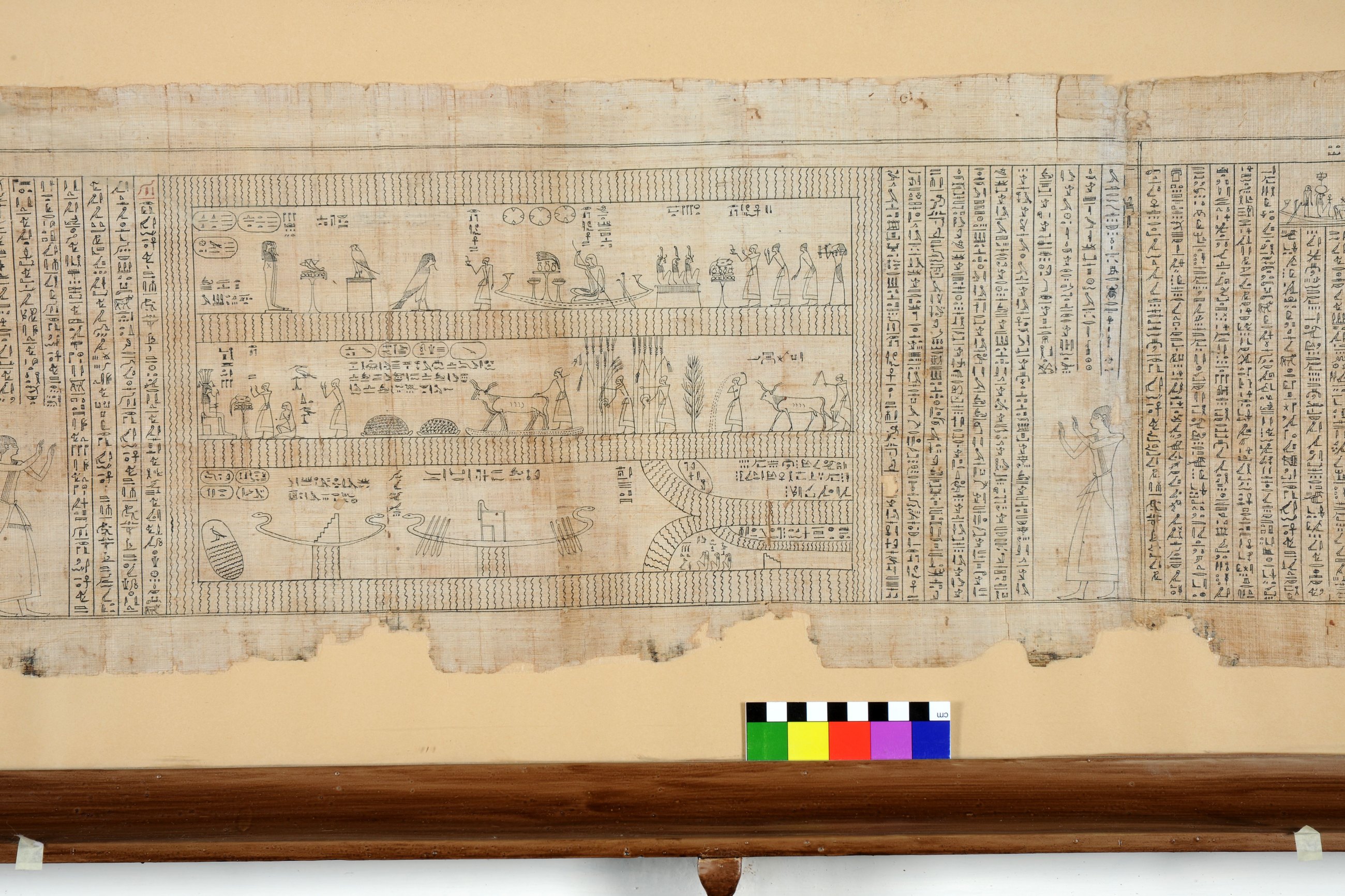
Spell 110 (Birch: 'The going in Peace, and taking the good Path to the Fields of Heth [Peace, or Food].') is on Lepsius's plates XL-XLII and on photographs 16, 17 of the 31 Museo Egizio photographs of the roll. The vignette of the Field of Offerings (Lepsius pl. XLI) shows the dead man ploughing, reaping and sailing in the fields of the next world. The TLA gives its captions as a second text (upper, middle and lower register); they follow the columns here, and Birch's English describes the vignette in his divisions I-III.
The Egyptian is the transliteration of the Thesaurus Linguae Aegyptiae (edition by Burkhard Backes), with the column number of the spell before each column; the numbers are those of Lepsius's plates. On the papyrus the text runs in vertical columns of cursive hieroglyphs from right to left along the roll; titles and some words are written in red. Signs restored by the editor are in square brackets, signs the scribe left out in angle brackets, superfluous signs in braces and damaged signs in half brackets. The English is the translation by Samuel Birch, published in 1867 and made from Lepsius's copy of this papyrus, so the English and the Egyptian come from the same manuscript. It was the first complete English translation of the Book of the Dead; many passages are now understood differently. Birch's own square brackets give his alternatives and explanations. The photographs are by the Museo Egizio; each shows a stretch of the roll, and the note of each section says where the spell stands on it.
How was this verified? (Provenance)
Where on the image
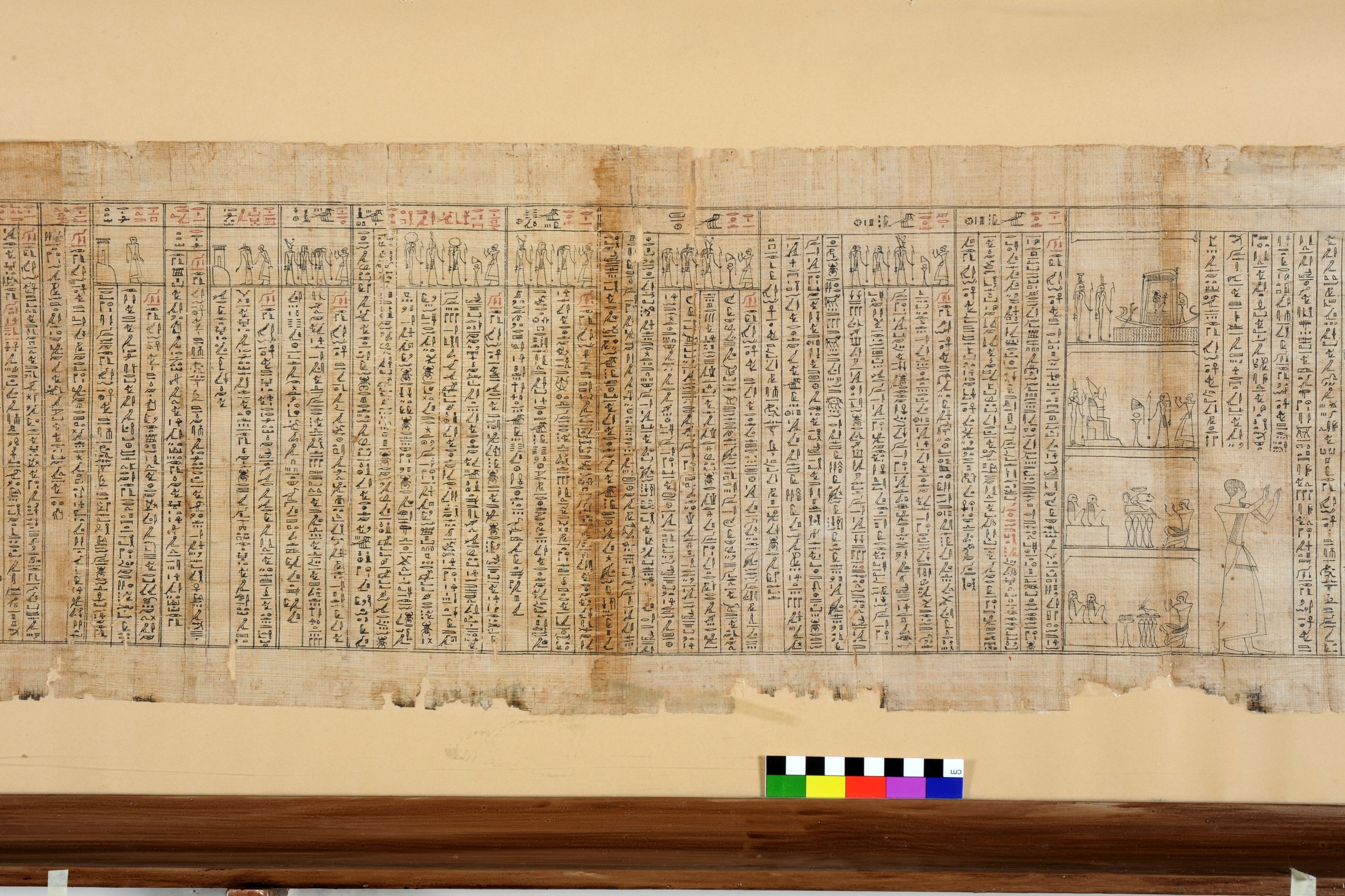
Turin 1791, Spell 110 (TLA Tb 110〈1〉, Tb 110〈2〉: columns 1-20; Lepsius 1842, pl. XL-XLII). Photograph 16 of 31 (Commons Book_of_the_Dead_of_Iuefankh,_papyrus_-_Museo_Egizio_Turin_C_1791_p019.jpg): its columns at 66-84% with a man adoring at their foot (Lepsius pl. XL), the vignette of the Field of Offerings in three registers at 12-65% (Lepsius pl. XLI), and its next columns with a second adoring man at 0-12%; it continues on photograph 17. Photograph 17 of 31 (Commons Book_of_the_Dead_of_Iuefankh,_papyrus_-_Museo_Egizio_Turin_C_1791_p018.jpg): its last columns at the right-hand edge (89-100%; Lepsius pl. XLII). Checked by eye: the photographs were matched to Lepsius's plates by their vignettes, red titles and framed compartments, and the overlapping edges of neighbouring photographs were compared.
1ḏd-mdw jn Wsjr […] mꜣꜥ-ḫrw nʾ,t wr〈.t〉 jy.n =j jm sjp =j bꜥḥ =j swḏꜣ =j Wꜣḫi̯ jnk kꜣ
2sqꜣi̯ m ḫsbḏ nb sḫ,t kꜣ md{,t}〈wi̯〉 Spd,t r nw =s ḏd-mdw jn Wsjr […] mꜣꜥ-ḫrw Wꜣḫi̯ jy.n =j
3jm m wnm šb{p},w sḫm =j m stp〈,t〉.pl m jḥ.pl ꜣpd.pl šms =j kꜣ.pl Wsjr […] mꜣꜥ-ḫrw ḏd =f Wt,t
4jy.n =j {n-}jm wnḫ =j ḥbs.pl ṯz.n =j sjꜣ,t Rꜥ,w js ẖnw p,t šms =j nṯr.pl šms =j Rꜥ,w jm,j p,t ḏd-mdw jn Wsjr […] mꜣꜥ-ḫrw
5Wsr,t r-tp ḥw,t jw msi̯.n =〈⸢j⸣〉 Ḥw ḏd-mdw jn Wsjr […] mꜣꜥ-ḫrw jt btj
6spꜣ,t nṯr jy.n =j jm =ṯ ḫsf =j ꜥ =f m fꜣi̯ n,t šms.n =j tp =ṯ Ḥn,wt-nb,t-ꜥb〈,w〉
7ḏd ⸢z⸣ sšmi̯.n =j ⸢mn〈w〉⸣ {n}m š.pl ḥr,j{t} jw rḏi̯.n =j jꜣ,w
8m sk,tt ꜣḫ =sn Wsjr […] mꜣꜥ-ḫrw ḫr nṯr-ꜥꜣ
9ꜥq m-ḥtp šzp wꜣ,t nfr.t r sḫ,t-ḥtp ḏd-mdw jn Wsjr […] mꜣꜥ-ḫrw wnn =j jm =s mj jm,j =s bꜥḥi̯ =j m mw =s wnm =j
10m tʾ =s sḫni̯ =j m tꜣ =s ḏꜣi̯ =j m dp,t-nṯr rḫ =j 〈nʾ〉,t.pl spꜣ,t.pl n,tj jm =s r skꜣ r jsḫ jt r zmꜣ ḏf〈ꜣ〉 =s rꜥ,w-nb jn Wsjr […] mꜣꜥ-ḫrw
11〈Wsjr〉 […] 〈mꜣꜥ-ḫrw〉 ḏd =f jti̯ Ḥr,w jn Swtj mꜣn,w r ⸢qd⸣ m sḫ,t-Ḥtp sfḫ =k Ḥr,w Swtj wn wꜣ,t pn!! m p,t jsk pn m ḏꜣi̯.t Ḥtp
12jnk šdi̯ s〈j〉 m ꜥ,t Šw ẖni̯ =j m š =s r nʾ,t.pl =s bḥn.n =j j〈ꜣ〉kb.pl r ꜥḥꜣ =sn wsr rʾ =j spd ꜣḫ,{t}〈w〉 =j nn sḫm =sn jm =j jw =j
13rḫ.kw š.pl nʾ,t.pl n〈,j.w〉 sḫ,t-ḥtp,t twj =〈j〉 jm =s wsr =j jm =s ꜣḫ =j jm =s wnwn =j jm =s skꜣ =j jm =s jsḫ =j jm =s n〈h〉p =j jm =s
14ẖni̯ =j jm =s m š.pl =s spr =j r nʾ,t.pl =s wnn =j m sḫ,t-ḥtp,t jy.n =j bꜣ =j m-ḫt =j ḥwj =〈j〉 tp-ꜥ,wj =j m nb-Tꜣ,du sštꜣ.n =〈j〉 ḥkꜣ =j
15sḫꜣ =j n smḫ.n =j jm =s ꜥnḫ.kw ḏi̯!.n =j ꜣw,t-jb ḥtp ḥtp.k〈w〉 šzp =j ṯꜣw wnn =j m-ḥtp m nb ṯꜣw jy.n =j jm
16wn n =j tp =j ꜥẖn.pl Rꜥ,w rs.n =j psḏ Ḥzꜣ,t
17jw =j m nʾ,t =j jnk jrr! mꜣꜥ,t nn jri̯ =j jzf,t
18jnk mnjw zp =f m tꜣ r-〈t〉j,du
19m drf.pl nb.pl n〈,j〉.w tꜣ ḏr ḫpr tꜣ ḥr wḏ,t
20n〈,j.t〉 […] šps
upper register, right to leftWsjr […] mꜣꜥ-ḫrw psḏ,t-ꜥꜣ,t ẖni̯.t m š Ḥtp Wsjr […] mꜣꜥ-ḫrw Wsjr […] mꜣꜥ-ḫrw Ḥtp nṯr-ꜥꜣ nb-p,t nṯr.pl ꜣḫ.pl,tj ⸢n⸣ ⸢nt{t}nt⸣ qnqn,t nʾ,t wr〈,t〉 wnn m Ḥtp m sḫ,t.pl n〈,j.t〉 ⸢ḫnt,j.t⸣
middle register, right to leftskꜣ p,t 〈r-〉ꜣw =f ⸢ds⸣ wꜣ〈ḫ〉i̯,t […] wꜣḏ-wr ḥtp ⸢ds⸣ rʾ n〈,j〉 ḥ〈ḏ〉,t jtr,w ḫꜣ m ꜣw =f nn ḏd wsḫ,t =f nn wnn rmi̯.w jm =f nn wnn jw.pl nb jm =f nn wnn ḥfj nb.t jm =f ḏi̯.t bꜥḥ Wsjr […] mꜣꜥ-ḫrw Ḥꜥpi̯ jti̯-nṯr,pl
lower register, right to lefts,t ꜣḫ.pl nṯr jm,j =s Rꜥ,w ꜣw =sn mḥ 7 bd,t mḥ 3 jn sꜥḥ〈.pl〉 jqr.w ꜣsḫ sn msḫn{ḫr} nṯr.pl ⸢tqf⸣ jm,j nšn 〈j〉ḫ,t mnḫ.t n〈,j〉 ⸢qmꜣ.pl⸣ sw Šw Tfnw,t Gbb jzhn p,t ⸢ḥdj⸣ drj nṯr jm,j =f Wnn-nfr,w ḏf〈ꜣ〉,w-wr,pl wjꜣ Rꜥ,w-Ḥr,w-ꜣḫ,tj ḫft ḏꜣi̯ =f r sḫ,t-jꜣl ḥtm,t n〈,t〉 smꜣj ḏf〈ꜣ〉,t wsr,t nḥ〈,t〉
CX. The going in Peace, and taking the good Path to the Fields of Heth [Peace, or Food].
Vignette. — Deceased praying.]
I am in it like the God who is in it, filled with its waters, eating of its bread, resting in its land. I go in the sacred boat. I know the places where to plough and mow the corn, to collect the harvest in it daily.
Horus in Manu is taken by Suti to build up the fields of Hetp. Oh Horus! Set catches thee. Open this road in the heaven, this is thy place in the boat of the Goddess Hetp. I am the one who made it in the house of Shu. I rowed from its pools to its lands. I have destroyed the grievers at their contention. My mouth is supplied, my spirit is sharpened. They do not prevail against me. I know the pools and lands of the fields of Hetp. I am in it. I prevail in it, I understand in it, hoeing and ploughing in it, mowing in it, sowing in it, rowing in its pools, approaching its lands. I am from the fields of Hetp, my Soul comes following me. Food is in my hands from the Lord of the Earth. My charms are secret. It has ordered that I am not in it. I live. I have had given joy and peace to me. I am at peace through the Lord of the Winds. I have come thence. I have opened my head, and seen the Sun. I have watched the setting light of the Cow. I am from my city. I have done truth, I have not done faults. I am he who is staying for awhile from all his earthly sports, when the earth was made by orders of the great. ..
Scent surrounded by the Celestial Nile.
Division I. Three lakes, called Ken km (Many Waters ;—Innumerable Waters), and the Great City of the Waters. Three mummied Gods, called “ the Gods of the Horizons.” An altar and a hawk, called Peace, the Great Lord of Heaven. Behind the Gods is “being in peace in the fields of Kant.” The deceased offering to the Soul Baicth. Three symbols of Lands." The deceased in his boat “ navigating in Peace.” The deceased offering to the Great Gods: three in number, cow -and serpent-headed wearing feathers. The deceased is followed by two others, and Thoth writing on a palette.
II. The deceased offering to Hapi or the Nile, and offering the Harvest. Three pools: Hetp, or Peace; An mer ut her (the Salt Lake of the Sea, or Bitter Lake); and another, Uat ha (Lengthy reeds). The deceased treading out the corn in the thrashing-floor. The chapter of the river 1000 miles long, of unknown breadth; there are no (rami) fish, no isles, and no snakes in it.' The deceased reaping the white and the red corn. The deceased sowing and ploughing.
III. Five pools: “ Corn,” User (Power), Hesemenaa (Strangler of waters), Sma (Smiter), A (Water). Two boats: one with a flight of steps, “the boat of the Sun, the Lord of the Horizons, when he goes to the fields of the Aahenru (Great food)." The throne boat. The God in it is Annefer. The Chambers of the Waters of Heaven," a bifurcate branch of the river. Here are placed in the upper division a pool, “the God in it is the Suu.” The Place of the Spirits, their length is 7 cubits, the ears of their corn 3 cubits, for the wise dead to mow them.” 2nd part above, a smaller branch of the river separating off the upper part; this is called “the Birthplace of the Gods, .... created things.” The... .... Shu, Tefnu, and Seb seated, and throne-
[Vignette. — Deceased adoring.]
Oh, great Land, I have come from thee. I have prepared, I have irrigated, I have .... the meadows. am the Bull painted [drawn] blue, the Lord of the Fields; the Bull called [by] Sothis at her time. Oh Ukhauaha [Meadow], I have come from thee eating, strengthened by the thighs of bulls, and by birds, I serve the Earth [Type]. Oh Utet [Green], I have come putting on my clothes! have put on me the woof of the
Sun when within the Heaven. I serve the Gods, I follow the Sun in Heaven. Oh Usert [Sustenance], at the head of the place where Hu has been born! Oh divine Land of Corn and Barley, I have come from thee! I have stopped my arm from working at my service in thee, who art called Ruler of Purity— Pure Mistress. I have passed and anchored from thy upper waters. I have given adoration from the cabin. They salute the Osiris.
Notes
- Birch's English was taken from three scans of Bunsen's Egypt's Place in Universal History, vol. V (1867), on the Internet Archive. The three OCR texts were aligned word by word and each word was settled by their agreement; running heads, page numbers, footnote markers and footnotes were removed. Some OCR errors may remain, chiefly in proper names.
- Birch uses the terms and name forms of his time: Hades, Aahlu (Elysium), Tum for Atum, Seb for Geb, Anup for Anubis, Phoenix or Bennu for the heron.
- Labels such as 'title line' or 'gate 1' before a line of the Egyptian translate the position labels of the TLA.
- The TLA has no hieroglyphic encoding for these texts, so only the transliteration is shown.
Cite
Sources
- Source: Papyrus of Iuefankh, Turin, Museo Egizio Cat. 1791 (Museo Egizio photographs, CC0) + TLA transliteration (ed. B. Backes, CC BY-SA 4.0) + English of Samuel Birch (1867, public domain) (holding institution)
- Critical edition: Thesaurus Linguae Aegyptiae, ed. Burkhard Backes (2018 data, AED-TEI)
← previous · → next · v cycle view · l back to library