Book of the Dead, Spell 133: Instructing the Dead to be in the Heart of the Sun, made on a ... (papyrus of Iuefankh)
Introduction
The Book of the Dead, in Egyptian the spells for going forth by day, is a collection of funerary spells written on papyrus rolls and placed in burials from the New Kingdom to the Roman period. Each roll was made for one person, with spells taken from a large repertoire and illustrated with drawings (vignettes). This library gives one complete roll: the papyrus of Iuefankh in the Museo Egizio, Turin (Cat. 1791), written in the Ptolemaic period (332-30 BCE) and coming from Thebes. Richard Lepsius published it in 1842 and divided it into 165 chapters; his numbering is still the standard numbering of the spells, and it is used here.
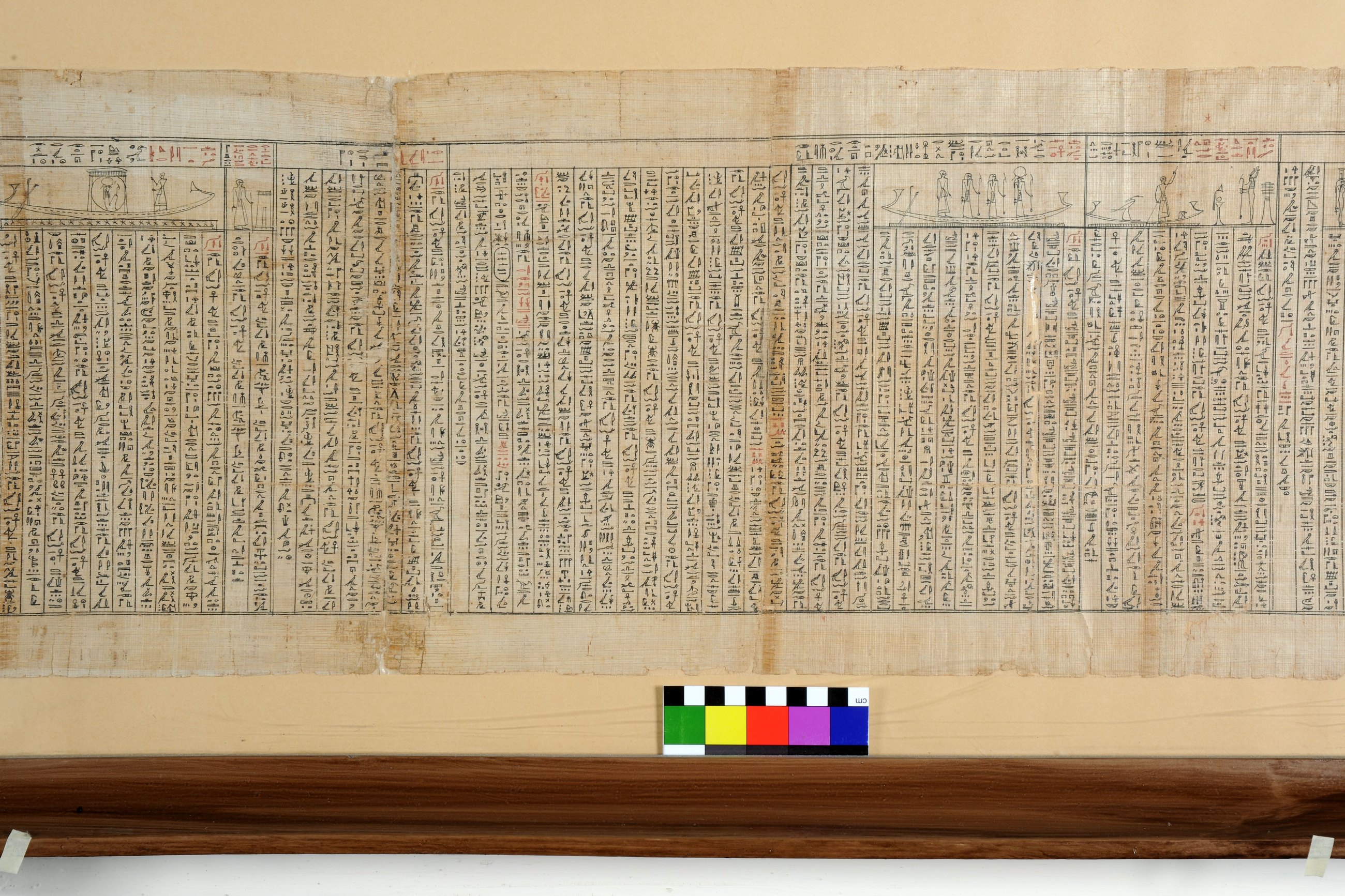
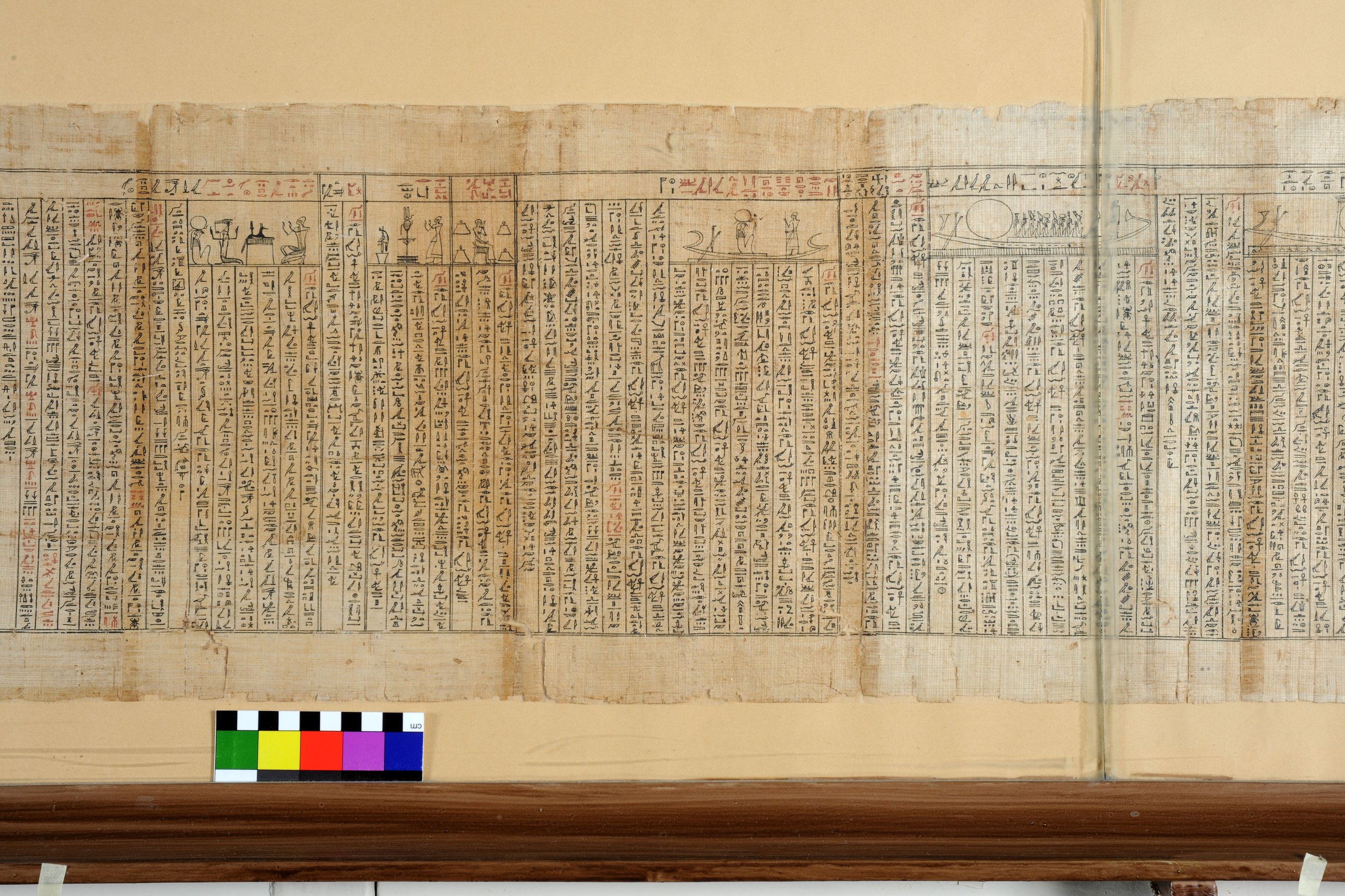
Spell 133 (Birch: 'The book of Instructing the Dead to be in the Heart of the Sun, made on a Day of the Month.') is on Lepsius's plates LIV-LV and on photographs 21, 22 of the 31 Museo Egizio photographs of the roll.
The Egyptian is the transliteration of the Thesaurus Linguae Aegyptiae (edition by Burkhard Backes), with the column number of the spell before each column; the numbers are those of Lepsius's plates. On the papyrus the text runs in vertical columns of cursive hieroglyphs from right to left along the roll; titles and some words are written in red. Signs restored by the editor are in square brackets, signs the scribe left out in angle brackets, superfluous signs in braces and damaged signs in half brackets. The English is the translation by Samuel Birch, published in 1867 and made from Lepsius's copy of this papyrus, so the English and the Egyptian come from the same manuscript. It was the first complete English translation of the Book of the Dead; many passages are now understood differently. Birch's own square brackets give his alternatives and explanations. The photographs are by the Museo Egizio; each shows a stretch of the roll, and the note of each section says where the spell stands on it.
How was this verified? (Provenance)
Where on the image
Turin 1791, Spell 133 (TLA Tb 133: title line, columns 1-14; Lepsius 1842, pl. LIV-LV). Photograph 21 of 31 (Commons Book_of_the_Dead_of_Iuefankh,_papyrus_-_Museo_Egizio_Turin_C_1791_p014.jpg): the boat with the shrine at 0-16% (Lepsius pl. LIV); it continues on photograph 22. Photograph 22 of 31 (Commons Book_of_the_Dead_of_Iuefankh,_papyrus_-_Museo_Egizio_Turin_C_1791_p013.jpg): the rest of its boat vignette and its columns at 86-100%. Checked by eye: the photographs were matched to Lepsius's plates by their vignettes, red titles and framed compartments, and the overlapping edges of neighbouring photographs were compared.
titlemḏꜣ,t n.t sjqr ꜣḫ,w ḥr jb n Rꜥ,w jri̯.t n hrw ꜣbd
1ḏd-mdw jn Wsjr […] mꜣꜥ-ḫrw ḫꜥi̯ Rꜥ,w m ꜣḫ,t =f psḏ,t =f m-ḫt =f m pri̯ nṯr jm s,t jmn.t ḫr sdꜣdꜣ
2m ꜣḫ,t jꜣb,t〈j〉.t n.t p,t ḥr ḫrw ꜣs,t sḏsr.n =s wꜣ,t n Rꜥ,w tp〈,j〉-ꜥ wr pẖr〈.w〉 ṯzi̯ ṯw jr =k Rꜥ,w jm,j-kꜣ{r}j =f nsb.w =k ṯꜣw.pl
3ꜥm =k mḥ〈y〉,t.pl ꜥm =k bsk ⸢bjb⸣ ⸢ḫnt-jb⸣ =k hrw n ⸢ḫnti̯⸣ =k mꜣꜥ,t psš =k šms,w nꜥi̯.y wjꜣ nn,t wḥm m wḥm wr.pl
4ḥr ḫrw =k jp =k qs.pl =k sꜣq =k ꜥ,t.pl =k ḏi̯! =k ḥr =k r jmn,tt nfr.t jwi̯ jm-mꜣw,t rꜥ,w-nb ṯwt js twt pw n nbw ẖr,j zmꜣ,pl
5n jtn m p,t ẖr sdꜣdꜣ pẖr 〈m-〉mꜣw,t rꜥ,w-nb j ḥꜥꜥ! ꜣḫ,t hy m nwḥ.pl =k nṯr.pl jm,j.w-p,t mꜣꜣ.w Wsjr
6[…] mꜣꜥ-ḫrw ḏi̯ =ṯn n =f jꜣ,w mj Rꜥ,w ntf wr ḏꜥr wrr,t hrw sjp dbḥ,pl =s Wsjr pwy wꜥ,w wḏꜣ
7zp m ẖ,t twy tp〈,j〉.t n.t jm,j.w-bꜣḥ Rꜥ,w zp-2 Wsjr […] mꜣꜥ-ḫrw m wḏꜣ rʾ ḥr-tp tꜣ m ẖr,t-nṯr Wsjr […] mꜣꜥ-ḫrw wḏꜣ〈.w〉 mj Rꜥ,w
8〈rꜥ,w-〉nb ḥjp Wsjr […] mꜣꜥ-ḫrw nn wrḏ.n =f m tꜣ pn ḏ,t nfr ,wj mꜣꜣ m jr,t.du sḏm m msḏr.du mꜣꜥ.t zp-2 Wsjr […] mꜣꜥ-ḫrw ḥꜣw zp-2 m
9Jwn,w jw =f m Rꜥ,w ḏsr ḥjp.t m šms nw,w nn ḏd.n =f mꜣꜣ.n =f nn wḥm.n =f sḏm.n =f m pr,w štꜣ-ḥr hy hnw n Wsjr
10[…] mꜣꜥ-ḫrw ḥꜥ-nṯr n Rꜥ,w m wjꜣ =k m ḏꜣi̯.t nw,w mj sḥtp kꜣ n nṯr n mri̯.y =f Wsjr […] mꜣꜥ-ḫrw bjk ꜥꜣ ḫpr,w.pl
11ḏd-mdw ḥr wjꜣ mḥ 4 m ꜣw,t =f ⸢ḥsb.w⸣ m wꜣḏ m ḏꜣḏꜣ,t jri̯.t nw,t ẖr{,t} =f n.t sbꜣ.pl swꜥb〈.w〉 twr.tw m ḥzmn snṯr js jri̯.n =k twt n Rꜥ,w ḥr mḥ,t
12n-mꜣw zẖꜣ m ztj rḏi̯〈.w〉 m wjꜣ pn js jri̯.n =k twt n ꜣḫ,w pn mri̯.y =k m wjꜣ pn sqdd! =f m wjꜣ-n-Rꜥ,w mꜣꜣ sw Rꜥ,w jm =f ḏs =f jmi̯ =k jri̯ s〈j〉
13n ḥr-nb nb!! wp,w〈-ḥr〉 ḥꜥ =k ḏs =k m jti̯ =k m zꜣ =k zꜣw ṯw wr,tj sjqr ꜣḫ.w ḥr jb n Rꜥ,w rḏi̯.t sḫm =f ḫr psḏ,t wnn.ḫr mꜣꜣ sw nṯr.pl mj wꜥ,w jm =sn
14mꜣꜣ sw mt.pl ḥr ḥr =sn mꜣꜣ.tw m ẖr,t-nṯr mj ḥjp n Rꜥ,w
CXXXIII. The book of Instructing the Dead to be in the Heart of the Sun, made on a Day of the Month.
[Vignette. — Deceased paddling the Sun in the Ark of hU Boat.]
The Sun rises from his horizon, his Gods are behind him. When he comes forth from the Amenti, the despisers [?] fall down in the eastern horizon of the heaven at the words of Isis. She has prepared the path of the Sun, the great chief.
Thou mayest approach, borne, oh Sun in his chest. Thou snuffest the winds, thou swallowest the North wind, thou eatest the heart, thou exhalest thy heart, the day when thou inhalest that truth. Thou stretchest thy servants who bring the boat in heaven — perceiving as the perceivers of thy word. Thou preparest thy bones, foldest thy hands, thou placest thy face to the happy West, coming there [thou art] seen daily. Thy figure then is a figure of gold, having the circle of a disk in heaven, having the form of a circle, [?] seen daily.
Oh rejoicing in the horizon, hailing from thy ropes; oh Gods in the heaven, beholding the Osiris! give ye glory to him as to the Sun. He is the chief, requiring the crown the day of making its prayers [or wreaths]. He is the Osiris, the only one ever coming from the body, the head of those who belong to the race of the Sun.
The Osiris is as well spoken [?] on earth as in Hades, the Osiris goeth forth, like the Sun, lord of the paddle. The Osiris has never been set to rest in this land for ever. Beautiful is what he sees with his eyes and hears with his ears. True, true is the Osiris ... in Annu [Heliopolis]. He is like the Sun, distributing the boatmen to serve Nuher. He has not been spoken of, seen, perceived, or heard in the mystical house of Cross-head [or Fire-face]. The adorations of the Osiris, hail, divine limbs of the Sun, traversing the firmament in thy boat, when that God has assumed the type he likes[?] the hawk, greatest of transformations. Said of a boat four cubits long, painted in green, with its accompaniments. Make the heaven below it with stars, wash and steep it in natron and incense. When thou hast made the figure of the Sun on a piece of papyrus painted in yellow, place it in the boat. When thou hast made that deceased where thou wishest in that boat, he is towed in the boat of the Sun. The Sun himself sees him in it. Do not let any one see it except thyself; or thy father or thy son. Having kept it well, prepare the dead, the delight of the Sun. It makes him prevail as the Gods, for the Gods look upon him as one of themselves, the dead fall on their faces when they see him. He is seen in Hades as the boatman of the Sun.
Notes
- Birch's English was taken from three scans of Bunsen's Egypt's Place in Universal History, vol. V (1867), on the Internet Archive. The three OCR texts were aligned word by word and each word was settled by their agreement; running heads, page numbers, footnote markers and footnotes were removed. Some OCR errors may remain, chiefly in proper names.
- Birch uses the terms and name forms of his time: Hades, Aahlu (Elysium), Tum for Atum, Seb for Geb, Anup for Anubis, Phoenix or Bennu for the heron.
- Labels such as 'title line' or 'gate 1' before a line of the Egyptian translate the position labels of the TLA.
- The TLA has no hieroglyphic encoding for these texts, so only the transliteration is shown.
Cite
Sources
- Source: Papyrus of Iuefankh, Turin, Museo Egizio Cat. 1791 (Museo Egizio photographs, CC0) + TLA transliteration (ed. B. Backes, CC BY-SA 4.0) + English of Samuel Birch (1867, public domain) (holding institution)
- Critical edition: Thesaurus Linguae Aegyptiae, ed. Burkhard Backes (2018 data, AED-TEI)
← previous · → next · v cycle view · l back to library