Book of the Dead, Spell 134: Adoration to the Sun; the Day of the Month of going in the Bark (papyrus of Iuefankh)
Introduction
The Book of the Dead, in Egyptian the spells for going forth by day, is a collection of funerary spells written on papyrus rolls and placed in burials from the New Kingdom to the Roman period. Each roll was made for one person, with spells taken from a large repertoire and illustrated with drawings (vignettes). This library gives one complete roll: the papyrus of Iuefankh in the Museo Egizio, Turin (Cat. 1791), written in the Ptolemaic period (332-30 BCE) and coming from Thebes. Richard Lepsius published it in 1842 and divided it into 165 chapters; his numbering is still the standard numbering of the spells, and it is used here.
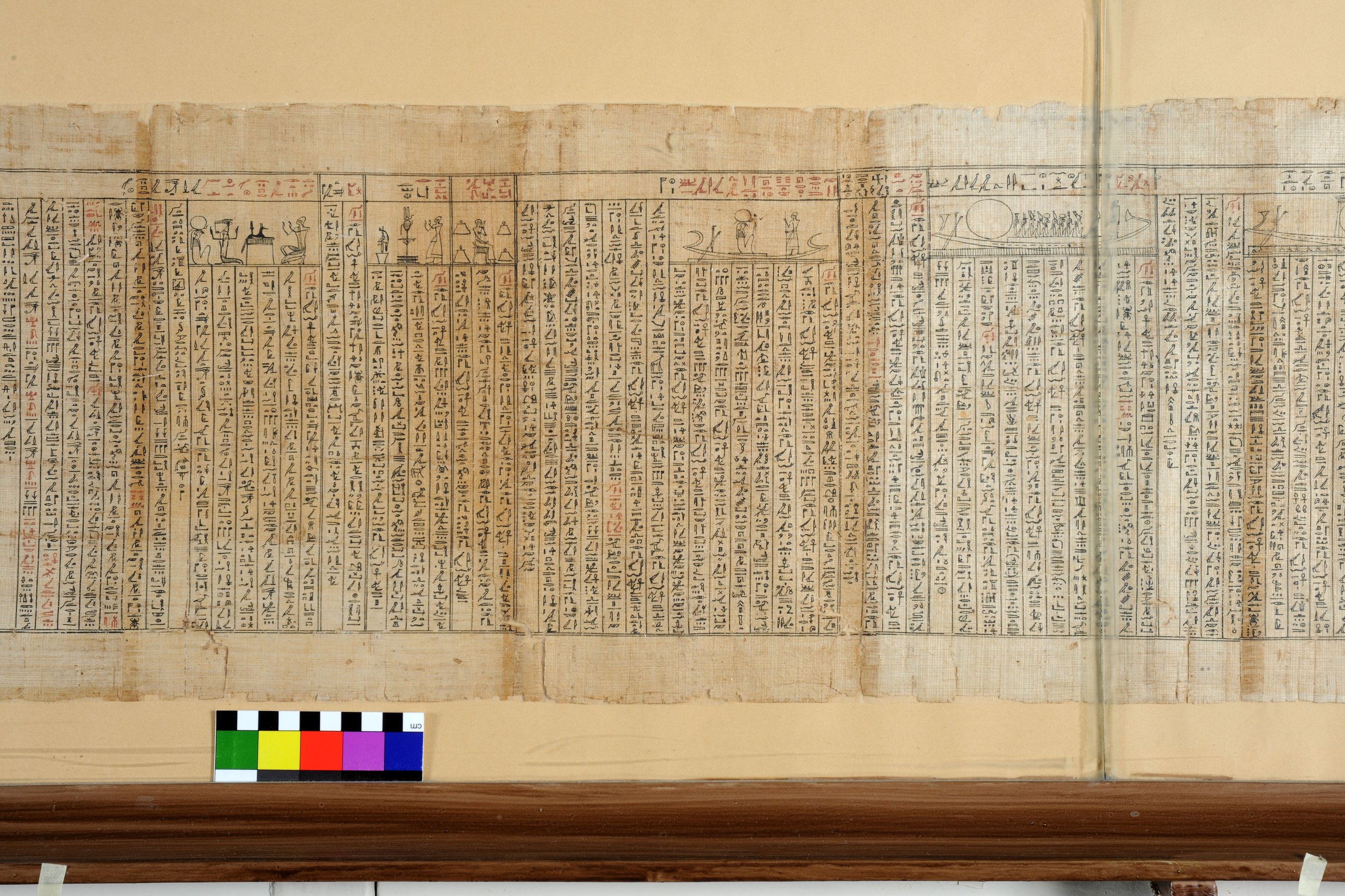
Spell 134 (Birch: 'The Adoration to the Sun; the Day of the Month of going in the Bark.') is on Lepsius's plate LV and on photograph 22 of the 31 Museo Egizio photographs of the roll.
The Egyptian is the transliteration of the Thesaurus Linguae Aegyptiae (edition by Burkhard Backes), with the column number of the spell before each column; the numbers are those of Lepsius's plates. On the papyrus the text runs in vertical columns of cursive hieroglyphs from right to left along the roll; titles and some words are written in red. Signs restored by the editor are in square brackets, signs the scribe left out in angle brackets, superfluous signs in braces and damaged signs in half brackets. The English is the translation by Samuel Birch, published in 1867 and made from Lepsius's copy of this papyrus, so the English and the Egyptian come from the same manuscript. It was the first complete English translation of the Book of the Dead; many passages are now understood differently. Birch's own square brackets give his alternatives and explanations. The photographs are by the Museo Egizio; each shows a stretch of the roll, and the note of each section says where the spell stands on it.
How was this verified? (Provenance)
Where on the image
Turin 1791, Spell 134 (TLA Tb 134: title line, columns 1-10; Lepsius 1842, pl. LV). Photograph 22 of 31 (Commons Book_of_the_Dead_of_Iuefankh,_papyrus_-_Museo_Egizio_Turin_C_1791_p013.jpg): the boat with the disc and the row of gods at 69-80% (Lepsius pl. LV). Checked by eye: the photographs were matched to Lepsius's plates by their vignettes, red titles and framed compartments, and the overlapping edges of neighbouring photographs were compared.
titledwꜣ Rꜥ,w ⸢hr⸣w n ꜣbd nꜥi̯.y m wjꜣ
1ḏd-mdw jn Wsjr […] mꜣꜥ-ḫrw j:nḏ-ḥr =k Rꜥ,w ḥr〈,j〉-jb kꜣ{r}j =f wbn m wbn psḏ m psḏ ḏdḥ.w z ḥḥ.pl r mr〈,wt〉 =f ḏḏ!
2ḥr =f n ḥnmm〈,t〉 Ḫprj ḥr〈,j〉-jb wjꜣ =f sḫr =f ꜥꜣpp rꜥ,w-nb jn ms.w Gbb sḫr ḫfti̯.pl n.w Wsjr ḫmḫm =sn m
3wjꜣ-n-Rꜥ,w šꜥd Ḥr,w tp.pl =sn r p,t m ꜣpd.pl ḫpi̯{.tw} =sn r tꜣ m ꜥr.pl r mw m rm.pl ḏꜣ nb ḏꜣ,t nb〈.t〉 ḫmi̯ =sn
4Wsjr […] mꜣꜥ-ḫrw h〈ꜣi̯〉 =sn m p,t h〈ꜣi̯〉 =sn m tꜣ jwi̯ =sn ḥr mw šꜣjs =sn m-ꜥb sbꜣ.pl ḥsq st Ḏḥwtj
5jnr m jtr,tj gr.pl jdi̯.pl n Wsjr […] mꜣꜥ-ḫrw Rꜥ,w js pw nṯr pn wr šꜥd ꜥꜣ šf〈y〉,t wꜥb =f m znf =ṯn bꜥbꜥ =f
6m dšr〈,w〉 =ṯn ḫmḫm.y =sn Wsjr […] mꜣꜥ-ḫrw wjꜣ n jti̯ =f Rꜥ,w Ḥr,w pw Wsjr […] mꜣꜥ-ḫrw msi̯ sw mw,t =f ꜣs,t rnn sw
7Nb,t-ḥw,t mj jri̯.t =sn n Ḥr,w ḫsf zm〈ꜣ〉,y〈t〉 Stš mꜣꜣ =sn wrr〈,t〉 mn.tw m ḥꜣ,t =f ḫr =sn ḥr ḥr =sn mꜣꜥ-ḫrw Wsjr-Wnn-nfr,w mꜣꜥ-ḫrw r ḫfti̯.pl =f m p,t m tꜣ
8m ḏꜣḏꜣ,t n.t nṯr nb nṯr,t nb〈.t〉 ḏd-mdw ḥr bjk m wjꜣ ḥḏ,t m tp =f twt n Jtm,w Šw Tfnw,t Gbb Nw,t Wsjr Ḥr,w ꜣs,t Nb,t-ḥw,t zẖꜣ.pl m ztj ḥr
9mḥ,t n-mꜣwj rḏi̯〈.w〉 m wjꜣ pn ḥnꜥ twt n ꜣḫ pn ḏ,t =f m ꜥš mrḥ.w m mrḥ〈,t〉 n.t ḥꜥ-nṯr m ḥkn,jw rḏi̯〈.w〉 r pḥ,tw
10nn n nṯr.pl wdn n =sn snṯr ḥr sḏ,t ꜣpd.pl ꜣšr.pl dwꜣ Rꜥ,w pw m wnn mꜣꜥ{,t} m šs-mꜣꜥ{.t} ḥḥ n zp
CXXXIV. The Adoration to the Sun; the Day of the Month of going in the Bark.
[Vignette —Deceased adoring the Boat of the Sun, in which are the Hawk of Haroeris, Tum, Shu,
Tefnu, An, Khona, Osiris, Horus, Isis, and Nephthys.]
Hail, oh thou Sun in his ark shining with his light, gleaming with his gleam! detaining millions at his wish, placed in the face of those who see; the Creator in the midst of his boat, who smiteth the Apophis daily, say for the children of Seb, who smiteth the enemies of Osiris, they are crushed by the boat. Horus smites off their heads to the heaven (as) for the fowls, their thighs to the earth for wild beasts, to the waters for the fishes. The Osiris crushes all evil Spirits, male or female, whether they go from heaven or earth, come out of the waters or cross from the tips of the stars. Thoth cuts them up, — a stone out of the buildings of those who possess the ark of Osiris [?]. The Sun is that Great God, the greatest of smiters, the most powerful of terrifiers, he washes in your blood, he dips in your gore. For the Osiris crushes them in the boat of his father the Sun. Horus is the Osiris. His mother Isis produced him, Nephthys nursed him, likewise they made the conspirators of Set to turn back for Horus. When they see the crown placed before him they fall down on their faces. Osiris Onnophris has made his justification against his enemies in heaven, on earth, amongst the chief of the Gods and Goddesses. Said over a hawk in the boat with a crown on its head, and the figures of Tum, Mau, Tefnu, Seb, Nupe, Osiris and Horus, Isis and Nephthys, painted yellow upon a piece of papyrus. Placed in this boat is the figure of the deceased, his body of cedar; wax the limbs of the God with wax; bring unguents. Place behind it these gods; offer to them burning incense, fowls and food. Adoring the Sun he is true, in real linen, millions of times.
Notes
- Birch's English was taken from three scans of Bunsen's Egypt's Place in Universal History, vol. V (1867), on the Internet Archive. The three OCR texts were aligned word by word and each word was settled by their agreement; running heads, page numbers, footnote markers and footnotes were removed. Some OCR errors may remain, chiefly in proper names.
- Birch uses the terms and name forms of his time: Hades, Aahlu (Elysium), Tum for Atum, Seb for Geb, Anup for Anubis, Phoenix or Bennu for the heron.
- Labels such as 'title line' or 'gate 1' before a line of the Egyptian translate the position labels of the TLA.
- The TLA has no hieroglyphic encoding for these texts, so only the transliteration is shown.
Cite
Sources
- Source: Papyrus of Iuefankh, Turin, Museo Egizio Cat. 1791 (Museo Egizio photographs, CC0) + TLA transliteration (ed. B. Backes, CC BY-SA 4.0) + English of Samuel Birch (1867, public domain) (holding institution)
- Critical edition: Thesaurus Linguae Aegyptiae, ed. Burkhard Backes (2018 data, AED-TEI)
← previous · → next · v cycle view · l back to library