Book of the Dead, Spell 136: Another chapter, made on the sixth Day of the Month, the Day of being ... (papyrus of Iuefankh)
Introduction
The Book of the Dead, in Egyptian the spells for going forth by day, is a collection of funerary spells written on papyrus rolls and placed in burials from the New Kingdom to the Roman period. Each roll was made for one person, with spells taken from a large repertoire and illustrated with drawings (vignettes). This library gives one complete roll: the papyrus of Iuefankh in the Museo Egizio, Turin (Cat. 1791), written in the Ptolemaic period (332-30 BCE) and coming from Thebes. Richard Lepsius published it in 1842 and divided it into 165 chapters; his numbering is still the standard numbering of the spells, and it is used here.
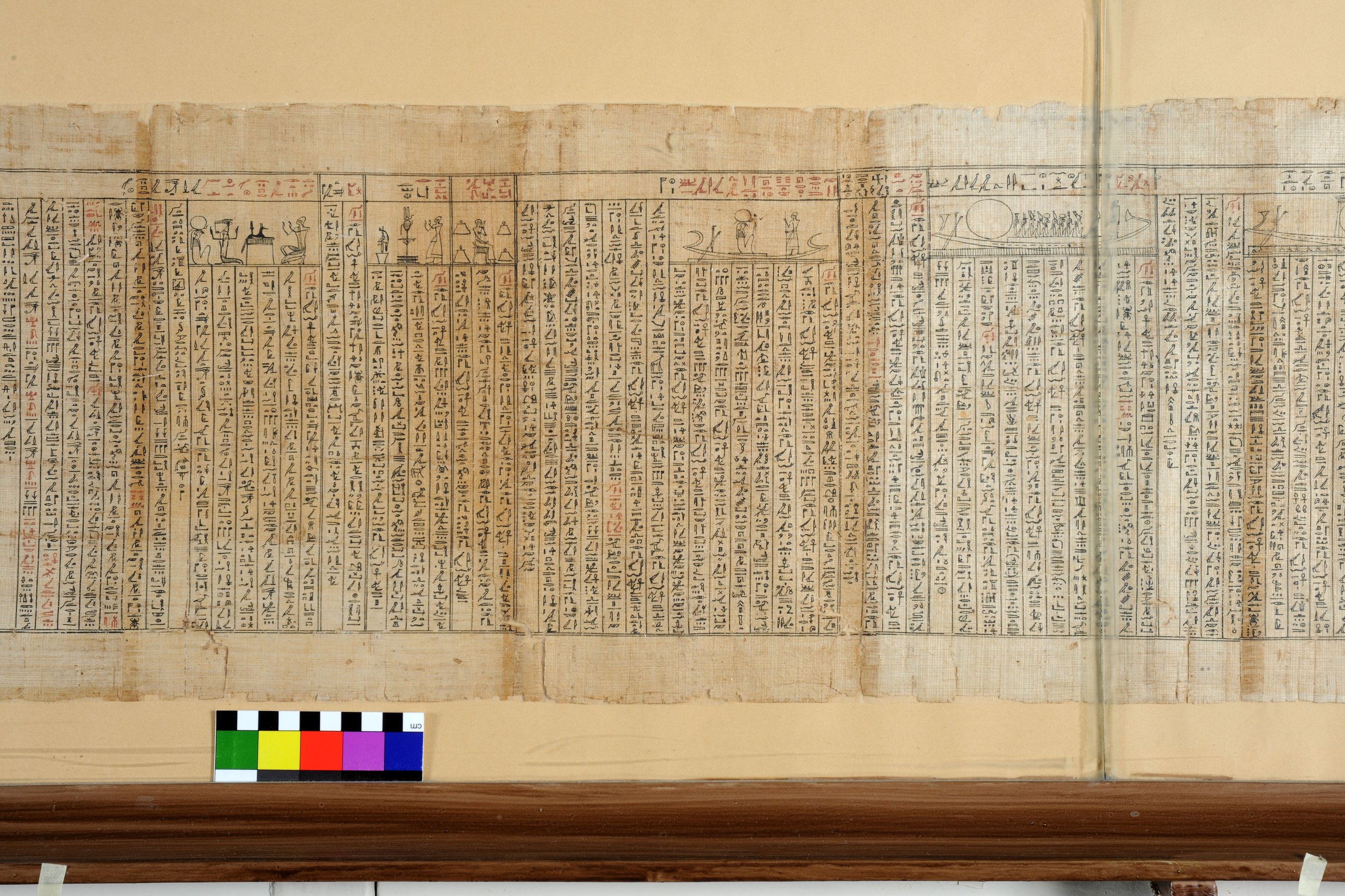
Spell 136 (Birch: 'Another chapter, made on the sixth Day of the Month, the Day of being conducted in the Boat of the Sun.') is on Lepsius's plate LVI and on photograph 22 of the 31 Museo Egizio photographs of the roll.
The Egyptian is the transliteration of the Thesaurus Linguae Aegyptiae (edition by Burkhard Backes), with the column number of the spell before each column; the numbers are those of Lepsius's plates. On the papyrus the text runs in vertical columns of cursive hieroglyphs from right to left along the roll; titles and some words are written in red. Signs restored by the editor are in square brackets, signs the scribe left out in angle brackets, superfluous signs in braces and damaged signs in half brackets. The English is the translation by Samuel Birch, published in 1867 and made from Lepsius's copy of this papyrus, so the English and the Egyptian come from the same manuscript. It was the first complete English translation of the Book of the Dead; many passages are now understood differently. Birch's own square brackets give his alternatives and explanations. The photographs are by the Museo Egizio; each shows a stretch of the roll, and the note of each section says where the spell stands on it.
How was this verified? (Provenance)
Where on the image
Turin 1791, Spell 136 (TLA Tb 136: title line, columns 1-15; Lepsius 1842, pl. LVI). Photograph 22 of 31 (Commons Book_of_the_Dead_of_Iuefankh,_papyrus_-_Museo_Egizio_Turin_C_1791_p013.jpg): the boat with the sun-headed god under a red title at 49-62% (Lepsius pl. LVI). Checked by eye: the photographs were matched to Lepsius's plates by their vignettes, red titles and framed compartments, and the overlapping edges of neighbouring photographs were compared.
titleky jri̯.pl m hrw snw,t n hrw sqd,〈w〉t m wjꜣ-n-Rꜥ,w
1ḏd-mdw jn Wsjr […] mꜣꜥ-ḫrw m =k jrf ḫꜣ-bꜣ≡s m Jwn,w ḥnmm〈,t〉 m H̱r,j-ꜥḥꜣ ms,yt{j} ꜥrq sšd =f nḏri̯.w dp,w
2wḏꜥ-md,t Wsjr […] mꜣꜥ-ḫrw ḥnꜥ =sn r sštꜣ n,tj m qr.w,t nṯr.pl šdi̯ Wsjr […] mꜣꜥ-ḫrw wjꜣ j{w}〈m〉 =f n ḫꜣ r tp.w =f
3pri̯〈.w〉 jm =f r p,t sqdi̯ =sn jm =f ḥnꜥ Rꜥ,w sqdi̯ Wsjr […] mꜣꜥ-ḫrw jm =f ⸢gꜣw,t⸣ ḫsf-ꜥ wꜣw wꜥr,t twy
4n〈.t〉 Nw,t r rwd pwy n Sbg jw Gbb Nw,t jb =sn nḏm〈.w〉 wḥm rn mꜣwj rnpi̯ wnn nfr,pl Rꜥ,w m ꜣḫ,pl =f wnn.t =f
5m ḏd.n =f twt r bꜥḥ wr jti̯ nṯr.pl {z}〈n〉šnj dp n bjnr ḥr〈,j〉-jb jw,tj ḫmi̯.tw =f nb hmhm m nhz ḥp,t
6psḏ,t wꜣš.tw bꜣ.tw spd.tw r nṯr.pl nḥm =k Wsjr […] mꜣꜥ-ḫrw m-ꜥ jri̯.tj〈=f〉 r =f bḥn ḏꜣ pfj jm =f qn jb =f ḏi̯ =k
7wsr Wsjr […] mꜣꜥ-ḫrw r nṯr.pl ꜣḫ.w mt.pl nb Wsjr […] mꜣꜥ-ḫrw wsr nb wsr.pl ntf nb-mꜣꜥ〈,t〉 jri̯ wḏ,t mk,t =f
8mk,t Rꜥ,w m p,t ḏi̯ =k swꜣ Wsjr […] mꜣꜥ-ḫrw ḥr wjꜣ =k Rꜥ,w m-ḥtp jri̯ wꜣ,t =f sqdi̯ wjꜣ =k mk,t =f mk,t =k ntf ḫsf
9ꜣd,tj ḥr Rꜥ,w rꜥ,w-nb jy.n =f mj Ḥr,w ḏsr ꜣḫ,t sr.n =f Rꜥ,w ḥr ꜥr.w,t ꜣḫ,t ḥꜥi̯ n =f nṯr.pl m ḫsf =f jw ꜥꜣ Ḏḥwtj 〈n〉 Wsjr […] mꜣꜥ-ḫrw nn pḥ
10sw nbd nn ḫmi̯ sw jr,j.pl ꜥr.w,t =sn Wsjr […] mꜣꜥ-ḫrw štꜣ-ḥr m-ẖnw ꜥḥ,t ḥr,j ḫm Wsjr […] mꜣꜥ-ḫrw zbi̯ md,t
11n Rꜥ,w jy.n =f smjw.n =f wp〈w,t〉 n nb =s ntf wsr jb pn wdn ꜣ,t m jri̯.ypl ḥtp ḏd-mdw jn z ḥr twt n ꜣḫ,w rḏi̯〈.w〉 m wjꜣ pn jsk
12wꜥb.tw twr.tw ḥr rḏi̯〈.t〉 snṯr ḥr sḏ,t m-bꜣḥ Rꜥ,w tʾ ḥ〈n〉q〈,t〉 jwf ꜣpd.pl sqdi̯.t p{n}〈w〉 m wjꜣ-n-Rꜥ,w jr ꜣḫ,w jri̯ =tw n =f nn jw =f m-m ꜥnḫ,w nn ski̯ =f
13ḏ,t wnn =f m nṯr ḏsr nn ḫmi̯ sw 〈j〉ḫ,t-nb〈,t〉 ḏw〈.t〉 wnn =f m ꜣḫ,w mnḫ m jmn,tt nn mt =f m-wḥm jw =f wnm =f zjw =f ḥnꜥ Wsjr rꜥ,w-nb jw
14sṯꜣ.tw =f ḥnꜥ nsw,t.ypl-bj,tj.pl jw =f sjw =f mw ḥr ḥbb,t n.t jtr,w jw =f jri̯ =f nḏmnḏm wnn =f ḥr pri̯〈.t〉 m hrw mj Ḥr,w
15jw =f ꜥnḫ =f wnn =f mj nṯr dwꜣ.tw =f jn ꜥnḫ,w mj Rꜥ,w ꜥḥꜣ ṯw ḥr =k wr zp-2 jmi̯ =k jri̯.t n r〈m〉{r}〈ṯ〉-nb wp-ḥr =k ḏs =k
CXXXVI. Another chapter, made on the sixth Day of the Month, the Day of being conducted in the Boat of the Sun.
Vignette. Deceased paddling the Sun.)
The Shades in Annu [Heliopolis], the beings of light in Kar protect him. Mesta weaves his clothes, she fashions the blade [?]. The Osiris disputes with them at the recesses which are in the halls of the Gods. The Osiris penetrates in the boat, he has ... his chiefs when he came out of it to the heaven. They tow him along with the Sun; the Osiris is towed in it by the ropemen, stopping the dissolution of the leg of the Firmament at the growth of the weak. (?)Seb and Nu are delighted in their hearts, repeating the name; Growing light, the beauty of the Sun in its light, is, in its being an image, as it is said, for the Great Inundater, the father of the Gods, the suppliers of delicious taste in the heart. He is unbroken, a Lord crying out when the Gods raise the paddle, adored, praised, prepared against [for] the Gods. Save thou the Osiris from the attack made against him at that crossing. His heart fails. Give thou the Osiris support against Gods, Spirits, and the dead. The Osiris prevails as Lord of the powerful. He is the Lord of Truth, he has done what has been ordered. His actions are the actions of the Sun in Heaven. Let him cross in thy boat, oh Sun! in peace. He makes way, he tows thy boat, his actions are thy actions. He it is who stops the annihilator of the Sun daily. He has come like Horus, preserver of the horizon. He has put aside the Sun in the corner halls of the horizon. He has rejoiced the Gods by his stopping. Great are Thoth and the Osiris. Snares have not taken him; those who guard their halls have not smashed him. The Osiris is a hidden face within the hall and over the shrine. The Osiris passing words to the Sun, he has come, he has been introduced, thou hast prepared his terror. He is making this heart prevail, constantly offering and making peace.
Said of a person in the form of a Spirit placed in that boat. Then, having washed and steeped it, place burning incense before the Sun, bread and drink, flesh and geese; that passage takes place in the boat of the Sun. If the Spirit has been thus treated, he will be among the living, he does not decay for ever, he is as an immortal God, no evil thing injures him. He is as a Spirit created in the West. He never dies again. He has eaten and drunk with Osiris daily. He has been towed with (or by) the kings, he has drunk out of the streams of the river, he makes it his delight that he comes out at the day like Horus. He has lived and is like a God, he has been adored, [said] by the living like the Sun, he has contended for thee much. Do not let any one see it except thyself.
Notes
- Birch's English was taken from three scans of Bunsen's Egypt's Place in Universal History, vol. V (1867), on the Internet Archive. The three OCR texts were aligned word by word and each word was settled by their agreement; running heads, page numbers, footnote markers and footnotes were removed. Some OCR errors may remain, chiefly in proper names.
- Birch uses the terms and name forms of his time: Hades, Aahlu (Elysium), Tum for Atum, Seb for Geb, Anup for Anubis, Phoenix or Bennu for the heron.
- Labels such as 'title line' or 'gate 1' before a line of the Egyptian translate the position labels of the TLA.
- The TLA has no hieroglyphic encoding for these texts, so only the transliteration is shown.
Cite
Sources
- Source: Papyrus of Iuefankh, Turin, Museo Egizio Cat. 1791 (Museo Egizio photographs, CC0) + TLA transliteration (ed. B. Backes, CC BY-SA 4.0) + English of Samuel Birch (1867, public domain) (holding institution)
- Critical edition: Thesaurus Linguae Aegyptiae, ed. Burkhard Backes (2018 data, AED-TEI)
← previous · → next · v cycle view · l back to library