Book of the Dead, Spell 135: Another Chapter, said when the Moon is young in the (papyrus of Iuefankh)
Introduction
The Book of the Dead, in Egyptian the spells for going forth by day, is a collection of funerary spells written on papyrus rolls and placed in burials from the New Kingdom to the Roman period. Each roll was made for one person, with spells taken from a large repertoire and illustrated with drawings (vignettes). This library gives one complete roll: the papyrus of Iuefankh in the Museo Egizio, Turin (Cat. 1791), written in the Ptolemaic period (332-30 BCE) and coming from Thebes. Richard Lepsius published it in 1842 and divided it into 165 chapters; his numbering is still the standard numbering of the spells, and it is used here.
Spell 135 (Birch: 'Another Chapter, said when the Moon is young in the') is on Lepsius's plate LV and on photograph 22 of the 31 Museo Egizio photographs of the roll.
The Egyptian is the transliteration of the Thesaurus Linguae Aegyptiae (edition by Burkhard Backes), with the column number of the spell before each column; the numbers are those of Lepsius's plates. On the papyrus the text runs in vertical columns of cursive hieroglyphs from right to left along the roll; titles and some words are written in red. Signs restored by the editor are in square brackets, signs the scribe left out in angle brackets, superfluous signs in braces and damaged signs in half brackets. The English is the translation by Samuel Birch, published in 1867 and made from Lepsius's copy of this papyrus, so the English and the Egyptian come from the same manuscript. It was the first complete English translation of the Book of the Dead; many passages are now understood differently. Birch's own square brackets give his alternatives and explanations. The photographs are by the Museo Egizio; each shows a stretch of the roll, and the note of each section says where the spell stands on it.
How was this verified? (Provenance)
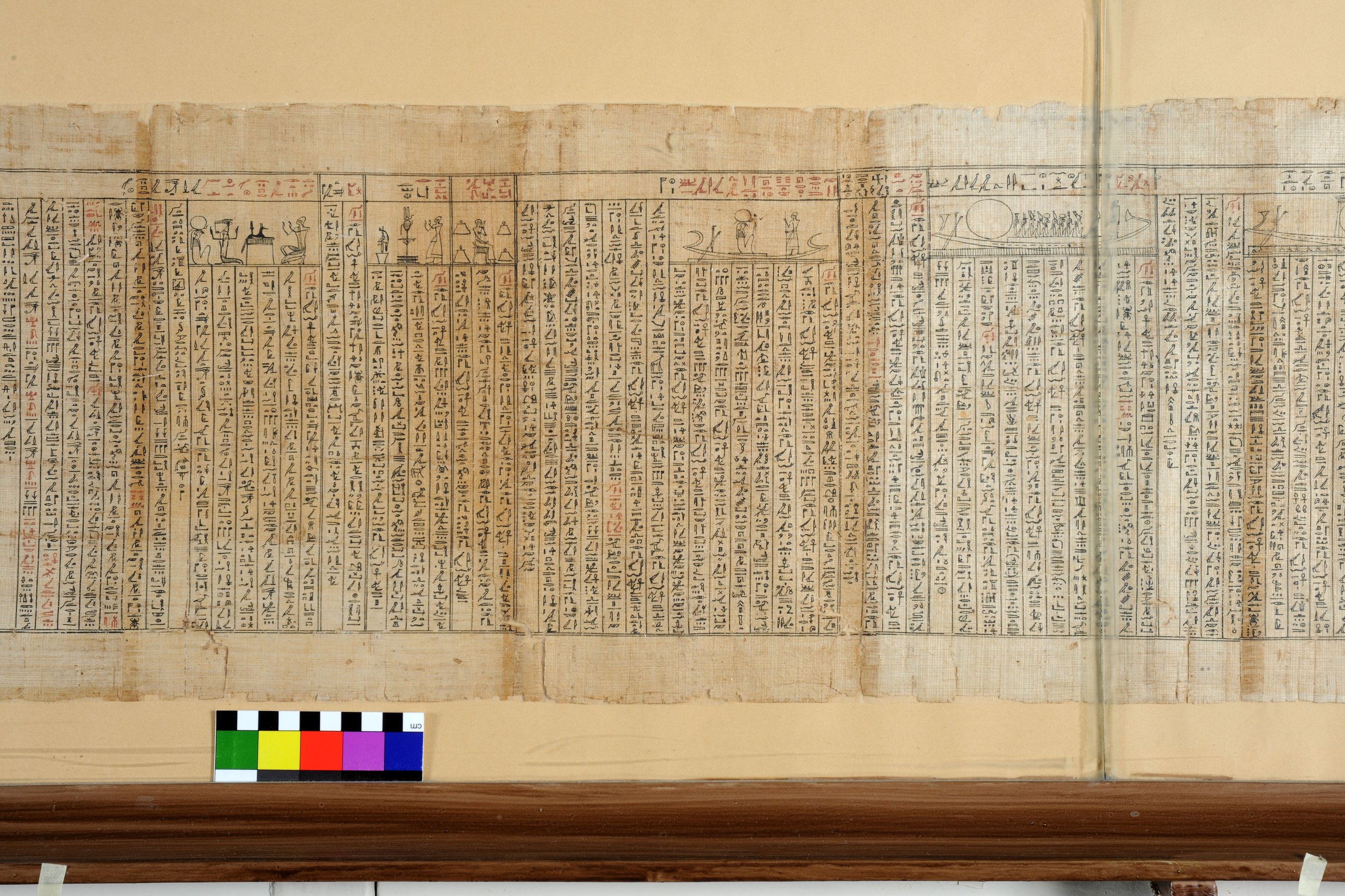
Where on the image
Turin 1791, Spell 135 (TLA Tb 135: title line, columns 1-4; Lepsius 1842, pl. LV). Photograph 22 of 31 (Commons Book_of_the_Dead_of_Iuefankh,_papyrus_-_Museo_Egizio_Turin_C_1791_p013.jpg): it stands between Spell 134 and Spell 136 on this photograph (the roll is continuous, so every spell between two identified spells lies between them). Checked by eye: the photographs were matched to Lepsius's plates by their vignettes, red titles and framed compartments, and the overlapping edges of neighbouring photographs were compared.
titlek〈y〉 rʾ ḏd ḫft jꜥḥ,w m rnp hrw ꜣbd
1ḏd-mdw jn Wsjr […] mꜣꜥ-ḫrw wnḫ ky-ḏd wn ṯw Wsjr ḥꜣty ẖꜣ〈p〉 p,t wnḫ =f swḏꜣ Ḥr,w nfr rꜥ,w-nb ꜥꜣ jrw wdn ꜣ,t
2ḫsr =f ḥꜣtj m ḥr n Wsjr […] mꜣꜥ-ḫrw m =k sw jwi̯〈.w〉 ntf Rꜥ,w m sqd,wt ntf nṯr 4 ḥr,j.pl gs ḥr〈,t〉 spr.n Wsjr […] mꜣꜥ-ḫrw
3m hrw =f h〈ꜣi̯.w〉 m nwḥ.pl =f n wnn,t{j} jr rḫ rʾ pn wnn =f m ꜣḫ,w jqr m ẖr,t-nṯr nn mt =f m-wḥm m ẖr,t-nṯr jw =f wnm =f r-gs Wsjr
4jr rḫ sw ḥr-tp tꜣ wnn =f mj Ḏḥwtj jw dwꜣ.tw =f jn ꜥnḫ,w nn ḫr =f n ꜣ,t n.t nsw,t šmm〈,t〉 n.t Bꜣs,tt swḏꜣ =f n jꜣw,t ꜥꜣ.t nfr.t
CXXXV. Another Chapter, said when the Moon is young in the
Month.
The Osiris has bandaged or opened the wound (in) the body of the heaven. It is bandaged, the good Horus cures it daily, the greatest of created types, offering at the time, dissipating the injury from the face of the Osiris, making it go. He is the Sun as he is conducted along. He is the Four superior Gods of the Upper place. The Osiris has approached in his day, coming by his rope to the Beings.
If this chapter is known, he is a wise Spirit in Hades; he does not die a second time in Hades. He has eaten where Osiris is. If he knows it when on earth, he has been adored like Thoth; [is said] by the living. He does not fall down a moment to the king [Sut] or the heat of Pasht. He goes out to the great and good chief.
Notes
- Birch's English was taken from three scans of Bunsen's Egypt's Place in Universal History, vol. V (1867), on the Internet Archive. The three OCR texts were aligned word by word and each word was settled by their agreement; running heads, page numbers, footnote markers and footnotes were removed. Some OCR errors may remain, chiefly in proper names.
- Birch uses the terms and name forms of his time: Hades, Aahlu (Elysium), Tum for Atum, Seb for Geb, Anup for Anubis, Phoenix or Bennu for the heron.
- Labels such as 'title line' or 'gate 1' before a line of the Egyptian translate the position labels of the TLA.
- The TLA has no hieroglyphic encoding for these texts, so only the transliteration is shown.
Cite
Sources
- Source: Papyrus of Iuefankh, Turin, Museo Egizio Cat. 1791 (Museo Egizio photographs, CC0) + TLA transliteration (ed. B. Backes, CC BY-SA 4.0) + English of Samuel Birch (1867, public domain) (holding institution)
- Critical edition: Thesaurus Linguae Aegyptiae, ed. Burkhard Backes (2018 data, AED-TEI)
← previous · → next · v cycle view · l back to library