Book of the Dead, Spell 140: Book made on the 30th of Epiphi, when the Eye is full on the ... (papyrus of Iuefankh)
Introduction
The Book of the Dead, in Egyptian the spells for going forth by day, is a collection of funerary spells written on papyrus rolls and placed in burials from the New Kingdom to the Roman period. Each roll was made for one person, with spells taken from a large repertoire and illustrated with drawings (vignettes). This library gives one complete roll: the papyrus of Iuefankh in the Museo Egizio, Turin (Cat. 1791), written in the Ptolemaic period (332-30 BCE) and coming from Thebes. Richard Lepsius published it in 1842 and divided it into 165 chapters; his numbering is still the standard numbering of the spells, and it is used here.
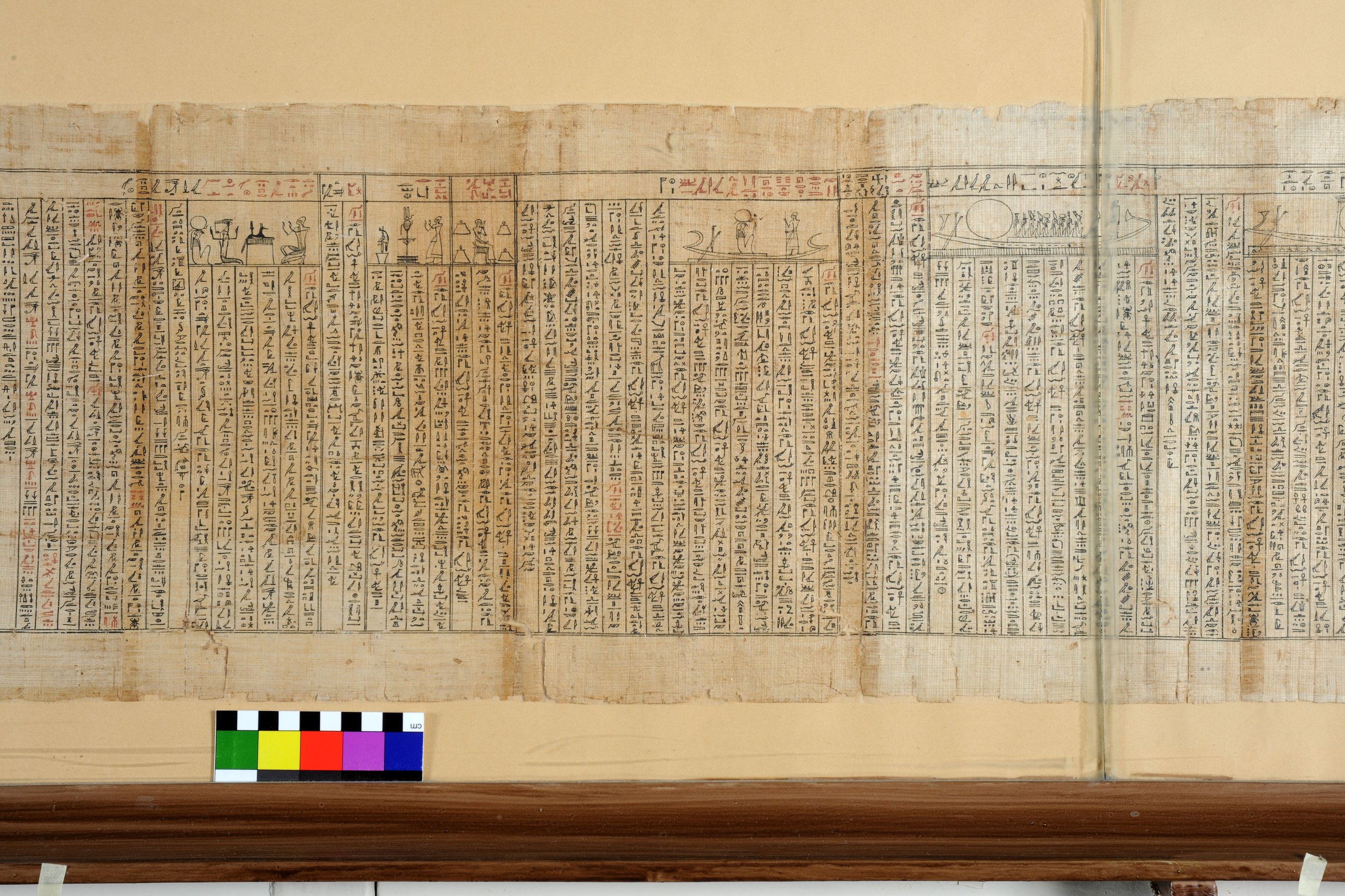
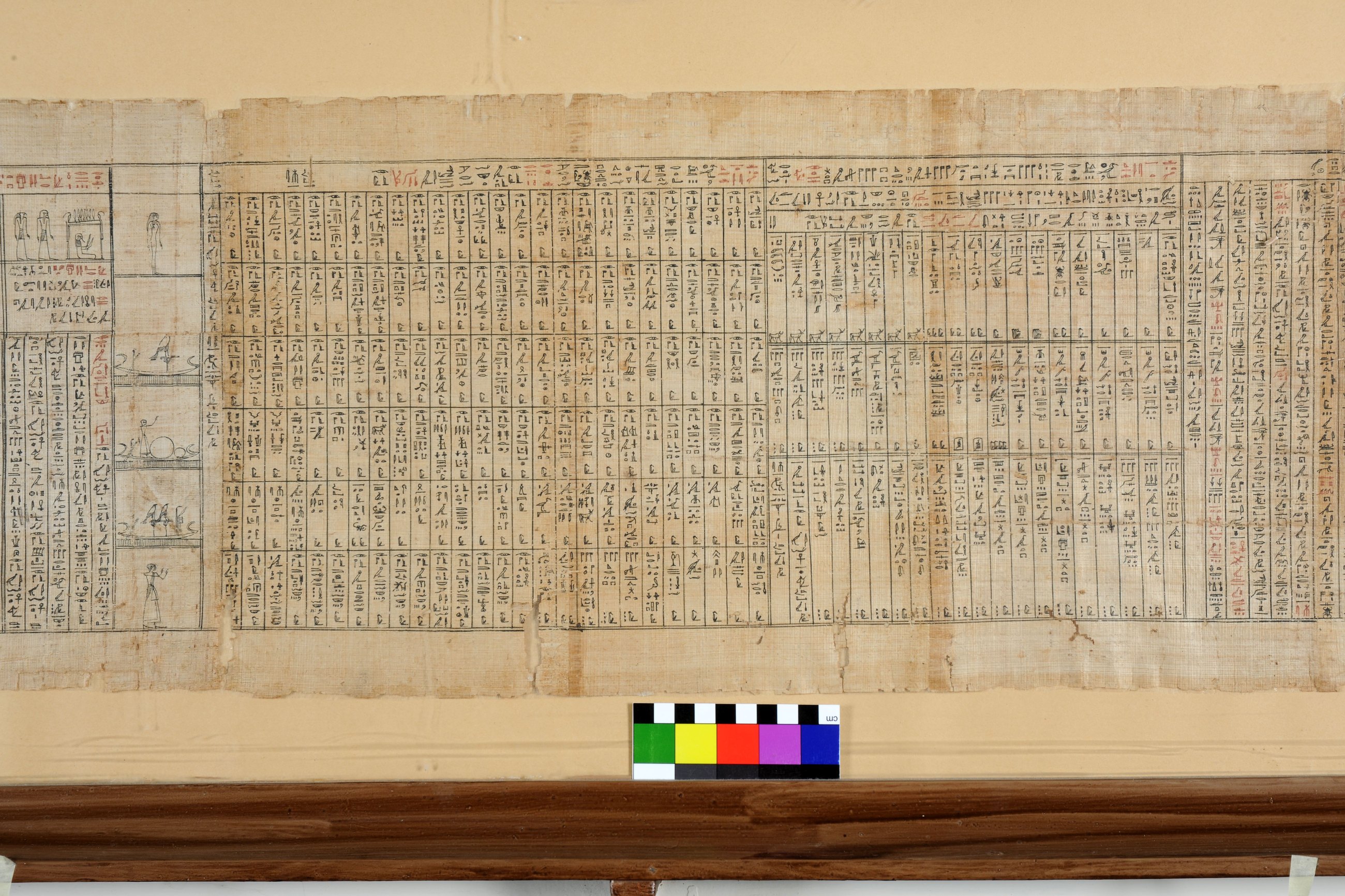
Spell 140 (Birch: 'The Book made on the 30th of Epiphi, when the Eye is full on the 30th of Epiphi.') is on Lepsius's plate LVII and on photographs 22, 23 of the 31 Museo Egizio photographs of the roll.
The Egyptian is the transliteration of the Thesaurus Linguae Aegyptiae (edition by Burkhard Backes), with the column number of the spell before each column; the numbers are those of Lepsius's plates. On the papyrus the text runs in vertical columns of cursive hieroglyphs from right to left along the roll; titles and some words are written in red. Signs restored by the editor are in square brackets, signs the scribe left out in angle brackets, superfluous signs in braces and damaged signs in half brackets. The English is the translation by Samuel Birch, published in 1867 and made from Lepsius's copy of this papyrus, so the English and the Egyptian come from the same manuscript. It was the first complete English translation of the Book of the Dead; many passages are now understood differently. Birch's own square brackets give his alternatives and explanations. The photographs are by the Museo Egizio; each shows a stretch of the roll, and the note of each section says where the spell stands on it.
How was this verified? (Provenance)
Where on the image
Turin 1791, Spell 140 (TLA Tb 140: title line, columns 1-15; Lepsius 1842, pl. LVII). Photograph 22 of 31 (Commons Book_of_the_Dead_of_Iuefankh,_papyrus_-_Museo_Egizio_Turin_C_1791_p013.jpg): red title at 8-23% with the sun god, the kneeling figures and the jackal on a shrine; it continues on photograph 23. Photograph 23 of 31 (Commons Book_of_the_Dead_of_Iuefankh,_papyrus_-_Museo_Egizio_Turin_C_1791_p012.jpg): its last columns at 88-100%. Checked by eye: the photographs were matched to Lepsius's plates by their vignettes, red titles and framed compartments, and the overlapping edges of neighbouring photographs were compared.
titlemḏꜣ,t jri̯.t m ꜣbd 2 pr〈,t〉 ꜥrq,y ḫft mḥ wḏꜣ,t m ꜣbd 2 pr〈,t〉 ꜥrq,y
1ḏd-mdw jn Wsjr […] mꜣꜥ-ḫrw ḫꜥi̯ Sḫm wbn〈.w〉 〈m〉 ꜣḫ,t ḫꜥi̯ Jtm,w ḥr sṯj jꜣd,t =f ꜣḫ,w wbn〈.w〉 m p,t ḥw,t-bnbn
2m ḥꜥꜥ〈w,t〉 jm,j-tw =sn twt〈.w〉 mj-qd =sn ḫrw nhm m-ẖnw kꜣ{r}jw hnw pẖr〈.w〉 m dꜣ,t
3sn-tꜣ m rʾ n Jtm,w Ḥr,w-ꜣḫ,tj wḏ,t ḥm =f n psḏ,t šms,w n.w ḥm =f wꜣḏ ḥm =f ḥr ⸢nk⸣ ky-ḏd jri̯〈.t〉 kꜣ〈,t〉 wḏꜣ,t m =ṯn
4ḥꜥ =j rḏi̯ n =f nrjw ꜥ.w,t =j nb〈.t〉 swꜣḏ.〈t〉n =sn pri̯ =f rʾ =f ḥm =f jw ꜣḫ,t =f ḥtp =s ḥr s,t =s ḥr ḥm =f wnw,t
5twy n.t grḥ,w mḥ〈.t〉 wnw,t 4.t tꜣ nfr〈.w〉 m ꜣbd 2 pr,t ꜥrq,y jw ḥm n wḏꜣ,t m-bꜣḥ-ꜥ-n psḏ,t wbn ḥm =f mj zp-tp〈,j〉 jw wḏꜣ〈,t〉
6m tp =f Rꜥ,w Jtm,w wḏꜣ,t Šw Gbb Wsjr Swtj Ḥr,w Mntj Bꜥḥ Rꜥ,w r-nḥḥ Ḏḥwtj nꜥjw
7ḏ,t Nw,t ꜣs,t Nb,t-ḥw,t Ḥw,t-Ḥr,w Nḫt Mr,t Mꜣꜥ,t Jnp〈,w〉 tꜣ msi̯ ḏ,t bꜣ Ḥꜣ,t-mḥy,t Rꜥ,w
8ḥsb.ntw wḏꜣ,t m-bꜣḥ nb tꜣ pn ꜥḥꜥ,n =s mḥ.tw ḥtp.tw wn.jn nn n nṯr.pl m ḥꜥꜥ〈w,t〉 ={ṯn} m hrw pn ḏr,t =sn ẖr =sn!! ꜥḥꜥ,n jri̯ ḥ〈ꜣ〉b n
9nṯr nb ḏd =sn hꜣy n =ṯ ḥkn,w m Rꜥ,w sqdi̯ jz,t.y wjꜣ sḫr ꜥꜣpp hꜣy n =ṯ ḥkn,w n{.t} Rꜥ,w sḫpr.jw
10Ḫprj hꜣy n =ṯ ḥkn,w m Rꜥ,w ḥꜥꜥ〈w,t〉 jm =f dr ḫfti̯.pl =f hꜣy n =ṯ ḥkn,w m Rꜥ,w dr tp.pl n ms,pl-bdš〈,t〉
11jꜣ,wj n =ṯ ḥkn,w n Wsjr […] mꜣꜥ-ḫrw ḏd-mdw ḥr wḏꜣ,t n.t ḫsbḏ mꜣꜥ.t 〈ḥ〉mꜣg〈,t〉 rʾ-pw swꜥb.tw m nbw wdnw
12n =s 〈j〉ḫ,t-nb,t nfr〈.t〉 wꜥb〈.t〉 m-bꜣḥ =s ḫft Rꜥ,w ḏi̯ =f sw m ꜣbd 2 pr〈,t〉 ꜥrq,y ḥnꜥ jri̯.t k.t wḏꜣ,t n.t ḫnm〈,t〉 rḏi̯〈.tj〉 n z r ꜥ,t.pl nb〈.t〉 mri̯.wt ={j}f wnn〈⸢.tj⸣〉 ḏd rʾ pn
13m wjꜣ-n-Rꜥ,w jw sṯꜣ.tw =f ḥnꜥ nn n nṯr.pl wnn =f mj wꜥ,w jm =sn jw sṯz.tw =f m ẖr,t-nṯr jr ḏd rʾ pn mj,tt pꜣ wdnw
14m mḥ wḏꜣ,t wḏꜣ,t ḫꜣw,t 4 n Rꜥ,w Jtm,w ḫꜣw,t 4 n wḏꜣ,t ḫꜣw,t 4 n nn n nṯr.pl n,tj ḥr wꜥ,w nb jm =sn tʾ nfr tʾ-ḥḏ 5 dgꜣ.pl
15tʾ-ḥḏ 5 šꜥy-bjꜣ 5 snṯr dnj〈,t〉 dq〈r〉.pl dnj〈,t〉 jwf ꜣšr
CXL. The Book made on the 30th of Epiphi, when the Eye is full on the 30th of Epiphi.
[Vignette — Deceased adoring the Jackal of Anubis on a Doorway, the Kyo, and Ra.]
The Paddle of the Light of the Horizon rises. Tum rises from the stench [?] of the river, a Spirit shining in heaven, an abode capped with joy. Among them is an image like their form, a joyful speech from the chest, addressing the (one) coming from the gateway, flattering from the mouth of Tum, the Lord of the Horizon. He orders in person the Gods, the servants of his person, his person shows thee his face! or he causes the Eye to be taken (or called). Grant me my limbs, he has placed victory in all my arms; supplying to them his Coming out, his mouth, and his person. His Eye [his Spirit] is at peace in its place on (or over) his person at the hour of the night, full, the fourth hour of the earth, complete on the 30 Epiphi. The person of the Eye is then before the Gods. The person shines as he did at first. Ra and Tum, Uga [the Eye], Shu, Seb, Osiris, Seti, Horus, Mentu, Bah [the Inundation], Ra, Aions, Thoth, Na.au [Air], Geta, Nuhar, Isis, Nephthys, Athor, Nukht, Mera, Ma, Anepu [Anubis], the Land of eternal birth, the Soul of the body of the Sun, have come out of his head.
The eye having been veiled before the Lord of that Land, it has been made full and at peace [sets]. As for Gods ye rejoice on that day. Their hands they hold [it]. When the festival of each God is made they say: Hail to the discourse with the Sun. The boatmen tow the boat, and overthrow the Apophis! Hail to the discourse of the Sun! Kheper makes his transformations.
Hail to the discourse from the Sun in which he rejoices to bruise his enemies! Hail to the discourse of the Sun, to bruise the heads of those born evil. Adoration of [Come to] the discourse of the Osiris.
Said over or on an eye of real or false lapis lazuli: the mouth is washed with gold, offer all good and pure things before it, when the Sun, places it on the 30th Epiphi, make also a second eye of red jasper. A person then places himself in whatever direction he has wished. This chapter being said in the boat of the Sun, the person is towed with the Gods as if he were one of them: he is borne along out of Hades. Besides saying this chapter likewise there are the offerings at the filling of the (two) eyes; four altars to the Sun and Tum, four altars to the Eye, four altars to the said Gods; there being on each of them of bread five loaves, of conserve five loaves, five bits of meat, one ounce of frankincense, one ounce of flour, and one slice of flesh.
Notes
- Birch's English was taken from three scans of Bunsen's Egypt's Place in Universal History, vol. V (1867), on the Internet Archive. The three OCR texts were aligned word by word and each word was settled by their agreement; running heads, page numbers, footnote markers and footnotes were removed. Some OCR errors may remain, chiefly in proper names.
- Birch uses the terms and name forms of his time: Hades, Aahlu (Elysium), Tum for Atum, Seb for Geb, Anup for Anubis, Phoenix or Bennu for the heron.
- Labels such as 'title line' or 'gate 1' before a line of the Egyptian translate the position labels of the TLA.
- The TLA has no hieroglyphic encoding for these texts, so only the transliteration is shown.
Cite
Sources
- Source: Papyrus of Iuefankh, Turin, Museo Egizio Cat. 1791 (Museo Egizio photographs, CC0) + TLA transliteration (ed. B. Backes, CC BY-SA 4.0) + English of Samuel Birch (1867, public domain) (holding institution)
- Critical edition: Thesaurus Linguae Aegyptiae, ed. Burkhard Backes (2018 data, AED-TEI)
← previous · → next · v cycle view · l back to library