Book of the Dead, Spell 141: Preparing the Spirits to know the Names of the Gods of the Southern and ... (papyrus of Iuefankh)
Introduction
The Book of the Dead, in Egyptian the spells for going forth by day, is a collection of funerary spells written on papyrus rolls and placed in burials from the New Kingdom to the Roman period. Each roll was made for one person, with spells taken from a large repertoire and illustrated with drawings (vignettes). This library gives one complete roll: the papyrus of Iuefankh in the Museo Egizio, Turin (Cat. 1791), written in the Ptolemaic period (332-30 BCE) and coming from Thebes. Richard Lepsius published it in 1842 and divided it into 165 chapters; his numbering is still the standard numbering of the spells, and it is used here.
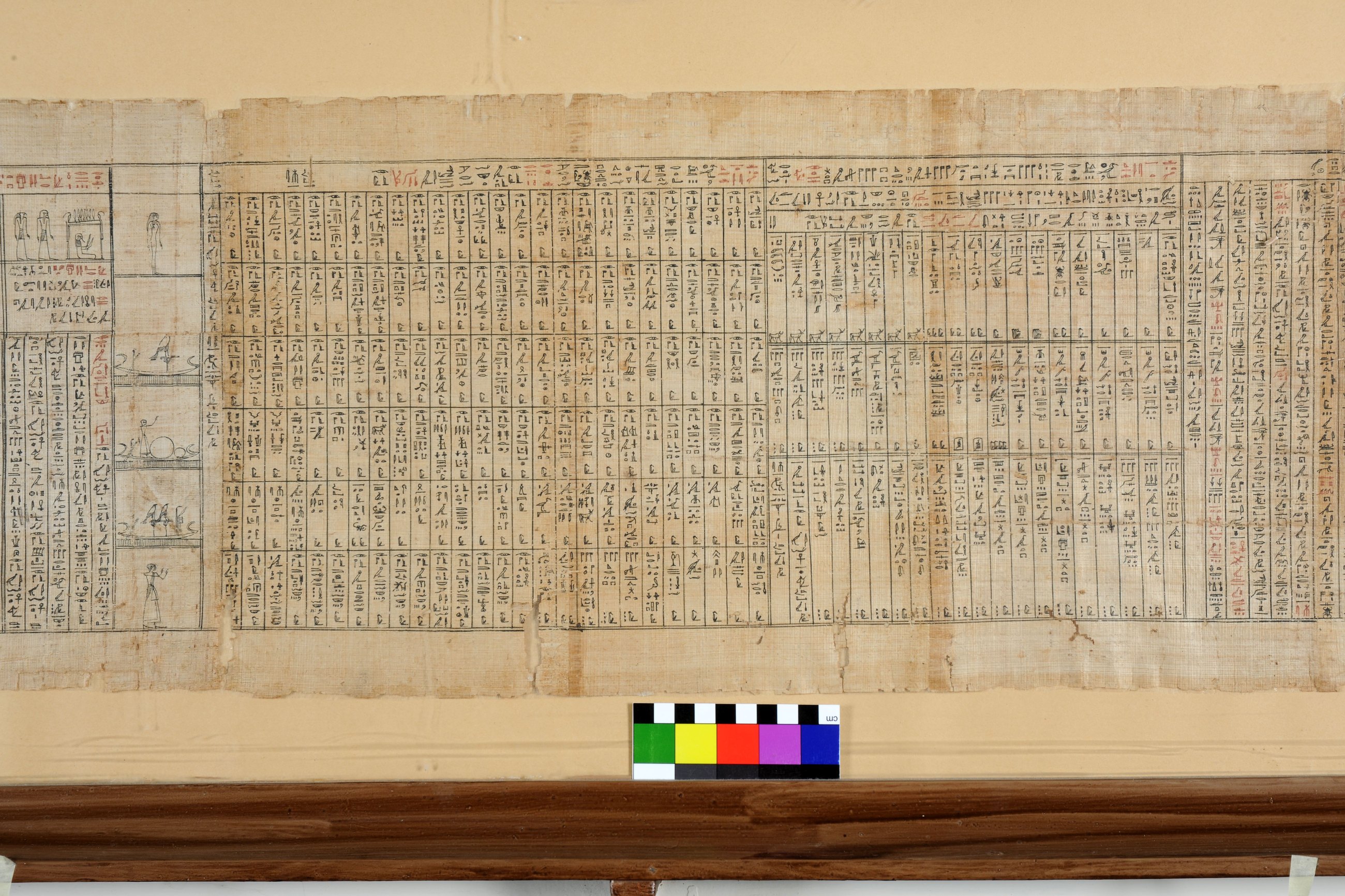
Spell 141 (Birch: 'The book of Preparing the Spirits to know the Names of the Gods of the Southern and Northern Heaven, the Gods in the two Orbits, the Gods who traverse the Gate. It has been made to a Person for his Father and Mother. It is the chapter of the Festivals of the West when he is instructed, he is tho Delight of the Sun, the Delight of the Gods, he is with them. Said on the Day of the Ninth Festival by the Osiris. An Offering of Food, Drink, Oxen and Geese Slices, and burning Incense, is offered to Osiris in all his Names by the Osiris.') is on Lepsius's plate LVIII and on photograph 23 of the 31 Museo Egizio photographs of the roll.
The Egyptian is the transliteration of the Thesaurus Linguae Aegyptiae (edition by Burkhard Backes), with the column number of the spell before each column; the numbers are those of Lepsius's plates. On the papyrus the text runs in vertical columns of cursive hieroglyphs from right to left along the roll; titles and some words are written in red. Signs restored by the editor are in square brackets, signs the scribe left out in angle brackets, superfluous signs in braces and damaged signs in half brackets. The English is the translation by Samuel Birch, published in 1867 and made from Lepsius's copy of this papyrus, so the English and the Egyptian come from the same manuscript. It was the first complete English translation of the Book of the Dead; many passages are now understood differently. Birch's own square brackets give his alternatives and explanations. The photographs are by the Museo Egizio; each shows a stretch of the roll, and the note of each section says where the spell stands on it.
How was this verified? (Provenance)
Where on the image
Turin 1791, Spell 141 (TLA Tb 141: title line, 60 labelled lines (1,1 ... 20,3); Lepsius 1842, pl. LVIII). Photograph 23 of 31 (Commons Book_of_the_Dead_of_Iuefankh,_papyrus_-_Museo_Egizio_Turin_C_1791_p012.jpg): the title in red and black at 57-88% over a two-line heading and a table of short columns ending in cattle signs (Lepsius pl. LVIII). Checked by eye: the photographs were matched to Lepsius's plates by their vignettes, red titles and framed compartments, and the overlapping edges of neighbouring photographs were compared.
title 1mḏꜣ,t n.t sjqr ꜣḫ.w rḫ rn.pl n.w nṯr.pl n p,t rsj〈.t〉 p,t mḥ,t〈j.t〉 nṯr.pl jm,j.w qr,tj nṯr.pl sšmi̯ dꜣ,t jri̯.tn z r jti̯ =f
title 2mw,t =f rʾ-pw ḥ〈ꜣ〉b.pl n.w jmn,tt js jqr ḥr jb n Rꜥ,w ḥr jb n nṯr.pl wnn =f ḥnꜥ =sn ḏd.t hrw psḏn,t〈jw〉 jn Wsjr […] mꜣꜥ-ḫrw wdnw
title 3m tʾ ḥ〈n〉q,t jḥ.pl ꜣpd.pl ꜣšr snṯr ḥr sḏ,t wdn.w n Wsjr m rn〈.pl〉 =f nb.w m ḏḏ! n Wsjr […] mꜣꜥ-ḫrw
1,1n Wsjr-ḫnt〈,j〉-jmn,tt nb-ꜣbḏ,w zp-4
2,1n Ḥr,w-ꜣḫ,tj
3,1n Nw,w jti̯ nṯr.pl
4,1n Mꜣꜥ,t zꜣ,t-Rꜥ,w
5,1n wjꜣ-n-Rꜥ,w
6,1n Jtm,w Ḫprj
7,1n psḏ,t-ꜥꜣ,t
8,1n psḏ,t-nḏs,t
9,1n Ḥr,w nb wrr〈,t〉
10,1n Šw Tfnw,t
11,1n Gbb Nw,t
12,1n Wsjr ꜣs,t Nb,t-ḥw,t
13,1n Ḥw,t-kꜣ-nb〈,t-r-〉ḏr
14,1n {S}〈Š〉nj〈,t〉-p,t-wṯs〈,t〉-nṯr
15,1n Ꜣḫ-bj,t〈t〉-sꜥḥ〈,t〉-nṯr
16,1n Jmn,yt ḫnti̯,t-s,t =s
17,1n Wr-mr〈w〉,t≡s-dšr〈,t〉-šnj
18,1n H̱nm〈,t〉-m-ꜥnḫ-jnz,y〈t〉
19,1n Sḫm-rn≡s{t}-m-ḥmw,t
20,1n kꜣ ṯꜣ,du!! jd,t.pl
1,2n Sḫm-nfr-wn-jtn-ḥmw-nfr-n-p,t-mḥ,t〈j,t〉
2,23,2n Pẖr-sšm-Tꜣ,du-ḥmw-nfr-n-p,t-jmn,tt
4,25,2n Jꜣḫ,w-ḥr-jb-ḥw,t-ꜥḫm,pl-ḥmw-nfr-n-p,t-jꜣb,tt
6,27,2n Ḫnt,j-ḥr-jb-ḥw,t-dšr〈,t〉-ḥmw-nfr-n-p,t-rsj〈,t〉
8,29,2n Jms,tj Ḥpy Dwꜣ-mw,t≡f Qbḥ-sn,pl≡f
10,2n jtr,tj šmꜥ.t
11,2n jtr,tj mḥ,t〈j.t〉
12,2n sk,tt mꜥn{n}ḏ,t
13,2n Ḥw,t-Ḥr,w
14,2n Ḏḥwtj kꜣ-mꜣꜥ,t
15,2n Ḏḥwtj wḏꜥ-md,t n psḏ,t
16,2n Ḏḥwtj sšmi̯ nṯr.pl
17,2n nṯr.pl rsj.pl nṯr.pl mḥ,tj.pl
18,2n nṯr.pl jmn,tt nṯr.pl jꜣb,tt
19,2n nṯr.pl mꜣs,tjw
20,2n nṯr.pl pr-wr nṯr.pl pr-nzr
1,3n nṯr.pl jꜣ,t.pl nṯr.pl ꜣḫ,tj.w
2,3n nṯr.pl sḫ,tj.w nṯr.pl qr,t.jw
3,3n nṯr.pl nḏs.pl wꜣ,t.pl rsj.pl wꜣ,t.pl mḥ,t〈j〉.pl
4,3n wꜣ,t.pl jmn,tt wꜣ,t.pl jꜣb,t〈j〉.tpl
5,3n sšmi̯ sbꜣ.pl n〈.w〉 dꜣ,t
6,3n jr,j-ꜥꜣ.pl n〈.w〉 dꜣ,t sbḫ,t.pl n〈.t〉 dꜣ,t
7,3n sbꜣ.pl štꜣ.pl n〈.w〉 dꜣ,t
8,3n jr,j-⸢ꜥꜣ⸣.pl sbꜣ.pl n〈.w〉 dꜣ,t
9,3n ꜥꜣ.pl štꜣ.pl n〈.w〉 dꜣ,t
10,3n štꜣ-ḥr.pl zꜣw wꜣ,t.pl
11,3n jr,j-ꜥꜣ.pl nw ḏḏ! sbḥ,w
12,3n zꜣw.pl jꜣ,t.pl ḏḏ! ḥr nfr,t!! ky-ḏd nfr
13,3n rkḥ,wy{,t} ḏḏ! sḏ,t m ꜥḫ
14,3n wn.pl ꜥḫm.ypl m ḫ,t
15,3n sḏ,t m jmn,tt
16,3ḏḏ! mꜣꜥ-ḫrw n ꜣḫ,w
17,3jqr m jmn,tt
18,3jꜣb,tt ḥnꜥ kꜣ =f
19,3m ḏḏ! n Wsjr […] mꜣꜥ-ḫrw
20,3
CXLI. The book of Preparing the Spirits to know the Names of the Gods of the Southern and Northern Heaven, the Gods in the two Orbits, the Gods who traverse the Gate. It has been made to a Person for his Father and Mother. It is the chapter of the Festivals of the West when he is instructed, he is tho Delight of the Sun, the Delight of the Gods, he is with them. Said on the Day of the Ninth Festival by the Osiris. An Offering of Food, Drink, Oxen and Geese Slices, and burning Incense, is offered to Osiris in all his Names by the Osiris.
To Osiris who dwells in the West, Lord of Abydos [East] (four times).
To the Lord of the Orbits.
To Nuhar, father of the Gods.
To Ma [Truth], the daughter of the Sun.
To the Boat of the Sun. TO Turn, the creator.
To the Great Gods.
To the Little Gods.
To Horus, Lord of the Crown.
To Shu and Tefnu [Gemini].
To Seb and Nu.
To Osiris, Isis, and Nephthys.
To Hat ka, the Universal Lord [Mystical Cow].
To the Sister of the Heaven, the divine [Mystical Cow].
To Hebi, the Saah (Mummy) [Mystical Cow].
To Amenti who dwells in her house [Mystical Cow]. To the Greatly beloved, red-haired [Mystical Cow]. To the Giver of Life to her Skin [Mystical Cow].
To the Name strong by work [Mystical Cow].
To the Bull of the Cows.
To the Good Paddle, opener of the Disk.
To the Good Paddle of the Northern Heaven.
To the Whirler, traverser of the Earth.
To the Good Paddle of the Western Heaven.
To the Spirit in the House of Eagles.
To the Good Paddle of the Eastern Heaven.
To Khenti dwelling in the Red House.
To the Good Paddle in the Southern Heaven.
To Amset, Hapi, Tuautmutf, and Kabhsenuf.
To the Southern Passage [or Place].
To the Northern Passage [or Place].
To the Ark and Cabin.
To Athor.
To Thoth, the husband of Truth or Bull of the West. To Thoth, weigher of the words of the Gods.
To Thoth, traverser of the Gods.
To the Gods of the South and North.
To the Gods of the West and East.
To the Gods.
To the Gods of the Great House, to the Gods of the abode of Flame. To the Gods of the Place, the Gods of the Horizon. To the Gods of the Field, the Gods of the Orbits.
To the Roads of the West, the Roads of the East.
To the Passers through the Gates of the Doorway.
To the Doorkeepers of the Gateway, the Doors of the Gateway.
To the secret Doors of the Gateway.
To the secret Faces, the Guardians of the Gate.
To the Doorkeepers of the same Givers of Reproaches. To the Keepers of the Places prepared for the Good, or making good.
To the Braziers giving fire to the Altars.
To the Openers, the extinguishers of Flame.
To the Flame in the West.
To the Givers of justification to the Spirit.
To the Preparation in the West.
To the East and its type.
By the Gifts of the Osiris, the justified.
Notes
- Birch's English was taken from three scans of Bunsen's Egypt's Place in Universal History, vol. V (1867), on the Internet Archive. The three OCR texts were aligned word by word and each word was settled by their agreement; running heads, page numbers, footnote markers and footnotes were removed. Some OCR errors may remain, chiefly in proper names.
- Birch uses the terms and name forms of his time: Hades, Aahlu (Elysium), Tum for Atum, Seb for Geb, Anup for Anubis, Phoenix or Bennu for the heron.
- Labels such as 'title line' or 'gate 1' before a line of the Egyptian translate the position labels of the TLA.
- The TLA has no hieroglyphic encoding for these texts, so only the transliteration is shown.
Cite
Sources
- Source: Papyrus of Iuefankh, Turin, Museo Egizio Cat. 1791 (Museo Egizio photographs, CC0) + TLA transliteration (ed. B. Backes, CC BY-SA 4.0) + English of Samuel Birch (1867, public domain) (holding institution)
- Critical edition: Thesaurus Linguae Aegyptiae, ed. Burkhard Backes (2018 data, AED-TEI)
← previous · → next · v cycle view · l back to library