Book of the Dead, Spell 149: First ABODE (papyrus of Iuefankh)
Introduction
The Book of the Dead, in Egyptian the spells for going forth by day, is a collection of funerary spells written on papyrus rolls and placed in burials from the New Kingdom to the Roman period. Each roll was made for one person, with spells taken from a large repertoire and illustrated with drawings (vignettes). This library gives one complete roll: the papyrus of Iuefankh in the Museo Egizio, Turin (Cat. 1791), written in the Ptolemaic period (332-30 BCE) and coming from Thebes. Richard Lepsius published it in 1842 and divided it into 165 chapters; his numbering is still the standard numbering of the spells, and it is used here.
Spell 149 (Birch: 'First ABODE.') is on Lepsius's plates LXXI-LXXIII and on photographs 27, 28 of the 31 Museo Egizio photographs of the roll. The TLA divides this spell into three parts with continuous column numbers; they are given here together.
The Egyptian is the transliteration of the Thesaurus Linguae Aegyptiae (edition by Burkhard Backes), with the column number of the spell before each column; the numbers are those of Lepsius's plates. On the papyrus the text runs in vertical columns of cursive hieroglyphs from right to left along the roll; titles and some words are written in red. Signs restored by the editor are in square brackets, signs the scribe left out in angle brackets, superfluous signs in braces and damaged signs in half brackets. The English is the translation by Samuel Birch, published in 1867 and made from Lepsius's copy of this papyrus, so the English and the Egyptian come from the same manuscript. It was the first complete English translation of the Book of the Dead; many passages are now understood differently. Birch's own square brackets give his alternatives and explanations. The photographs are by the Museo Egizio; each shows a stretch of the roll, and the note of each section says where the spell stands on it.
How was this verified? (Provenance)
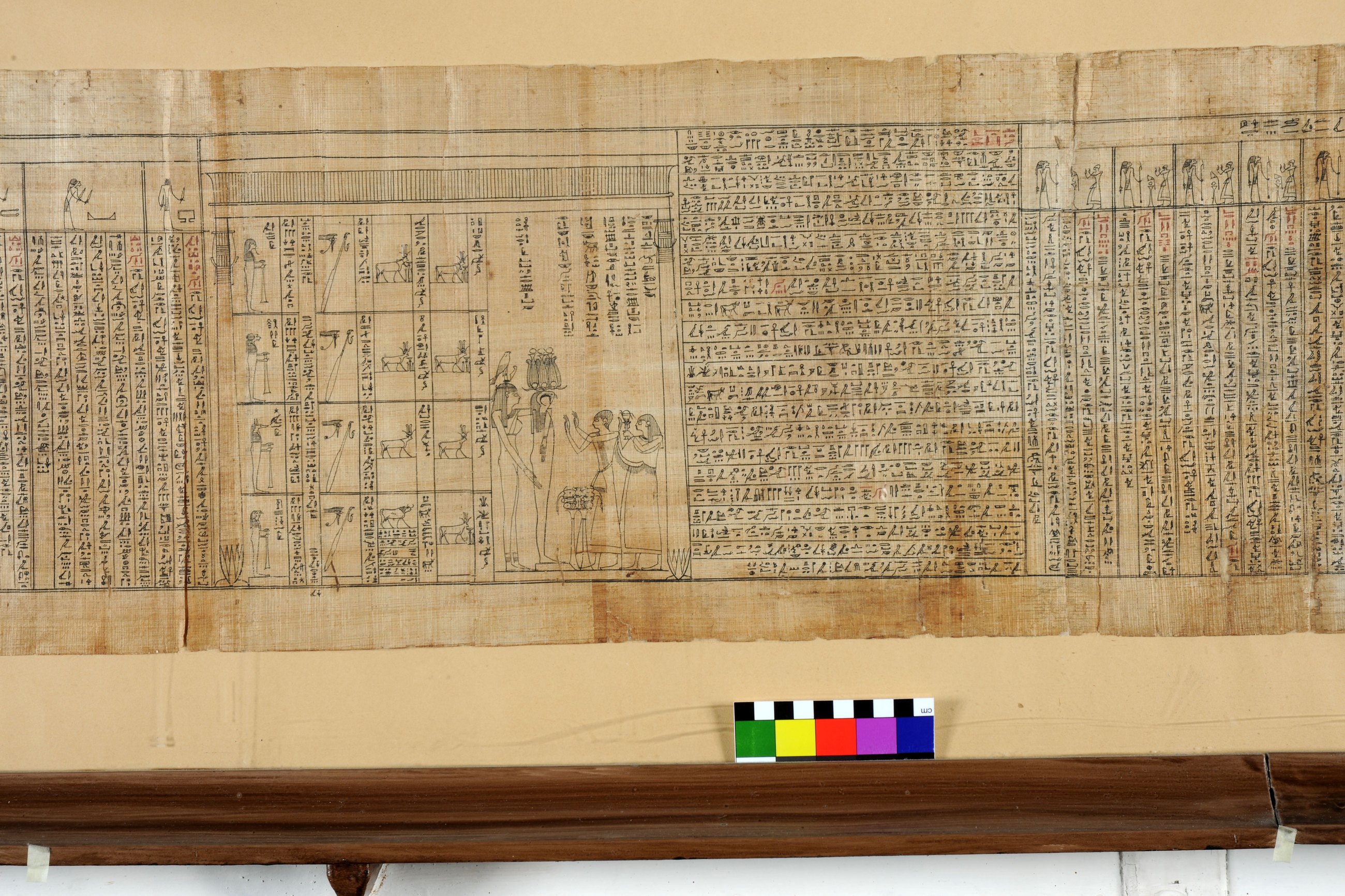
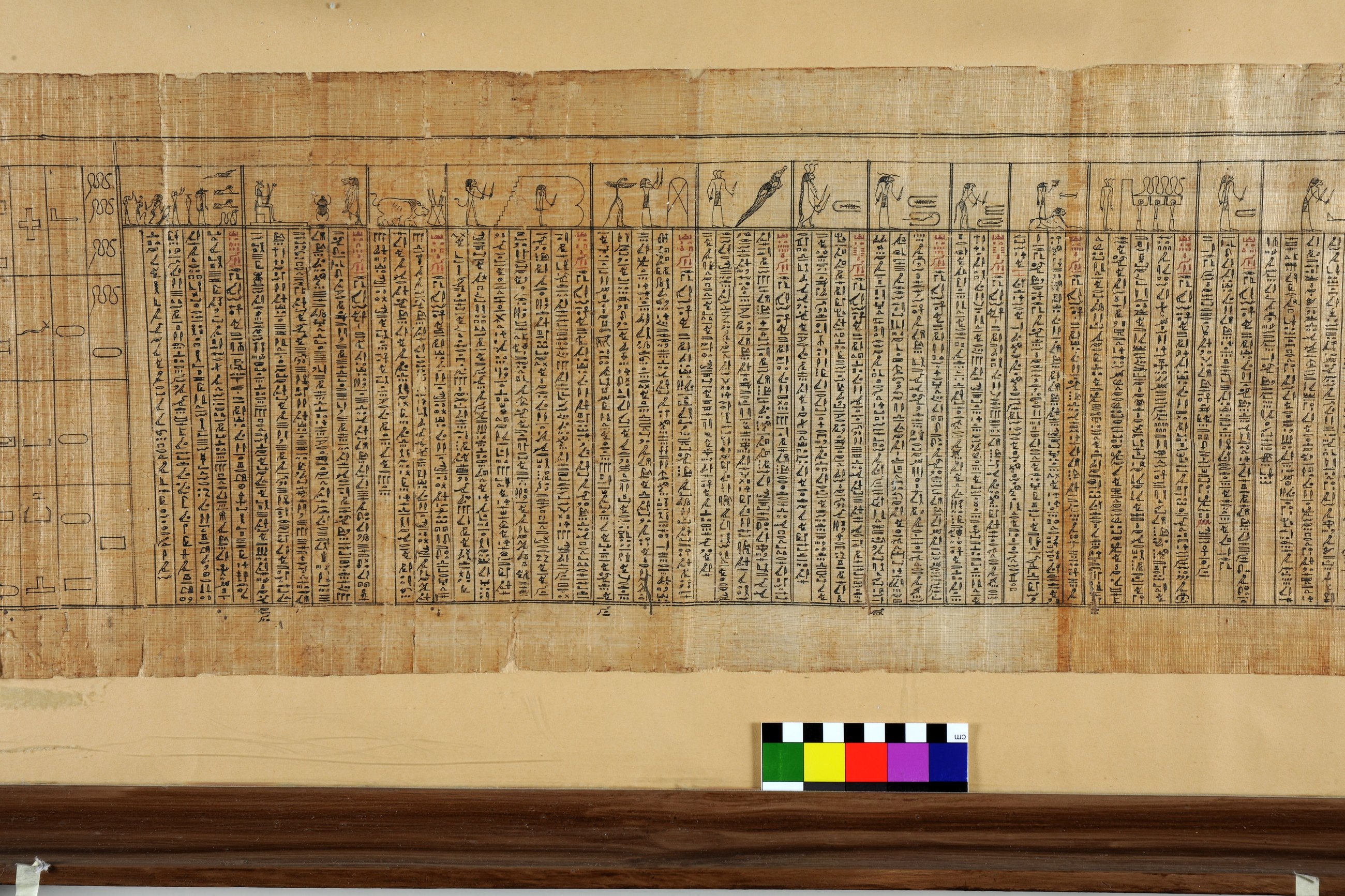
Where on the image
Turin 1791, Spell 149 (TLA Tb 149〈1〉, Tb 149〈2〉, Tb 149〈3〉: columns 1-64; Lepsius 1842, pl. LXXI-LXXIII). Photograph 27 of 31 (Commons Book_of_the_Dead_of_Iuefankh,_papyrus_-_Museo_Egizio_Turin_C_1791_p08.jpg): its first mounds with their figures from 15% to the left-hand edge (Lepsius pl. LXXI); it continues on photograph 28. Photograph 28 of 31 (Commons Book_of_the_Dead_of_Iuefankh,_papyrus_-_Museo_Egizio_Turin_C_1791_p07.jpg): its mounds, each a framed figure over columns with red tops, fill 9-100% (Lepsius pl. LXXI-LXXIII); the map vignette of Spell 150 (no text) is at 0-9%. Checked by eye: the photographs were matched to Lepsius's plates by their vignettes, red titles and framed compartments, and the overlapping edges of neighbouring photographs were compared. Birch numbers this spell CL (his numbers run one ahead of Lepsius's from 145 on).
1jꜣ,t tp〈,j〉.t ḏd-mdw jn Wsjr […] mꜣꜥ-ḫrw j jꜣ,t twy tp〈,j〉.t n.t jmn,tt ꜥnḫ =tw jm =s m šns zꜣr〈,t〉.pl kfi̯ ꜥfn,t =ṯn 〈m〉-ḫsf,w =j
2twt sms〈,w〉 jm,j =ṯn ṯz =f qs.pl =j smn =f ꜥ,t.pl =j jni̯ n =j Jḥy nb jb sꜣq =f qs.pl =j smn =f wrr,t n.t Jtm,w smn =tw
3tp n Nḥb〈,w〉-kꜣ mḥ Wsjr […] mꜣꜥ-ḫrw mḫꜣ,yt ḥqꜣ =k m nṯr.pl ꜥnḫ =j 〈m〉 mꜣꜥ-ḫrw ky-ḏd ḫꜣw,t ḥw,t.pl =k m nṯr.pl Mn,w qd kꜣ n Wsjr […] mꜣꜥ-ḫrw {bꜣ}〈zꜣ〉 =f
4jꜣ,t sn,nw〈.t〉 ḏd-mdw jn Wsjr […] mꜣꜥ-ḫrw j wr ẖr,t m sḫ,t-jꜣl twy jnb.pl =s m bjꜣ jw qꜣ〈,w〉 jt =s m mḥ 7
5ẖms.pl m mḥ 2 jw mꜣw〈,t〉.pl =f m mḥ 3 jn ꜣḫ 7 m ꜣw =f {jw}〈ꜣ〉zḫ s〈t〉 r-gs Ḥr,w-ꜣḫ,tj jw =j rḫ.kw sbꜣ sḫ,t-jꜣl pri̯ Rꜥ,w
6jm =f m jꜣb,tt n.t p,t jw rsj =f m š ḫꜣr.pl mḥ,t〈t〉 =f m nwy rʾ.pl b〈w〉 sqdi̯ Rꜥ,w jm =f m ṯꜣw m ẖnnj jnk smj.w
7m dp,t-nṯr jnk ẖn,w jw,tj wrḏ.n =f m wjꜣ-n-Rꜥ,w jw =j rḫ.kw nh,t twy n.t mfk〈ꜣ,t〉 pri̯ Rꜥ,w jm,j-tw =s šmi̯〈.w〉 ḥr
8sṯz〈,w〉-Šw r sbꜣ jꜣb,tt n.t p,t pri̯ Rꜥ,w jm =f jw =j rḫ.kw sḫ,t-jꜣl twy n.t Rꜥ,w qꜣ〈,w〉 {q}〈b〉d,t =s m mḥ 7 jw ẖms.pl
9m mḥ 3 jw mꜣw〈,t〉.pl =f m mḥ 3 jn ꜣḫ m mḥ 7 ꜣzḫ s〈t〉 r-gs bꜣ.pl jꜣb,tt
10jꜣ,t 3,nw〈.t〉 ḏd-mdw jn Wsjr […] mꜣꜥ-ḫrw j jꜣ,t twy n.t ꜣḫ.pl jw{n},tj sqdi̯.t ḥr =s jw sgr =s ꜣḫ.w jw =s m nsr,t m ḫ,t n.t
11nbj,t j{w} jꜣ,t twy ꜣḫ.w ḥr =ṯn ẖr swꜥb jꜣ,t m =ṯn mj wḏḏ!.t =ṯn n =j jrj〈.t〉 =ṯn n =j pw jn Wsjr […]
12mꜣꜥ-ḫrw jn Wsjr ḏd =f jnk ṯz dšr,t jm,j.t wp,t jꜣḫ,w sꜥnḫ tm,pl m hh n rʾ =f nḥm Rꜥ,w m-ꜥ ꜥꜣpp wnn =f ꜥnḫ〈.w〉 ḏ,t
13jꜣ,t 4,nw〈.t〉 ḏd-mdw jn Wsjr […] mꜣꜥ-ḫrw j ḥr〈,j〉-tp jꜣ,t twy št〈ꜣ.t〉 j ḏw pf qꜣi̯ ꜥꜣ m ẖr,t-nṯr ḫnn! p,t ḥr =f n-s〈w〉 ḫt 300 m ꜣw =f
14ḫt 30 m wsḫ =f jw ḥfj pfy ḥr =f stj ds.du rn =f n-s〈w〉 mḥ 70 m sjn =f ꜥnḫ =f m ḥsq ꜣḫ.w mtj.pl m ẖr,t-nṯr ꜥḥꜥ =j
15m-ḏrj =k mꜣꜥ sqd,wt =j m wjꜣ ky-ḏd mꜣꜣ wꜥ,w r =k jnk dmḏ jnk ṯꜣ〈y〉 ḥbs tp =k wḏꜣ =k wḏꜣ =j ṯz-pẖr jnk wr-ḥkꜣ,pl rḏi̯ n =j Rꜥ,w
16jr,t.du =j ꜣḫ =j jm =f jšs〈,t〉 pw šm-ḥr-ẖ,t≡f pḥ =k r pḥ,tj =k ky-ḏd ḏw =k m =k wj šmi̯.k〈w〉 rf pḥ,tj =k m-ꜥ =j jnk wṯz
17pḥ,tj jy.n =j rḏi̯ wꜣi̯.y ꜣkr ḥtp =j m-mšr〈,w〉 pẖr =j p,t j{m}〈w〉 =k m jn,t wḏ drp,w =k ḥr-tp tꜣ m-bꜣḥ nṯr-ꜥꜣ [⸢m⸣] Jwn,w ky-ḏd ẖr,t-nṯr
18jꜣ,t 5,nw〈.t〉 ḏd-mdw jn Wsjr […] mꜣꜥ-ḫrw j jꜣ,t twy n.t ꜣḫ.pl jw,tj zš ḥr =s jw ꜣḫ.w jm,j〈.w〉 =s m mḥ 7 m ḫpd =sn n,tj ꜥnḫ =sn m
19šw,t.pl nni̯,w j jꜣ,t twy n.t ꜣḫ.w j ꜣḫ.w jm,j =s{n} wn wꜣ,t =ṯn swꜣ =j ḥr{ḥr} =ṯn ḫpi̯〈.kw〉 r jmn,tt nfr.t wḏḏ.t n =j pw
20jn Wsjr ꜣḫ nb-ꜥnḫ Wsjr m ꜣḫ,w =f jnk jri̯ ꜣbd,w mtr n smd,t jw pẖr.n =j jr,t-Ḥr,w ẖr ꜥ =j m šms〈,w〉 n Ḏḥwtj nn nṯr =f wdi̯ =f
21ḥr =j ky-ḏd wdi̯ ḥr =f r =j jr mt nb mt,t nb〈.t〉 nsb =f rʾ =f r =j ḫfti̯ ḫfti̯,t jy r =j m hrw pn ḫr =f r nm,t
22jꜣ,t 6,nw〈.t〉 ḏd-mdw jn Wsjr […] mꜣꜥ-ḫrw j jmḥ,t twy ḏsr〈.t〉 r nṯr.pl štꜣ.pl n ꜣḫ.w qsn mtj.pl nṯr jm,j =s sḫr r{r}m.pl rn =f
23j:nḏ-ḥr =ṯ jmḥ,t twy ḏsr.t jy.n =j r mꜣꜣ nṯr.pl jm =s wn =ṯn ḥr =ṯn kfꜣ =ṯn n =j ꜥfn,t =ṯn m-ḫsf m-ḥtp m =ṯn jy.n =j
24p〈t〉r =j qꜣj =ṯn jy.n =j r jri̯〈.t〉 pgꜣ.pl =ṯn nn sḫm sḫr r{r}m.pl jm =j n jwi̯ ḫꜣy,tj.pl m-sꜣ =j zp-2 ꜥnḫ =j m-ḥtp jm =ṯn
25jꜣ,t 7〈,nw.t〉 ḏd-mdw jn Wsjr […] mꜣꜥ-ḫrw j Jst pfj ḥri̯ mꜣꜣ jw hh m sḏ,t m ꜣḫ,w =f ky-ḏd ꜣḫ jw ḥfꜣ,w jm Rḏi̯ =k rn =f n-s〈w〉 mḥ
267 m ꜣw =f psḏ =f ꜥnḫ m ꜣḫ.w ḥtm ꜣḫ,w =sn ḥꜣ =k Rḏi̯ =k Jss pzḥ.w m rʾ ={n}〈f〉 sḫr r{r}m.pl =f
27gbꜣ ky-ḏd mw m jr,t.du =f sḏ jbḥ.pl =k bdš mtw〈,t〉 =k ⸢js〈k〉⸣ nn jwi̯ =k jm =j nn h〈ꜣ〉b mtw〈,t〉 =k jm =j ḫr sḏr ḥr sšw.w =k šmm =k
28m tꜣ pn sp⸢〈ꜣ〉⸣,t ky-ḏd sp,t.du =k m b〈w〉 ḫr ḥr ḏw =f ky-ḏd ꜥ,t =f m wḏ ḏ,t ky-ḏd ḥḏi̯ jy ṯz-pẖr ḫwi̯ ḥsq tp =f jn
below 28mꜣj
29jꜣ,t 8,nw〈.t〉 ḏd-mdw jn Wsjr […] mꜣꜥ-ḫrw j h〈ꜣi̯.t〉 ḥtp〈.t〉 twy wr.t ꜥꜣ.t nwy jw,tj sḫm n mw jm,j =s n wr snḏ =s n ꜥꜣ n šf〈y,t〉 =s
30qꜣ〈,w〉 n hmhm =s j nṯr qꜣi̯ jm,j =s h〈ꜣi̯〉 ḥtp rn =f ntf zꜣw n-mr,wt tm tkn jm =f jnk nw〈r〉 pwy ḥr,j wꜥr,t gr =s jw jni̯.n =j
31〈j〉ḫ,t tꜣ n Jtm,w nw n sḫd jz,t.ypl jw nrjw n ={t}〈j〉 ḥr,j.w ḫm jw rḏi̯.n =j šf〈y〉,t n nb,w-〈j〉ḫ,t nn jṯi̯ wj
32r nm,t nn ḥtm.tw bꜣ =j n mr,wt =sn jm =j jnk sšmi̯ ꜣḫ,t mḥ,t〈j〉.t jw =j rḫ.kw nṯr-ꜥꜣ n,tj jm =s
33jꜣ,t 9,nw〈.t〉 ḏd-mdw jn Wsjr […] mꜣꜥ-ḫrw j Jkn,t twy št〈ꜣ.t〉 n〈.t〉 nṯr.pl snḏ n =s ꜣḫ.pl r rḫ rn =s jw,tj pri̯〈.t〉 ꜥq r =s jw nṯr pfj ꜥꜣ
34jm =s snḏ n =f nṯr.pl ky-ḏd ꜣḫ.pl n ḥr〈,w〉 =f snḏ n =f ꜣḫ.pl ky-ḏd mtj.pl n hmhm =f jw wn =s m ḫ,t jw ṯꜣw =s 〈ḥr〉 ḥtm
35fnḏ jri̯.n =f s〈j〉 r jm,j.w-ḫt =ṯn n-mr,wt ꜣḫ.pl jm,j〈.w〉 =s tm rḏi̯.t ssn =sn ṯꜣw jm =s wp-ḥr nṯr pwy ꜥꜣ šps jm,j-swḥ,t≡f
36jri̯.n =f sw r wnn,t{j} jm =f nn mr,wt tkn jm =f wp-ḥr jrw ꜥꜣ j:nḏ-ḥr =k nṯr pwy ꜥꜣ šps 〈j〉m〈,j〉-swḥ,t≡f jy.n =j ḫr =k wnn =j
37m šms〈,w〉 =k pri̯.n =j ꜥq.n =j m Jkn,t wn.n =j ꜥꜣ.du =s ssn =j ṯꜣw jm =s ꜥnḫ =j m ḥtp =s ꜣḫ =j jm =s
38jꜣ,t 10,nw〈.t〉 ḏd-mdw jn Wsjr […] mꜣꜥ-ḫrw j jꜣ,t twy n.t qꜥḥ.w jṯi̯ ꜣḫ.pl m-ꜥwꜣ,y sḫm m šw,t wnm nfr,wt ky-ḏd
39zẖꜣ〈,w〉 hmhm!! ḥwꜣ,w ḥr mꜣꜣ m jr,wj =sn jw,tj sḫm m šw,t.pl =sn nn,ypl wꜣḏ ṯḥn〈,t〉 zpi̯〈.w〉 jn =sn r tꜣ jm,j.w jꜣ,t =sn
40⸢jwm⸣!! ṯn ḥr ẖ,t =ṯn nḏm ḥwꜣ,w =ṯn r swꜣ =j ṯn nn jṯi̯ =tw m ꜣḫ =j nn sḫm =tw m šw,t =j jnk bjk-nṯr〈,j〉
41šdi̯ =tw n =j ꜥntj.pl kꜣp =tw n =j m snṯr ḥr sḏ,t sq{r}j.w n =j wdn,w qrs =j r tꜣ ꜣs,t Nb,t-ḥw,t n-ḥꜣ =j ḏsr =ṯn
42n =j wꜣ,t n.t nꜥy pfj jnk kꜣ Nw,t Nḥb,w-kꜣ〈,w〉 jy.n =j ḫr =ṯn nṯr.pl jpn nḥm =ṯn wj ḏi̯ =ṯn n =j ꜣḫ,pl =j n-ḏ,t
43jꜣ,t 11,nw〈.t〉 ḏd-mdw jn Wsjr […] mꜣꜥ-ḫrw j jꜣ,t twy jm,j〈.t〉 ẖr,t-nṯr ẖ,t pw sḫm m ꜣḫ.pl jw,tj pri̯〈.t〉 ꜥq r =s n ꜥꜣ n
44snḏ {z}〈n〉 wbꜣ n,tj jm =s n ꜥꜣ n šf〈y〉,t =s mꜣꜣ nṯr.pl jm =s n ꜥb〈w〉 =f mꜣꜣ mtj.pl jm =s m šꜥd =f wp-ḥr nṯr.pl wnn jm =s n-ḏ,t št〈ꜣ〉.t
45r ꜣḫ.pl j 〈j〉ꜣd pwy jm,j ẖr,t-nṯr ḏi̯ =k swꜣ =j jnk jr,t twy n.t Ḥr,w wr〈,t〉-ḥkꜣ m ds pri̯ m Stš rd.du =j n =j ḏ,t
46ḫꜥi̯.tw wsr.kw m jr,t twy ṯzi̯ jb =j m-ḫt bꜣg ꜣḫ =j m p,t wsr =j m tꜣ pwy.n =j m bjk gꜣg =j m smn,w
47rḏi̯ n =j ḫnd ky-ḏd ḫni̯〈.t〉 ḥr ꜣ⸢ḥ⸣,t tw⸢y⸣ n.t Ḥtp〈,t〉 h〈ꜣi̯〉.kw r jdb.pl nṯr.pl ꜥḥꜥ =j ḥr =s ḥmsi̯ =j ḥr =s ḫꜥi̯ =〈j〉 m nṯr jm,j =s
48wn n =j sbꜣ mꜣꜥ,tj wnm.n =j m ḏfꜣ m sḫ,t-ḥtp hꜣi̯ =j ḥr jdb.pl n{.t} sk,tj {jw}〈r〉 wꜣ,t mꜣꜥ.t
49swꜣ =j bꜥḥ ṯz.n =j mꜣq,t r p,t m nṯr.pl jnk wꜥ,w jm =sn md{,t}〈wi̯〉 =j m smn,w sḏm nṯr.pl ḫrw =j wḥm.n Spd,t
50jꜣ,t 12,nw〈.t〉 ḏd-mdw jn Wsjr […] mꜣꜥ-ḫrw j jꜣ,t twy n.t wnw,t jꜣ,t twy n.t wnw,t jm,j.t Rʾ-sṯꜣ,w hh =s m ḫ,t nn 〈j〉ꜥr n =s
51nṯr.pl nn zmꜣ.n ꜣḫ.pl {j}m{,j} =s jw ꜥrꜥ,t.pl ḥr =s ḥr ḥtm bꜣ.pl =sn j jꜣ,t twy n.t wnw,t wnn =〈j〉 m bjk jm,j =s
52jw =j m wr jm,j ꜣḫ.pl jw =j m 〈j〉ḫm.pl-sk.pl 〈j〉ḫm.pl-sk.t{j}.pl ḥr =s nn ski̯ rn =j j sṯj-nṯr.pl
53jm,j.w jꜣ,t wnw,t wnn =j ḥnꜥ =ṯn ꜥnḫ =j ḥnꜥ =ṯn mri̯{wt} =ṯn wj r nṯr.pl =ṯn
54jꜣ,t 13,nw〈.t〉 ḏd-mdw jn Wsjr […] mꜣꜥ-ḫrw j jꜣ,t twy n.t mw jw,tj sḫm ꜣḫ.pl jm =s jw mw =s m ḫ,t jw wꜣ,w =s m sḏ,t jw hh =s
55m ꜣḫ,t nbj.t m-mr〈,wt〉 tm sjw mw =s nn ꜥḫm mw n jbw =sn n,tj〈.w〉 jm =s n wr n 〈snḏ〉 =〈s〉 snḏ n =s ꜣḫ.w n ꜥꜣ n šf〈y〉,t =s mꜣꜣ nṯr.pl
56ꜣḫ.pl mtj.pl mw =s m wꜣ〈,w〉 nn ꜥḫm n jbw =sn n ḥtp jb =sn n-mr,t tm tkn jm =s mḥ jtr,w jdḥ,w mj nj
57m rḏw pri̯ m Wsjr sḫm =j bꜥḥi̯ =j m nw mj nṯr pfy jm,j jꜣ,t n.t mw n,tj zꜣw s〈j〉 snḏ =s sjw nṯr.pl mw =s m ḥri̯〈.t〉 =st r ꜣḫ.pl
58j:nḏ-ḥr =k nṯr pfy jm,j jꜣ,t n.t mw jy.n =j ḫr =k ḏi̯ =k sḫm =j m mw sjw =〈j〉 m nw mj-qd jri̯.n =k n nṯr jw =j m nṯr pfj ꜥꜣ jwi̯
59n =f Ḥꜥpi̯ ḫpr n =f sm,pl rd n =f wꜣḏ.du!!.pl nb ḏi̯ =ṯn ḥtp n nṯr.pl pri̯ jm =f ḥtp =k n =j ḏi̯ =k jwi̯ n =j ḥꜥpi̯ sḫm =j m sḫ,t.pl sm,pl jnk zꜣ
below 59=k n ḏ,t =〈k〉
60jꜣ,t 14,nw〈.t〉 ḏd-mdw jn Wsjr […] mꜣꜥ-ḫrw j jꜣ,t twy n.t H̱r,j-ꜥḥꜣ ḫsf Ḥꜥpi̯ ḥr Ḏd,w
61ḏi̯ jwi̯ Ḥꜥpi̯ ḫꜣi̯.w{t} m jp r sšmi̯ =f n rʾ nb wnm ḏi̯ ḥtp n nṯr.pl pri̯-r-ḫrw n ꜣḫ.pl jw ḥfj pn
62jm =s m qr,tj ꜣb,w r rʾ n〈,j〉 ṯpḥ,t Ḥꜥpi̯ jy.n =f ḥnꜥ mw =f ꜥḥꜥ =f r wꜥr,t twy n.t H̱r,j-ꜥḥꜣ r ḏꜣḏꜣ,t
63tp〈,j.t〉 nwy wnm npy ḥtp ḏfꜣ ṯzi̯.tw ꜥꜣi̯.tw twt.tw nṯr jm,j H̱r,j-ꜥḥꜣ
64ḥtp.kw ḥtm.kw m rḏw pri̯ m Wsjr ḫft ḫr jm =f
CL. First ABODE.
[Vignette. — Baal-headed Demon, two Swords, and a Labyrinth.]
Hail, the head Abode of the West! He who has lived in it [has done so] off cakes of thorns catching your garments. The venerable image which belongs to you stops me. He ties my bones, he disposes my arras. I led Ahi, Lord of the Heart. He collects my bones, he places the crown of Tum. He placed the head of Nahab [a Viper; or on my neck]. The Osiris fills the balance; thou rulest among the Gods. I live justified: or, [Thou rulest] thy altars as the Gods. Khem builds the type of the Osiris and his soul.
Second Abode.
[Vignette.— Cynocephalus-headed Demon holding two Swords and a Hill.]
Oh Greatest of possessions in the Fields of the Aahenru [Elysium]! Its wall of earth. The height of its corn is seven cubits, the ears are two, its stalks are three cubits, [said] by the Spirits seven (cubits) in length. It is mowed where the Lord of the Horizon is. I knew the Gate of the Fields of the Aahenru. The Sun comes out of it from the East of the heaven. Its South is in the Pool of Kharu, its North is in the Waters of Rabu. The Sun is led in it by sailing and rowing. I am the one figured in the divine keel. I am the Rower, who has never been at rest in the boat of the Sun. I knew the Sycomore of Copper. [?] The Sun goes out of it, walking through it; Shu is transported to the Gate of the East of the heaven. The Sun comes out of it. I knew the Aahenru [Elysium] of the Sun: the height of its corn is seven cubits, are three cubits, the spikes are four [said] by the Spirits there of seven cubits, mowing where the Spirits of the East are. Third Abode.
[Vignette. — Ape-headed God with two Swords before the noosed Cord.]
Oh Abode of the Spirits! There is no sailing through it. It silences the Spirits. It is of flame, of smoking fire. It is the abode of the Spirits. Your faces are under it. It is washed by you. As ye [ordered] me, so have I done to you, [Said] by the Osiris. Osiris, he says: I bind the red crown on the forehead of the Spirit, who gives life to those existing by the fire of his mouth, saving the Sun from Apophis. lie lives for ever.
Fourth Abode.
[Vignette. — Three Gods sustaining the Hills and a Snake and a triple Snake-headed Goddess ]
Oh great Secret Abode! Oh the very tall hill in Hades! The heaven rests upon it. It is about 300 canes in length and 30 canes in breadth. There is a snake on it, Sati is his name. He is about 70 cubits in his coil. He lives by decapitating the condemned [?] Spirits in Hades. I stand at thy shape. I sail in the boat, or look only at thee. I am united, I am the male veiling thy head. Thou art well, I am well also, I am the viper. The Sun has given me eyes by which I see. He is crawling on his belly, following thee, after thy glory, or thy hill. I make thee go to him. Thy honour is through me. I am the one who has transported the glorified. I have come to catch Haker [the viper]. I am at peace the night I go round the heaven. Thou art the valley; ordered is thy food on earth before the Great God of Annu or Hades.
Fifth Abode.
(Vignette. — Thoth Ibis-headed holding an Eye, standing on a Lion over shuttle of Nit.]
Hail, Abode of the Spirits, through which there is no passage The Spirits belonging to it are seven cubits in their thighs [long], they live as wretched shades. Oh this Abode of the Spirits! Oh ye Spirits belonging to them! open your road. I pass by your faces passing to the good West. I have ordered it, is [said] by Osiris, the Spirit, the living Lord, Osiris in his illumination. I make the months, I appoint the fifteenth of the month. I have gone round the Eye of Horus. I minister in the service of Thoth. No god comes out against me, or opposes his face to me. If any condemned [?] Spirit, male or female, sets his mouth against me, or any male or female devil comes to me on that day, he falls at the block.
Sixth Abode.
[Vignette.— Hawk-headed Ape holding two Swords over two Abodes, one in shape of a Horseshoe, out of which a Cerastes goes forth, the other in shape of a double Horse-shoe.]
Oh the Gate reserved for the Gods, and mystery to Spirits, rejecting the dead! Over thrower of Fish is the name of the God in it. Hail, reserved Gate! I have come to see the Gods in it. Show your countenance, reach to me your head attire, stopping or welcoming. Let me see your form. I have come to behold you. Let not the Overthrower of Fishes prevail against me, nor the Pursuers come after me. I live through the welcome you give.
Seventh Abode.
[Vignette.— Ram-headed Demon with Swords, a Centipede going out of a Horse-shoe, and a Cerastes entering into one.)
Oh that Abode coming in sight! there is the glow of fire in its light [the Spirit]. There is a snake there, Ruhak is its name. He is about 7 cubits in the length of his back, living off the dead, strangling their Spirits. Go back, Ruhak, biting with the mouth to catch his fishes [prey], fascinating or striking cold with his eyes. Draw thy teeth, weaken thy venom, or thou dost not pass by me. Do not send thy venom to me, overthrowing and prostrating me through it. Empty is thy poison in this land, at the edge or thy lips in the place, fallen in this hill or this house. Sent forth for ever, or destroying for ever, coming in turn, protecting the decapitation of his head [is said] by the Lion.
Eighth ABODE.
[Vignette. Demon, Hippopotamus Body, human Head, holding two Swords, on her Head three Snakes, before her a Horse-shoe in which a Reptile.)
Hail, the Place of dismissing Peace, the great place of the waters! No one has withstood the water in it, the greatness of its terror, or the magnitude of its fear, or the height of its roaring. There is a tall God in it, Dis-misser of Peace is his name. He keeps at pleasure; none escape from him. I am that crawling reptile in it. I have brought the things of the land of Tum, the time of overthrowing the ministers. Thou hast conquered those in the shrine. I have struck terror to the Lords of things. Do not take me to the block, do not strangle my soul as they wish to do to me. I am the passenger of the Northern horizon. I knew the Great God who is in it.
Ninth ABODE.
[Vignette. — Demon with Head formed of three Snakes holding two Swords.]
Oh the secret Place of Destruction of the Gods, which has terrified the Spirits, [not] knowing its name! There is neither going in nor out of it. That Great God who is in it, he has terrified the gods or Spirits; with his terror he has terrified the Spirits, or the condemned [?] by his roaring. It has opened with fire; the blasts are stifling the nostril. He has made them against your followers at the desire of the Spirits who are in it. They are not able to breathe the blasts in it, except that Great God in his egg; he has made it to be in it. He has not allowed any to escape him except the great forms. Hail, oh Great God in his css I have come to thee. I am in thy service. I have come out, and gone from the place of destruction. I have opened its doors, I have breathed the blasts in it, I live off its food, I exist in it. Tenth Abode.
[Vignette.— Tablet, human Demon with two Swords, and winged Viper on Legs.]
Hail, the Abode of the Arms, taker of Spirits by stealth, prevailing against the shade, devouring the perfect or the written, roaring at those defiled through the glances of their eyes! Their wretched shades, do not prevail against a tablet of tin taken say they at that region in their Abodes. Ye should come on your bellies and revel in your filth to let me pass you, who has neither been taken away by my spirit nor overcome by my shade. I am the Hawk, the God of Time. Scent has been supplied, flaming incense has been burnt around me. I have slaughtered the offering. When embalmed on earth, Isis and Nephthys were behind me. Prepare me a road for this snake. I am the Bull [male, husband] of Nuhar, [Nahab] the viper. I have come to you, oh Gods. Save me, give me iny intelligence for ever.
Eleventh Abode.
[Vignette. — A Bow, zigzag, place, Lion-headed female Demon with two Swords, and male Cynocephalus God also with two Swords.]
Oh the Abode in Hades! It is the belly prevailing against Spirits. There is neither coming out of nor going into it, on account of the greatness of the terror of passing him who is in it; through the greatness of its terrors, the Gods look at his opposition the condemned in it look at his blows, except the Gods who are in it for ever, closed for the Spirits. Oh the... .... in the Hades allow me to cross. I am the Eye of Horus, the hard uraeus emanating from Set. My feet are for ever raised. I prevail as that Eye, suspending my heart after my soul reposes in heaven. I prevail on earth. I have flown as a hawk. I cackle as a goose. I tread or alight at this field of Hetp. I go to the corner where the Gods are. I stand in it, I sit on it, crowned as a God in it. I have opened the Gate of the Hall of Truth. I have eaten of the kuphi, or sweet food, in the fields of Hetp. I have gone out of the corner of the cabin. Where the right road is crossing Bah [Turah], I have tied the weapon to the heaven, unknown to the Gods. I am one of them. My words are those of the goose [Seb]: the Gods listen to my words. Satp [Sothis] has understood them.
Twelfth ABODE.
Vignette. — Demon, a Hippopotamus, and Axe-blade, with four Swords.]
Hail, Abode of the Hour! hail, Abode of the Hour in the Rusta, glowing with flame! the Gods do not touch it, the Spirits do not assemble [repose] in it. There are uraei in it about to strangle their souls. Oh Abode of the Hour! there is a hawk in it. I am as the greatest of those who belong to the Spirits. I am as those never destroyed, never destroyed in it. My name does not perish. Oh Scents of the Gods in the Abode of the Hour! I am with you, I live with you, ye have wished me to be at your Gods.
Thirteenth Abode.
[Vignette. — Demons: a Hare-headed God with Bow and Arrows, a Scarabaeus, and Tahur.]
Oh the Place of Waters! none of the dead can stand in it. Its water is of fire, its flow is of fire, it glows with smoking fire if wished, there is no drinking it. The thirst of those who are in it is inextinguishable. Through the greatness of its terror, and the magnitude of its fear, the Gods, the damned, and the Spirits look at its waters from a distance. Their thirst is inextinguishable, they have no peace; if they wish, they cannot escape it. Reeds fill its river like the foul flux emanating from Osiris. I prevail and I drink its waters like the God who is in that Abode of the Waters, who is guarding it; the Gods fear to drink of its waters in all their burning directions. Oh God in the Abode of the Waters! I have come to thee. Let me prevail against these waters, I drink of the waters which thou hast made fora God. I am as that Great God. The Nile, who created grass and has planted all green things has gone to him. Give ye to the Gods the food which comes from him. Do nothing to me. Let the Nile go to me. I prevail in the grassy meads. am the Soul of the body.
Fourteenth ABODE.
[Vignette.— Demon. Crocodile drinking out of a Vase, a Hawk and human-headed Sphinx Anubis, a Stirs or tie, God adoring, Hawk, bi faced Demon with Swords, Nit and Horus.]
Oh the Abode of Kal, turning the Nile from Tattu! let the Nile go measured with a rule [?] at his passage to every feeding mouth, giving the food of the Gods, the meals of Spirits. There is that snake in it in his house of Abu [Elephantine], at the door of the Gate of the Nile; he has come with its waters, he stands at the foot of Kalau, the ministers on the water eating the grain, the food, and the kuphi; the God is conducted, magnified, typified in Kalu. I at peace, I suffocate with the stench which emanates from Osiris, the accusers fall in it.
Notes
- Birch's English was taken from three scans of Bunsen's Egypt's Place in Universal History, vol. V (1867), on the Internet Archive. The three OCR texts were aligned word by word and each word was settled by their agreement; running heads, page numbers, footnote markers and footnotes were removed. Some OCR errors may remain, chiefly in proper names.
- Birch uses the terms and name forms of his time: Hades, Aahlu (Elysium), Tum for Atum, Seb for Geb, Anup for Anubis, Phoenix or Bennu for the heron.
- Labels such as 'title line' or 'gate 1' before a line of the Egyptian translate the position labels of the TLA.
- The TLA has no hieroglyphic encoding for these texts, so only the transliteration is shown.
Cite
Sources
- Source: Papyrus of Iuefankh, Turin, Museo Egizio Cat. 1791 (Museo Egizio photographs, CC0) + TLA transliteration (ed. B. Backes, CC BY-SA 4.0) + English of Samuel Birch (1867, public domain) (holding institution)
- Critical edition: Thesaurus Linguae Aegyptiae, ed. Burkhard Backes (2018 data, AED-TEI)
← previous · → next · v cycle view · l back to library