Book of the Dead, Spell 148: Instructing the Spirit, the Delight of the Sun, who prevails as Tum, who is ... (papyrus of Iuefankh)
Introduction
The Book of the Dead, in Egyptian the spells for going forth by day, is a collection of funerary spells written on papyrus rolls and placed in burials from the New Kingdom to the Roman period. Each roll was made for one person, with spells taken from a large repertoire and illustrated with drawings (vignettes). This library gives one complete roll: the papyrus of Iuefankh in the Museo Egizio, Turin (Cat. 1791), written in the Ptolemaic period (332-30 BCE) and coming from Thebes. Richard Lepsius published it in 1842 and divided it into 165 chapters; his numbering is still the standard numbering of the spells, and it is used here.
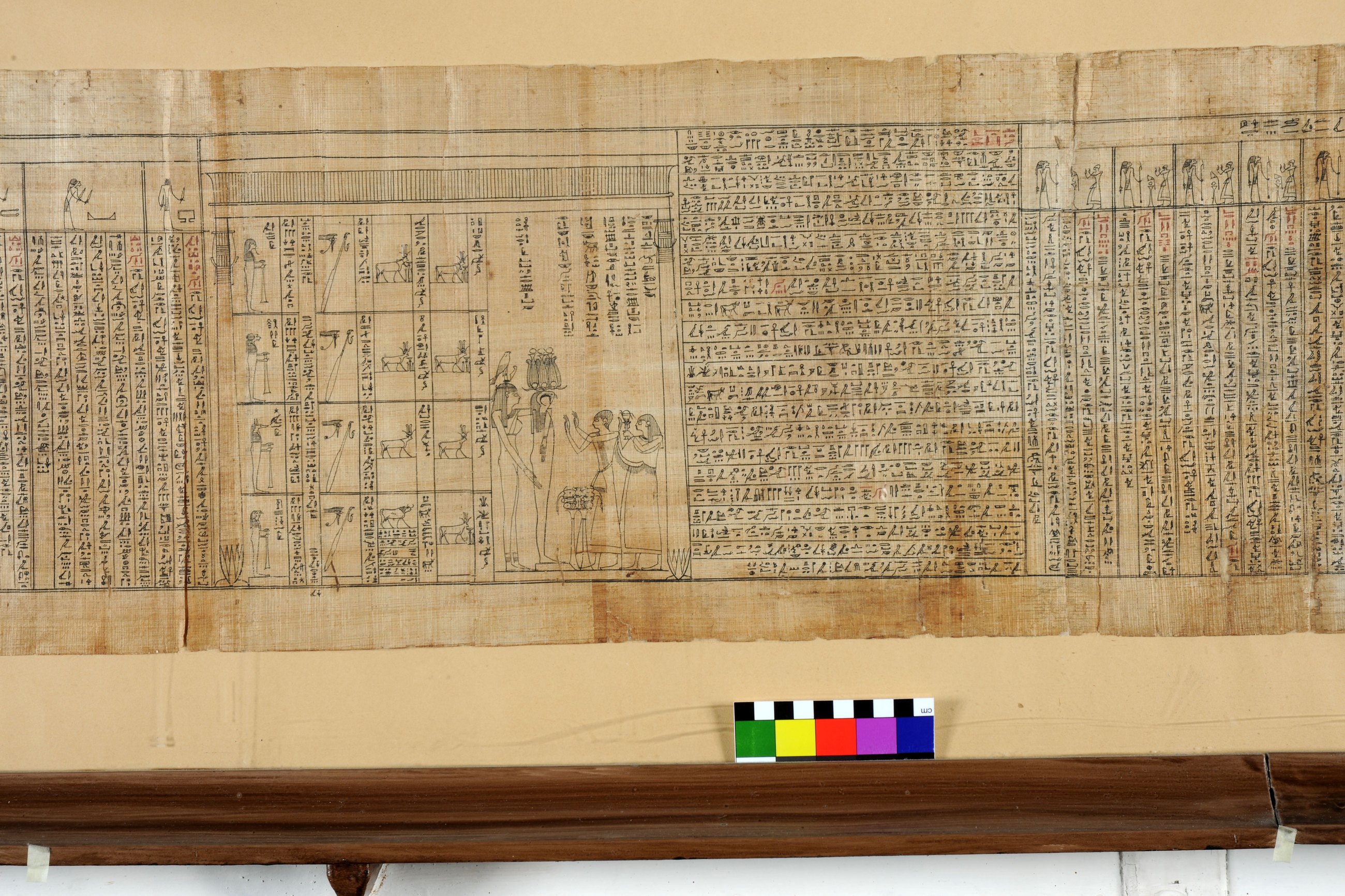
Spell 148 (Birch: 'The Book of instructing the Spirit, the Delight of the Sun, who prevails as Tum, who is rendered great as Osiris, who is made powerful like him who dwells in the West, who is terrible like the Gods.') is on Lepsius's plates LXIX-LXX and on photograph 27 of the 31 Museo Egizio photographs of the roll.
The Egyptian is the transliteration of the Thesaurus Linguae Aegyptiae (edition by Burkhard Backes), with the column number of the spell before each column; the numbers are those of Lepsius's plates. On the papyrus the text runs in vertical columns of cursive hieroglyphs from right to left along the roll; titles and some words are written in red. Signs restored by the editor are in square brackets, signs the scribe left out in angle brackets, superfluous signs in braces and damaged signs in half brackets. The English is the translation by Samuel Birch, published in 1867 and made from Lepsius's copy of this papyrus, so the English and the Egyptian come from the same manuscript. It was the first complete English translation of the Book of the Dead; many passages are now understood differently. Birch's own square brackets give his alternatives and explanations. The photographs are by the Museo Egizio; each shows a stretch of the roll, and the note of each section says where the spell stands on it.
How was this verified? (Provenance)
Where on the image
Turin 1791, Spell 148 (TLA Tb 148: columns 1-37; Lepsius 1842, pl. LXIX-LXX). Photograph 27 of 31 (Commons Book_of_the_Dead_of_Iuefankh,_papyrus_-_Museo_Egizio_Turin_C_1791_p08.jpg): the horizontal lines at 50-76% (Lepsius pl. LXIX) and the vignette of the cows and the bull under a cornice at 15-50% (Lepsius pl. LXX). Checked by eye: the photographs were matched to Lepsius's plates by their vignettes, red titles and framed compartments, and the overlapping edges of neighbouring photographs were compared. Birch numbers this spell CXLIX (his numbers run one ahead of Lepsius's from 145 on).
1mḏꜣ,t n.t sjqr ꜣḫ{.tw} ḥr jb n Rꜥ,w rḏi̯.t sḫm =f ḫr Jtm,w sꜥꜣ =f ḫr Wsjr swsr =f ḫr ḫnt,j-jmn,tt rḏi̯.t šf〈y〉,t =f ḫr psḏ,t jri̯.tw =f hrw ꜣbd〈,w〉 sn,wt smd,t
2wꜣg ḥ〈ꜣ〉b Ḏḥw,tj ms〈w,t〉-Wsjr ḥ〈ꜣ〉b Mn,w grḥ n h〈ꜣ〉kr sštꜣ m dꜣ,t bz štꜣ m jgr,t sḏ {r}ḏw.w wbꜣ jn,t sštꜣ n rḫ〈.w〉 rs〈j〉 srwḏ jb n ꜣḫ
3wsḫ nmt,t =f rḏi̯.t šmi̯ =f dr ky-ḏd jrj ⸢j〈w〉n⸣ ḥr =f swbꜣ ḥr =f ḥnꜥ nṯr n rḏi̯ mꜣꜣ r〈m〉{r}〈ṯ〉 nb wp-ḥr nswt ḥnꜥ ẖr〈,j〉-ḥ〈ꜣ〉b〈,t〉 n mꜣꜣ
4ḥr ḥm jy.tw r-rw,t jr ꜣḫ nb jri̯ =tw n =f mḏꜣ,t tn jw bꜣ =f pri̯〈.w〉 m hrw ḥnꜥ ꜥnḫ,pl jw =f sḫm =f m-m nṯr.pl jw,t ḫsf =f
5m šs-mꜣꜥ ḥḥ n zp jw nṯr.pl jpn pẖr =sn sw sjꜣ =sn sw wnn.ḫr =f mj wꜥ,w jm =sn ḏi̯ =f rḫ ḫpr n =f m šꜣ,w mḏꜣ,t tn štꜣ〈,t〉 mꜣꜥ〈.t〉
6zp-2 nn rḫ ky m b〈w〉-nb r-nḥḥ nn ḏd n r〈m〉ṯ,t nb.t nn wḥm n jr,t!! nn sḏm n msḏr nn rḏi̯.t mꜣꜣ =s wp-ḥr =f ḥnꜥ sbꜣ sw jmi̯ =k ꜥšꜣ-rʾ.pl ky-ḏd rḏi̯.t wp-ḥr =k
7ḏs =k ḥnꜥ jm,j-jb =k jri̯ =k m-ẖnw zḥ n ḥbs wdi̯〈.w〉 m sbꜣ〈.pl〉 m qnw r-ḏr =f sštꜣ pw mꜣꜥ 〈n〉 rḫ s〈j〉 ḥꜣw-mr nb m b〈w〉 nb sḏfꜣ ꜣḫ
8m ẖr,t-nṯr rḏi̯.t ḏfꜣ n bꜣ =f ḥr-tp tꜣ rḏi̯.t wnn =f ꜥnḫ〈.w〉 r-nḥḥ nn sḫm 〈j〉ḫ,t-nb〈,t〉 jm =f ḏd-md,t j:nḏ-ḥr =k Rꜥ,w psḏ m jtn =f ꜥnḫ pri̯
9m ꜣḫ,t jw Wsjr […] mꜣꜥ-ḫrw rḫ〈.w〉 rn =k jw =f rḫ〈.w〉 sfḫ kꜣ.y,t ḥnꜥ kꜣ jr〈,j〉 =w ḏḏ!.w
10tʾ ḥ〈n〉q,t n ꜥnḫ,w sḏfꜣ.w jmn,tj.w ḏḏ! =ṯn tʾ ḥ〈n〉q,t n Wsjr […] mꜣꜥ-ḫrw sḏfꜣ =ṯn sw
11ḏi̯ =ṯn n =f ꜣḫ,w sšmi̯ ={f}ṯn 〈sw〉 Wsjr […] mꜣꜥ-ḫrw ⸢〈ḥr〉⸣ šms =ṯn ẖr ḫpd =ṯn ḏi̯ =ṯn tʾ ḥ〈n〉q,t
12ꜣḫ,w n Wsjr […] mꜣꜥ-ḫrw ntf ꜣḫ m ẖr,t-nṯr Ḥw,t-kꜣ-nb〈,t〉-r-ḏr Šn〈j〉,t-p,t-〈w〉ṯz〈,t〉-nṯr jqr〈.t〉 ḫnt〈,j.t〉-s,t =s ꜣḫ-bj〈,tt〉-sꜥḥ,w
13Wr-mr,wt≡s-dšr-šn〈j〉,pl Sḫm〈,t〉-rn≡s-m-ḥmw〈,t〉 H̱nm〈,t〉-ꜥnḫ-jnmm≡s kꜣ ṯꜣ〈y〉 jd,t.pl
14j sḫm-n-p,t-wn-jtn-ḥm,w-nfr{.t}-n-p,t-mḥ,t〈t〉 j Rꜥ,w-sšm-Tꜣ,du-ḥm,w-nfr-n-p,t-jmn,t j ꜣḫ-ḥr〈,j〉-jb-ḥw,t-ꜥḫm,pl-ḥm,w-nfr-n-p,t-jꜣb,tt
15j ḫnt〈,j〉-ḥr〈,j〉-jb-ḥw,t-dšr,pl-ḥm,w-nfr{.t}-n-p,t-rsj〈,t〉 ḏi̯ =ṯn tʾ ḥ〈n〉q,t ḏf〈ꜣ〉.w ꜣḫ,w n Wsjr […]
16mꜣꜥ-ḫrw m n,tj ꜣḫ m Wsjr j jti̯ nṯr.pl j mw,t nṯr.pl m ẖr,t-nṯr nḥm =ṯn Wsjr […] mꜣꜥ-ḫrw m-ꜥ 〈j〉ḫ,t-nb,t ḏw〈.t〉
17m-ꜥ sḏb nb ḏw m-ꜥ nkn nb ḏw m-ꜥ sḫt pfj mr dm ḏd.t r〈m〉t.pl nṯr.pl ꜣḫ.pl mtj.pl m hrw pn m
18grḥ pn m smd,t tn m rnp,t tn ẖr,t.pl =s js ḏd-mdw jn z ḫft Rꜥ〈,w〉 ḏi̯ =f sw ḥr nn n nṯr.pl zẖꜣ〈.w〉 m wꜣḏ ḥr ꜥn rḏi̯
19ḥtp m-bꜣḥ =s tʾ ḥ〈n〉q,t jwf snṯr jri̯ pr-ḫrw ꜣḫ pw ḫr Rꜥ,w sḏf〈ꜣ〉 ꜣḫ m ẖr,t-nṯr
20nḥm z pw m-ꜥ 〈j〉ḫ,t-nb,t ḏw〈.t〉 jmi̯ =k jri̯ ḥr r〈m〉{r}〈ṯ〉{,t} nb wp-ḥr =k ḏs =k mḏꜣ,t tn n.t Wnn-nfr,w mꜣꜥ-ḫrw
21jr jri̯ =tw n =f nn wnn Rꜥ,w m ḥm,w =f m mk,t =f nn ḫmi̯ sw ḫfti̯〈.pl〉 nb.pl gꜣw.tw =f ky-ḏd n =f m ẖr-nṯr m p,t
22m tꜣ m b〈w〉 nb šmi̯ =f jm =sn sḏfꜣ ꜣḫ{,w}.pl m ẖr,t-nṯr m šs-mꜣꜥ ḥḥ n zp
27Wsjr nb-nḥḥ ⸢wr⸣ nb-ḏ,t nṯr-ꜥꜣ ḥqꜣ jgr,t
28Jmn,tt-nfr,t ꜥ.wj =s r šzp =k
26jꜣ,w n =k kꜣ-jmn,tt ⸢wr⸣ nb-ḏ,t nṯr-ꜥꜣ ḥqꜣ
25jgr,t šzp =k Wsjr […] mꜣꜥ-ḫrw r jmn,tt
24nfr.t m-ḥtp zmi̯,t ḏi̯ =s ꜥ.wj =s r šzp =k ḥnꜥ
23nb〈,t〉-pr =k nn gmi̯ wn =k
29Ḥw,t-kꜣ-nb〈,t-r〉-ḏr Šn,tj!!-wṯz〈,t〉-nṯr Jmn.t ḫnt〈,j.t〉-s,t =s Ꜣḫ-bj,t〈t〉-sꜥḥ-nṯr
31Wr-mr,wt≡s-dšr,t-šnj,pl H̱nm〈,t〉-ꜥnḫ-jnmm≡s Sḫm-rn≡s-m-ḥmw〈,t〉 Kꜣ ṯꜣy ḥm.y〈,t〉
32ḏḏ! =ṯn tʾ ḥ〈n〉q,t ḏf〈ꜣ〉 ꜣḫ,pl n Wsjr […] mꜣꜥ-ḫrw ḏfꜣ =ṯn sw ḏi̯ =ṯn n =f tʾ ḥ〈n〉q,t jḥ.pl ꜣpd.pl 〈j〉ḫ,t-nb,t nfr〈.t〉
33j Sḫm-wn-jtn-ḥm,w-nfr-n-p,t-mḥ,tt j Dbn-sšm-Tꜣ,du-ḥm,w-nfr-n-p,t-jꜣb,tt j ꜣḫ-ḥr〈,j〉-jb-ꜥḫm,pl-ḥm,w-nfr-p,t-jmn,tt j ḫnt〈,j〉-ḥr〈,j〉-jb-ḥw,t-dšr,pl-ḥm,w-nfr-n-p,t-rsj〈,t〉
36j nṯr.pl ḥr〈,j.w〉-jb p,t tꜣ sšmi̯.pl Dꜣ,t j nṯr.pl ḥr〈,j.w〉-jb p,t tꜣ jm,j〈.w〉 ẖr,t-nṯr m pr,w Wsjr ḥqꜣ-ḏ,t j nṯr.pl šms Rꜥ,w jm,j〈.w〉-ḫt Wnn-nfr,w j nṯr.pl šms〈,w〉 n jm,j tꜣ-ḏsr ḥr,j.pl sšm.pl Dꜣ,t
35ḏi̯ =ṯn tʾ ḥ〈n〉q,t jḥ.pl ꜣpd.pl n Wsjr […] mꜣꜥ-ḫrw ḏfꜣ.pl sw ḏi̯ =ṯn n =f ꜣḫ,w m ẖr,t-nṯr ḏi̯ =ṯn n =f ḥr n p,t tꜣ ꜣḫ,t Jwn,w Dꜣ,t jw Wsjr […] mꜣꜥ-ḫrw rḫ sw rḫ =ṯn sw
37Jmsṯ Ḥpy Dwꜣ-mw,t≡f Qbḥ-sn,pl≡f
CXLIX. The Book of instructing the Spirit, the Delight of the Sun, who prevails as Tum, who is rendered great as Osiris, who is made powerful like him who dwells in the West, who is terrible like the Gods.
Made the day of the month of festival of the Sixth and the festival of the Fifteenth, of the festival of the Lintel, that of Thoth, that of the birthday of Osiris, of Skhem, and the night of the festival of Haker, the mysteries of the Gate, and of traversing the secret places in Hell, prevailing against the Evil, passing the secret valleys, the mouth and path of which are unknown, corroborating the Spirit who stretches his legs, to go his journey correctly or making a hole it to pass through it with the God. No man sees it except a king and a priest, no slave’s face looks at it. Every Spirit for whom this book has been made having come and gone round, his Soul comes away on the day with the living, he has prevailed as the Gods do, he is not stopped in true linen for a million of times [at all]. The Gods, they approach him, they touch him, for he is like one of them; he lets [them] know what he has done in [the beginning of] this secret book of truth. There is not known any such anywhere or ever; no men have spoken it, no eye has perceived it, no ear has heard it, not any one other face has looked in it to learn it. Do not thou multiply its chapters, or do not thou let any face except thy own [see it] and eat thy heart, doing it in the midst of the Hall of Clothes, [Judgment], it is put forth by the God with all his power. It is true secret; when it is known, all the providers in all places supply the [dead] Spirits in Hades, food is given to his Soul on earth, he is made to live for ever, nothing prevails against him.
The Speech. — Hail, oh Sun, shining in the living orb, coming out of the horizon! The Osiris has known thy name, he has known the seven cows and their bull, who give of food and of drink to the living, and who feed the Gods of the West. Give ye food and drink to the Osiris, feed him. Give ye things to him the Osiris he pursues ye he serves ye at your side. Give ye food and drink to the Spirit of the Osiris. He is a Spirit in Hades.
[Names of Cows and Bull.]
1. Hat ka neb ter. Abode of being of the Universal Lord.
2. Shen pe Uts neter. Turn of heaven, conductor of the God.
3. Akar khent kats. Wise one keeping her place.
Mera hba sahu. Lower world, mummy.
5. Ur merits tesher shen. The greatly-beloved, redhaired.
6. Khem rans em khekh. Prevailing by the name in her throat.
7. Nem ankh anems. Imparting life to her skin.
8. The Bull, the husband of the Cows.
Oh Chief of the heaven, opener of the Orb, good paddle of the North of the heaven!
Oh Sun, traversing the earth, good paddle of the West of the heaven!
Oh Spirit, dwelling in the abode of the Extinguished, [?] good paddle of the East of the heaven
Oh Breath, dwelling in the red abode [desert], good paddle of the South of the heaven!
Give ye food, drink, and supplies to the deceased, in that he is a Spirit like Osiris.
Oh Father of the Gods, Mother of the Gods in Hades save ye the Osiris from every evil thing, from all evil deriders, or pollution, from all evil liers in wait, from the wicked netting of the dead [deficient] Gods, Spirits, quick or dead! on that day announce the words, on that night, on that fifteenth-day festival, on that year when it occurs. Said by a person facing the Sun, who gives him the heart of the Gods painted green upon a tablet. Place a heap before it of food and drink, flesh and incense; make the meals of the dead, supplying the dead in Hades. A person is then saved from all evil things in Hades Do not let any human face see it except thy own face. This is the Book of Annefer; should he have made the same, the Sun is rudder and protector. No opposition destroys him; he is or has been purged in Hell, in Heaven or Earth, in all places in which he goes; the spirits in Hell are supplied in pure linen for ever.”
[The Vignette.— Th Deceased adoring the Mummy of Ptah-Sokharis. Osiris imported by the
G Goddess of the West. Ptah It called “ Osiris, Lord of many Days, the Chief, the Lord of
Eternity, Great God, Ruler of Akar.t.” The West is styled The good West holds out her
Arms to take thee." Ptah-Sokharis-Osiris.]
The deceased says: “ Hail, Bull of the West! Chief, Eternal Lord, Ruler of Akar, receive thou the Osiris at the happy West in peace. The land gives her arms to take thee, with thy wife, no fault is found in thee.”
The seven Cows and Bulls are invoked by their names already cited:
“ Give ye food and drink, incense, light, provide them. Give ye to him daily food and drink, oxen, geese, and all good things.”
The four Paddles and Eyes are invoked by their mystical names:
1. Amset. Oh Gods superintending heaven and earth, passers of the Empyreal Gate!
2. Hapi. Oh Gods, protectors of heaven and earth, attached to Hades, in the abode of Osiris!
3. Tuautmutf. Oh Gods, servants of the Sun, belonging to Annefer.
4. Kabhsenuf. Oh Gods, servants of the attached to the land of Taser, over the passengers of the Gate, give ye bread and drink, flesh and fowl, to the Osiris, supply them, give ye to him information [light] in Hades. Give ye to him to go through the secret places of the Horizon, the lintels of the Gate. The Osiris has known them, [as] ye know them.
Notes
- Birch's English was taken from three scans of Bunsen's Egypt's Place in Universal History, vol. V (1867), on the Internet Archive. The three OCR texts were aligned word by word and each word was settled by their agreement; running heads, page numbers, footnote markers and footnotes were removed. Some OCR errors may remain, chiefly in proper names.
- Birch uses the terms and name forms of his time: Hades, Aahlu (Elysium), Tum for Atum, Seb for Geb, Anup for Anubis, Phoenix or Bennu for the heron.
- Labels such as 'title line' or 'gate 1' before a line of the Egyptian translate the position labels of the TLA.
- The TLA has no hieroglyphic encoding for these texts, so only the transliteration is shown.
Cite
Sources
- Source: Papyrus of Iuefankh, Turin, Museo Egizio Cat. 1791 (Museo Egizio photographs, CC0) + TLA transliteration (ed. B. Backes, CC BY-SA 4.0) + English of Samuel Birch (1867, public domain) (holding institution)
- Critical edition: Thesaurus Linguae Aegyptiae, ed. Burkhard Backes (2018 data, AED-TEI)
← previous · → next · v cycle view · l back to library