Book of the Dead, Spell 153: Escaping from the Net (papyrus of Iuefankh)
Introduction
The Book of the Dead, in Egyptian the spells for going forth by day, is a collection of funerary spells written on papyrus rolls and placed in burials from the New Kingdom to the Roman period. Each roll was made for one person, with spells taken from a large repertoire and illustrated with drawings (vignettes). This library gives one complete roll: the papyrus of Iuefankh in the Museo Egizio, Turin (Cat. 1791), written in the Ptolemaic period (332-30 BCE) and coming from Thebes. Richard Lepsius published it in 1842 and divided it into 165 chapters; his numbering is still the standard numbering of the spells, and it is used here.
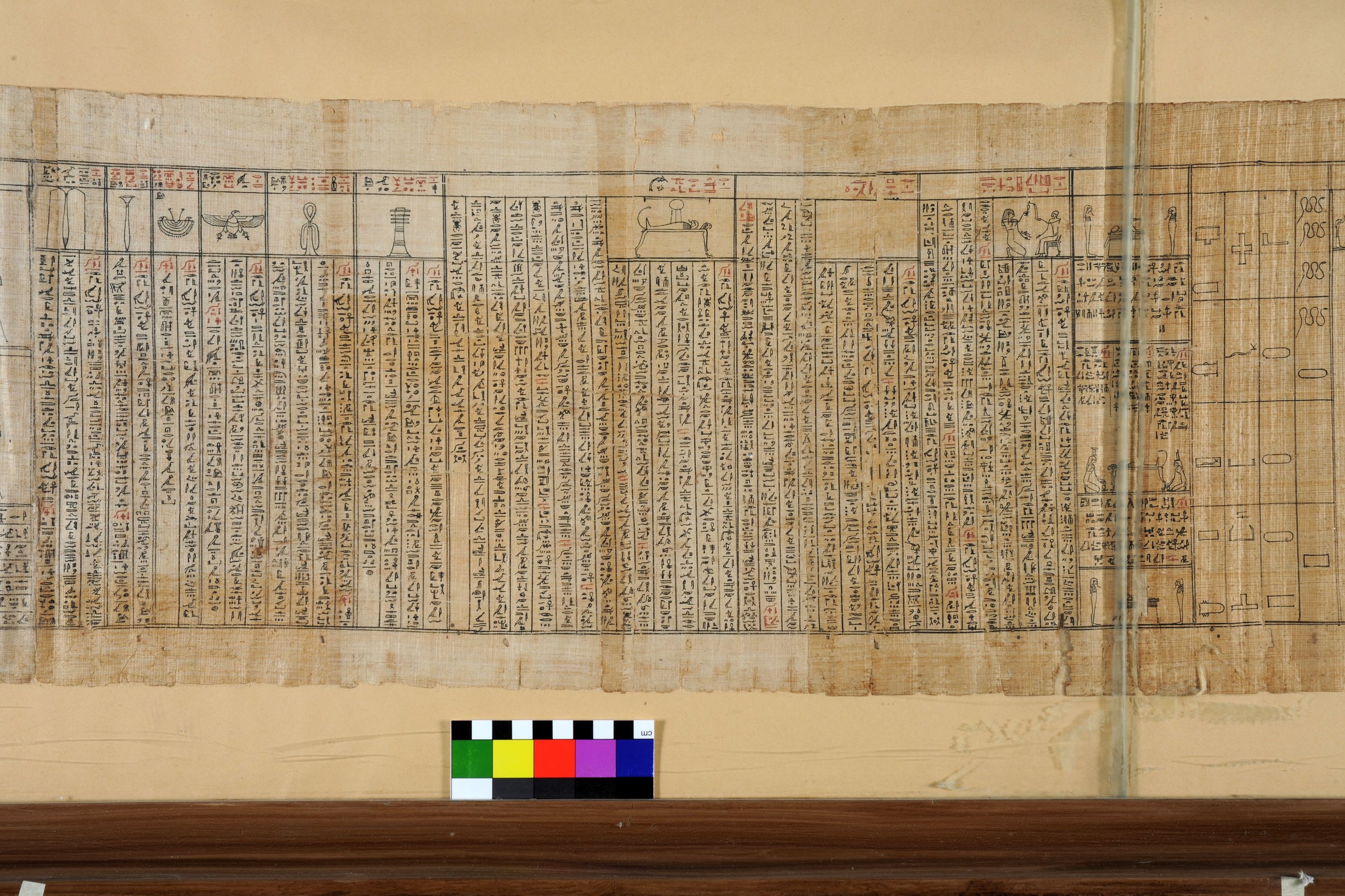
Spell 153 (Birch: 'The chapter of Escaping from the Net.') is on Lepsius's plate LXXIV and on photograph 29 of the 31 Museo Egizio photographs of the roll.
The Egyptian is the transliteration of the Thesaurus Linguae Aegyptiae (edition by Burkhard Backes), with the column number of the spell before each column; the numbers are those of Lepsius's plates. On the papyrus the text runs in vertical columns of cursive hieroglyphs from right to left along the roll; titles and some words are written in red. Signs restored by the editor are in square brackets, signs the scribe left out in angle brackets, superfluous signs in braces and damaged signs in half brackets. The English is the translation by Samuel Birch, published in 1867 and made from Lepsius's copy of this papyrus, so the English and the Egyptian come from the same manuscript. It was the first complete English translation of the Book of the Dead; many passages are now understood differently. Birch's own square brackets give his alternatives and explanations. The photographs are by the Museo Egizio; each shows a stretch of the roll, and the note of each section says where the spell stands on it.
How was this verified? (Provenance)
Where on the image
Turin 1791, Spell 153 (TLA Tb 153: title line, columns 1-9; Lepsius 1842, pl. LXXIV). Photograph 29 of 31 (Commons Book_of_the_Dead_of_Iuefankh,_papyrus_-_Museo_Egizio_Turin_C_1791_p06.jpg): red title at 61-67%, its columns at 55-68%. Checked by eye: the photographs were matched to Lepsius's plates by their vignettes, red titles and framed compartments, and the overlapping edges of neighbouring photographs were compared. Birch numbers this spell CLIV (his numbers run one ahead of Lepsius's from 145 on).
titlerʾ n pri̯〈.t〉 m jꜣd,t
1ḏd-mdw jn Wsjr […] mꜣꜥ-ḫrw j mꜣwi̯ m ḥr =f sḫm.pl jpw ms.pl 〈j〉pw jti̯.pl ky-ḏd jti̯.pl =sn ḥ〈ꜣ〉m.pl ꜥḫi̯.ypl m-ẖnw nwy
2nn ḥ〈ꜣ〉m.{nn}n =ṯn w〈j〉 ky-ḏd {n}〈w〉nḏw.w 〈m〉 jꜣd,t =ṯn twy wḥꜥ =ṯn wj šmi̯ m tꜣ jm =sn {w}ḏb〈ꜣ〉.pl =sn r p,t
3dns =sn r tꜣ pri̯ m-ꜥb =s{w} Wsjr […] mꜣꜥ-ḫrw 〈m〉 nwḥ =s pri̯.n =j m Ḏd,w Wsjr […] mꜣꜥ-ḫrw jm =s bjk
4wš r =j rn =j jri̯ =ṯn ḏꜣy,t.pl rḏi̯ =tw m wḥꜥ ḏd =f n jmn ky-ḏd jri̯.n =j pwy r〈m〉ṯ.pl m mḥ ḏd =f jmn,y jw =j rḫ.kw ꜥḏ
5jm,y ḥwj wj wr{,t} n =k ky-ḏd ṯz jm,j šmꜥ wr n =k jr ḫt n,tj 〈j〉m ḏr,t pw n.t ꜣs,t šꜥd.t n,tj jm =s ḥsb〈,t〉 twy n.t Wsjr ky-ḏd rn n wḥꜥ.pl =sn
6ḥr,j ⸢nꜣk⸣ =f šꜥd pw ḥsb.pl Ḥr,w jm jw rḫ.kw rn n ḏbꜣ wdns.w pn rn n ky-ḏd ⸢tjtw⸣ nbj.w wdn.w pꜣḏ
7mꜣs,t m Rw,tj jw =j rḫ.kw nwḥ n =s ⸢{j}〈ḥ〉〈ꜣ〉m.y⸣ {n-}n,tj ḥr =s rwḏ pw n.t Jtm,w jw =j rḫ.kw rn n wḥꜥ.pl =sn ḥr,j.{n}〈pl〉 ꜣkr.pl
8pw ꜥ.pl ꜣẖb,wy =s mḫsf {sbd}〈sbq〉 Šzm,w jw =j rḫ.kw rn n ꜥ.wj =ṯn jw ꜥ.wj =sn wn =f ꜥ pwy n nṯr-ꜥꜣ sḏm md,t m Jwn,w grḥ pwy n smd,t ḏd-mdw ḥr twt n
9ꜣḫ pn rḏi̯〈.w〉 m wjꜣ pn jsk jri̯.n =k sk,tt m gs =f wnmi̯ mꜥnḏ,t m gs =f jꜣbi̯ wdn =sn tʾ ḥ〈n〉q,t 〈j〉ḫ,t-nb〈,t〉 nfr〈.t〉 hrw ms-Wsjr jr rḏi̯ =tw n =f nn wnn bꜣ =f ꜥnḫ〈.w〉 r-nḥḥ n mt =f m-wḥm
CLIV. The chapter of Escaping from the Net.
(Vignette. [Pap. — Deceased walking away from a Net.]
On! seeing with his face, the prevailers, chief of the born that is, fathers or their fathers, catching the birds flying on the waters! Do not catch your equals or fellows with your nets, [nor] catch me in them, walking away from earth. They reach to heaven, they stretch to earth. The Osiris comes forth and breaks them [when they are stretched]. I have come forth from Tattu, the Osiris there; the hawk laments my name. Make ye the poles, ?] placed to net. He says to the God Ameni, [Hidden] or I have made men to fly with wings. Ameni says to him, I know the. the chief belonging to thee, or I tie him belonging to the South, the chief, to thee. [?] It is the stick which is in the hand of Isis, cutting that which is in it; it is the knife [?] of Osiris — or the name of their catcher is Harana kaf shat, [over the pursuit of blows]. The blows are where the bodies of Horus are. I knew the name of the box Utensu is the name, or. . offerings —the foot and the sole of the foot of the Lion-Gods. I know the [name of the] rope of the fowlers; which is in it — the work of Tum. I knew the name of their fishers —over the vipers or the hands of its monster stopping the. ...of... am. I knew the names of your arms. The arms are those of Bent-arm, those of the Great God listening to words in Annu [Heliopolis] the night of the Festival of the 15th of the month.
Said over the figure of that Spirit, placed in the boat. Then make to thee a cabin on its left hand, and a forecastle on its right; offer to them food and drink, and all good things, the day of the birth of Osiris. When thou hast done so, thy Soul lives for ever, and never dies again.
Notes
- Birch's English was taken from three scans of Bunsen's Egypt's Place in Universal History, vol. V (1867), on the Internet Archive. The three OCR texts were aligned word by word and each word was settled by their agreement; running heads, page numbers, footnote markers and footnotes were removed. Some OCR errors may remain, chiefly in proper names.
- Birch uses the terms and name forms of his time: Hades, Aahlu (Elysium), Tum for Atum, Seb for Geb, Anup for Anubis, Phoenix or Bennu for the heron.
- Labels such as 'title line' or 'gate 1' before a line of the Egyptian translate the position labels of the TLA.
- The TLA has no hieroglyphic encoding for these texts, so only the transliteration is shown.
Cite
Sources
- Source: Papyrus of Iuefankh, Turin, Museo Egizio Cat. 1791 (Museo Egizio photographs, CC0) + TLA transliteration (ed. B. Backes, CC BY-SA 4.0) + English of Samuel Birch (1867, public domain) (holding institution)
- Critical edition: Thesaurus Linguae Aegyptiae, ed. Burkhard Backes (2018 data, AED-TEI)
← previous · → next · v cycle view · l back to library