Book of the Dead, Spell 154: Not letting the Body corrupt (papyrus of Iuefankh)
Introduction
The Book of the Dead, in Egyptian the spells for going forth by day, is a collection of funerary spells written on papyrus rolls and placed in burials from the New Kingdom to the Roman period. Each roll was made for one person, with spells taken from a large repertoire and illustrated with drawings (vignettes). This library gives one complete roll: the papyrus of Iuefankh in the Museo Egizio, Turin (Cat. 1791), written in the Ptolemaic period (332-30 BCE) and coming from Thebes. Richard Lepsius published it in 1842 and divided it into 165 chapters; his numbering is still the standard numbering of the spells, and it is used here.
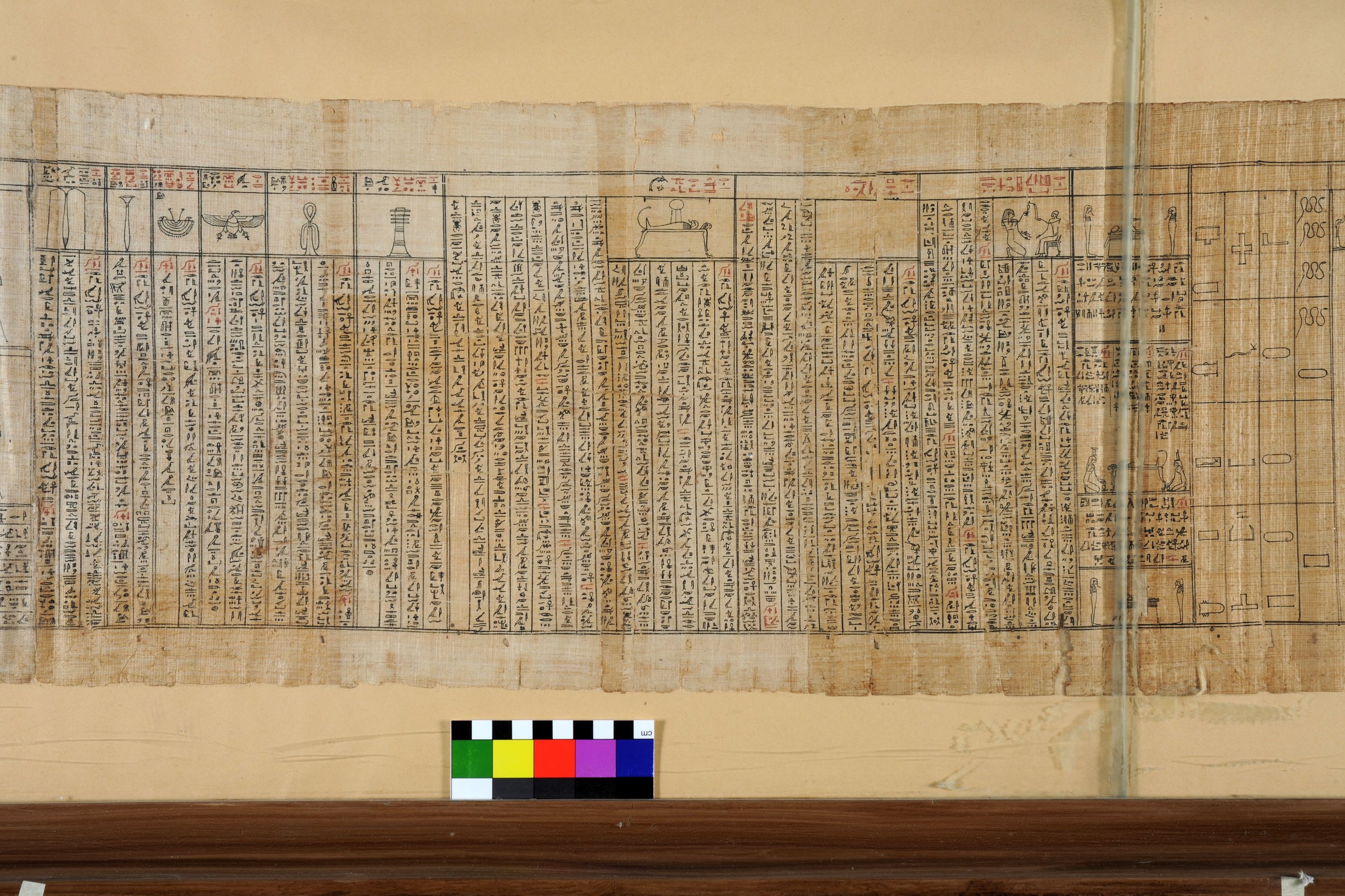
Spell 154 (Birch: 'The chapter of Not letting the Body corrupt.') is on Lepsius's plate LXXV and on photograph 29 of the 31 Museo Egizio photographs of the roll.
The Egyptian is the transliteration of the Thesaurus Linguae Aegyptiae (edition by Burkhard Backes), with the column number of the spell before each column; the numbers are those of Lepsius's plates. On the papyrus the text runs in vertical columns of cursive hieroglyphs from right to left along the roll; titles and some words are written in red. Signs restored by the editor are in square brackets, signs the scribe left out in angle brackets, superfluous signs in braces and damaged signs in half brackets. The English is the translation by Samuel Birch, published in 1867 and made from Lepsius's copy of this papyrus, so the English and the Egyptian come from the same manuscript. It was the first complete English translation of the Book of the Dead; many passages are now understood differently. Birch's own square brackets give his alternatives and explanations. The photographs are by the Museo Egizio; each shows a stretch of the roll, and the note of each section says where the spell stands on it.
How was this verified? (Provenance)
Where on the image
Turin 1791, Spell 154 (TLA Tb 154: title line, columns 1-14; Lepsius 1842, pl. LXXV). Photograph 29 of 31 (Commons Book_of_the_Dead_of_Iuefankh,_papyrus_-_Museo_Egizio_Turin_C_1791_p06.jpg): red title at 50-55% with the mummy on a bier, its columns at 33-55% (Lepsius pl. LXXV). Checked by eye: the photographs were matched to Lepsius's plates by their vignettes, red titles and framed compartments, and the overlapping edges of neighbouring photographs were compared. Birch numbers this spell CLV (his numbers run one ahead of Lepsius's from 145 on).
titlerʾ n tm rḏi̯.t zbi̯ ẖꜣ,t
1ḏd-mdw jn Wsjr […] mꜣꜥ-ḫrw j:nḏ-ḥr =k jti̯ =j Wsjr ky-ḏd Jtm,w jy.n =j sdw{t}ḫ =j jwf =j pn nn zbj ẖꜣ,t =j tn jw =j tm.kw zp-2 mj
2jti̯ =j Wsjr Ḫprj mj,t{t}〈j〉 pw jw,tj zbj ẖꜣ,t =f mi̯ r =k sḫm ṯꜣw =〈j〉 r =k nb ṯꜣw ṯni̯.w r mj,t{t}〈j〉 =f ḏdi̯ =〈j〉 jr =k nbj.w =k wj m nb q{r}js
3ḏi̯ =k hꜣi̯ =j r 〈n〉ḥḥ mj nw jri̯.n =k ḥnꜥ jti̯ =k Jtm,w ky-ḏd jri̯.n jti̯ =k Jtm,w nn zbi̯ ẖꜣ,t =f pꜣ pw jw,tj ski̯ =f nn jri̯ =j
4msḏd!〈.t〉 =k kꜣ mri̯{.wt} 〈wj〉 kꜣ =k nn wjn =f wj šdi̯{.n} wj m ẖ,t =k kꜣ tm ḥwꜣ =〈j〉 mj nn n jri̯.n =k r nṯr nb nṯr,t nb〈.t〉
5ꜥw,t nb〈.t〉 ḏdf〈,t〉 nb〈.t〉 zbi̯.t〈j〉=f pri̯ bꜣ =f m-ḫt mt h〈ꜣi̯〉 =f m-ḫt zbi̯ =f sw〈t〉 pw n ẖnnj =f qsn ky-ḏd qs.w =f tm〈.w〉 ḥwꜣ =sn
6smꜣy =f jṯi̯.y ḥꜥ =f sgr.y psḏ,t jri̯ =w jwf tm〈.w〉 n ḏw ky-ḏd mw ḏw fꜣi̯ =f snsn =f ḥwꜣ =f ḫpr =f
7n fntj.pl ꜥšꜣ.{t}pl tm jri̯ =f jm =f zbi̯〈.w〉 n jr,t Šw m nṯr nb nṯr,t nb〈.t〉 m ꜣpd.pl nb rm.pl nb ḥfj nb ḏdf,t nb〈.t〉 m ꜥw,t nb〈.t〉 mj,tt mtj.pl tm.y
8tm mꜣꜥ n,tj rḏi̯.n ={w}j ḥr ẖ,t =sn sjꜣ =sn wj jr snḏ =j ḥrjw.n =sn jw sw ḥr-nb mj,tt mt〈.w〉 m {ft}〈ḏd〉f,t nb.t ꜥnḫ〈.t〉 ky-ḏd mj,tt m ꜣ,t =f
9tm〈.w〉 zp-2 m ꜥw,t nb〈.t〉 m ꜣpd.pl nb m rm.pl nb m ḥf〈ꜣ,w〉 nb m ḏd{.tw}f〈,t〉 nb〈.t〉 ꜥnḫ mt 〈jw〉 =sn jm nn zni̯ jrj ḏdf,t nb〈.t〉 tm =sn ky-ḏd ḏd =ṯn nb tm =sn jy r =j m
10ḫpr,w.pl =sn nn rḏi̯ =k wj n smꜣy pwy jm,j ⸢bw⸣ ky-ḏd rmn smꜣ ḥꜥ =sn ẖnn jmn šbn ky-ḏd šbi̯ m ẖꜣ,t.pl ꜥšꜣ.tpl ꜥnḫ m smꜣ ꜥnḫ jrj{.pl}
11wḏ,t =f nn rḏi̯ =k wj r ḏbꜥ.pl =f nn sḫm jm =k m wḏ m nb nṯr.pl j:nḏ-ḥr =k jti̯ =j Wsjr wnn ḥꜥ =k ḥnꜥ =k nn ḥwꜣ =k nn fntj.pl =k nn fꜣi̯ =k snsn =k nn jm{m}〈k〉 =k
12nn ḫpr =k m fntj.pl nn zbi̯ =〈j〉 n jr,t Šw jw =j wnn.kw zp-2 ꜥnḫ.kw zp-2 rwḏ.kw zp-2 rs.n =j m-ḥtp nn ẖnn =〈j〉 nn ḥtm =j jm sqꜣi̯ zp-2
13nn h〈ꜣ〉b gꜣw =j nn jꜣd msḏr =j nn rḏi̯!! sw tp =j nḥb,t =j nn jṯi̯.tw ns{,t} =j nn wsḥ.tw =〈j〉 nn wnjwn!! jnḥ.wdu =j
14nn ḫpr nkn r ẖꜣ,t =j nn ski̯ =s nn ḥtm =s m tꜣ pn ḏ,t 〈n〉ḥḥ
CLV. The chapter of Not letting the Body corrupt.
Vignette. — Sun shedding its Rays on the Mummy on its Bier.)
Hall, oh my father Osiris or Tum! I have come, I prepare this my body. This my body does not pass away. I have not done like my father Osiris, the Creator. It is as if his body does not pass away. Come thou, raise the winds, the Lord of the Winds, where is like. Establish thee, thou art honoured as the Lord of Embalming. Let me go for ever, as thou hast done with thy father Tum, or as thy father Tum has done. His body does not waste. He it is who is indestructible. I do not do what thou hatest, but what thy thought wishes. No harm was done to me when I passed through thy belly, receiving no impurity, which thou hast given to every God and Goddess, every beast, and reptile, when it [he] has perished, its [his] soul departs after death, it goes after it perishes; it is empty corruption or [his] bones; they do not rot his hair; or it [he] take its flesh, or silencing the Gods that its flesh is made without evil, or evil fluid, it [he] rises, it [he] stinks; he turns to filth, he changes into innumerable insects, he is not made of it. The eye of Shu has rotted in all Gods and Goddesses, fowl, fish, snakes, reptiles, and beasts like the dead, doing what is not true. I have been placed in their bellies. They touch me. The fear of me alarms them. All creation is, when dead, [turned] into living reptiles, or, as in its [his] moment of not existing, into beasts, birds, fishes, snakes, and reptiles, which live and die; they do not pass and make reptiles; they are not, or all which ye say are not. Let me come in their forms. I am not made for the injuries which are in substance, or arm smiting the limbs, the concealed corruption, full of or changing into numerous bodies, living by destroying life, doing what he [it] has been ordered. I do not place myself in his fingers, [there] what has been ordered by the Lord of the Gods does not prevail against thee.
Hail, my father Osiris! Thy limbs are with thee; thou dost not corrupt, thou dost not turn to worms, thou dost not rise up, thou dost not stink, thou dost not decay [?], thou dost not change into worms. The Eye of Shu has not decayed away —I am! I am! I live! live I grow! I grow! I wake in peace. I am not corrupted, I am not suffocated there. I grow tall. My substance is not sent away; my ear does not grow deaf; my head and neck do not separate; my tongue has not been taken away, it has not been cut out; my eyebrow is not plucked out. No injury is done to my body, it neither wastes nor is suffocated in that land for ever and ever!
Notes
- Birch's English was taken from three scans of Bunsen's Egypt's Place in Universal History, vol. V (1867), on the Internet Archive. The three OCR texts were aligned word by word and each word was settled by their agreement; running heads, page numbers, footnote markers and footnotes were removed. Some OCR errors may remain, chiefly in proper names.
- Birch uses the terms and name forms of his time: Hades, Aahlu (Elysium), Tum for Atum, Seb for Geb, Anup for Anubis, Phoenix or Bennu for the heron.
- Labels such as 'title line' or 'gate 1' before a line of the Egyptian translate the position labels of the TLA.
- The TLA has no hieroglyphic encoding for these texts, so only the transliteration is shown.
Cite
Sources
- Source: Papyrus of Iuefankh, Turin, Museo Egizio Cat. 1791 (Museo Egizio photographs, CC0) + TLA transliteration (ed. B. Backes, CC BY-SA 4.0) + English of Samuel Birch (1867, public domain) (holding institution)
- Critical edition: Thesaurus Linguae Aegyptiae, ed. Burkhard Backes (2018 data, AED-TEI)
← previous · → next · v cycle view · l back to library