Book of the Dead, Spell 162: Placing Warmth? under the Head of the (papyrus of Iuefankh)
Introduction
The Book of the Dead, in Egyptian the spells for going forth by day, is a collection of funerary spells written on papyrus rolls and placed in burials from the New Kingdom to the Roman period. Each roll was made for one person, with spells taken from a large repertoire and illustrated with drawings (vignettes). This library gives one complete roll: the papyrus of Iuefankh in the Museo Egizio, Turin (Cat. 1791), written in the Ptolemaic period (332-30 BCE) and coming from Thebes. Richard Lepsius published it in 1842 and divided it into 165 chapters; his numbering is still the standard numbering of the spells, and it is used here.
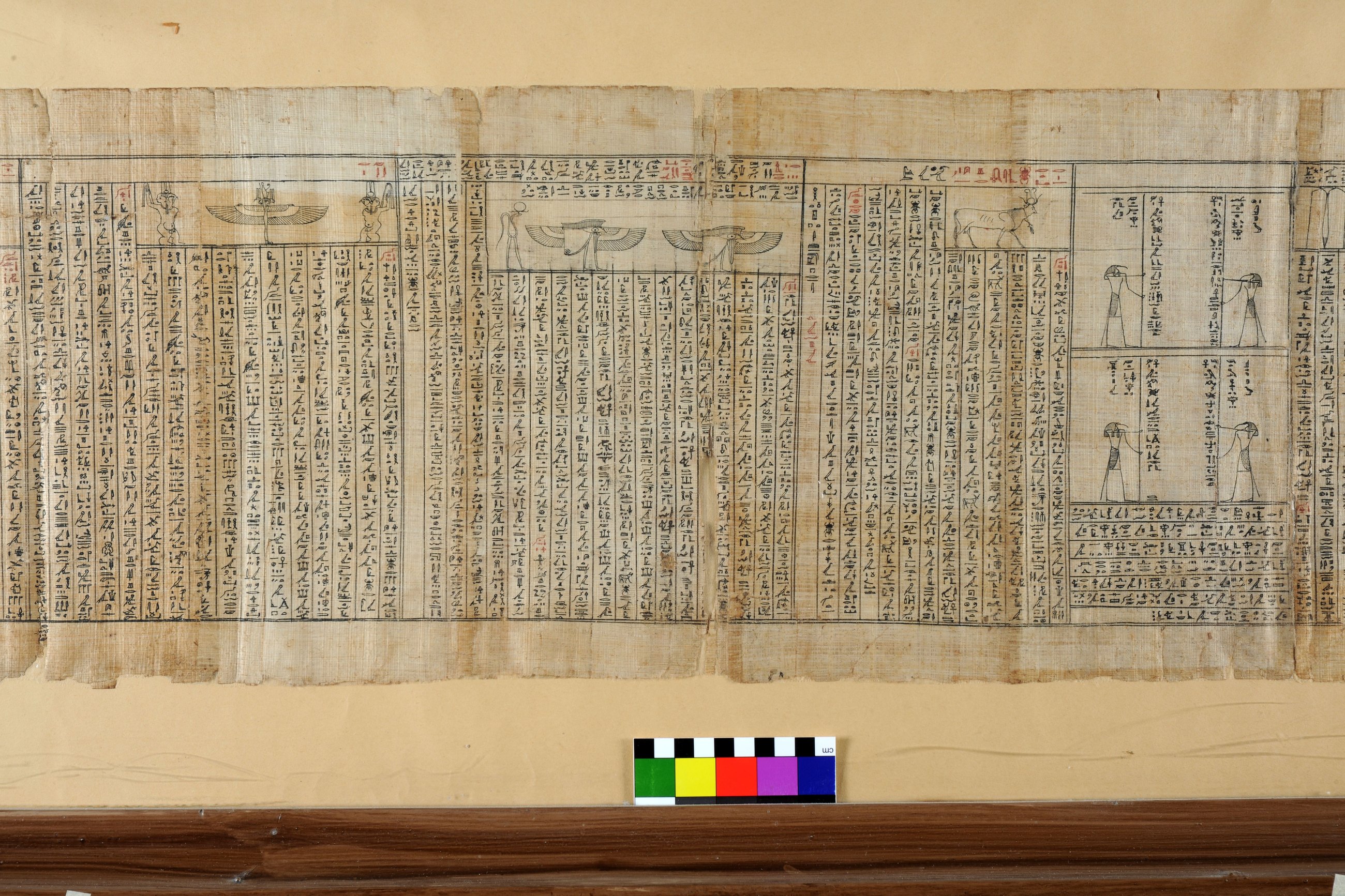
Spell 162 (Birch: 'The chapter of Placing Warmth? under the Head of the') is on Lepsius's plate LXXVII and on photograph 30 of the 31 Museo Egizio photographs of the roll.
The Egyptian is the transliteration of the Thesaurus Linguae Aegyptiae (edition by Burkhard Backes), with the column number of the spell before each column; the numbers are those of Lepsius's plates. On the papyrus the text runs in vertical columns of cursive hieroglyphs from right to left along the roll; titles and some words are written in red. Signs restored by the editor are in square brackets, signs the scribe left out in angle brackets, superfluous signs in braces and damaged signs in half brackets. The English is the translation by Samuel Birch, published in 1867 and made from Lepsius's copy of this papyrus, so the English and the Egyptian come from the same manuscript. It was the first complete English translation of the Book of the Dead; many passages are now understood differently. Birch's own square brackets give his alternatives and explanations. The photographs are by the Museo Egizio; each shows a stretch of the roll, and the note of each section says where the spell stands on it.
How was this verified? (Provenance)
Where on the image
Turin 1791, Spell 162 (TLA Tb 162: title line, columns 1-13; Lepsius 1842, pl. LXXVII). Photograph 30 of 31 (Commons Book_of_the_Dead_of_Iuefankh,_papyrus_-_Museo_Egizio_Turin_C_1791_p05.jpg): red title at 68-79% with the cow, its columns at 60-80% (Lepsius pl. LXXVII). Checked by eye: the photographs were matched to Lepsius's plates by their vignettes, red titles and framed compartments, and the overlapping edges of neighbouring photographs were compared. Birch numbers this spell CLXIII (his numbers run one ahead of Lepsius's from 145 on).
titlerʾ n rḏi̯.t ḫpr bs ẖr tp n ꜣḫ
1ḏd-md,t j:nḏ-ḥr =k pꜣ rw pḥ,tj qꜣi̯-šw,tj nb wrr,t ḥn.w m nḫḫ ntk nb mṯꜣ rwḏ m wbn ḥꜣy
2nn ḏrw,w wbn =f ntk nb ḫpr,w.pl ꜥšꜣ{.t} jnmm.pl ḥꜣp sw m wḏꜣ,t r ms.pl =f ntk nꜥš dn,wyt m-ẖnw psḏ,t
3pḥrr ꜥꜣ ḫ〈ꜣ〉ḫ nmt,t ntk nṯr nꜥš jy n ꜥš n =f nhp,w mꜣjr m-ꜥ jꜣd{,tj} sw mi̯ n ḫrw =j jnk ꜣhꜣ,t
4rn =k m rʾ =j jw =j r ḏd.tw =f P〈ꜣ〉 n-Hꜣqꜣhꜣgꜣ ḥr rn =k ⸢jwrw⸣ ⸢jw⸣ ⸢jqrs⸣ ⸢jnq⸣ ⸢rbty⸣
5rn =k srpt mꜣj srjw rn =k ḫrstj rn =k dwꜣ.n =j rn =k jnk ꜣhꜣ,t sḏm ḫrw =j n pꜣ hrw rḏi̯.jn{n} =k
6bs ẖr tp n Rꜥ,w m =k sw m Dꜣ,t nṯr〈,j〉.t m Jwn,w ḏi̯ =k ḫpr =f mj n,tj ḥr-tp tꜣ ntf bꜣ =k m ḫmi̯ r =f mi̯ n Wsjr […] mꜣꜥ-ḫrw
7ḏi̯ =k ḫpr bs ẖr tp =f yw ntf p〈w〉 bꜣ n tꜣ ẖꜣ,t ꜥꜣ.t n,tj ḥtp.tw m Jwn,w ⸢Jtm,w⸣ rn =f ⸢brktṯw⸣ rn =f mi̯ jr =k
8ḏi̯ =k ḫpr =f mj wꜥ,w m šms,pl =k hꜣy ntf ntk ḏd-mdw ḥr rpy,t ꜣhꜣ,t jri̯.tw m nb,w nfr ḏi̯〈.w〉 r ḫḫ n ꜣḫ ḥnꜥ jri̯.t =s m zẖꜣ,w
9ḥr ḏmꜥ n-mꜣwj rḏi̯〈.w〉 ẖr tp =f wnn bs.pl ꜥšꜣ.{t}pl m qd =f nb mj n,tt ḥr-tp tꜣ mk,t ꜥꜣ.t wr zp-2 jri̯.tn ꜣhꜣ,t n zꜣ =s Rꜥ,w m ḥtp =f
10wnn s,t =f jnḥw.tw m mšꜥ ⸢mhꜣd,t⸣ wnn =f nṯri̯〈.w〉 m ẖr,t-nṯr nn šnꜥ.tw =f ḥr sbꜣ.pl nb n Dꜣ,t m šs-mꜣꜥ
11ḏd.ḫr =k rḏi̯.n =k nṯr,t tn r ḫḫ n ꜣḫ j jmn nꜣ jmn pꜣ n,tj m ḥr,t jmm! ḥr =k n tꜣ ẖꜣ,t n〈.t〉 zꜣ =k swḏꜣ =k sw m ẖr,t-nṯr
12mḏꜣ,t pw ꜥꜣ.t štꜣ,w jmi̯ =k rḏi̯ mꜣꜣ s〈j〉 jr,t-nb〈,t〉 bw,t pw rḫ s〈j〉 ḥꜣp sw ḫpr sw mḏꜣ,t tn
13ḥnw,t ḥw,t jmn〈.t〉 rn =s jwi̯≡f-pw
CLXIII. The chapter of Placing Warmth? under the Head of the
Spirit.
[Vignette. — Cow wearing Disk and Plumes, and Collar.] ]
Oh Paru! [the Lion] glorious, tall plumes! Lord of the Crown, flogging [turning back] with a whip. Thou art Lord of the Generation, growing as the morning light without limit when it shines. Thou art Lord of the numerous Transformations of Skins, hiding them in the Eye at its birth. Thou art the settler of quarrels among the Gods, the great runner, the swift of foot. Thou art the God, the protector of him who has brought his cry to thee. I complain, I protest against those who hurt me; my cry has come! I am the Cow, thy name my mouth. I will tell it, Penha kahakaliar is thy name. Aur au aa karusa ank, Ruba ta thy name. Ivher mau ser is thy name! Kharusata is thy name. I have adored thy name. I am the Cow listening to these words the day I have made thee warmth under the head of the Sun, placing it in the Gate of the God of Time in Annu [Heliopolis]. Let him be as if he was on earth. lie is thy soul, let him have no harm. The Osiris has come. Let warmth be placed under his head. Yes! He is the Soul of the body of the Great One who is at rest in Annu [Heliopolis]. Light, Great Creator, is his name! Barukatatau is his name. Go thou, let him be as one of thy flying servants. Thou art he, he is thou.
Said of the lady, the Cow made of good gold, placed at the neck of the Spirit; and it is made in outline upon a roll of Papyrus placed under his head. There are innumerable warmths in all his frame, as when lie was upon earth. The composition is very great, made by the Cow to her son the Sun when he sets. His place is protected from the myriads of fires. He is God in Hades he has not been turned away from any of the Gates of the Doorway as a true person.
You should say, also, when you have placed this Goddess at the throat of the dead:
Oh Ammon-Ammon! the Ammons who are in heaven! give thy face to the body of thy son, make him well in Hades.
This book is the greatest of mysteries; do not let the eye of any one see it; that is detestable. Learn it, hide it, make it. The Book of the Ruler of the Hidden Place is its name.
It is ended!
Supplement.
The Chapters introduced into a Second Book, besides those of the Manifestation to
Light.
Notes
- Birch's English was taken from three scans of Bunsen's Egypt's Place in Universal History, vol. V (1867), on the Internet Archive. The three OCR texts were aligned word by word and each word was settled by their agreement; running heads, page numbers, footnote markers and footnotes were removed. Some OCR errors may remain, chiefly in proper names.
- Birch uses the terms and name forms of his time: Hades, Aahlu (Elysium), Tum for Atum, Seb for Geb, Anup for Anubis, Phoenix or Bennu for the heron.
- Labels such as 'title line' or 'gate 1' before a line of the Egyptian translate the position labels of the TLA.
- The TLA has no hieroglyphic encoding for these texts, so only the transliteration is shown.
Cite
Sources
- Source: Papyrus of Iuefankh, Turin, Museo Egizio Cat. 1791 (Museo Egizio photographs, CC0) + TLA transliteration (ed. B. Backes, CC BY-SA 4.0) + English of Samuel Birch (1867, public domain) (holding institution)
- Critical edition: Thesaurus Linguae Aegyptiae, ed. Burkhard Backes (2018 data, AED-TEI)
← previous · → next · v cycle view · l back to library