Book of the Dead, Spell 163: Not allowing the Body of a Person to corrupt in Hades; to save him ... (papyrus of Iuefankh)
Introduction
The Book of the Dead, in Egyptian the spells for going forth by day, is a collection of funerary spells written on papyrus rolls and placed in burials from the New Kingdom to the Roman period. Each roll was made for one person, with spells taken from a large repertoire and illustrated with drawings (vignettes). This library gives one complete roll: the papyrus of Iuefankh in the Museo Egizio, Turin (Cat. 1791), written in the Ptolemaic period (332-30 BCE) and coming from Thebes. Richard Lepsius published it in 1842 and divided it into 165 chapters; his numbering is still the standard numbering of the spells, and it is used here.
Spell 163 (Birch: 'The chapter of Not allowing the Body of a Person to corrupt in Hades; to save him from the Devourers of Souls who are imprisoned in the Gate; and not to allow his Sins to be transported from Earth against him. It makes his flesh and his bones sound against worms [?], and every God who is lying in wait for him in Hades. It lets him go out and go in as he has wished. It lets him do everything which is in his heart; he is not crossed. [?]') is on Lepsius's plates LXXVII-LXXVIII and on photograph 30 of the 31 Museo Egizio photographs of the roll.
The Egyptian is the transliteration of the Thesaurus Linguae Aegyptiae (edition by Burkhard Backes), with the column number of the spell before each column; the numbers are those of Lepsius's plates. On the papyrus the text runs in vertical columns of cursive hieroglyphs from right to left along the roll; titles and some words are written in red. Signs restored by the editor are in square brackets, signs the scribe left out in angle brackets, superfluous signs in braces and damaged signs in half brackets. The English is the translation by Samuel Birch, published in 1867 and made from Lepsius's copy of this papyrus, so the English and the Egyptian come from the same manuscript. It was the first complete English translation of the Book of the Dead; many passages are now understood differently. Birch's own square brackets give his alternatives and explanations. The photographs are by the Museo Egizio; each shows a stretch of the roll, and the note of each section says where the spell stands on it.
How was this verified? (Provenance)
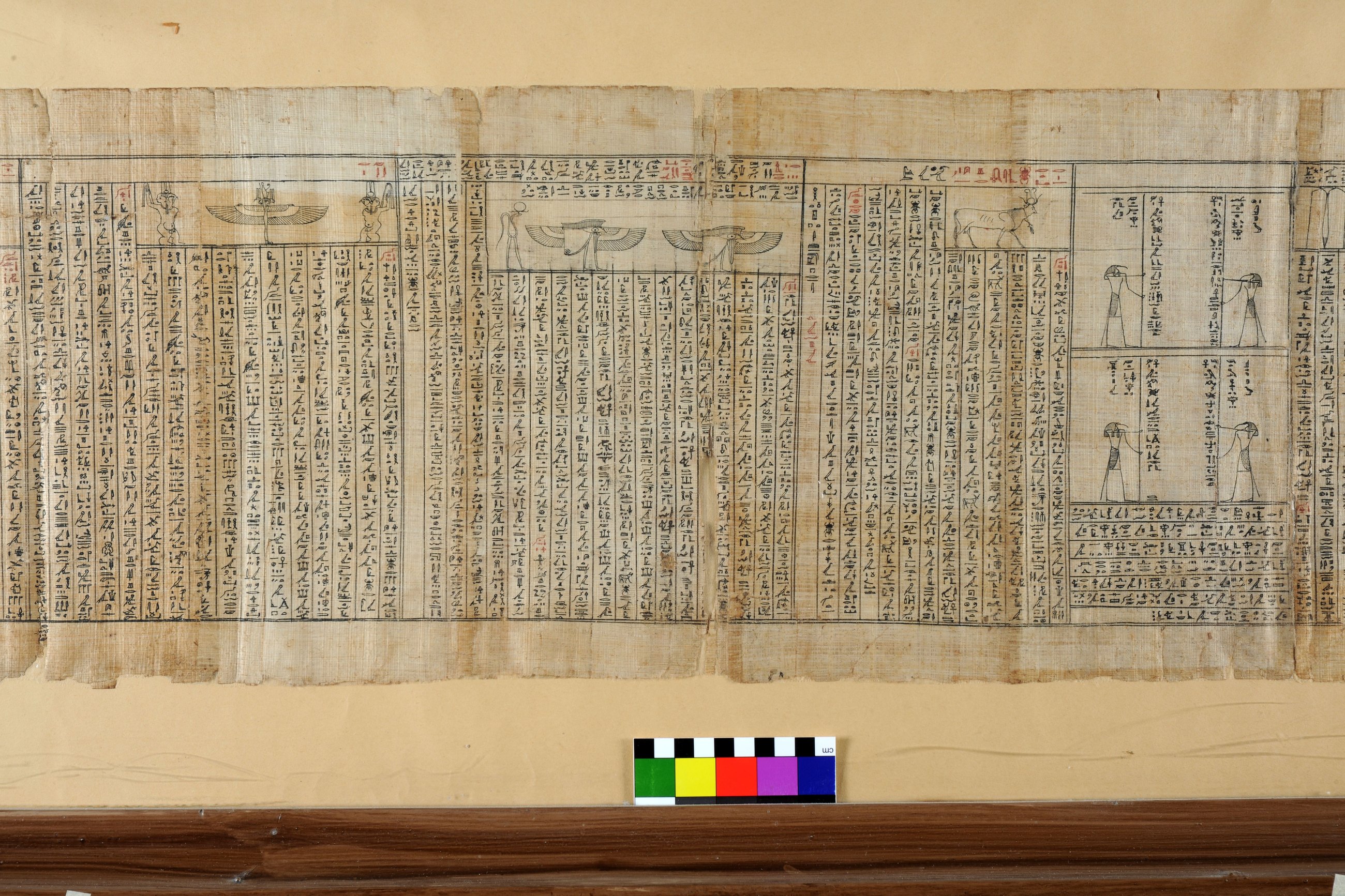
Where on the image
Turin 1791, Spell 163 (TLA Tb 163: title line, columns 1-19; Lepsius 1842, pl. LXXVII-LXXVIII). Photograph 30 of 31 (Commons Book_of_the_Dead_of_Iuefankh,_papyrus_-_Museo_Egizio_Turin_C_1791_p05.jpg): the title in black and red at 30-60% over the two winged eyes (Lepsius pl. LXXVII-LXXVIII). Checked by eye: the photographs were matched to Lepsius's plates by their vignettes, red titles and framed compartments, and the overlapping edges of neighbouring photographs were compared. Birch numbers this spell CLXIV (his numbers run one ahead of Lepsius's from 145 on).
titlerʾ.pl jni̯ r ky šft m-ḥꜣw pri̯〈.t〉 m hrw rʾ n tm ḏi̯〈.t〉 ski̯ ẖꜣ,t n z m ẖr,t-nṯr r nḥm =f m-ꜥ wnm bꜣ.pl n,tj ḏdḥ{,w} m-ḫnt Dꜣ,t ḥnꜥ tm rḏi̯.t ṯzi̯ =tw btꜣ,w =f ḥr-tp tꜣ ḥr =f rḏi̯.t wḏꜣ jwf =f qs.pl =f r dnm ḥnꜥ nṯr nb n,tj thi̯ m ẖr,t-nṯr rḏi̯.t pri̯ =f h〈ꜣ〉i̯ =f r mr,wt =f jri̯.t p〈ꜣ〉 n,tj nb m jb =f nn jntj.tw =f
1ḏd-mdw jn Wsjr […] mꜣꜥ-ḫrw jnk pꜣ bꜣ n tꜣ ẖꜣ,t ꜥꜣ.t n,tj ḥtp.tw m Jrhb ntf zꜣ n tꜣ ẖꜣ,t n〈.t〉
2Ḥrty pꜣ {ḫꜣs,t}〈nb〉 {t}〈r〉mn n,tj ḥtp.tw n pꜣ pḥw,w Snhqrg j pꜣ bꜣ n,tj bw ft jb =f r wbn
3ḥtp ḥtp bꜣ =f m-ẖnw tꜣy =f ẖꜣ,t n,tj ḥtp.tw m Snhprgn mi̯ n Wsjr […] mꜣꜥ-ḫrw n[ḥm] =f sw
4m-ꜥ bꜣ.pl ḥz〈ꜣ〉 ḥr sḫm ḥꜣ,tj.pl n,tj jṯi̯ ꜥ,t.pl pri̯ hh n rʾ =w r dp bꜣ.pl j pꜣ n,tj sḏr m-ẖnw ẖꜣ,t =f ḫpr
5hh =f m sḏ,t rkḥw.tw m-ẖnw pꜣ ywm [ḫ]y [pꜣ] [ywm] [m] [pꜣy] =[f] [rhb,w] [mi̯] [ḏi̯] =[⸢k⸣] [sḏ,t]
6ḫꜣꜥ =k rhb,w r p〈ꜣ〉 n,tj jw =f r sꜥḥꜥ ḏr,t =f r ꜥḥꜥ〈,w〉 Wsjr […] mꜣꜥ-ḫrw šꜣꜥ 〈n〉ḥḥ ḏ,t ky Wsjr […] mꜣꜥ-ḫrw pꜣ ꜥḥꜥ〈,w〉 n tꜣ p,t
7pꜣy =f ꜥḥꜥ〈,w〉 n p〈ꜣ〉 j〈w〉tn ḏr,ww p,t ẖr bꜣ =k tꜣ ẖr sšm =k nḥm =k Wsjr […] mꜣꜥ-ḫrw n ḏi̯ =k ⸢ꜣy⸣.tw =f jn kꜣwy
8ꜥm bꜣ.pl n,tj ṯzi̯ ḏbꜥ ḫpr bꜣ =f m-ẖnw ẖꜣ,t =f ṯz-pẖr ntf jmn m-ẖnw ḏfḏ n wḏꜣ,t Šršr{zp-2} ⸢Šꜣp,w⸣ ⸢nṯr⸣ ⸢jri̯⸣
9⸢kꜣ⸣ r〈n〉 =f ntf ḥtp pꜣ mḥ,t〈j〉 jmn,tt n tꜣ dhn,t Njpt n pꜣ tꜣ-zt,t jw bw jri̯ =f ḏꜣi̯ r jꜣb,tt j Jmn pꜣ kꜣ ḫprr
10nb wḏꜣ,t.j ḥz〈ꜣ〉 ḏfḏ rn =k Wsjr […] mꜣꜥ-ḫrw tj,t.pl n wḏꜣ,t.j =k Šršr{ḫ,t} rn n tꜣ
11wꜥ.t ⸢Šꜣp,w⸣ ⸢nṯr⸣ ⸢jri̯⸣ ⸢kꜣ⸣ rn n tꜣ k〈y〉.t ntf Šk Jmn Šknsrhtw tp Jtm,w sḥḏ n =f Tꜣ,du
12rn =f m-mꜣꜥ〈,t〉 zp-2 mi̯ n Wsjr […] mꜣꜥ-ḫrw jw =f n p〈ꜣ〉 tꜣ n mꜣꜥ,t m jri̯ ḫꜣꜥ =f wꜥi̯.{wtj}〈tw〉 =f jw =f n p〈ꜣ〉 tꜣ n,tj bw jri̯ =w p〈t〉r =f ꜥn
13rn =k jrm ꜣḫ-jqr ky-ḏd qnw ntf pꜣ bꜣ n tꜣ ẖꜣ,t ꜥꜣ.t n,tj m Zꜣw Ni̯,t ḏd-md,t ḥr ḥfj ẖr〈,j〉 rd.du{tj} ẖr〈,j〉
14jtn ꜥb.du jw wḏꜣ,t.j ẖr rd.du{tj} ẖr ḏnḥ.wj n,tj m p〈ꜣ〉 ḏfḏ n tꜣ wꜥ.t twt n fꜣi̯ ꜥ m ḥr n B〈s〉 ẖr〈,j〉 šw,t.j 〈j〉ꜣ,t =f
15m bjk n,tj n p〈ꜣ〉 ḏfḏ n tꜣ k〈y〉.t twt n fꜣi̯ ꜥ m ḥr n Ni̯,t ẖr〈,j〉 šw,t.j 〈j〉ꜣ{d},t =f m bjk zẖꜣ m ꜥntj.pl šw ḥr mḥ〈,t〉 wḥm m wꜣḏ
16šmꜥi̯ ḥnꜥ mw n tꜣ ẖnm〈,t〉 jmn,t〈j〉.t n Km,t ḥr pry n wꜣḏ,t bnd z ḥr ꜥ,t.pl nb〈.t〉 jm =f nn šnꜥ.tw =f ḥr sbꜣ.pl nb n Dꜣ,t wnn =f ḥr wnm
17sjw wzš m pḥ,tj =f mj wnn =f ḥr-tp tꜣ nn sꜥḥꜥ.tw ḫnw nb r =f ꜣḫ ḏr,t n kꜣy jm =f r nḥḥ ḏ,t jr jri̯ mḏꜣ,t tn ḥr-tp tꜣ nn kfꜣ.tw =f
18jn wpw,tj.pl thꜣ n,tj jri̯ swꜣ,w n tꜣ ḏr =f nn dm =f nn mt =f n šꜥd n nswt nn jṯi̯.tw =f r ḏdḥ,w nb ḫr ꜥq =f r qnb,y pri̯ m mꜣꜥ-ḫrw
19wḏꜣ =f r ḥr〈,w〉 jzf,t n,tj ḫpr〈.w〉 m tꜣ ḏr =f
CLXIV. The chapter of Not allowing the Body of a Person to corrupt in Hades; to save him from the Devourers of Souls who are imprisoned in the Gate; and not to allow his Sins to be transported from Earth against him. It makes his flesh and his bones sound against worms [?], and every God who is lying in wait for him in Hades. It lets him go out and go in as he has wished. It lets him do everything which is in his heart; he is not crossed. [?]
Vignette. — Two symbolical Eyes, winged and on Legs; and a disked and horned Snake on human Legs.)
I am the Soul of the great body which is at rest in Aruhaba. It is the springs of the body of Haruta, the arm which is at rest at the waters of Senhakarukana. Oh the Soul of his substance! unwearied is his heart at his rising and setting. II is soul is at rest within his body, which is at rest in Senhakarukana. The Osiris has come. He takes him from the souls of Hes, prevailer over hearts, takers of hands. Fire comes out of their mouths to taste the souls. Oh the Being dormant within his body, making his burning in flame glowing within the sea, raising the sea by his vapour! Come, give the fire, transport the vapour to the Being who will raise his hand to set up the Osiris for ever! The Osiris takes the time of the heaven, his time is that of the whole Creation. Heaven hold thy soul, the earth holds thy form. Save thou the Osiris, do not let him be captured [is said] by the Takers, the devourers of souls by whom the evil-doer is borne off. Make his soul in his body again. lie is hidden in the midst of the Pupil, Sharu- Sharu, Shapu-Arka is his name. He sets at the Northwest of the forehead of Apt of Nubia. He does not make a passage to the East. Oh Amen! the Bull, the Scarab, Lord of the Two Eyes ordering the Pupil, is thy name, oh Osiris! The litui of thy eyes; Sharu- Sharu Khet is the name of the first; Shapu-Arkat is the name of the other. Shaka-Amen, Shakanasa at the head of Tum who has illuminated the world, is his name in reality. The Osiris has come, he is from the land of Truth, leaving it, making, he is alone. He is at the region in which he makes no reappearance. With the wise or numerous Spirits is thy name. lie is the Soul of the great body which is in Sais.
Said of a snake having legs, having a horned disk. There are two eyes having legs and having wings. There is in the pupil of one eye the figure of the Arm-raiser, with the head of a beast, having plumes, his back in the shape of a hawk. There is in the pupil the other a figure of a God raising his arm, with the face of Nit, having plumes, his back like that of a hawk. It is painted yellow out of a paint-pot [?] made of Southern felspar, with water of the Western Lakes of Egypt, on a slip of papyrus binding a person on each arm. lie is not turned away at the doors of the Gate. He is eating, drinking, and passing, as he did on earth. ‘There has not stood any opponent against him. The Seizers do not lay hand on him for an age and ever. If this book is made on earth, he is not captured, say the Guides, takers of those who delude the whole earth. lie neither consumes nor perishes under the blows of Sut he is not taken to prison; he enters in to the Opponents [demons of the Halls], he comes forth justified. He goes forth to scare the evil which is done in the whole earth.
Notes
- Birch's English was taken from three scans of Bunsen's Egypt's Place in Universal History, vol. V (1867), on the Internet Archive. The three OCR texts were aligned word by word and each word was settled by their agreement; running heads, page numbers, footnote markers and footnotes were removed. Some OCR errors may remain, chiefly in proper names.
- Birch uses the terms and name forms of his time: Hades, Aahlu (Elysium), Tum for Atum, Seb for Geb, Anup for Anubis, Phoenix or Bennu for the heron.
- Labels such as 'title line' or 'gate 1' before a line of the Egyptian translate the position labels of the TLA.
- The TLA has no hieroglyphic encoding for these texts, so only the transliteration is shown.
Cite
Sources
- Source: Papyrus of Iuefankh, Turin, Museo Egizio Cat. 1791 (Museo Egizio photographs, CC0) + TLA transliteration (ed. B. Backes, CC BY-SA 4.0) + English of Samuel Birch (1867, public domain) (holding institution)
- Critical edition: Thesaurus Linguae Aegyptiae, ed. Burkhard Backes (2018 data, AED-TEI)
← previous · → next · v cycle view · l back to library