Book of the Dead, Spell 165: The Boat, not letting it to make the Body flow and to swallow their ... (papyrus of Iuefankh)
Introduction
The Book of the Dead, in Egyptian the spells for going forth by day, is a collection of funerary spells written on papyrus rolls and placed in burials from the New Kingdom to the Roman period. Each roll was made for one person, with spells taken from a large repertoire and illustrated with drawings (vignettes). This library gives one complete roll: the papyrus of Iuefankh in the Museo Egizio, Turin (Cat. 1791), written in the Ptolemaic period (332-30 BCE) and coming from Thebes. Richard Lepsius published it in 1842 and divided it into 165 chapters; his numbering is still the standard numbering of the spells, and it is used here.
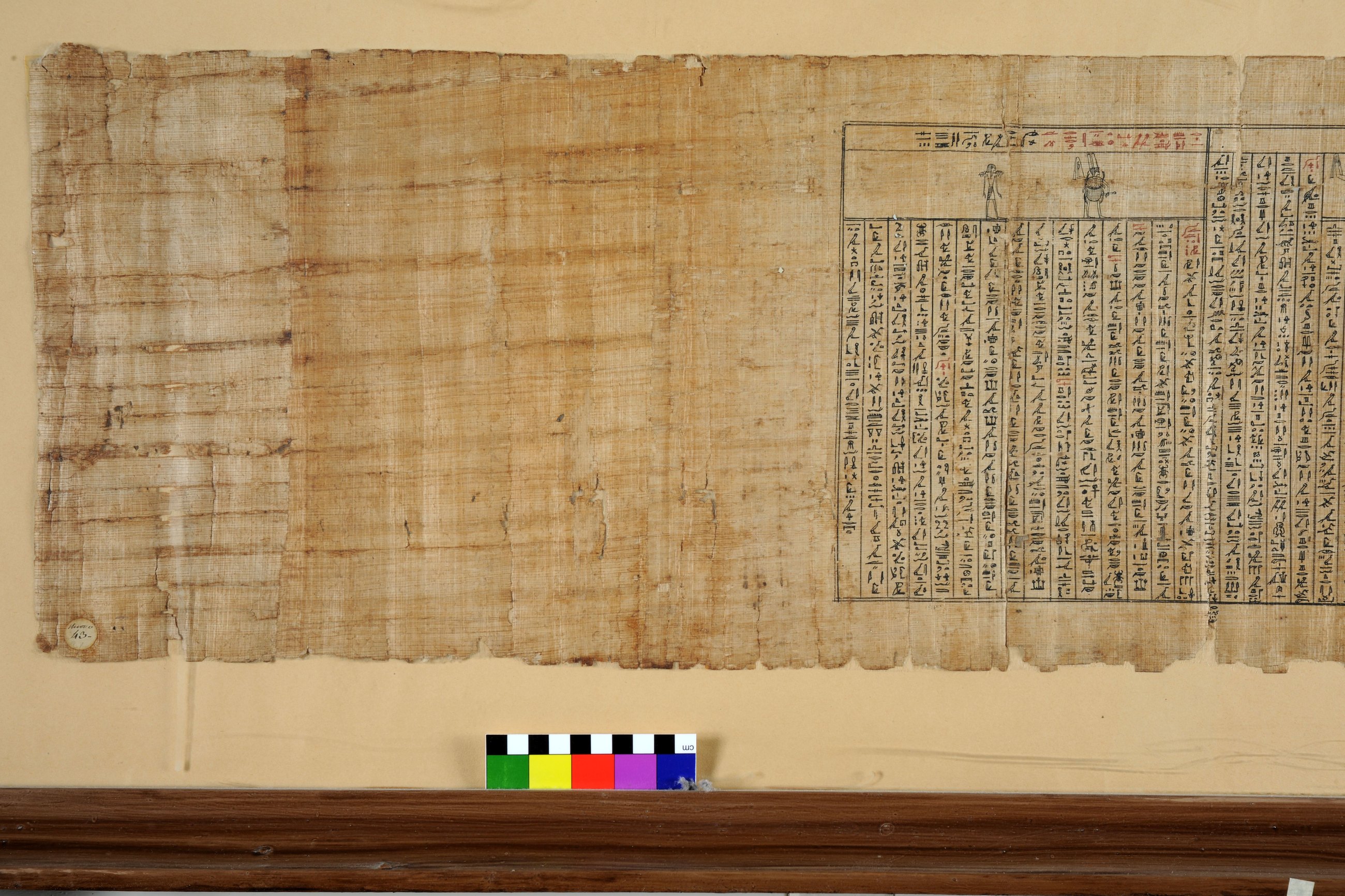
Spell 165 (Birch: 'The chapter of The Boat, not letting it to make the Body flow and to swallow their W T aters.') is on Lepsius's plate LXXIX and on photograph 31 of the 31 Museo Egizio photographs of the roll.
The Egyptian is the transliteration of the Thesaurus Linguae Aegyptiae (edition by Burkhard Backes), with the column number of the spell before each column; the numbers are those of Lepsius's plates. On the papyrus the text runs in vertical columns of cursive hieroglyphs from right to left along the roll; titles and some words are written in red. Signs restored by the editor are in square brackets, signs the scribe left out in angle brackets, superfluous signs in braces and damaged signs in half brackets. The English is the translation by Samuel Birch, published in 1867 and made from Lepsius's copy of this papyrus, so the English and the Egyptian come from the same manuscript. It was the first complete English translation of the Book of the Dead; many passages are now understood differently. Birch's own square brackets give his alternatives and explanations. The photographs are by the Museo Egizio; each shows a stretch of the roll, and the note of each section says where the spell stands on it.
How was this verified? (Provenance)
Where on the image
Turin 1791, Spell 165 (TLA Tb 165: title line, columns 1-15; Lepsius 1842, pl. LXXIX). Photograph 31 of 31 (Commons Book_of_the_Dead_of_Iuefankh,_papyrus_-_Museo_Egizio_Turin_C_1791_p04.jpg): red title at 62-89% over the ithyphallic god with a scarab body and a standing figure; its columns at 62-89% (Lepsius pl. LXXIX); the rest of the roll (0-62%) is blank. Checked by eye: the photographs were matched to Lepsius's plates by their vignettes, red titles and framed compartments, and the overlapping edges of neighbouring photographs were compared. Birch numbers this spell CLXVI (his numbers run one ahead of Lepsius's from 145 on).
titlerʾ n mnj tm{m} ḏi̯.t tḫnj =s r srwḏ ẖꜣ,t r sꜥm nwy =sn
1ḏd-md,t j pꜣ Bḫn,w zp-2 pꜣ wr zp-2 Jmn zp-2 pꜣ rw Yks pꜣ nṯr wr nṯr.pl jꜣb,tt
2n.t p,t Jmn Ntkrty Jmn j pꜣ jmn jwn,w štꜣ ḫpr,w nb ꜥb.du Ḥr,w ⸢ꜥꜣ⸣ ⸢Nw,t⸣ N〈jryk〉
3ky-ḏd Kjryk rn =k Ksyk rn =k ꜣrktkstk rn =k Jmn Njnkntkšr
4ky-ḏd 〈Njnkn〉tjkšr Jmn Rw,ty rn =k j Jmn dbḥ,w =j m-ꜥ =k jw =j rḫ.kw rn =k ḫpr,w =k
5m rʾ =j jnmm =k m jr,t.du =j mi̯ n jwꜥ{ꜥ}〈,w〉 =k sšmi̯ =k Wsjr […] mꜣꜥ-ḫrw ḏi̯ =k
6sw r Dꜣ,t nḥḥ ḏi̯ =k ḥtp ꜥ,t.pl =f tm〈.w〉 m ẖr,t-nṯr ky-ḏd jgr,t jw =f nṯri̯〈.w〉 ẖꜣ,t =f tm.tw jw =f wḏꜣ〈.w〉 r ḫꜣ bjn nn spḥw〈.tj〉=f
7sw swꜣš =j n rn =k jri̯ =k n =j ⸢j{m}〈nn〉m⸣ ꜥm =k r-ḏd rḫ =〈j〉 ṯw wr zp-2 jmn rn =k Rtsšk
8jrj.y =j n =k jnnm bꜣ Yrqy rn =k Mrqt rn =k Rw,ty rn =k Nsqbb
9rn =k Tns zp-2 rn =k Šrštkt rn =k Jmn zp-2 p〈ꜣ〉 nṯr zp-2 Jmn
10swꜣš =j n rn =k ḏi̯ =j ꜥm =k ḏi̯ =k ḥtp =j m Dꜣ,t ꜥ,t.pl =j tm.tw ḏd.jn bꜣ n,tj m ⸢Nw,t⸣
11jri̯.y =j mk,t =j jri̯.y =j ḏ{t}〈d〉.t =k nb.t ḏd-mdw ḥr twt n fꜣi̯ ꜥ šw,t.du m tp =f rd.du =f wn.tw ḥr-jb =f m
12ḫprr zẖꜣ〈.w〉 m ḫsbḏ ḥr mw n.w qmy ḥnꜥ wꜥ twt jw ḥr =f m ḥr n r〈m〉{r}ṯ.pl jw ꜥ.du{.pl} =f {sw}〈ws〉tn.w
13jw ḥr n šf,t ḥr qꜥḥ,w =f wnmi̯ ky ḥr qꜥḥ,w =f jꜣbi̯ zẖꜣ〈.w〉 ḥr wꜥ.t jshꜣ pꜣ twt n fꜣi̯
14ꜥ m-ꜥqꜣ ḥꜣ,tj =f zẖꜣ pꜣ twt ḥr pꜣy =f mnḏ.du nn rḏi̯ rḫ s〈j〉 ky-ḏd rmn Sgdy
15n,tj m Dꜣ,t sjw =f mw m ḥbb,t n.t j〈t〉r,w psḏ =f mj sbꜣ.pl m ḥr,t
CLXVI. The chapter of The Boat, not letting it to make the Body flow and to swallow their W T aters.
Vignette. — Amen Ra, with the Body of a Scarab, ithyphallic, holding a whip, followed by a God with a human Head, between twoothersof Rami.]
On Pabekhennu Pabekhennu! Paur Paur! Ammon Ammon Paru Iukasa the God, the eldest of the Gods of the East of the heaven! Ammon Natakaruti Ammon, the hider of skins, the secret one of transformations, Lord of ... of Nuhar! Na-or Ka-ari is thy name, Easaika is thy name, Arutaikasataika is thy name. Ammon-Na-Anka. Thou art Sharu or Taksharu, Ammon-lluta is thy name. Oli Ammon! I beg to know thy name, thy shapes are in my mouth, thy skin in my eyes. Thy issue and thy form have come. The Osiris, place thou him at the Gate for ever. Let his arms be at rest as Tum in Hades. He is the God of Time, his body has been put away. He is sound at the evil altar. He is not dragged to it. I adore thy name. Thou makest to me a skin; thou wishest to say what is well known. Hidden is thy name, Ruta sa shaka. I make to thee a skin, my soul. Iruka is thy name, Markata is thy name, Ruta is thy name, Nasakabu is thy name, Tanasa-tanasa is thy name, Sharushatakata is thy name. Ammon- Ammon the God, the God! Ammon, I adore thy name. I give thee what thou eatest. I give welcome in the gate my arms are held down.
Said by the Soul which is in the firmament: I do thy orders, I perform all thy words.
Said over a figure with raised arms, having feather plumes on his head, his feet are bare, his middle is in shape of a scarabaeus; painted blue with gum water, with an image whose face is that of a man, whose arms are bowed, having the face of a ram upon his right shoulder, and another on his left. Write on a scrap [?] the figure of the Arm-raiser in the midst of his heart, paint the figures on his breasts. Do not let it be known or touched by the strangler who is in the Gate. He drinks waters out of the streams of the river, he shines like the stars above.
Notes
- Birch's English was taken from three scans of Bunsen's Egypt's Place in Universal History, vol. V (1867), on the Internet Archive. The three OCR texts were aligned word by word and each word was settled by their agreement; running heads, page numbers, footnote markers and footnotes were removed. Some OCR errors may remain, chiefly in proper names.
- Birch uses the terms and name forms of his time: Hades, Aahlu (Elysium), Tum for Atum, Seb for Geb, Anup for Anubis, Phoenix or Bennu for the heron.
- Labels such as 'title line' or 'gate 1' before a line of the Egyptian translate the position labels of the TLA.
- The TLA has no hieroglyphic encoding for these texts, so only the transliteration is shown.
Cite
Sources
- Source: Papyrus of Iuefankh, Turin, Museo Egizio Cat. 1791 (Museo Egizio photographs, CC0) + TLA transliteration (ed. B. Backes, CC BY-SA 4.0) + English of Samuel Birch (1867, public domain) (holding institution)
- Critical edition: Thesaurus Linguae Aegyptiae, ed. Burkhard Backes (2018 data, AED-TEI)
← previous · → next · v cycle view · l back to library