Book of the Dead, Spell 164: Second Chapter (papyrus of Iuefankh)
Introduction
The Book of the Dead, in Egyptian the spells for going forth by day, is a collection of funerary spells written on papyrus rolls and placed in burials from the New Kingdom to the Roman period. Each roll was made for one person, with spells taken from a large repertoire and illustrated with drawings (vignettes). This library gives one complete roll: the papyrus of Iuefankh in the Museo Egizio, Turin (Cat. 1791), written in the Ptolemaic period (332-30 BCE) and coming from Thebes. Richard Lepsius published it in 1842 and divided it into 165 chapters; his numbering is still the standard numbering of the spells, and it is used here.
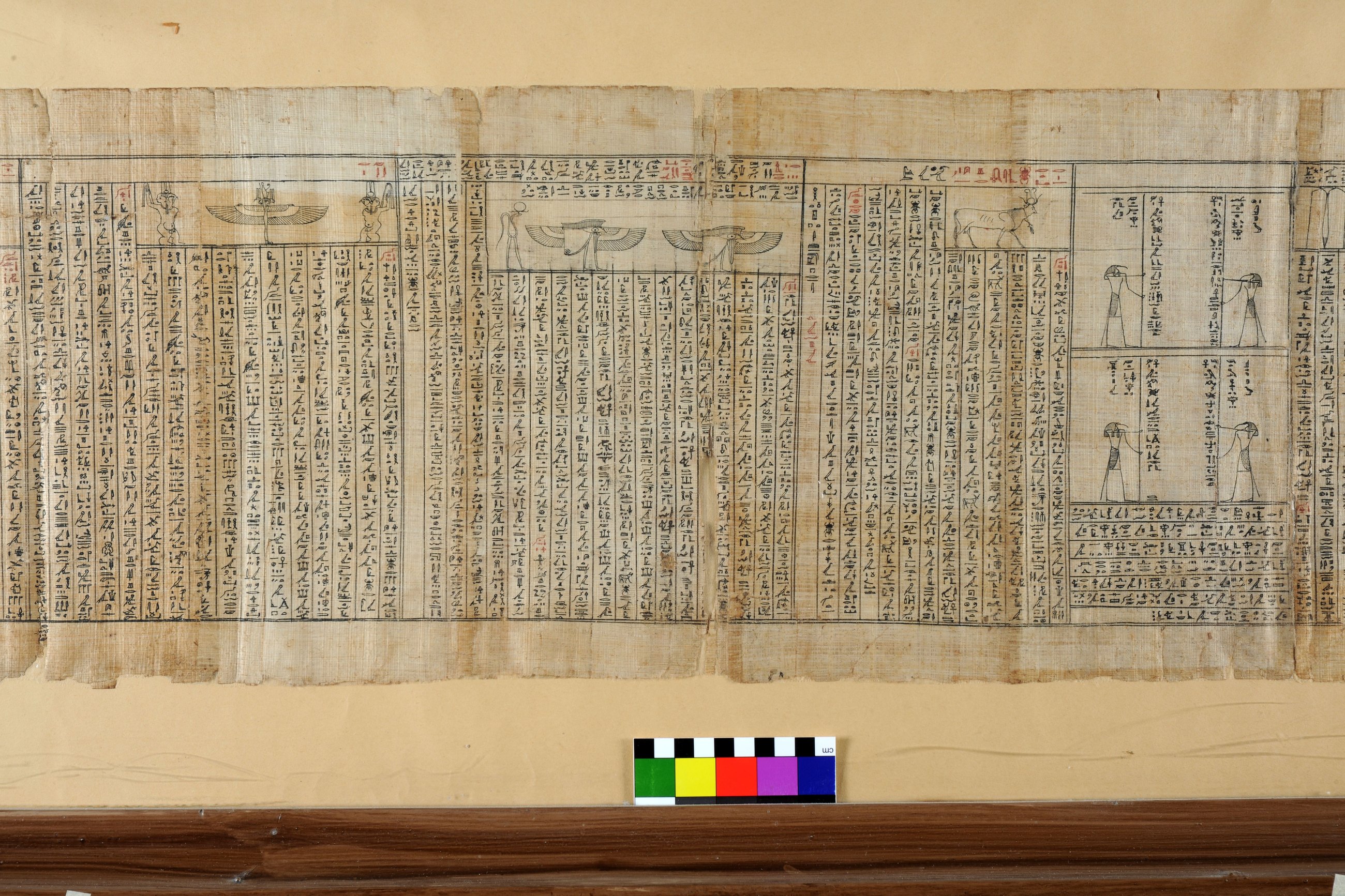
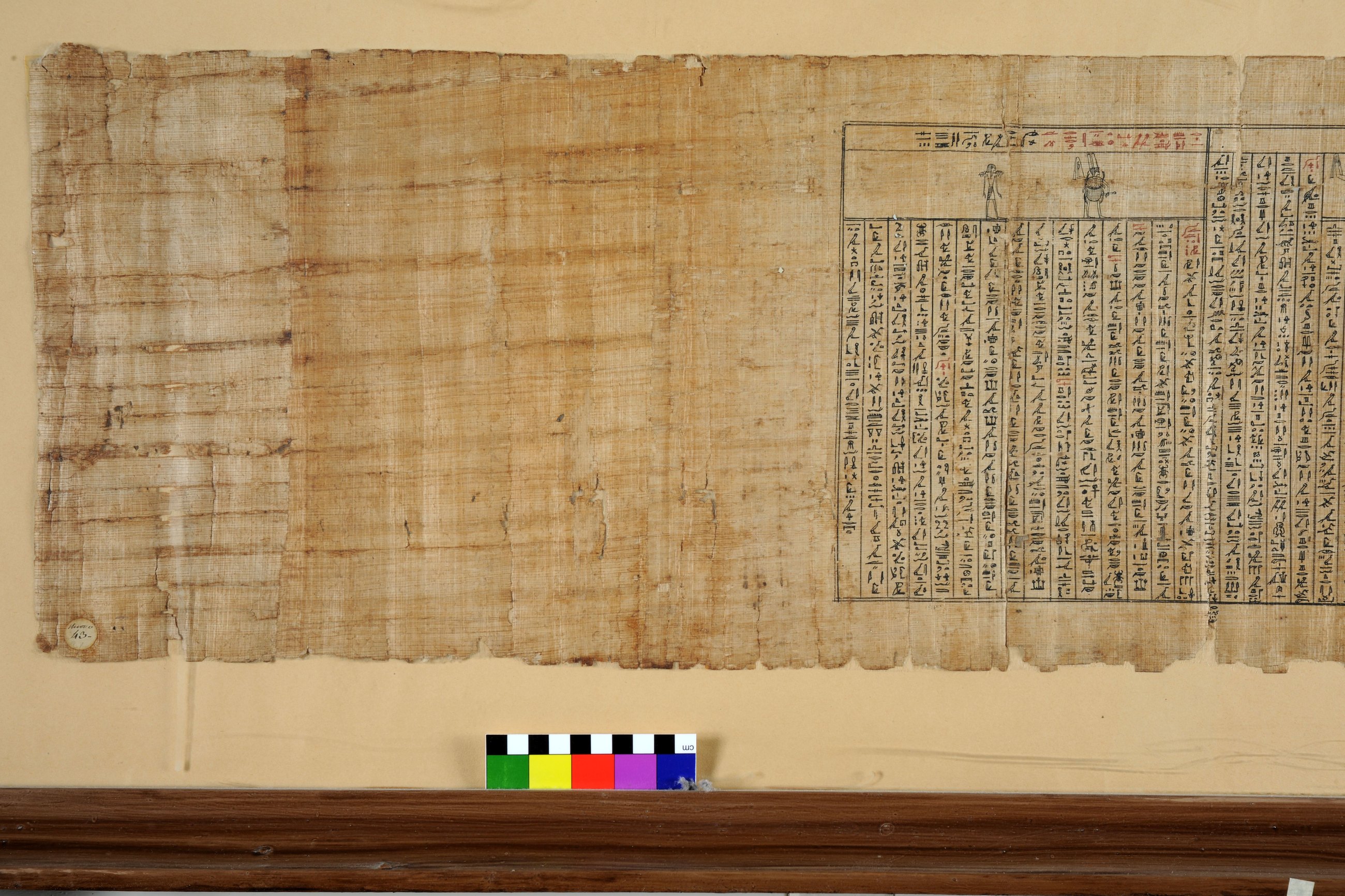
Spell 164 (Birch: 'The second Chapter.') is on Lepsius's plates LXXVIII-LXXIX and on photographs 30, 31 of the 31 Museo Egizio photographs of the roll.
The Egyptian is the transliteration of the Thesaurus Linguae Aegyptiae (edition by Burkhard Backes), with the column number of the spell before each column; the numbers are those of Lepsius's plates. On the papyrus the text runs in vertical columns of cursive hieroglyphs from right to left along the roll; titles and some words are written in red. Signs restored by the editor are in square brackets, signs the scribe left out in angle brackets, superfluous signs in braces and damaged signs in half brackets. The English is the translation by Samuel Birch, published in 1867 and made from Lepsius's copy of this papyrus, so the English and the Egyptian come from the same manuscript. It was the first complete English translation of the Book of the Dead; many passages are now understood differently. Birch's own square brackets give his alternatives and explanations. The photographs are by the Museo Egizio; each shows a stretch of the roll, and the note of each section says where the spell stands on it.
How was this verified? (Provenance)
Where on the image
Turin 1791, Spell 164 (TLA Tb 164: title line, columns 1-16; Lepsius 1842, pl. LXXVIII-LXXIX). Photograph 30 of 31 (Commons Book_of_the_Dead_of_Iuefankh,_papyrus_-_Museo_Egizio_Turin_C_1791_p05.jpg): red title at 27-29% over the winged goddess between two dwarf figures; its columns at 0-30%; it continues on photograph 31. Photograph 31 of 31 (Commons Book_of_the_Dead_of_Iuefankh,_papyrus_-_Museo_Egizio_Turin_C_1791_p04.jpg): its last columns at 90-100%. Checked by eye: the photographs were matched to Lepsius's plates by their vignettes, red titles and framed compartments, and the overlapping edges of neighbouring photographs were compared. Birch numbers this spell CLXV (his numbers run one ahead of Lepsius's from 145 on).
titleky rʾ
1ḏd-md,t j:nḏ-ḥr =ṯ Sḫm,t Bꜣs,tt 〈⸢jr,t⸣〉-Rꜥ,w ḥnw,t nṯr.pl ṯꜣi̯ mḥ,t nb〈,t〉 jnsi̯ ḥnw,t ḥḏ,t dšr,t wꜥ,wtj〈.t〉 ḥr tp n jti̯ =s nn ḫpr nṯr.pl ḥr-tp =s wr〈,t〉-ḥkꜣ
2m wjꜣ-n-ḥḥ ḏsr〈.t〉 ḫꜥ〈,w〉 m s,t sgr mw,t n Pšks ḥm,t-nsw,t n Prhq ḫpr,w
3ḥnw,t nb〈,t〉 jz.pl Mw,t m ꜣḫ,t n.t p,t hru̯ Mr,wt tjtj〈.t〉 ḫnnj ḥtp m ḫfꜥ =ṯ wnn =ṯ ꜥḥꜥ.tw m ḥꜣ,t wjꜣ jti̯ =ṯ
4ḥr sḫr ḏw-qd jw =ṯ ḏi̯ =ṯ mꜣꜥ,t m ḥꜣ,t wjꜣ =f nt〈ṯ〉 wnm,yt jw,tj zp =s jm,j Spytkhrspsrmkk-rmt
5rn =ṯ jw =ṯ m srq,w ꜥꜣ{.t} n.t Sqnq,t m ḥꜣ,t wjꜣ n jti̯ =ṯ Ḥrpgkšršb
6js m ḏd nḥsi̯〈,t〉 n Jwn,tj.w n.w Tꜣ-ztj j〈ꜣ〉,w n =ṯ nḫt.t r nṯr.pl hnw n =ṯ ḫmn,w bꜣ.pl ꜥnḫ.pl n,tj m ḏbꜣ,t =sn
7m jꜣ,w n šf〈y〉,t =ṯ nt{j}〈ṯ〉 mw,t =w nt〈ṯ〉 šꜣꜥ =sn jri̯ n =sn s,t ḥtp m Dꜣ,t štꜣ.t swḏꜣ qs.pl =〈w〉 wḏꜣ =w r ḥr〈,w〉
8nṯri̯ =ṯ st m s,t nḥḥ swḏꜣ sn r ḫꜣ bjn bꜣ{.pl} ḥzꜣ ḥr m-ẖnw psḏ,t sfj pri̯ m ḥzꜣ ḥr ḥꜣp ḏ,t =f r nkj
9tꜣr jm ḏr gmi̯ =tw rn =⸢w⸣ pꜣ rw štꜣ rn n p〈ꜣ〉 wꜥ,w zꜣ pꜣ nmmj wḏꜣ,t Sḫm,t wr.t
10ḥnw,t nṯr.pl rn =ṯ tj,t m rn n Mw,t nṯri̯ bꜣ.pl =s wḏꜣ ẖꜣ〈,t〉.pl =s wḏꜣ ={w}st r tꜣ ḫb,t {n}〈k〉ꜣwjt n,tj m ḫꜣ bjn
11nn spḥ.w st ḏd tꜣ nṯr,t m rʾ =s ḏs =s jri̯.y =j m ḏd =ṯn nꜣ ṯꜣ.w n pꜣ bꜣ jri̯ =w n =f q{r}js
12ḏd-mdw ḥr ⸢jrw⸣ Mw,t ẖr〈,j〉{.pl} ḥr 3 wꜥ,w m ḥr n Pḫꜣ,t ẖr〈,j〉 šw,t.j ky m ḥr n Pꜥy,t ẖr〈,j〉 ḥḏ,t dšr,t ky m ḥr n Nrjw ẖr〈,j〉 šw,t.j ẖr〈,j〉 mṯꜣ
13ẖr〈,j〉 ḏnḥ,w.du m ꜥgꜣ,t n mꜣj zẖꜣ m ꜥnd,pl šw ḥr snṯr wꜣḏ wḥm m ry〈,t〉 ḥr pry n jnsi̯ jw wꜥ nmmj ꜥḥꜥ〈.w〉 m-bꜣḥ =s ḥꜣ =s
14jw ḥr =f r =s ẖr šw,t.j jw =f m fꜣi̯〈.t〉 ꜥ ẖr ḥr.du wꜥ,w m ḥr n bjk ky m ḥr n pꜥ,t wt{.pl} šnb,t 〈=f〉 jm =f wnn =f nṯri̯〈.w〉 m-ꜥ nṯr.pl m ẖr,t-nṯr
15nn šnꜥ.tw =f r-nḥḥ ḏ,t wḏꜣ jwf =f qs.pl =f mj-n,tj nn sw mt =f sjw =f mw ḥr ḥbb,t n.t j〈t〉r,w jw ḏi̯ =tw n =f ꜣḥ〈,t〉 m sḫ,t-jꜣnr
16ḏi̯ =tw n =f sbꜣ n p,t wḏꜣ =f r nkjw r tꜣr n,tj m Dꜣ,t nn ḏdḥw =tw bꜣ{.pl} =〈f〉 ḏrjw jri̯ =f nḥm =f r n,tj r-gs =f nn wnm sw
below 16rʾ.pl nb
CLXV. The second Chapter.
[Vignette.— A Goddess with a human Head wearing a Pschent, between two Vulture Heads wearing Plumes, standing winged. On each side of her stands a Pygmy, with a Hawk a human Head wearing Plumes, holding a Whip.]
Hail Pasht, Bast, and Ra, regent of the Gods, wing-bearer, lady of linen, regent of the upper and lower worlds, the only one, delight of her father uncreate of the Gods, who is over her mother Urams in the boat of millions of years, arranging the crown in the silent place; the mother of Pa-sha-ka-sa royal wife of Paruhaka, the Creator, the regent, Lord of the Tomb, mother in the horizon of heaven, doing what her heart has wished, prostrating the detainers of food with thy fist! Thou art standing in the boat of thy father, overthrowing the doer of evil. Thou hast placed truth in the prow of his boat. Thou art the Flame-eater. Nothing ever remains behind thee. Kaharu-sapu-saru-inahaka-ruma is thy name. Thou art as the great fire of Sa-ka-na-ka in the prow of the boat. lie is Harupuka ka sharu-shabau when mentioned by the land of lies, which is of the land of An, of the land of the Phut [Kenus]. Glory to thee, thou art stronger than the Gods! Adoration to thee! the forms of the living souls who are in their places give glory to the terrors of thee their mother; thou art their origin, giving them a place of rest in the Secret Gate; making their bones sound, they are sound against the terror of the God of Time, keeping them in their place for ever, rendering them sound at the evil altar of souls of Hes within the company of Gods. The babe emanating from Hes, hiding his body, is thy name. A-taru Am-ter heinut ranu [names never discovered] Pa-ru-slita [the Mystic Lion] is the name of one son. The little Pigmy, the Eye, Pasht, the great regent of the Gods, is thy name. Atom is the name of the mother Goddess of Time. The souls endure, the bodies are well at the block of the annihilated who are at the evil altar. Do not draw them there, says the Goddess with her own mouth. I do as ye takers say ye did to the Soul, Paba, giving him a burial.
Said over the figure of the mother Goddess having three heads, the first in shape of a lioness having plumes; another is in the shape of a mortal having the upper and lower crown; another is in the shape of a vulture having plumes and having a phallus, having wings and the claws of a lion, painted in yellow traced in outline [?]. on a piece of linen. There is a pygmy in front and behind it. His face is turned towards her, having plumes, lifting his arms, having two faces; one the face of a hawk, the other the face of a man, naked, his knees bent. He is as a God among the Gods of Hades. He has not been turned away for an age and ever. His limbs and his bones are as sound as if he had never died, he drinks water out of the streams of the river, fields are given to him in the Aahenru, he has given to him the entrance of heaven, he is sound against, he is safe against the stinging reptiles which are in the Gate. The souls have not been imprisoned where his soul is[?]. He has done so that he saves himself from every thing where he is. Worms do not eat him.
Notes
- Birch's English was taken from three scans of Bunsen's Egypt's Place in Universal History, vol. V (1867), on the Internet Archive. The three OCR texts were aligned word by word and each word was settled by their agreement; running heads, page numbers, footnote markers and footnotes were removed. Some OCR errors may remain, chiefly in proper names.
- Birch uses the terms and name forms of his time: Hades, Aahlu (Elysium), Tum for Atum, Seb for Geb, Anup for Anubis, Phoenix or Bennu for the heron.
- Labels such as 'title line' or 'gate 1' before a line of the Egyptian translate the position labels of the TLA.
- The TLA has no hieroglyphic encoding for these texts, so only the transliteration is shown.
Cite
Sources
- Source: Papyrus of Iuefankh, Turin, Museo Egizio Cat. 1791 (Museo Egizio photographs, CC0) + TLA transliteration (ed. B. Backes, CC BY-SA 4.0) + English of Samuel Birch (1867, public domain) (holding institution)
- Critical edition: Thesaurus Linguae Aegyptiae, ed. Burkhard Backes (2018 data, AED-TEI)
← previous · → next · v cycle view · l back to library