Dhammapada 3: Cittavagga, Thought (verses 33-43)
Introduction
Chapter 3 of the Dhammapada, the Cittavagga ('Thought' in Max Müller's translation), verses 33-43. The Dhammapada is a collection of 423 verses in Pali attributed to the Buddha, part of the Khuddakanikāya of the Pali canon; its compilation is usually dated to about the third century BCE.
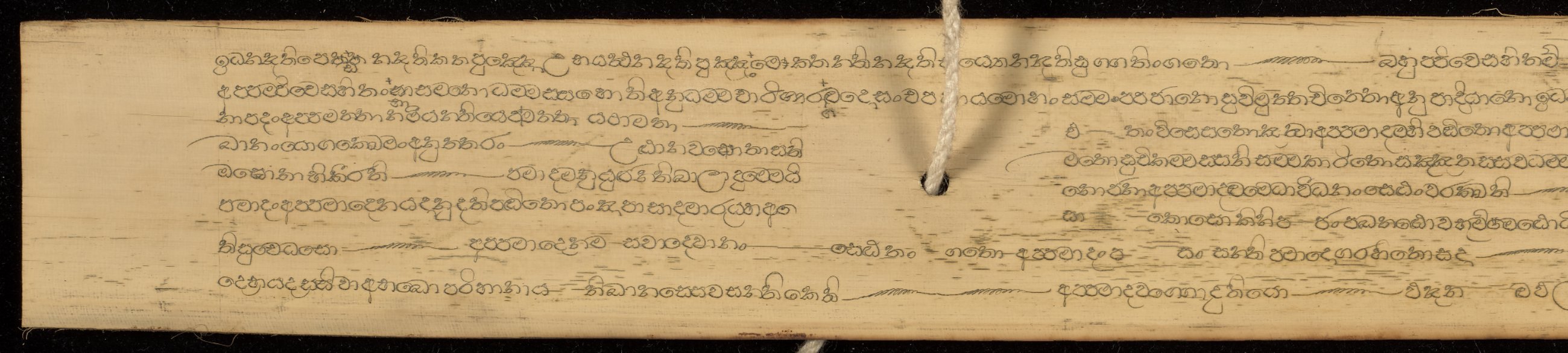
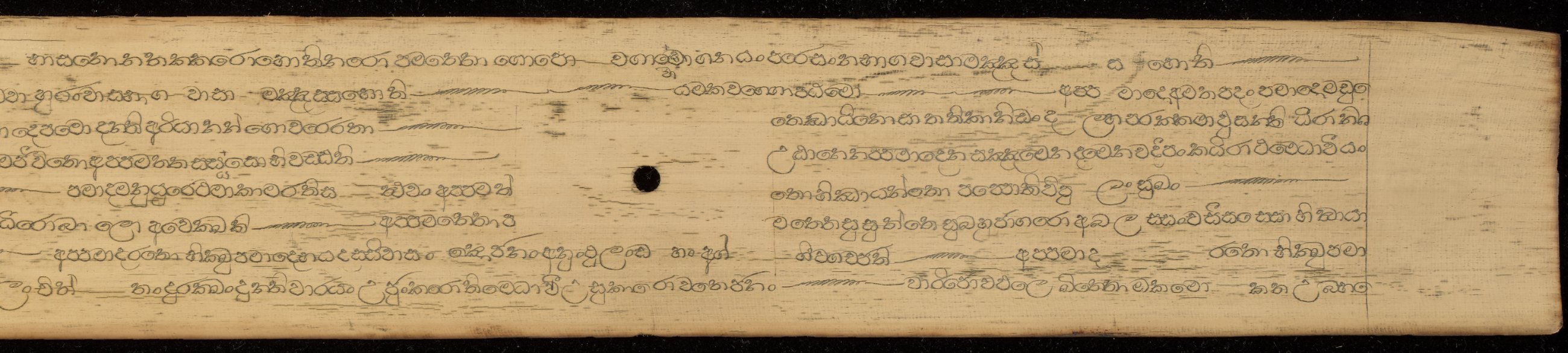
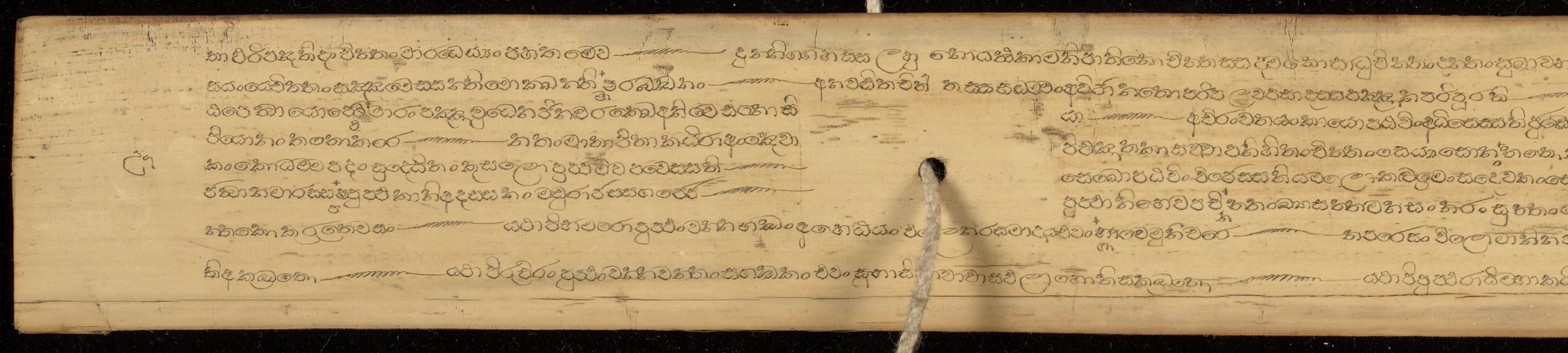
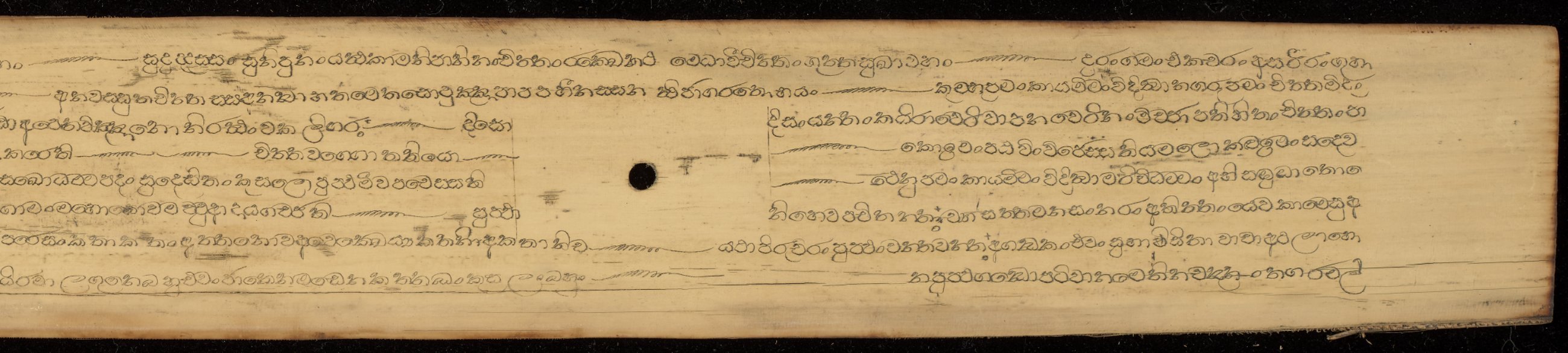
The images are of a Sinhalese palm-leaf manuscript in the John Rylands Library, Manchester (Pali MS 19), once owned by T. W. Rhys Davids. The text is written in Sinhalese script across the whole width of each leaf, nine lines a side, interrupted only by the string holes; each image is one half of a leaf side. This chapter is on fol. 5b, 6a. Each section holds the verses that end on that side.
The Pali is the Mahāsaṅgīti edition published by SuttaCentral, and the English is Max Müller's translation in the Sacred Books of the East (1881), which sometimes renders two verses together (for example 58-59).
How was this verified? (Provenance)
Where on the image
Pali MS 19, fol. 5b (both halves of the leaf side). Checked on the image: the side begins 'idha nandati pecca nandati (v.18)' and its last line ends 'vārijova thale khitto okamokata ubbha- (v.34)'. The Pali shown is the Mahāsaṅgīti edition (SuttaCentral), not a transcription of the manuscript; the scribe's spellings differ in places.
33Phandanaṁ capalaṁ cittaṁ, dūrakkhaṁ dunnivārayaṁ; Ujuṁ karoti medhāvī, usukārova tejanaṁ.
33As a fletcher makes straight his arrow, a wise man makes straight his trembling and unsteady thought, which is difficult to guard, difficult to hold back.
Where on the image
Pali MS 19, fol. 6a (both halves of the leaf side). Checked on the image: the side begins '-to pariphandatidaṃ cittaṃ māradheyyaṃ pahātave (end of v.34)' and its last line ends 'na pupphagandho paṭivātameti na candanaṃ tagaramalli- (v.54)'. Verse 34 begins on fol. 5b and ends on fol. 6a; both sides are shown. The Pali shown is the Mahāsaṅgīti edition (SuttaCentral), not a transcription of the manuscript; the scribe's spellings differ in places.
34Vārijova thale khitto, okamokataubbhato; Pariphandatidaṁ cittaṁ, māradheyyaṁ pahātave.
35Dunniggahassa lahuno, yatthakāmanipātino; Cittassa damatho sādhu, cittaṁ dantaṁ sukhāvahaṁ.
36Sududdasaṁ sunipuṇaṁ, yatthakāmanipātinaṁ; Cittaṁ rakkhetha medhāvī, cittaṁ guttaṁ sukhāvahaṁ.
37Dūraṅgamaṁ ekacaraṁ, asarīraṁ guhāsayaṁ; Ye cittaṁ saṁyamissanti, mokkhanti mārabandhanā.
38Anavaṭṭhitacittassa, saddhammaṁ avijānato; Pariplavapasādassa, paññā na paripūrati.
39Anavassutacittassa, ananvāhatacetaso; Puññapāpapahīnassa, natthi jāgarato bhayaṁ.
40Kumbhūpamaṁ kāyamimaṁ viditvā, Nagarūpamaṁ cittamidaṁ ṭhapetvā; Yodhetha māraṁ paññāvudhena, Jitañca rakkhe anivesano siyā.
41Aciraṁ vatayaṁ kāyo, pathaviṁ adhisessati; Chuddho apetaviññāṇo, niratthaṁva kaliṅgaraṁ.
42Diso disaṁ yaṁ taṁ kayirā, verī vā pana verinaṁ; Micchāpaṇihitaṁ cittaṁ, pāpiyo naṁ tato kare.
43Na taṁ mātā pitā kayirā, aññe vāpi ca ñātakā; Sammāpaṇihitaṁ cittaṁ, seyyaso naṁ tato kare.
34As a fish taken from his watery home and thrown on dry ground, our thought trembles all over in order to escape the dominion of Mara (the tempter).
35It is good to tame the mind, which is difficult to hold in and flighty, rushing wherever it listeth; a tamed mind brings happiness.
36Let the wise man guard his thoughts, for they are difficult to perceive, very artful, and they rush wherever they list: thoughts well guarded bring happiness.
37Those who bridle their mind which travels far, moves about alone, is without a body, and hides in the chamber (of the heart), will be free from the bonds of Mara (the tempter).
38If a man's thoughts are unsteady, if he does not know the true law, if his peace of mind is troubled, his knowledge will never be perfect.
39If a man's thoughts are not dissipated, if his mind is not perplexed, if he has ceased to think of good or evil, then there is no fear for him while he is watchful.
40Knowing that this body is (fragile) like a jar, and making this thought firm like a fortress, one should attack Mara (the tempter) with the weapon of knowledge, one should watch him when conquered, and should never rest.
41Before long, alas! this body will lie on the earth, despised, without understanding, like a useless log.
42Whatever a hater may do to a hater, or an enemy to an enemy, a wrongly-directed mind will do us greater mischief.
43Not a mother, not a father will do so much, nor any other relative; a well-directed mind will do us greater service.
Notes
- Müller's English is from the Wikisource transcription, which leaves out the diacritics the printed book uses in names (for example Nirvana, Brahmana, Mara).
- Words in round brackets are Müller's additions for sense.
Cite
Sources
- Source: Manchester, John Rylands Library, Pali MS 19 (palm leaf, Sinhalese script) + SuttaCentral Pali (Mahāsaṅgīti) + Max Müller's English (SBE X, 1881) (holding institution)
- Critical edition: SuttaCentral, Mahāsaṅgīti Tipiṭaka edition
← previous · → next · v cycle view · l back to library