Dhammapada 8: Sahassavagga, The Thousands (verses 100-115)
Introduction
Chapter 8 of the Dhammapada, the Sahassavagga ('The Thousands' in Max Müller's translation), verses 100-115. The Dhammapada is a collection of 423 verses in Pali attributed to the Buddha, part of the Khuddakanikāya of the Pali canon; its compilation is usually dated to about the third century BCE.
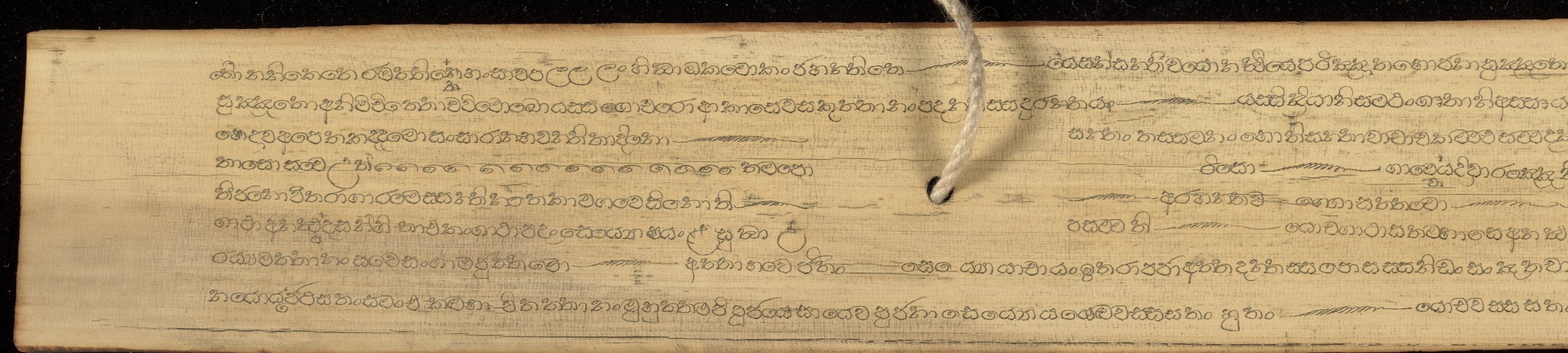
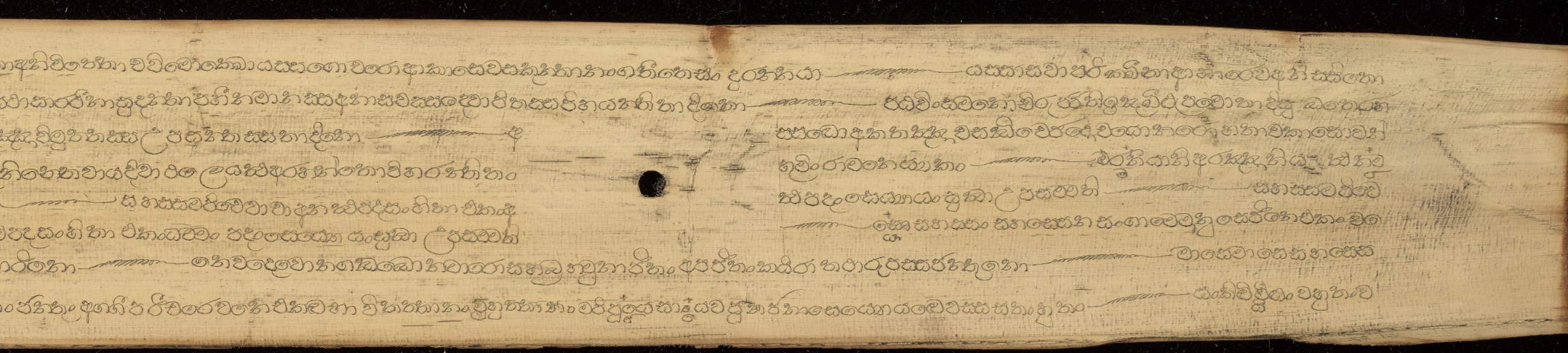
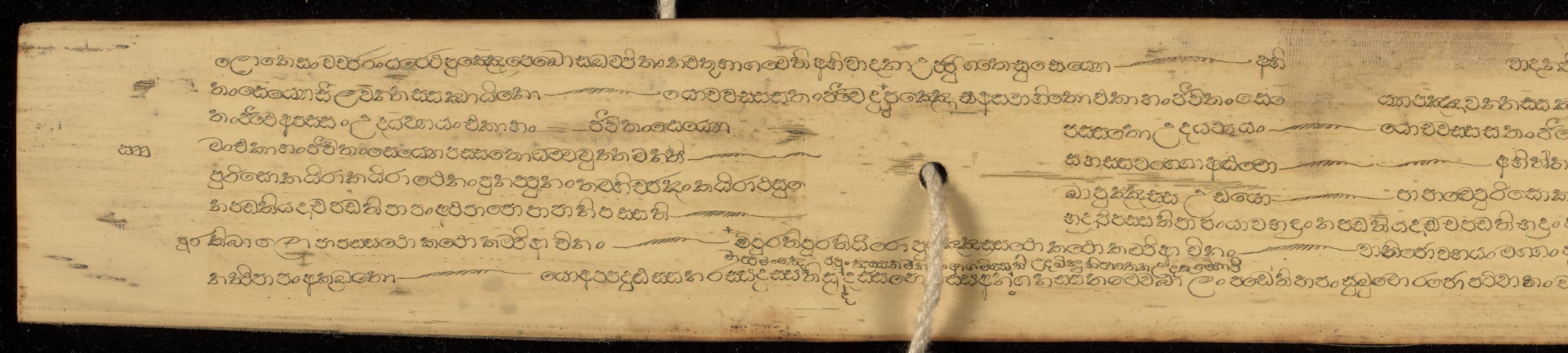
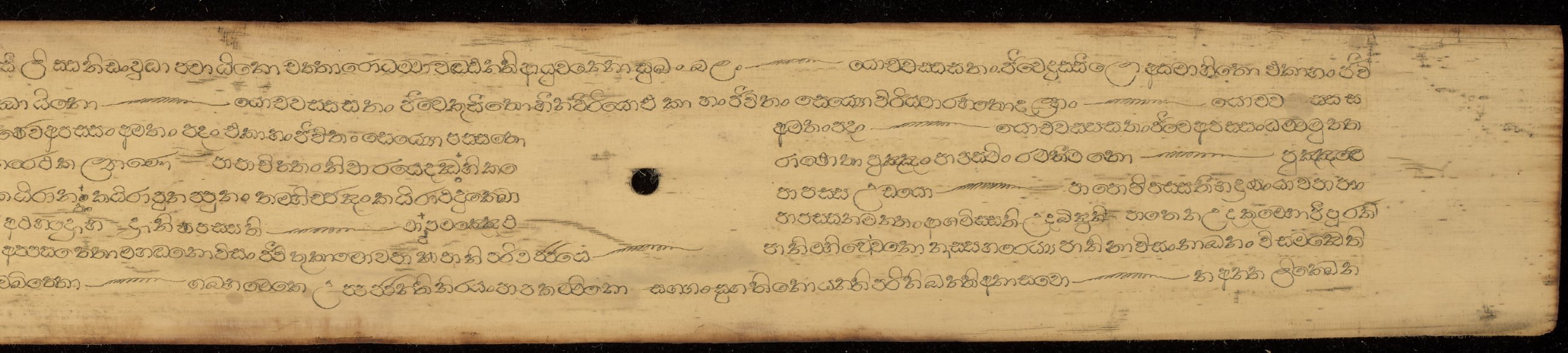
The images are of a Sinhalese palm-leaf manuscript in the John Rylands Library, Manchester (Pali MS 19), once owned by T. W. Rhys Davids. The text is written in Sinhalese script across the whole width of each leaf, nine lines a side, interrupted only by the string holes; each image is one half of a leaf side. This chapter is on fol. 7b, 8a. Each section holds the verses that end on that side.
The Pali is the Mahāsaṅgīti edition published by SuttaCentral, and the English is Max Müller's translation in the Sacred Books of the East (1881), which sometimes renders two verses together (for example 58-59).
How was this verified? (Provenance)
Where on the image
Pali MS 19, fol. 7b (both halves of the leaf side). Checked on the image: the side begins '-to na nikete ramanti te, haṃsāva pallalaṃ hitvā (v.91)' and its last line ends 'yaṃ kiñci yiṭṭhaṃ va hutaṃ va (v.108)'. The Pali shown is the Mahāsaṅgīti edition (SuttaCentral), not a transcription of the manuscript; the scribe's spellings differ in places.
100Sahassamapi ce vācā, anatthapadasaṁhitā; Ekaṁ atthapadaṁ seyyo, yaṁ sutvā upasammati.
101Sahassamapi ce gāthā, anatthapadasaṁhitā; Ekaṁ gāthāpadaṁ seyyo, yaṁ sutvā upasammati.
102Yo ca gāthā sataṁ bhāse, anatthapadasaṁhitā; Ekaṁ dhammapadaṁ seyyo, yaṁ sutvā upasammati.
103Yo sahassaṁ sahassena, saṅgāme mānuse jine; Ekañca jeyyamattānaṁ, sa ve saṅgāmajuttamo.
104Attā have jitaṁ seyyo, yā cāyaṁ itarā pajā; Attadantassa posassa, niccaṁ saññatacārino.
105Neva devo na gandhabbo, na māro saha brahmunā; Jitaṁ apajitaṁ kayirā, tathārūpassa jantuno.
106Māse māse sahassena, yo yajetha sataṁ samaṁ; Ekañca bhāvitattānaṁ, muhuttamapi pūjaye; Sāyeva pūjanā seyyo, yañce vassasataṁ hutaṁ.
107Yo ca vassasataṁ jantu, aggiṁ paricare vane; Ekañca bhāvitattānaṁ, muhuttamapi pūjaye; Sāyeva pūjanā seyyo, yañce vassasataṁ hutaṁ.
100Even though a speech be a thousand (of words), but made up of senseless words, one word of sense is better, which if a man hears, he becomes quiet.
101Even though a Gatha (poem) be a thousand (of words), but made up of senseless words, one word of a Gatha is better, which if a man hears, he becomes quiet.
102Though a man recite a hundred Gathas made up of senseless words, one word of the law is better, which if a man hears, he becomes quiet.
103If one man conquer in battle a thousand times thousand men, and if another conquer himself, he is the greatest of conquerors.
104-105One's own self conquered is better than all other people; not even a god, a Gandharva, not Mara with Brahman could change into defeat the victory of a man who has vanquished himself, and always lives under restraint.
106If a man for a hundred years sacrifice month after month with a thousand, and if he but for one moment pay homage to a man whose soul is grounded (in true knowledge), better is that homage than sacrifice for a hundred years.
107If a man for a hundred years worship Agni (fire) in the forest, and if he but for one moment pay homage to a man whose soul is grounded (in true knowledge), better is that homage than sacrifice for a hundred years.
Where on the image
Pali MS 19, fol. 8a (both halves of the leaf side). Checked on the image: the side begins 'loke saṃvaccharaṃ yajetha puññapekkho (v.108)' and its last line ends 'na antalikkhe na (v.127)'. Verse 108 begins on fol. 7b and ends on fol. 8a; both sides are shown. The Pali shown is the Mahāsaṅgīti edition (SuttaCentral), not a transcription of the manuscript; the scribe's spellings differ in places.
108Yaṁ kiñci yiṭṭhaṁ va hutaṁ va loke, Saṁvaccharaṁ yajetha puññapekkho; Sabbampi taṁ na catubhāgameti, Abhivādanā ujjugatesu seyyo.
109Abhivādanasīlissa, niccaṁ vuḍḍhāpacāyino; Cattāro dhammā vaḍḍhanti, āyu vaṇṇo sukhaṁ balaṁ.
110Yo ca vassasataṁ jīve, dussīlo asamāhito; Ekāhaṁ jīvitaṁ seyyo, sīlavantassa jhāyino.
111Yo ca vassasataṁ jīve, duppañño asamāhito; Ekāhaṁ jīvitaṁ seyyo, paññavantassa jhāyino.
112Yo ca vassasataṁ jīve, kusīto hīnavīriyo; Ekāhaṁ jīvitaṁ seyyo, vīriyamārabhato daḷhaṁ.
113Yo ca vassasataṁ jīve, apassaṁ udayabbayaṁ; Ekāhaṁ jīvitaṁ seyyo, passato udayabbayaṁ.
114Yo ca vassasataṁ jīve, apassaṁ amataṁ padaṁ; Ekāhaṁ jīvitaṁ seyyo, passato amataṁ padaṁ.
115Yo ca vassasataṁ jīve, apassaṁ dhammamuttamaṁ; Ekāhaṁ jīvitaṁ seyyo, passato dhammamuttamaṁ.
108Whatever a man sacrifice in this world as an offering or as an oblation for a whole year in order to gain merit, the whole of it is not worth a quarter (a farthing); reverence shown to the righteous is better.
109He who always greets and constantly reveres the aged, four things will increase to him, viz. life, beauty, happiness, power.
110But he who lives a hundred years, vicious and unrestrained, a life of one day is better if a man is virtuous and reflecting.
111And he who lives a hundred years, ignorant and unrestrained, a life of one day is better if a man is wise and reflecting.
112And he who lives a hundred years, idle and weak, a life of one day is better if a man has attained firm strength.
113And he who lives a hundred years, not seeing beginning and end, a life of one day is better if a man sees beginning and end.
114And he who lives a hundred years, not seeing the immortal place, a life of one day is better if a man sees the immortal place.
115And he who lives a hundred years, not seeing the highest law, a life of one day is better if a man sees the highest law.
Notes
- Müller's English is from the Wikisource transcription, which leaves out the diacritics the printed book uses in names (for example Nirvana, Brahmana, Mara).
- Words in round brackets are Müller's additions for sense.
Cite
Sources
- Source: Manchester, John Rylands Library, Pali MS 19 (palm leaf, Sinhalese script) + SuttaCentral Pali (Mahāsaṅgīti) + Max Müller's English (SBE X, 1881) (holding institution)
- Critical edition: SuttaCentral, Mahāsaṅgīti Tipiṭaka edition
← previous · → next · v cycle view · l back to library