Dhammapada 10: Daṇḍavagga, Punishment (verses 129-145)
Introduction
Chapter 10 of the Dhammapada, the Daṇḍavagga ('Punishment' in Max Müller's translation), verses 129-145. The Dhammapada is a collection of 423 verses in Pali attributed to the Buddha, part of the Khuddakanikāya of the Pali canon; its compilation is usually dated to about the third century BCE.
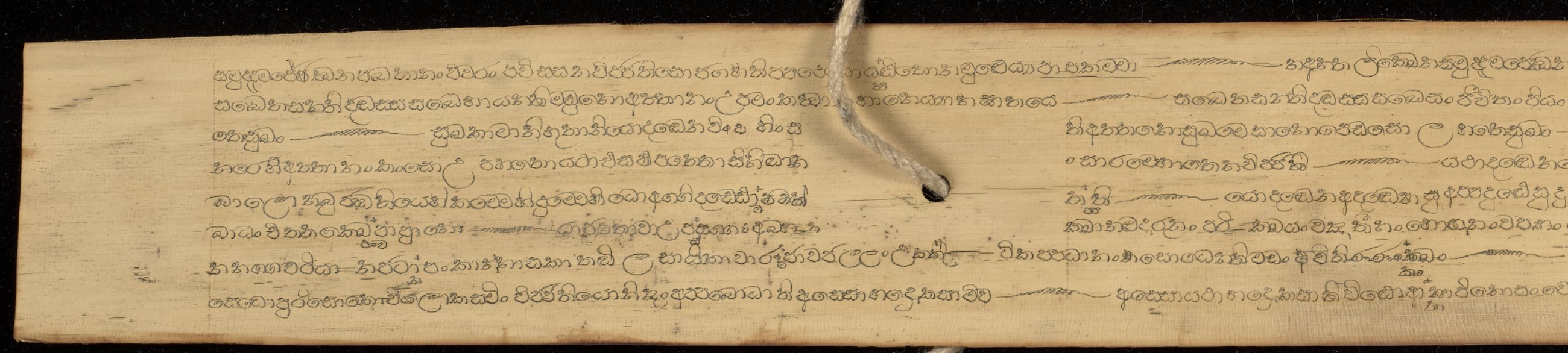
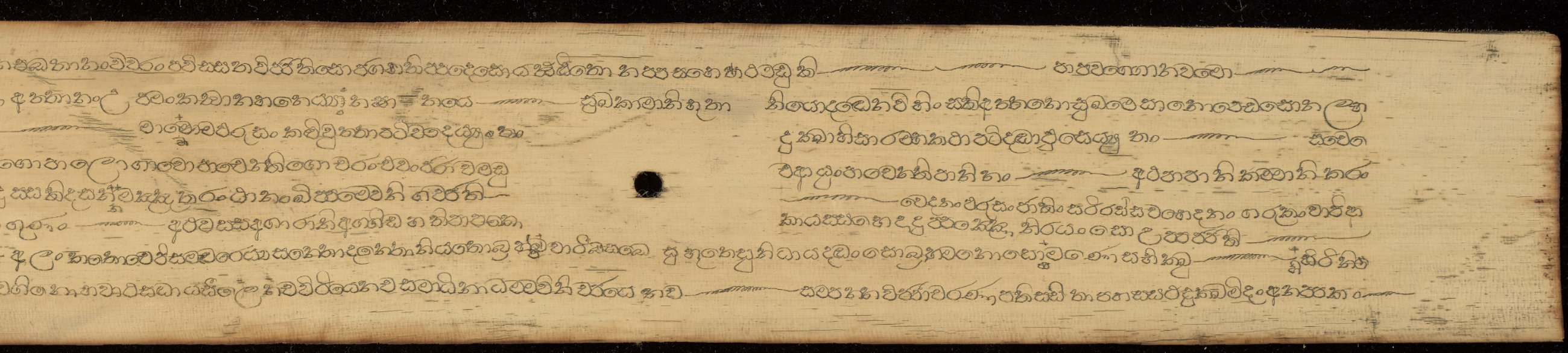
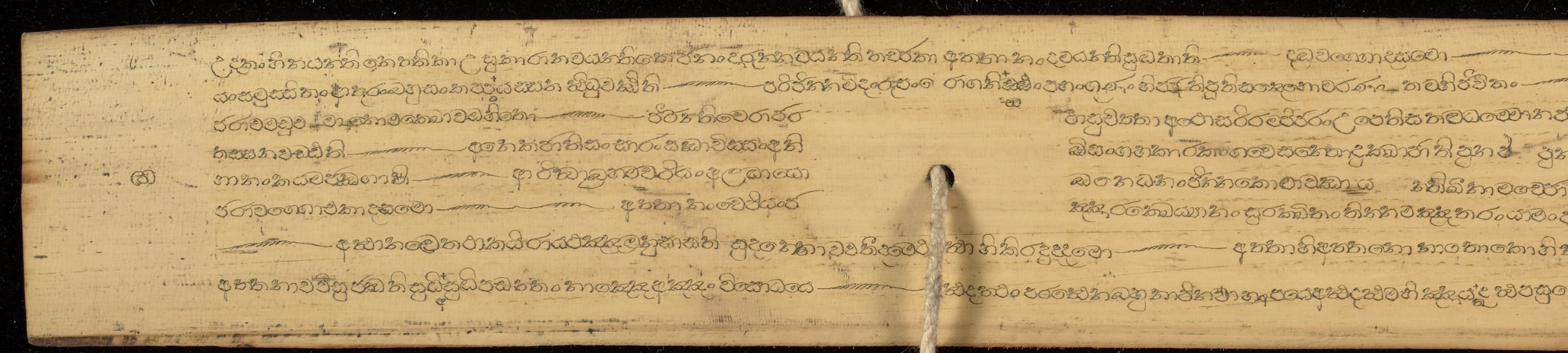
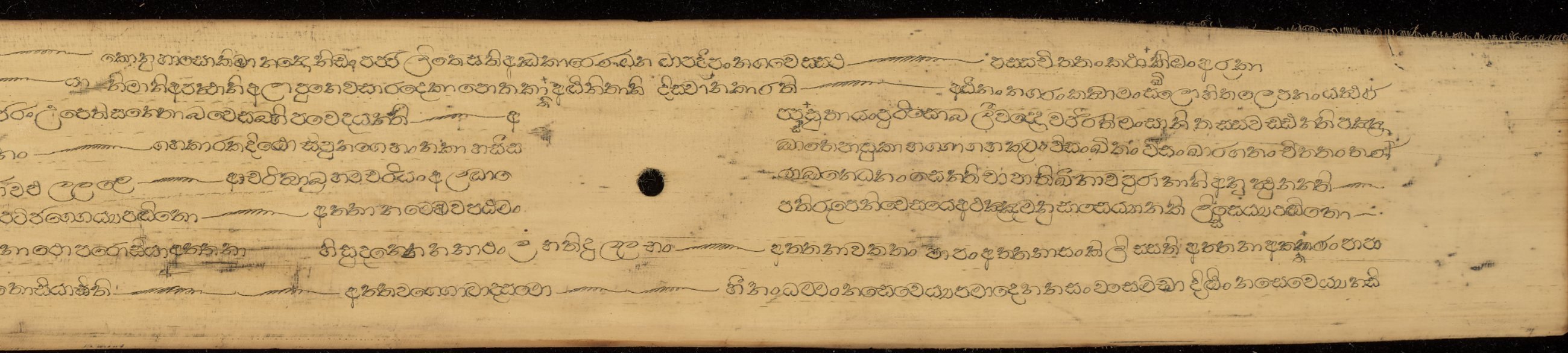
The images are of a Sinhalese palm-leaf manuscript in the John Rylands Library, Manchester (Pali MS 19), once owned by T. W. Rhys Davids. The text is written in Sinhalese script across the whole width of each leaf, nine lines a side, interrupted only by the string holes; each image is one half of a leaf side. This chapter is on fol. 8b, 9a. Each section holds the verses that end on that side.
The Pali is the Mahāsaṅgīti edition published by SuttaCentral, and the English is Max Müller's translation in the Sacred Books of the East (1881), which sometimes renders two verses together (for example 58-59).
How was this verified? (Provenance)
Where on the image
Pali MS 19, fol. 8b (both halves of the leaf side). Checked on the image: the side begins 'samuddamajjhe na pabbatānaṃ vivaraṃ pavissa (v.127)' and its last line ends '... pahassatha dukkhamidaṃ anappakaṃ (end of v.144)'. The Pali shown is the Mahāsaṅgīti edition (SuttaCentral), not a transcription of the manuscript; the scribe's spellings differ in places.
129Sabbe tasanti daṇḍassa, sabbe bhāyanti maccuno; Attānaṁ upamaṁ katvā, na haneyya na ghātaye.
130Sabbe tasanti daṇḍassa, sabbesaṁ jīvitaṁ piyaṁ; Attānaṁ upamaṁ katvā, na haneyya na ghātaye.
131Sukhakāmāni bhūtāni, yo daṇḍena vihiṁsati; Attano sukhamesāno, pecca so na labhate sukhaṁ.
132Sukhakāmāni bhūtāni, yo daṇḍena na hiṁsati; Attano sukhamesāno, pecca so labhate sukhaṁ.
133Māvoca pharusaṁ kañci, vuttā paṭivadeyyu taṁ; Dukkhā hi sārambhakathā, paṭidaṇḍā phuseyyu taṁ.
134Sace neresi attānaṁ, kaṁso upahato yathā; Esa pattosi nibbānaṁ, sārambho te na vijjati.
135Yathā daṇḍena gopālo, gāvo pājeti gocaraṁ; Evaṁ jarā ca maccu ca, āyuṁ pājenti pāṇinaṁ.
136Atha pāpāni kammāni, karaṁ bālo na bujjhati; Sehi kammehi dummedho, aggidaḍḍhova tappati.
137Yo daṇḍena adaṇḍesu, appaduṭṭhesu dussati; Dasannamaññataraṁ ṭhānaṁ, khippameva nigacchati.
138Vedanaṁ pharusaṁ jāniṁ, sarīrassa va bhedanaṁ; Garukaṁ vāpi ābādhaṁ, cittakkhepaṁ va pāpuṇe.
139Rājato vā upasaggaṁ, Abbhakkhānaṁ va dāruṇaṁ; Parikkhayaṁ va ñātīnaṁ, Bhogānaṁ va pabhaṅguraṁ.
140Atha vāssa agārāni, aggi ḍahati pāvako; Kāyassa bhedā duppañño, nirayaṁ sopapajjati.
141Na naggacariyā na jaṭā na paṅkā, Nānāsakā thaṇḍilasāyikā vā; Rajojallaṁ ukkuṭikappadhānaṁ, Sodhenti maccaṁ avitiṇṇakaṅkhaṁ.
142Alaṅkato cepi samaṁ careyya, Santo danto niyato brahmacārī; Sabbesu bhūtesu nidhāya daṇḍaṁ, So brāhmaṇo so samaṇo sa bhikkhu.
143Hirīnisedho puriso, koci lokasmi vijjati; Yo niddaṁ apabodheti, asso bhadro kasāmiva.
144Asso yathā bhadro kasāniviṭṭho, Ātāpino saṁvegino bhavātha; Saddhāya sīlena ca vīriyena ca, Samādhinā dhammavinicchayena ca; Sampannavijjācaraṇā patissatā, Jahissatha dukkhamidaṁ anappakaṁ.
129All men tremble at punishment, all men fear death; remember that you are like unto them, and do not kill, nor cause slaughter.
130All men tremble at punishment, all men love life; remember that thou art like unto them, and do not kill, nor cause slaughter.
131He who seeking his own happiness punishes or kills beings who also long for happiness, will not find happiness after death.
132He who seeking his own happiness does not punish or kill beings who also long for happiness, will find happiness after death.
133Do not speak harshly to anybody; those who are spoken to will answer thee in the same way. Angry speech is painful, blows for blows will touch thee.
134If, like a shattered metal plate (gong), thou utter not, then thou hast reached Nirvana; contention is not known to thee.
135As a cowherd with his staff drives his cows into the stable, so do Age and Death drive the life of men.
136A fool does not know when he commits his evil deeds: but the wicked man burns by his own deeds, as if burnt by fire.
137He who inflicts pain on innocent and harmless persons, will soon come to one of these ten states:
138He will have cruel suffering, loss, injury of the body, heavy affliction, or loss of mind,
139Or a misfortune coming from the king, or a fearful accusation, or loss of relations, or destruction of treasures,
140Or lightning-fire will burn his houses; and when his body is destroyed, the fool will go to hell.
141Not nakedness, not platted hair, not dirt, not fasting, or lying on the earth, not rubbing with dust, not sitting motionless, can purify a mortal who has not overcome desires.
142He who, though dressed in fine apparel, exercises tranquillity, is quiet, subdued, restrained, chaste, and has ceased to find fault with all other beings, he indeed is a Brahmana, an ascetic (sramana), a friar (bhikshu).
143Is there in this world any man so restrained by humility that he does not mind reproof, as a well-trained horse the whip?
144Like a well-trained horse when touched by the whip, be ye active and lively, and by faith, by virtue, by energy, by meditation, by discernment of the law you will overcome this great pain (of reproof), perfect in knowledge and in behaviour, and never forgetful.
Where on the image
Pali MS 19, fol. 9a (both halves of the leaf side). Checked on the image: the side begins 'udakañhi nayanti nettikā (v.145; line 2 has v.147, so not the same words in v.80)' and its last line ends 'micchādiṭṭhiṃ na seveyya na si- (v.167)'. The Pali shown is the Mahāsaṅgīti edition (SuttaCentral), not a transcription of the manuscript; the scribe's spellings differ in places.
145Udakañhi nayanti nettikā, Usukārā namayanti tejanaṁ; Dāruṁ namayanti tacchakā, Attānaṁ damayanti subbatā.
145Well-makers lead the water (wherever they like); fletchers bend the arrow; carpenters bend a log of wood; good people fashion themselves.
Notes
- Müller's English is from the Wikisource transcription, which leaves out the diacritics the printed book uses in names (for example Nirvana, Brahmana, Mara).
- Words in round brackets are Müller's additions for sense.
Cite
Sources
- Source: Manchester, John Rylands Library, Pali MS 19 (palm leaf, Sinhalese script) + SuttaCentral Pali (Mahāsaṅgīti) + Max Müller's English (SBE X, 1881) (holding institution)
- Critical edition: SuttaCentral, Mahāsaṅgīti Tipiṭaka edition
← previous · → next · v cycle view · l back to library