Dhammapada 16: Piyavagga, Pleasure (verses 209-220)
Introduction
Chapter 16 of the Dhammapada, the Piyavagga ('Pleasure' in Max Müller's translation), verses 209-220. The Dhammapada is a collection of 423 verses in Pali attributed to the Buddha, part of the Khuddakanikāya of the Pali canon; its compilation is usually dated to about the third century BCE.
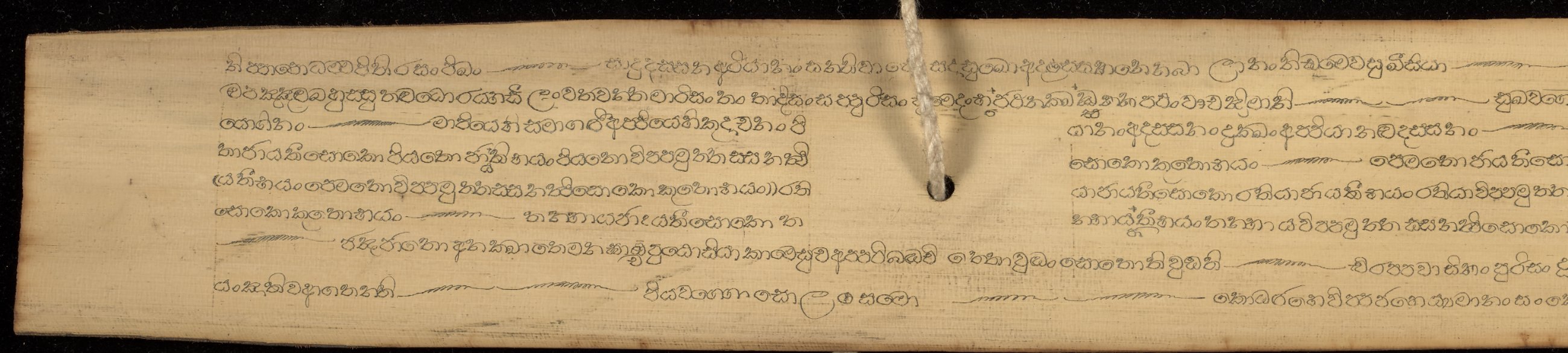
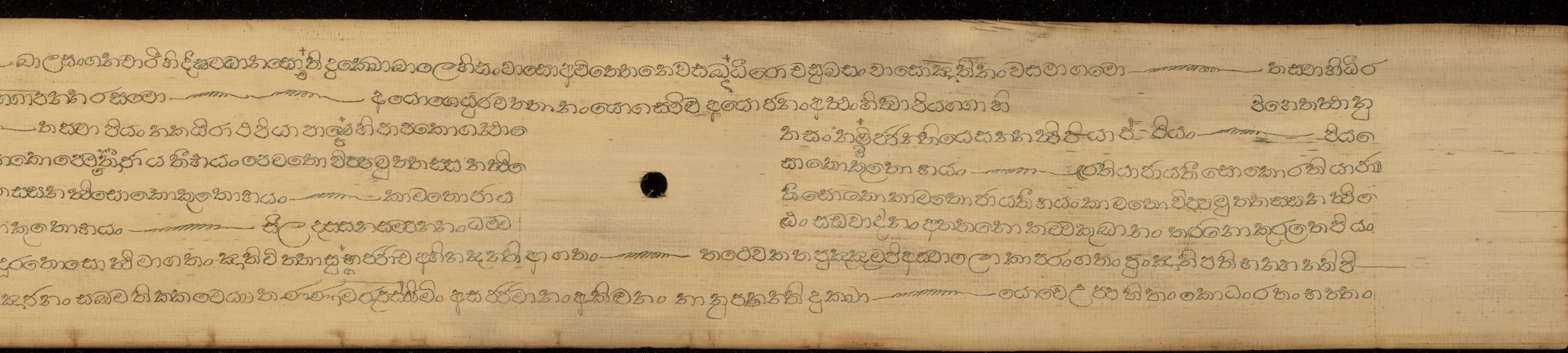
The images are of a Sinhalese palm-leaf manuscript in the John Rylands Library, Manchester (Pali MS 19), once owned by T. W. Rhys Davids. The text is written in Sinhalese script across the whole width of each leaf, nine lines a side, interrupted only by the string holes; each image is one half of a leaf side. This chapter is on fol. 10b. Each section holds the verses that end on that side.
The Pali is the Mahāsaṅgīti edition published by SuttaCentral, and the English is Max Müller's translation in the Sacred Books of the East (1881), which sometimes renders two verses together (for example 58-59).
How was this verified? (Provenance)
Where on the image
Pali MS 19, fol. 10b (both halves of the leaf side). Checked on the image: the side begins 'nippāpo dhammapītirasaṃ pibaṃ (end of v.205)' and its last line ends 'yo ve uppatitaṃ kodhaṃ rathaṃ bhantaṃ (v.222)'. The Pali shown is the Mahāsaṅgīti edition (SuttaCentral), not a transcription of the manuscript; the scribe's spellings differ in places.
209Ayoge yuñjamattānaṁ, yogasmiñca ayojayaṁ; Atthaṁ hitvā piyaggāhī, pihetattānuyoginaṁ.
210Mā piyehi samāgañchi, appiyehi kudācanaṁ; Piyānaṁ adassanaṁ dukkhaṁ, appiyānañca dassanaṁ.
211Tasmā piyaṁ na kayirātha, piyāpāyo hi pāpako; Ganthā tesaṁ na vijjanti, yesaṁ natthi piyāppiyaṁ.
212Piyato jāyatī soko, piyato jāyatī bhayaṁ; Piyato vippamuttassa, natthi soko kuto bhayaṁ.
213Pemato jāyatī soko, pemato jāyatī bhayaṁ; Pemato vippamuttassa, natthi soko kuto bhayaṁ.
214Ratiyā jāyatī soko, ratiyā jāyatī bhayaṁ; Ratiyā vippamuttassa, natthi soko kuto bhayaṁ.
215Kāmato jāyatī soko, kāmato jāyatī bhayaṁ; Kāmato vippamuttassa, natthi soko kuto bhayaṁ.
216Taṇhāya jāyatī soko, taṇhāya jāyatī bhayaṁ; Taṇhāya vippamuttassa, natthi soko kuto bhayaṁ.
217Sīladassanasampannaṁ, dhammaṭṭhaṁ saccavedinaṁ; Attano kamma kubbānaṁ, taṁ jano kurute piyaṁ.
218Chandajāto anakkhāte, Manasā ca phuṭo siyā; Kāmesu ca appaṭibaddhacitto, Uddhaṁsototi vuccati.
219Cirappavāsiṁ purisaṁ, dūrato sotthimāgataṁ; Ñātimittā suhajjā ca, abhinandanti āgataṁ.
220Tatheva katapuññampi, asmā lokā paraṁ gataṁ; Puññāni paṭigaṇhanti, piyaṁ ñātīva āgataṁ.
209He who gives himself to vanity, and does not give himself to meditation, forgetting the real aim (of life) and grasping at pleasure, will in time envy him who has exerted himself in meditation.
210Let no man ever look for what is pleasant, or what is unpleasant. Not to see what is pleasant is pain, and it is pain to see what is unpleasant.
211Let, therefore, no man love anything; loss of the beloved is evil. Those who love nothing and hate nothing, have no fetters.
212From pleasure comes grief, from pleasure comes fear; he who is free from pleasure knows neither grief nor fear.
213From affection comes grief, from affection comes fear; he who is free from affection knows neither grief nor fear.
214From lust comes grief, from lust comes fear; he who is free from lust knows neither grief nor fear.
215From love comes grief, from love comes fear; he who is free from love knows neither grief nor fear.
216From greed comes grief, from greed comes fear; he who is free from greed knows neither grief nor fear.
217He who possesses virtue and intelligence, who is just, speaks the truth, and does what is his own business, him the world will hold dear.
218He in whom a desire for the Ineffable (Nirvana) has sprung up, who is satisfied in his mind, and whose thoughts are not bewildered by love, he is called urdhvamsrotas (carried upwards by the stream).
219Kinsmen, friends, and lovers salute a man who has been long away, and returns safe from afar.
220In like manner his good works receive him who has done good, and has gone from this world to the other;—as kinsmen receive a friend on his return.
Notes
- Müller's English is from the Wikisource transcription, which leaves out the diacritics the printed book uses in names (for example Nirvana, Brahmana, Mara).
- Words in round brackets are Müller's additions for sense.
Cite
Sources
- Source: Manchester, John Rylands Library, Pali MS 19 (palm leaf, Sinhalese script) + SuttaCentral Pali (Mahāsaṅgīti) + Max Müller's English (SBE X, 1881) (holding institution)
- Critical edition: SuttaCentral, Mahāsaṅgīti Tipiṭaka edition
← previous · → next · v cycle view · l back to library