Grímnismál
Introduction
Grímnismál is preserved in the Codex Regius of the Poetic Edda (GKS 2365 4to, Árni Magnússon Institute, Reykjavík), an Icelandic parchment book written about 1270. The poem fills fol. 8v-11r (manuscript pages 16-21).
Pages: each section holds the stanzas that begin on one manuscript page and links that page's photograph (handrit.is); a stanza that runs onto the next page links both pages. The page of every stanza comes from Wimmer and Finnur Jónsson's 1891 diplomatic edition, which prints the text of each manuscript page, and the first line of every page was checked on the photograph. 'Where on the image' under each section gives the details.
Texts: the first Old Norse text is the manuscript's own text, letter by letter, from the diplomatic transcription of Wimmer and Finnur Jónsson (1891), which prints each page line for line: line breaks are the manuscript's, ‖ marks a new page, letters in italics are supplied where the scribe abbreviated, and special letters are kept (ſ long s, ꝛ round r, ꝼ insular f, ı dotless i, ꜹ the av ligature, ǫ and ę with hooks, ᛘ the rune for maðr, small capitals for the scribe's small capitals). The manuscript writes the poem as continuous lines without stanza breaks; the stanza numbers (Guðni Jónsson's) are inserted where each stanza begins and do not appear in the manuscript. Letters with a dot below are marked for deletion in the manuscript; letters between ⸌ and ⸍ are written above the line, and ⟨marg. ...⟩ gives what Wimmer and Jónsson print in the margin (corrections, and in Vafþrúðnismál the speaker marks o, v, q). The manuscript's prose (the prose before and after the poem, the prose links between speeches, the red titles and speaker notes such as 'Freyıa q.', Freyja said) is shown where it stands, marked 'prose'; where verse goes on after such a piece inside a stanza, the stanza number is repeated with 'cont.'. Thorpe's English for the prose is given at the same place where he translates it; he gives the speaker notes as the speaker's name before the stanza. The second text is Guðni Jónsson's normalized edition (via heimskringla.no), a reading text in modern spelling; in places it adds words or lines from other manuscripts and follows modern editions where they rearrange stanzas. The English is Benjamin Thorpe's 1866 translation (public domain).
Stanza order: In the manuscript stanza 24 (Fimm hundruð golfa) comes before stanza 23 (Fimm hundruð dura): 24 begins at the foot of fol. 9v and ends at the top of fol. 10r, and 23 follows it on 10r. The edition reverses the two.
How was this verified? (Provenance)
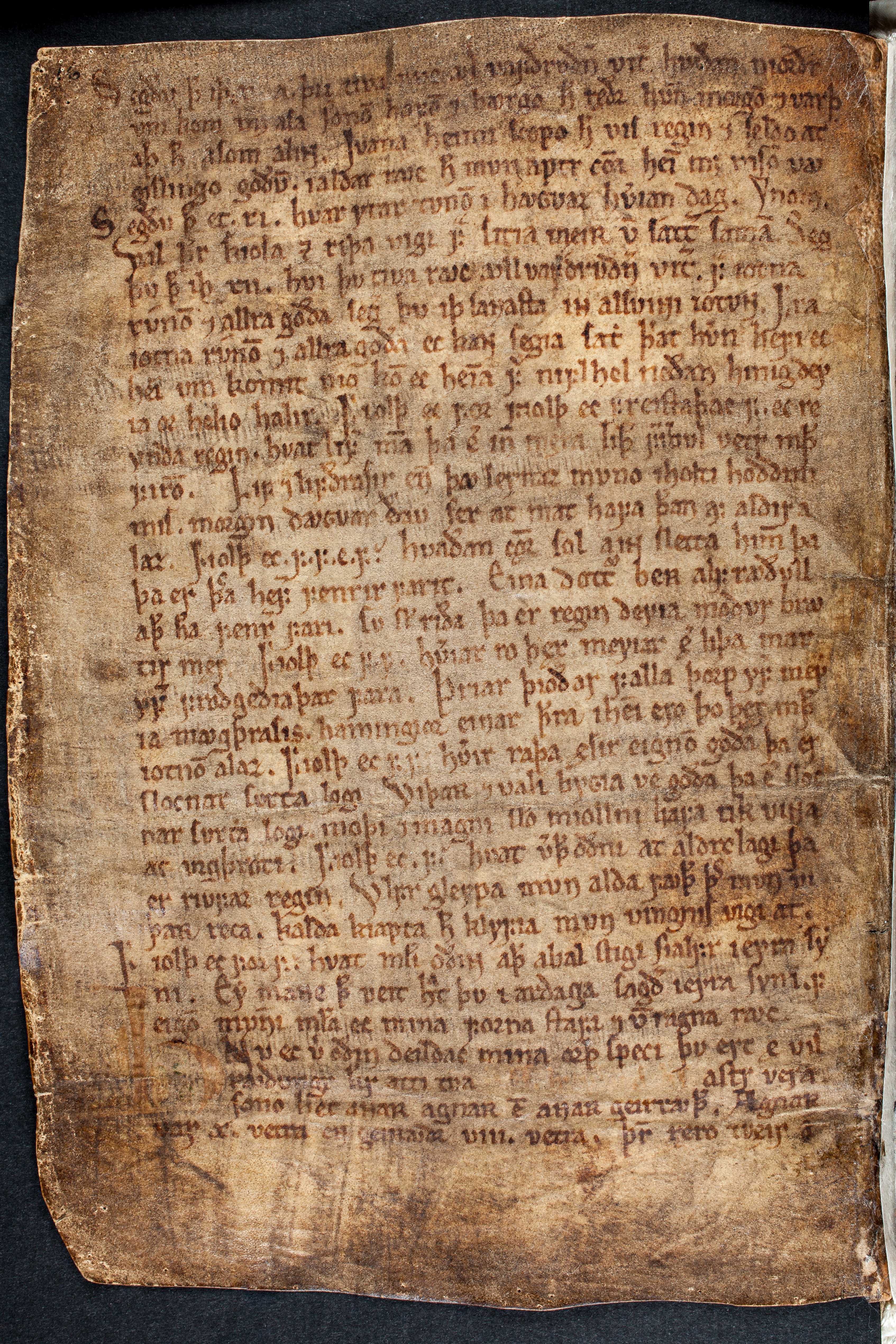
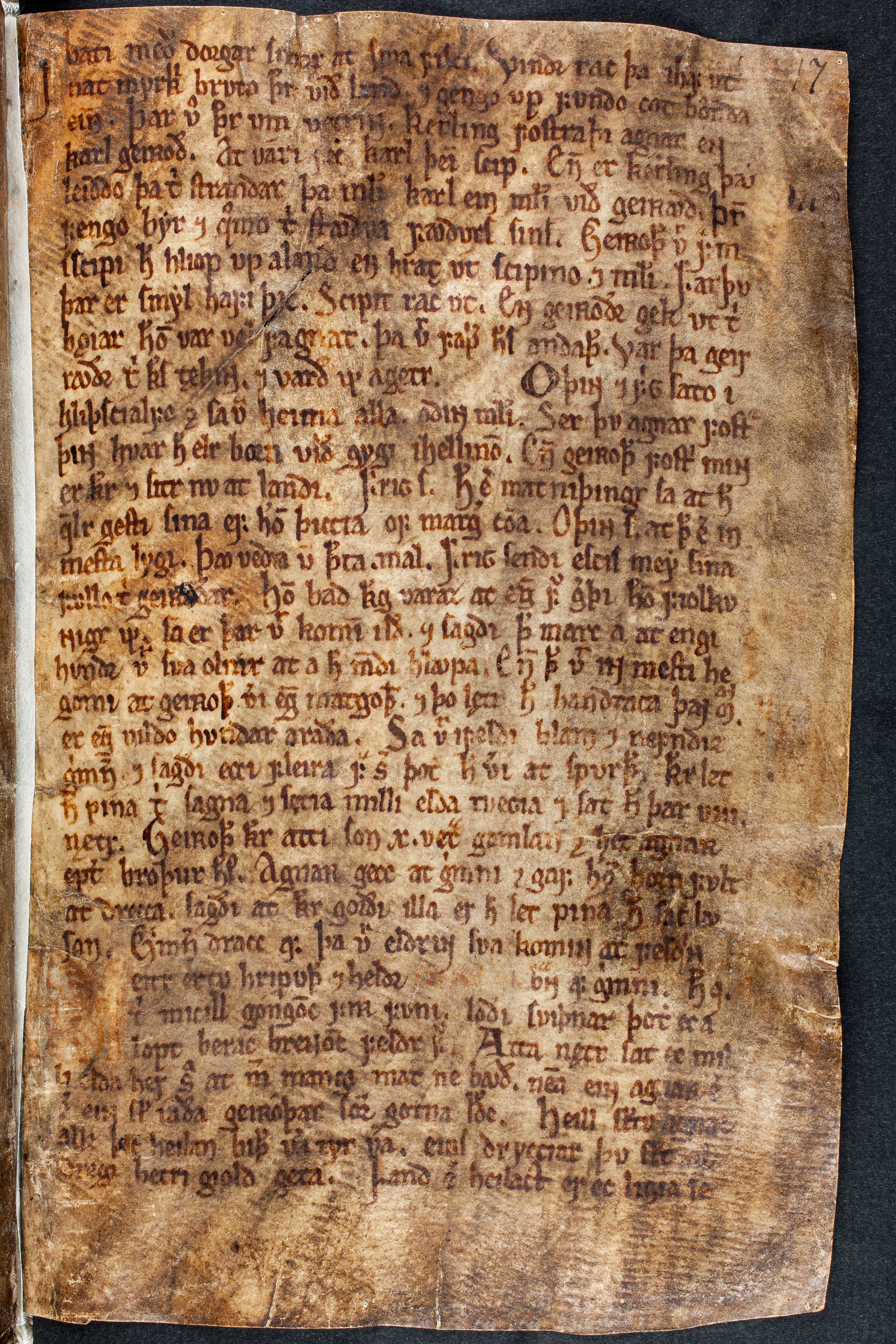
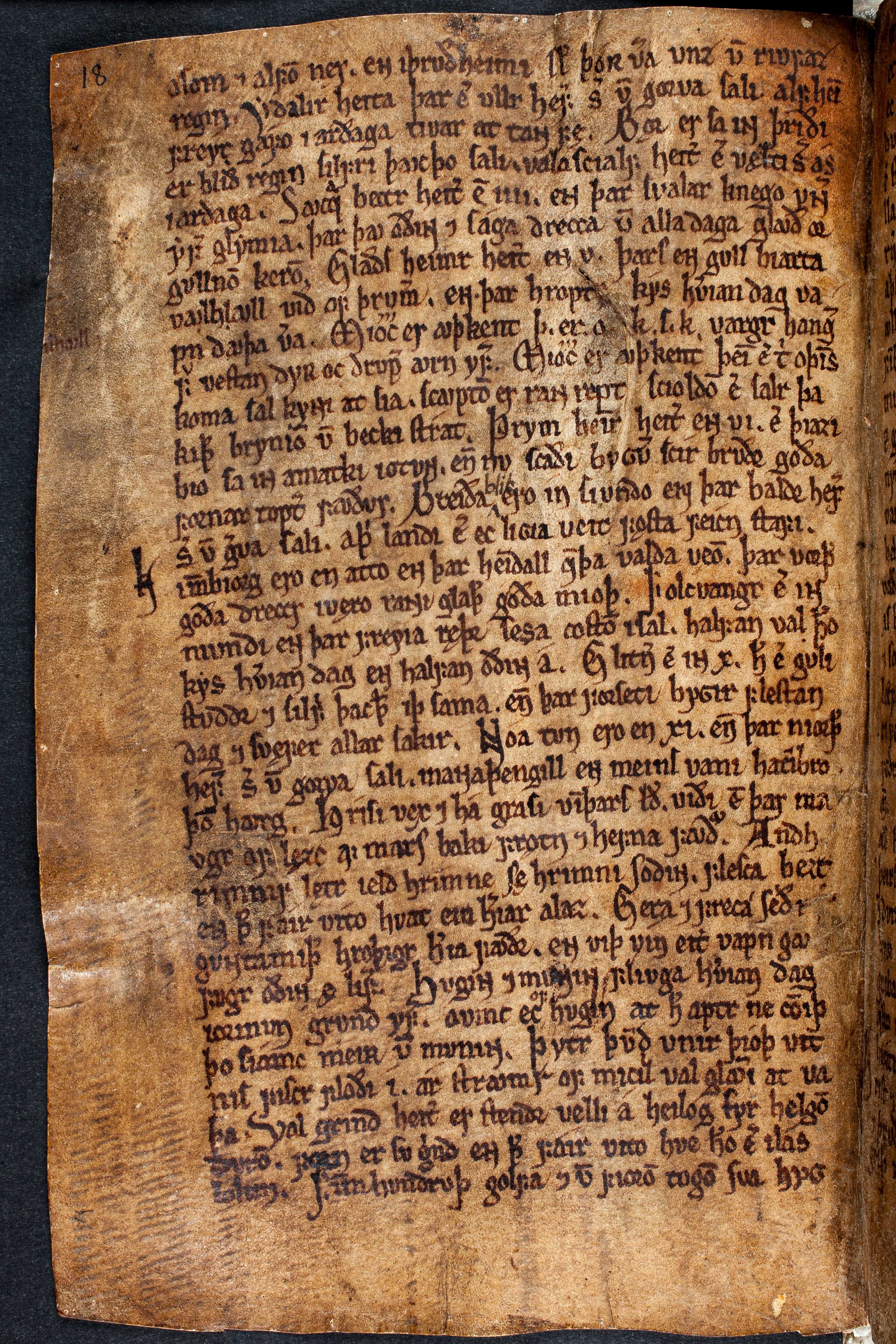
Where on the image
Fol. 8v (manuscript page 16; handrit.is image 25; Wimmer and Jónsson 1891 page 16, caption 'Vafþrúðnismál v. 38 - Grímnismál pr.'): the prose of this section begins in line 31. Fol. 9r (manuscript page 17; handrit.is image 26; Wimmer and Jónsson 1891 page 17, caption 'Grímnismál pr. - v. 4'): stanzas 1-4 begin here; stanza 4 runs on to fol. 9v. Fol. 9v (manuscript page 18; handrit.is image 27; Wimmer and Jónsson 1891 page 18, caption 'Grímnismál v. 4-24'): the top of the page finishes stanza 4 ('ásum ok alfum nær ...'). Checked on the image: the first line of fol. 8v has 'Seg þú þat it tíunda' (Vafþrúðnismál 38); the first line of fol. 9r has 'báti með dorgar sínar' (the prose before Grímnismál); the first line of fol. 9v has 'ásum ok alfum nær' (end of Grímnismál 4). The manuscript's prose in this section is shown in its place and marked 'prose': the prose before the poem, with its title (ꝼra ſonom hrꜹðvngſ konvngſ) (Wimmer and Jónsson 1891 page 16, lines 31-33; page 17, lines 1-26); the last words of that prose (... hann q., he said), written at the end of line 27 after the first words of stanza 1, with the end of the red title Grímnismál (translated at the end of Thorpe's paragraph before stanza 1) (Wimmer and Jónsson 1891 page 17, line 27). Thorpe's English for it is given at the same place ('King Hraudung had two sons ...'). Diplomatic text: Wimmer and Jónsson 1891, page 16, lines 31-33; page 17, lines 1-33; page 18, lines 1-2, transcribed from their page images and proofread line by line; they print each manuscript page line for line beside its phototype, so the line breaks shown are the manuscript's.
proseHrꜹðvngr konvngr attı tva ꝼra ſonom. hrꜹðvngſ konvngſ.
ſono het aɴaʀ agnaʀ en aɴaʀ geırrꜹþr. Agnaʀ
var x. vetra eɴ geıʀꜹðꝛ vııı. vetra. þeır ręro tvęır á
‖ bátı með ðóꝛgar ſınar at ſmá ꝼıſcı. Vınðꝛ rac þa ıhaꝼ vt
I nát myrkrı brvto þeır vıð lanð. oc gengo vp ꝼvnðo cot bǫ́nða
eınn. Þar voro þeır vm vetrıɴ. Kerlıng ꝼoſtraþı agnar eɴ
karl geıʀoð. At várı ꝼecc karl þeım ſcıp. Enn er ke⸌/⸍rlıng þꜹ⸌/⸍
leıððo þa tıl ſtranðar þa męltı karl eın męlı vıð geıʀꜹð. Þeır
ꝼengo býr oc qvomo tıl ſtꜹðva ꝼꜹðvrſ ſınſ. Geıʀoþr var ꝼram
ıſcıpı hann hlıóp vp alanð eɴ hratt v́t ſcıpıno. oc męltı. Farþv
þar er ſmýl haꝼı þıc. Scıpıt rac vt. Eɴ geıʀoðꝛ gek vt tıl
bǫ́ıar hanom var vel ꝼagnat. þa var ꝼaþır hanſ anðaþr. Var þa geır
rꜹðꝛ tıl konvngſ tękıɴ. oc varð ᛘ agętr. Oþıɴ oc ꝼrıɢ ſato ı
hlıþſcíalꝼo oc ſa vm heıma alla. oðıɴ męltı. Sér þv agnar ꝼoſtra
þıɴ hvar hann elr boꝛn vıð gygı ıhellınom. Enn geıʀoþr ꝼoſtrı mıɴ
er konvngr oc ſıtr nv at lanðı. Fʀıɢ ſ. Hann er mat nıþıngr ſa at hann
qvelr geſtı ſına eꝼ hanom þıccıa ᴏꝼ margır coma. Oþıɴ ſ. at þat er ın
meſta lygı. Þꜹ veðıa vm þetta. mál. Fʀıɢ ſenðı eſcıſ meẏ ſína
ꝼvllo tıl geıʀoðar. Hon bað konvng varaz at eıgı ꝼyr gerþı hanom ꝼıolkv
ɴıgr ᛘ. ſa er þar var komınn ılanð. oc ſagðı þat marc á at engı
hvnðꝛ var ſva ólmr at á hann mvnðı hlꜹpa. Enn þat var ıɴ meſtı he-
gómı at geıʀoþr verı eıgı matgóþr. oc þo lętr hann hanðtaca þaɴ ᴍaɴ.
er eıgı vılðo hvnðar áraða. Sa var ıꝼelðı blám oc neꝼnðız
grımnır. oc ſagðı eccı ꝼleíra ꝼra ſer þott hann verı at ſpvrþr. Konvngr let
hann pína tıl ſagna oc ſetıa mıllı elða tveɢıa oc ſát hann þar vııı.
nętr. Geıʀoþr konvngr attı ſon x. vetra gamlan oc hét agnaʀ
eptır broþur hanſ. Agnaʀ gecc at grımnı oc gaꝼ hanom hoꝛn ꝼvlt
at ðrecca. ſagðı at konvngr goꝛðı ılla er hann let pína hann ſac lꜹ
ſan. Grımnır ðracc aꝼ þa var elðrıɴ ſva komıɴ at ꝼelðrıɴ
1Heıtr ertv hrıpvþr oc helðꝛ Grımnıſ m prosebraɴ aꝼ grımnı. hann q. al
1 cont.tıl mıcıll góngomc ꝼıʀ ꝼvnı. loðı ſvıþnar þott ec a
lopt berac breɴᴏmc ꝼelðr ꝼyr. 2Átta nętr ſat ec mıl
lı elða her sva at mer mangı mat ne bꜹ́ð. nema eıɴ agnaʀ er
er eıɴ ſcal ráða geıʀóþar ſonꝛ gotna lanðe. 3Heıll ſcaltv agnaʀ
allz þıc heılan bıþr veratyr vera. eınſ ðryccıar þv ſcalt al
ðregı betrı gıolð geta. 4Lanð er heılact er ec lıɢıa ſe
‖ aſom oc alꝼom nęr. eɴ ıþrvðheımı ſcal þóʀ vera vnz vm rıvꝼaz
regın.
Compare: Normalized text (Guðni Jónsson)
1Heitr ertu, hripuðr, / ok heldr til mikill; / göngumk firr, funi! / loði sviðnar, / þótt ek á loft berak; / brennumk feldr fyr. 2Átta nætr sat ek / milli elda hér, / svá at mér manngi / mat né bauð / nema einn Agnarr, / er einn skal ráða, / Geirröðar sonr, / Gotna landi. 3Heill skaltu, Agnarr, / alls þik heilan biðr / Veratýr vera; / eins drykkjar / þú skalt aldrigi / betri gjöld geta. 4Land er heilagt, / er ek liggja sé / ásum ok alfum nær; / en í Þrúðheimi / skal Þórr vera / unz of rjúfask regin.
proseKing Hraudung had two sons, one named Agnar, the other Geirröd. Agnar was ten, and Geirröd eight winters old. They both rowed out in a boat, with their hooks and lines, to catch small fish; but the wind drove them out to sea. In the darkness of the night they were wrecked on the shore, and went up into the country, where they found a cottager, with whom they stayed through the winter. The cottager's wife brought up Agnar, and the cottager, Geirröd, and gave him good advice. In the spring the man got them a ship; but when he and his wife accompanied them to the strand, the man talked apart with Geirröd. They had a fair wind, and reached their father's place. Geirröd was at the ship's prow: he sprang on shore, but pushed the ship out, saying, "Go where an evil spirit may get thee." The vessel was driven out to sea, but Geirröd went up to the town, where he was well received; but his father was dead. Geirröd was then taken for king, and became a famous man. Odin and Frigg were sitting in Hlidskiâlf, looking over all the world. Odin said, "Seest thou Agnar, thy foster-son, where he is, getting children with a giantess in a cave? while Geirröd, my foster-son, is a king residing in his country." Frigg answered, "He is so inhospitable that he tortures his guests, if he thinks that too many come." Odin replied that that was the greatest falsehood; and they wagered thereupon. Frigg sent her waiting-maid Fulla to bid Geirröd be on his guard, lest the trollmann who was coming should do him harm, and also say that a token whereby he might be known was, that no dog, however fierce, would attack him. But that King Geirröd was not hospitable was mere idle talk. He, nevertheless, caused the man to be secured whom no dog would assail. He was clad in a blue cloak, and was named Grimnir, and would say no more concerning himself, although he was questioned. The king ordered him to be tortured to make him confess, and to be set between two fires; and there he sat for eight nights. King Geirröd had a son ten years old, whom he named Agnar, after his brother. Agnar went to Grimnir and gave him a full horn to drink from, saying that the king did wrong in causing him to be tortured, though innocent. Grimnir drank from it. The fire had then so approached him that his cloak was burnt; whereupon he said:-- 1Fire! thou art hot, and much too great; flame! let us separate. My garment is singed, although I lift it up, my cloak is scorched before it. 2Eight nights have I sat between fires here, and to me no one food has offered, save only Agnar, the son of Geirröd, who alone shall rule over the land of Goths. 3Be thou blessed, Agnar! as blessed as the god of men bids thee to be. For one draught thou never shalt get better recompense. 4Holy is the land, which I see lying to Æsir and Alfar near; but in Thrûdheim Thor shall dwell until the powers perish.
Where on the image
Fol. 9v (manuscript page 18; handrit.is image 27; Wimmer and Jónsson 1891 page 18, caption 'Grímnismál v. 4-24'): stanzas 5-22 begin here. Checked on the image: the first line of fol. 9v has 'ásum ok alfum nær' (end of Grímnismál 4). Diplomatic text: Wimmer and Jónsson 1891, page 18, lines 2-34, transcribed from their page images and proofread line by line; they print each manuscript page line for line beside its phototype, so the line breaks shown are the manuscript's.
5Ẏðalır heıta þar er vllr heꝼır ſer vm goꝛva ſalı. alꝼheım
ꝼreẏ́ṛ gáꝼo ı arðaga tıvar at taɴ ꝼę. 6Bǫꝛ er ſa ıɴ þrıðı
er blıð regın ſılꝼrı þꜹcþo ſalı. valaſcıalꝼ heıtır er vęltı ſer ás
ıarðaga. 7Sꜹcqva beccr heıtır enn ıııı. eɴ þar ſvalar knego vɴır
ẏꝼır glẏmıa. þar þꜹ oðıɴ oc ſága ðrecca vm alla ðaga glꜹð oꝛ
gvllnom kerom. 8Glaðſ heımr heıtır eɴ v. þarſ eɴ gvll bıarta
⟨marg. alhꜹll,⟩ vꜹ̣lhḷꜹll vıð ᴏꝼ þrvmır. eɴ. þar hroptr kýs hverıan ðag va-
pn ðꜹþa vera. 9Mıöc̈ er ꜹþkent þ. er. o. k. ſ. k. vargr hangır
ꝼyr veſtan ðʏʀ oc ðrvpır ꜹrn yꝼır. 10Mıöc̈ er ꜹþkent þeım er tıl oþıns
koma ſal kyɴı at ſıa. ſcꜹptom er raɴ rept ſcıolðom er ſalr þa
kıþr brynıom vm beckı ſtrát. 11Þrym heımr heıtır eɴ vı. er þıazı
bío ſa ıɴ amátkı ıotvɴ. enn nv ſcaðı byɢvır ſcír brvðꝛ goða
ꝼoꝛnar toptır ꝼꜹðvr. 12Breıða ero ín ſıvnðo eɴ þar balðꝛ heꝼır
ſer vm gerva ſalı. aþvı lanðı er ec lıɢıa veıt ꝼǫſta ꝼeícn ſtaꝼı.
13Hımınbıoꝛg ero en atto eɴ þar heımðall qveþa valða vęom. þar voꝛþr
goða ðreccr ıvęro raɴı glaþr góða mıoþ. 14Folcvangr er ıɴ
nıvnðı eɴ þar ꝼreyıa ręþꝛ ſeſa coſtom ıſal. halꝼan val hon
kẏs hverıan ðag eɴ halꝼan oðıɴ á. 15Glıtnır er ıɴ x. hann er gvllı
ſtvððꝛ oc ſılꝼrı þacþr ıþ ſama. enn þar ꝼoꝛſetı byɢıʀ ꝼleſtan
ðag oc ſvęꝼer allar ſakır. 16Nóa tvn ero en xı. enn þar nıoꝛþr
heꝼır ſer vm goꝛva ſalı. maɴaþengıll eɴ meınſ vanı hatımbro
þom hꜹrg. 17Hríſı vex oc há graſı vınþarſ lanð. vıðı en þar ma-
vgr ᴏꝼ lęzc aꝼ marſ bakı ꝼrǫcn oc heꝼna ꝼꜹðvr. 18Anðh
rımnır lętr ıelð hrímne ſę hrímnı ſoðıɴ. ꝼleſca bezt
eɴ þat ꝼáır víto hvat eın herıar alaz. 19Gera oc ꝼreca ſeðr
gvɴtamıþr hroþıgr herıa ꝼꜹðꝛ. eɴ vıþ vín eıtt vapn gꜹ
ꝼvgr oðıɴ ę lıꝼır. 20Hvgıɴ oc mvɴıɴ ꝼlıvga hverıan ðag
ıoꝛmvn grvnð yꝼır. ovmc ec,⸌ᴏꝼ⸍hvgın at hann aptr ne comıþ
þo ſıámc meıʀ vm mvɴıɴ. 21Þytr þvnð vnır þıóþ vıt
nıſ ꝼıſcr ꝼloðı í. ár ſtrꜹmr ᴏꝼ mıcıll val glꜹmı at va
þa. 22Val grınð heıtır er ſtenðꝛ vellı á heılog fyr helgom
ðvrom. ꝼoꝛn er ſv grınð eɴ þat ꝼáır vıto hve hon er ılás
lokın.
Compare: Normalized text (Guðni Jónsson)
5Ýdalir heita, / þar er Ullr hefir / sér of görva sali; / Alfheim Frey / gáfu í árdaga / tívar at tannféi. 6Bær er sá inn þriði, / er blíð regin / silfri þökðu sali; / Valaskjalf heitir, / er vélti sér / áss í árdaga. 7Sökkvabekkr heitir inn fjórði, / en þar svalar knegu / unnir yfir glymja; / þar þau Óðinn ok Sága / drekka um alla daga / glöð ór gullnum kerum. 8Glaðsheimr heitir inn fimmti, / þars in gullbjarta / Valhöll víð of þrumir; / en þar Hroftr kýss / hverjan dag / vápndauða vera. 9Mjök er auðkennt, / þeim er til Óðins koma / salkynni at séa; / sköftum er rann reft, / skjöldum er salr þakiðr, / brynjum um bekki strát. 10Mjök er auðkennt, / þeir er til Óðins koma / salkynni at séa: / vargr hangir / fyr vestan dyrr, / ok drúpir örn yfir. 11Þrymheimr heitir inn sétti, / er Þjazi bjó, / sá inn ámáttki jötunn; / en nú Skaði byggvir, / skír brúðr goða, / fornar tóftir föður. 12Breiðablik eru in sjaundu, / en þar Baldr hefir / sér of gerva sali, / á því landi, / er ek liggja veit / fæsta feiknstafi. 13Himinbjörg eru in áttu, / en þar Heimdall / kveða valda véum; / þar vörðr goða / drekkr í væru ranni / glaðr inn góða mjöð. 14Fólkvangr er inn níundi, / en þar Freyja ræðr / sessa kostum í sal; / halfan val / hon kýss hverjan dag, / en halfan Óðinn á. 15Glitnir er inn tíundi, / hann er gulli studdr / ok silfri þakðr it sama; / en þar Forseti / byggir flestan dag / ok svæfir allar sakir. 16Nóatún eru in elliftu, / en þar Njörðr hefir, / sér of görva sali; / manna þengill / inn meins vani / hátimbruðum hörgi ræðr. 17Hrísi vex / ok háu grasi / Víðars land viði; / en þar mögr of læzt / af mars baki / frækn at hefna föður. 18Andhrímnir / lætr í Eldhrímni / Sæhrímni soðinn, / fleska bezt; / en þat fáir vitu, / við hvat einherjar alask. 19Gera ok Freka / seðr gunntamiðr / hróðigr Herjaföður; / en við vín eitt / vápngöfugr / Óðinn æ lifir. 20Huginn ok Muninn / fljúga hverjan dag / Jörmungrund yfir; / óumk ek of Hugin, / at hann aftr né komi-t, / þó sjámk meir of Munin. 21Þýtr Þund, / unir Þjóðvitnis / fiskr flóði í; / árstraumr þykkir / ofmikill / Valglaumni at vaða. 22Valgrind heitir, / er stendr velli á / heilög fyr helgum dyrum; / forn er sú grind, / en þat fáir vitu, / hvé hon er í lás of lokin.
5Ydalir it is called, where Ullr has himself a dwelling made. Alfheim the gods to Frey gave in days of yore for a tooth-gift. 6The third dwelling is, where the kind powers have with silver decked the hall; Valaskiâlf 'tis called, which for himself acquired the As in days of old. 7Sökkvabekk the fourth is named o'er which the gelid waves resound; Odin and Saga there, joyful each day, from golden beakers quaff. 8Gladsheim the fifth is named, there the golden-bright Valhall stands spacious, there Hropt selects each day those men who die by weapons. 9Easily to be known is, by those who to Odin come, the mansion by its aspect. Its roof with spears is laid, its hall with shields is decked, with corslets are its benches strewed. 10Easily to be known is, by those who to Odin come, the mansion by its aspect. A wolf hangs before the western door, over it an eagle hovers. 11Thrymheim the sixth is named, where Thiassi dwelt that all-powerful Jötun; but Skadi now inhabits, the bright bride of gods, her father's ancient home. 12Breidablik is the seventh, where Baldr has built for himself a hall, in that land, in which I know exists the fewest crimes. 13Himinbiörg is the eighth, where Heimdall, it is said, rules o'er the holy fanes: there the gods' watchman, in his tranquil home, drinks joyful the good mead. 14Fôlkvang is the ninth, there Freyia directs the sittings in the hall. She half the fallen chooses each day, but Odin th' other half. 15Glitnir is the tenth; it is on gold sustained, and eke with silver decked. There Forseti dwells throughout all time, and every strife allays. 16Nôatûn is the eleventh, there Niörd has himself a dwelling made, prince of men; guiltless of sin, he rules o'er the high-built fane. 17O'ergrown with branches and high grass is Vidar's spacious Landvîdi: There will the son descend, from the steed's back, bold to avenge his father. 18Andhrimnir makes, in Eldhrimnir, Sæhrimnir to boil, of meats the best; but few know how many Einheriar it feeds. 19Geri and Freki the war-wont sates, the triumphant sire of hosts; but on wine only the famed in arms, Odin, ever lives. 20Hugin and Munin fly each day over the spacious earth. I fear for Hugin, that he come not back, yet more anxious am I for Munin. 21Thund roars; joyful in Thiodvitnir's water lives the fish; the rapid river seems too great for the battle-steed to ford. 22Valgrind is the lattice called, in the plain that stands, holy before the holy gates: ancient is that lattice, but few only know how it is closed with lock.
Where on the image
Fol. 9v (manuscript page 18; handrit.is image 27; Wimmer and Jónsson 1891 page 18, caption 'Grímnismál v. 4-24'): stanza 24 begins here; stanza 24 runs on to fol. 10r. Fol. 10r (manuscript page 19; handrit.is image 28; Wimmer and Jónsson 1891 page 19, caption 'Grímnismál v. 24-37'): the top of the page finishes stanza 24 ('með bugum ...'); stanza 23 begins here. Checked on the image: the first line of fol. 9v has 'ásum ok alfum nær' (end of Grímnismál 4); the first line of fol. 10r has 'með bugum' (end of Grímnismál 24). In the manuscript stanza 24 (Fimm hundruð golfa) comes before stanza 23 (Fimm hundruð dura): 24 begins at the foot of fol. 9v and ends at the top of fol. 10r, and 23 follows it on 10r. The edition reverses the two. Diplomatic text: Wimmer and Jónsson 1891, page 18, line 34; page 19, lines 1-4, transcribed from their page images and proofread line by line; they print each manuscript page line for line beside its phototype, so the line breaks shown are the manuscript's.
24Fımmhvnðrvþ golꝼa oc vm ꝼıoꝛom togom ſva hyɢ
‖ ec bılſcırnı meþ bvgomọˀ raɴa þeıra er ec rept vıta mínſ veıt
ec meſt magar. 23Fımmhvnðrvþ ðv́ra oc vm ꝼıoꝛom togom sva hyɢ
ec at valhꜹllo vera. vııı. hvnðrvþ eínherıa ganga oꝛ eınom
ðvrom þa er þeır ꝼara at vıtnı at vega.
Compare: Normalized text (Guðni Jónsson)
23Fimm hundruð dura / ok umb fjórum tögum, / svá hygg ek á Valhöllu vera; / átta hundruð Einherja / ganga senn ór einum durum, / þá er þeir fara við vitni at vega. 24Fimm hundruð golfa / ok umb fjórum tögum, / svá hygg ek Bilskirrni með bugum; / ranna þeira, / er ek reft vita, / míns veit ek mest magar.
23Five hundred doors, and forty eke, I think, are in Valhall. Eight hundred Einheriar will at once from each door go when they issue with the wolf to fight. 24Five hundred floors, and forty eke, I think, has Bilskirnir with its windings. Of all the roofed houses that I know, is my son's the greatest.
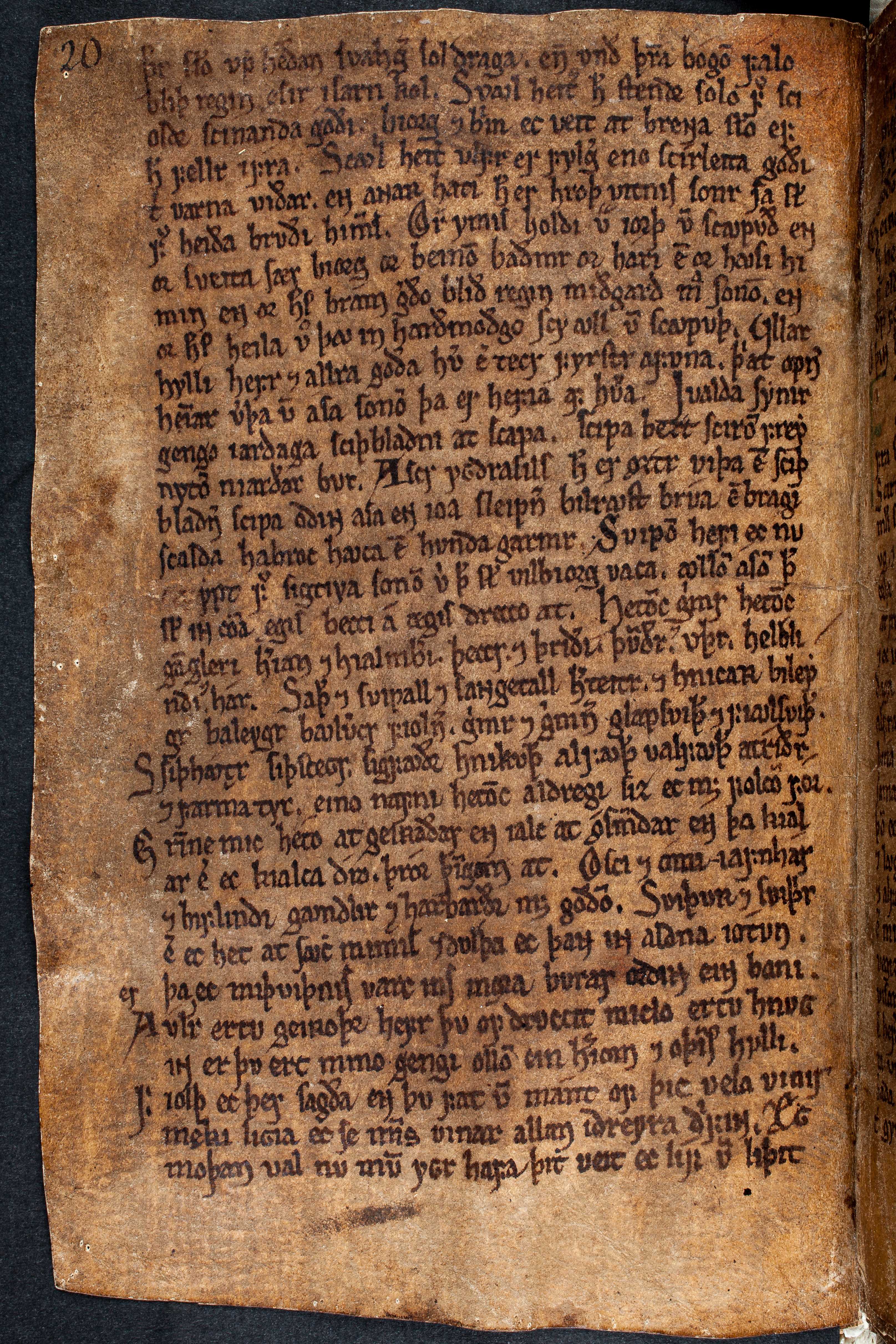
Where on the image
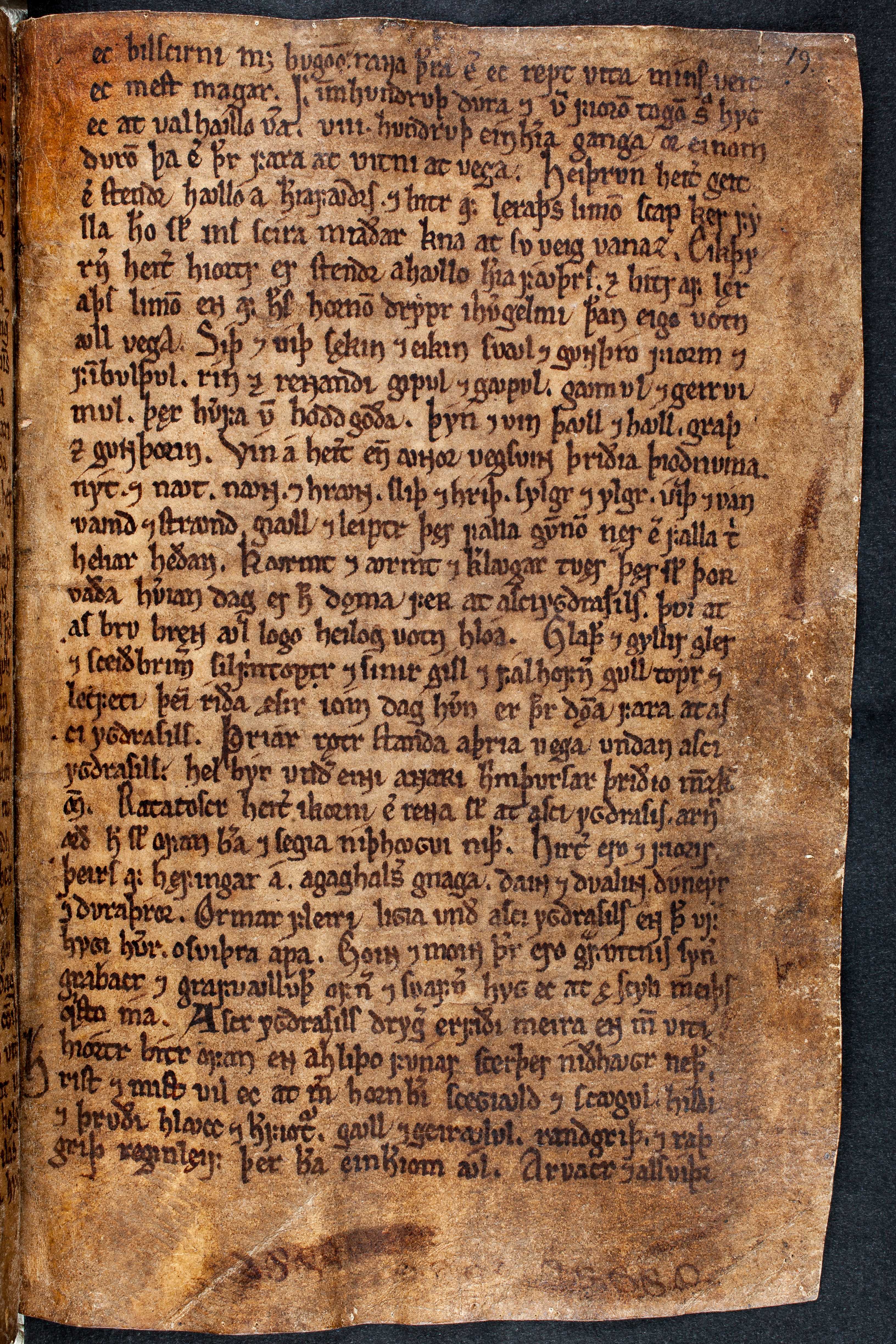
Fol. 10r (manuscript page 19; handrit.is image 28; Wimmer and Jónsson 1891 page 19, caption 'Grímnismál v. 24-37'): stanzas 25-37 begin here; stanza 37 runs on to fol. 10v. Fol. 10v (manuscript page 20; handrit.is image 29; Wimmer and Jónsson 1891 page 20, caption 'Grímnismál v. 37-53'): the top of the page finishes stanza 37 ('svangir sól draga ...'). Checked on the image: the first line of fol. 10r has 'með bugum' (end of Grímnismál 24); the first line of fol. 10v has 'svangir sól draga' (end of Grímnismál 37). Diplomatic text: Wimmer and Jónsson 1891, page 19, lines 4-32; page 20, lines 1-2, transcribed from their page images and proofread line by line; they print each manuscript page line for line beside its phototype, so the line breaks shown are the manuscript's.
25Heıþrv́n heıtır geıt
er ſtenðꝛ hꜹllo a herıaꝼꜹðꝛſ. oc bıtr aꝼ lęraþs lımom ſcap ker ꝼẏ
lla hon ſcal ınſ ſcíra mıaðar kna at ſv veıg vanaz. 26Eıkþy-
rnır heıtır hıoꝛtr er ſtenðꝛ ahꜹllo herıa ꝼꜹ́þrſ. oc bítr aꝼ lęr
aþſ límom eɴ aꝼ hanſ hoꝛnom ðrýpr ıhvergelmı þaþan eıgo votn
ꜹll vega. 27Síþ oc víþ ſękın oc eıkın ſvꜹl oc gvɴþró ꝼıoꝛm oc
ꝼımbvlþvl. rín oc reɴanðı gıpvl oc gꜹpvl. gꜹmvl oc geırvı
mvl. þęr hverꝼa vm hoðð goða. þýn oc vın þꜹll oc hꜹll. graþ
oc gvɴþoꝛn. 28Vín á heıtır enn ꜹɴᴏꝛ vegſvıɴ þrıðıa þıoðnvma.
nýt. oc nꜹt. nꜹɴ. oc hrꜹɴ. ſlıþ oc hríþ. ſylgr oc ylgr. víþ oc ván
vꜹnð oc ſtrꜹnð gıꜹll oc leıptr þęr ꝼalla gvmnom nęr er ꝼalla tıl
helıar heðan. 29Kꜹrmt oc ꜹrmt oc kerlꜹgar tvęr þęr ſcal þoʀ
vaða hverıan ðag er hann ðǫma ꝼᴇʀ at aſcıʏɢðraſılſ. þvı at
aſ brv breɴ ꜹll logo heılog votn hlóa. 30Glaþr oc gyllır gler
oc ſceıðbrımır ſılꝼrıntopṭr oc ſınır gíſl oc ꝼálhoꝼnır gvlltoppr oc
lettꝼetı þeım ríða ęſır ıóm ðag hvern er þeır ðǫma ꝼara at aſ
cı ʏɢðraſılſ. 31Þrıár rǫtr ſtanða aþrıa vega vnðan aſcı
ʏɢðraſılſˀ hel býr vnðır eıɴı aɴarı hrımþvrſar þrıðıo mennzkır.
ᴍenn. 32Ratatoſcr heıtır ıkoꝛnı er reɴa ſcal at aſcı ʏɢðraſıſ. arnar
oꝛð hann ſcal oꝼan bera oc ſegıa níþhꜹɢᴠı nıþr. 33Hırtır ero oc ꝼıoꝛır.
þeırſ aꝼ hęꝼıngar á. agaghalſır gnaga. ðaıɴ oc ðvalıɴ. ðv́neẏr
oc ðvraþróꝛ. 34Ormar ꝼleırı lıɢıa vnðır aſcı ʏɢðraſılſ eɴ þat vꝼ
hyɢı hverr. oſvıþra apa. Goıɴ oc ᴍoıɴ þeır ero graꝼvıtnıſ ſynır
grabacr oc graꝼvꜹllvþr oꝼnır oc ſvaꝼnır hyɢ ec at ę ſcylı meıþſ
qvıſto má. 35Aſcr ʏɢðraſılſ ðrygır erꝼıðı meıra eɴ menn vítı
hıóꝛtr bítr oꝼan eɴ ahlıþo ꝼv́nar ſcerþer níðhꜹɢʀ neþan.
36Hrıſt oc mıſt vıl ec at mer hoꝛn berı ſceɢıꜹlð oc ſcꜹgvl. hılðı
oc þrvðı hlꜹcc oc herꝼıotvr. gꜹll oc geırꜹlvl. ranðgrıþ. oc raþ-
grıþ regınlęıꝼ þer bera eınherıom ꜹ́l. 37Arvacr ocalſvíþꝛ
‖ þeır ſcolo vpp heðan ſvangır ſol ðraga. enn vnð þeıra bógom ꝼálo
blíþ regın ęſır ıſarn kol.
Compare: Normalized text (Guðni Jónsson)
25Heiðrún heitir geit, / er stendr höllu á / ok bítr af Læraðs limum; / skapker fylla / hon skal ins skíra mjaðar; / kná-at sú veig vanask. 26Eikþyrnir heitir hjörtr, / er stendr höllu á / ok bítr af Læraðs limum; / en af hans hornum / drýpr í Hvergelmi, / þaðan eigu vötn öll vega. 27Síð ok Víð, / Sækin ok Eikin, / Svöl ok Gunnþró, / Fjörm ok Fimbulþul, / Rín ok Rennandi, / Gipul ok Göpul, / Gömul ok Geirvimul, / þær hverfa um hodd goða, / Þyn ok Vín, / Þöll ok Höll, / Gráð ok Gunnþorin. 28Vína heitir ein, / önnur Vegsvinn, / þriðja Þjóðnuma, / Nyt ok Nöt, / Nönn ok Hrönn, / Slíð ok Hríð, / Sylgr ok Ylgr, / Víð ok Ván, / Vönd ok Strönd, / Gjöll ok Leiftr, / þær falla gumnum nær, / er falla til Heljar heðan. 29Körmt ok Örmt / ok Kerlaugar tvær, / þær skal Þórr vaða / dag hvern, / er hann dæma ferr / at aski Yggdrasils, / því at ásbrú / brenn öll loga, / heilög vötn hlóa. 30Glaðr ok Gyllir, / Glær ok Skeiðbrimir, / Silfrintoppr ok Sinir, / Gísl ok Falhófnir, / Gulltoppr ok Léttfeti, / þeim ríða æsir jóm / dag hvern, / er þeir dæma fara / at aski Yggdrasils. 31Þríar rætr / standa á þría vega / undan aski Yggdrasils; / Hel býr und einni, / annarri hrímþursar, / þriðju mennskir menn. 32Ratatoskr heitir íkorni, / er renna skal / at aski Yggdrasils, / arnar orð / hann skal ofan bera / ok segja Niðhöggvi niðr. 33Hirtir eru ok fjórir, / þeirs af hæfingar / gaghalsir gnaga: / Dáinn ok Dvalinn, / Duneyrr ok Duraþrór. 34Ormar fleiri liggja / und aski Yggdrasils, / en þat of hyggi hverr ósviðra apa: / Góinn ok Móinn, / þeir ro Grafvitnis synir, / Grábakr ok Grafvölluðr, / Ófnir ok Sváfnir, / hygg ek, at æ skyli / meiðs kvistu má. 35Askr Yggdrasils / drýgir erfiði / meira en menn um viti: / hjörtr bítr ofan, / en á hliðu fúnar, / skerðir Niðhöggr neðan. 36Hrist ok Mist / vil ek, at mér horn beri, / Skeggjöld ok Skögul, / Hildr ok Þrúðr, / Hlökk ok Herfjötur, / Göll ok Geirönul, / Randgríðr ok Ráðgríðr / ok Reginleif, / þær bera Einherjum öl. 37Árvakr ok Alsviðr / þeir skulu upp heðan / svangir sól draga; / en und þeira bógum / fálu blíð regin, / æsir, ísarnkol.
25Heidrûn the goat is called, that stands o'er Odin's hall, and bites from Lærâd's branches. He a bowl shall fill with the bright mead; that drink shall never fail. 26Eikthyrnir the hart is called, that stands o'er Odin's hall, and bites from Lærâd's branches; from his horns fall drops into Hvergelmir, whence all waters rise:-- 27Sid and Vid, Soekin and Eikin, Svöl and Gunnthrô, Fiörm and Fimbulthul, Rin and Rennandi, Gipul and Göpul, Gömul and Geirvimul: they round the gods' dwelling wind. Thyn and Vin, Thöll and Höll, Grâd and Gunnthorin. 28Vina one is called, a second Vegsvin, a third Thiodnuma; Nyt and Nön and Hrön, Slid and Hrid, Sylg and Ylg, Vîd and Vân, Vönd and Strönd, Gioll and Leipt; these (two) fall near to men, but fall hence to Hel. 29Körmt and Ormt, and the Kerlaugs twain: these Thor must wade each day, when he to council goes at Yggdrasil's ash; for the As-bridge is all on fire, the holy waters boil. 30Glad and Gyllir, Gler and Skeidbrimir, Sillfrintopp and Sinir, Gisl and Falhôfnir, Gulltopp and Lettfeti; on these steeds the Æsir each day ride, when they to council go, at Yggdrasil's ash. 31Three roots stand on three ways under Yggdrasil's ash: Hel under one abides, under the second the Hrimthursar, under the third mankind. 32Ratatösk is the squirrel named, which, has to run in Yggdrasil's ash; he from above the eagle's words must carry, and beneath to Nidhögg repeat. 33Harts there are also four, which from its summits, arch-necked, gnaw. Dâin and Dvalin, Duneyr and Durathrôr. 34More serpents lie under Yggdrasil's ash, than any one would think of witless mortals: Gôin and Môin,--they are Grafvitnir's sons--Grâbak and Grafvöllud, Ofnir and Svafnir, will, I ween, the branches of that tree ever lacerate. 35Yggdrasil's ash hardship suffers greater than men know of; a hart bites it above, and in its side it rots, Nidhögg beneath tears it. 36Hrist and Mist the horn shall bear me Skeggöld and Skögul, Hlökk and Herfiotur, Hildi and Thrûdi, Göll and Geirölul, Randgríd and Râdgrîd, and Reginleif, these bear beer to the Einheriar. 37Arvakr and Alsvid, theirs 'tis up hence fasting the sun to draw: under their shoulder the gentle powers, the Æsir, have concealed an iron-coolness.
Where on the image
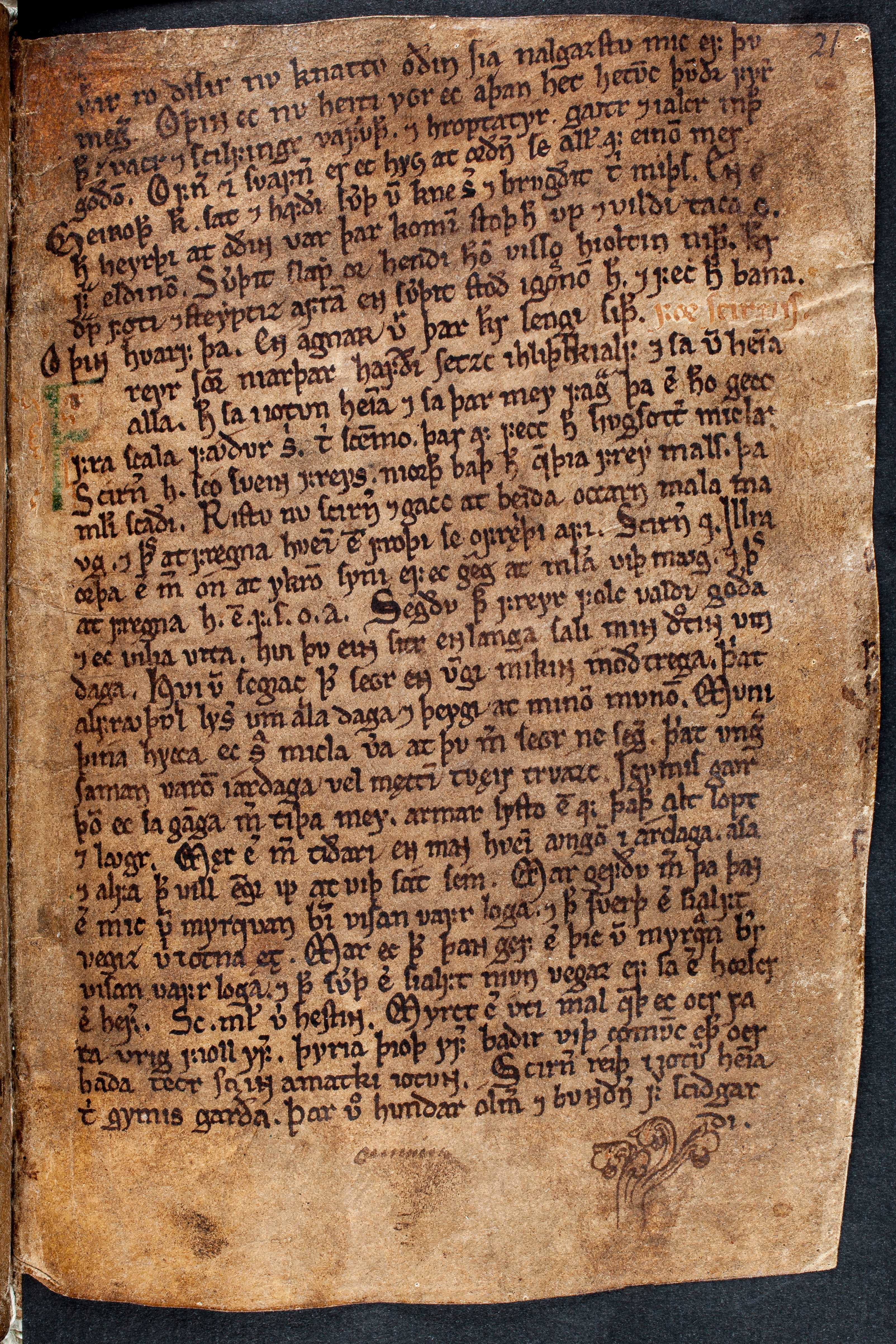
Fol. 10v (manuscript page 20; handrit.is image 29; Wimmer and Jónsson 1891 page 20, caption 'Grímnismál v. 37-53'): stanzas 38-53 begin here; stanza 53 runs on to fol. 11r. Fol. 11r (manuscript page 21; handrit.is image 30; Wimmer and Jónsson 1891 page 21, caption 'Grímnismál v. 53 - Skírnismál pr. efter v. 10'): the top of the page finishes stanza 53 ('nú knáttu Óðin sjá ...'). Checked on the image: the first line of fol. 10v has 'svangir sól draga' (end of Grímnismál 37); the first line of fol. 11r has 'nú knáttu Óðin sjá' (end of Grímnismál 53). Diplomatic text: Wimmer and Jónsson 1891, page 20, lines 2-32; page 21, lines 1-2, transcribed from their page images and proofread line by line; they print each manuscript page line for line beside its phototype, so the line breaks shown are the manuscript's.
38Svꜹl heıtır hann ſtenðꝛ ſolo ꝼyr ſcı-
olðꝛ ſcínanða góðı. bıoꝛg oc brım ec veıt at breɴa ſcolo eꝼ
hann ꝼellr ıꝼrá. 39Scꜹll heıtır vlꝼr er ꝼylgır eno ſcírleıta goðı
tıl varna vıðar. eɴ aɴaʀ hatı hann er hroþ vıtnıſ ſonr ſa ſcal
ꝼyr heıða brvðı hımınſ. 40Ór ymıſ holðı var ıoꝛþ vm ſcꜹpvð eɴ
oꝛ ſveıta ſær bıoꝛg oꝛ beınom baðmr oꝛ hárı en oꝛ hꜹſı hı
mın 41eɴ oꝛ hanſ brám gerðo blıð regın mıðgarð manna ſonom. eɴ
oꝛ hanſ heıla voro þꜹ ın harðmoðgo ſcy ꜹll vm ſcꜹpvþ. 42Ullar
hyllı heꝼr oc allra goða hverr er tecr ꝼyrſtr aꝼvna. þvıat opnır
heımar verþa vm áſa ſonom þa er heꝼıa aꝼ hvera. 43Ivalða ſẏnır
gengo ıarðaga ſcıþblaðnı at ſcapa. ſcıpa bezt ſcırom ꝼreẏ
nytom nıarðar bvr. 44Aſcr ʏɢðraſılſ hann er ǫztr vıþa en ſcıþ
blaðnır ſcıpa oðıɴ aſa eɴ ıoa ſleıpnır bılrꜹſt brv́a en bragı
ſcalða habroc hꜹca en hvnða garmr. 45Svıpom heꝼı ec nv
[..] ẏpt ꝼyr ſıgtıva ſonom vıþ þat ſcal vılbıoꝛg vaca. ꜹllom áſom þat
ſcal ıɴ coma ęgıſ beccı á ægıſ ðrecco at. 46Hetomc grımr hetomc
ganglerı herıan oc hıalmberı. þeccr. oc þrıðı. þvnðr.⸌oc⸍vþr. helblı-
nðı.⸌oc⸍hár. 47Saþr oc ſvıpall oc ſaɴgetall herteıtr. oc hnıcaʀ bıleẏ
gr baleygr bꜹlvercr ꝼıolnır. grımr oc grımnır glapſvıþr oc ꝼıꜹlſvıþr.
48Sıþhꜹ́ttr ſıþſceɢʀ. ſıgꝼꜹðꝛ hnıkvþr alꝼꜹþr valꝼꜹþr atríðr
oc ꝼarma tyr. eıno naꝼnı hetomc alðregı ſız ec meþ ꝼolcom ꝼóꝛ.
49Grımne mıc héto at geıʀaðar eɴ ıalc at ǫ́ſmvnðar eɴ þa kıal
ar er ec kıalca ðró. þróꝛ þıngom at. Oſcı oc ómı. ıaꝼnhár
oc bıꝼlınðı gꜹnðlır oc harbarðꝛ meþ goðom. 50Svıþvʀ oc ſvıþrır
er ec het at ſꜹcc mımıſ ocðvlþa ec þaɴ ıɴ alðna ıótvn.
⟨marg. er,⟩ þa,ec mıþvıþnıſ varc ınſ mǫꝛa bvrar oꝛðıɴ eıɴ banı.
51Av́lr ertv geıʀoþꝛ heꝼr þv ᴏꝼ ðrvccıt mıclo ertv hnvɢ-
ıɴ er þv ert mıno gengı ollom eın herıom oc oþınſ hyllı.
52Fıolþ ec þer ſagða eɴ þv ꝼat vm mánt ᴏꝼ þıc vela vınır
mękı lıɢıa ec ſe mıns vınar allan ıðreyra ðrıꝼıɴ. 53Eɢ⸌c⸍
moþan val nv mvn yɢʀ haꝼa þıtt veıt ec lıꝼ vm lıþıt
‖ varar ro ðíſır nv knattv oðın ſıá nalgazſtv mıc eꝼ þv
megır.
Compare: Normalized text (Guðni Jónsson)
38Svalinn heitir, / hann stendr sólu fyrir, / skjöldr, skínanda goði; / björg ok brim, / ek veit, at brenna skulu, / ef hann fellr í frá. 39Sköll heitir ulfr, / er fylgir inu skírleita goði / til varna viðar, / en annarr Hati, / hann er Hróðvitnis sonr, / sá skal fyr heiða brúði himins. 40Ór Ymis holdi / var jörð of sköpuð, / en ór sveita sær, / björg ór beinum, / baðmr ór hári, / en ór hausi himinn. 41En ór hans brám / gerðu blíð regin / Miðgarð manna sonum, / en ór hans heila / váru þau in harðmóðgu / ský öll of sköpuð. 42Ullar hylli / hefr ok allra goða / hverr er tekr fyrstr á funa, / því at opnir heimar / verða of ása sonum, / þá er hefja af hvera. 43Ívalda synir / gengu í árdaga / Skíðblaðni at skapa, / skipa bezt, / skírum Frey, / nýtum Njarðar bur. 44Askr Yggdrasils, / hann er æðstr viða, / en Skíðblaðnir skipa, / Óðinn ása, / en jóa Sleipnir, / Bilröst brúa, / en Bragi skalda, / Hábrók hauka, / en hunda Garmr. 45Svipum hef ek nú yppt / fyr sigtíva sonum, / við þat skal vilbjörg vaka; / öllum ásum / þat skal inn koma / Ægis bekki á, / Ægis drekku at. 46Hétumk Grímr, / hétumk Gangleri, / Herjann ok Hjalmberi, / Þekkr ok Þriði, / Þundr ok Uðr, / Herblindi ok Hár. 47Saðr ok Svipall / ok Sanngetall, / Herteitr ok Hnikarr, / Bileygr, Báleygr, / Bölverkr, Fjölnir, / Grímr ok Grímnir, / Glapsviðr ok Fjölsviðr; 48Síðhöttr, Síðskeggr, / Sigföðr, Hnikuðr, / Alföðr, Valföðr, / Atríðr ok Farmatýr; / einu nafni / hétumk aldregi, / síz ek með folkum fór. 49Grímni mik hétu / at Geirröðar, / en Jalk at Ásmundar, / en þá Kjalar, / er ek kjálka dró, / Þrór þingum at, / Viðurr at vígum, / Óski ok Ómi, / Jafnhár ok Biflindi, / Göndlir ok Hárbarðr með goðum. 50Sviðurr ok Sviðrir / er ek hét at Sökkmímis, / ok dulðak þann inn aldna jötun, / þá er ek Miðvitnis vark / ins mæra burar / orðinn einbani. 51Ölr ertu, Geirröðr, / hefr þú ofdrukkit; / miklu ertu hnugginn, / er þú ert mínu gengi, / öllum Einherjum / ok Óðins hylli. 52Fjölð ek þér sagðak, / en þú fátt of mant; / of þik véla vinir; / mæki liggja / ek sé míns vinar / allan í dreyra drifinn. 53Eggmóðan val / nú mun Yggr hafa, / þitt veit ek líf of liðit; / úfar ro dísir, / nú knáttu Óðin sjá, / nálgasktu mik, ef þú megir.
38Svalin the shield is called, which stands before the sun, the refulgent deity; rocks and ocean must, I ween, be burnt, fell it from its place. 39Sköll the wolf is named, that the fair-faced goddess to the ocean chases; another Hati hight, he is Hrôdvitnir's son; he the bright maid of heaven shall precede. 40Of Ymir's flesh was earth created, of his blood the sea, of his bones the hills, of his hair trees and plants, of his skull the heaven; 41And of his brows the gentle powers formed Midgard for the sons of men; but of his brain the heavy clouds are all created. 42Ullr's and all the gods' favour shall have, whoever first shall look to the fire; for open will the dwelling be, to the Æsir's sons, when the kettles are lifted off. 43Ivaldi's sons went in days of old Skidbladnir to form, of ships the best, for the bright Frey, Niörd's benign son. 44Yggdrasil's ash is of all trees most excellent, and of all ships, Skidbladnir, of the Æsir, Odin, and of horses, Sleipnir, Bifröst of bridges, and of skallds, Bragi, Hâbrôk of hawks, and of dogs, Garm, [Brimir of swords.] 45Now I my face have raised to the gods' triumphant sons, at that will welcome help awake; from all the Æsir, that shall penetrate, to Oegir's bench, to Oegir's compotation. 46I am called Grim, I am called Gangleri, Herian and Hiâlmberi, Thekk and Thridi, Thund and Ud, Helblindi and Har, 47Sad and Svipall, and Sanngetall, Herteit and Hnikar Bileyg, Bâleyg, Bölverk, Fiölnir, Grîm and Grimnir, Glapsvid and Fiölsvid, 48Sîdhött, Sîdskegg Sigfödr, Hnikud, Alfodr, Valfödr, Atrid and Farmatyr; by one name I never have been called, since among men I have gone. 49Grimnir I am called at Geirröd's, and at Asmund's Jâlk and Kialar, when a sledge I drew; Thrôr at the public meetings, Vidur in battles, Oski and Omi, Jafnhâr and Biflindi, Gôndlir and Harbard with the gods. 50Svidur and Svidrir I was at Sökkmimir's called, and beguiled that ancient Jötun, when of Midvitnir's renowned son I was the sole destroyer. 51Drunken art thou, Geirröd, thou hast drunk too much, thou art greatly by mead beguiled. Much didst thou lose, when thou wast of my help bereft, of all the Einheriar's and Odin's favour. 52Many things I told thee, but thou hast few remembered: thy friends mislead thee. My friend's sword lying I see, with blood all dripping. 53The fallen by the sword Ygg shall now have; thy life is now run out: Wroth with thee are the Dîsir: Odin thou now shalt see: draw near to me if thou canst.
Where on the image
Fol. 11r (manuscript page 21; handrit.is image 30; Wimmer and Jónsson 1891 page 21, caption 'Grímnismál v. 53 - Skírnismál pr. efter v. 10'): stanza 54 begins here. Checked on the image: the first line of fol. 11r has 'nú knáttu Óðin sjá' (end of Grímnismál 53). The manuscript's prose in this section is shown in its place and marked 'prose': the prose after the poem (Wimmer and Jónsson 1891 page 21, lines 5-9). Thorpe's English for it is given at the same place ('King Geirröd was sitting ...'). Diplomatic text: Wimmer and Jónsson 1891, page 21, lines 2-9, transcribed from their page images and proofread line by line; they print each manuscript page line for line beside its phototype, so the line breaks shown are the manuscript's.
54Oþıɴ ec nv heıtı ʏɢʀ ec áþan het hetvmc þvnðꝛ ꝼyrır
þatˀ vacr oc ſcılꝼıngr váꝼvþr. oc hroptatýr. gꜹtr oc ıalcr meþ
goðom. Oꝼnır oc ſvaꝼnır er ec hyɢ at oꝛðnır ſe allır aꝼ eınom mer.
proseGeıʀoþr konvngr. ſat oc haꝼðı ſverþ vm kne ſer oc brvgðıt tıl mıþſ. Eɴ er
hann heyrþı at oðıɴ var þar komınn ſtoþ hann vp oc vılðı taca o.
ꝼra elðınom. Sverþıt ſlapp oꝛ henðı hanom vıſſo hıoltín nıþr. konvngr
ðrap ꝼǫtı oc ſteẏptız aꝼram eɴ ſverþıt ſtoð ıgo⸌g⸍,nom hann. oc ꝼecc hann bana.
Oþıɴ hvarꝼ þa. Eɴ agnaʀ var þar konvngr lengı ſıþan.
Compare: Normalized text (Guðni Jónsson)
54Óðinn ek nú heiti, / Yggr ek áðan hét, / hétumk Þundr fyr þat, / Vakr ok Skilfingr, / Váfuðr ok Hroftatýr, / Gautr ok Jalkr með goðum, / Ófnir ok Sváfnir, / er ek hygg, at orðnir sé / allir af einum mér.
54Odin I now am named, Ygg I was called before, before that, Thund, Vakr and Skilfing, Vâfudr and Hrôptatyr, with the gods, Gaut and Jâlk, Ofnir and Svafnir, all which I believe to be names of me alone. proseKing Geirröd was sitting with his sword lying across his knees, half drawn from the scabbard, but on finding that it was Odin, he rose for the purpose of removing him from the fires, when the sword slipt from his hand with the hilt downwards; and the king having stumbled, the sword pierced him through and killed him. Odin then vanished, and Agnar was king for a long time after.
Cite
Sources
- Source: Codex Regius (GKS 2365 4to) page images via handrit.is + Wimmer and Jónsson's 1891 diplomatic text + Guðni Jónsson's normalized Old Norse via heimskringla.no + Thorpe (1866) English (holding institution)
- Critical edition: Diplomatic text of Codex Regius, Wimmer and Finnur Jónsson 1891; normalized text (Guðni Jónsson) for comparison
← previous · → next · v cycle view · l back to library