Vafþrúðnismál
Introduction
Vafþrúðnismál is preserved in the Codex Regius of the Poetic Edda (GKS 2365 4to, Árni Magnússon Institute, Reykjavík), an Icelandic parchment book written about 1270. The poem fills fol. 7v-8v (manuscript pages 14-16).
Pages: each section holds the stanzas that begin on one manuscript page and links that page's photograph (handrit.is); a stanza that runs onto the next page links both pages. The page of every stanza comes from Wimmer and Finnur Jónsson's 1891 diplomatic edition, which prints the text of each manuscript page, and the first line of every page was checked on the photograph. 'Where on the image' under each section gives the details.
Texts: the first Old Norse text is the manuscript's own text, letter by letter, from the diplomatic transcription of Wimmer and Finnur Jónsson (1891), which prints each page line for line: line breaks are the manuscript's, ‖ marks a new page, letters in italics are supplied where the scribe abbreviated, and special letters are kept (ſ long s, ꝛ round r, ꝼ insular f, ı dotless i, ꜹ the av ligature, ǫ and ę with hooks, ᛘ the rune for maðr, small capitals for the scribe's small capitals). The manuscript writes the poem as continuous lines without stanza breaks; the stanza numbers (Guðni Jónsson's) are inserted where each stanza begins and do not appear in the manuscript. Letters with a dot below are marked for deletion in the manuscript; letters between ⸌ and ⸍ are written above the line, and ⟨marg. ...⟩ gives what Wimmer and Jónsson print in the margin (corrections, and in Vafþrúðnismál the speaker marks o, v, q). The second text is Guðni Jónsson's normalized edition (via heimskringla.no), a reading text in modern spelling; in places it adds words or lines from other manuscripts and follows modern editions where they rearrange stanzas. The English is Benjamin Thorpe's 1866 translation (public domain).
English alignment: The Gutenberg text of Thorpe prints stanza 32 with the number 33 (so 33 appears twice); here his stanzas are matched in order, and the old version of this entry, which dropped one of them, is corrected.
How was this verified? (Provenance)
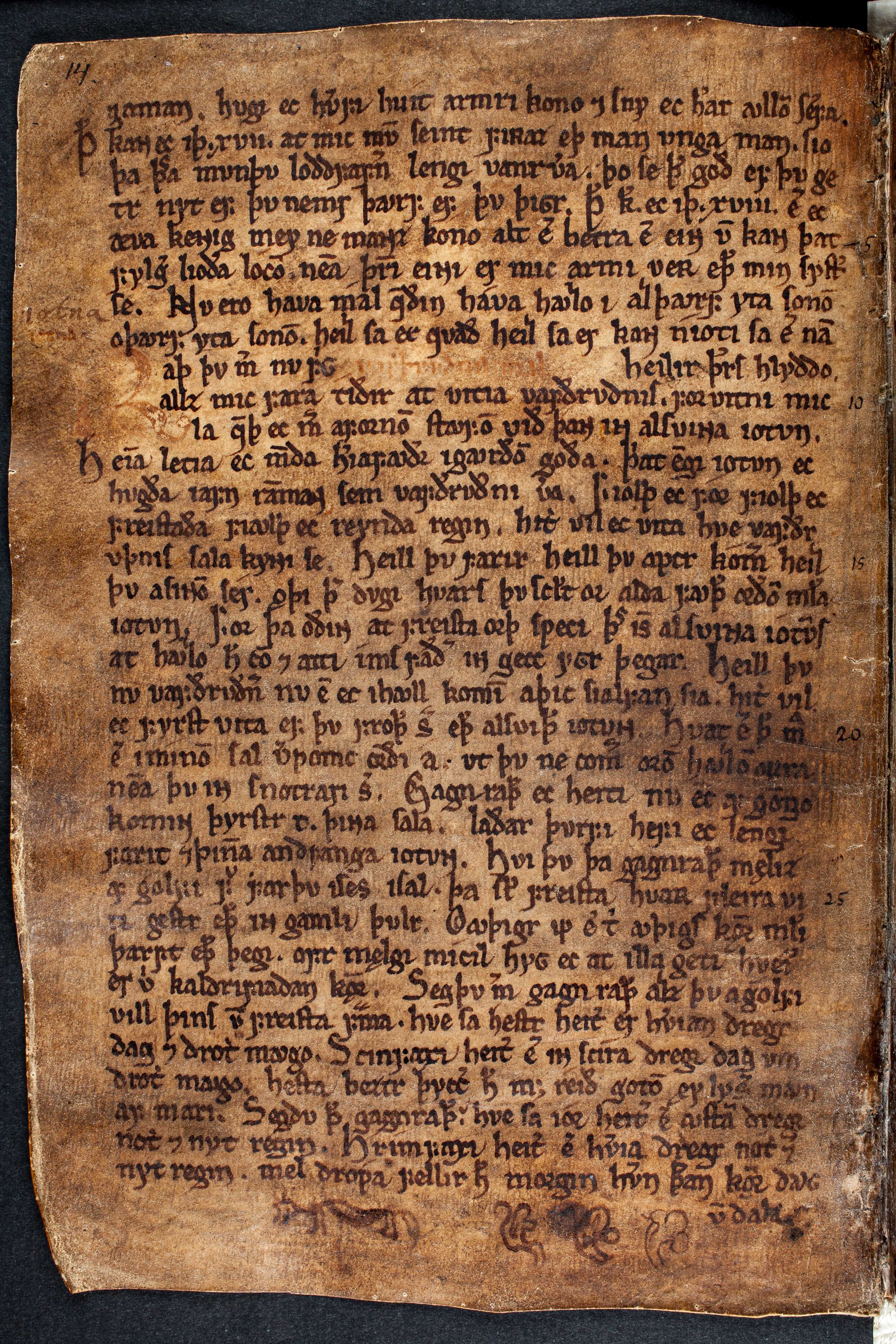
Where on the image
Fol. 7v (manuscript page 14; handrit.is image 23; Wimmer and Jónsson 1891 page 14, caption 'Hávamál v. 161 - Vafþrúðnismál v. 14'): stanza 1 is lower on the page (the first line belongs to the end of Hávamál 161); stanzas 1-14 begin here. Checked on the image: the first line of fol. 7v has 'gaman' (end of Hávamál 161). Diplomatic text: Wimmer and Jónsson 1891, page 14, lines 9-35, transcribed from their page images and proofread line by line; they print each manuscript page line for line beside its phototype, so the line breaks shown are the manuscript's.
1Raþ þv mer nv ꝼrıɢ vaꝼþrvðnıſ mal
allz mıc ꝼara tíðır at vıtıa vaꝼðrvðnıſ. ꝼoꝛvıtnı mıc
la qveþ ec mer aꝼoꝛnom ſtꜹꝼom vıð þaɴ ıɴ alſvıɴa ıotvn.
2Heıma letıa ec mvnða herıaꝼꜹðꝛ ıgꜹrðom goða. þvıat engı ıotvn ec
hvgða ıaꝼn rammaɴ ſem vaꝼðrvðnı vera. 3Fıolþ ec ꝼóꝛ ꝼıolþ ec
ꝼreıſtaða ꝼıꜹlþ ec reynða regın. hıtt vıl ec vıta hve vaꝼðr
vþnıſ ſala kyɴı ſe. 4Heıll þv ꝼarır heıll þv aptr kómır heıll
þv aſıɴᴏm ſér. ǫþı þer ðvgı hvarſ þv ſcalt oꝛ alða ꝼꜹþr oꝛðom męla
ıotvn. 5Foꝛ þa oðıɴ at ꝼreıſta oꝛþ ſpecı þes ıns alſvıɴa ıótvnſ
at hꜹllo hann com oc attı íſ ꝼaðır ıɴ gecc yɢʀ þegar. 6Heıll þv
nv vaꝼðrvðnır nv em ec ıhꜹll komınn aþıc ſıalꝼan ſıa. hıtt vıl
ec ꝼyrſt vıta eꝼ þv ꝼroþr ſer eþa alſvıþr ıotvɴ. 7Hvat er þat manna
er ımínom ſal verpomc oꝛðı á. vt þv ne comır oꝛom hꜹllom ọꝼra
nema þv ıɴ ſnotrarı ſer. 8Gagnraþr ec heıtı nv emc aꝼ gongo
komıɴ þyrſtr t. þıɴa ſala. laðar þvrꝼı heꝼı ec lengı
ꝼarıt ocþınna anðꝼanga ıotvɴ. 9Hvı þv þa gagnraþr męlız
aꝼ gólꝼı ꝼyr ꝼarþv ıſes ıſal. þa ſcal ꝼreıſta hvaʀ ꝼleıra vı
tı geſtr eþa ıɴ gamlı þvlr. 10Oꜹþıgr ᛘ er tıl ꜹþıgſ kǫmꝛ męlı
þarꝼt eþa þegı. oꝼr męlgı mícıl hyɢ ec at ılla getı hveım
er vıþ kalðrıꝼıaðan kǫmꝛ. 11Segþv mer gagnraþr allz þv agólꝼı
vıll þınſ vm ꝼreıſta ꝼrama. hve ſa heſtr heıtır er hverıan ðregr
ðag oc ðrott mꜹgo. 12Scınꝼaxı heıtır er ıɴ ſcíra ðregꝛ ðag vm
ðrott mꜹgo. heſta beztr þyccır hann meþ reıð gotom ęy lysır mꜹ́n
aꝼ marı. 13Segðv þat gagnraþrˀ hve ſa ıóꝛ heıtır er ꜹſtan ðregꝛ
nott oc nyt regın. 14Hrímꝼaxı heıtır er hverıa ðregr nótt oc
nyt regın. mel ðrópa ꝼellır hann moꝛgın hvern þaþan kǫmꝛ ðꜹɢ
vm ðala.
Compare: Normalized text (Guðni Jónsson)
1"Ráð þú mér nú, Frigg, / alls mik fara tíðir / at vitja Vafþrúðnis; / forvitni mikla / kveð ek mér á fornum stöfum / við þann inn alsvinna jötun." 2"Heima letja / ek mynda Herjaföðr / í görðum goða; / því at engi jötun / ek hugða jafnramman / sem Vafþrúðni vera." 3"Fjölð ek fór, / fjölð ek freistaða, / fjölð ek reynda regin; / hitt vil ek vita, / hvé Vafþrúðnis / salakynni sé." 4"Heill þú farir! / heill þú aftr komir! / heill þú á sinnum sér! / æði þér dugi, / hvars þú skalt, Aldaföðr, / orðum mæla jötun. 5Fór þá Óðinn / at freista orðspeki / þess ins alsvinna jötuns; / at höllu hann kom, / ok átti Íms faðir; / inn gekk Yggr þegar. 6"Heill þú nú, Vafþrúðnir, / nú em ek í höll kominn / á þik sjalfan sjá; / hitt vil ek fyrst vita, / ef þú fróðr sér / eða alsviðr jötunn." 7"Hvat er þat manna / er í mínum sal / verpumk orði á? / Út þú né komir / órum höllum frá, / nema þú inn snotrari sér." 8"Gagnráðr ek heiti, / nú emk af göngu kominn, / þyrstr til þinna sala; / laðar þurfi - / hef ek lengi farit - / ok þinna andfanga, jötunn." 9"Hví þú þá, Gagnráðr, / mælisk af golfi fyr? / Far þú í sess í sal! / Þá skal freista, / hvárr fleira viti, / gestr eða inn gamli þulr." 10"Óauðigr maðr, / er til auðigs kemr, / mæli þarft eða þegi; / ofrmælgi mikil, / hygg ek, at illa geti / hveim er við kaldrifjaðan kemr." 11"Seg þú mér, Gagnráðr, / alls þú á golfi vill / þíns of freista frama, / hvé sá hestr heitir, / er hverjan dregr / dag of dróttmögu." 12"Skinfaxi heitir, / er inn skíra dregr / dag of dróttmögu; / hesta beztr / þykkir hann með Hreiðgotum; / ey lýsir mön af mari." 13"Seg þú þat, Gagnráðr, / alls þú á golfi vill / þíns of freista frama, / hvé sá jór heitir, / er austan dregr / nótt of nýt regin." 14"Hrímfaxi heitir, / er hverja dregr / nótt of nýt regin; / méldropa fellir hann / morgin hvern; / þaðan kemr dögg um dala."
1Odin. Counsel thou me now, Frigg! as I long to go Vafthrûdnir to visit; great desire, I say, I have, in ancient lore with that all-wise Jötun to contend. 2Frigg. At home to bide Hærfather I would counsel, in the gods' dwellings; because no Jötun is, I believe, so mighty as is Vafthrûdnir. 3Odin. Much have I journeyed, much experienced, mighty ones many proved; but this I fain would know, how in Vafthrûdnir's halls it is. 4Frigg. In safety mayest thou go, in safety return; in safety on thy journeyings be; may thy wit avail thee, when thou, father of men! shalt hold converse with the Jötun. 5Then went Odin the lore to prove of that all-wise Jötun. To the hall he came which Im's father owned. Ygg went forthwith in. 6Odin. Hail to thee, Vafthrûdnir! to thy hall I am now come, thyself to see; for I fain would know, whether thou art a cunning and all-wise Jötun. 7Vafthrûdnir. What man is this, that in my habitation by word addresses me? Out thou goest not from our halls, if thou art not the wiser. 8Odin. Gagnrâd is my name, from my journey I am come thirsty to thy halls, needing hospitality,--for I long have journeyed--and kind reception from thee, Jötun! 9Vafthrûdnir. Why then, Gagnrâd! speakest thou from the floor? Take in the hall a seat; then shall be proved which knows most, the guest or the ancient talker. 10Gagnrâd. A poor man should, who to a rich man comes, speak usefully or hold his tongue: over-much talk brings him, I ween, no good, who visits an austere man. 11Vafthrûdnir. Tell me, Gagnrâd! since on the floor thou wilt prove thy proficiency, how the horse is called that draws each day forth over human kind? 12Gagnrâd. Skinfaxi he is named, that the bright day draws forth over human kind. Of coursers he is best accounted among the Reid-goths. Ever sheds light that horse's mane. 13Vafthrûdnir. Tell me now, Gagnrâd! since on the floor thou wilt prove thy proficiency, how that steed is called, which from the east draws night o'er the beneficent powers? 14Gagnrâd. Hrimfaxi he is called, that each night draws forth over the beneficent powers. He from his bit lets fall drops every morn, whence in the dales comes dew.

Where on the image
Fol. 8r (manuscript page 15; handrit.is image 24; Wimmer and Jónsson 1891 page 15, caption 'Vafþrúðnismál v. 15-37'): stanzas 15-37 begin here. Checked on the image: the first line of fol. 8r has 'Seg þú þat, Gagnráðr' (Vafþrúðnismál 15). Diplomatic text: Wimmer and Jónsson 1891, page 15, lines 1-36, transcribed from their page images and proofread line by line; they print each manuscript page line for line beside its phototype, so the line breaks shown are the manuscript's.
15Segðv þat gˀ hve ſv ą́ heıtır er ðeılır meþ ıotna ſónom grvnð oc meþ
goðom. 16Iꝼıng heıtır á er ðeılır meþ aḷðạ ſonom grvnð oc meþ goðom ⟨marg. ,ıotna⟩
opın reɴa hon ſcal vm alðꝛ ðaga verþrat ís a á. 17Segðv þat g. aˀ
hve ſa vꜹllr heıtır er ꝼıɴaz vıgı at ſvrtr oc ın ſvaſo goð. 18Uıgrıþr ⟨marg. o⟩
heıtır vollr er ꝼıɴaz vígı at ſvrtr oc ın ſvaſo goð. hvnðraþ r-
aſta hann er a hverıan veg ſa er þeım vollr vıtaþr. 19Froþr ertv ⟨marg. v⟩
nv geſtr ꝼar þv a becc ıotvnſ oc melomc ıſesı ſaman. hꜹꝼðı
veðıa vıð ſcolom hꜹllo ı geſtr vm geðſpekı. capıtvlum. ⟨marg. o⟩
20Segðv þat ıþ eína eꝼ þıtt ǫþı ðvgır oc þv vaꝼþrvðnır vıtır. hvaþan
ıoꝛð vm com eþa vp hımınn ꝼyrſt ıɴ ꝼroþı ıotvɴ. 21Ór ymıſ hol ⟨marg. v⟩
ðı var ıoꝛð vm ſcꜹpvð en oꝛ beınom bıoꝛgˀ hımınn oꝛ hꜹſı ınſ hrım
kalða ıótvnſ eɴ oꝛ ſveıta ſıoꝛ. 22Segðv þat. ıı. e. þ. ę. ð. oc þ. vˀ ⟨marg. o⟩
hvaðan mánı vm kom sva at ꝼᴇʀ menn yꝼır eþa ſol ıþ ſama. 23Mvnðıl ⟨marg. v⟩
ꝼǫꝛı heıtır hann er mána ꝼaþır oc sva ſolar ıþ ſama. hımın hverꝼa þꜹ
ſcolo hverıan ðag ꜹlðom at ár talı. 24Segðv þat. ıþ ııı. allz þıc ſvıɴan ⟨marg. o⟩
qveþa oc þ. v. v. hvaðan ðagr vm com ſa er ꝼᴇʀ ðrot yꝼır eþa nott meþ
nıðom. 25Dellıngꝛ heıtır hann er ðagſ ꝼaþır. eɴ not var nꜹrvı boꝛın. ⟨marg. v⟩
nẏ oc nıþ ſcopo nẏt regın ꜹlðom at ar talı. 26Segðv þat ıþ. ıııı. ⟨marg. o.⟩
a. þ. ꝼˀ hvaðan vetr vm com eþa varmt ſvmar ꝼyrſt meþ ꝼroþ
regın. 27Uınðſvalr h. hann er vetrar ꝼaþır eɴ ſvaſvþꝛ ſvmars. ⟨marg. v.⟩
28Segðv þat ıþ. v. a. þ. ꝼˀ hverr aſa ellztr eþa ymıſ nıðıa yrþı í ⟨marg. o.q⟩
arðaga. 29Óróꝼı vetra aþr verı ıoꝛþ ſcópvþ þa var bergelmır boꝛınn ⟨marg. v.⟩
þrvðgelmır var þes ꝼaðır eɴ ꜹrgelmır aꝼı. 30Segðv þat ıt. vı. a. ⟨marg. o.q⟩
þ. ſ. q. hvaþan ꜹrgelmır com meþ ıotna ſonom ꝼyrſt ıɴ ꝼroþı ıó
tvɴ. 31Or elıvagom ſtvcco eítr ðropar sva óx vɴᴢ varð oꝛ ıotvɴ ⟨marg. v.⟩
32Segðv þat ıþ vıı. a. þ. ſ. q. hve ſa bǫ́ꝛn gat eɴ alðnı ıotvɴ. er ⟨marg. o.q⟩
hann haꝼðıt gygıar gaman. 33Vnðır henðı vaxa qvaþo hrímþvrſı ⟨marg. v q⟩
meẏ oc mꜹg ſaman. ꝼótr vıð ꝼǫtı gat ınſ ꝼroða ıotvnſ
ſer hꜹꝼðaþaɴ ſon. 34Segðv þat ıþ. vııı. a. þ. ꝼˀ hvat þv ꝼyrſt ⟨marg. o q⟩
mant eþa ꝼremſt vm veıtzſt þv ert alſvıþr ıotvɴ. 35Oróꝼı vetra ⟨marg. v.q⟩
aþr verı ıoꝛð vm ſcꜹpvð þa var bergelmır boꝛıɴ. þat ec ꝼẏrſt vm mán
er ſa ıɴ ꝼroþı ıotvɴ var a lvðꝛ vm lagıðꝛ. 36Segðv þat ıþ ıx. a ⟨marg. o.q⟩
þ. ſ. q. e. hvaðan vınðꝛ vm kǫmꝛ sva at ꝼᴇʀ vág yꝼır ę. menn hann
ſıalꝼan vm ſıá. 37Hręſvelgr heıtır er ſıtr ahımınſ enða ıo ⟨marg. v.q⟩
tvɴ ıarnar hám. aꝼ hann vengıom qveþa vınð koma alla ᴍenn
ẏꝼır.
Compare: Normalized text (Guðni Jónsson)
15Seg þú þat, Gagnráðr, / alls þú á golfi vill / þíns of freista frama, / hvé sú á heitir, / er deilir með jötna sonum / grund ok með goðum." 16"Ífing heitir á, / er deilir með jötna sonum / grund ok með goðum; / opin renna / hon skal of aldrdaga; / verðr-at íss á á." 17Seg þú þat, Gagnráðr, / alls þú á golfi vill / þíns of freista frama, / hvé sá völlr heitir, / er finnask vígi at / Surtr ok in svásu goð." 18"Vígriðr heitir völlr, / er finnask vígi at / Surtr ok in svásu goð; / hundrað rasta / hann er á hverjan veg; / sá er þeim völlr vitaðr." 19"Fróðr ertu nú, gestr, / far þú á bekk jötuns, / ok mælumk í sessi saman; / höfði veðja / vit skulum höllu í, / gestr, of geðspeki. 20"Seg þú þat it eina, / ef þitt æði dugir / ok þú, Vafþrúðnir, vitir, / hvaðan jörð of kom / eða upphiminn / fyrst, inn fróði jötunn." 21"Ór Ymis holdi / var jörð of sköpuð, / en ór beinum björg, / himinn ór hausi / ins hrímkalda jötuns, / en ór sveita sær." 22"Seg þú þat annat, / ef þitt æði dugir / ok þú, Vafþrúðnir, vitir, / hvaðan máni kom, / sá er ferr menn yfir, / eða sól it sama." 23"Mundilfari heitir, / hann er mána faðir / ok svá Sólar it sama; / himin hverfa / þau skulu hverjan dag / öldum at ártali." 24"Seg þú þat it þriðja, / alls þik svinnan kveða / ok þú, Vafþrúðnir, vitir, / hvaðan dagr of kom, / sá er ferr drótt yfir, / eða nótt með niðum." 25"Dellingr heitir, / hann er Dags faðir, / en Nótt var Nörvi borin; / ný ok nið / skópu nýt regin / öldum at ártali." 26"Seg þú þat it fjórða, / alls þik fróðan kveða, / ok þú, Vafþrúðnir, vitir, / hvaðan vetr of kom / eða varmt sumar / fyrst með fróð regin." 27"Vindsvalr heitir, / hann er Vetrar faðir, / en Svásuðr sumars." 28"Seg þú þat it fimmta, / alls þik fróðan kveða, / ok þú, Vafþrúðnir, vitir, / hverr ása ellztr / eða Ymis niðja / yrði í árdaga." 29"Örófi vetra / áðr væri jörð of sköpuð, / þá var Bergelmir borinn, / Þrúðgelmir / var þess faðir, / en Aurgelmir afi." 30"Seg þú þat it sétta, / alls þik svinnan kveða, / ok þú, Vafþrúðnir, vitir, / hvaðan Aurgelmir kom / með jötna sonum / fyrst, inn fróði jötunn." 31"Ór Élivágum / stukku eitrdropar, / svá óx, unz varð jötunn; / þar eru órar ættir / komnar allar saman; / því er þat æ allt til atalt." 32"Seg þú þat it sjaunda, / alls þik svinnan kveða, / ok þú, Vafþrúðnir, vitir, / hvé sá börn gat, / inn baldni jötunn, / er hann hafði-t gýgjar gaman." 33"Undir hendi vaxa / kváðu hrímþursi / mey ok mög saman; / fótr við fæti / gat ins fróða jötuns / sexhöfðaðan son." 34"Seg þú þat it átta, / alls þik svinnan kveða, / ok þú, Vafþrúðnir, vitir, / hvat þú fyrst of mant / eða fremst of veizt, / þú ert alsviðr, jötunn." 35Örófi vetra / áðr væri jörð of sköpuð, / þá var Bergelmir borinn; / þat ek fyrst of man, / er sá inn fróði jötunn / á var lúðr of lagiðr." 36"Seg þú þat it níunda, / alls þik svinnan kveða, / ok þú, Vafþrúðnir, vitir, / hvaðan vindr of kemr, / svá at ferr vág yfir; / æ menn han sjalfan of sjá." 37"Hræsvelgr heitir, / er sitr á himins enda, / jötunn í arnar ham; / af hans vængjum / kvæða vind koma / alla menn yfir."
15Vafthrûdnir. Tell me, Gagnrâd! since on the floor thou wilt prove thy proficiency, how the stream is called, which earth divides between the Jötuns and the Gods? 16Gagnrâd. Ifing the stream is called which earth divides between the Jötuns and the Gods: open shall it run throughout all time. On that stream no ice shall be. 17Vafthrûdnir. Tell me, Gagnrâd! since on the floor thou wilt prove thy proficiency, how that plain is called, where in fight shall meet Surt and the gentle Gods? 18Gagnrâd. Vigrid the plain is called where in fight shall meet Surt and the gentle Gods; a hundred rasts it is on every side. That plain is to them decreed. 19Vafthrûdnir. Wise art thou, O guest! Approach the Jötuns bench, and sitting let us together talk; we will our heads in the hall pledge, guest! for wise utterance. 20Gagnrâd. Tell me first, if thy wit suffices, and thou, Vafthrûdnir! knowest, whence first came the earth, and the high heaven, thou, sagacious Jötun? 21Vafthrûdnir. From Ymir's flesh the earth was formed, and from his bones the hills, the heaven from the skull of that ice-cold giant, and from his blood the sea. 22Gagnrâd. Tell me secondly, if thy wit suffices, and thou, Vafthrûdnir! knowest, whence came the moon, which over mankind passes, and the sun likewise? 23Vafthrûdnir. Mundilfoeri hight he, who the moon's father is, and eke the sun's: round heaven journey each day they must, to count years for men. 24Gagnrâd. Tell me thirdly, since thou art called wise, and if thou, Vafthrûdnir! knowest, whence came the day, which over people passes, and night with waning moons? 25Vafthrûdnir. Delling hight he who the day's father is, but night was of Nörvi born; the new and waning moons the beneficent powers created, to count years for men. 26Gagnrâd. Tell me fourthly, since they pronounce thee sage, and if thou, Vafthrûdnir! knowest, whence winter came, and warm summer first among the wise gods? 27Vafthrûdnir. Vindsval hight he, who winter's father is, and Svâsud summer's; yearly they both shall ever journey, until the powers perish. 28Gagnrâd. Tell me fifthly, since they pronounce thee sage, and if thou, Vafthrûdnir! knowest, which of the Æsir earliest, or of Ymir's sons, in days of old existed? 29Vafthrûdnir. Countless winters, ere earth was formed, was Bergelmir born; Thrûdgelmir was his sire, his grandsire Aurgelmir. 30Gagnrâd. Tell me sixthly, since thou art called wise, and if thou, Vafthrûdnir! knowest, whence first came Aurgelmir, among the Jötun's sons, thou sagacious Jötun? 31Vafthrûdnir. From Elivâgar sprang venom drops, which grew till they became a Jötun; but sparks flew from the south-world: to the ice the fire gave life. 32Gagnrâd. Tell me seventhly, since thou are called wise, and if thou knowest, Vafthrûdnir! how he children begat, the bold Jötun, as he had no giantess's company? 33Vafthrûdnir. Under the armpit grew, 'tis said, of the Hrîmthurs, a girl and boy together; foot with foot begat, of that wise Jötun, a six-headed son. 34Gagnrâd. Tell me eighthly, since thou art called wise, and if thou knowest, Vafthrûdnir! what thou doest first remember, or earliest knowest? Thou art an all-wise Jötun. 35Vafthrûdnir. Countless winters, ere earth was formed, Bergelmir was born. That I first remember, when that wise Jötun in an ark was laid. 36Gagnrâd. Tell me ninthly, since thou art called wise, and if thou knowest, Vafthrûdnir! whence the wind comes, that over ocean passes, itself invisible to man? 37Vafthrûdnir. Hraesvelg he is called, who at the end of heaven sits, a Jötun in an eagle's plumage: from his wings comes, it is said, the wind, that over all men passes.

Where on the image
Fol. 8v (manuscript page 16; handrit.is image 25; Wimmer and Jónsson 1891 page 16, caption 'Vafþrúðnismál v. 38 - Grímnismál pr.'): stanzas 38-55 begin here. Checked on the image: the first line of fol. 8v has 'Seg þú þat it tíunda' (Vafþrúðnismál 38). The last syllable of stanza 39 (vanom) is written at the end of the next line, after stanza 40 and a reference sign (Wimmer and Jónsson 1891 page 16, line 5); the diplomatic text shows it where it stands. On fol. 8v the answer to stanza 40 is written from 'Val þeir kjósa' on; the first lines of stanza 41 in the edition (Allir einherjar ...) are not written there (Wimmer and Jónsson 1891 page 16, line 6). The last words of stanza 55 (vísastr vera) are written on fol. 8v after the opening words of the prose before Grímnismál and its title (Wimmer and Jónsson 1891 page 16, lines 30-31); that prose belongs to Grímnismál and is given there. Diplomatic text: Wimmer and Jónsson 1891, page 16, lines 1-31, transcribed from their page images and proofread line by line; they print each manuscript page line for line beside its phototype, so the line breaks shown are the manuscript's.
38Segðv þat ıþ. x. a. þu tıva rꜹ́c ꜹll vaꝼðrvðnır vıtır. hvaðan nıoꝛðr
vm kom meþ aſa ſonom hoꝼom oc hꜹrgom hann ręðꝛ hvnn moꝛgom oc varþ
aþ hann aſom alıɴ. 39Ivana heımı ſcopo hann vıſ regın oc ſęlðo at
gıſlıngo goðvm. ıalðar rꜹ́c hann mvn aptr coma heım meþ vıſom vꜹ
40Segðv þat et. xı. hvar ytar tvnom ı hꜹɢᴠaz hverıan ðag. ⸆nom.
41Val þeır kíoſa oc rıþa vígı ꝼra ſıtıa meıʀ vm ſáttır ſaman. 42Seg
þv þat ıþ xıı. hvı þv tıva rꜹc ꜹll vaꝼðrvðnır vıtır. ꝼra ıotna
⟨marg. q⟩ rv́nom oc allra goða ſegır þv ıþ ſaɴaſta ıɴ alſvıɴı ıotvɴ. 43Fra
ıotna rv́nom oc allra goða ec kaɴ ſegıa ſatt þvıat hvern heꝼı ec
heım vm komıt nío kom ec heıma ꝼyr nıꝼlhel neðan hınıg ðeẏ
⟨marg. q⟩ ıa oꝛ helıo halır. 44Fıolþ ec ꝼoꝛ ꝼıolþ ec ꝼreıſtaþac ꝼ. ec re
ỵnða regın. hvat lıꝼır manna þa er ınn męra lıþr ꝼımbvl vetr meþ
⟨marg. q⟩ ꝼırom. 45Lıꝼ oc lıꝼðraſır enn þꜹ leynaz mvno ıholtı hoððmı
mıſ. moꝛgın ðꜹɢᴠar ðav ſer at mat haꝼa þaþan aꝼ alðır a
⟨marg. q⟩ laz. 46Fıolþ ec. ꝼ. ꝼ. e. ꝼˀ hvaðan cǫmꝛ ſol aıɴ ſletta hımın þa
⟨marg. q⟩ þa er þesa heꝼır ꝼenrır ꝼarıt. 47Eına ðottvr bᴇʀ alꝼrꜹðvll
aþr hana ꝼenrır ꝼarı. ſv ſcal rıða þa er regın ðeyıa moðvr brꜹ
⟨marg. .q⟩ tır męr. 48Fıolþ ec ꝼ. ꝼ. hverıar ro þęr meyıar ęr lıþa mar
⟨marg. v.q⟩ yꝼır ꝼroðgeðıaþar ꝼara. 49Þrıar þıoð ár ꝼalla þoꝛp yꝼır meẏ
ıa mꜹgþraſıs. hamıngıoꝛ eınar þeıra ıheımı ero þo þęr meþ
⟨marg. o q⟩ ıotnom alaz. 50Fıolþ ec ꝼ. ꝼˀ hverır raþa ęſır eıgnom goða þa er
⟨marg. .q⟩ ſlocnar ſvrta logı 51Vıþaʀ oc válı byɢıa vé goða þa er ſloc
nar ſvrta logı. móþı oc magnı ſcolo mıollnı haꝼa ok vıɴa
⟨marg. .q⟩ at vígþrotı. 52Fıolþ ec. ꝼˀ hvat verþr oðnı at alðrę lagı þa
⟨marg. v.q⟩ er rıvꝼaz regın. 53Vlꝼr gleypa mvn alða ꝼꜹþr þes mvn vı
þaʀ reca. kalða kıapta hann klyꝼıa mvn vıngnıſ vıgı at.
54⟨marg. o.q⟩ Fıolþ ec ꝼoꝛ ꝼˀ hvat męltı oðıɴ aþr abál ſtıgı ſıalꝼr ıeyra ſẏ
⟨marg. v.q⟩ nı. 55Eẏ maɴe þat veıt hvat þv ı arðaga ſagðır ıeyra ſynı. ꝼ
eıgom mvnnı męlta ec mína ꝼoꝛna ſtaꝼı oc vm ragna rꜹ́c.
⟨marg. v q⟩ Nv ec vıþ oðın ðeılðac mına oꝛþ ſpecı þv ert ę vıſ
aſtr vera.
Compare: Normalized text (Guðni Jónsson)
38"Seg þú þat it tíunda, / alls þú tíva rök / öll, Vafþrúðnir, vitir, / hvaðan Njörðr of kom / með ása sonum - / hofum ok hörgum / hann ræðr hundmörgum - / ok varð-at hann ásum alinn." 39"Í Vanaheimi / skópu hann vís regin / ok seldu at gíslingu goðum, / í aldar rök / hann mun aftr koma / heim með vísum vönum." 40"Seg þú þat et ellifta, / hvar ýtar túnum í / höggvask hverjan dag; / val þeir kjósa / ok ríða vígi frá, / sitja meir of sáttir saman." 41"Allir einherjar / Óðins túnum í / höggvask hverjan dag, / val þeir kjósa / ok ríða vígi frá, / sitja meirr of sáttir saman." 42"Seg þú þat it tolfta, / hví þú tíva rök / öll, Vafþrúðnir, vitir, / frá jötna rúnum / ok allra goða / segir þú it sannasta, / inn alsvinni jötunn." 43"Frá jötna rúnum / ok allra goða / ek kann segja satt, / því at hvern hef ek / heim of komit; / níu kom ek heima / fyr Niflhel neðan; / hinig deyja ór helju halir." 44"Fjölð ek fór, / fjölð ek freistaðak, / fjölð ek of reynda regin: / Hvat lifir manna, / þá er inn mæra líðr / fimbulvetr með firum?" 45"Líf ok Lifþrasir, / en þau leynask munu / í holti Hoddmímis; / morgindöggvar / þau sér at mat hafa, / en þaðan af aldir alask." 46"Fjölð ek fór, / fjölð ek freistaðak, / fjölð ek of reynda regin: / Hvaðan kemr sól / á inn slétta himin, / er þessa hefr fenrir farit?" 47"Eina dóttur / berr alfröðull, / áðr hana fenrir fari; / sú skal ríða, / þá er regin deyja, / móður brautir, mær." 48"Fjölð ek fór, / fjölð ek freistaðak, / fjölð ek of reynda regin: / Hverjar ro þær meyjar, / er líða mar yfir, / fróðgeðjaðar fara?" 49"Þríar þjóðár / falla þorp yfir / meyja Mögþrasis; / hamingjur einar / þær er í heimi eru, / þó þær með jötnum alask." 50"Fjölð ek fór, / fjölð ek freistaðak, / fjölð ek of reynda regin: / Hverir ráða æsir / eignum goða, / þá er sloknar Surta logi?" 51"Víðarr ok Váli / byggja vé goða, / þá er sloknar Surta logi, / Móði ok Magni / skulu Mjöllni hafa / Vingnis at vígþroti." 52"Fjölð ek fór, / fjölð ek freistaðak, / fjölð ek of reynda regin; / Hvat verðr Óðni / at aldrlagi, / þá er of rjúfask regin?" 53"Ulfr gleypa / mun Aldaföðr, / þess mun Víðarr vreka; / kalda kjafta / hann klyfja mun / vitnis vígi at." 54"Fjölð ek fór, / fjölð ek freistaðak, / fjölð ek of reynda regin; / Hvat mælti Óðinn, / áðr á bál stigi, / sjalfr í eyra syni?" 55"Ey manni þat veit, / hvat þú í árdaga / sagðir í eyra syni; / feigum munni / mælta ek mína forna stafi / ok of ragnarök. / Nú ek við Óðin / deildak mína orðspeki; / þú ert æ vísastr vera."
38Gagnrâd. Tell me tenthly, since thou all the origin of the gods knowest, Vafthrûdnir! whence Niörd came among the Æsir's sons? O'er fanes and offer-steads he rules by hundreds, yet was not among the Æsir born. 39Vafthrûdnir. In Vanaheim wise powers him created, and to the gods a hostage gave. At the world's dissolution, he will return to the wise Vanir. 40Gagnrâd. Tell me eleventhly, since all the condition of the gods thou knowest, Vafthrûdnir! what the Einheriar do in Haerfather's halls, until the powers perish? 41Vafthrûdnir. All the Einheriar in Odin's halls each day together fight; the fallen they choose, and from the conflict ride; beer with the Æsir drink, of Saehrimnir eat their fill, then sit in harmony together. 42Gagnrâd. Tell me twelfthly, as thou all the condition of the gods knowest, Vafthrûdnir! of the Jötuns' secrets, and of all the gods', say what truest is, thou all-knowing Jötun! 43Vafthrûdnir. Of the secrets of the Jötuns and of all the gods, I can truly tell; for I have over each world travelled; to nine worlds I came, to Niflhel beneath: here die men from Hel. 44Gagnrâd. Much have I journeyed, much experienced, mighty ones many proved. What mortals will live, when the great "Fimbul"-winter shall from men have passed? 45Vafthrûdnir. Lif and Lifthrasir; but they will be concealed in Hoddmimir's holt. The morning dews they will have for food. From, them shall men be born. 46Gagnrâd. Much have I journeyed, much experienced, mighty ones many proved. Whence will come the sun in that fair heaven, when Fenrir has this devoured? 47Vafthrûdnir. A daughter shall Alfrödull bear, ere Fenrir shall have swallowed her. The maid shall ride, when the powers die, on her mother's course. 48Gagnrâd. Much have I journeyed, etc. Who are the maidens that o'er the ocean travel, wise of spirit, journey? 49Vafthrûdnir. O'er people's dwellings three descend of Mögthrasir's maidens, the sole Hamingiur who are in the world, although with Jötuns nurtured. 50Gagnrâd. Much have I journeyed, etc. Which of the Æsir will rule o'er the gods' possession, when Surt's fire shall be quenched? 51Vafthrûdnir. Vidar and Vali will the gods' holy fanes inhabit, when Surt's fire shall be quenched. Môdi and Magni will Miöllnir possess, and warfare strive to end. 52Gagnrâd. Much have I journeyed, etc. What of Odin will the life's end be, when the powers perish? 53Vafthrûdnir. The wolf will the father of men devour; him Vidar will avenge: he his cold jaws will cleave, in conflict with the wolf. 54Gagnrâd. Much have I journeyed, etc. What said Odin in his son's ear, ere he on the pile was laid? 55Vafthrûdnir. That no one knoweth, what thou in days of old saidst in thy son's ear. With dying mouth my ancient saws I have said, and the gods' destruction. With Odin I have contended in wise utterances: of men thou ever art the wisest!
Notes
- The Gutenberg text of Thorpe prints stanza 32 with the number 33 (so 33 appears twice); here his stanzas are matched in order, and the old version of this entry, which dropped one of them, is corrected.
Cite
Sources
- Source: Codex Regius (GKS 2365 4to) page images via handrit.is + Wimmer and Jónsson's 1891 diplomatic text + Guðni Jónsson's normalized Old Norse via heimskringla.no + Thorpe (1866) English (holding institution)
- Critical edition: Diplomatic text of Codex Regius, Wimmer and Finnur Jónsson 1891; normalized text (Guðni Jónsson) for comparison
← previous · → next · v cycle view · l back to library