Skírnismál
Introduction
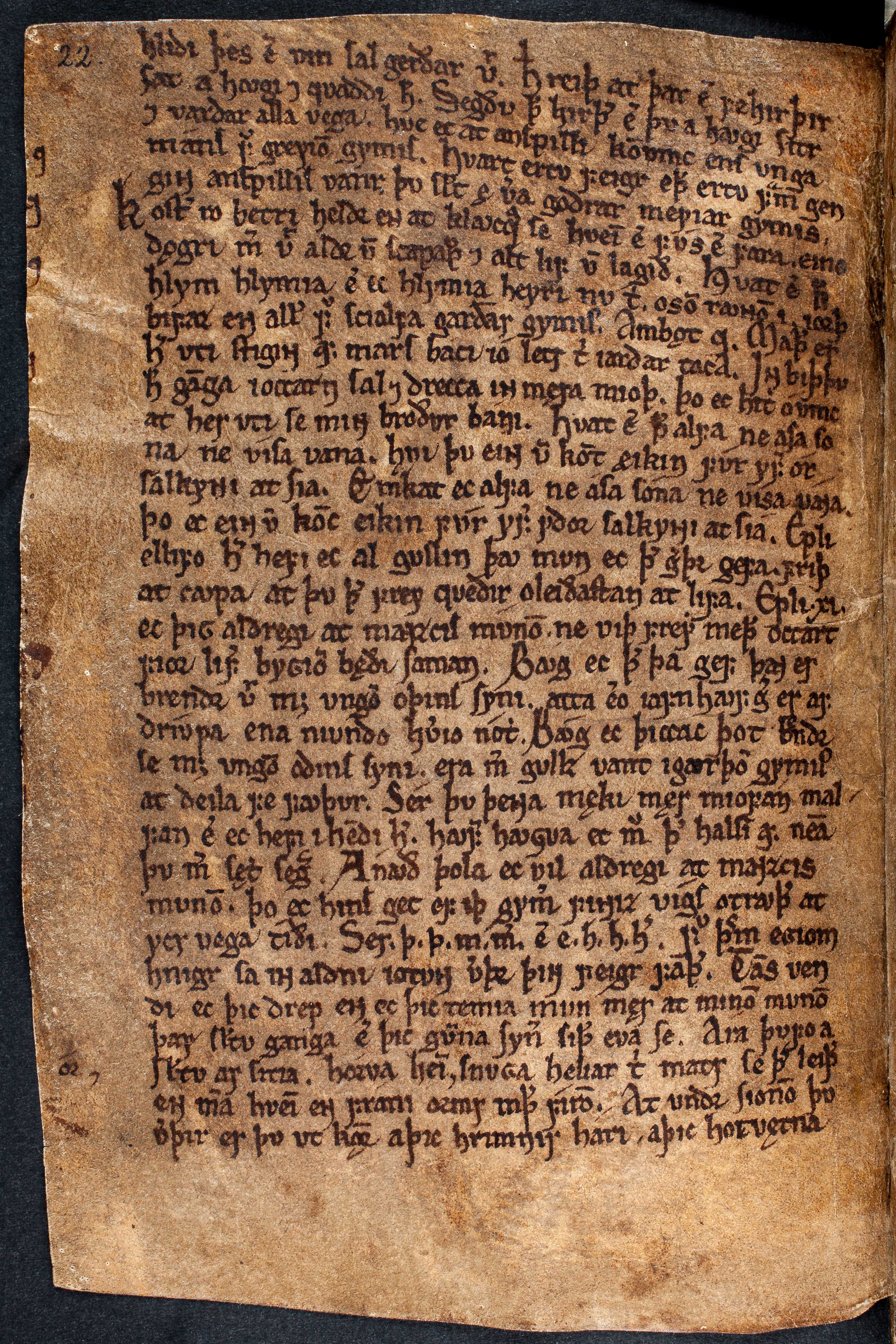
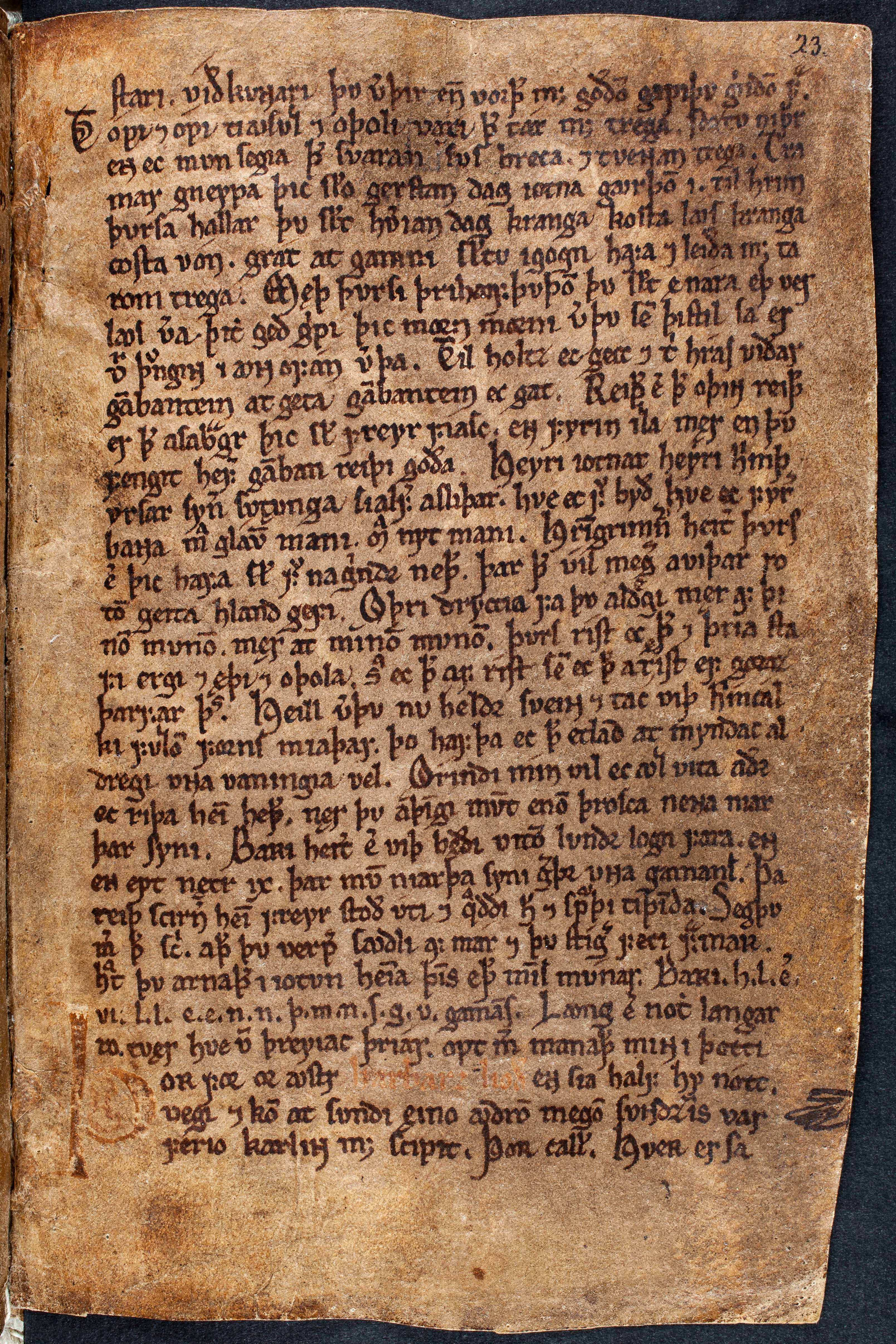
Skírnismál is preserved in the Codex Regius of the Poetic Edda (GKS 2365 4to, Árni Magnússon Institute, Reykjavík), an Icelandic parchment book written about 1270. The poem fills fol. 11r-12r (manuscript pages 21-23).
Pages: each section holds the stanzas that begin on one manuscript page and links that page's photograph (handrit.is); a stanza that runs onto the next page links both pages. The page of every stanza comes from Wimmer and Finnur Jónsson's 1891 diplomatic edition, which prints the text of each manuscript page, and the first line of every page was checked on the photograph. 'Where on the image' under each section gives the details.
Texts: the first Old Norse text is the manuscript's own text, letter by letter, from the diplomatic transcription of Wimmer and Finnur Jónsson (1891), which prints each page line for line: line breaks are the manuscript's, ‖ marks a new page, letters in italics are supplied where the scribe abbreviated, and special letters are kept (ſ long s, ꝛ round r, ꝼ insular f, ı dotless i, ꜹ the av ligature, ǫ and ę with hooks, ᛘ the rune for maðr, small capitals for the scribe's small capitals). The manuscript writes the poem as continuous lines without stanza breaks; the stanza numbers (Guðni Jónsson's) are inserted where each stanza begins and do not appear in the manuscript. Letters with a dot below are marked for deletion in the manuscript; letters between ⸌ and ⸍ are written above the line, and ⟨marg. ...⟩ gives what Wimmer and Jónsson print in the margin (corrections, and in Vafþrúðnismál the speaker marks o, v, q). The manuscript's prose (the prose before and after the poem, the prose links between speeches, the red titles and speaker notes such as 'Freyıa q.', Freyja said) is shown where it stands, marked 'prose'; where verse goes on after such a piece inside a stanza, the stanza number is repeated with 'cont.'. Thorpe's English for the prose is given at the same place where he translates it; he gives the speaker notes as the speaker's name before the stanza. The second text is Guðni Jónsson's normalized edition (via heimskringla.no), a reading text in modern spelling; in places it adds words or lines from other manuscripts and follows modern editions where they rearrange stanzas. The English is Benjamin Thorpe's 1866 translation (public domain).
How was this verified? (Provenance)
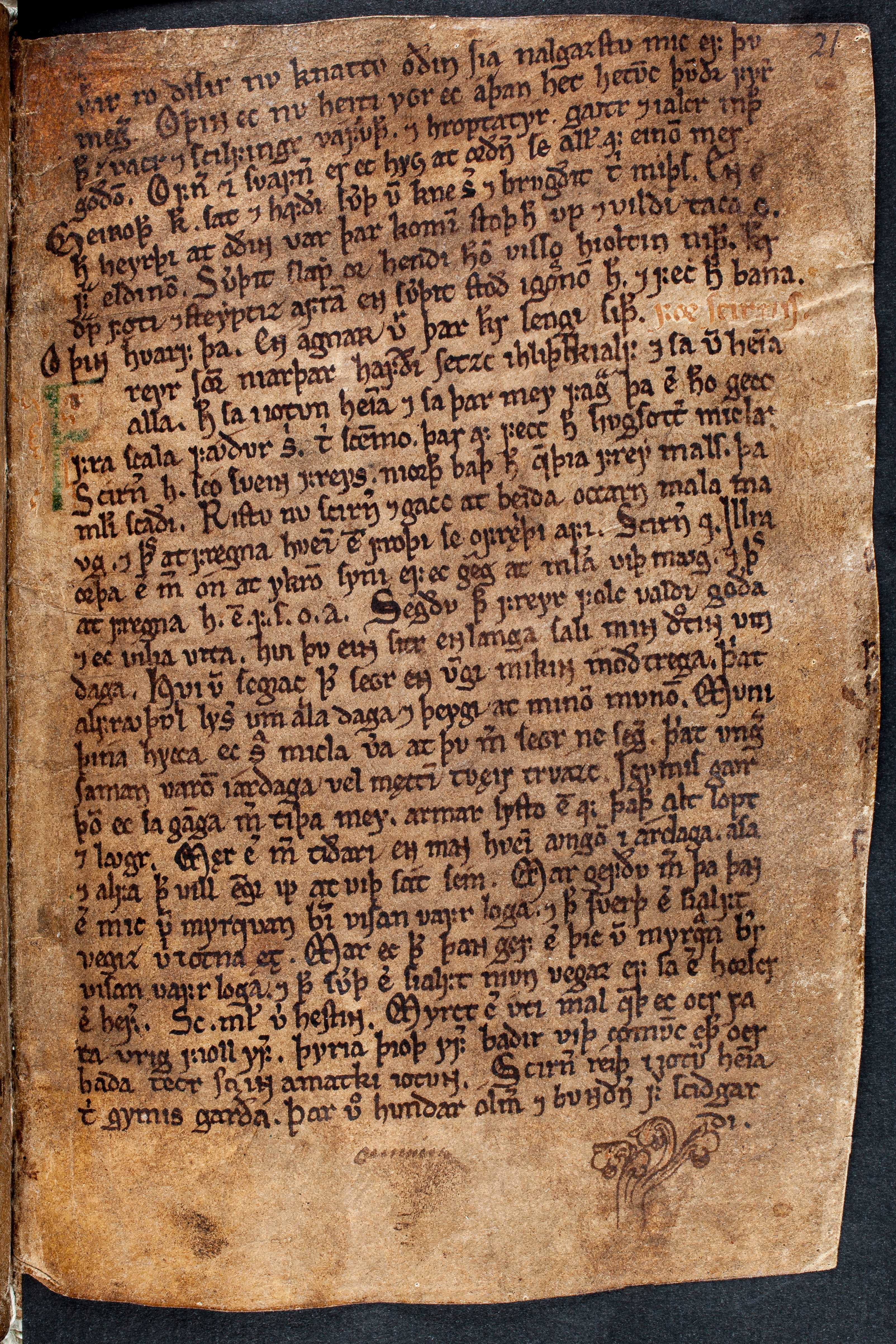
Where on the image
Fol. 11r (manuscript page 21; handrit.is image 30; Wimmer and Jónsson 1891 page 21, caption 'Grímnismál v. 53 - Skírnismál pr. efter v. 10'): stanza 1 is lower on the page (the first line belongs to the end of Grímnismál 53); stanzas 1-10 begin here. Checked on the image: the first line of fol. 11r has 'nú knáttu Óðin sjá' (end of Grímnismál 53). The manuscript's prose in this section is shown in its place and marked 'prose': the title (ꝼoꝛ ſcırnıſ) and the prose before the poem, ending with 'then Skaði said' (Wimmer and Jónsson 1891 page 21, lines 9-14); the speaker note Scırnır q. (Skírnir said), which Thorpe gives as the speaker name Skirnir (Wimmer and Jónsson 1891 page 21, line 15); the note Sc. męltı vıþ heſtıɴ (Skírnir said to the horse), which Thorpe gives as 'Skirnir Speaks to the Horse' (Wimmer and Jónsson 1891 page 21, line 29). Thorpe's English for it is given at the same place ('Frey, son of Niord ...'). Diplomatic text: Wimmer and Jónsson 1891, page 21, lines 9-31, transcribed from their page images and proofread line by line; they print each manuscript page line for line beside its phototype, so the line breaks shown are the manuscript's.
proseꝼoꝛ ſcırnıſ.
Freyr ſonꝛ nıarþar haꝼðı ſetzc ıhlıþſkıalꝼ oc ſa vm heıma
alla. Hann ſa ı ıotvn heıma oc ſa þar mey ꝼagra þa er hon gecc
ꝼra ſcala ꝼꜹðvr ſınſ. tıl ſcemmo. þar aꝼ ꝼecc hann hvgſottır_ mıclar.
Scírnır h. ſcó ſveıɴ ꝼreys. nıoꝛþr baþ hann qveþıa ꝼreẏ malſ. þa
męltı ſcaðı. 1Rıſtv nv ſcırnır oc gacc at beıða occarn mala ma
vg. oc þes at ꝼregna hveım enn ꝼroþı ſe oꝼręþı aꝼı. proseScırnır q. 2Illra
oꝛþa er mer ón at ykrom ſynı eꝼ ec geng at męla vıþ mꜹg. oc þes
at ꝼregna h. enn. ꝼ. ſ. o. a. 3Segðv þat ꝼreyr ꝼolc valðı goða ⟨marg. ſc⟩
oc ec vılıa vıta. hvı þv eıɴ ſıtr eɴ langa ſalı mıɴ ðrotıɴ vm
ðaga. 4Hvı vm ſegıac þer ſeɢʀ eɴ vngı mıkıɴ móðtrega. þvıat ⟨marg. ꝼ.⟩
alꝼrꜹþvll lysır vm alla ðaga oc þeygı at mınom mvnom. 5Mvnı ⟨marg. ſ.⟩
þína hycca ec sva mıcla vera at þv mer ſeɢʀ ne ſegır. þvıat vngır
ſaman varom ıárðaga vel męttım tvęır trv́azc. 6Igymıſ gꜹr ⟨marg. ꝼ.⟩
þom ec ſa ganga mer tıþa mey. armar lyſto en aꝼ þaþan alt lopt
oc lꜹgr. 7Męr er mer tıðarı eɴ maɴ hveım ꜹngom ı árdaga. aſa
oc alꝼa þat vıll engı ᛘ at vıþ ſát ſém. 8Mar geꝼðv mer þa þaɴ ⟨marg. ſ.⟩
er mıc vm myrqvan berı vıſan vaꝼr loga. oc þat ſverþ er ſıalꝼt
vegız vıþ ıotna ętt. 9Mar ec þer þaɴ geꝼ er þıc vm myrqvun berr
vıſan vaꝼr loga. oc þat ſverþ er ſıalꝼt mvn vegaz eꝼ ſa er hoꝛſcr
er heꝼır. proseSc. męltı vıþ heſtıɴ. 10Myrct er v́tı mal qveþ ec ocr ꝼa
ra vrıg ꝼıoll yꝼır. þyrıa þıoþ yꝼır baðır vıþ comvmc eþa ocr
baða tecr ſa ıɴ amatkı ıotvɴ.
Compare: Normalized text (Guðni Jónsson)
1"Rístu nú, Skírnir, / ok gakk skjótt at beiða / okkarn mála mög / ok þess at fregna, / hveim inn fróði sé / ofreiði afi." 2"Illra orða / er mér ón at ykkrum syni, / ef ek geng at mæla við mög / ok þess at fregna, / hveim inn fróði sé / ofreiði afi." 3"Segðu mér þat, Freyr, / folkvaldi goða, / ok ek vilja vita: / Hví þú einn sitr / endlanga sali, / minn dróttinn, um daga?" 4"Hví um segjak þér, / seggr inn ungi, / mikinn móðtrega? / Því at álfröðull / lýsir um alla daga / ok þeygi at mínum munum." 5"Muni þína / hykk-a ek svá mikla vera, / at þú mér, seggr, né segir, / því at ungir saman / várum í árdaga, / vel mættim tveir trúask." 6"Í Gymis görðum / ek ganga sá / mér tíða mey; / armar lýstu, / en af þaðan / allt loft ok lögr." 7"Mær er mér tíðari / en manna hveim / ungum í árdaga; / ása ok alfa / þat vill engi maðr / at vit samt séim." 8"Mar gefðu mér þá / þann er mik um myrkvan beri / vísan vafrloga, / ok þat sverð, / er sjalft vegisk / við jötna ætt." 9"Mar ek þér þann gef, / er þik um myrkvan berr / vísan vafrloga, / ok þat sverð, / er sjalft mun vegask / ef sá er horskr, er hefr." 10"Myrkt er úti, / mál kveð ek okkr fara / úrig fjöll yfir, / þursa þjóð yfir; / báðir vit komumk, / eða okkr báða tekr / sá inn ámáttki jötunn."
proseFrey, son of Niord; had one day seated himself in Hlidskialf, and was looking over all regions, when turning his eyes to Jotunheim, he there saw a beautiful girl, as she was passing from her father's dwelling to her bower. Thereupon he became greatly troubled in mind. Frey's attendant was named Skirnir; him Niord desired to speak with Frey; when Skadi said:-- 1Rise up now, Skirnir! go and request our son to speak; and inquire with whom he so sage may be offended. 2Skirnir. Harsh words I have from your son to fear, if I go to speak with him, and to inquire with whom he so sage may be offended. 3Skirnir. Tell me now, Frey, prince of gods! for I desire to know, why alone thou sittest in the spacious hall the livelong day? 4Frey. Why shall I tell thee, thou young man, my mind's great trouble? for the Alfs' illuminator shines every day, yet not for my pleasure. 5Skirnir. Thy care cannot, I think, be so great, that to me thou canst not tell it; for in early days we were young together: well might we trust each other. 6Frey. In Gymir's courts I saw walking a maid for whom I long. Her arms gave forth light wherewith shone all air and water. 7Is more desirable to me that maid than to any youth in early days; yet will no one, Æsir or Alfar, that we together live. 8Skirnir. Give me but thy steed, which can bear me through the dusk, flickering flame, and that sword, which brandishes itself against the Jotuns' race. 9Frey. I will give thee my steed, which can bear thee through the dusk, flickering flame, and that sword, which will itself brandish, if he is bold who raises it. 10Skirnir Speaks to the Horse. Dark it is without, 'tis time, I say, for us to go across the misty fells, over the Thursar's land: we shall both return, or the all-potent Jotun will seize us both. Skirnir rides to Jotunheim, to Gymir's mansion, where fierce dogs were chained at the gate of the enclosure that was round Gymir's hall. He rides on to where a cowherd was sitting on a mound, and says to him:
Where on the image
Fol. 11r (manuscript page 21; handrit.is image 30; Wimmer and Jónsson 1891 page 21, caption 'Grímnismál v. 53 - Skírnismál pr. efter v. 10'): the prose of this section begins in line 31. Fol. 11v (manuscript page 22; handrit.is image 31; Wimmer and Jónsson 1891 page 22, caption 'Skírnismál pr. efter v. 10 - v. 28'): stanzas 11-28 begin here; stanza 28 runs on to fol. 12r. Fol. 12r (manuscript page 23; handrit.is image 32; Wimmer and Jónsson 1891 page 23, caption 'Skírnismál v. 28 - Hárbarðsljóð v. 1'): the top of the page finishes stanza 28 ('víðkunnari þú verðir ...'). Checked on the image: the first line of fol. 11r has 'nú knáttu Óðin sjá' (end of Grímnismál 53); the first line of fol. 11v has 'hliði þess er um sal Gerðar var' (the prose after Skírnismál 10); the first line of fol. 12r has 'víðkunnari þú verðir' (end of Skírnismál 28). The manuscript's prose in this section is shown in its place and marked 'prose': the prose on Skírnir's ride to Gymir's house and the herdsman on the mound, which Thorpe does not translate (Wimmer and Jónsson 1891 page 21, lines 31-33; page 22, lines 1-2); the speaker note Ambǫt q. (the maid said), which Thorpe gives as 'A serving-maid' (Wimmer and Jónsson 1891 page 22, line 9). Diplomatic text: Wimmer and Jónsson 1891, page 21, lines 31-33; page 22, lines 1-33; page 23, line 1, transcribed from their page images and proofread line by line; they print each manuscript page line for line beside its phototype, so the line breaks shown are the manuscript's.
proseScırnır reíþ ı ıotvn heıma
tıl gymıs garða. Þar voro hvnðar ólmır oc bvɴðnır ꝼyr ſcıðgar
ðı.
‖ hlıðı þes er vm ſal gerðar var. Hann reıþ at þar er ꝼehırþır
ſat a hꜹgı oc qvaððı hann. 11Segðv þat hırþır er þv a hꜹgı ſıtr
oc varðar alla vega. hve ec at anſpıllı komvmc enſ vnga
⟨marg. .q⟩ mánſ ꝼyr greyıom gymıſ. 12Hvart ertv ꝼeıgr eþa ertv ꝼram gen
gıɴ anſpıllıſ vanr þv ſcalt ę vera goðrar meyıar gymis.
13⟨marg. q⟩ Koſtır ro betrı helðꝛ eɴ at klꜹcqva ſe hveım er ꝼv́s er ꝼara. eıno
⟨marg. q⟩ ðǫgrı mer var alðꝛ vm ſcapaþr oc alt lıꝼ vm lagıð. 14Hvat er þat
hlym hlymıa er ec hlymıa heyrı nv tıl. oſom rꜹɴᴏm ı. ıoꝛþ
bıꝼaz eɴ allır ꝼyr ſcıalꝼa garðar gymıſ. proseAmbǫt q. 15Maþr er
⟨marg. q⟩ her vtı ſtıgıɴ aꝼ marſ bácı ıó letr tıl ıarðar taca. 16Iɴ bıþþv
hann ganga ıoccarn ſal oc ðrecca ıɴ męra mıoþ. þo ec hıtt óvmc
at her vtı ſe mıɴ broðvr bánı. 17Hvat er þat alꝼa ne aſa ſo
na ne víſa vana. hvı þv eıɴ vm komt ęıkın ꝼv́r yꝼır ór
ſalkyɴı at ſıa. 18Emkat ec alꝼa ne áſa ſóna ne vısa váɴa.
þo ec eıɴ vm komc eıkın ꝼv́r yꝼır yðoꝛ ſalkyɴı at ſıá. 19Eplı
ellıꝼo her heꝼı ec al gvllın þꜹ mvn ec þer gerþꝛ geꝼa. ꝼrıþ
at cꜹpa at þv þer ꝼrey qveðır oleıðaſtan at lıꝼa. 20Eplı. xı.
ec þıɢ alðregı at maɴᴢcıſ mv́nom. ne vıþ ꝼreẏ meþan occart
⟨marg. q⟩ ꝼıoꝛ lıꝼır byɢıom bęðı ſaman. 21Bꜹ́g ec þer þa geꝼ þaɴ er
brenðꝛ var meþ vngom oþınſ ſynı. atta ero ıaꝼnhꜹꝼgır er aꝼ
⟨marg. q⟩ ðrıv́pa ena nıvnðo hverıo nótt. 22Bꜹ́g ec þıccac þot brenðꝛ
ſe meþ vngom oðınſ ſynı. era mer gvllz vant ıgꜹrþom gymıſ
⟨marg. q⟩ at ðeıla ꝼe ꝼꜹþvr. 23Sér þv þeɴa mękı męr mıoꝼán mal-
ꝼan er ec heꝼı ıhenðı her. hꜹꝼvþ hꜹɢᴠa ec mvn þer halſı aꝼ nema
þv mer ſętt ſegır. 24Ánꜹð þola ec vıl alðregı at maɴᴢcıs
mvnom. þo ec hınſ get eꝼ ıþ gymır ꝼıɴız vígſ otrꜹþır at
ycr vega tíðı. 25Ser. þ. þ. m. mer. er e. h. h. her. ꝼyr þeſom eɢıom
hnıgr ſa ıɴ alðnı ıotvɴ verþꝛ þıɴ ꝼeıgr ꝼaþır. 26Tams ven
ðı ec þıc ðrep eɴ ec þıc temıa mvn męr at mınom mvnom
þar ſcaltv ganga er þıc gvmna ſynır ſıþan eva ſe. 27Ára þvꝼo a
⟨marg. óꝛ,⟩ ſcaltv ar ſıtıa. hóꝛva heımꝛ, ſnvɢa helıar tıl matr ſe þer leıþr
eɴ manna hveım eɴ ꝼránı oꝛmr meþ ꝼírom. 28At vnðꝛ ſıonom þv
verþır er þv vt kǫmꝛ aþıc hrımnır hárı. aþıc hotvętna
‖ ſtarı. víðkvɴarı þv verþır enn voꝛþr meþ goðom gapıþv grınðom ꝼra.
Compare: Normalized text (Guðni Jónsson)
11"Segðu þat, hirðir, / er þú á haugi sitr / ok varðar alla vega: / Hvé ek at andspilli / komumk ins unga mans / fyr greyjum Gymis?" 12"Hvárt ertu feigr, / eða ertu framgenginn? / -- -- -- / Andspillis vanr / þú skalt æ vera / góðrar meyjar Gymis." 13"Kostir ro betri / heldr en at klökkva sé, / hveim er fúss er fara; / einu dægri / mér var aldr of skapaðr / of allt líf of lagit." 14"Hvat er þat hlym hlymja, / er ek heyri nú til / ossum rönnum í? / Jörð bifask, / en allir fyrir / skjalfa garðar Gymis." 15"Maðr er hér úti, / stiginn af mars baki, / jó lætr til jarðar taka." / -- -- -- 16"Inn bið þú hann ganga / í okkarn sal / ok drekka inn mæra mjöð; / þó ek hitt óumk, / at hér úti sé / minn bróðurbani. 17Hvat er þat alfa / né ása sona / né víssa vana? / Hví þú einn of komt / eikinn fúr yfir / ór salkynni at séa?" 18"Emk-at ek alfa / né ása sona / né víssa vana; / þó ek einn of komk / eikinn fúr yfir / yður salkynni at séa." 19"Epli ellifu / hér hef ek algullin, / þau mun ek þér, Gerðr, gefa, / frið at kaupa, / at þú þér Frey kveðir / óleiðastan lifa." 20"Epli ellifu / ek þigg aldregi / at mannskis munum, / né vit Freyr, / meðan okkart fjör lifir, / byggjum bæði saman." 21"Baug ek þér þá gef, / þann er brenndr var / með ungum Óðins syni; / átta eru jafnhöfðir, / er af drjúpa / ina níundu hverja nótt." 22"Baug ek þikk-a-k, / þótt brenndr séi / með ungum Óðins syni; / er-a mér gulls vant / í görðum Gymis, / at deila fé föður." 23"Sér þú þenna mæki, mær, / mjóvan, málfáan, / er ek hef í hendi hér? / Höfuð höggva / ek mun þér hálsi af, / nema þú mér sætt segir." 24"Ánauð þola / ek vil aldregi / at mannskis munum; / þó ek hins get, / ef it Gymir finnizk, / vígs ótrauðir, / at ykkr vega tíði." 25"Sér þú þenna mæki, mær, / mjóvan, málfáan, / er ek hef í hendi hér? / Fyr þessum eggjum / hnígr sá inn aldni jötunn, / verðr þinn feigr faðir. 26Tamsvendi ek þik drep, / en ek þik temja mun, / mær, at mínum munum; / þar skaltu ganga, / er þik gumna synir / síðan æva séi. 27Ara þúfu á / skaltu ár sitja / horfa heimi ór, / snugga heljar til; / matr né þér meir leiðr / en manna hveim / innfráni ormr með firum. 28At undrsjónum þú verðir, / er þú út kemr; / á þik Hrímnir hari, / á þik hotvetna stari; / víðkunnari þú verðir / en vörðr með goðum, / gapi þú grindum frá.
11Tell me, cowherd! as on the mound thou sittest, and watchest all the ways, how I to the speech may come, of the young maiden, for Gymir's dogs? 12Cowherd. Either thou art death-doomed, or thou art a departed one. Speech wilt thou ever lack with the good maid of Gymir. 13Skirnir. Better choices than to whine there are for him who is prepared to die: for one day was my age decreed, and my whole life determined. 14Gerd. What is that sound of sounds, which I now sounding hear within our dwelling? The earth is shaken, and with it all the house of Gymir trembles. 15A serving-maid. A man is here without, dismounted from his horse's back: he lets his steed browse on the grass. 16Gerd. Bid him enter into our hall, and drink of the bright mead; although I fear it is my brother's slayer who waits without. 17Who is this of the Alfar's, or of the Æsir's sons, or of the wise Vanir's? Why art thou come alone, through the hostile fire, our halls to visit? 18Skirnir. I am not of the Alfar's, nor of the Æsir's sons, nor of the wise Vanir's; yet I am come alone, through the hostile fire, your halls to visit. 19Apples all-golden I have here eleven: these I will give thee, Gerd, thy love to gain, that thou mayest say that Frev to thee lives dearest. 20Gerd. The apples eleven I never will accept for any mortal's pleasure; nor will I and Frey, while our lives last, live both together. 21Skirnir. The ring too I will give thee, which was burnt with the young son of Odin. Eight of equal weight will from it drop, every ninth night. 22Gerd. The ring I will not accept, burnt though it may have been with the young son of Odin. I have no lack of gold in Gymir's courts; for my father's wealth I share. 23Skirnir. Seest thou this sword, young maiden! thin, glittering-bright, which I have here in hand? I thy head will sever from thy neck, if thou speakst not favourably to me. 24Gerd. Suffer compulsion will I never, to please any man; yet this I foresee, if thou and Gymir meet, ye will eagerly engage in fight. 25Skirnir. Seest thou this sword, young maiden! thin, glittering-bright, which I have here in hand? Beneath its edge shall the old Jotun fall: thy sire is death-doomed. 26With a taming-wand I smite thee, and I will tame thee, maiden! to my will. Thou shalt go thither, where the sons of men shall never more behold thee. 27On an eagle's mount thou shalt early sit, looking and turned towards Hel. Food shall to thee more loathsome be than is to any one the glistening serpent among men. 28As a prodigy thou shalt be, when thou goest forth; Hrimnir shall at thee gaze, all beings at thee stare; more wide-known thou shalt become than the watch among the gods, if thou from thy gratings gape.
Where on the image
Fol. 12r (manuscript page 23; handrit.is image 32; Wimmer and Jónsson 1891 page 23, caption 'Skírnismál v. 28 - Hárbarðsljóð v. 1'): stanzas 29-42 begin here. Checked on the image: the first line of fol. 12r has 'víðkunnari þú verðir' (end of Skírnismál 28). The manuscript's prose in this section is shown in its place and marked 'prose': the prose on Skírnir's return to Freyr (Wimmer and Jónsson 1891 page 23, lines 24-25). Thorpe's English for it is given at the same place ('Skimir then rode home ...'). Diplomatic text: Wimmer and Jónsson 1891, page 23, lines 2-30, transcribed from their page images and proofread line by line; they print each manuscript page line for line beside its phototype, so the line breaks shown are the manuscript's.
29Tópı oc ópı tıꜹſvll oc oþolı vaxı þer tár meþ trega. ſeztv nıþr
eɴ ec mvn ſegıa þer ſvaran ſvſ breca. oc tveɴan trega. 30Tra
mar gneypa þıc ſcolo gerſtan ðag ıotna gꜹrþom ı. tıl hrım
þvrſa hallar þv ſcalt hverıan ðag kranga koſta lꜹ́ſ kranga
coſta vón. grát at gamnı ſcaltv ıgogn haꝼa oc leıða meþ ta
rom trega. 31Męþ þvrſı þrıhꜹꝼþvþom þv ſcalt ę nára eþ ver
lꜹ́ſ vera. þıtt geð grıpı þıc moꝛn moꝛnı ver þv ſem þıſtıl ſa er
var þrvngıɴ ı ꜹɴ oꝼán verþa. 32Tıl holtz ec gecc oc tıl hráſ vıðar
gambanteın at geta gambanteın ec gat. 33Reıþr er þer oþıɴ reıþr
er þer aſabragr þıc ſcal ꝼreyr ꝼıaſc. eɴ ꝼyrın ılla męr en þv
ꝼengıt heꝼır gamban reıþı goða. 34Heyrı ıotnar heẏrı hrımþ
vrſar ſynır ſvttvnga ſıalꝼır aſlıþar. hve ec ꝼyr byð hve ec ꝼyrır
baɴa manna glꜹ́m manı. ᴍanna nyt manı. 35Hrımgrımnır heıtır þvrſ
er þıc haꝼa ſcal ꝼyr nagrınðꝛ neþan. þar þer víl megır avıþar ro
tom geıta hlanð geꝼı. Ǫþrı ðryccıa ꝼa þv alðregı męr aꝼ þı
nom mvnom. męr at mınom mvnom. 36Þvrſ ríſt ec þer oc þrıa ſta
ꝼı ergı oc ęþı oc oþola. sva ec þat aꝼ ríſt ſem ec þat ár⸌e⸍,ıſt eꝼ goꝛaz
þarꝼar þes. 37Heıll verþv nv helðꝛ ſveıɴ oc tac vıþ hrímcál
kı ꝼvllom ꝼoꝛnſ mıaþar. þo haꝼþa ec þat etlað at mynðac al-
ðregı vɴa vanıngıa vel. 38Ǫ́rınðı mín vıl ec ꜹll vıta aðꝛ
ec rıþa heım heþan. nęr þv aþıngı mvnt enom þroſca neɴa nıar
þar ſynı. 39Baʀı heıtır er vıþ bęðı vıtom lvnðꝛ logn ꝼara. eɴ
eɴ ept nętr ıx. þar mvn nıarþa ſynı gerþꝛ vɴa gamanſ. proseÞa
reıþ ſcırnır heım ꝼreyr ſtoð v́tı oc qvaððı hann oc ſpvrþı tıþınða. 40Segþv
mer þat ſcırnır. aþr þv verpır ſꜹðlı aꝼ már oc þv ſtígır ꝼetı ꝼramaʀ.
hvat þv arnaþır ı ıotvn heıma þıns eþa mınſ mv́nar. 41Baʀı. h. l. er.
vı. l. l. e. e. n. n. þ. m. n. ſ. g. v. gamanſ. 42Lꜹng er nott langar
ro tvęr hve vm þreyıac þrıár. opt mer manaþr mıɴı þottı
eɴ ſıa halꝼ hy nótt.
Compare: Normalized text (Guðni Jónsson)
29Tópi ok ópi, / tjösull ok óþoli, / vaxi þér tár með trega; / sezk þú niðr, / en ek mun segja þér / sváran súsbreka / ok tvennan trega: 30Tramar gneypa / þik skulu gerstan dag / jötna görðum í; / til hrímþursa hallar / þú skalt hverjan dag / kranga kostalaus, / kranga kostavön; / grát at gamni / skaltu í gögn hafa / ok leiða með tárum trega. 31Með þursi þríhöfðuðum / þú skalt æ nara, / eða verlaus vera; / þitt geð grípi, / þik morn morni; / ver þú sem þistill, / sá er var þrunginn / í önn ofanverða. 32Til holts ek gekk / ok til hrás viðar, / gambantein at geta, / gambantein ek gat. 33Reiðr er þér Óðinn, / reiðr er þér Ásabragr, / þik skal Freyr fíask, / in firinilla mær, / en þú fengit hefr / gambanreiði goða. 34Heyri jötnar, / heyri hrímþursar, / synir Suttungs, / sjalfir ásliðar, / hvé ek fyrbýð, / hvé ek fyrirbanna / manna glaum mani, / manna nyt mani. 35Hrímgrímnir heitir þurs, / er þik hafa skal / fyr nágrindr neðan; / þar þér vílmegir / á viðarrótum / geitahland gefi; / æðri drykkju / fá þú aldregi, / mær, af þínum munum, / mær, at mínum munum. 36Þurs ríst ek þér / ok þría stafi, / ergi ok æði ok óþola; / svá ek þat af ríst, / sem ek þat á reist, / ef gerask þarfar þess." 37"Heill ver þú nú heldr, sveinn, / ok tak við hrímkálki / fullum forns mjaðar; / þó hafðak ek þat ætlat, / at myndak aldregi / unna vaningja vel." 38"Örendi mín / vil ek öll vita, / áðr ek ríða heim heðan, / nær þú á þingi / munt inum þroska / nenna Njarðar syni." 39"Barri heitir, / er vit bæði vitum, / lundr lognfara; / en eft nætr níu / þar mun Njarðar syni / Gerðr unna gamans." 40"Segðu mér þat, Skírnir, / áðr þú verpir söðli af mar / ok þú stígir feti framar: / Hvat þú árnaðir / í Jötunheima / þíns eða míns munar?" 41"Barri heitir, / er vit báðir vitum, / lundr lognfara; / en eft nætr níu / þar mun Njarðar syni / Gerðr unna gamans." 42"Löng er nótt, / langar ro tvær, / hvé of þreyjak þrjár? / Oft mér mánaðr / minni þótti / en sjá half hýnótt."
29Solitude and disgust, bonds and impatience, shall thy tears with grief augment. Set thee down, and I will tell thee of a whelming flood of care, and a double grief. 30Terrors shall bow thee down the livelong day, in the Jotuns' courts. To the Hrimthursar's halls, thou shalt each day crawl exhausted, joyless crawl; wail for pastime shalt thou have, and tears and misery. 31With a three-headed Thurs thou shalt be ever bound, or be without a mate. Thy mind shall tear thee from morn to morn: as the thistle thou shalt be which has thrust itself on the house-top. 32To the wold I have been, and to the humid grove, a magic wand to get. A magic wand I got. 33Wroth with thee is Odin, wroth with thee is the Æsir's prince; Frey shall loathe thee, even ere thou, wicked maid! shalt have felt the gods' dire vengeance. 34Hear ye, Jotuns! hear ye, Hrimthursar! sons of Suttung! also ye, Æsir's friends! how I forbid, how I prohibit man's joy unto the damsel, man's converse to the damsel. 35Hrimgrimnir the Thurs is named, that shall possess thee, in the grating of the dead beneath; there shall wretched thralls, from the tree's roots, goats' water give thee. Other drink shalt thou, maiden! never get, either for thy pleasure, or for my pleasure. 36Thurs I cut for thee, and three letters mere: ergi, and oedi, and othola. So will I cut them out, as I have cut them, in, if there need shall be. 37Gerd. Hail rather to thee, youth! and accept an icy cup, filled with old mead; although I thought not that I ever should love one of Vanir race. 38Skirnir. All my errand will I know, ere I hence ride home. When wilt thou converse hold with the powerful son of Niord? 39Gerd. Barri the grove is named, which we both know, the grove of tranquil paths. Nine nights hence, there to Niord's son Gerd will grant delight. proseSkimir then rode home. Frey was standing without, and spoke to him, asking tidings: 40Tell me, Skirnir! ere thou thy steed unsaddlest, and a foot hence thou goest, what thou hast accomplished in Jotunheim, for my pleasure or thine? 41Skirnir. Barri the grove is named, which we both know, the grove of tranquil paths. Nine nights hence, there to Niord's son Gerd will grant delight. 42Frey. Long is one night, yet longer two will be; how shall I three endure. Often a month to me less has seemed than half a night of longing.
Cite
Sources
- Source: Codex Regius (GKS 2365 4to) page images via handrit.is + Wimmer and Jónsson's 1891 diplomatic text + Guðni Jónsson's normalized Old Norse via heimskringla.no + Thorpe (1866) English (holding institution)
- Critical edition: Diplomatic text of Codex Regius, Wimmer and Finnur Jónsson 1891; normalized text (Guðni Jónsson) for comparison
← previous · → next · v cycle view · l back to library