Hárbarðsljóð
Introduction
Hárbarðsljóð is preserved in the Codex Regius of the Poetic Edda (GKS 2365 4to, Árni Magnússon Institute, Reykjavík), an Icelandic parchment book written about 1270. The poem fills fol. 12r-13v (manuscript pages 23-26).
Pages: each section holds the stanzas that begin on one manuscript page and links that page's photograph (handrit.is); a stanza that runs onto the next page links both pages. The page of every stanza comes from Wimmer and Finnur Jónsson's 1891 diplomatic edition, which prints the text of each manuscript page, and the first line of every page was checked on the photograph. 'Where on the image' under each section gives the details.
Texts: the first Old Norse text is the manuscript's own text, letter by letter, from the diplomatic transcription of Wimmer and Finnur Jónsson (1891), which prints each page line for line: line breaks are the manuscript's, ‖ marks a new page, letters in italics are supplied where the scribe abbreviated, and special letters are kept (ſ long s, ꝛ round r, ꝼ insular f, ı dotless i, ꜹ the av ligature, ǫ and ę with hooks, ᛘ the rune for maðr, small capitals for the scribe's small capitals). The manuscript writes the poem as continuous lines without stanza breaks; the stanza numbers (Guðni Jónsson's) are inserted where each stanza begins and do not appear in the manuscript. Letters with a dot below are marked for deletion in the manuscript; letters between ⸌ and ⸍ are written above the line, and ⟨marg. ...⟩ gives what Wimmer and Jónsson print in the margin (corrections, and in Vafþrúðnismál the speaker marks o, v, q). The manuscript's prose (the prose before and after the poem, the prose links between speeches, the red titles and speaker notes such as 'Freyıa q.', Freyja said) is shown where it stands, marked 'prose'; where verse goes on after such a piece inside a stanza, the stanza number is repeated with 'cont.'. Thorpe's English for the prose is given at the same place where he translates it; he gives the speaker notes as the speaker's name before the stanza. The second text is Guðni Jónsson's normalized edition (via heimskringla.no), a reading text in modern spelling; in places it adds words or lines from other manuscripts and follows modern editions where they rearrange stanzas. The English is Benjamin Thorpe's 1866 translation (public domain).
English alignment: The Gutenberg text of Thorpe misprints stanza 26 as '36' and stanza 29 as '39'; here his stanzas are matched in order, which restores two stanzas the old version of this entry had dropped or misplaced.
How was this verified? (Provenance)
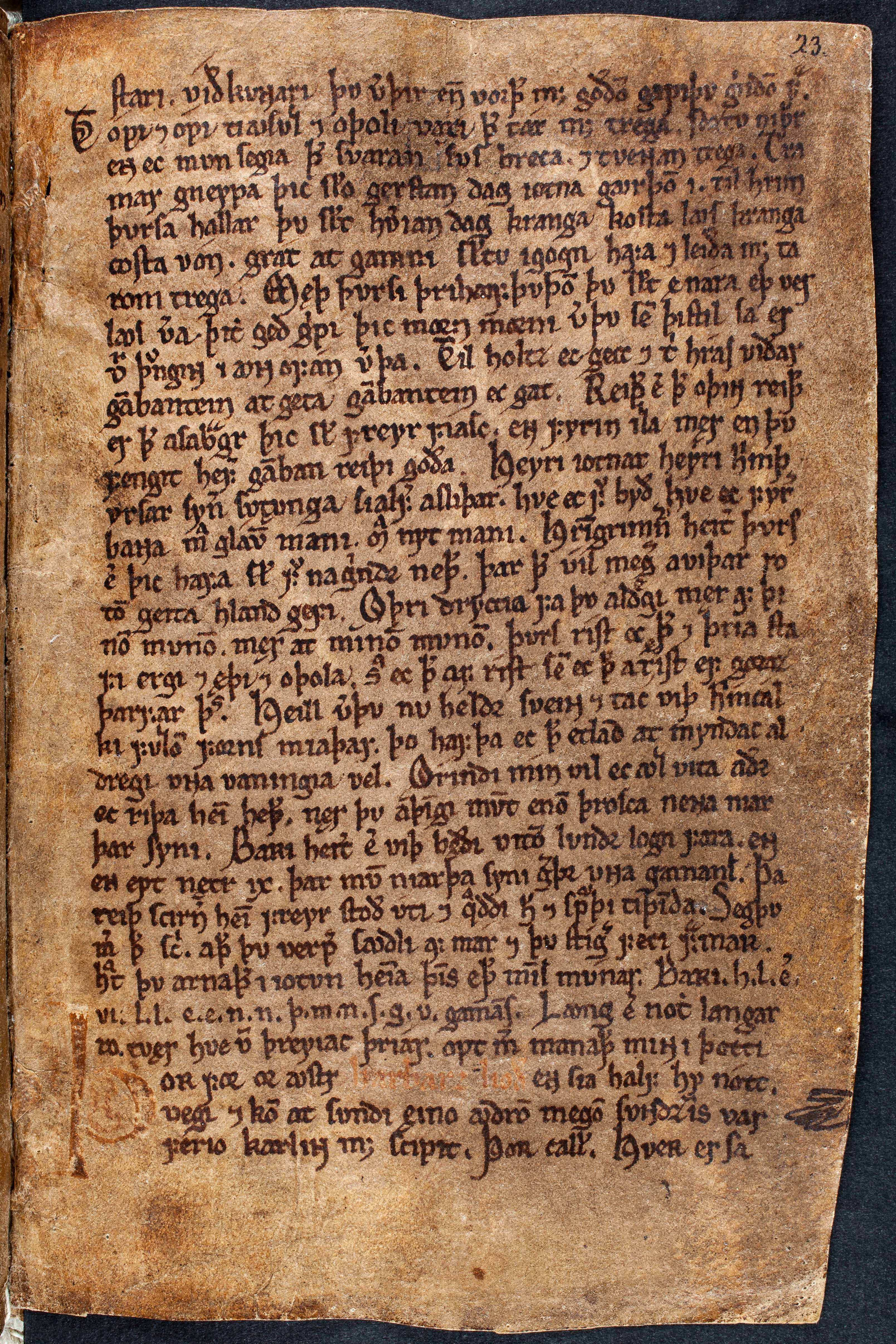
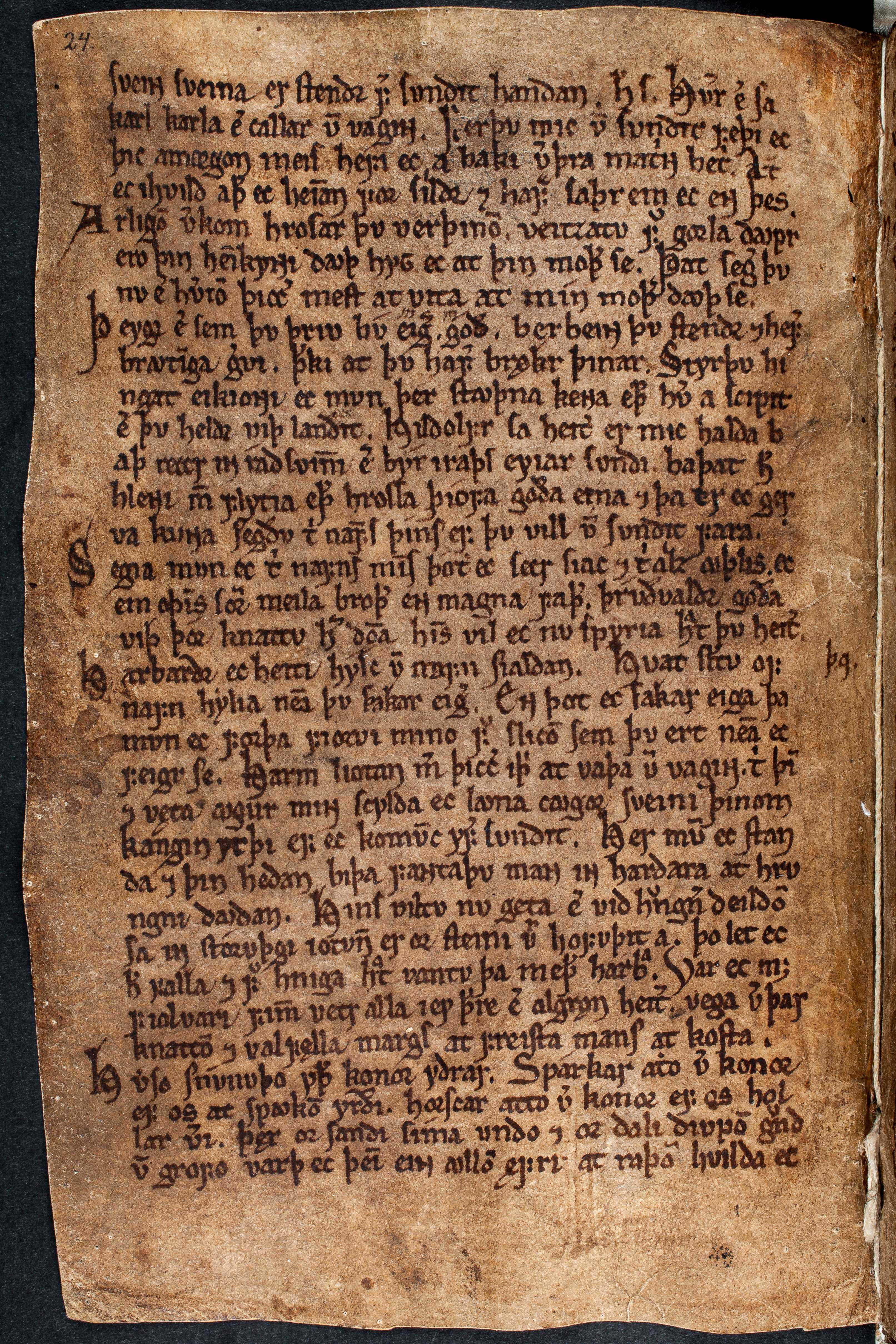
Where on the image
Fol. 12r (manuscript page 23; handrit.is image 32; Wimmer and Jónsson 1891 page 23, caption 'Skírnismál v. 28 - Hárbarðsljóð v. 1'): stanza 1 is lower on the page (the first line belongs to the end of Skírnismál 28); stanza 1 begins here; stanza 1 runs on to fol. 12v. Fol. 12v (manuscript page 24; handrit.is image 33; Wimmer and Jónsson 1891 page 24, caption 'Hárbarðsljóð v. 1-18'): the top of the page finishes stanza 1 ('sveinn sveina ...'). Checked on the image: the first line of fol. 12r has 'víðkunnari þú verðir' (end of Skírnismál 28); the first line of fol. 12v has 'sveinn sveina' (end of Hárbarðsljóð 1). The manuscript's prose in this section is shown in its place and marked 'prose': the prose before the poem, with its title (harbarz lıoð) (Wimmer and Jónsson 1891 page 23, lines 30-32). Thorpe's English for it is given at the same place ('Thor journeying from the eastern parts ...'). Diplomatic text: Wimmer and Jónsson 1891, page 23, lines 30-32; page 24, line 1, transcribed from their page images and proofread line by line; they print each manuscript page line for line beside its phototype, so the line breaks shown are the manuscript's.
proseÞᴏʀ ꝼoꝛ oꝛ ꜹſtr harbarz lıoð
vegı oc kom at ſvnðı ęıno ꜹðrom megom ſvɴðzıns var
ꝼerıo karlıɴ meþ ſcıpıt. Þᴏʀ callaþı. 1Hvᴇʀ er ſa
‖ ſveıɴ ſveına er ſtenðꝛ ꝼyr ſvnðıt hanðan.
Compare: Normalized text (Guðni Jónsson)
1"Hverr er sá sveinn sveina, / er stendr fyr sundit handan?"
proseThor journeying from the eastern parts came to a strait or sound, on the other side of which was a ferryman with his boat. Thor cried out:-- 1Who is the knave of knaves, that by the sound stands yonder?
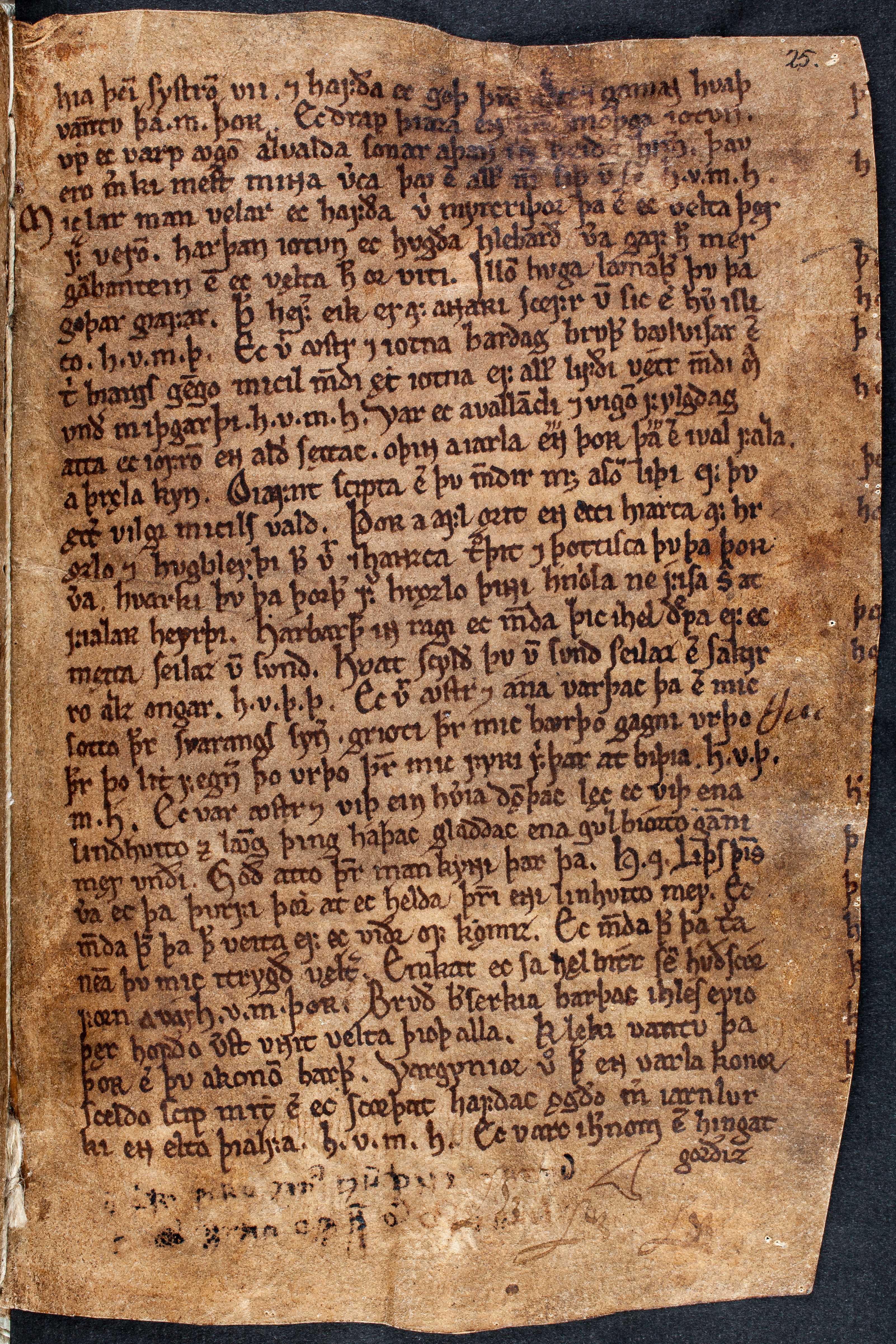
Where on the image
Fol. 12v (manuscript page 24; handrit.is image 33; Wimmer and Jónsson 1891 page 24, caption 'Hárbarðsljóð v. 1-18'): stanzas 2-18 begin here; stanza 18 runs on to fol. 13r. Fol. 13r (manuscript page 25; handrit.is image 34; Wimmer and Jónsson 1891 page 25, caption 'Hárbarðsljóð v. 18-40'): the top of the page finishes stanza 18 ('hjá þeim systrum sjau ...'). Checked on the image: the first line of fol. 12v has 'sveinn sveina' (end of Hárbarðsljóð 1); the first line of fol. 13r has 'hjá þeim systrum sjau' (end of Hárbarðsljóð 18). The manuscript's prose in this section is shown in its place and marked 'prose': the speaker note Hann ſ. (he said), which Thorpe gives as the speaker name Harbard (Wimmer and Jónsson 1891 page 24, line 1). Diplomatic text: Wimmer and Jónsson 1891, page 24, lines 1-33; page 25, lines 1-2, transcribed from their page images and proofread line by line; they print each manuscript page line for line beside its phototype, so the line breaks shown are the manuscript's.
proseHann ſ. 2Hverr er ſa
karl karla er callar vm vagıɴ. 3Ferþv mıc vm ſvnðıt ꝼeþı ec
þıc amoꝛgon meıſ heꝼı ec a bakı verþra matrıɴ betrı. Át
ec ıhvílð aþr ec heıman ꝼoꝛ ſıllðꝛ oc haꝼra ſaþr em ec eɴ þes.
4Árlıgom verkom hroſar þv verþınom. veıtzatv ꝼyr goꝛla ðꜹpr
ero þın heımkyɴı ðꜹþ hyɢ ec at þın moþır ſe. 5Þat ſegır þv
nv er hverıom þıccır meſt at vıta at mín moþır ðꜹþ ſe.
6Þeygı er ſem þv þrıv bv́ e⸌‴⸍ıgır. ⸌‴⸍góð. ber beıɴ þv ſtenðꝛ ocheꝼır
brꜹtınga gervı. þatkı at þv haꝼır brǫkr þınar. 7Styrþv hı
ngat eıkıoɴı ec mvn þer ſtꜹþna keɴa eþa hverr a ſcıpıt
er þv helðꝛ vıþ lanðıt. 8Hılðolꝼr ſa heıtır er mıc halða b-
aþ reccr ıɴ ráðſvınnı er býr ıraþſ eýıar ſvnðı. baþat hann
hleɴı menn ꝼlytıa eþa hroſſa þíoꝼa goða eına oc þa er ec ger
va kvɴa ſegðv tıl naꝼnſ þínſ eꝼ þv vıll vm ſvnðıt ꝼara.
9Segıa mvn ec tıl naꝼnſ mınſ þótt ec ſecr ſıac oc tıl allz ꜹþlıs. ec
em oþıns ſonꝛ meıla broþır eɴ magna ꝼaþır. þrv́ðvalðꝛ goða
vıþ þóꝛ knattv her ðǫma hıns vıl ec nv ſpýrıa hvat þv heıtır.
10Hárbarðꝛ ec heıtı hýlc vm naꝼn ſıalðan. 11Hvat ſcaltv oꝼ ⟨marg. þ.q.⟩
naꝼn hẏlıa nema þv ſakar eıgır. 12Eɴ þot ec ſakar eıga þa
mvn ec ꝼoꝛþa ꝼıoꝛvı mıno ꝼyr ſlıcom ſem þv ert nema ec
ꝼeıgr ſe. 13Harm lıotan mer þıccır ıþvı at vaþa vm vagıɴ. tıl þın
oc vęta ꜹgur mıɴ ſcylða ec lꜹna cꜹgoꝛ ſveını þınom
kangın yrþı eꝼ ec komvmc yꝼır ſvnðıt. 14Her mvn ec ſtan
ða oc þın heðan bıþa ꝼaɴtaþv man ıɴ harðara at hrv-
ngnı ðꜹðan. 15Hınſ vıltv nv geta er vıð hrvngnır ðeılðom
ſa ıɴ ſtóꝛvþgı ıotvnn er oꝛ ſteını var hoꝼvþıt a. þo let ec
hann ꝼalla oc ꝼyr hnıga hvat vantv þa meþan hárbarþr. 16Var ec meþ
ꝼıolvarı ꝼımm vetr alla ıey þeıre er algrǫn heıtır. vega ver þar
knattom oc val ꝼęlla margſ at ꝼreıſta manſ at koſta.
17Hverſo ſnv́nvþo yþr konoꝛ yðrar. 18Spárkar atto ver konoꝛ
eꝼ os at ſpꜹkom ẏrðı. hoꝛſcar atto ver konoꝛ eꝼ os hol
lar verı. þęr oꝛ ſanðı ſíma vnðo oc oꝛ ðalı ðıvpom grvnð
vm groꝼo varþ ec þeım eıɴ ꜹllom ęꝼrı at raþom hvılða ec
‖ hıa þeım ſyſtrom vıı. oc haꝼða ec geþ þeıra allt oc gamaɴ hvaþ
vanntv þa. m. þoʀ.
Compare: Normalized text (Guðni Jónsson)
2"Hverr er sá karl karla, / er kallar of váginn?" 3"Fer þú mik um sundit, / fæði ek þik á morgun; / meis hef ek á baki, / verðr-a matr in betri; / át ek í hvíld, / áðr ek heiman fór, / síldr ok hafra; / saðr em ek enn þess." 4"Árligum verkum / hrósar þú, verðinum; / veizt-at-tu fyrir görla, / döpr eru þín heimkynni, / dauð, hygg ek, at þín móðir sé." 5"Þat segir þú nú, / er hverjum þykkir / mest at vita, / at mín móðir dauð sé." 6"Þeygi er sem þú / þrjú bú góð eigir; / berbeinn þú stendr / ok hefr brautinga gervi, / þatki, at þú hafir brækr þínar." 7"Stýrðu hingat eikjunni, / ek mun þér stöðna kenna, - / eða hverr á skipit, / er þú heldr við landit?" 8"Hildolfr sá heitir, / er mik halda bað, / rekkr inn ráðsvinni, / er býr í Ráðseyjarsundi; / bað-at hann hlennimenn flytja / eða hrossaþjófa, / góða eina / ok þá, er ek görva kunna; / segðu til nafns þíns, / ef þú vill um sundit fara!" 9"Segja mun ek til nafns míns, / þótt ek sekr séak, / ok til alls eðlis: / Ek em Óðins sonr, / Meila bróðir, / en Magna faðir, / þrúðvaldr goða, / við Þór knáttu hér dæma! / Hins vil ek nú spyrja, / hvat þú heitir." 10"Hárbarðr ek heiti, / hylk um nafn sjaldan." 11"Hvat skaltu of nafn hylja, / nema þú sakar eigir?" 12"En þótt ek sakar eiga, / þá mun ek forða fjörvi mínu / fyr slíkum sem þú ert, / nema ek feigr sé." 13"Harm ljótan / mér þykkir í því / at vaða um váginn til þín / ok væta ögur minn; / skylda ek launa / kögursveini þínum / kanginyrði, / ef ek kæmumk yfir sundit." 14"Hér mun ek standa / ok þín heðan bíða; / fannt-a þú mann in harðara / at Hrungni dauðan." 15"Hins viltu nú geta, / er vit Hrungnir deildum, / sá inn stórúðgi jötunn, / er ór steini var höfuðit á; / þó lét ek hann falla / ok fyrir hníga. / Hvat vanntu þá meðan, Hárbarðr?" 16"Var ek með Fjölvari / fimm vetr alla / í ey þeiri, / er Algræn heitir; / vega vér þar knáttum / ok val fella, / margs at freista, / mans at kosta." 17"Hversu snúnuðu yðr konur yðrar?" 18"Sparkar áttu vér konur, / ef oss at spökum yrði; / horskar áttu vér konur, / ef oss hollar væri; / þær ór sandi / síma undu, / ok ór dali djúpum / grund of grófu; / varð ek þeim einn öllum / efri at ráðum; / hvílda ek hjá þeim systrum sjau, / ok hafða ek geð þeira allt ok gaman. / Hvat vanntu þá meðan, Þórr?"
2Harbard. Who is the churl of churls, that cries across the water? 3Thor. Ferry me across the sound, to-morrow I'll regale thee. I have a basket on my back: there is no better food: at my ease I ate, before I quitted home, herrings and oats, with which I yet feel sated. 4Harbard. Thou art in haste to praise thy meal: thou surely hast no foreknowledge; for sad will be thy home: thy mother, I believe, is dead. 5Thor. Thou sayest now what seems to every one most unwelcome to know--that my mother is dead. 6Harbard. Thou dost not look like one who owns three country dwellings, bare-legged thou standest, and like a beggar clothed; thou hast not even breeches. 7Thor. Steer hitherward thy boat; I will direct thee where to land. But who owns this skiff, which by the strand thou holdest? 8Harbard. Hildolf fief is named who bade me hold it, a man in council wise, who dwells in Radso sound. Robbers he bade me not to ferry, or horse-stealers, but good men only, and those whom I well knew. Tell me then thy name, if thou wilt cross the sound. 9Thor. I my name will tell, (although I am an outlaw) and all my kin: I am Odin's son, Meili's brother, and Magni's sire, the gods' mighty leader: With Thor thou here mayest speak. I will now ask how thou art called. 10Harbard. I am Harbard called; seldom I my name conceal. 11Thor. Why shouldst thou thy name conceal, unless thou crime hast perpetrated? 12Harbard. Yet, though I may crime have perpetrated, I will nathless guard my life against such as thou art; unless I death-doomed am. 13Thor. It seems to me a foul annoyance to wade across the strait to thee, and wet my garments: but I will pay thee, mannikin! for thy sharp speeches, if o'er the sound I come. 14Harbard. Here will I stand, and here await thee. Thou wilt have found no stouter one since Hrungnir's death. 15Thor. Thou now remindest me how I with Hrungnir fought, that stout-hearted Jotun, whose head was all of stone; yet I made him fall, and sink before me. What meanwhile didst thou, Harbard? 16Harbard. I was with Fiolvari five winters through, in the isle which Algron hight. There we could fight, and slaughter make, many perils prove, indulge in love. 17Thor. How did your women prove towards you? 18Harbard. Sprightly women we had, had they but been meek; shrewd ones we had, had they but been kind. Of sand a rope they twisted, and from the deep valley dug the earth: to them all I alone was superior in cunning. I rested with the sisters seven, and their love and pleasures shared. What meanwhile didst thou, Thor?
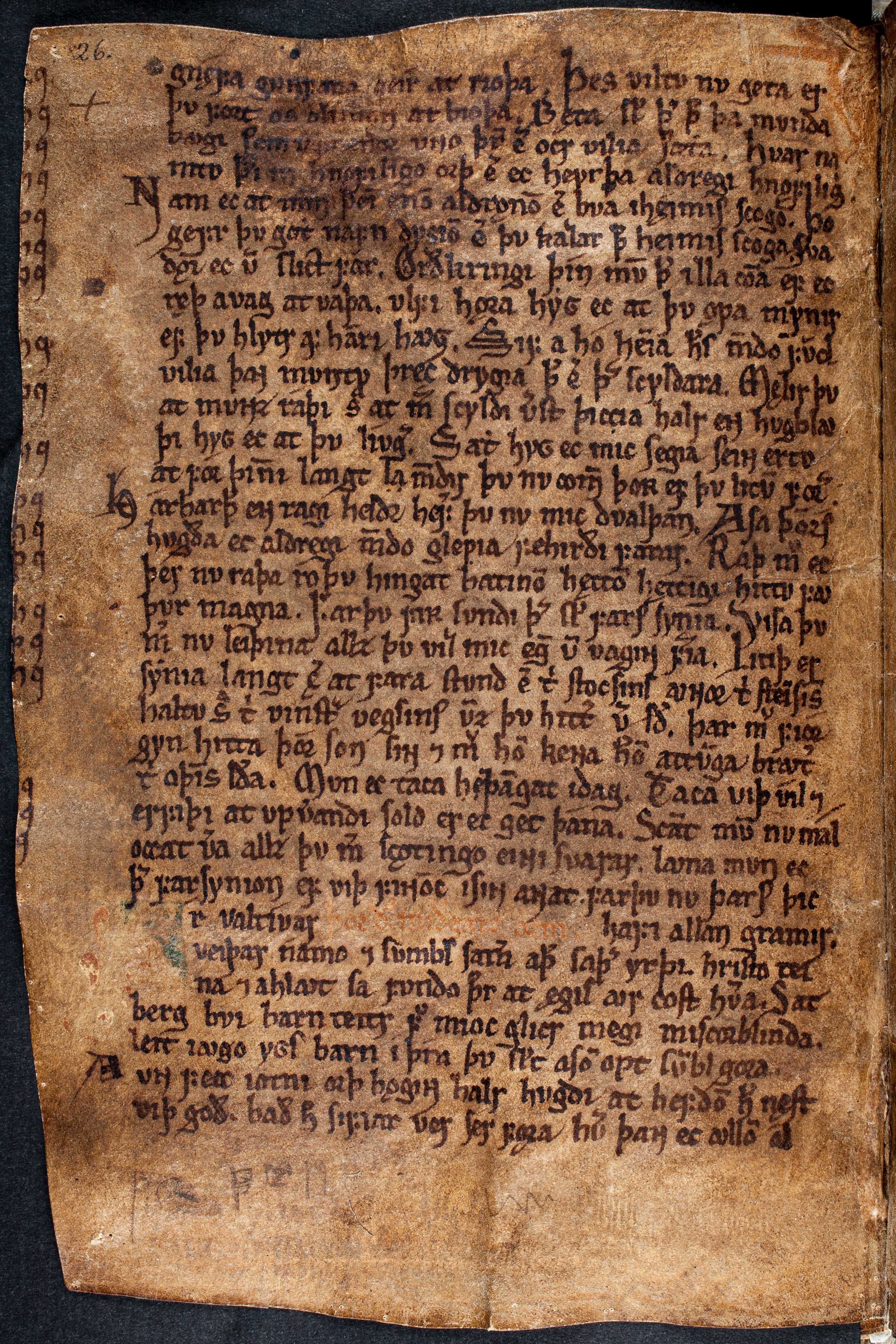
Where on the image
Fol. 13r (manuscript page 25; handrit.is image 34; Wimmer and Jónsson 1891 page 25, caption 'Hárbarðsljóð v. 18-40'): stanzas 19-40 begin here; stanza 40 runs on to fol. 13v. Fol. 13v (manuscript page 26; handrit.is image 35; Wimmer and Jónsson 1891 page 26, caption 'Hárbarðsljóð v. 40 - Hymiskviða v. 3'): the top of the page finishes stanza 40 ('gnæfa gunnfana ...'). Checked on the image: the first line of fol. 13r has 'hjá þeim systrum sjau' (end of Hárbarðsljóð 18); the first line of fol. 13v has 'gnæfa gunnfana' (end of Hárbarðsljóð 40). Diplomatic text: Wimmer and Jónsson 1891, page 25, lines 2-33; page 26, line 1, transcribed from their page images and proofread line by line; they print each manuscript page line for line beside its phototype, so the line breaks shown are the manuscript's.
19Ec ðrap þıaza eɴ þrv́ðmoþga ıotvn. ⟨marg. þ⟩
vpp ec varp ꜹgom allvalða ſonar aþaɴ ıɴ heıða hımın. þav
ero merkı meſt mıɴa verca þꜹ er allır menn ſıþan vm ſe. h. v. m. h. ⟨marg. h⟩
20Mıclar man velar ec haꝼða vıþ myrcrıþoꝛ þa er ec velta þęr
ꝼra verom. harþan ıotvn ec hvgða hlebarð vera gaꝼ hann mer
gambanteın en ec vęlta hann oꝛ vıtı. 21Illom hvga lꜹnaþır þv þa ⟨marg. þ q⟩
goþar gıaꝼar. 22Þat heꝼır eık er aꝼ aɴarı ſceꝼr vm ſıc er hverr ıſlı ⟨marg. h q⟩
co. h. v. m. þ. 23Ec var ꜹſtr oc ıotna barðag brvþır bꜹlvıſar er ⟨marg. þ q⟩
tıl bıargſ gengo mıcıl mvnðı ętt ıotna eꝼ allır lıꝼðı vętr mvnðı ᴍanna
vnðır mıþgarþı. h. v. m. h. 24Var ec avallanðı oc vıgom ꝼylgðag ⟨marg. h q⟩
atta ec ıoꝼrom eɴ alðrı ſęttac. oþıɴ a ıarla e⸌‴⸍ɴ þoʀ þa⸌‴⸍ er ıval ꝼalla.
a þręla kyn. 25Oıaꝼnt ſcıpta er þv mvnðır meþ aſom lıþı eꝼ þv ⟨marg. þ q⟩
ęttır vılgı mıcılſ valð. 26Þoʀ a aꝼl ǫꝛıt eɴ eccı hıarta aꝼ hr- ⟨marg. h q⟩
ǫzlo oc hvgbleyþı þer var ıhaɴᴢca troþıt oc þottıſca þv þa þoʀ
vera. hvarkı þv þa þoꝛþır ꝼyr hrǫzlo þıɴı hn⸌ı⸍oſa ne ꝼíſa sva at
ꝼıalaʀ heyrþı. 27Hárbarþr ıɴ ragı ec mvnða þıc ıhel ðrepa eꝼ ec ⟨marg. þ q⟩
mętta ſeılaz vm ſvnð. 28Hvat ſcylðır þv vm ſvnð ſeılaz er ſakır ⟨marg. h q⟩
ro allz ongar. h. v. þ. þ. 29Ec var ꜹſtr oc ána varþac þa er mıc
ſotto þeır ſvarangſ ſynır. grıotı þeır mıc bꜹrþo gagnı vrþo
þeır þo lıtt ꝼegnır þo vrþo þeır mıc ꝼyʀı ꝼrıþar at bıþıa. h. v. þ.
m. h. 30Ec var ꜹſtr oc vıþ eın hverıa ðǫmþac lęc ec vıþ ena ⟨marg. h q⟩
lınðhvıto oc lꜹng þıng háþac glaððac ena gvllbíoꝛto gamnı
męr vnðı. 31Goð atto þeır man kẏɴı þar þa. H. q. 32Lıþſ þıns ⟨marg. þ⟩
vera ec þa þvrꝼı þoꝛır at ec helða þeırı eɴı lınhvıto mey. 33Ec ⟨marg. þ⟩
mvnða þer þa þat veıta eꝼ ec vıðꝛ ᴏꝼ kǫmız. 34Ec mvnða þer þa trva ⟨marg. h⟩
nema þv mıc ıtrygð vęltır. 35Emkat ec ſa hęlbítr ſem hv́ðſcóꝛ
ꝼoꝛn avár. 36h. v. m. þoʀ. 37Brvðır berſerkıa barþac ıhléſ eyıo ⟨marg. þ⟩
þęr hoꝼðo verſt vɴıt velta þıoþ alla. 38Klękı vantv þa ⟨marg. h⟩
þoʀ er þv akonom barþır. 39Vargynıoꝛ voro þer eɴ varla konoꝛ ⟨marg. þ⟩
ſcelðo ſcıp mıtt er ec ſcoꝛþat haꝼðac ǫgðo mer ıarnlvr
kı eɴ elto þıalꝼa. h. v. m. h. 40Ec varc ıhernom er hıngat
goꝛðız
‖ ⟨marg. þ.q⟩ gnę́ꝼa gv́ɴꝼana geír at rıoþá.
Compare: Normalized text (Guðni Jónsson)
19"Ek drap Þjaza, / inn þrúðmóðga jötun, / upp ek varp augum / Alvalda sonar / á þann inn heiða himin; / þau eru merki mest / minna verka, / þau er allir menn síðan of séa. / Hvat vanntu þá meðan, Hárbarðr?" 20"Miklar manvélar / ek hafða við myrkriður, / þá er ek vélta þær frá verum; / harðan jötun / ek hugða Hlébarð vera, / gaf hann mér gambantein, / en ek vélta hann ór viti." 21"Illum huga / launaðir þú þá góðar gjafar." 22"Þat hefr eik, / er af annarri skefr, / of sik er hverr í slíku. / Hvat vanntu þá meðan Þórr?" 23"Ek var austr / ok jötna barðak / brúðir bölvísar, / er til bjargs gengu; / mikil myndi ætt jötna, / ef allir lifði / vætr myndi manna / undir Miðgarði. / Hvat vanntu þá meðan, Hárbarðr?" 24"Var ek á Vallandi / ok vígum fylgdak, / atta ek jöfrum, / en aldri sættak; / Óðinn á jarla, / þá er í val falla, / en Þórr á þrælakyn." 25"Ójafnt skipta / er þú myndir með ásum liði, / ef þú ættir vilgi mikils vald." 26"Þórr á afl ærit, / en ekki hjarta; / af hræðslu ok hugbleyði / þér var í hanzka troðit, / ok þóttisk-a þú þá Þórr vera; / hvárki þú þá þorðir / fyr hræðslu þinni / hnjósa né físa, / svá at Fjalarr heyrði." 27"Hárbarðr inn ragi, / ek mynda þik í hel drepa, / ef ek mætta seilask um sund." 28"Hvat skyldir um sund seilask, / er sakir ro alls engar? / Hvat vanntu þá, Þórr?" 29"Ek var austr / ok ána varðak, / þá er mik sóttu / þeir Svárangs synir; / grjóti þeir mik börðu, / gagni urðu þeir þó lítt fegnir, / þó urðu þeir mik fyrri / friðar at biðja. / Hvat vanntu þá meðan, Hárbarðr?" 30"Ek var austr / ok við einhverja dæmðak, / lék ek við ina línhvítu / ok launþing háðak; / gladdak ina gullbjörtu, / gamni mær unði." 31"Góð átt þú þér mankynni þar þá." 32"Liðs þíns / væra ek þá þurfi, Þórr, / at ek helda þeiri inni línhvítu mey." 33"Ek munda þér þá þat veita, / ef ek viðr of kæmumk." 34"Ek mynda þér þá trúa, / nema þú mik í tryggð véltir." 35"Emk-at ek sá hælbítr / sem húðskór forn á vár." 36"Hvat vanntu þá meðan, Þórr?" 37"Brúðir berserkja / barðak í Hléseyju; / þær höfðu verst unnit, / vélta þjóð alla." 38"Klæki vanntu þá, Þórr, / er þú á konum barðir." 39"Vargynjur þat váru, / en varla konur, / skelldu skip mitt, / er ek skorðat hafðak, / ægðu mér járnlurki / en eltu Þjalfa. / Hvat vanntu meðan, Hárbarðr?" 40"Ek vark í hernum, / er hingat gerðisk / gnæfa gunnfana, / geir at rjóða."
19Thor. I slew Thiassi, that stout-hearted Jotun: up I cast the eyes of Allvaldi's son into the heaven serene: they are signs the greatest of my deeds. What meanwhile didst thou, Harbard? 20Harbard. Great seductive arts I used against the riders of the night, when from their husbands I enticed them. A mighty Jotun I believed Hlebard to be: a magic wand he gave me, but from his wits I charmed him. 21Thor. With evil mind then thou didst good gifts requitè 22Harbard. One tree gets that which, is from another scraped: each one in such case is for self. What meanwhile didst thou, Thor? 23Thor. In the east I was, and slew the Jotun brides, crafty in evil, as they to the mountain went. Great would have been the Jotun race, had they all lived; and not a man left in Midgard. What meanwhile didst thou, Harbard? 24Harbard. I was in Valland, and followed warfare; princes I excited, but never reconciled. Odin has all the jarls that in conflict fall; but Thor the race of thralls. 25Thor. Unequally thou wouldst divide the folk among the Æsir, if thou but hadst the power. 26Harbard. Thor has strength over-much, but courage none; from cowardice and fear, thou wast crammed into a glove, and hardly thoughtest thou wast Thor. Thou durst not then, through thy terror, either sneeze or cough, lest Fialar it might hear. 27Thor. Harbard, thou wretch! I would strike thee dead, could I but stretch my arm across the sound. 28Harbard. Why wouldst thou stretch thy arm across the sound, when there is altogether no offence? But what didst thou, Thor? 29Thor. In the east I was, and a river I defended, when the sons of Svarang me assailed, and with stones pelted me, though in their success they little joyed: they were the first to sue for peace. What meanwhile didst thou, Harbard? 30Harbard. I was in the east, and with a certain lass held converse; with that fair I dallied, and long meetings had. I that gold-bright one delighted; the game amused her. 31Thor. Then you had kind damsels there? 32Harbard. Of thy aid I had need, Thor! in retaining that maiden lily-fair. 33Thor. I would have given it thee, if I had had the opportunity. 34Harbard. I would have trusted thee, my confidence if thou hadst not betrayed it. 35Thor. I am not such a heel-chafer as an old leather shoe in spring. 36Harbard. What meanwhile didst thou, Thor? 37Thor. The Berserkers' brides I on Læsso cudgeled; they the worst had perpetrated, the whole people, had seduced. 38Harbard. Dastardly didst thou act, Thor! when thou didst cudgel women. 39Thor. She-wolves they were, and scarcely women. They crushed my ship, which with props I had secured, with iron clubs threatened me, and drove away Thialfi. What meanwhile didst thou, Harbard? 40Harbard. I in the army was, which was hither sent, war-banners to raise, lances to redden.
Where on the image
Fol. 13v (manuscript page 26; handrit.is image 35; Wimmer and Jónsson 1891 page 26, caption 'Hárbarðsljóð v. 40 - Hymiskviða v. 3'): stanzas 41-60 begin here. Checked on the image: the first line of fol. 13v has 'gnæfa gunnfana' (end of Hárbarðsljóð 40). Diplomatic text: Wimmer and Jónsson 1891, page 26, lines 1-26, transcribed from their page images and proofread line by line; they print each manuscript page line for line beside its phototype, so the line breaks shown are the manuscript's.
41Þes vıltv nv geta er
⟨marg. h q⟩ þv ꝼóꝛt os óluban at bıoþa. 42Bęta ſcal þer þat þa mvnða
⟨marg. þ q⟩ bꜹ́gı ſem ıaꝼnenðꝛ vɴᴏ þeır er ocr vılıa ſætta. 43Hvar na-
mtv þesı ın hnǫꝼılıgo oꝛþ er ec heyrþa alðregı hnǫꝼılıgrı.
44⟨marg. h q, þ q⟩ Nam ec at monnom þeım enom alðrǫnom er bva ıhę́ımıſ ſcogom. 45Þo
⟨marg. h q⟩ geꝼr þv gott naꝼn ðýſıom er þv kallar þat heımıſ ſcóga. 46Sva
⟨marg. þ q⟩ ðǫmı ec vm ſlıct ꝼar. 47Orðkrıngı þín mvn þer ılla coma eꝼ ec
ręþ avag at vaþa. vlꝼı hǫꝛa hẏɢ ec at þv ǫpa mynır
⟨marg. h q.⟩ eꝼ þv hlytr aꝼ hamrı hꜹɢ. 48Sıꝼ a hó heıma hanſ mvnðo ꝼvnd
⟨marg. þ q⟩ vılıa þaɴ mvntv þrec ðrygıa þat er þer ſcylðara. 49Męlır þv
at mvɴᴢ ráþı sva at mer ſcylðı verſt þıccıa halr eɴ hvgblꜹ
⟨marg. h q⟩ þı hyɢ ec at þv lívgır. 50Satt hyɢ ec mıc ſegıa ſeıɴ ertv
at ꝼóꝛ þınnı langt ḷạ mvnðır þv nv comınn þoʀ eꝼ þv lıtvm ꝼǫꝛır.
51⟨marg. þ q, h q⟩ Hárbarþr eɴ ragı helðꝛ heꝼır þv nv mıc ðvalþan. 52Aſa þóꝛſ
⟨marg. þ q⟩ hvgða ec alðregı mvnðo glepıa ꝼehırðı ꝼarar. 53Raþ mvn ec
þer nv raþa ró þv hıngat batınom hęttom hęttıngı hıttv ꝼꜹ
⟨marg. h q, þ q⟩ þvr magna. 54Farþv ꝼıʀ ſvnðı þer ſcal ꝼarſ ſýnıa. 55Vıſa þv
⟨marg. h q⟩ mer nv leıþına allz þv vıll mıc eıgı vm vagıɴ ꝼerıa. 56Lıtıþ er
ſýnıa langt ęr at ꝼara ſtvnð er tıl ſtocſınſ ꜹɴᴏꝛ tıl ſteınſıns
haltv sva tıl vınſtra vegſınſ vnz þv hıttır ver lanð. þar mvn ꝼıóꝛ
gyn hıtta þóꝛ ſon ſıɴ oc mvn hon keɴa hanom attvnga brꜹtır
⟨marg. q, q⟩ tıl oþıns lanða. 57Mvn ec taca ḥẹþangat ıðag. 58Taca vıþ víl oc
⟨marg. q⟩ erꝼıþı at vp veranðı ſolo er ec get þána. 59Scamt mvn nv mál
occat vera allz þv mer ſcǫtıngo eıɴı ſvarar. lꜹna mvn ec
þer ꝼarſynıon eꝼ vıþ ꝼıɴᴏmc ıſıɴ aɴat. 60ꝼarþv nv þarſ þıc
haꝼı allan gramır.
Compare: Normalized text (Guðni Jónsson)
41"Þess viltu nú geta, / er þú fórt oss óljúfan at bjóða." 42"Bæta skal þér þat þá / munda baugi, / sem jafnendr unnu, / þeir er okkr vilja sætta." 43"Hvar namtu þessi / in hnæfiligu orð, / er ek heyrða aldregi / in hnæfiligri?" 44"Nam ek at mönnum / þeim inum aldrænum, / er búa í heimis skógum." 45"Þó gefr þú gott nafn dysjum, / er þú kallar þær heimis skóga." 46"Svá dæmi ek of slíkt far." 47"Orðkringi þín / mun þér illa koma, / ef ek ræð á vág at vaða; / ulfi hæra / hygg ek þik æpa munu, / ef þú hlýtr af hamri högg." 48"Sif á hó heima, / hans muntu fund vilja, / þann muntu þrek drýgja, / þat er þér skyldara." 49"Mælir þú at munns ráði, / svá at mér skyldi verst þykkja, / halr inn hugblauði, / hygg ek, at þú ljúgir." 50"Satt hygg ek mik segja; / seinn ertu at för þinni, / langt myndir þú nú kominn, Þórr, / ef þú litum færir." 51"Hárbarðr inn ragi, / heldr hefr þú nú mik dvalðan." 52"Ása-þórs hugða ek / aldregi mundu / glepja féhirði farar." 53"Ráð mun ek þér nú ráða; / ró þú hingat bátinum, / hættum hætingi, / hittu föður Magna." 54"Farðu firr sundi, / þér skal fars synja." 55"Vísa þú mér nú leiðina, / alls þú vill mik eigi um váginn ferja." 56Lítit er at synja, / langt er at fara; / stund er til stokksins, / önnur til steinsins, / haltu svá til vinstra vegsins, / unz þú hittir Verland; / þar mun Fjörgyn / hitta Þór, son sinn, / ok mun hon kenna hánum áttunga brautir / til Óðins landa." 57"Mun ek taka þangat í dag?" 58"Taka við víl ok erfiði, / at upprennandi sólu, / er ek get þána." 59"Skammt mun nú mál okkat, / alls þú mér skætingu einni svarar; / launa mun ek þér farsynjun, / ef vit finnumk í sinn annat." 60"Far þú nú, / þars þik hafi allan gramir."
41Thor. Of that thou now wilt speak, as thou wentest forth us hard terms to offer. 42Harbard. That shall be indemnified by a hand-ring, such as arbitrators give, who wish to reconcile us. 43Thor. Where didst thou learn words than which I never heard more irritating? 44Harbard. From men I learned them, from ancient men, whose home is in the woods. 45Thor. Thou givest certainly a good name to grave-mounds, when thou callest them, homes in the woods. 46Harbard. So speak I of such a subject. 47Thor. Thy shrewd words will bring thee evil, if I resolve the sound to ford. Louder than a wolf thou wilt howl, I trow, if of my hammer thou gettest a touch. 48Harbard. Sif has a gallant at home; thou wilt anxious be to find him: thou shalt that arduous work perform; it will beseem thee better. 49Thor. Thou utterest what comes upmost, so that to me it be most annoying, thou dastardly varlet! I believe thou art lying. 50Harbard. I believe I am telling truth. Thou art travelling slowly; thou wouldst have long since arrived, hadst thou assumed another form. 51Thor. Harbard! thou wretch! rather is it thou who hast detained me. 52Harbard. I never thought that a ferryman could the course of Asa-Thor retard. 53Thor. One advice I now will give thee: row hither with thy boat; let us cease from threats; approach the sire of Magni. 54Harbard. Go farther from the sound, the passage is refused thee. 55Thor. Show me then the way, if thou wilt not ferry me across the water. 56Harbard. That's too little to refuse. 'Tis far to go; 'tis to the stock an hour, and to the stone another; then keep the left hand way, until thou reachest Verland; there will Fiorgyn find her son Thor, and point out to him his kinsmen's ways to Odin's land. 57Thor. Can I get there to-day? 58Harbard. With pain and toil thou mayest get there, while the sun is up, which, I believe, is now nigh. 59Thor. Our talk shall now be short, as thou answerest with scoffing only. For refusing to ferry me I will reward thee, if another time we meet. 60Harbard. Just go to where all the powers of evil may have thee.
Notes
- The Gutenberg text of Thorpe misprints stanza 26 as '36' and stanza 29 as '39'; here his stanzas are matched in order, which restores two stanzas the old version of this entry had dropped or misplaced.
Cite
Sources
- Source: Codex Regius (GKS 2365 4to) page images via handrit.is + Wimmer and Jónsson's 1891 diplomatic text + Guðni Jónsson's normalized Old Norse via heimskringla.no + Thorpe (1866) English (holding institution)
- Critical edition: Diplomatic text of Codex Regius, Wimmer and Finnur Jónsson 1891; normalized text (Guðni Jónsson) for comparison
← previous · → next · v cycle view · l back to library