Hymiskviða
Introduction
Hymiskviða from the Poetic Edda, preserved in Codex Regius (GKS 2365 4to, c. 1270). 5 sections across 4 distinct manuscript pages.
How was this verified? (Provenance)
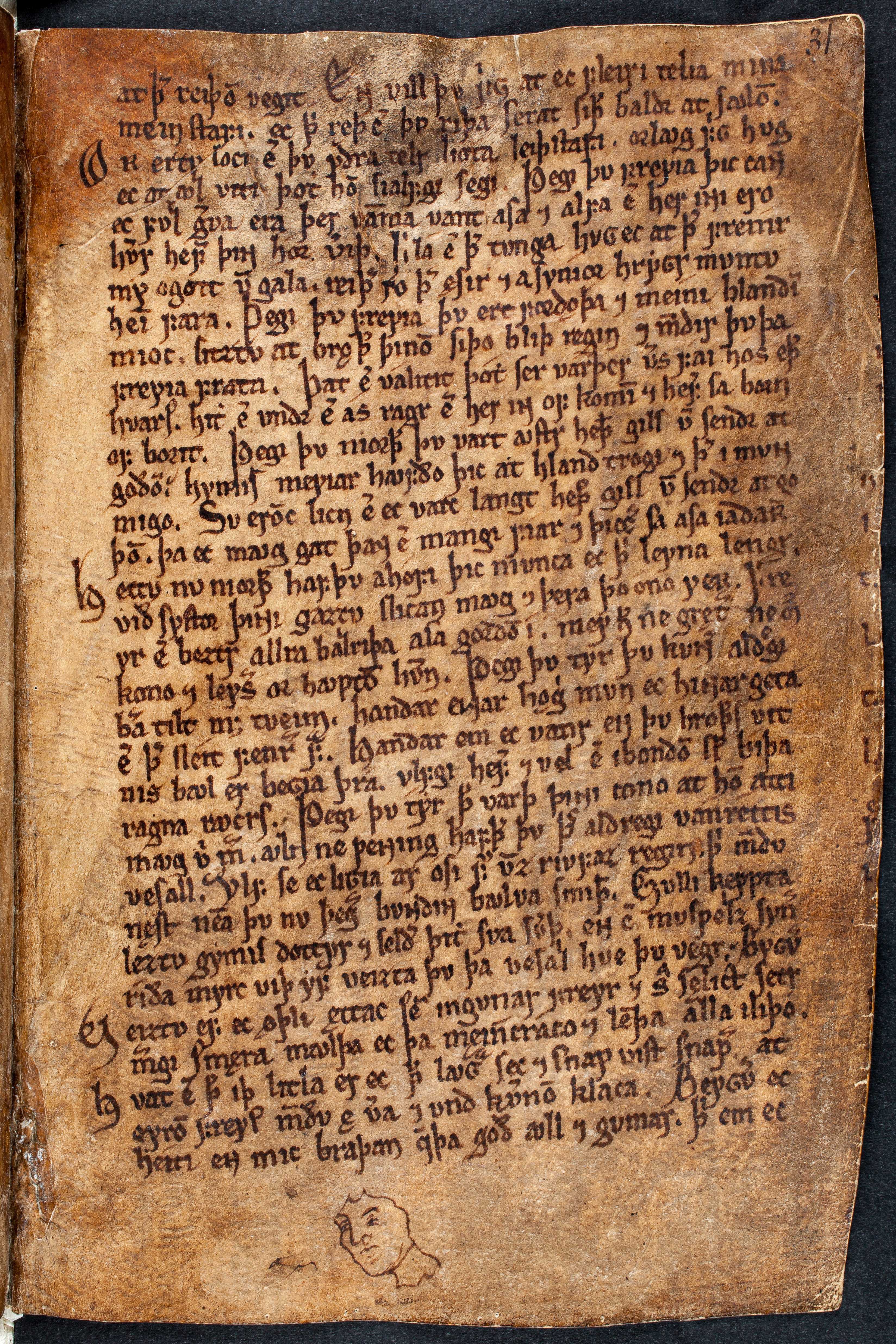
1Ár valtívar / veiðar námu / ok sumblsamir, / áðr saðir yrði, / hristu teina / ok á hlaut sáu; / fundu þeir at Ægis / örkost hvera. 2Sat bergbúi / barnteitr fyr / mjök glíkr megi / miskorblinda; / leit í augu / Yggs barn í þrá: / "Þú skalt ásum / oft sumbl gera." 3Önn fekk jötni / orðbæginn halr, / hugði at hefndum / hann næst við goð, / bað hann Sifjar ver / sér færa hver, - / "þanns ek öllum öl / yðr of heita." 4Né þat máttu / mærir tívar / ok ginnregin / of geta hvergi, / unz af tryggðum / Týr Hlórriða / ástráð mikit / einum sagði: 5"Býr fyr austan / Élivága / hundvíss Hymir / at himins enda; / á minn faðir / móðugr ketil, / rúmbrugðinn hver, / rastar djúpan." 6"Veiztu ef þiggjum / þann lögvelli?" / "Ef, vinr, vélar / vit gervum til." 7Fóru drjúgum / dag þann fram / Ásgarði frá, / unz til Egils kvámu; / hirði hann hafra / horngöfgasta; / hurfu at höllu, / er Hymir átti. 8Mögr fann ömmu / mjök leiða sér, / hafði höfða / hundruð níu, / en önnur gekk / algullin fram / brúnhvít bera / bjórveig syni: / 9. "Áttniðr jötna, / ek viljak ykkr / hugfulla tvá / und hvera setja; / er minn fríi / mörgu sinni / glöggr við gesti, / görr ills hugar."
1Once the celestial gods had been taking fish, and were in compotation, ere they the truth discovered. Rods they shook, and blood inspected, when they found at Oegir's a lack of kettles. 2Sat the rock-dweller glad as a child, much like the son of Miskorblindi. In his eyes looked Ygg's son steadfastly. "Thou to the Æsir shalt oft a compotation give." 3Caused trouble to the Jotun th' unwelcome-worded As: he forthwith meditated vengeance on the gods. Sif's husband he besought a kettle him to bring, "in which I beer for all of you may brew." 4The illustrious gods found that impossible, nor could the exalted powers it accomplish, till from true-heartedness, Ty to Hlorridi much friendly counsel gave. 5"There dwells eastward of Elivagar the all-wise Hymir, at heaven's end. My sire, fierce of mood, a kettle owns, a capacious cauldron, a rast in depth." _Thor_. 6"Knowest thou whether we can get the liquor-boiler?" _Ty_. "Yes, friend! if we stratagem' employ." Rapidly they drove forward that day from Asgard, till to the giant's home they came. 7Thor stalled his goats, splendid of horn, then turned him to the hall that Hymir owned. The son his granddam found to him most loathful; heads she had nine hundred. 8But another came all-golden forth, fair-browed, bearing the beer-cup to her son: 9"Ye Jotuns' kindred! I will you both, ye daring pair, under the kettles place. My husband is oftentimes niggard towards guests, to ill-humour prone."
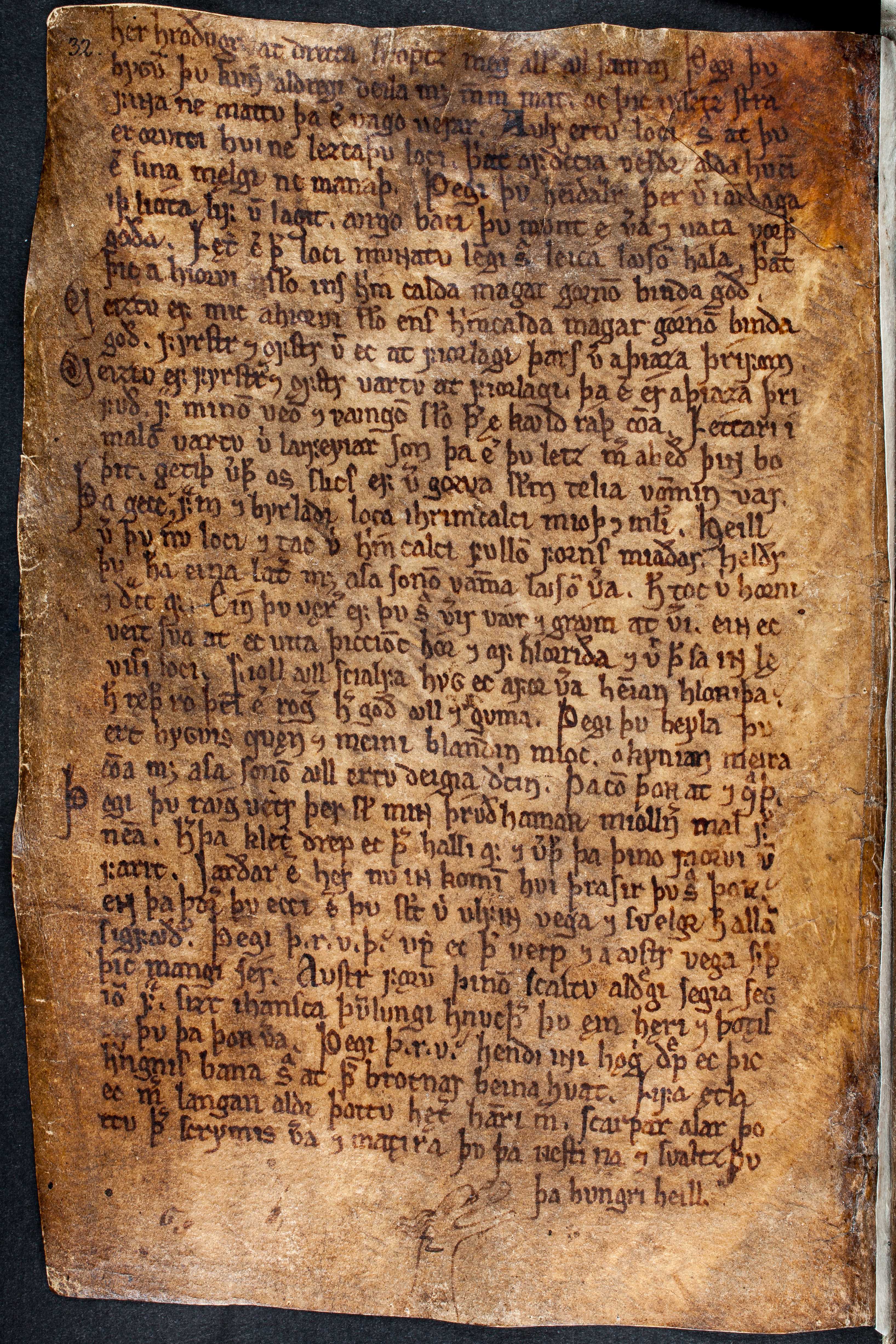
10En váskapaðr / varð síðbúinn / harðráðr Hymir / heim af veiðum, / gekk inn í sal, / glumðu jöklar, / var karls, en kom, / kinnskógr frörinn. 11"Ver þú heill, Hymir, / í hugum góðum, / nú er sonr kominn / til sala þinna, / sá er vit vættum / af vegi löngum; / fylgir hánum / hróðrs andskoti, / vinr verliða; / Véurr heitir sá. 12Sé þú, hvar sitja / und salar gafli, / svá forða sér, / stendr súl fyrir." / Sundr stökk súla / fyr sjón jötuns, / en áðr í tvau / áss brotnaði. 13Stukku átta, / en einn af þeim / hverr harðsleginn / heill af þolli; / fram gengu þeir, / en forn jötunn / sjónum leiddi / sinn andskota. 14Sagði-t hánum / hugr vel þá, / er hann sá gýgjar græti / á golf kominn, / þar váru þjórar / þrír of teknir, / bað senn jötunn / sjóða ganga. 15Hvern létu þeir / höfði skemmra / ok á seyði / síðan báru; / át Sifjar verr, / áðr sofa gengi, / einn með öllu / öxn tvá Hymis. 16Þótti hárum / Hrungnis spjalla / verðr Hlórriða / vel fullmikill: / "Munum at aftni / öðrum verða / við veiðimat / vér þrír lifa." 17Véurr kvaðzk vilja / á vág róa, / ef ballr jötunn / beitr gæfi. / "Hverf þú til hjarðar, / ef þú hug trúir, / brjótr berg - Dana, / beitur sækja. 18Þess vænti ek, / at þér myni-t / ögn af oxa / auðfeng vera." / Sveinn sýsliga / sveif til skógar, / þar er uxi stóð / alsvartr fyrir.
10But the monster, the fierce-souled Hymir, late returned home from the chase. He the hall entered, the icebergs resounded, as the churl approached; the thicket on his cheeks was frozen. 11"Hail to thee, Hymir! be of good cheer: now thy son is come to thy hall, whom we expected from his long journey; him accompanies our famed adversary, the friend of man, who Veor hight. 12See where they sit under the hall's gable, as if to shun thee: the pillar stands before them." In shivers flew the pillar at the Jotun's glance; the beam was first broken in two. 13Eight kettles fell, but only one of them, a hard-hammered cauldron, whole from the column. The two came forth, but the old Jotun with eyes surveyed his adversary. 14Augured to him his mind no good, when he saw the giantess's sorrow on the floor coming. Then were three oxen taken, and the Jotun bade them forthwith be boiled. 15Each one they made by the head shorter, and to the fire afterwards bore them. Sif's consort ate, ere to sleep he went, completely, he alone, two of Hymir's beeves. 16Seemed to the hoary friend of Hrungnir Hlorridi's refection full well large: "We three to-morrow night shall be compelled on what we catch to live." 17Veor said he would on the sea row, if the bold Jotun him would with baits supply: "To the herd betake thee, (if thou in thy courage trustest, crusher of the rock-dwellers!) for baits to seek. 18I expect that thou wilt bait from an ox easily obtain." The guest in haste to the forest went, where stood an all-black ox before him.
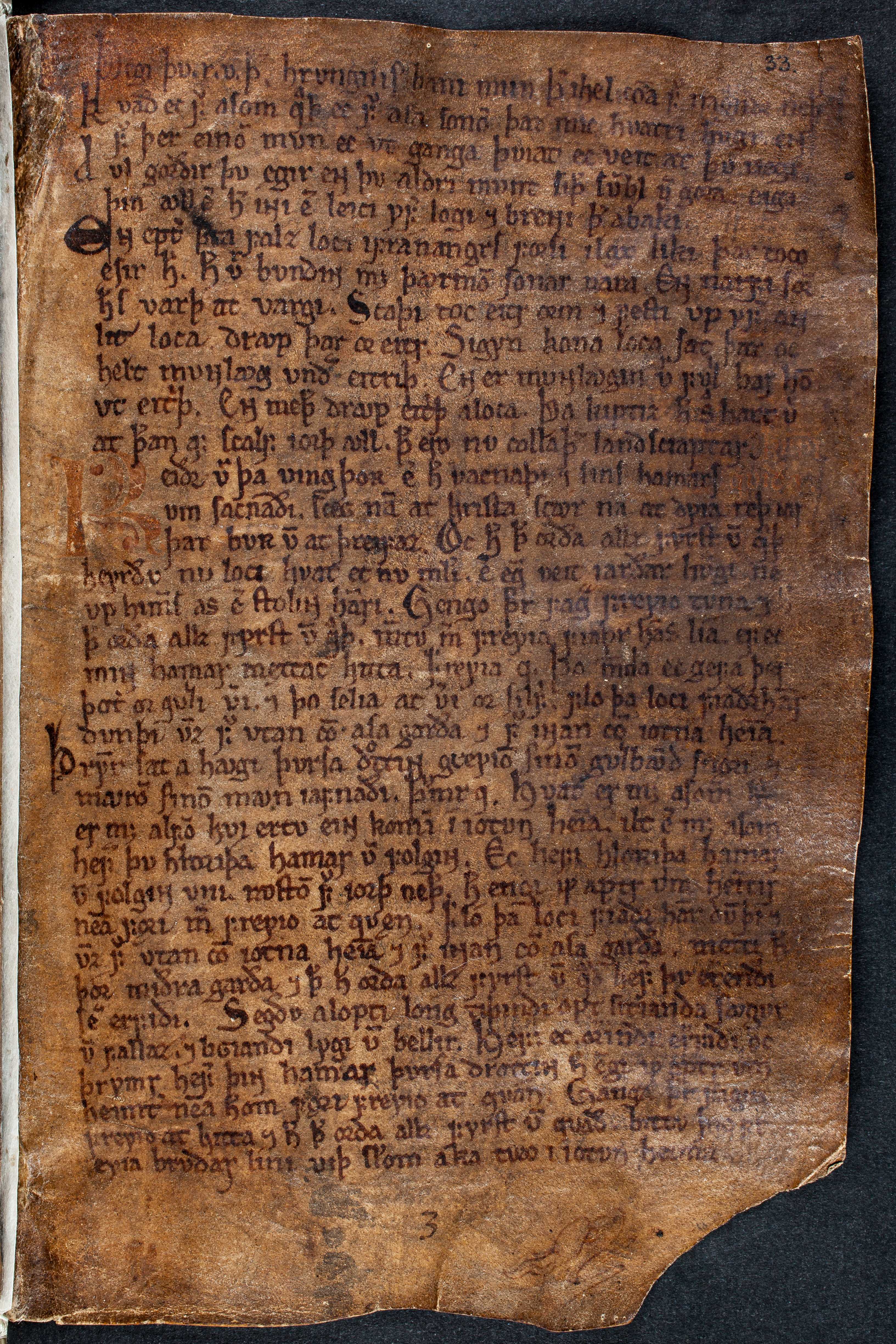
19Braut af þjóri / þurs ráðbani / hátún ofan / horna tveggja. / "Verk þykkja þín / verri miklu / kjóla valdi / en þú kyrr sitir." 20Bað hlunngota / hafra dróttinn / áttrunn apa / útar færa, / en sá jötunn / sína talði / lítla fýsi / at róa lengra. 21Dró meir Hymir / móðugr hvali / einn á öngli / upp senn tváa, / en aftr í skut / Óðni sifjaðr / Véurr við vélar / vað gerði sér. 22Egndi á öngul, / sá er öldum bergr, / orms einbani / uxa höfði; / gein við agni, / sú er goð fía, / umgjörð neðan / allra landa. 23Dró djarfliga / dáðrakkr Þórr / orm eitrfáan / upp at borði; / hamri kníði / háfjall skarar / ofljótt ofan / ulfs hnitbróður. 24Hraungalkn hlumðu, / en hölkn þutu, / fór in forna / fold öll saman; / sökkðisk síðan / sá fiskr í mar. 25Óteitr jötunn, / er aftr reru, / svá at ár Hymir / ekki mælti, / veifði hann ræði / veðrs annars til. 26"Mundu of vinna / verk halft við mik, / at þú heim hvali / haf til bæjar / eða flotbrúsa / festir okkarn." 27Gekk Hlórriði, / greip á stafni / vatt með austri / upp lögfáki, / einn með árum / ok með austskotu / bar hann til bæjar / brimsvín jötuns / ok holtriða / hver í gegnum.
19The Thursar's bane wrung from an ox the high fastness of his two horns. "To me thy work seems worse by far, ruler of keels! than if thou hadst sat quiet." 20The lord of goats the apes' kinsman besought the horse of plank farther out to move; but the Jotun declared his slight desire farther to row. 21The mighty Hymir drew, he alone, two whales up with his hook; but at the stern abaft Veor cunningly made him a line. 22Fixed on the hook the shield of men, the serpent's slayer, the ox's head. Gaped at the bait the foe of gods, the encircler beneath of every land. 23Drew up boldly the mighty Thor the worm with venom glistening, up to the side; with his hammer struck, on his foul head's summit, like a rock towering, the wolf's own brother. 24The icebergs resounded, the caverns howled, the old earth shrank together: at length the fish back into ocean sank. 25The Jotun was little glad, as they rowed back, so that the powerful Hymir nothing spake, but the oar moved in another course. 26"Wilt thou do half the work with me, either the whales home to the dwelling bear, or the boat fast bind?" 27Hlorridi went, grasped the prow, quickly, with its hold-water, lifted the water-steed, together with its oars and scoop; bore to the dwelling the Jotun's ocean-swine, the curved vessel, through the wooded hills.
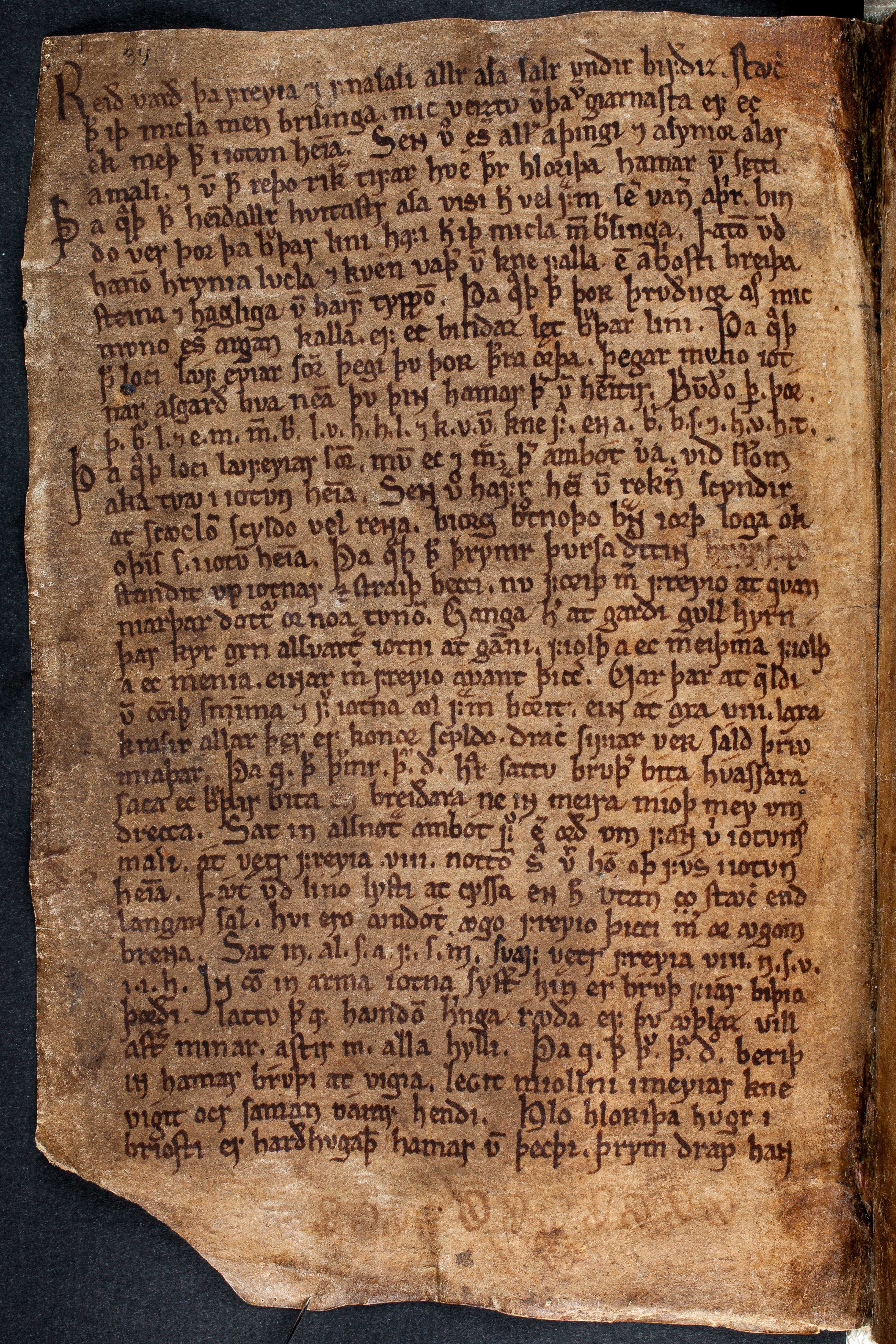
28Ok enn jötunn / um afrendi, / þrágirni vanr, / við Þór sennti, / kvað-at mann ramman, / þótt róa kynni / kröfturligan, / nema kálk bryti. 29En Hlórriði, / er at höndum kom, / brátt lét bresta / brattstein gleri; / sló hann sitjandi / súlur í gögnum; / báru þó heilan / fyr Hymi síðan. 30Unz þat in fríða / frilla kenndi / ástráð mikit, / eitt er vissi: / "Drep við haus Hymis, / hann er harðari, / kostmóðs jötuns / kálki hverjum." 31Harðr reis á kné / hafra dróttinn, / færðisk allra / í ásmegin; / heill var karli / hjalmstofn ofan, / en vínferill / valr rifnaði. 32"Mörg veit ek mæti / mér gengin frá, / er ek kálki sé / ór knéum hrundit;" / karl orð of kvað: / "knákat ek segja / aftr ævagi, / þú ert, ölðr, of heitt. 33Þat er til kostar, / ef koma mættið / út ór óru / ölkjól hofi." / Týr leitaði / tysvar hræra; / stóð at hváru / hverr kyrr fyrir. 34Faðir Móða / fekk á þremi / ok í gegnum steig / golf niðr í sal; / hóf sér á höfuð upp / hver Sifjar verr, / en á hælum / hringar skullu. 35Fóru-t lengi, / áðr líta nam / aftr Óðins sonr / einu sinni; / sá hann ór hreysum / með Hymi austan / folkdrótt fara / fjölhöfðaða. 36Hóf hann sér af herðum / hver standanda, / veifði hann Mjöllni / morðgjörnum fram, / ok hraunhvala / hann alla drap.
28But the Jotun yet ever frowned, to strife accustomed, with Thor disputed, said that no one was strong, however vigorously he might row, unless he his cup could break. 29But Hlorridi, when to his hands it came, forthwith brake an upright stone in twain; sitting dashed the cup through the pillars: yet they brought it whole to Hymir back. 30Until the beauteous woman gave important, friendly counsel, which she only knew: "Strike at the head of Hymir, the Jotun with food oppressed, that is harder than any cup." 31Rose then on his knee the stern lord of goats, clad in all his godlike power. Unhurt remained the old man's helm-block, but the round wine-bearer was in shivers broken. 32"Much good, I know, has departed from me, now that my cup I see hurled from my knees." Thus the old man spake: "I can never say again, beer thou art too hot. 33"Now 'tis to be tried if ye can carry the beer-vessel out of our dwelling." Ty twice assayed to move the vessel, yet at each time stood the kettle fast. 34Then Modi's father by the brim grasped it, and trod through the dwelling's floor. Sif's consort lifted the kettle on his head, while about his heels its rings jingled. 35They had far journeyed before Odin's son cast one look backward: he from the caverns saw, with Hymir from the east, a troop of many-headed monsters coming. 36From his shoulders he lifted the kettle down; Miollnir hurled forth towards the savage crew, and slew all the mountain-giants, who with Hymir had him pursued.
37Fóru-t lengi, / áðr liggja nam / hafr Hlórriða / halfdauðr fyrir; / var skær skökuls / skakkr á beini, / en því inn lævísi / Loki of olli. 38En ér heyrt hafið, - / hverr kann of þat / goðmálugra / görr at skilja? - / hver af hraunbúa / hann laun of fekk, / er hann bæði galt / börn sín fyrir. 39Þróttöflugr kom / á þing goða / ok hafði hver, / þanns Hymir átti; / en véar hverjan / vel skulu drekka / ölðr at Ægis / eitt hörmeitið.
37Long they had not journeyed when of Hlorridi's goats one lay down half-dead before the car. It from the pole had sprung across the trace; but the false Loki was of this the cause. 38Now ye have heard,--for what fabulist can more fully tell--what indemnity he from the giant got: he paid for it with his children both. 39In his strength exulting he to the gods' council came, and had the kettle, which Hymir had possessed, out of which every god shall beer with Oegir drink at every harvest-tide.
Cite
Source & Cross-References
- Source text: Codex Regius (GKS 2365 4to) via handrit.is + heimskringla.no + Thorpe (PG #14726) — view original
- Critical edition: Codex Regius (GKS 2365 4to)
← previous · → next · v cycle view · l back to library