Lokasenna
Introduction
Lokasenna is preserved in the Codex Regius of the Poetic Edda (GKS 2365 4to, Árni Magnússon Institute, Reykjavík), an Icelandic parchment book written about 1270. The poem fills fol. 15r-17r (manuscript pages 29-33).
Pages: each section holds the stanzas that begin on one manuscript page and links that page's photograph (handrit.is); a stanza that runs onto the next page links both pages. The page of every stanza comes from Wimmer and Finnur Jónsson's 1891 diplomatic edition, which prints the text of each manuscript page, and the first line of every page was checked on the photograph. 'Where on the image' under each section gives the details.
Texts: the first Old Norse text is the manuscript's own text, letter by letter, from the diplomatic transcription of Wimmer and Finnur Jónsson (1891), which prints each page line for line: line breaks are the manuscript's, ‖ marks a new page, letters in italics are supplied where the scribe abbreviated, and special letters are kept (ſ long s, ꝛ round r, ꝼ insular f, ı dotless i, ꜹ the av ligature, ǫ and ę with hooks, ᛘ the rune for maðr, small capitals for the scribe's small capitals). The manuscript writes the poem as continuous lines without stanza breaks; the stanza numbers (Guðni Jónsson's) are inserted where each stanza begins and do not appear in the manuscript. Letters with a dot below are marked for deletion in the manuscript; letters between ⸌ and ⸍ are written above the line, and ⟨marg. ...⟩ gives what Wimmer and Jónsson print in the margin (corrections, and in Vafþrúðnismál the speaker marks o, v, q). The manuscript's prose (the prose before and after the poem, the prose links between speeches, the red titles and speaker notes such as 'Freyıa q.', Freyja said) is shown where it stands, marked 'prose'; where verse goes on after such a piece inside a stanza, the stanza number is repeated with 'cont.'. Thorpe's English for the prose is given at the same place where he translates it; he gives the speaker notes as the speaker's name before the stanza. The second text is Guðni Jónsson's normalized edition (via heimskringla.no), a reading text in modern spelling; in places it adds words or lines from other manuscripts and follows modern editions where they rearrange stanzas. The English is Benjamin Thorpe's 1866 translation (public domain).
How was this verified? (Provenance)


Where on the image
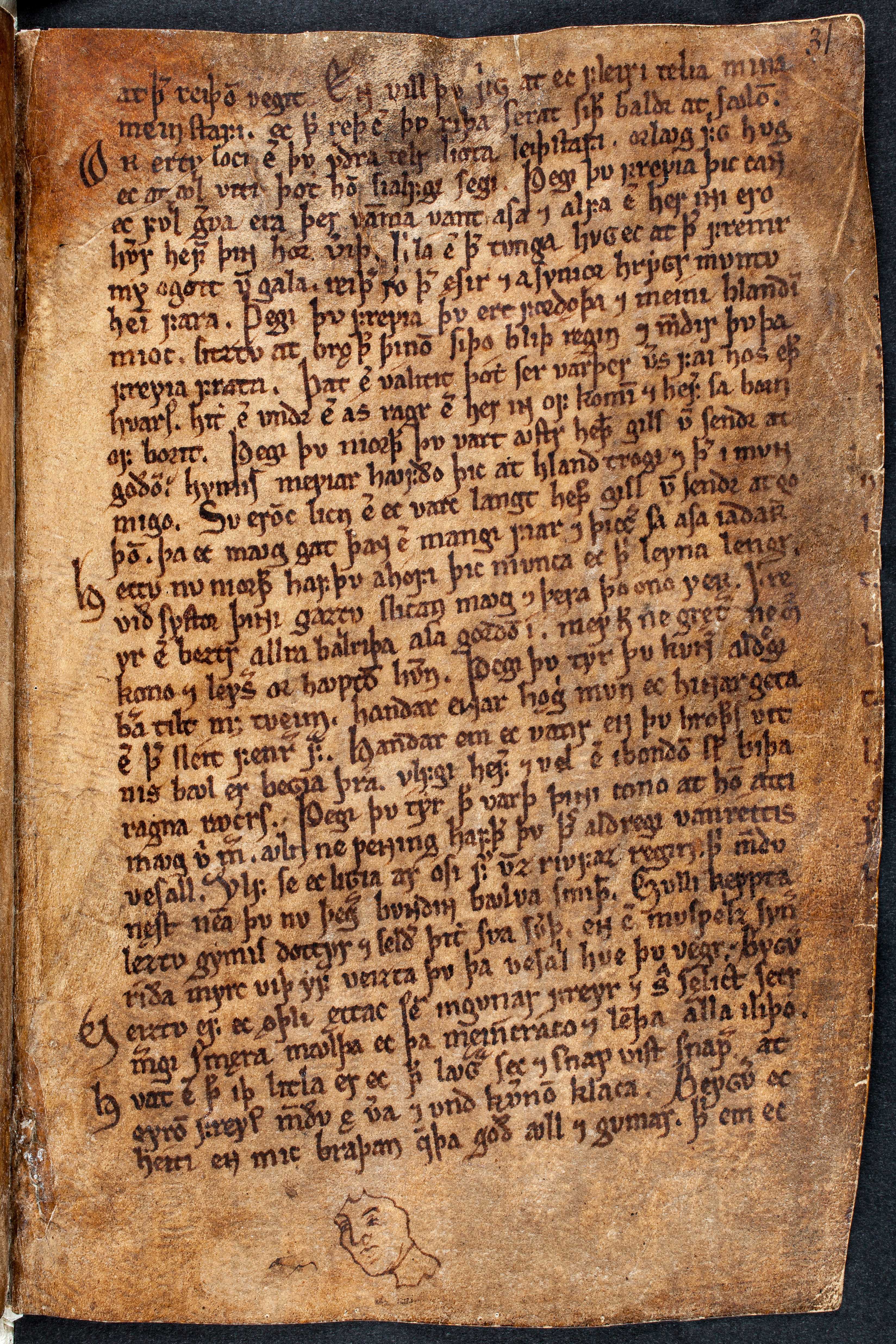
Fol. 15r (manuscript page 29; handrit.is image 38; Wimmer and Jónsson 1891 page 29, caption 'Hymiskviða v. 38 - Lokasenna v. 10'): stanza 1 is lower on the page (the first line belongs to the end of Hymiskviða 38); stanzas 1-10 begin here; stanza 10 runs on to fol. 15v. Fol. 15v (manuscript page 30; handrit.is image 39; Wimmer and Jónsson 1891 page 30, caption 'Lokasenna v. 10-27'): the top of the page finishes stanza 10 ('sitja sumbli at ...'). Checked on the image: the first line of fol. 15r has 'er hann bæði galt' (end of Hymiskviða 38); the first line of fol. 15v has 'sitja sumbli at' (end of Lokasenna 10). The manuscript's prose in this section is shown in its place and marked 'prose': the prose before the poem, with its title (ꝼra ęgı oc goðvm) and the first half of the title Lokasenna (Wimmer and Jónsson 1891 page 29, lines 3-16); the prose on Loki entering the hall (Wimmer and Jónsson 1891 page 29, lines 25-27). Thorpe's English for it is given at the same place ('Oegir, who is also named Gymir ...'; 'Loki then went into the hall ...'). Diplomatic text: Wimmer and Jónsson 1891, page 29, lines 3-34; page 30, line 1, transcribed from their page images and proofread line by line; they print each manuscript page line for line beside its phototype, so the line breaks shown are the manuscript's.
proseEgır,⸌er⸍ ꜹðro naꝼı ꝼra ęgı oc goðvm
het gẏ́mır hann haꝼðı bvıt aſom ꜹl þa er hann haꝼðı ꝼengıt
ketıl ıɴ mıcla ſem nv er ſagt. Tıl þeırar veızlo com oþınn
oc ꝼʀıɢ kona hanſ. Þoꝛır com eıgı þvıat hann var ıꜹſtr vegı. Sıꝼ var þar
kona þóꝛſ. Bragı,⸌oc⸍ıþvɴ kona hanſ. Tyr var þar hann var eınhenðꝛ
ꝼenrıſ vlꝼr ſleıt hꜹnð aꝼ hanom. þa er hann var bvɴðıɴ. Þar var nıoꝛþr
oc kona hanſ ſcaðı. Freyr oc ꝼreẏ́ıa. Uıðaʀ ſon oþıns. lokı var þar.
Oc þıonvſto menn ꝼreyſ. beyɢᴠır oc beyla. Mart var þar aſa oc alꝼa.
Ęgır attı tva þıonvſto menn ꝼımaꝼengr oc elðer. þar var lyſı gvll
haꝼt ꝼyr elðz lıós. Sıalꝼt barſc þar ꜹ́l. þar var grıþa ſtaðr
mıcıll. Meɴ loꝼoðo mıoc hverſo goðır þıonvſto menn egıſ voꝛo.
Lokı mattı eıgı heyra þat. oc ðrap hann ꝼımaꝼeng. þa ſcóco ęſır ſcıol
ðo ſına oc ǫpþo at loca. oc elto hann brꜹt tıl ſcogar. eɴn þeır ꝼoꝛo
at ðrecca. Locı hvarꝼ aptr oc hıttı vtı elðı locı qvaðı hann. loka
1Segðv þat elðır ſva at þv eınvgı ꝼetı gangır ꝼramaʀ. ſeɴa
hvat her ıɴı haꝼa at ꜹ́lmálom ſıgtıꝼa ſynır. 2Oꝼ vapn ⟨marg. e.⟩
ſíɴ ðǫma oc vm vıgrıſnı ſına ſıgtıꝼa ſynır. aſa oc alꝼa er
her ıɴı ero mangı er þer ıoꝛðı vınr. 3Iɴ ſcal ganga ęgıs hallır ⟨marg. l.q⟩
ı aþat ſvmb⸌ı⸍,at ſıá. [ḥṛọp̣]ıoll oc áꝼo ꝼǫꝛı ec aſa ſonom oc blenð ec
þeım sva meını míoþ. 4Ueıztv eꝼ þv ıɴ gengr ęgıſ hallır í á þat ⟨marg. e.q⟩
ſvmbl at ſıa. hropı oc rógı eꝼ þv eýs a(h)oll regın aþer mvno þav
þeʀa þat. 5Ueıztv þat elðır eꝼ vıð eınır ſcolom ſár yrðom ſacaz. ꜹþ ⟨marg. l.q⟩
ıgr verþa mvn ec ı anðſvoꝛom eꝼ þv męlır tıl mart. proseSıþan gecc
locı ıɴ ı hꜹllına. Eɴ er þeır ſa er ꝼyr voro hverr ıɴ var komıɴ þꜹg
noþo þeır allır. 6Þyrſtr ec com þesar hallar tıl loptr vm langan ⟨marg. l.q⟩
veg. aſo at bıþıa at mer eıɴ geꝼı męran ðrẏcc mıaðar. 7hvı
þęgıt er ſva þrvngın goð at þer męla ne megoð. ſeſſa ocſta
þı velıð mer ſvmblı at eða heıtıþ mıc heþan 8Seſſa oc ſtaðı ⟨marg. bra⟩
velıa þer. ſvmblı at ęſır alðregı. þvıat ęſır vıto hveım þeır alða
ſcolo gamban ſvmb⸌ı⸍,vm geta. 9Mantv þat oþıɴ er vıð ıarðaga
blenðom bloþı ſaman. ꜹlvı bergıa letztv eıgı mvnðo nema
ocr verı baþom boꝛıt. 10Rıſtv þa vıþaʀ oc lat vlꝼſ ꝼꜹþvr
‖ ſıtıa ſumblı at. ſıþr os locı qveþı laſta ſtꜹꝼom ęgıſ hꜹllo í.
Compare: Normalized text (Guðni Jónsson)
1"Segðu þat, Eldir, / svá at þú einugi / feti gangir framar, / hvat hér inni / hafa at ölmálum / sigtíva synir." 2"Of vápn sín dæma / ok um vígrisni sína / sigtíva synir; / ása ok alfa / er hér inni eru, / manngi er þér í orði vinr." 3"Inn skal ganga / Ægis hallir í / á þat sumbl at sjá; / jöll ok áfu / færi ek ása sonum, / ok blend ek þeim svá meini mjöð." 4"Veiztu, ef þú inn gengr / Ægis hallir í / á þat sumbl at sjá, / hrópi ok rógi / ef þú eyss á holl regin, / á þér munu þau þerra þat." 5"Veiztu þat, Eldir, / ef vit einir skulum / sáryrðum sakask, / auðigr verða / mun ek í andsvörum, / ef þú mælir til margt." 6"Þyrstr ek kom / þessar hallar til, / Loftr, um langan veg / ásu at biðja, / at mér einn gefi / mæran drykk mjaðar. 7Hví þegið ér svá, / þrungin goð, / at þér mæla né meguð? / Sessa ok staði / velið mér sumbli at / eða heitið mik heðan." 8"Sessa ok staði / velja þér sumbli at / æsir aldregi, / því at æsir vitu, / hveim þeir alda skulu / gambansumbl of geta." 9"Mantu þat, Óðinn, / er vit í árdaga / blendum blóði saman? / Ölvi bergja / lézktu eigi mundu, / nema okkr væri báðum borit." 10"Rístu þá, Viðarr, / ok lát ulfs föður / sitja sumbli at, / síðr oss Loki / kveði lastastöfum / Ægis höllu í."
proseOegir, who is also named Gymir, had brewed beer for the Æsir, after he had got the great kettle, as has been already related. To the entertainment came Odin and his wife Frigg. Thor did not come, being in the East, but his wife Sif was there, also Bragi and his wife Idun, and Ty, who was one-handed, Fenrisulf having bitten off his hand while being bound. Besides these there were Niord and his wife Skadi, Frey and Freyia, and Odin's son Vidar. Loki too was there, and Frey's attendants, Byggvir and Beyla. Many other Æsir and Alfar were also present. Oegir had two servants, Fimafeng and Eldir. Bright gold was there used instead of fire-light. The beer served itself to the guests. The place was a great sanctuary. The guests greatly praised the excellence of Oegir's servants. This Loki could not hear with patience, and so slew Fimafeng; whereupon the Æsir shook their shields, exclaimed against Loki, chased him into the forest, and then returned to drink. Loki came again, and found Eldir standing without, whom he thus addressed: 1Tell me, Eldir! ere thou thy foot settest one step forward, on what converse the sons of the triumphant gods at their potation? 2Eldir. Of their arms converse, and of their martial fame, the sons of the triumphant gods. Of the Æsir and the Alfar that are here within not one has a friendly word for thee. 3Loki. I will go into Oegir's halls, to see the compotation. Strife and hate to the Æsir's sons I bear, and will mix their mead with bale. 4Eldir. Knowest thou not that if thou goest into Oegir's halls to see the compotation, but contumely and clamour pourest forth on the kindly powers, they will wipe it all off on thee? 5Loki. Knowest thou not, Eldir, that if we two with bitter words contend, I shall be rich in answers, if thou sayest too much? proseLoki then went into the hall, but when those present saw who was come in, they all sat silent. 6Loki. I Lopt am come thirsty into this hall, from a long journey, to beseech the Æsir one draught to give me of the bright mead. 7Why gods! are ye so silent, so reserved, that ye cannot speak? A seat and place choose for me at your board, or bid me hie me hence. 8Bragi. A seat and place will the Æsir never choose for thee at their board; for well the Æsir know for whom they ought to hold a joyous compotation. 9Loki. Odin! dost thou remember when we in early days blended our blood together? When to taste beer thou didst constantly refuse, unless to both 'twas offered? 10Odin. Rise up, Vidar! and let the wolf's sire sit at our compotation; that Loki may not utter words of contumely in Oegir's hall.
Where on the image
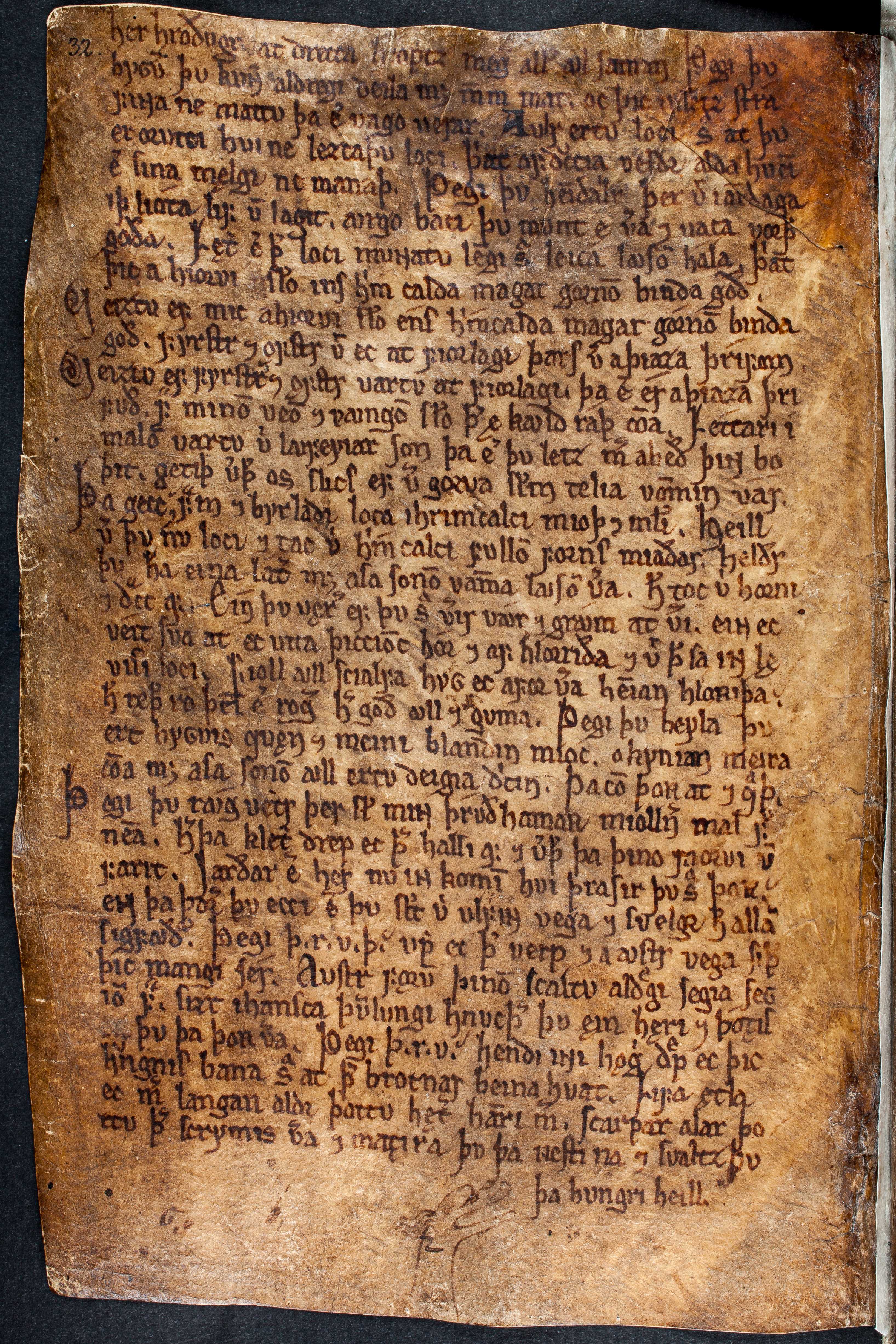
Fol. 15v (manuscript page 30; handrit.is image 39; Wimmer and Jónsson 1891 page 30, caption 'Lokasenna v. 10-27'): stanzas 11-27 begin here; stanza 27 runs on to fol. 16r. Fol. 16r (manuscript page 31; handrit.is image 40; Wimmer and Jónsson 1891 page 31, caption 'Lokasenna v. 27-45'): the top of the page finishes stanza 27 ('at þér vreiðum vegit ...'). Checked on the image: the first line of fol. 15v has 'sitja sumbli at' (end of Lokasenna 10); the first line of fol. 16r has 'at þér vreiðum vegit' (end of Lokasenna 27). The manuscript's prose in this section is shown in its place and marked 'prose': the prose on Víðarr giving Loki drink (Wimmer and Jónsson 1891 page 30, lines 1-2). Thorpe's English for it is given at the same place ('Vidar then rising ...'). Diplomatic text: Wimmer and Jónsson 1891, page 30, lines 1-33; page 31, line 1, transcribed from their page images and proofread line by line; they print each manuscript page line for line beside its phototype, so the line breaks shown are the manuscript's.
proseÞa
ſtoþ vıþaʀ vp oc ſkenctı loca. eɴ aþr hann ðryccı qvaððı hann aſona.
11Heılır ęſır heılar aſynıoꝛ oc ꜹll gıɴheılog goð. nema ſa eıɴ ás er
⟨marg. q⟩ ıɴar ſıtr bragı beccıom a. 12Mar oc mękı geꝼ ec þer mınſ ꝼıar oc bǫ
tır þer ſva bꜹgı bragı. ſıþr þv aſom ꜹꝼvnð vm gıalðır gremþv eıgı
⟨marg. q⟩ goð at þer. 13Ióſ oc armbꜹga mvnðv ę vera beɢıa vanr bragı. aſa oc
alꝼa er her ıɴı ero [ma..]þv ert vıþ víg varaſtr oc ſcıaʀaſtr
⟨marg. q.⟩ vıþ ſcót. 14Veıt ec eꝼ þyr vtan verac sva ſem ꝼyr ıɴan emc ęgıſ
hꜹll vm komıɴ. hꜹꝼvþ þıtt bera ec ıhenðı mer lıtt ec þer þat ꝼyr lygı.
15⟨marg. q⟩ Snıallr ertv ıſesı ſcalatv ſva goꝛa bragı becc ſcrꜹtvþr. vęga þv
⟨marg. q⟩ gacc eꝼ þv reıþr ſér hyɢᴢ vętr hvátr ꝼyrır. 16Bıþ ec bragı
barna ſıꝼıar ðvga oc allra oſc maga. at þv loca qveþıra laſ
⟨marg. .q⟩ ta ſtꜹꝼom ęgıſ hꜹllo í. 17Þegıþv ıþvɴ þıc qveþ ec allra qveɴa
vergıarnaſta vera. ſıtz tv arma þına lagðır ıtr þvegna vm
⟨marg. .q⟩ þıɴ broþvr bana. 18Loca ec qveþca laſta ſtꜹꝼom ęgıſ hꜹllo í
⟨marg. q⟩ braga ec kyʀı bıóꝛreıꝼan vılcat ec at ıþ reıðır vegız. 19Hvı
ıþ ęſır tvęır ſcoloþ ıɴı her ſar yrþom ſacaz. lopzcı þat veıt at hann
⟨marg. .q⟩ leıkıɴ er oc hann ꝼıoꝛgvall ꝼría. 20Þegı þv geꝼıon þes mvn ec nv
geta er þıc glapþı at geðı. ſveıɴ ıɴ hvítı er þer ſıglı gaꝼ oc
⟨marg. .þ.⟩ þv lagðır lęr yꝼır. 21Ǫʀ ertv locı oc ꜹrvítı er þv ꝼǫꝛ þer geꝼ
ıon at gremı. þvıat alðar oꝛlꜹg hyɢ ec at hon ꜹll vm vıtı
⟨marg. q⟩ ıaꝼn goꝛla ſem ec. 22Þegı þv oþıɴ þv kvɴır alðregı ðeıla vıg meþ
verom. opt þv gaꝼt þeım er þv geꝼa ſcylðıra enom ſlęvoꝛom
⟨marg. q⟩ ſıgr. 23Ueıztv eꝼ ec gaꝼ þeım er ec geꝼa ne ſcylða enom ſlęvoꝛom
ſıgr. atta vetr vartv ꝼyr ıoꝛþ neþan kýr mólcanðı oc cóna oc
⟨marg. q⟩ heꝼır þv þar boꝛıt oc hvgða ec þat argſ áþal. 24Eɴ þıc ſíga ko-
þo ſámſ eyıo í oc ðraptv avétt ſem vꜹloꝛ. vıtca lící ꝼóꝛ tv
ver þıoþ ẏꝼır. oc hvgða ec þat argſ áþal. 25Av́rlꜹgom ycrom ſcylıt
alðregı ſegıa ſeɢıom ꝼra. hvat ıþ ęſır. ıı. ðrygðvt ıarðaga ꝼır
rız ę ꝼoꝛn rꜹ́c ꝼırar. 26Þegı þv ꝼrıɢ þv ert ꝼıoꝛgynſ męr
oc heꝼır ę vergıoꝛn verıþ. er þa vea oc vılıa leztv þer vıþrıſ qvęn
baða ıbaðm vm tekıt. 27Ueıztv eꝼ ec ıɴı ettac egıſ hꜹllom
ı balðrı lıcan bvr. vt þv ne qvǫmır ꝼra aſa ſonom oc verı þa
‖ at þer reıþom vegıt.
Compare: Normalized text (Guðni Jónsson)
11"Heilir æsir, / heilar ásynjur / ok öll ginnheilög goð - / nema sá einn áss / er innar sitr, / Bragi, bekkjum á." 12"Mar ok mæki / gef ek þér míns féar, / ok bætir þér svá baugi Bragi, / síðr þú ásum / öfund of gjaldir, / grem þú eigi goð at þér." 13"Jós ok armbauga / mundu æ vera / beggja vanr, Bragi; / ása ok alfa, / er hér inni eru, / þú ert við víg varastr / ok skjarrastr við skot." 14"Veit ek, ef fyr útan værak, / svá sem fyr innan emk, / Ægis höll of kominn, / höfuð þitt / bæra ek í hendi mér; / lykak þér þat fyr lygi." 15"Snjallr ertu í sessi, / skal-at-tu svá gera, / Bragi bekkskrautuðr; / vega þú gakk, / ef þú vreiðr séir; / hyggsk vætr hvatr fyrir." 16"Bið ek þik, Bragi, / barna sifjar duga / ok allra óskmaga, / at þú Loka / kveðir-a lastastöfum / Ægis höllu í." 17"Þegi þú, Iðunn, / þik kveð ek allra kvenna / vergjarnasta vera, / síztu arma þína / lagðir ítrþvegna / um þinn bróðurbana." 18"Loka ek kveðk-a / lastastöfum / Ægis höllu í: / Braga ek kyrri / bjórreifan; / vilk-at ek, at it vreiðir vegizk." 19"Hví it æsir tveir / skuluð inni hér / sáryrðum sakask? / Loftki þat veit, / at hann leikinn er / ok hann fjörg öll fía." 20"Þegi þú, Gefjun, / þess mun ek nú geta, / er þik glapði at geði / sveinn inn hvíti, / er þér sigli gaf / ok þú lagðir lær yfir." 21"Ærr ertu, Loki, / ok örviti, / er þú fær þér Gefjun at gremi, / því at aldar örlög / hygg ek, at hon öll of viti / jafngörla sem ek." 22"Þegi þú, Óðinn, / þú kunnir aldregi / deila víg með verum; / oft þú gaft, / þeim er þú gefa skyldir-a, / inum slævurum sigr." 23"Veiztu, ef ek gaf, / þeim er ek gefa né skylda, / inum slævurum, sigr, / átta vetr / vartu fyr jörð neðan, / kýr mólkandi ok kona, / ok hefr þú þar börn borit, / ok hugða ek þat args aðal." 24"En þik síða kóðu / Sámseyu í, / ok draptu á vétt sem völur; / vitka líki / fórtu verþjóð yfir, / ok hugða ek þat args aðal." 25"Örlögum ykkrum / skylið aldregi / segja seggjum frá, / hvat it æsir tveir / drýgðuð í árdaga; / firrisk æ forn rök firar." 26"Þegi þú, Frigg, / þú ert Fjörgyns mær / ok hefr æ vergjörn verit, / er þá Véa ok Vilja / léztu þér, Viðris kvæn, / báða i baðm of tekit." 27"Veiztu, ef ek inni ættak / Ægis höllum i / Baldri líkan bur, / út þú né kvæmir / frá ása sonum, / ok væri þá at þér vreiðum vegit."
proseVidar then rising, presented Loki with drink, who before drinking thus addressed the Æsir: 11Hail, Æsir! Hail, Asyniur! And ye, all-holy gods! all, save that one As, who sits within there, Bragi, on yonder bench. 12Bragi. A horse and falchion I from my stores will give thee, and also with a ring reward thee, if thou the Æsir wilt not requite with malice. Provoke not the gods against thee. 13Loki. Of horse and rings wilt thou ever, Bragi! be in want. Of the Æsir and the Alfar, that are here present, in conflict thou art the most backward, and in the play of darts most timid. 14Bragi. I know that were I without, as I am now within, the hall of Oegir, I thy head would bear in my hand, and so for lying punish thee. 15Loki. Valiant on thy seat art thou, Bragi! but so thou shouldst not be, Bragi, the bench's pride! Go and fight, if thou art angry; a brave man sits not considering. 16Idun. I pray thee, Bragi! let avail the bond of children, and of all adopted sons, and to Loki speak not in reproachful words, in Oegir's hall. 17Loki. Be silent, Idun! of all women I declare thee most fond of men, since thou thy arms, carefully washed, didst twine round thy brother's murderer. 18Idun. Loki I address not with opprobrious words, in Oegir's hall. Bragi I soothe, by beer excited. I desire not that angry ye fight. 19Gefion. Why will ye, Æsir twain, here within, strive with reproachful words? Lopt perceives not that he is deluded, and is urged on by fate. 20Loki. Be silent, Gefion! I will now just mention, how that fair youth thy mind corrupted, who thee a necklace gave, and around whom thou thy limbs didst twine? 21Odin. Thou art raving, Loki! and hast lost thy wits, in calling Gefion's anger on thee; for all men's destinies, I ween, she knows as thoroughly as I do. 22Loki. Be silent, Odin! Thou never couldst allot conflicts between men: oft hast thou given to those to whom thou oughtest not--victory to cowards. 23Odin. Knowest thou that I gave to those I ought not--victory to cowards? Thou wast eight winters on the earth below, a milch cow and a woman, and didst there bear children. Now that, methinks, betokens a base nature. 24Loki. But, it is said, thou wentest with tottering steps in Samso, and knocked at houses as a Vala. In likeness of a fortune teller, thou wentest among people. Now that, methinks, betokens a base nature. 25Frigg. Your doings ye should never publish among men, what ye, Æsir twain, did in days of yore. Ever forgotten be men's former deeds! 26Loki. Be thou silent, Frigg! Thou art Fiorgyn's daughter, and ever hast been fond of men, since Ve and Vili, it is said, thou, Vidrir's wife, didst both to thy bosom take. 27Frigg. Know thou that if I had, in Oegir's halls, a son like Baldr, out thou shouldst not go from the Æsir's sons: thou should'st have been fiercely assailed.
Where on the image
Fol. 16r (manuscript page 31; handrit.is image 40; Wimmer and Jónsson 1891 page 31, caption 'Lokasenna v. 27-45'): stanzas 28-45 begin here; stanza 45 runs on to fol. 16v. Fol. 16v (manuscript page 32; handrit.is image 41; Wimmer and Jónsson 1891 page 32, caption 'Lokasenna v. 45-62'): the top of the page finishes stanza 45 ('hér hróðugr ...'). Checked on the image: the first line of fol. 16r has 'at þér vreiðum vegit' (end of Lokasenna 27); the first line of fol. 16v has 'hér hróðugr' (end of Lokasenna 45). The manuscript's prose in this section is shown in its place and marked 'prose': the speaker note Byɢᴠır, which Thorpe gives as the speaker name Byggvir (Wimmer and Jónsson 1891 page 31, line 28). Diplomatic text: Wimmer and Jónsson 1891, page 31, lines 1-33; page 32, line 1, transcribed from their page images and proofread line by line; they print each manuscript page line for line beside its phototype, so the line breaks shown are the manuscript's.
28Eɴ vıll þv ꝼrıɢ at ec ꝼleırı telıa mına
meın ſtaꝼı. ec þvı ręþ er þv rıþa ſerat ſıþan balðꝛ at ſꜹlom.
29Ǫʀ ertv locı er þv yðra telr lıóta leıþſtaꝼı. oꝛlꜹg ꝼrıɢ hvg
ec at ꜹll vıtı þott hon ſıalꝼgı ſegı. 30Þegı þv ꝼreyıa þıc caɴ
ec ꝼvll gerva era þer vamma vant aſa oc alꝼa er her ıɴı ero
hverr heꝼır þıɴ hóꝛ verıþ. 31Flá er þer tvnga hvɢ ec at þer ꝼrémr
mý ogott vm gala. reıþır ro þer ęſır oc aſýnıoꝛ hrẏɢʀ mvntv
heım ꝼara. 32Þegı þv ꝼreyıa þv ert ꝼoꝛðǫþa oc meíní blanðın ⟨marg. l⟩
mıoc. ſıtztv at brǫþr þınom ſıþo blıþ regın oc mvnðır þv þa
ꝼreyıa ꝼrata. 33Þat er válıtıt þótt ſer varþer vers ꝼáı hós eþa ⟨marg. n⟩
hvarſ. hıtt er vnðꝛ er ás ragr er her ıɴ ᴏꝼ komınn oc heꝼır ſa boꝛn
ᴏꝼ boꝛıt. 34Þegı þv nıoꝛþr þv vart ꜹſtr heþan gılſ vm ſenðꝛ at ⟨marg. l⟩
goðomˀ hymıſ meyıar hꜹꝼðo þıc at hlanð trógı oc þer ı mvɴ
mıgo. 35Sv eromc lıcn er ec varc langt heþan gıſl vm ſenðꝛ at go ⟨marg. n.⟩
þom. þa ec mꜹg gat þaɴ er mangı ꝼıar oc þıccır ſa aſa ıaðaʀ
36Hettv nv nıoꝛþr haꝼ þv ahóꝼı þıc mvnca ec þvı leyna lengr. ⟨marg. l.⟩
vıð ſyſtoꝛ þıɴı gaztv ſlıcan mꜹg oc þera þo óno veʀ. 37Fre ⟨marg. t.⟩
yr er beztr allra ballrıþa aſa goꝛðom í. mey hann ne grętır ne ᴍannz
kono oc leysır oꝛ hꜹptom hvern. 38Þegı þv tyr þv kvɴır alðregı ⟨marg. l.⟩
bera tılt meþ tveım. hanðar eɴar hǫgrı mvn ec hıɴar geta
er þer ſleít ꝼenrır ꝼra. 39Hanðar em ec vanr eɴ þv hroþrſ vıt ⟨marg. t.⟩
nıs bꜹl er beɢıa þrá. vlꝼgı heꝼır oc vel er ịbonðom ſcal bíþa
ragna rꜹcrſ. 40Þegı þv t⸌/⸍ýr þat varþ þıɴı cono at hon attı ⟨marg. l.⟩
mꜹg vıþ mer. ꜹln ne penıng haꝼþır þv þes alðregı vánréttıs
veſall. 41Vlꝼ ſe ec lıɢıa ar óſı ꝼyr vnz rıvꝼaz regın. þvı mvnðv ⟨marg. ꝼre⟩
nęſt nema þv nv þegır bvɴðıɴ bꜹlva ſmıþr. 42Gvllı keẏpta ⟨marg. l.⟩
leztv gẏmıſ ðottvr oc ſelðır þıtt ſva ſverþ. eɴ er mvſpellz ſynır
ríða myrc vıþ ẏꝼır veızta þv þa veſall hve þv vegrˀ proseByɢᴠır
43Ueıztv eꝼ ec ǫþlı ęttac ſem ıngvnar ꝼreýr oc sva ſęlıct ſetr
mergı ſmęra mꜹlþa ec þa męíncraco oc lemþa alla ılıþo.
44Hvat er þat ıþ lıtla er ec þat lꜹɢra ſec oc ſnap vıſt ſnapır. at ⟨marg. l.⟩
eyrom ꝼreyſ mvnðv ę vera oc vnð kvernom klaca. 45Beyɢvır ec
heítı eɴ mıc braþan qveþa goð ꜹll oc gvmar. þvı em ec
‖ her hroðvgr at ðrecca hroptz megır allır ꜹ́l ſaman.
Compare: Normalized text (Guðni Jónsson)
28"Enn vill þú, Frigg, / at ek fleiri telja / mína meinstafi: / ek því réð, / er þú ríða sér-at / síðan Baldr at sölum." 29"Ærr ertu, Loki, / er þú yðra telr / ljóta leiðstafi; / örlög Frigg, / hygg ek, at öll viti, / þótt hon sjalfgi segi." 30"Þegi þú, Freyja, / þik kann ek fullgörva, / er-a þér vamma vant: / ása ok alfa, / er hér inni eru, / hverr hefir þinn hór verit." 31"Flá er þér tunga, / hygg ek, at þér fremr myni / ógótt of gala; / reiðir ro þér æsir / ok ásynjur, / hryggr muntu heim fara." 32"Þegi þú, Freyja, / þú ert fordæða / ok meini blandin mjök, / síz þik at bræðr þínum / stóðu blíð regin / ok myndir þú þá, Freyja, frata." 33"Þat er válítit, / þótt sér varðir / vers fái, hós eða hvárs; / hitt er undr, er áss ragr / er hér inn of kominn / ok hefir sá börn of borit." 34"Þegi þú, Njörðr, / þú vart austr heðan / gíls of sendr at goðum; / Hymis meyjar / höfðu þik at hlandtrogi / ok þér i munn migu." 35"Sú erumk líkn, / er ek vark langt heðan / gísl of sendr at goðum, / þá ek mög gat, / þann er mangi fíár, / ok þykkir sá ása jaðarr." 36"Hættu nú, Njörðr, / haf þú á hófi þik, / munk-a ek því leyna lengr: / við systur þinni / gaztu slíkan mög, / ok er-a þó vánu verr." 37"Freyr er beztr / allra ballriða / ása görðum í; / mey hann né grætir / né manns konu / ok leysir ór höftum hvern." 38"Þegi þú, Týr, / þú kunnir aldregi / bera tilt með tveim; / handar innar hægri / mun ek hinnar geta, / er þér sleit Fenrir frá." 39"Handar em ek vanr, / en þú hróðrsvitnis, / böl er beggja þrá; / ulfgi hefir ok vel, / er í böndum skal / bíða ragnarökrs." 40"Þegi þú, Týr, / þat varð þinni konu, / at hon átti mög við mér; / öln né penning / hafðir þú þess aldregi / vanréttis, vesall." 41"Ulfr sé ek liggja / árósi fyrir, / unz rjúfask regin; / því mundu næst, / nema þú nú þegir, / bundinn, bölvasmiðr." 42"Gulli keypta / léztu Gymis dóttur / ok seldir þitt svá sverð; / en er Múspells synir / ríða Myrkvið yfir, / veizt-a þú þá, vesall, hvé þú vegr." 43"Veiztu, ef ek eðli ættak / sem Ingunar-Freyr / ok svá sælligt setr, / mergi smæra / mölða ek þá meinkráku / ok lemða alla í liðu." 44"Hvat er þat it litla / er ek þat löggra sék / ok snapvíst snapir? / At eyrum Freys / mundu æ vera / ok und kvernum klaka." 45"Byggvir ek heiti, / en mik bráðan kveða / goð öll ok gumar; / því em ek hér hróðugr, / at drekka Hrofts megir / allir öl saman."
28Loki. But wilt thou, Frigg! that of my wickedness I more recount? I am the cause that thou seest not Baldr riding to the halls. 29Freyia. Mad art thou, Loki! in recounting thy foul misdeeds. Frigg, I believe, knows all that happens, although she says it not. 30Loki. Be thou silent, Freyia! I know thee full well; thou art not free from vices: of the Æsir and the Alfar, that are herein, each has been thy paramour. 31Freyia. False is thy tongue. Henceforth it will, I think, prate no good to thee. Wroth with thee are the Æsir, and the Asyniur. Sad shalt thou home depart. 32Loki. Be silent, Freyia! Thou art a sorceress, and with much evil blended; since against thy brother thou the gentle powers excited. And then, Freyia! what didst thou do? 33Niord. It is no great wonder, if silk-clad dames get themselves husbands, lovers; but 'tis a wonder that a wretched As, that has borne children, should herein enter. 34Loki. Be silent, Niord! Thou wast sent eastward hence, a hostage from the gods. Hymir's daughters had thee for an utensil, and flowed into thy mouth. 35Niord. 'Tis to me a solace, as I a long way hence was sent, a hostage from the gods, that I had a son, whom no one hates, and accounted is a chief among the Æsir. 36Loki. Cease now, Niord! in bounds contain thyself; I will no longer keep it secret: it was with thy sister thou hadst such a son; hardly worse than thyself. 37Ty. Frey is best of all the exalted gods in the Æsir's courts: no maid he makes to weep, no wife of man, and from bonds looses all. 38Loki. Be silent, Ty! Thou couldst never settle a strife 'twixt two; of thy right hand also I must mention make, which Fenrir from thee tore. 39Ty. I of a hand am wanting, but thou of honest fame; sad is the lack of either. Nor is the wolf at ease: he in bonds must bide, until the gods' destruction. 40Loki. Be silent, Ty; to thy wife it happened to have a son by me. Nor rag nor penny ever hadst thou, poor wretch! for this injury. 41Frey. I the wolf see lying at the river's mouth, until the powers are swept away. So shalt thou be bound, if thou art not silent, thou framer of evil. 42Loki. With gold thou boughtest Gymir's daughter, and so gavest away thy sword: but when Muspell's sons through the dark forest ride, thou, unhappy, wilt not have wherewith to fight. 43Byggvir. Know that were I of noble race, like Ingun's Frey, and had so fair a dwelling, than marrow softer I would bray that ill-boding crow, and crush him limb by limb. 44Loki. What little thing is that I see wagging its tail, and snapping eagerly? At the ears of Frey thou shouldst ever be, and clatter under mills. 45Byggvir. Byggvir I am named, and am thought alert, by all gods and men; therefore am I joyful here, that all the sons of Hropt drink beer together.
Where on the image
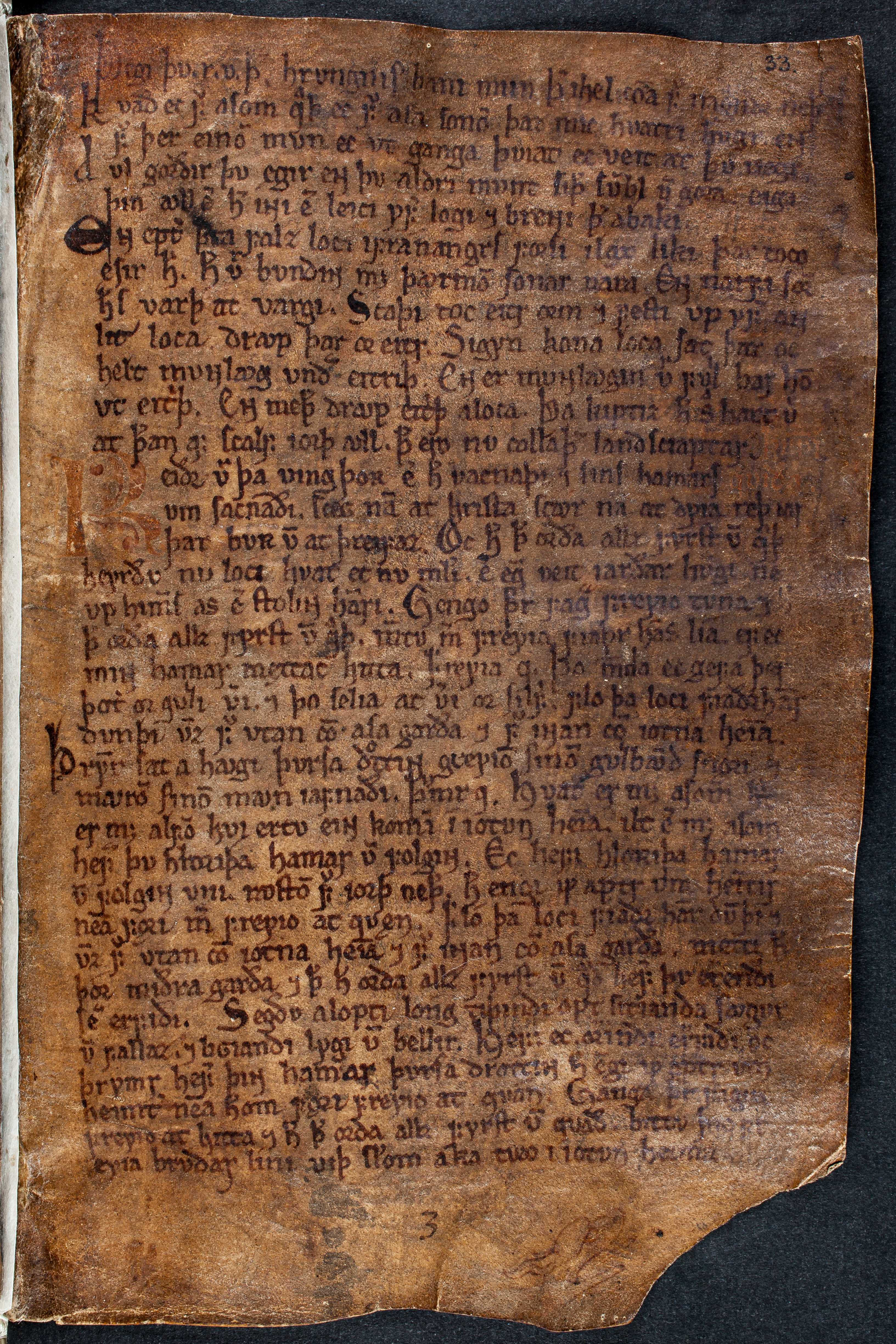
Fol. 16v (manuscript page 32; handrit.is image 41; Wimmer and Jónsson 1891 page 32, caption 'Lokasenna v. 45-62'): stanzas 46-62 begin here. Checked on the image: the first line of fol. 16v has 'hér hróðugr' (end of Lokasenna 45). The manuscript's prose in this section is shown in its place and marked 'prose': the prose on Sif pouring mead for Loki (Wimmer and Jónsson 1891 page 32, line 15); the prose on Loki taking the horn (Wimmer and Jónsson 1891 page 32, lines 17-18); the prose on Thor's arrival (Wimmer and Jónsson 1891 page 32, line 23). Thorpe's English for it is given at the same place ('Then came Sif forth ...'; 'He took the horn ...'; 'Thor then came in ...'). Diplomatic text: Wimmer and Jónsson 1891, page 32, lines 1-35, transcribed from their page images and proofread line by line; they print each manuscript page line for line beside its phototype, so the line breaks shown are the manuscript's.
46Þegı þv
byɢᴠır. þv kvɴır alðregı ðeıla meþ monnom mat. oc þıc ıꝼletz ſtrá
ꝼıɴa ne mattv þa er vágo verar. 47Avlr ertv lócı sva at þv
er oꝛvıtı hvı ne lezcaþv locı. þvıat oꝼðryccıa velðꝛ alða hveım
er ſına męlgı ne manaþ. 48Þegı þv heımðallr þer var ıárðaga
ıþ lıóta lıꝼ vm lagıt. ꜹrgo bacı þv mvnt ę vera oc vaca voꝛþr
goða. 49Lętt er þer locı mvɴattv lengı sva leıca lꜹſom hála. þvıat
þıc a hıoꝛvı [..]ſcolo ınſ hrím calða magar goꝛnom bınða goð.
50Ueıztv eꝼ mıc ahıoꝛvı ſcolo énſ hrímcalða magar góꝛnom bınða
goð. ꝼyrſtr oc ǫꝼſtr var ec at ꝼıoꝛlagı þarſ ver aþıaza þríꝼom.
51Ueıztv eꝼ ꝼyrſtr oc ǫꝼſtr vartv at ꝼıǫꝛlagı. þa er ér aþıaza þrı
ꝼvð. ꝼra mınom veom oc vꜹngom ſcolo þer ę kꜹlð ráþ coma. 52Léttarı í
malom vartv vıþ lꜹꝼeyıar ſon þa er þv letz mer abeð þıɴ bo
þıt. getıþ verþr os ſlıcſ eꝼ ver goꝛva ſcolom telıa vommın vár.
proseÞa gecc ꝫ ꝼram oc byrlaðı loca ıhrımcalcı mıoþ oc męltı. 53Heıll
ver þv nv locı oc tac vıþ hrím calcı ꝼvllom ꝼoꝛnſ mıaðar. helðr
þv hana eına látır meþ aſa ſonom vamma lꜹſom vera. proseHann toc vıþ hoꝛnı
oc ðracc aꝼ. 54Eín þv vęrır eꝼ þv sva verır vꜹ́r oc grꜹ́m at verı. eıɴ ec
veít ſva at ec vıta þıccıomc hóꝛ oc aꝼ hloꝛrıða oc var þat ſa ıɴ lę-
vıſı locı. 55Fıoll ꜹll ſcıalꝼa hyɢ ec aꝼoꝛ vera heıman hloʀıþaˀ
hann ręþr ró þeım er rǫgır her goð ꜹll oc gvma. 56Þegı þv beyla þv
ert byɢᴠıs qvęn oc meını blanðın mıoc. okynıan meıra
coma meþ aſa ſonom ꜹll ertv ðeıgıa ðrıtın. proseÞa com þoʀ at oc qvaþ.
57Þegı þv rꜹ́g vettr þer ſcal mıɴ þrv́ð hamaʀ mıollnır mal ꝼyr
nema. Herþa klett ðrep èc þer halſı aꝼ oc verþr þa þıno ꝼıoꝛvı vm
ꝼarıt. 58Iarðar er her nv ıɴ komınn hvı þraſır þv sva þoʀˀ
eɴ þa þoꝛır þv eccı er þv ſcalt vıþ vlꝼıɴ vega oc ſvelgꝛ hann allan
ſıgꝼꜹðvr. 59Þegı þ. r. v. þˀ vpp ec þer verp oc a ꜹſtr vega ſıþan
þıc mangı ſér. 60Avſtr ꝼǫꝛvm þınom ſcaltv alðregı ſegıa ſeɢ
ıom ꝼra. ſızt ıhanſca þvmlvngı hnvcþır þv ęın hęrı oc þóttıſ
(ca) þv þa þoʀ vera. 61Þegı þ. r. vˀ henðı ıɴı hǫgrı ðrep ec þıc
hrvngnıſ bana sva at þer brotnar beına hvat. 62Lıꝼa ętla
ec mer langan alðꝛ þottv hętır hamrı mer. ſcarpar alar þo-
ttv þer ſcrymıs vera oc máttıra þv þa neſtı na oc ſvaltzþv
þa hvngrı heıll.
Compare: Normalized text (Guðni Jónsson)
46"Þegi þú, Byggvir, / þú kunnir aldregi / deila með mönnum mat, / ok þik í flets strái / finna né máttu, / þá er vágu verar." 47"Ölr ertu, Loki, / svá at þú ert örviti, / - hví né lezk-a-ðu, Loki? - / því at ofdrykkja / veldr alda hveim, / er sína mælgi né man-at." 48"Þegi þú, Heimdallr, / þér var í árdaga / it ljóta líf of lagit; / örgu baki / þú munt æ vera / ok vaka vörðr goða." 49"Létt er þér, Loki; / mun-at-tu lengi svá / leika lausum hala, / því at þik á hjörvi / skulu ins hrímkalda magar / görnum binda goð." 50"Veiztu, ef mik á hjörvi / skulu ins hrímkalda magar / görnum binda goð, / fyrstr ok efstr / var ek at fjörlagi, / þars vér á Þjaza þrifum." 51"Veiztu, ef fyrstr ok efstr / vartu at fjörlagi, / þá er ér á Þjaza þrifuð, / frá mínum véum / ok vöngum skulu / þér æ köld ráð koma." 52"Léttari í málum / vartu við Laufeyjar son, / þá er þú létz mér á beð þinn boðit; / getit verðr oss slíks, / ef vér görva skulum / telja vömmin vár." 53"Heill ver þú nú, Loki, / ok tak við hrímkálki / fullum forns mjaðar, / heldr þú hana eina / látir með ása sonum / vammalausa vera." 54"Ein þú værir, / ef þú svá værir, / vör ok gröm at veri; / einn ek veit, / svá at ek vita þykkjumk, / hór ok af Hlórriða, / ok var þat sá inn lævísi Loki." 55"Fjöll öll skjalfa; / hygg ek á för vera / heiman Hlórriða; / han ræðr ró, / þeim er rægir hér / goð öll ok guma." 56"Þegi þú, Beyla, / þú ert Byggvis kvæn / ok meini blandinn mjök, / ókynjan meira / kom-a med ása sonum; / öll ertu, deigja, dritin." 57"Þegi þú, rög vættr, / þér skal minn þrúðhamarr, / Mjöllnir, mál fyrnema; / herðaklett / drep ek þér halsi af, / ok verðr þá þínu fjörvi of farit." 58"Jarðar burr / er hér nú inn kominn, / hví þrasir þú svá, Þórr? / En þá þorir þú ekki, / er þú skalt við ulfinn vega, / ok svelgr hann allan Sigföður." 59"Þegi þú, rög vættr, / þér skal minn þrúðhamarr, / Mjöllnir, mál fyrnema; / upp ek þér verp / ok á austrvega, / síðan þik manngi sér." 60"Austrförum þínum / skaltu aldregi / segja seggjum frá, / síz í hanska þumlungi / hnúkðir þú einheri, / ok þóttisk-a þú þá Þórr vera." 61"Þegi þú, rög vættr, / þér skal minn þrúðhamarr, / Mjöllnir, mál fyrnema; / hendi inni hægri / drep ek þik Hrungnis bana, / svá at þér brotnar beina hvat." 62"Lifa ætla ek mér / langan aldr, / þóttú hætir hamri mér; / skarpar álar / þóttu þér Skrýmis vera, / ok máttir-a þú þá nesti ná, / ok svalzt þú þá hungri heill."
46Loki. Be silent, Byggvir! Thou couldst never dole out food to men, when, lying in thy truckle bed, thou wast not to be found, while men were fighting. 47Heimdall. Loki, thou art drunk, and hast lost thy wits. Why dost thou not leave off, Loki? But drunkenness so rules every man, that he knows not of his garrulity. 48Loki. Be silent, Heimdall! For thee in early days was that hateful life decreed: with a wet back thou must ever be, and keep watch as guardian of the gods. 49Skadi. Thou art merry, Loki! Not long wilt thou frisk with an unbound tail; for thee, on a rock's point, with the entrails of thy ice-cold son, the gods will bind. 50Loki. Know, if on a rock's point, with the entrails of my ice-cold son, the gods will bind me, that first and foremost I was at the slaying, when we assailed Thiassi. 51Skadi. Know, if first and foremost thou wast at the slaying, when ye assailed Thiassi, that from my dwellings and fields shall to thee ever cold counsels come. 52Loki. Milder wast thou of speech to Laufey's son, when to thy bed thou didst invite me. Such matters must be mentioned, if we accurately must recount our vices. proseThen came Sif forth, and poured out mead for Loki in an icy cup, saying: 53Hail to thee, Loki! and this cool cup receive, full of old mead: at least me alone, among the blameless Æsir race, leave stainless. proseHe took the horn, drank, and said: 54So alone shouldst thou be, hadst thou strict and prudent been towards thy mate; but one I know, and, I think, know him well, a favoured rival of Hlorridi, and that is the wily Loki. 55Beyla. The fells all tremble: I think Hlorridi is from home journeying. He will bid be quiet him who here insults all gods and men. 56Loki. Be silent, Beyla! Thou art Byggvir's wife, and with much evil mingled: never came a greater monster among the Æsir's sons. Thou art a dirty strumpet. proseThor then came in and said: 57Silence, thou impure being! My mighty hammer, Miollnir, shall stop thy prating. I will thy head from thy neck strike; then will thy life be ended. 58Loki. Now the son of earth is hither come. Why dost thou chafe so, Thor? Thou wilt not dare do so, when with the wolf thou hast to fight, and he the all-powerful father swallows whole. 59Thor. Silence, thou impure being! My mighty hammer, Miollnir, shall stop thy prating. Up I will hurl thee to the east region, and none shall see thee after. 60Loki. Of thy eastern travels thou shouldest never to people speak, since in a glove-thumb thou, Einheri! wast doubled up, and hardly thoughtest thou wast Thor. 61Thor. Silence, thou impure being! My mighty hammer, Miollnir, shall stop thy prating: with this right hand I, Hrungnir's bane, will smite thee, so that thy every bone be broken. 62Loki. 'Tis my intention a long life to live, though with thy hammer thou dost threaten me. Skrymir's thongs seemed to thee hard, when at the food thou couldst not get, when, in full health, of hunger dying.
Where on the image
Fol. 17r (manuscript page 33; handrit.is image 42; Wimmer and Jónsson 1891 page 33, caption 'Lokasenna v. 63 - Þrymskviða v. 12'): stanzas 63-65 begin here. Checked on the image: the first line of fol. 17r has 'Þegi þú, rög vættr' (Lokasenna 63). The manuscript's prose in this section is shown in its place and marked 'prose': the prose after the poem, with its title (ꝼra loca) (Wimmer and Jónsson 1891 page 33, lines 5-12). Thorpe's English for it is given at the same place ('After this Loki ...'). Diplomatic text: Wimmer and Jónsson 1891, page 33, lines 1-12, transcribed from their page images and proofread line by line; they print each manuscript page line for line beside its phototype, so the line breaks shown are the manuscript's.
63Þegı þv. r. v. þer. hrv́ngnıſ banı mun þer ıhel coma ꝼyr nagrınðꝛ neþan
64Kvað ec ꝼyr áſom qvaþ ec ꝼyr aſa ſonom þaz mıc hvattı hvgr. eɴ
ꝼyr þer eınom mvn ec vt ganga þvıat ec veıt at þv vegr.
65Avl goꝛðır þv ęgır eɴ þv alðrı mvnt ſıþan ſvmbl vm goꝛa. eıga
þín ꜹll er her ıɴı er leıcı yꝼır lógı oc breɴı þer abakı. proseꝼra loca.
Eɴ eptır þetta ꝼalz locı ıꝼránangrſ ꝼoꝛſı ıláx lıkı þar toco
ęſır hann. Hann var bvɴðıɴ meþ þꜹrmom ſonar nara. Eɴ narꝼı ſonꝛ
hanſ varþ at vargı. Scaþı toc eıtr oꝛm oc ꝼeſtı vp yꝼır aɴ
lıt lóca. ðrꜹp þar oꝛ eıtr. Sıgyn kona loca ſat þar oc
helt mvɴlꜹg vnðır eıtrıþ. Eɴ er mvɴlꜹgın var ꝼvll bar hon
vt eıtrıþ. Eɴ meþan ðrꜹp eıtrıþ aloca. Þa kıptız hann sva hart vıþ
at þaþan aꝼ ſcalꝼ ıoꝛþ ꜹll. þat ero nv callaþır lanðſcıaptar.
Compare: Normalized text (Guðni Jónsson)
63"Þegi þú, rög vættr, / þér skal minn þrúðhamarr, / Mjöllnir, mál fyrnema; / Hrungnis bani / mun þér í hel koma / fyr nágrindr neðan." 64"Kvað ek fyr ásum, / kvað ek fyr ása sonum, / þats mik hvatti hugr, / en fyr þér einum / mun ek út ganga, / því at ek veit, at þú vegr. 65Öl gerðir þú, Ægir, / en þú aldri munt / síðan sumbl of gera; / eiga þín öll, / er hér inni er, / leiki yfir logi, / ok brenni þér á baki."
63Thor. Silence, thou impure being! My mighty hammer, Miollnir, shall stop thy prating. Hrungnir's bane shall cast thee down to Hel, beneath the gratings of the dead. 64Loki. I have said before the Æsir, I have said before the Æsir's sons, that which my mind suggested: but for thee alone will I go out; because I know that thou wilt fight. 65Oegir! thou hast brewed beer; but thou never shalt henceforth a compotation hold. All thy possessions, which are herein, flame shall play over, and on thy back shall burn thee. proseAfter this Loki, in the likeness of a salmon, cast himself into the waterfall of Franangr, where the Æsir caught him, and bound him with the entrails of his son Nari; but his other son, Narfi, was changed into a wolf. Skadi took a venomous serpent, and fastened it up over Loki's face. The venom trickled down from it. Sigyn, Loki's wife, sat by, and held a basin under the venom; and when the basin was full, carried the venom out. Meanwhile the venom dropped on Loki, who shrank from it so violently that the whole earth trembled. This causes what are now called earthquakes.
Cite
Sources
- Source: Codex Regius (GKS 2365 4to) page images via handrit.is + Wimmer and Jónsson's 1891 diplomatic text + Guðni Jónsson's normalized Old Norse via heimskringla.no + Thorpe (1866) English (holding institution)
- Critical edition: Diplomatic text of Codex Regius, Wimmer and Finnur Jónsson 1891; normalized text (Guðni Jónsson) for comparison
← previous · → next · v cycle view · l back to library