Þrymskviða
Introduction
Þrymskviða is preserved in the Codex Regius of the Poetic Edda (GKS 2365 4to, Árni Magnússon Institute, Reykjavík), an Icelandic parchment book written about 1270. The poem fills fol. 17r-18r (manuscript pages 33-35).
Pages: each section holds the stanzas that begin on one manuscript page and links that page's photograph (handrit.is); a stanza that runs onto the next page links both pages. The page of every stanza comes from Wimmer and Finnur Jónsson's 1891 diplomatic edition, which prints the text of each manuscript page, and the first line of every page was checked on the photograph. 'Where on the image' under each section gives the details.
Texts: the first Old Norse text is the manuscript's own text, letter by letter, from the diplomatic transcription of Wimmer and Finnur Jónsson (1891), which prints each page line for line: line breaks are the manuscript's, ‖ marks a new page, letters in italics are supplied where the scribe abbreviated, and special letters are kept (ſ long s, ꝛ round r, ꝼ insular f, ı dotless i, ꜹ the av ligature, ǫ and ę with hooks, ᛘ the rune for maðr, small capitals for the scribe's small capitals). The manuscript writes the poem as continuous lines without stanza breaks; the stanza numbers (Guðni Jónsson's) are inserted where each stanza begins and do not appear in the manuscript. Letters with a dot below are marked for deletion in the manuscript; letters between ⸌ and ⸍ are written above the line, and ⟨marg. ...⟩ gives what Wimmer and Jónsson print in the margin (corrections, and in Vafþrúðnismál the speaker marks o, v, q). The manuscript's prose (the prose before and after the poem, the prose links between speeches, the red titles and speaker notes such as 'Freyıa q.', Freyja said) is shown where it stands, marked 'prose'; where verse goes on after such a piece inside a stanza, the stanza number is repeated with 'cont.'. Thorpe's English for the prose is given at the same place where he translates it; he gives the speaker notes as the speaker's name before the stanza. The second text is Guðni Jónsson's normalized edition (via heimskringla.no), a reading text in modern spelling; in places it adds words or lines from other manuscripts and follows modern editions where they rearrange stanzas. The English is Benjamin Thorpe's 1866 translation (public domain).
English alignment: Thorpe prints stanza 7 as two stanzas (7 and 8), so from stanza 8 on his number is one higher than the Old Norse (Old Norse 8 = Thorpe 9, ... 32 = 33).
How was this verified? (Provenance)
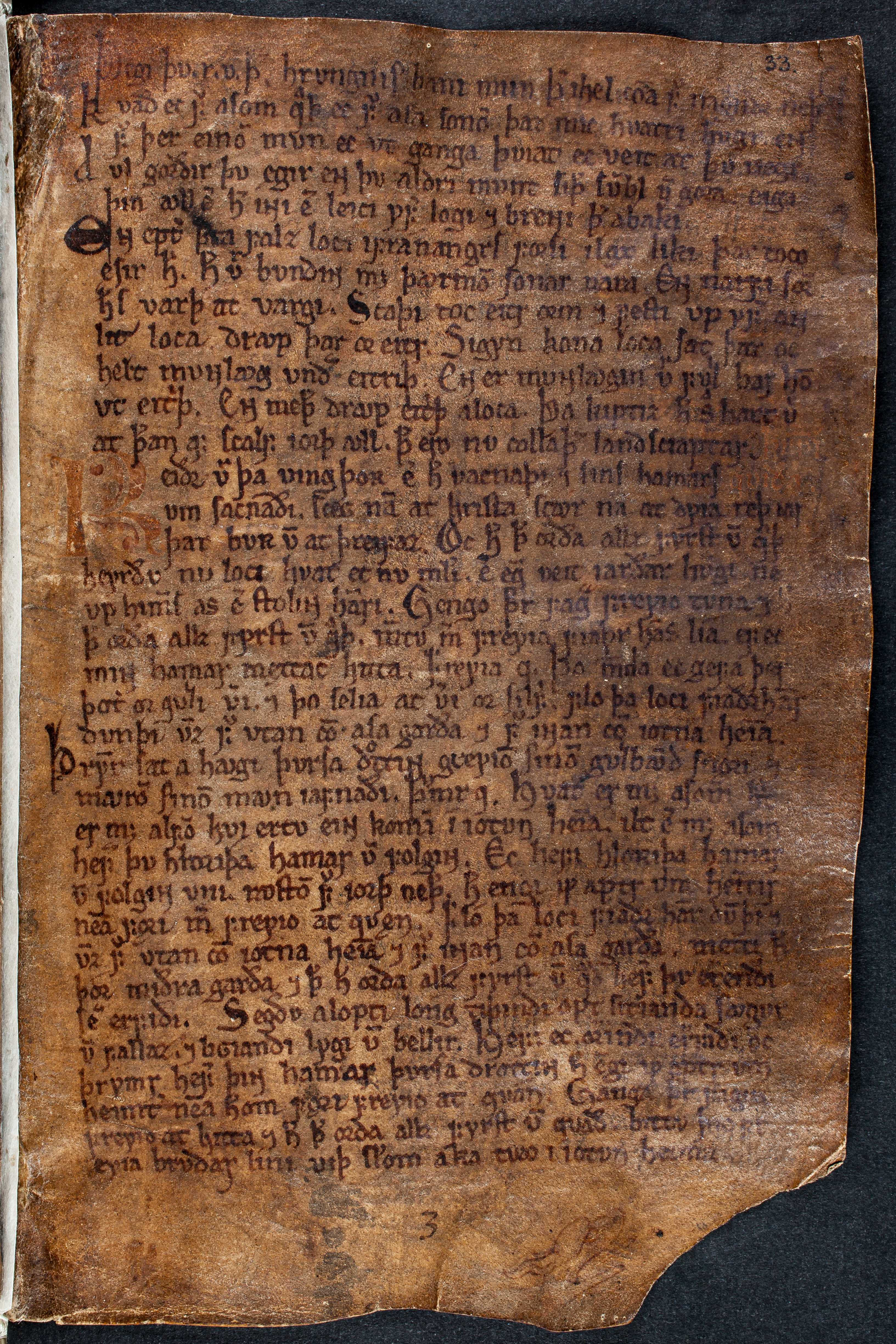
Where on the image
Fol. 17r (manuscript page 33; handrit.is image 42; Wimmer and Jónsson 1891 page 33, caption 'Lokasenna v. 63 - Þrymskviða v. 12'): stanza 1 is lower on the page (the first line belongs to Lokasenna 63); stanzas 1-12 begin here. Checked on the image: the first line of fol. 17r has 'Þegi þú, rög vættr' (Lokasenna 63). The manuscript's prose in this section is shown in its place and marked 'prose': the first half of the red title þrymſ qvıða, at the end of line 12 (Wimmer and Jónsson 1891 page 33, line 12); the second half of the title, qvıða, written at the end of line 13 after the first words of stanza 1 (Wimmer and Jónsson 1891 page 33, line 13); the speaker note Freyıa q. (Freyja said), which Thorpe gives as the speaker name Freyia (Wimmer and Jónsson 1891 page 33, line 19); the speaker note þrymr q. (Þrymr said), which Thorpe gives as the speaker name Thrym (Wimmer and Jónsson 1891 page 33, line 23). Diplomatic text: Wimmer and Jónsson 1891, page 33, lines 12-35, transcribed from their page images and proofread line by line; they print each manuscript page line for line beside its phototype, so the line breaks shown are the manuscript's.
proseþrymſ
1Reıðꝛ var þa vıng þóʀ er hann vacnaþı oc ſınſ hamarſ proseqvıða.
1 cont.vm ſacnaðı. ſceɢ nam at hrıſta ſcꜹ́r nam at ðyıa reþ ıar
þar bvʀ vm at þreıꝼaz. 2Oc hann þat oꝛða allz ꝼyrſt vm qvaþ
heyrðv nv lócı hvat ec nv męlı. er eıgı veıt ıarðar hvergı ne
vp hımınſ ás er ſtolıɴ hamrı. 3Gengo þeır ꝼagra ꝼreyıo tvna oc hann
þat oꝛða allz ꝼyrſt vm qvaþ. mvntv mer ꝼreyıa ꝼıaþr hams lıá. eꝼ ec
mıɴ hamar męttac hıtta. proseFreyıa q. 4Þo mvnða ec geꝼa þer
þott oꝛ gvllı verı. oc þo ſelıa at verı oꝛ ſılꝼrı. 5ꝼlo þa locı ꝼıaðꝛhamr
ðvnþı vnz ꝼyr vtan com aſa garða oc ꝼyr ıɴan com ıotna heıma.
6Þrymr ſat a hꜹgı þvrſa ðrottıɴ greyıom ſınom gvllbꜹnð ſnǫꝛı oc
mꜹrom ſınom mꜹn ıaꝼnaðı. proseþrymr q. 7Hvat er meþ aſom hvat
er meþ alꝼom hví ertv eıɴ komınn í ıotvn heıma. ılt er meþ aſom
heꝼır þv hloꝛıþa hamar vm ꝼolgıɴ. 8Ec heꝼı hloʀıþa hamar
vm ꝼolgıɴ vııı. rꜹſtom ꝼyr ıoꝛþ neþan. hann engı ᛘ aptr vm heımtır
nema ꝼǫꝛı mer ꝼreyıo at qvęn. 9Fló þa locı ꝼıaðꝛ hamr ðvnþı oc
vnz ꝼyr vtan com ıotna heıma oc ꝼyr ıɴan com aſa garða. męttı hann
þóꝛ mıðra garða oc þat hann oꝛða allz ꝼyrſt vm qvað 10heꝼır þv erenðı
ſem erꝼıðı. Segðv aloptı lóng tıþınðı opt ſıtıanða ſꜹgvr
vm ꝼallaz. oc lıɢıanðı lygı vm bellır. 11Heꝼı ec. o⸌‴⸍ꝛınðı. e⸌‴⸍rꝼıðı. oc
þrymr heꝼır þıɴ hamar þvrſa ðrottıɴ hann engı ᛘ aptr vm
heımtır nema hanom ꝼǫꝛı ꝼreyıo at qván. 12Ganga þeır ꝼagra
ꝼreyıo at hıtta oc hann þat oꝛða allz ꝼyrſt vm qvað. bıttv þıc ꝼr-
ęyıa brvðar línı vıþ ſcolom aka tvꜹ ı ıotvn heıma.
Compare: Normalized text (Guðni Jónsson)
1Vreiðr var þá Vingþórr / er hann vaknaði / ok síns hamars / of saknaði, / skegg nam at hrista, / skör nam at dýja, / réð Jarðar burr / um at þreifask. 2Ok hann þat orða / alls fyrst of kvað: / "Heyrðu nú, Loki, / hvat ek nú mæli / er eigi veit / jarðar hvergi / né upphimins: / áss er stolinn hamri!" 3Gengu þeir fagra / Freyju túna, / ok hann þat orða / alls fyrst of kvað: / "Muntu mér, Freyja, / fjaðrhams léa, / ef ek minn hamar / mættak hitta?". 4"Þó munda ek gefa þér / þótt ór gulli væri, / ok þó selja, / at væri ór silfri." 5Fló þá Loki, / - fjaðrhamr dunði, - / unz fyr útan kom / ása garða / ok fyr innan kom / jötna heima. 6Þrymr sat á haugi, / þursa dróttinn, / greyjum sínum / gullbönd sneri / ok mörum sínum / mön jafnaði. 7"Hvat er með ásum? / Hvat er með alfum? / Hví ertu einn kominn / í Jötunheima?" / "Illt er með ásum, / illt er með alfum; / hefr þú Hlórriða / hamar of folginn?" 8"Ek hef Hlórriða. / hamar of folginn / átta röstum / fyr jörð neðan; / hann engi maðr / aftr of heimtir, / nema færi mér / Freyju at kvæn." 9Fló þá Loki, / - fjaðrhamr dunði, - / unz fyr útan kom / jötna heima / ok fyr innan kom / ása garða. / Mætti hann Þór / miðra garða, / ok þat hann orða / alls fyrst of kvað: 10"Hefr þú erendi / sem erfiði? / Segðu á lofti / löng tíðendi, / oft sitjanda / sögur of fallask / ok liggjandi / lygi of bellir." 11"Hef ek erfiði / ok erendi; / Þrymr hefr þinn hamar, / þursa dróttinn; / hann engi maðr / aftr of heimtir, / nema hánum færi / Freyju at kván. 12Ganga þeir fagra / Freyju at hitta, / ok hann þat orða / alls fyrst of kvað: / "Bittu þik, Freyja, / brúðar líni; / vit skulum aka tvau / í Jötunheima."
1Wroth was Vingthor, when he awoke, and his hammer missed; his beard he shook, his forehead struck, the son of earth felt all around him; 2And first of all these words he uttered: "Hear now, Loki! what I now say, which no one knows anywhere on earth, nor in heaven above; the As's hammer is stolen!" 3They went to the fair Freyia's dwelling, and he these words first of all said: "Wilt thou me, Freyia, thy feather-garment lend, that perchance my hammer I may find?" 4Freyia. "That I would give thee, although of gold it were, and trust it to thee, though it were of silver." 5Flew then Loki--the plumage rattled--until he came beyond the Æsir's dwellings, and came within the Jotun's land. 6On a mound sat Thrym, the Thursar's lord, for his greyhounds plaiting gold bands and his horses' manes smoothing. 7"How goes it with the Æsir? How goes it with the Alfar? Why art thou come alone to Jotunheim?" Loki. "Ill it goes with the Æsir, Ill it goes with the Alfar. Hast thou Hlorridi's hammer hidden?" 8Thrym. "I have Hlorridi's hammer hidden eight rasts beneath the earth; it shall no man get again, unless he bring me Freyia to wife." 9Flew then Loki--the plumage rattled--until he came beyond the Jotun's dwellings, and came within the Æsir's courts; there he met Thor, in the middle court, who these words first of all uttered. 10"Hast thou had success as well as labour? Tell me from the air the long tidings. Oft of him who sits are the tales defective, and he who lies down utters falsehood." 11Loki. "I have had labour and success: Thrym has thy hammer, the Thursar's lord. It shall no man get again, unless he bring him Freyia to wife." 12They went the fair Freyia to find; and he those words first of all said: "Bind thee, Freyia, in bridal raiment, we two must drive to Jotunheim."
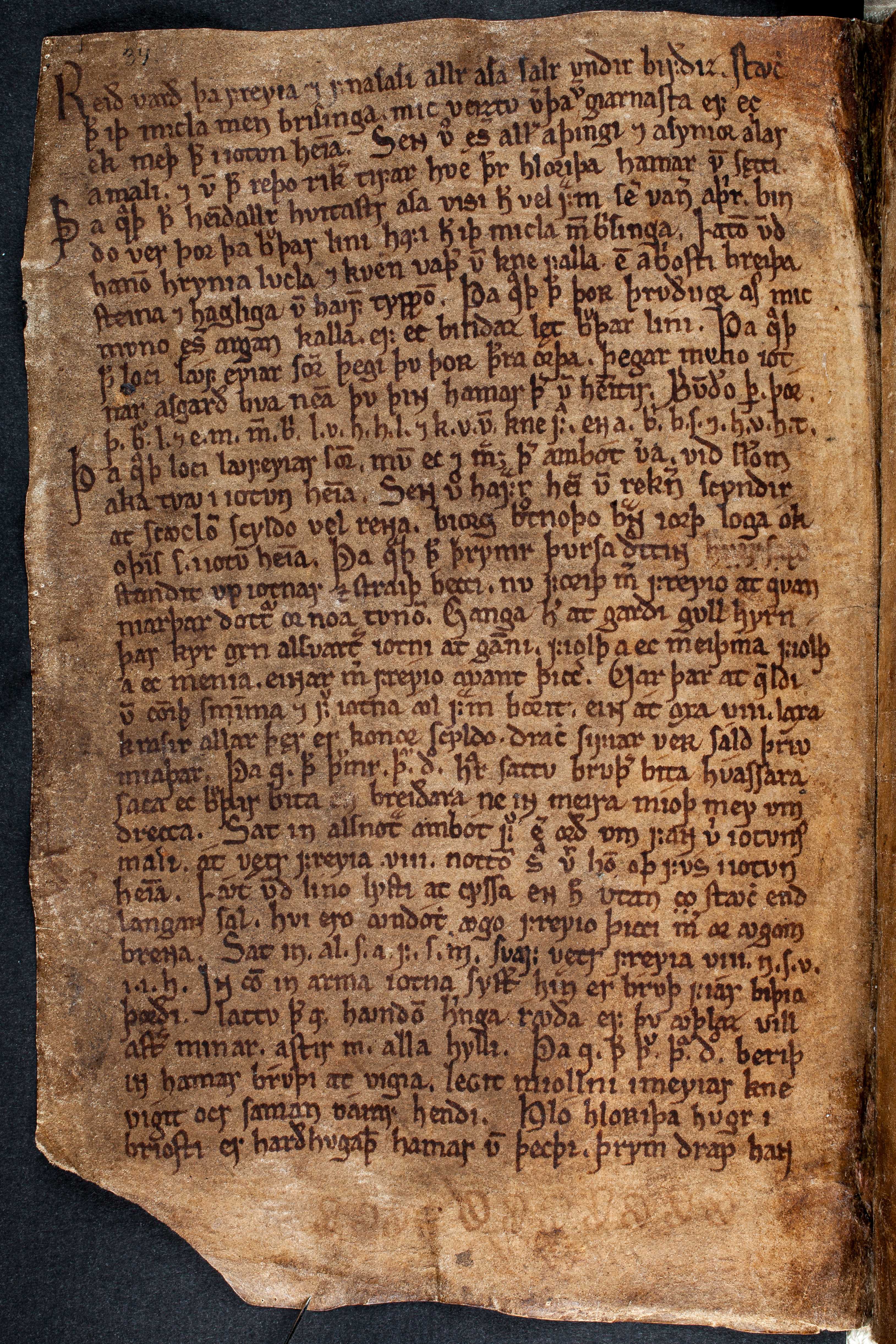

Where on the image
Fol. 17v (manuscript page 34; handrit.is image 43; Wimmer and Jónsson 1891 page 34, caption 'Þrymskviða v. 13-31'): stanzas 13-31 begin here; stanza 31 runs on to fol. 18r. Fol. 18r (manuscript page 35; handrit.is image 44; Wimmer and Jónsson 1891 page 35, caption 'Þrymskviða v. 31 - Vǫlundarkviða v. 7'): the top of the page finishes stanza 31 ('fyrstan, þursa dróttin ...'). Checked on the image: the first line of fol. 17v has 'Reið varð þá Freyja' (Þrymskviða 13); the first line of fol. 18r has 'fyrstan' (end of Þrymskviða 31). Diplomatic text: Wimmer and Jónsson 1891, page 34, lines 1-35; page 35, line 1, transcribed from their page images and proofread line by line; they print each manuscript page line for line beside its phototype, so the line breaks shown are the manuscript's.
13Reıð varð þa ꝼreyıa oc ꝼnaſaſı allr áſa ſalr vnðır bıꝼðız. ſtꜹcc
þat ıþ mıcla men brıſınga. mıc veıztv verþa⸌ver⸍,gıarnaſta eꝼ ec
ek meþ þer ı ıotvn heıma. 14Seɴ voro ęſır allır aþıngı oc aſynıoꝛ allar
amalı. oc vm þat reþo rıkır tıꝼar hve þeır hloꝛıþa hamar vm ſęttı.
15Þa qvaþ þat heımðallr hvıtaſtr áſa vısı hann vel ꝼram ſem vanır aþrır. bın
ðo ver þoꝛ þa brvþar lını haꝼı hann ıþ mıcla men brıſınga. 16Latom vnð
hanom hrynıa lvcla oc kven vaþır vm kne ꝼalla. en abrıoſtı breıþa
ſteína oc haglıga vm hꜹꝼvþ typpom. 17Þa qvaþ þat þoʀ þrvðvgꝛ áſ mıc
mvno ęſır argan kalla. eꝼ ec bınðaz lęt brvþar línı. 18Þa qvaþ
þat lócı lꜹ́ꝼ eyıar ſonꝛ þegı þv þoʀ þeıra oꝛþa. þegar mvno ıot
nar aſgarð bva nema þv þıɴ hamar þer vm heımtır. 19Bvnðo þeır. þóꝛ.
þ. brv. l. oc e. m. men. brı. l. v. h. h. l. oc k. v. vm. kne ꝼalla. eɴ a. brı. b. ſ. oc. h. v. h. t.
20Þa qvaþ locı lꜹꝼeyıar ſonꝛ. mvn ec oc meþ þer ambót vera. vıð ſcolom
aka tvꜹ ı ıotvn heıma. 21Seɴ voro haꝼrar heım vm reknır ſcynðır
at ſcꜹclom ſcylðo vel reɴa. bıoꝛg brotnoþo braɴ ıoꝛþ loga ók
oþınſ ſ. í ıotvn heıma. 22Þa qvaþ þat þrymr þvrſa ðrottıɴ [ḥṿạṛ ſạttṿ]
ſtanðıt vp ıotnar oc ſtraıþ beccı. nv ꝼoꝛıþ mer ꝼreyıo at qvan
nıarþar ðottvr oꝛ noa tvnom. 23Ganga her at garðı gvll hyrn-
þar kýr oxn alſvartır ıotnı at gamnı. ꝼıolþ a ec meıþma ꝼıolþ
a ec menıa. eıɴar mer ꝼreýıo avant þıccır. 24Uar þar at qvelðı
vm comıþ ſmı̣mma oc ꝼyr ıotna ꜹ́l ꝼram boꝛıt. eıɴ át oxa vııı. laxa
kraſır allar þęr er konoꝛ ſcylðo. ðracc ſıꝼıar veʀ ſálð þrıv
mıaþar. 25Þa q. þat þrymr. þvr. ðro. hvar ſattv brvþır bíta hváſſara
ſaca ec brvþır bíta (en) breıðara ne ıɴ meıra míoþ mey vm
ðrecca. 26Sat ın alſnotra ambót ꝼyr er oꝛð vm ꝼaɴ vıþ ıotvnſ
málı. át vętr ꝼreyıa .vııı. nottom sva var hon oþ ꝼv́s í íotvn
heıma. 27Lꜹ́t vnnð líno lyſtı at cyſſa eɴ hann vtan c̣ọ ſtꜹcc enð
langan ſal. hvı ero ꜹnðótt ꜹgo ꝼreyıo þıccı mer oꝛ ꜹgom
breɴa. 28Sat ın. al. ſ. a. ꝼ. ſ. m. ſvaꝼ vętr ꝼreyıa vııı. n. ſ. v.
ı. ı. h. 29Iɴ com ın arma ıotna ſyſtır hın er brv́þ ꝼıár bıþıa
þoꝛðı. lattv þer aꝼ hꜹnðom hrınga rꜹ́ða eꝼ þv ꜹþlaz vıll
aſtır mınar. aſtır m. alla hyllı. 30Þa q. þat þry. þvr. ðro. berıþ
ıɴ hamar brv́þı at vígıa. leɢıt mıollnı ı meyıar kne
vígıt ocr ſaman várar henðı. 31Hló hloʀıþa hvgr ı
brıoſtı er harðhvgaþr hamar vm þecþı. þrym ðrap haɴ
‖ ꝼyrſtan. þvr. ðro. oc ętt ıotvnſ alla lamþı.
Compare: Normalized text (Guðni Jónsson)
13Reið varð þá Freyja / ok fnasaði, / allr ása salr / undir bifðisk, / stökk þat it mikla / men Brísinga: / "Mik veiztu verða / vergjarnasta, / ef ek ek með þér / í Jötunheima." 14Senn váru æsir / allir á þingi / ok ásynjur / allar á máli, / ok um þat réðu / ríkir tívar / hvé þeir Hlórriða / hamar of sætti. 15Þá kvað þat Heimdallr, / hvítastr ása, / vissi hann vel fram / sem vanir aðrir: / "Bindum vér Þór þá / brúðar líni, / hafi hann it mikla / men Brísinga. 16Látum und hánum / hrynja lukla / ok kvenváðir / um kné falla, / en á brjósti / breiða steina / ok hagliga / um höfuð typpum." 17Þá kvað þat Þór, / þrúðugr áss: / "Mik munu æsir / argan kalla, / ef ek bindask læt / brúðar líni!" 18Þá kvað þat Loki / Laufeyjar sonr: / "Þegi þú, Þórr, / þeira orða. / Þegar munu jötnar / Ásgarð búa, / nema þú þinn hamar / þér of heimtir." 19Bundu þeir Þór þá / brúðar líni / ok inu mikla / meni Brísinga, / létu und hánum / hrynja lukla / ok kvenváðir / um kné falla, / en á brjósti / breiða steina, / ok hagliga / um höfuð typpðu. 20Þá kvað Loki / Laufeyjar sonr: / "Mun ek ok með þér / ambótt vera, / vit skulum aka tvær / í Jötunheima." 21Senn váru hafrar / heim of reknir, / skyndir at sköklum, / skyldu vel renna; / björg brotnuðu, / brann jörð loga, / ók Óðins sonr / í Jötunheima. 22Þá kvað þat Þrymr, / þursa dróttinn: / "Standið upp, jötnar, / ok stráið bekki, / nú færa mér / Freyju at kván / Njarðar dóttur / ór Nóatúnum. 23Ganga hér at garði / gullhyrnðar kýr, / öxn alsvartir / jötni at gamni; / fjölð á ek meiðma, / fjölð á ek menja, / einnar mér Freyju / ávant þykkir." 24Var þar at kveldi / of komit snemma / ok fyr jötna / öl fram borit; / einn át oxa, / átta laxa, / krásir allar, / þær er konur skyldu, / drakk Sifjar verr / sáld þrjú mjaðar. 25Þá kvat þat Þrymr, / þursa dróttinn: / "Hvar sáttu brúðir / bíta hvassara? / Sák-a ek brúðir / bíta breiðara, / né inn meira mjöð / mey of drekka." 26Sat in alsnotra / ambótt fyrir, / er orð of fann / við jötuns máli: / "Át vætr Freyja / átta nóttum, / svá var hon óðfús / í Jötunheima." 27Laut und línu, / lysti at kyssa, / en hann útan stökk / endlangan sal: / "Hví eru öndótt / augu Freyju? / Þykki mér ór augum / eldr of brenna." 28Sat in alsnotra / ambótt fyrir, / er orð of fann / við jötuns máli: / "Svaf vætr Freyja / átta nóttum, / svá var hon óðfús / í Jötunheima." 29Inn kom in arma / jötna systir, / hin er brúðféar / biðja þorði: / "Láttu þér af höndum / hringa rauða, / ef þú öðlask vill / ástir mínar, / ástir mínar, / alla hylli. 30Þá kvað þat Þrymr, / þursa dróttinn: / "Berið inn hamar / brúði at vígja, / lekkið Mjöllni / í meyjar kné, / vígið okkr saman / Várar hendi." 31Hló Hlórriða / hugr í brjósti, / er harðhugaðr / hamar of þekkði; / Þrym drap hann fyrstan, / þursa dróttin, / ok ætt jötuns / alla lamði.
13Wroth then was Freyia, and with anger chafed, all the Æsir's hall beneath her trembled: in shivers flew the famed Brisinga necklace. "Know me to be of women lewdest, if with thee I drive to Jotunheim." 14Straightway went the Æsir all to council, and the Asyniur all to hold converse; and deliberated the mighty gods, how they Hlorridi's hammer might get back. 15Then said Heimdall, of Æsir brightest--he well foresaw, like other Vanir--"Let us clothe Thor with bridal raiment, let him have the famed Brisinga necklace. 16"Let by his side keys jingle, and woman's weeds fall round his knees, but on his breast place precious stones, and a neat coif set on his head." 17Then said Thor, the mighty As: "Me the Æsir will call womanish, if I let myself be clad in bridal raiment." 18Then spake Loki, Laufey's son: "Do thou, Thor! refrain from suchlike words: forthwith the Jotuns will Asgard inhabit, unless thy hammer thou gettest back." 19Then they clad Thor in bridal raiment, and with the noble Brisinga necklace, let by his side keys jingle, and woman's weeds fall round his knees; and on his breast placed precious stones, and a neat coif set on his head. 20Then said Loki, Laufey's son: "I will with thee as a servant go: we two will drive to Jotunheim." 21Straightway were the goats homeward driven, hurried to the traces; they had fast to run. The rocks were shivered, the earth was in a blaze; Odin's son drove to Jotunheim. 22Then said Thrym, the Thursar's lord: "Rise up, Jotuns! and the benches deck, now they bring me Freyia to wife, Niord's daughter, from Noatun. 23"Hither to our court let bring gold-horned cows, all-black oxen, for the Jotuns' joy. Treasures I have many, necklaces many, Freyia alone seemed to me wanting." 24In the evening they early came, and for the Jotuns beer was brought forth. Thor alone an ox devoured, salmons eight, and all the sweetmeats women should have. Sif's consort drank three salds of mead. 25Then said Thrym, the Thursar's prince: "Where hast thou seen brides eat more voraciously? I never saw brides feed more amply, nor a maiden drink more mead." 26Sat the all-crafty serving-maid close by, who words fitting found against the Jotun's speech: "Freyia has nothing eaten for eight nights, so eager was she for Jotunheim." 27Under her veil he stooped desirous to salute her, but sprang back along the hall. "Why are so piercing Freyia's looks? Methinks that fire burns from her eyes." 28Sat the all-crafty serving-maid close by, who words fitting found against the Jotun's speech: "Freyia for eight nights has not slept, so eager was she for Jotunheim." 29In came the Jotun's luckless sister, for a bride-gift she dared to ask: "Give me from thy hands the ruddy rings, if thou wouldst gain my love, my love and favour all." 30Then said Thrym, the Thursar's lord: "Bring the hammer in, the bride to consecrate; lay Miollnir on the maiden's knee; unite us each with other by the hand of Vor." 31Laughed Hlorridi's soul in his breast, when the fierce-hearted his hammer recognized. He first slew Thrym, the Thursar's lord, and the Jotun's race all crushed;
Where on the image
Fol. 18r (manuscript page 35; handrit.is image 44; Wimmer and Jónsson 1891 page 35, caption 'Þrymskviða v. 31 - Vǫlundarkviða v. 7'): stanza 32 begins here. Checked on the image: the first line of fol. 18r has 'fyrstan' (end of Þrymskviða 31). Diplomatic text: Wimmer and Jónsson 1891, page 35, lines 1-4, transcribed from their page images and proofread line by line; they print each manuscript page line for line beside its phototype, so the line breaks shown are the manuscript's.
32Drap hann ına ꜹlðno ıot
na ſyſtvr hın er brvþ ꝼıar ᴏꝼ beþıt haꝼðı. hon ſkell vm hlꜹ́t ꝼyr
ſcıllınga eɴ hꜹɢ hamarſ ꝼyr hrınga ꝼıolþ. Sva com oþınſ ſonꝛ enðꝛ
at hamrı.
Compare: Normalized text (Guðni Jónsson)
32Drap hann ina öldnu / jötna systur, / hin er brúðféar / of beðit hafði; / hon skell of hlaut / fyr skillinga, / en högg hamars / fyr hringa fjölð. / Svá kom Óðins sonr / endr at hamri.
32He slew the Jotun's aged sister, her who a bride-gift had demanded; she a blow got instead of skillings, a hammer's stroke for many rings. So got Odin's son his hammer back.
Notes
- Thorpe prints stanza 7 as two stanzas (7 and 8), so from stanza 8 on his number is one higher than the Old Norse (Old Norse 8 = Thorpe 9, ... 32 = 33).
Cite
Sources
- Source: Codex Regius (GKS 2365 4to) page images via handrit.is + Wimmer and Jónsson's 1891 diplomatic text + Guðni Jónsson's normalized Old Norse via heimskringla.no + Thorpe (1866) English (holding institution)
- Critical edition: Diplomatic text of Codex Regius, Wimmer and Finnur Jónsson 1891; normalized text (Guðni Jónsson) for comparison
← previous · → next · v cycle view · l back to library