Enuma Elish, Tablet VI: the creation of humankind and of Babylon
Introduction
Ea creates humankind from the blood of the guilty god Qingu to bear the gods' labour. The gods build Babylon and the temple Esagil for Marduk, hold a banquet, and begin to proclaim his fifty names.
Enuma Elish ('When on high'), the Babylonian Poem of Creation, tells how Marduk, god of Babylon, defeated Tiamat, created the ordered world and became king of the gods. It was written on seven tablets and recited in Babylon during the New Year festival. The date of composition is debated (proposals range from the 18th to the 12th century BCE); the surviving copies date from the 9th to the 2nd century BCE and come from Ashur, Nineveh, Kish, Babylon, Sippar, Uruk and other sites. This page follows the line numbering of the electronic Babylonian Library edition.
How this page is built. Each section is a run of consecutive lines as written on one photographed clay tablet. For every line the eBL edition (https://www.ebl.lmu.de/corpus/L/1/2/SB/VI) lists the manuscripts that carry it, with each tablet's own column and line numbers; the tablet chosen for each run is the photographed copy of the work with the most signs preserved there. Commentaries and texts that only quote a line are never chosen. School and excerpt tablets are used only for lines that no photographed library copy preserves as well, and only where they carry the line as text; their sections say so (BM.33572, BM.33690, BM.38043, BM.54855, BM.55380). The original text is eBL's transliteration of that tablet's signs (not a modern composite text): square brackets mark broken signs, x an illegible sign, # a damaged sign, ? an uncertain reading, and words in {braces} are determinatives; the notes give a key to every sign used on this page, and eBL's layout codes are written out in words (for example '(line break)' or '(blank space)'). Superscript numbers are the line numbers of the eBL edition, used in both the Akkadian and the English. The English is B. R. Foster's translation in the eBL edition (CC BY-NC-SA 4.0), one line of English per line of the poem; italics mark uncertain renderings, as in the source. Where the tablet is broken, the English still translates the whole line of eBL's composite text; each section's note names the lines that are broken on its tablet.
Finding a line on the photograph. Each section names the tablet, the face and column, and the tablet's own line numbers (a prime, as in 5', counts from the first preserved line of a broken column). On a tablet with six columns the obverse carries columns i-iii from left to right; the reverse, turned over from bottom to top, carries columns iv-vi from right to left. The photographs often show the obverse above the reverse with the edges around them; a fragment preserves only part of this layout.
This page shows 125 of the 166 lines of the eBL edition (75%), from 12 tablets in the British Museum: K.3567 (Nineveh), BM.33572, K.12000.B (Nineveh), K.5923 (Nineveh), BM.33690, BM.54855, BM.38043, K.3449.A (Nineveh), K.9883 (Nineveh), K.13867 (Nineveh), BM.55380, K.13865 (Nineveh).
Lines not shown. 41 of the 166 lines of the eBL edition are not shown, because no photographed copy of the work used here carries them: 8 (no photograph in eBL: VAT.9676 (Vorderasiatisches Museum, Berlin), VAT.11363 (Vorderasiatisches Museum, Berlin), BM.92629, Ashm-1924.1828 (Ashmolean Museum); not in the eBL Fragmentarium (no photograph there): IM.121284); 9-12 (no photograph in eBL: VAT.9676 (Vorderasiatisches Museum, Berlin), BM.92629, Ashm-1924.1828 (Ashmolean Museum); not in the eBL Fragmentarium (no photograph there): IM.121284); 13-20 (no photograph in eBL: VAT.9676 (Vorderasiatisches Museum, Berlin), SU-1951.237 (Museum of Anatolian Civilizations, Ankara), BM.92629, Ashm-1924.1828 (Ashmolean Museum); not in the eBL Fragmentarium (no photograph there): IM.121284); 61-64 (no photograph in eBL: VAT.9676 (Vorderasiatisches Museum, Berlin), SU-1952.60 (Şanlıurfa Museum), Ashm-1924.1828 (Ashmolean Museum); not in the eBL Fragmentarium (no photograph there): IM.121284; unnumbered manuscript: unnumbered); 65-67 (no photograph in eBL: VAT.9676 (Vorderasiatisches Museum, Berlin), SU-1952.60 (Şanlıurfa Museum); not in the eBL Fragmentarium (no photograph there): IM.121284; unnumbered manuscript: unnumbered); 71-73 (no photograph in eBL: VAT.9676 (Vorderasiatisches Museum, Berlin), SU-1952.60 (Şanlıurfa Museum); not in the eBL Fragmentarium (no photograph there): IM.121284; unnumbered manuscript: unnumbered); 111-112 (no photograph in eBL: VAT.9676 (Vorderasiatisches Museum, Berlin), SU-1952.60 (Şanlıurfa Museum), Ashm-1924.1828 (Ashmolean Museum); not in the eBL Fragmentarium (no photograph there): IM.121284); 113 (no photograph in eBL: SU-1952.60 (Şanlıurfa Museum), Ashm-1924.1828 (Ashmolean Museum), VAT.9676 (Vorderasiatisches Museum, Berlin); not in the eBL Fragmentarium (no photograph there): IM.121284); 114-116 (no photograph in eBL: VAT.9676 (Vorderasiatisches Museum, Berlin), SU-1952.60 (Şanlıurfa Museum), Ashm-1924.1828 (Ashmolean Museum); not in the eBL Fragmentarium (no photograph there): IM.121284); 127-129 (no photograph in eBL: VAT.9676 (Vorderasiatisches Museum, Berlin), SU-1952.60 (Şanlıurfa Museum), Ashm-1924.1828 (Ashmolean Museum); not in the eBL Fragmentarium (no photograph there): IM.121284); 158-165 (no photograph in eBL: VAT.9676 (Vorderasiatisches Museum, Berlin), Ist-A.512 (Istanbul Archaeological Museum), BM.92629, Ashm-1924.1828 (Ashmolean Museum); not in the eBL Fragmentarium (no photograph there): IM.121284); 166 (no photograph in eBL: VAT.9676 (Vorderasiatisches Museum, Berlin), Ist-A.512 (Istanbul Archaeological Museum), BM.92629; not in the eBL Fragmentarium (no photograph there): IM.121284). A line is shown only on a photographed tablet that carries it as text. Commentaries and other texts that quote a line (letters, rituals, god lists) are not used as witnesses, because they carry it with explanations or inside another text; tablets without a photograph in eBL are not used, because the line could not be shown on its tablet.
How was this verified? (Provenance)
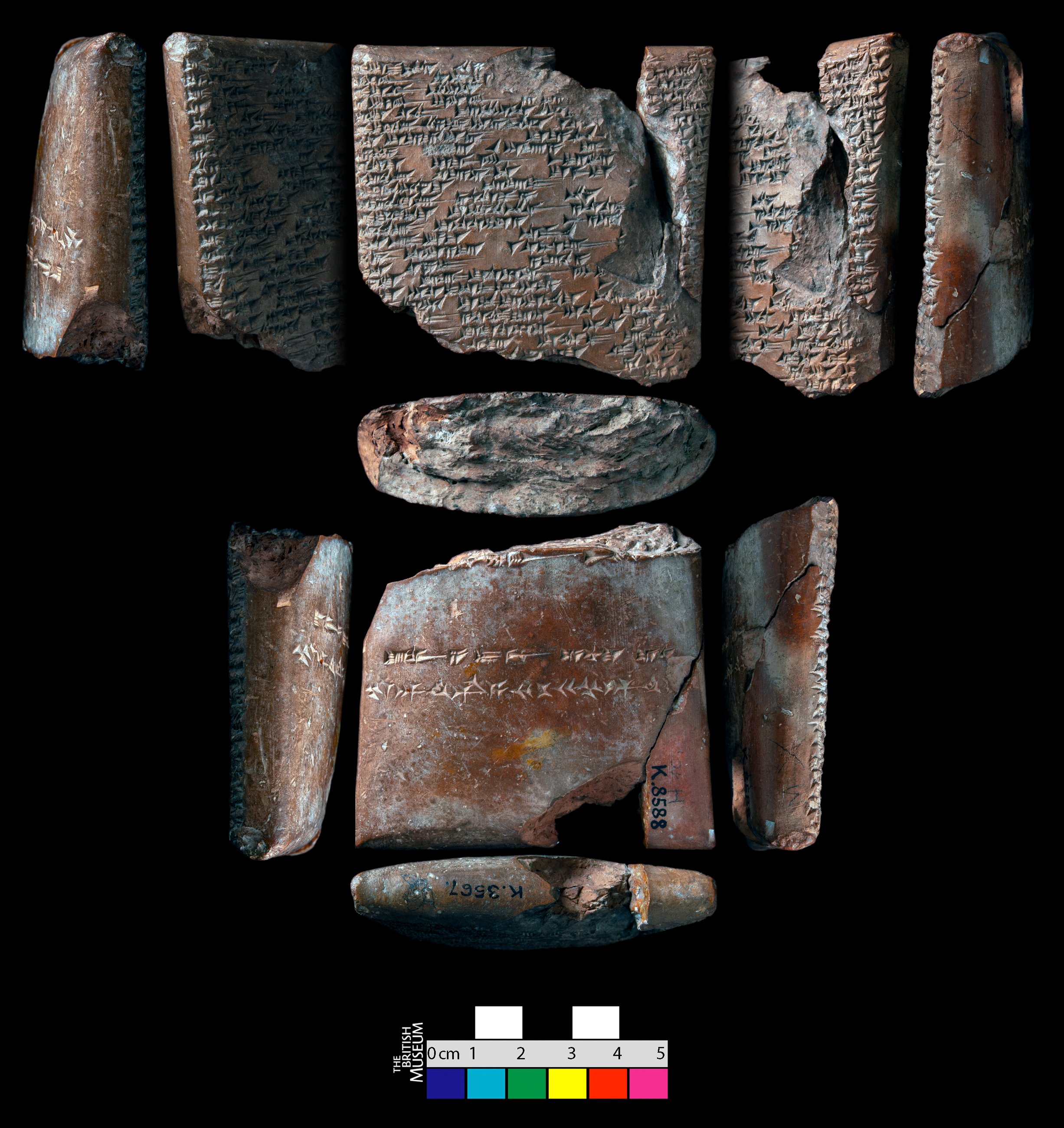
Where on the image
British Museum K.3567: reverse, the tablet's own line 2'. eBL's corpus edition (https://www.ebl.lmu.de/corpus/L/1/2/SB/VI) attributes SB VI 1 to this manuscript at these column and line numbers. Photograph checked: obverse, reverse and edges, ink K.3567 on the bottom edge and K.8588 on a joined piece. About 25 to 27 lines on the obverse, consistent with eBL's 27 obverse lines of Tablet V. The reverse is broken at the top: a damaged row of signs along the broken upper part is eBL's reverse 1'-2' (V 158 lost at r 1', then the catch-line VI 1 at r 2'); after a blank space, the two clear lines in the middle of the reverse are Ashurbanipal's colophon (eBL r 3'-4', 'tup-pi 5.KAM2.ME e-nu-ma e-lis'), as eBL's record of K.3567 for Tablet V (colophon field) gives them. eBL's corpus edition labels this line r 1', the label it also gives V 158; eBL's own transcription of K.3567 (colophon field of its Tablet V record) numbers it r 2', after V 158 at r 1', so it is given here as r 2'. On the photograph it is the damaged row of signs along the broken top of the reverse, not the two clear lines below the blank space, which are Ashurbanipal's colophon. K.3567, a copy of SB V, carries this line as its catch-line: the opening of the next tablet of the series, copied at the end of the previous one (eBL lists catch-lines among its quotations; unlike commentaries and quotations in other texts, a catch-line is the line itself on a copy of the work). On this tablet line 1 is partly broken (square brackets and x in the Akkadian). The English of this line translates eBL's composite text, so it includes words that are not preserved on this tablet but are restored from other manuscripts or by the editors. Square brackets in the English mark eBL's restorations in its composite text; words that survive on other tablets carry no brackets even where this tablet is broken.
1[x x x zik]-ri!?# DINGIR#-MEŠ ina še-me₂#-e#-šu#
1When Marduk had heard the speech of the gods,
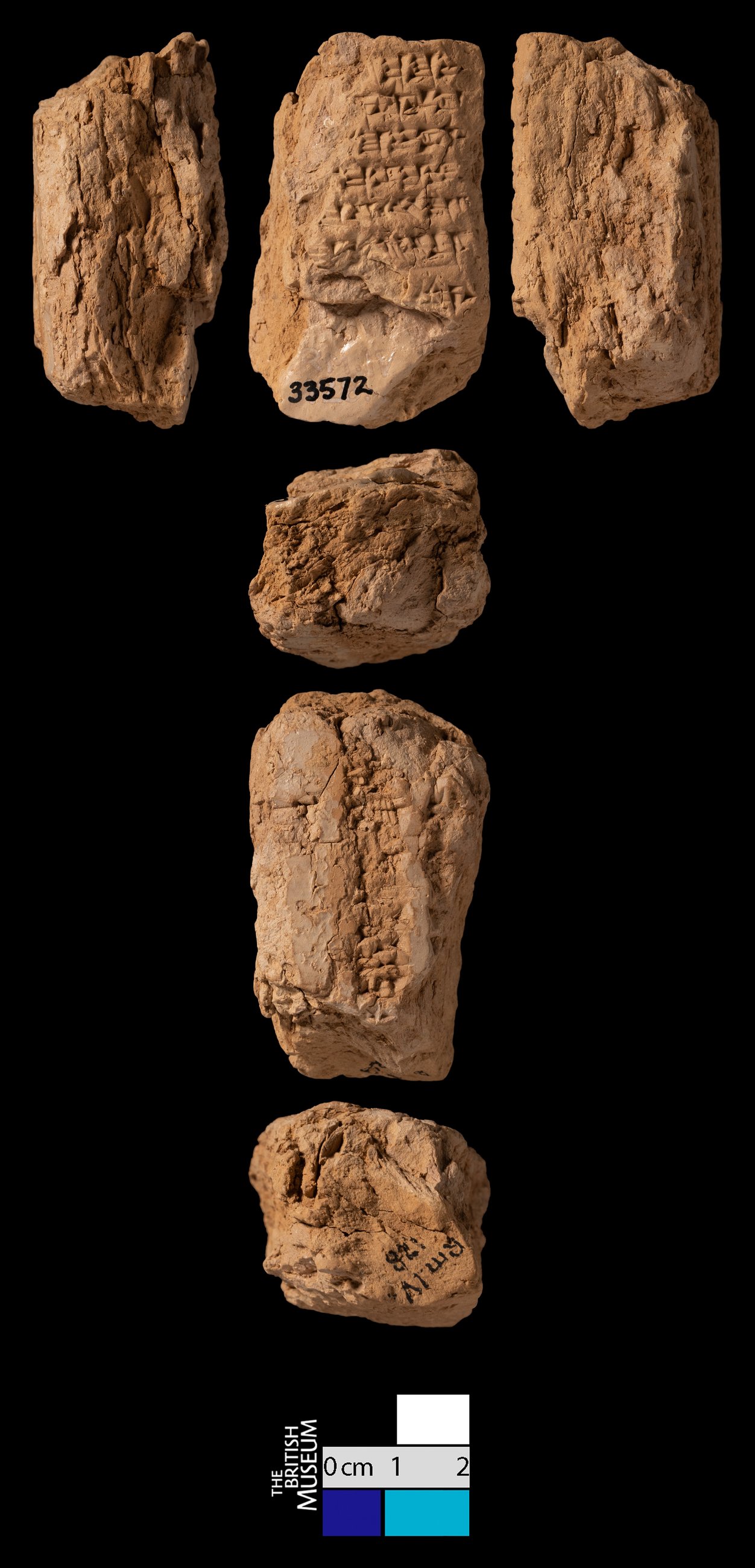
Where on the image
British Museum BM.33572: obverse, the tablet's own lines 1' to 6'. eBL's corpus edition (https://www.ebl.lmu.de/corpus/L/1/2/SB/VI) attributes SB VI 2-7 to this manuscript at these column and line numbers. Photograph checked: obverse, reverse and edges of a small fragment about 2.5 cm wide, ink 33572 on the obverse and Rm IV 128 on an edge. About seven lines on the obverse, consistent with eBL's six; traces on the reverse. eBL classes BM.33572 as a school tablet (a scribal exercise that copies an excerpt of the text), not a library copy of the whole work. It carries these lines as text (eBL's transliteration has no commentary or quotation markup), and it is used because no photographed library copy preserves these lines as well. On this tablet lines 2-7 are partly broken (square brackets and x in the Akkadian). The English of these lines translates eBL's composite text, so it includes words that are not preserved on this tablet but are restored from other manuscripts or by the editors. Square brackets in the English mark eBL's restorations in its composite text; words that survive on other tablets carry no brackets even where this tablet is broken.
2[x x li]b₃-ba-šu i#-b[an-na-a x x x x]
3[x x x x x] a#-na {d}e₂-[a x x x]
4[x x lib₃-b]i-šu i-ta-m[u-u₂ x x x x x]
5[x x lu-uk-ṣu]r-ma eṣ-ma-tu₄ l[u-šab-ši-ma]
6[lu-uš-zi-iz]-ma lu-ul-la-a# [x x x x x x x]
7[lu-ub-bi-m]a LU₂#.U₁₈!?.LU? <<lu?>> a?-m[e?-lu]
2He was resolved to make artful things:
3He would tell his idea to Ea,
4What he thought of in his heart he proposes,
5“I shall compact blood, I shall cause bones to be,
6“I shall make stand a human being, let “Man” be its name.
7“I shall create human beings,
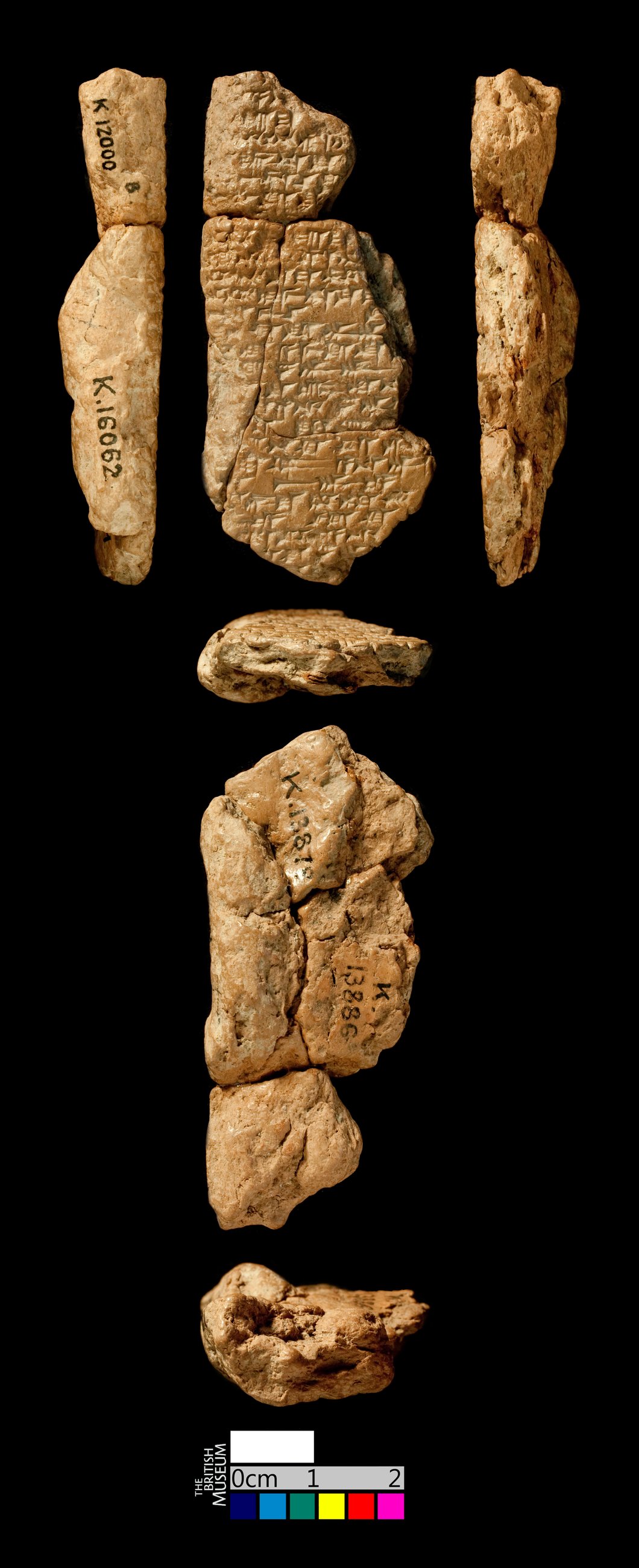
Where on the image
British Museum K.12000.B: obverse, the tablet's own lines 1' to 27'. eBL's corpus edition (https://www.ebl.lmu.de/corpus/L/1/2/SB/VI) attributes SB VI 21-47 to this manuscript at these column and line numbers. Photograph checked: obverse, reverse and edges of a joined fragment, ink K.12000 B and K.16062 on the left edge, K.13886 and K.138.. on the reverse. The obverse has about 27 lines of small script across three joined pieces, consistent with eBL's 27; the reverse is uninscribed. On this tablet of lines 21-23, 39, 47 only one to three signs survive and lines 24-38, 40-46 are partly broken (square brackets and x in the Akkadian). The English of these lines translates eBL's composite text, so it includes words that are not preserved on this tablet but are restored from other manuscripts or by the editors. Square brackets in the English mark eBL's restorations in its composite text; words that survive on other tablets carry no brackets even where this tablet is broken.
21[lu]-u₂# k[i-nam-ma x x x x x x x]
22[ki-n]a-a-t[i x x x x x x x x x x x]
23[man-n]u-um-ma [x x x x x x x x]
24[x] ti-amta uš-b[al-ki-tu₂-ma x x x x x x]
25[l]i-in-na-ad-[nam-ma x x x x x x x x]
26ar-nu-uš-šu₂ lu-[u₂-ša₂-aš₂-ša₂-a x x x x x]
27i#-pu-lu-šu-[ma x x x x x x x x]
28a#-na# {d#}lugal#-[dim₃-me-er-an-ki-a x x x x x x x x]
29{d}qin#-g[u]-um#-ma# [x x x x x x x x]
30(gloss: 10) u₃ ti-amta# uš-ba[l-ki-tu₂-ma x x x x x x]
31ik-mu-šu-ma mah-[riš x x x x x x x]
32an-nam i-mi₃-du-šu-m[a x x x x x x x]
33ina da-mi₃-šu₂ i[b-nu-u₂ x x x x]
34i#-mid dul-li DINGIR.DINGIR-[ma x x x x x]
35[u]l-tu a-me-lu-tu i[b-nu-u x x x x x]
36[dul]-lu ša₂ DINGIR.DINGIR [x x x x x x x]
37[šip-r]u šu-u₂ la n[a-ṭu-u₂ x x x]
38[ina nik-l]a-a-ti ša₂ {d}A[MAR.UTU x x x x x x x]
39[{d}AMAR].UTU šar-ru [x x x x x x]
40[(x) {d}a]-nun-na-ki gim-rat-[su-nu x x x x x]
41u₂#-ad-di a-na {d}a#-[nim x x x x x x]
42[x] GIŠ₃# ina AN-e [x x x x x x]
43[uš-t]aš-ni-ma al-ka-kat₃ [x x x x x]
44[x A]N-e u₃ KI-t[i₃ x x x x x]
45[ul-t]u te-re-e#-ti [x x x x x x x x x]
46[x {d}a-nun-n]a-ki ša₂ AN-e# [x x x x x x x x x x x x]
47[{d}a-nun-na-k]i p[a-a-šu-nu x x x x]
21Let your first reply be the truth!
22Do you speak with me truthful words!
23“Who was it that started the war,
24“Suborned Tiamat and drew up for battle?
25“Let him be given over to me, the one who started the war,
26“I shall make him bear his punishment, you shall dwell in peace.”
27The Igigi, the great gods answered him,
28To Lugaldimmeankia, counselor of the gods, their lord,
29“It was Qingu who made war,
30“Suborned Tiamat and drew up for battle.”
31They bound and held him before Ea,
32They imposed the punishment on him and shed his blood.
33From his blood they (Marduk and Ea) made humankind,
34He imposed the toil of the gods and the gods (from it).
35After Ea the wise had made humankind,
36And had imposed the toil of the gods on them —
37That deed is beyond comprehension,
38By the artifices of Marduk did Nudimmud create —
39Marduk the king divided the gods,
40All the Anunna-gods, all of them, into upper and lower,
41He assigned to Anu for duty at his command.
42Three hundred he posted in heaven for duty,
43A like number he designated for the ways of the netherworld:
44Six hundred he made dwell in heaven and netherworld.
45After he had given all the commands,
46And had divided the shares of the Anunna-gods of heaven and netherworld,
47The Anunna-gods made ready to speak,
Where on the image
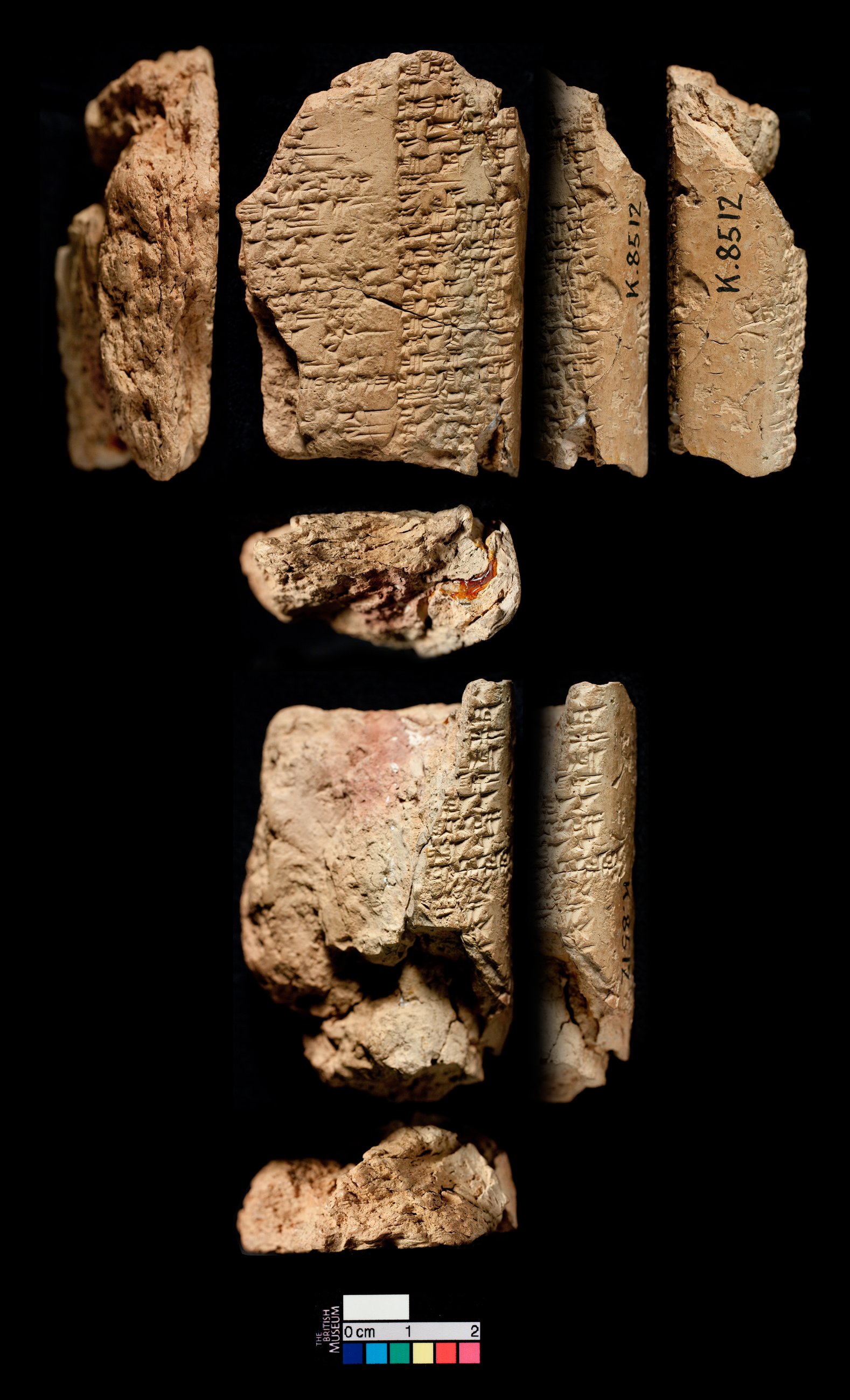
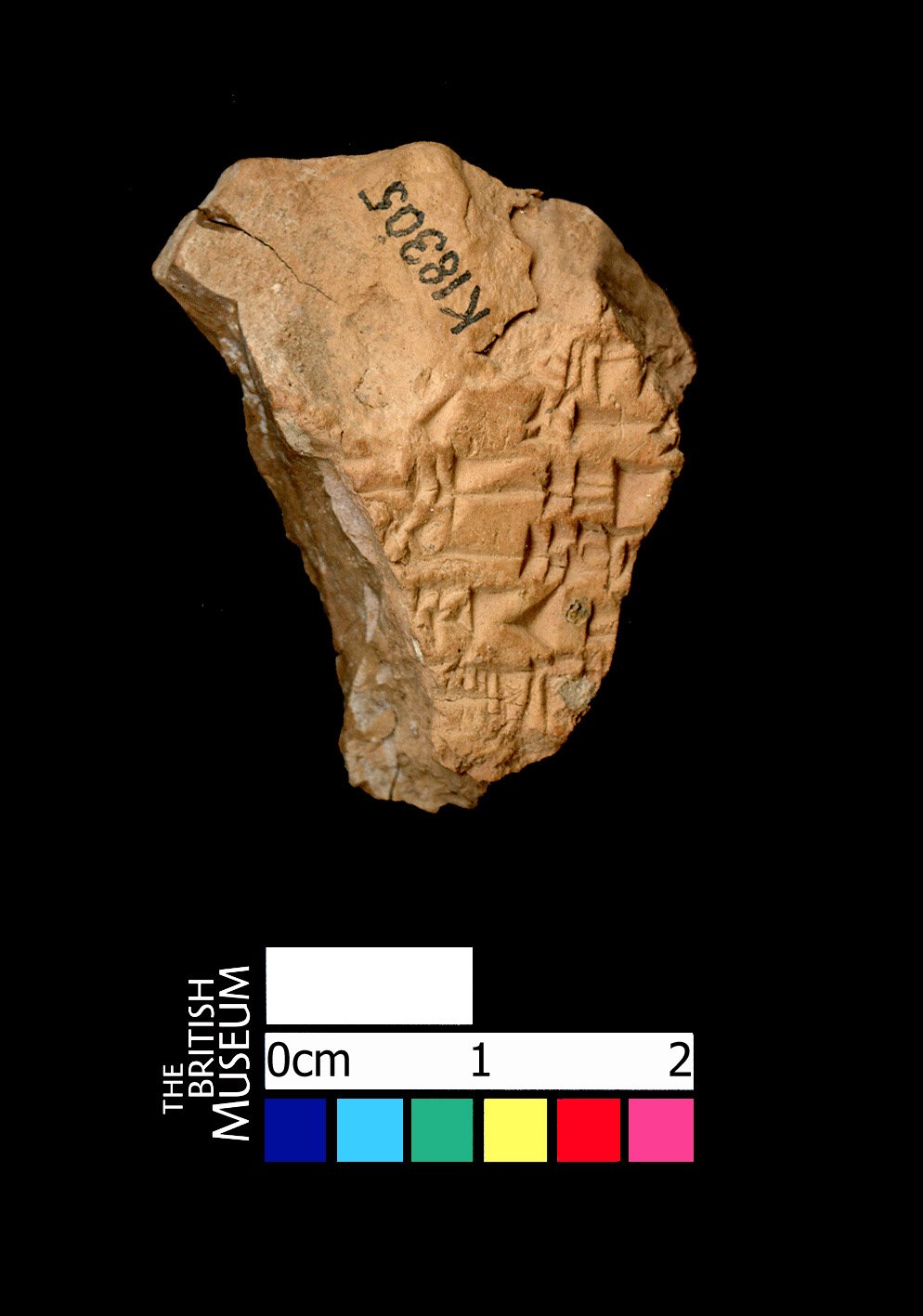
British Museum K.5923: obverse, the tablet's own lines 21' to 23'. eBL's corpus edition (https://www.ebl.lmu.de/corpus/L/1/2/SB/VI) attributes SB VI 48-50 to this manuscript at these column and line numbers. Photograph checked: one face of K.5923 alone, a fragment about 2.5 cm tall with about 12 lines; the joined pieces K.8512 (two columns on the obverse, text on the reverse, ink number K.8512) and K.18305 (about 5 lines) are photographed separately and are linked as well. eBL treats K.5923 + K.8512 + K.18305 as one manuscript and holds a separate photograph of each of these pieces; it does not say which piece carries which line, so the photographs of K.5923 + K.8512 + K.18305 are linked, and the lines are on one or more of them. On this tablet lines 48-50 are partly broken (square brackets and x in the Akkadian). The English of these lines translates eBL's composite text, so it includes words that are not preserved on this tablet but are restored from other manuscripts or by the editors. Square brackets in the English mark eBL's restorations in its composite text; words that survive on other tablets carry no brackets even where this tablet is broken.
48[x x x x x x x x x] šu-nu iz-zak-ru#
49[x x x x x x x šu-bar-ra]-a!?#-ni taš-ku#-nu-ma#
50[x x x x x x x] ina# mah#-ri#-[k]a
48To Marduk their lord they said,
49“Now, Lord, you who have freed us from toil,
50“How may we requite you?
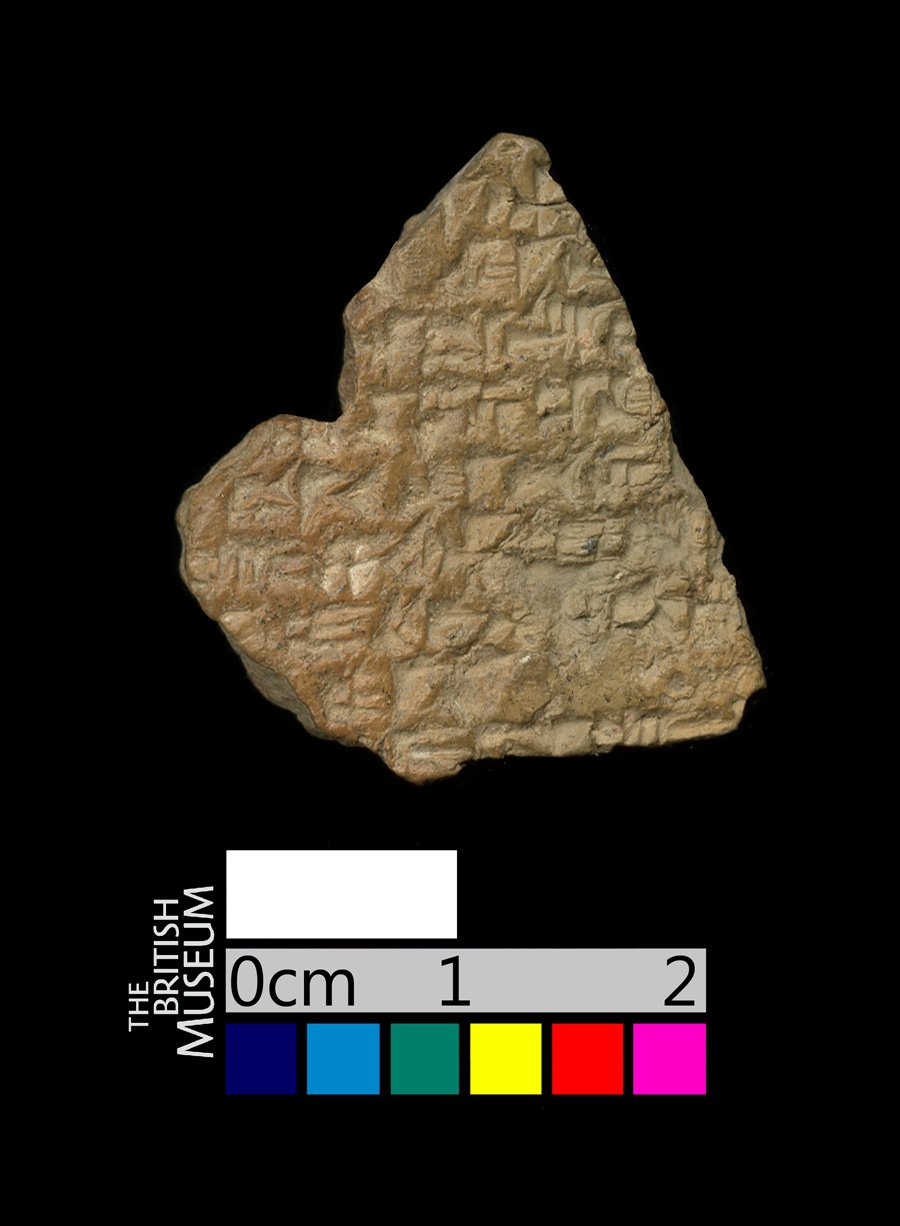
Where on the image
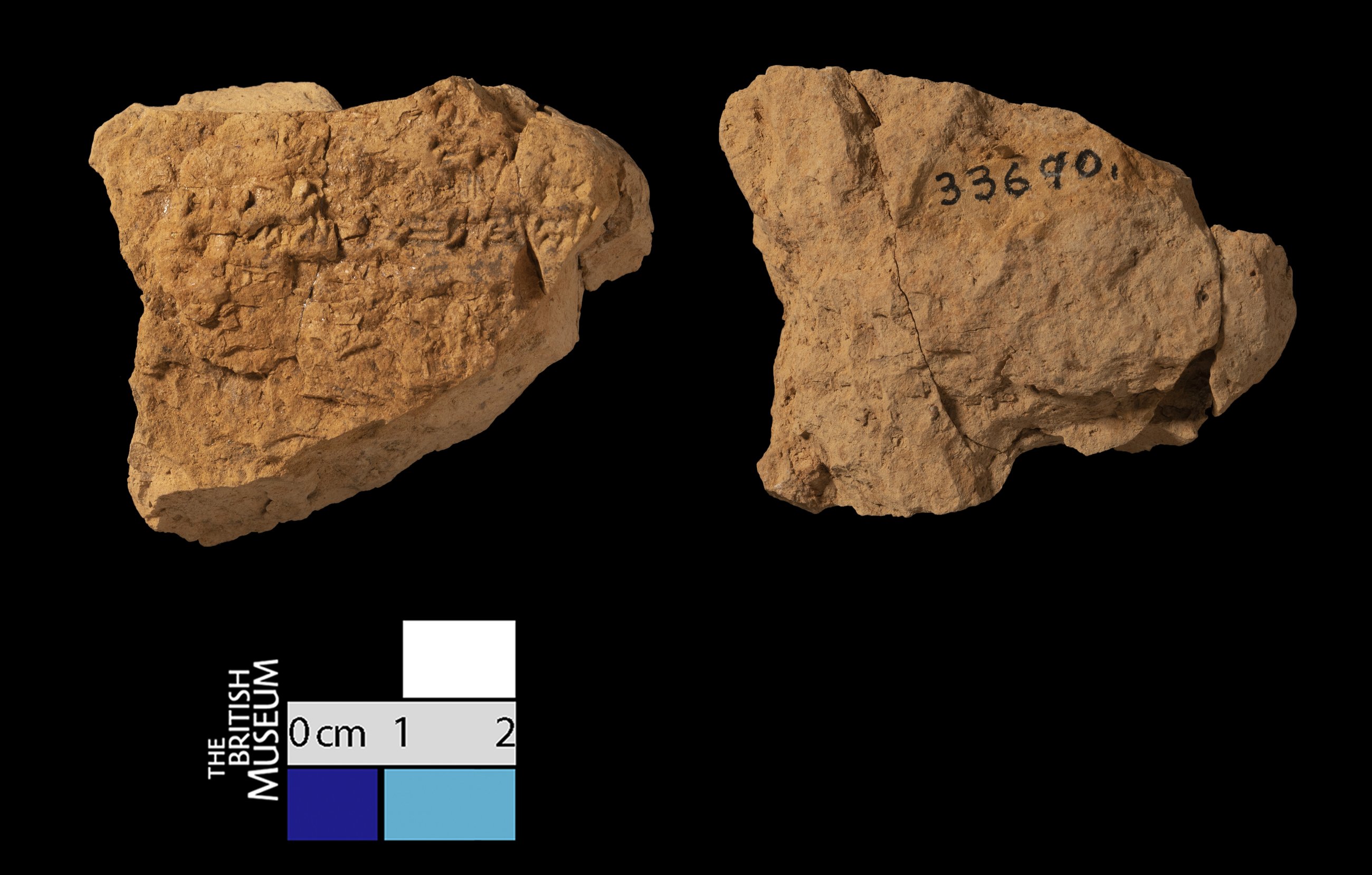
British Museum BM.33690: obverse, the tablet's own lines 4' to 7'. eBL's corpus edition (https://www.ebl.lmu.de/corpus/L/1/2/SB/VI) attributes SB VI 51-54 to this manuscript at these column and line numbers. Photograph checked: inscribed face and uninscribed back only (no edges), ink 33690 on the back. The fragment is about 3.5 cm wide and very worn, with about five or six lines still recognisable; enough surface for eBL's seven obverse lines. eBL classes BM.33690 as a school tablet (a scribal exercise that copies an excerpt of the text), not a library copy of the whole work. It carries these lines as text (eBL's transliteration has no commentary or quotation markup), and it is used because no photographed library copy preserves these lines as well. On this tablet of line 54 only one to three signs survive and lines 51-53 are partly broken (square brackets and x in the Akkadian). The English of these lines translates eBL's composite text, so it includes words that are not preserved on this tablet but are restored from other manuscripts or by the editors. Square brackets in the English mark eBL's restorations in its composite text; words that survive on other tablets carry no brackets even where this tablet is broken.
51[x x x x pa-rak]-ku# ša# n[a-bu]-u₂# zi#-[kir-šu]
52[x x x x x x x] nu-bat-ta-ni# i nu-ša-ap-š[i-ih x x x]
53[x x x x pa-rak-k]u ni-m[e-d]a [x x x]
54[x x x x x ni-ka-aš-ša-d]a i# [x x x x x x x x]
51“We will make a shrine, whose name shall be a byword,
52“Your chamber shall be our stopping place, we shall find rest therein.
53“We shall set up a shrine shrine, we shall reinforce its emplacement,
54“When we come (to visit you), we shall find rest therein.”
Where on the image
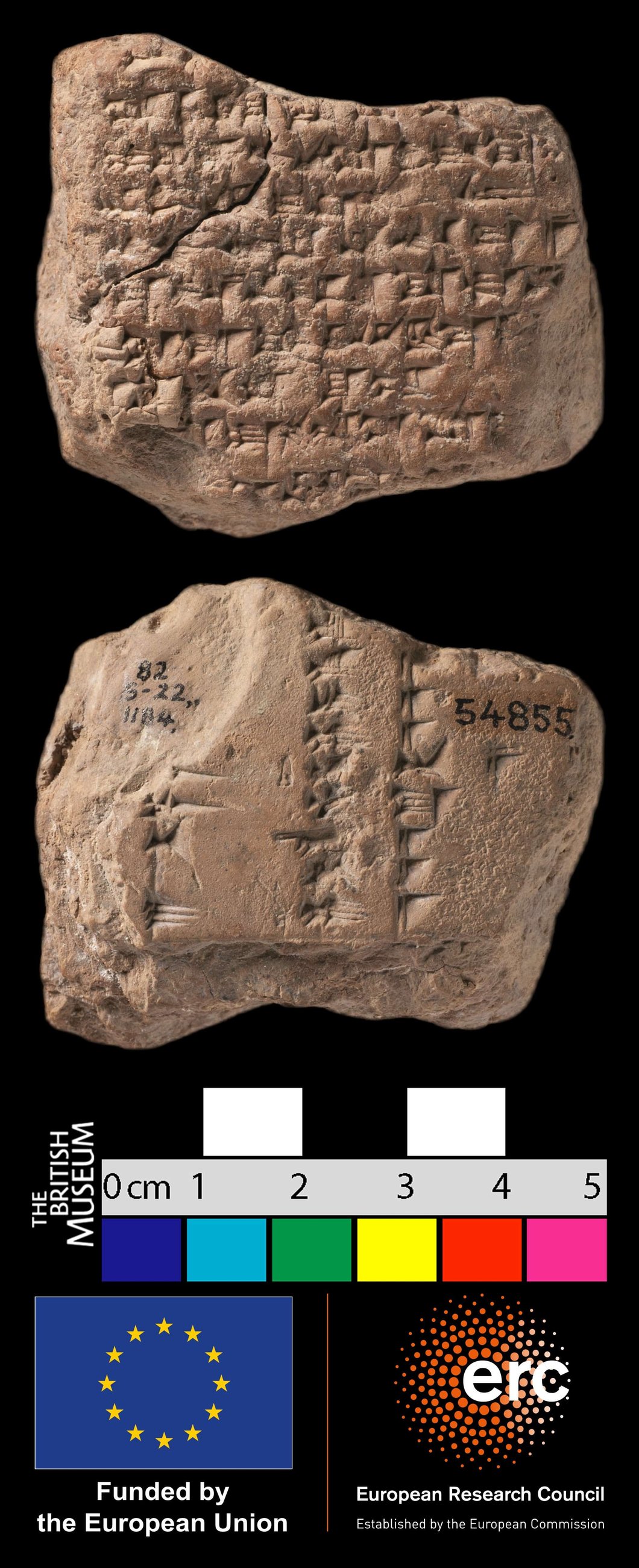
British Museum BM.54855: obverse, the tablet's own lines 4' to 9'. eBL's corpus edition (https://www.ebl.lmu.de/corpus/L/1/2/SB/VI) attributes SB VI 55-60 to this manuscript at these column and line numbers. Photograph checked: obverse and reverse only, ink 54855 and 82-5-22,1184 on the reverse. About nine lines on the obverse, matching eBL's nine; the reverse has a few lines in narrow columns. eBL classes BM.54855 as a school tablet (a scribal exercise that copies an excerpt of the text), not a library copy of the whole work. It carries these lines as text (eBL's transliteration has no commentary or quotation markup), and it is used because no photographed library copy preserves these lines as well. On this tablet lines 55-60 are partly broken (square brackets and x in the Akkadian). The English of these lines translates eBL's composite text, so it includes words that are not preserved on this tablet but are restored from other manuscripts or by the editors. Square brackets in the English mark eBL's restorations in its composite text; words that survive on other tablets carry no brackets even where this tablet is broken.
55[x x x] an-ni-ti i-na še-(erased: ni)-mi-[šu]
56[x x] u₄#-mu im-mi-ru zi-mu-šu₂ ma-a-[diš]
57[ep-š]a₂-ma KA₂.DINGIR.RA{ki#} ša te-ri-[ša₂ x x x]
58[li-ib-na-a]t-su lip-pa-ti-iq-ma pa-r[ak-ka x x x]
59[{d}a-nun-n]a-ki it-ru-ku al-[la]
60[x x x] iš#-ta#-at li-bit-ta-šu# [x x x x]
55When Marduk heard this,
56His features glowed brightly, like the day,
57“Then build Babylon the task as that you requested,
58“Let bricks be formed for it, build high the shrine.”
59The Anunna-gods set to with hoes,
60One (full) year they made its bricks.
Where on the image
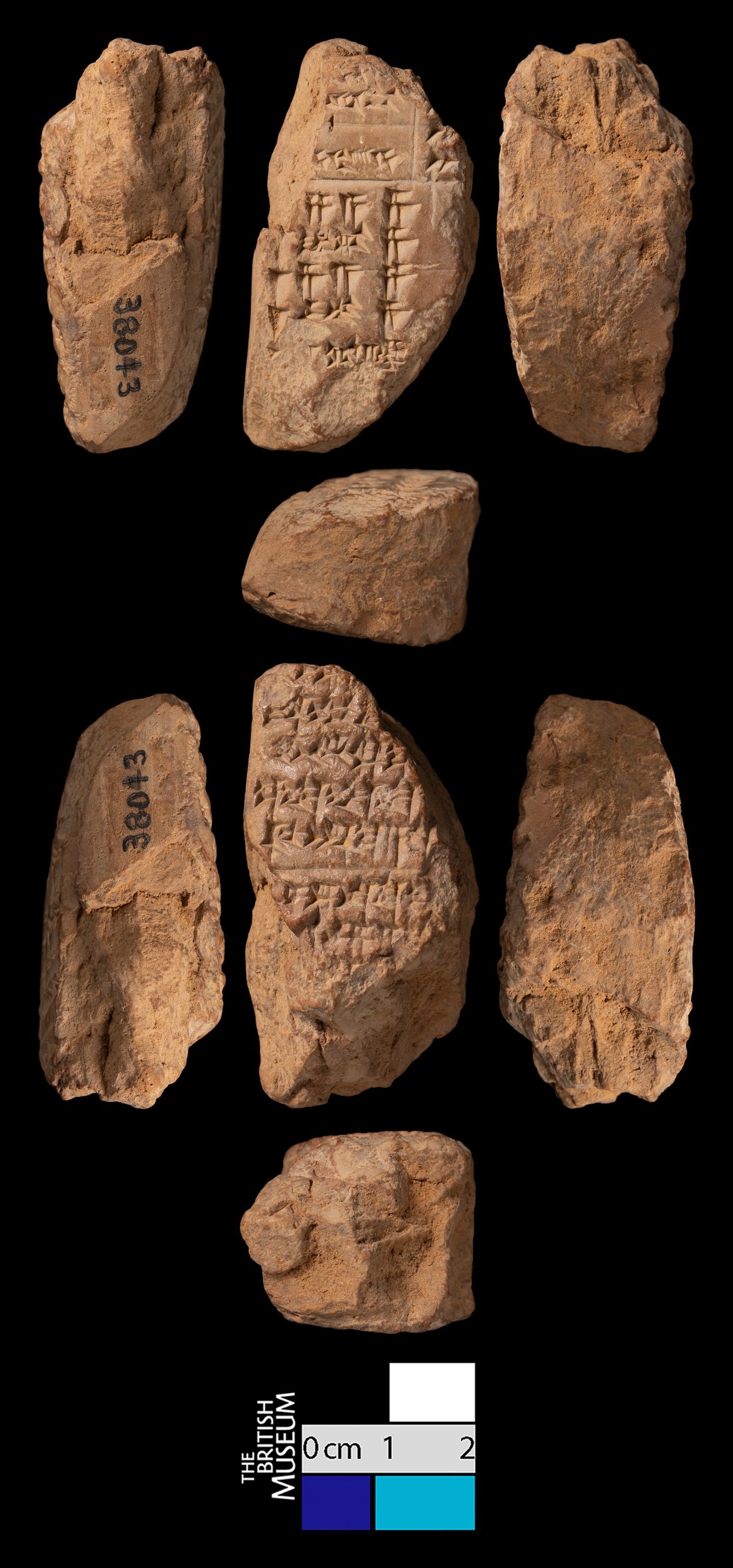
British Museum BM.38043: obverse, the tablet's own lines 6' to 8'. eBL's corpus edition (https://www.ebl.lmu.de/corpus/L/1/2/SB/VI) attributes SB VI 68-70 to this manuscript at these column and line numbers. Photograph checked: obverse, reverse and edges, ink 38043 on the left edge. About three to four lines of large signs at the top of the obverse plus ruled divisions; consistent with eBL's three obverse lines. The other face also carries about eight lines. eBL classes BM.38043 as a school tablet (a scribal exercise that copies an excerpt of the text), not a library copy of the whole work. It carries these lines as text (eBL's transliteration has no commentary or quotation markup), and it is used because no photographed library copy preserves these lines as well. On this tablet of line 70 only one to three signs survive and lines 68-69 are partly broken (square brackets and x in the Akkadian). The English of these lines translates eBL's composite text, so it includes words that are not preserved on this tablet but are restored from other manuscripts or by the editors. Square brackets in the English mark eBL's restorations in its composite text; words that survive on other tablets carry no brackets even where this tablet is broken.
68{d#}a#-nun-na-ki k[a-li-šu-nu x x x x x x x x]
69[x G]IŠ₃ {d}i₂-gi₃-gi₃ š[a x x x x x x x x x x x x x]
70[x x i-n]a [x x x x x x x x x]
68All the Anunna-gods devised their own shrines.
69The three hundred Igigi-gods of heaven and the six hundred of Apsu all convened.
70The Lord, on the Exalted Dais, which they built as his dwelling,
Where on the image
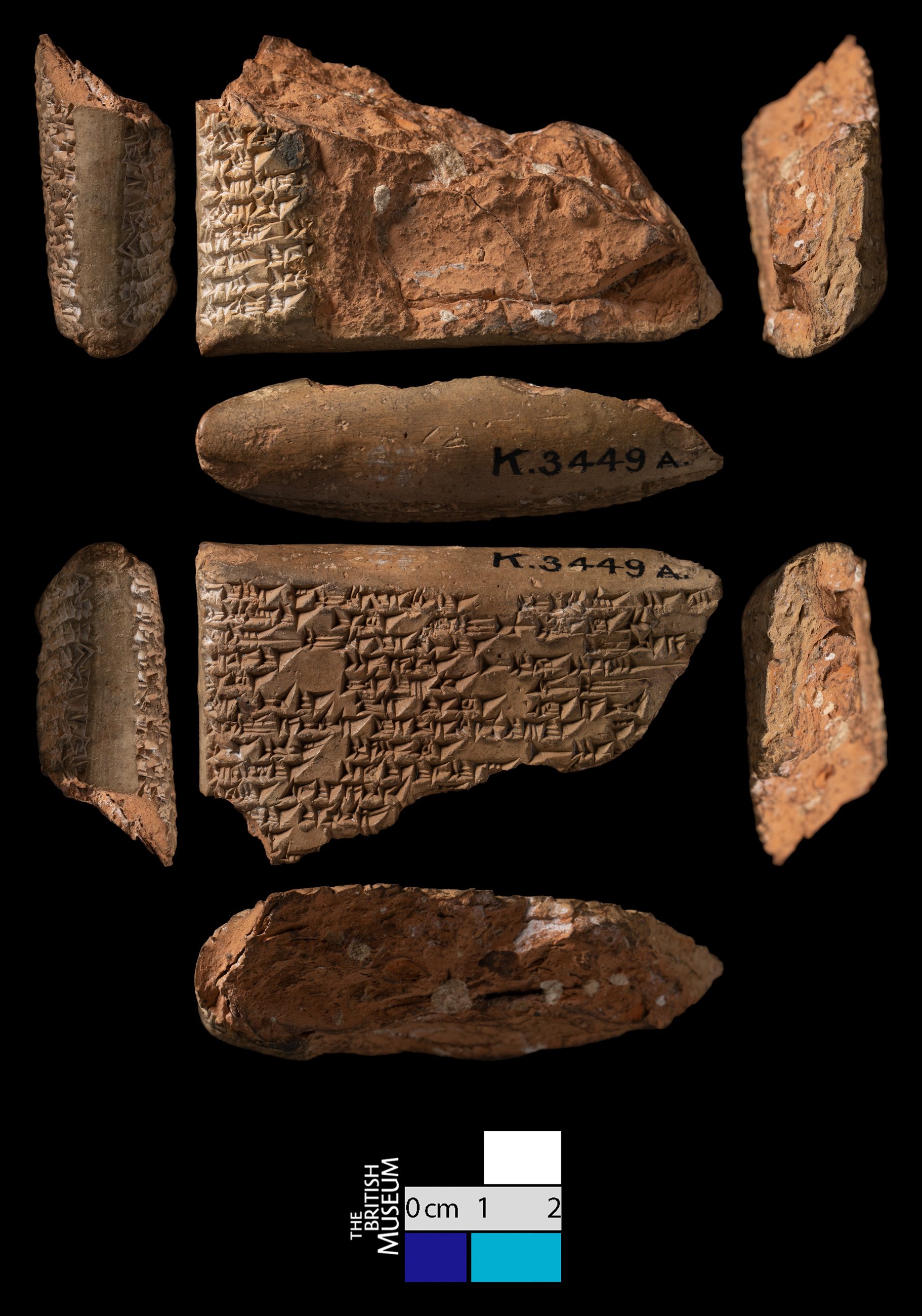
British Museum K.3449.A: obverse, the tablet's own lines 1' to 9'. eBL's corpus edition (https://www.ebl.lmu.de/corpus/L/1/2/SB/VI) attributes SB VI 74-82 to this manuscript at these column and line numbers. Photograph checked: obverse, reverse and edges, ink K.3449 A on the top edge and reverse. About 9 to 10 lines along the left of the obverse and about 13 lines across the reverse, matching eBL's 9 and 13. On this tablet of lines 74-76, 78, 81-82 only one to three signs survive and lines 77, 79-80 are partly broken (square brackets and x in the Akkadian). The English of these lines translates eBL's composite text, so it includes words that are not preserved on this tablet but are restored from other manuscripts or by the editors. Square brackets in the English mark eBL's restorations in its composite text; words that survive on other tablets carry no brackets even where this tablet is broken.
74u₂-[ši-bu-ma x x x x]
75zar-ba-bu# [x x x x x x x x x x]
76iš-tu n[i-gu-tu₂ x x x x x x]
77ina e₂-sag-g[il x x x x x x x x x x x]
78kun-na [x x x x x x x x x x x x x]
79man-za-az AN#-[e x x x x x x x x x x x x x]
80DINGIR-MEŠ GAL-M[EŠ x x x x x x x x]
81DINGIR-MEŠ NA[M-MEŠ x x x x x x x x x x]
82im-hur-ma [x x x x x x x x x x x x]
74The great gods sat down,
75They set out cups, they sat down at the feast.
76After they had taken their enjoyment inside it,
77In awe-inspiring Esagila they held a ceremony,
78All the orders and plans were made permanent,
79All the gods divided the stations of heaven and netherworld,
80The fifty of the great gods took their thrones,
81The seven gods of destinies were confirmed forever for rendering judgment.
82The Lord took the bow, his weapon, and laid it before them,
Where on the image
British Museum K.3449.A: reverse, the tablet's own lines 1 to 9. eBL's corpus edition (https://www.ebl.lmu.de/corpus/L/1/2/SB/VI) attributes SB VI 83-91 to this manuscript at these column and line numbers. Photograph checked: obverse, reverse and edges, ink K.3449 A on the top edge and reverse. About 9 to 10 lines along the left of the obverse and about 13 lines across the reverse, matching eBL's 9 and 13. On this tablet lines 83-91 are partly broken (square brackets and x in the Akkadian). The English of these lines translates eBL's composite text, so it includes words that are not preserved on this tablet but are restored from other manuscripts or by the editors. Square brackets in the English mark eBL's restorations in its composite text; words that survive on other tablets carry no brackets even where this tablet is broken.
83sa-pa-ra ša₂ i-te-ep-pu-šu i-mu-ru DINGIR-MEŠ [x x x]
84i-mu-ru-ma {giš}BAN ki-i nu-uk-ku-lat b[i-nu-ta]
85ep-šet i-te-ep-pu-šu i-na-a-d[u!?/d[a!? x x x]
86iš-ši-ma {d}a-num ina UKKIN DINGIR-MEŠ [x x x]
87{giš}BAN it-ta-šiq ši-i [x x x x]
88im-bi-ma ša {giš}BAN ki-a-am [x x x]
89i-ṣu a-rik lu iš-te-nu-um-ma ša₂-n[u-u x x x x]
90šal-šu₂ šum-ša₂ MUL BAN ina AN-e# [x x x]
91u₂-kin-ma gi-is-gal-la-ša₂# it#-t[i x x x x x x]
83The gods his fathers looked upon the net he had made.
84They saw how artfully the bow was fashioned,
85His fathers were full of praises for his handiwork.
86Anu raised (it), speaking to the assembly of the gods,
87He kissed the bow, “This be my daughter!”
88He named the bow, these are its names:
89‘Longwood’ shall be the first, ‘May It Be on Target’ shall be the second.”
90The third name, ‘Bow Star’, he made visible in heaven,
91He fixed its position in the sky with respect to the gods his brethren.
Where on the image
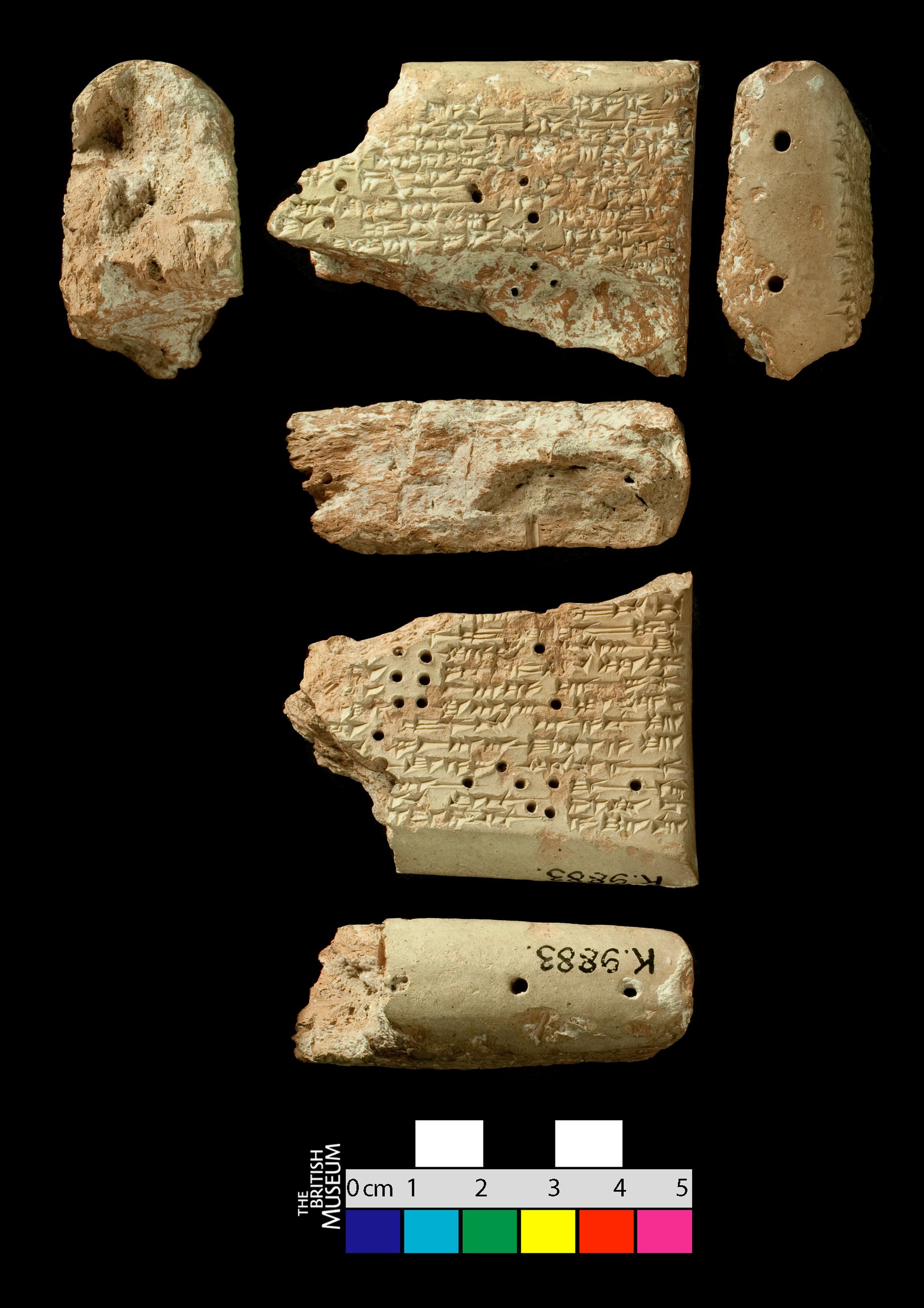
British Museum K.9883: obverse, the tablet's own lines 8 to 13. eBL's corpus edition (https://www.ebl.lmu.de/corpus/L/1/2/SB/VI) attributes SB VI 92-97 to this manuscript at these column and line numbers. Photograph checked: obverse, reverse and edges, ink K.9883 on the reverse and bottom edge. About 12 to 13 lines on each face, consistent with eBL's 13 and 13. On this tablet of line 95 only one to three signs survive and lines 92-94, 96-97 are partly broken (square brackets and x in the Akkadian). The English of these lines translates eBL's composite text, so it includes words that are not preserved on this tablet but are restored from other manuscripts or by the editors. Square brackets in the English mark eBL's restorations in its composite text; words that survive on other tablets carry no brackets even where this tablet is broken.
92[x x x x x x x {giš}B]AN i-ši-mu {d}a-nu-um
93[x x x x x x LUGAL-u₂-t]i ša₂ ina DINGIR.DINGIR ša-qa-a-ta
94[x x x x x x DINGIR.DINGI]R šu-a-ša₂ ul-te-šib-ši
95[x x x x x DINGIR].DINGIR GAL-MEŠ
96[x x x x x ul-l]u-u šu-nu uš-kin-nu
97[x x x x x x r]a-ma-ni-šu₂-nu a-ra-ru
92After Anu had ordained the destinies of the bow,
93He set up royal throne that stood highest among the gods,
94Anu had him sit there, in the assembly of the gods.
95Then the great gods convened,
96They exalted Marduk's destiny, they prostrated themselves.
97They laid upon themselves a curse (if they broke the oath),
Where on the image
British Museum K.9883: reverse, the tablet's own lines 1 to 13. eBL's corpus edition (https://www.ebl.lmu.de/corpus/L/1/2/SB/VI) attributes SB VI 98-110 to this manuscript at these column and line numbers. Photograph checked: obverse, reverse and edges, ink K.9883 on the reverse and bottom edge. About 12 to 13 lines on each face, consistent with eBL's 13 and 13. On this tablet of lines 108-110 only one to three signs survive and lines 98-107 are partly broken (square brackets and x in the Akkadian). The English of these lines translates eBL's composite text, so it includes words that are not preserved on this tablet but are restored from other manuscripts or by the editors. Square brackets in the English mark eBL's restorations in its composite text; words that survive on other tablets carry no brackets even where this tablet is broken.
98[x x x x x x x x x] u₂#-lap-pi#-tu₄# nap-ša₂-a-ti
99[x x x x x x x x] DINGIR#.DINGIR e-pi-i-šu₂
100[x x x x x x x AN]-e# u# KI#-ti₃ šu-nu# uk-tin-nu-šu
101[x x x x] an#-šar₂# {d}asar-lu₂-hi it#-ta#-bi šu-uš-šu₂
102[x x x x x qa-be₂]-e# ni-il-bi-na# ap-pa
103[x x x x x] šu₂-nu li#-pi-qu-šu₂
104[x x x x] lu-u šu-tu-rat e-liš u sap-liš#
105[x x šu-uš-qu]-u#-ma DUMU mu-tir gi#-mil#-li-ni#
106[x x x lu]-u# šu#-tu-rat ša₂-ni-na a-a ir-š[i]
107[x x x x re]-u₂#-ti# ṣal#-mat# SAG#.DU# bi-na-tuš-šu₂
108[x x x x x x x x x x x x x a]l-kat₃-su
109[x x x x x x x x x x GAL]-MEŠ
110[x x x x x x x x x eš-re-su-u]n
98With water and oil they swore, they touched their throats.
99They granted him exercise of kingship over the gods,
100They established him forever for lordship of heaven and netherworld.
101Anshar gave him his illustrious name, Asalluhi,
102“When his name is spoken, we will all do obeisance,
103“At his command the gods shall pay heed.
104“His word shall be supreme above and below,
105“The son, our champion, shall be the highest.
106“His lordship shall be supreme, he shall have no rival,
107“He shall be the shepherd of the people of this land, his creatures.
108“They shall tell of his ways, without forgetting, in the future.
109“He shall establish for his fathers great food offerings,
110“He shall provide for them, he shall take care of their sanctuaries.
Where on the image
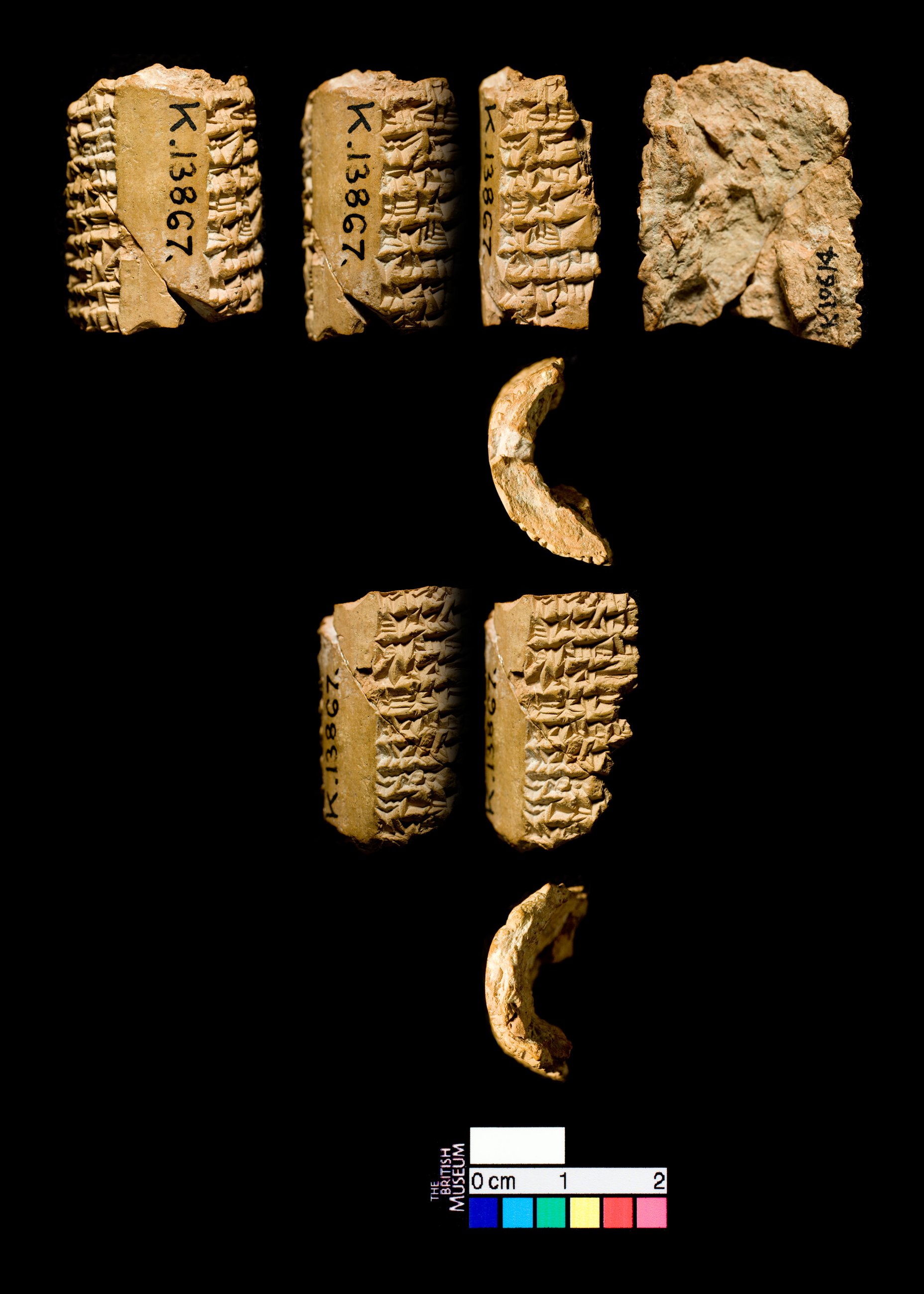
British Museum K.13867: reverse, the tablet's own lines 1' to 10'. eBL's corpus edition (https://www.ebl.lmu.de/corpus/L/1/2/SB/VI) attributes SB VI 117-126 to this manuscript at these column and line numbers. Photograph checked: several angled views of a curved fragment (corner of a tablet), ink K.13867 on the edge and K.10614 on a joined piece. About nine to ten lines on each inscribed face, consistent with eBL's 9 obverse and 10 reverse. On this tablet of lines 119, 121-122, 124, 126 only one to three signs survive and lines 117-118, 120, 123, 125 are partly broken (square brackets and x in the Akkadian). The English of these lines translates eBL's composite text, so it includes words that are not preserved on this tablet but are restored from other manuscripts or by the editors. Square brackets in the English mark eBL's restorations in its composite text; words that survive on other tablets carry no brackets even where this tablet is broken.
117a#-a# im#-ma#-[ša₂-a x x x x x x]
118ma-ti-ši-n[a x x x x x x x x x x x x]
119lu-u₂ z[i-za-ma x x x x x x x]
120(gloss: 10) na-ši m[a-la x x x x x x x x x x x x]
121i nim-bi#-[ma x x x x x x x]
122al-ka-tu[š x x x x x x x x x x x x]
123{d}AMAR.UTU š[a₂ x x x x x x x x x x x x x x x]
124ša₂-kin [x x x x x x x x x x x x x x]
125ša₂ ina {giš}T[UKUL-šu₂ x x x x x x x x x]
126DINGIR#-MEŠ# [x x x x x x x x x x]
117“Let (these) not be forgotten, let them sustain their gods.
118“Let their holy places be conspicuous, let their sanctuaries be well built.
119“Though the people of this land be divided as to gods,
120“For us, whatever name we pronounce, he shall be our god.
121“Let us pronounce his fifty names,
122“That his ways shall be (thereby) manifest, his deeds likewise(?):
123“(1) MARDUK! Who, at his birth, was named by his forefather Anu,
124“Establisher of pasture and watering place, who enriches (their) stables,
125“Who by his Deluge weapon subdued the clangorous,
126“Who rescued the gods his forefathers in distress.
Where on the image
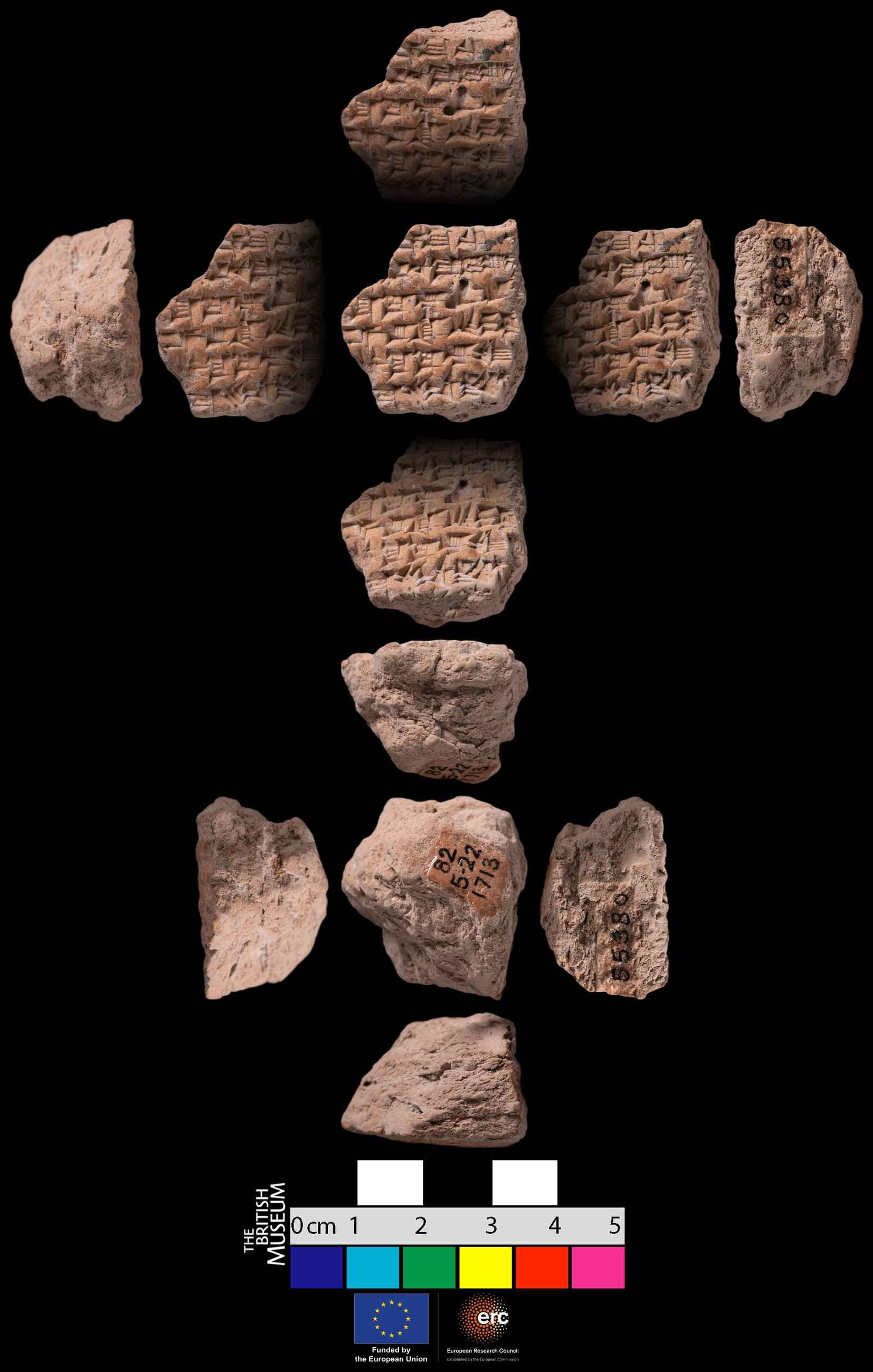
British Museum BM.55380: obverse, the tablet's own lines 1' to 2'. eBL's corpus edition (https://www.ebl.lmu.de/corpus/L/1/2/SB/VI) attributes SB VI 130-131 to this manuscript at these column and line numbers. Photograph checked: obverse, reverse and all edges, ink 55380 on the edges and 82-5-22,1713 on the reverse. About seven to eight lines on the obverse, consistent with eBL's seven plus one unplaced line; reverse uninscribed. eBL classes BM.55380 as a school tablet (a scribal exercise that copies an excerpt of the text), not a library copy of the whole work. It carries these lines as text (eBL's transliteration has no commentary or quotation markup), and it is used because no photographed library copy preserves these lines as well. On this tablet of line 130 only one to three signs survive and line 131 is partly broken (square brackets and x in the Akkadian). The English of these lines translates eBL's composite text, so it includes words that are not preserved on this tablet but are restored from other manuscripts or by the editors. Square brackets in the English mark eBL's restorations in its composite text; words that survive on other tablets carry no brackets even where this tablet is broken.
130[x x x x x x x š]u-[nu x x x x]
131[x x x x x x na]p-šu-ru# e#-[ne₂-nu]
130“He imposed the gods' toil, that they be released.
131“Creation, destruction, absolution, punishment:
Where on the image
British Museum BM.55380: the inscribed face, the tablet's own line 3'. eBL's corpus edition (https://www.ebl.lmu.de/corpus/L/1/2/SB/VI) attributes SB VI 132 to this manuscript at these column and line numbers. Photograph checked: obverse, reverse and all edges, ink 55380 on the edges and 82-5-22,1713 on the reverse. About seven to eight lines on the obverse, consistent with eBL's seven plus one unplaced line; reverse uninscribed. eBL classes BM.55380 as a school tablet (a scribal exercise that copies an excerpt of the text), not a library copy of the whole work. It carries these lines as text (eBL's transliteration has no commentary or quotation markup), and it is used because no photographed library copy preserves these lines as well. On this tablet line 132 is partly broken (square brackets and x in the Akkadian). The English of this line translates eBL's composite text, so it includes words that are not preserved on this tablet but are restored from other manuscripts or by the editors. Square brackets in the English mark eBL's restorations in its composite text; words that survive on other tablets carry no brackets even where this tablet is broken.
132[x x x x x] na#-an-nu-šu lu-u₂ na[p-lu-su x x x x x]
132“Each shall be at his command, they shall look to him.
Where on the image
British Museum BM.55380: obverse, the tablet's own lines 4' to 8'. eBL's corpus edition (https://www.ebl.lmu.de/corpus/L/1/2/SB/VI) attributes SB VI 133-137 to this manuscript at these column and line numbers. Photograph checked: obverse, reverse and all edges, ink 55380 on the edges and 82-5-22,1713 on the reverse. About seven to eight lines on the obverse, consistent with eBL's seven plus one unplaced line; reverse uninscribed. eBL classes BM.55380 as a school tablet (a scribal exercise that copies an excerpt of the text), not a library copy of the whole work. It carries these lines as text (eBL's transliteration has no commentary or quotation markup), and it is used because no photographed library copy preserves these lines as well. On this tablet lines 133-137 are partly broken (square brackets and x in the Akkadian). The English of these lines translates eBL's composite text, so it includes words that are not preserved on this tablet but are restored from other manuscripts or by the editors. Square brackets in the English mark eBL's restorations in its composite text; words that survive on other tablets carry no brackets even where this tablet is broken.
133[{d}ma-ru-u]k-ku lu-u₂ [DI]NGIR.DINGIR [x x x x x x]
134[x x x x] {d#}a-nun-ki mu-šap#-[ši-hu x x x x]
135[{d}ma-ru-tu]-uk#-ku lu-u₂ t[u-kul-tu₄ x x x x x x x x]
136[ša-a-šu-m]a li-it-t[a-ʾ-i-da-šu x x x x x]
137[x x x x x] e#-zi!?#-<iz> muš!?#-ta!?#-[al x x x x x x x (x)]
133“(2) MARUKKA shall he be, the god who created them (humankind),
134“Who granted (thereby) the Anunna-gods contentment, who let the Igigi-gods rest.
135“(3) MARUTUKKU shall be the trust of his land, city, and people,
136“The people shall heed him hereafter.
137“(4) MERSHAKUSHU, angry but deliberative, furious but relenting,
Where on the image
British Museum K.5923: reverse, the tablet's own lines 4' to 14'. eBL's corpus edition (https://www.ebl.lmu.de/corpus/L/1/2/SB/VI) attributes SB VI 138-148 to this manuscript at these column and line numbers. Photograph checked: one face of K.5923 alone, a fragment about 2.5 cm tall with about 12 lines; the joined pieces K.8512 (two columns on the obverse, text on the reverse, ink number K.8512) and K.18305 (about 5 lines) are photographed separately and are linked as well. eBL treats K.5923 + K.8512 + K.18305 as one manuscript and holds a separate photograph of each of these pieces; it does not say which piece carries which line, so the photographs of K.5923 + K.8512 + K.18305 are linked, and the lines are on one or more of them. On this tablet of lines 138, 147 only one to three signs survive and lines 139-146, 148 are partly broken (square brackets and x in the Akkadian). The English of these lines translates eBL's composite text, so it includes words that are not preserved on this tablet but are restored from other manuscripts or by the editors. Square brackets in the English mark eBL's restorations in its composite text; words that survive on other tablets carry no brackets even where this tablet is broken.
138[x x x x x x x x x x ka]r-as#-su
139[x x x x x x x x x x x x (x) nim-bu]-u pu-h[u]r-ni
140[x x x x x x x x x UG]U DINGIR.DINGIR AD.AD#-šu₂
141[x x x x x x x x x] u# KI-ti₃# ka-li#-šu₂-un
142[x x x x x x x x x šu]-ʾ#-du-ru e#-liš u šap#-liš
143[x x x x x x x x] šum-šu₂ ša₂ ni-iz-ku#-ru# a-šir₃# DINGIR.DINGIR AD.AD-šu₂
144[x x x x x x x it-ta-a]d-du-u šu-bat-ni [x pu-uš-q]i₃
145[x x x x x x x x x x x] u₂-za-ʾ-i-z[u man]-za-za
146[x x x x x liš-ta]r-i-bu li#-nu-u₂#-[šu₂ x šub]-ti
147[x x x x x x x x x x x] AD-šu₂ [{d}a-nu]m
148[x x x x x x x x x] IGI#.DU#-u₂ d[an-nu]
138“Deep is his heart, all encompassing his feelings.
139“(5) LUGALDIMMERANKIA is his name that we all pronounced,
140“Whose commands we exalted above those of the gods his fathers.
141“He shall be Lord of All the Gods of Heaven and Netherworld,
142The king at whose disclosures the gods above and below stand in awe.
143“(6) NARI-LUGALDIMMERANKIA is the name we invoked, mentor of all the gods,
144“Who founded for us dwellings in heaven and netherworld in time of crisis,
145“Who divided the positions of the Igigi- and Anunna-gods,
146“At his name the gods shall tremble and quake in (their) dwellings.
147“(7) ASALLUHI is that name of his which Anu, his father, pronounced,
148“He shall be the light of the gods, the mighty defender,
Where on the image
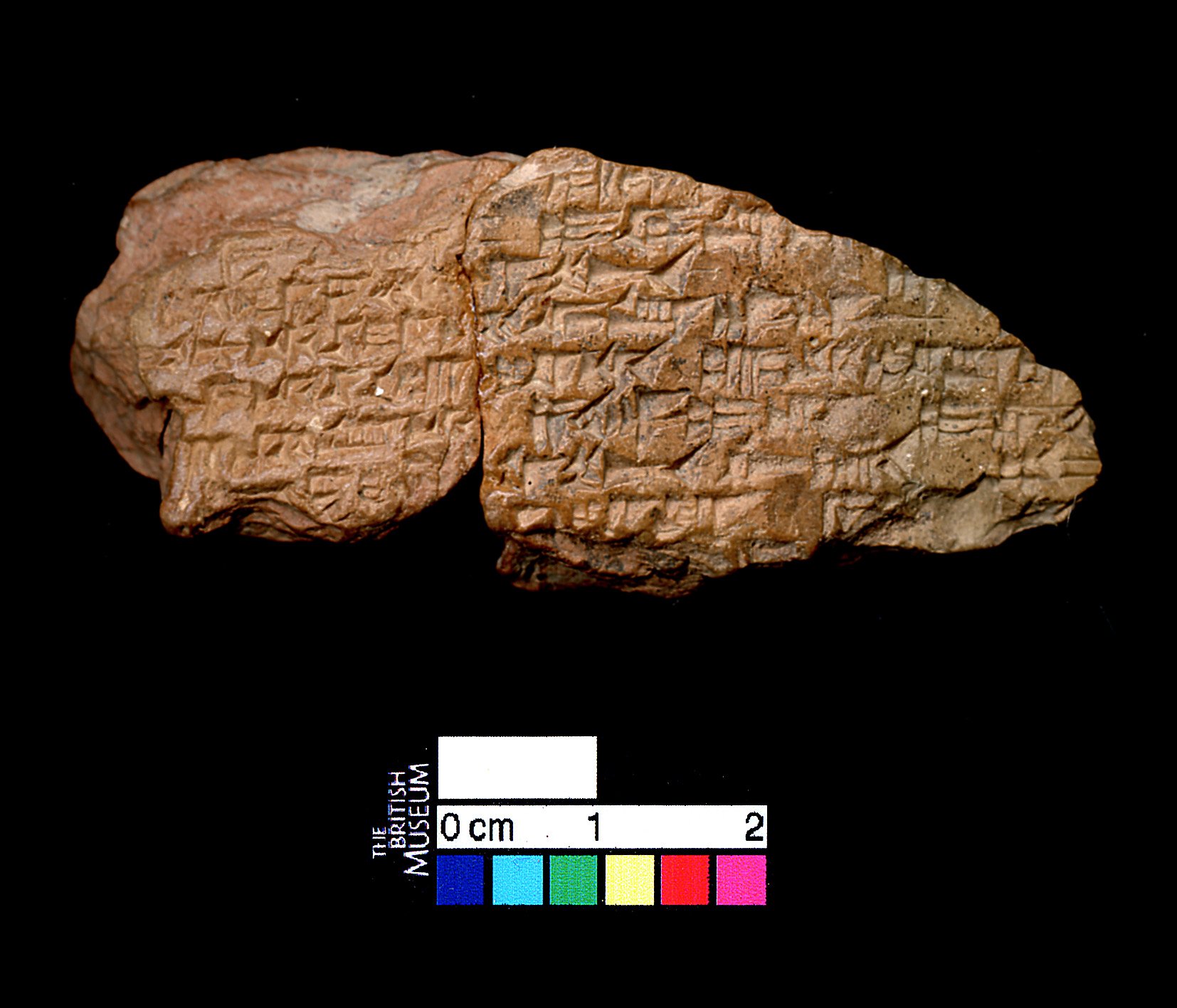
British Museum K.13865: reverse, the tablet's own lines 1' to 9'. eBL's corpus edition (https://www.ebl.lmu.de/corpus/L/1/2/SB/VI) attributes SB VI 149-157 to this manuscript at these column and line numbers. Photograph checked: one face of a fragment made of two joined pieces (join line visible), about 3.5 cm wide; no ink number visible. About nine lines, matching eBL's nine reverse lines. On this tablet of lines 149, 157 only one to three signs survive and lines 150-156 are partly broken (square brackets and x in the Akkadian). The English of these lines translates eBL's composite text, so it includes words that are not preserved on this tablet but are restored from other manuscripts or by the editors. Square brackets in the English mark eBL's restorations in its composite text; words that survive on other tablets carry no brackets even where this tablet is broken.
149[x x x x x x x] la#-mas#-[si x x x x x]
150[x ša₂-aš₂]-mi₃ dan#-ni# i-ṭi-ru šu#-[bat-ni x x x x]
151[x x x x-{d}nam]-ti-la ša₂-niš im#-bu-u DIN[GIR x x x]
152[x x x b]i-nu-ti-šu₂-ma ik#-ši-ru DINGIR.DINGIR a[b-tu-ti]
153[x x x] ina šip-ti-šu₂ el-le-ti u₂-bal-li-ṭu DIN[GIR-MEŠ x x (x)]
154[mu-ab-b]it eg-ru-ti za-ʾ-i-ri i ni-i[m-bu-u₂-šu₂]
155[{d}asar-lu₂-hi-{d}nam]-ru# ša₂ i[n-n]a-bu-u šal-šiš šum-[šu₂]
156[x x x mu]l-li#-lu a-l[ak-ti-ni]
157[x x x x x x x x x x x x x x] {d#}[la-ha-mu]
149“Who, according to his name, is guardian spirit of god and land,
150“And who in mighty single combat saved our dwellings from harm.
151“Asalluhi they named secondly (8) NAMTILA, god who maintains life,
152“Who, in accordance with its meaning, repaired the shattered gods,
153“The lord who revived the moribund gods by his sacral magic spell,
154“Let us praise him as destroyer of the wayward foes!
155Asalluhi, whose name was called thirdly (9) NAMRU,
156“The pure god who purifies our ways.”
157Anshar, Lahmu, and Lahamu pronounced these three of his names,
Notes
- Akkadian: eBL transliteration of the signs on the photographed tablet (manuscript-level ATF), not a composite text.
- English: B. R. Foster's translation in the eBL edition; it renders eBL's composite text, including restorations from other tablets.
- Line numbers: eBL edition. Each section also gives the tablet's own column and line numbers.
- Signs in the Akkadian: [ ] broken away; x illegible sign; # damaged sign; ? uncertain reading; ! sign corrected by the editor; ( ) signs perhaps broken away; { } determinative; < > sign omitted by the scribe, supplied by the editor; << >> sign written in error by the scribe; / alternative readings; (gloss: ...) a note written by the scribe in small signs or in the margin.
Cite
Sources
- Source: British Museum tablet photographs + eBL manuscript transliterations (eBL corpus edition L I.2, Poem of Creation (Enuma elish) (ed. A. C. Heinrich, rev. Z. J. Földi and E. Jiménez), SB VI) + English of the eBL edition (B. R. Foster (eBL edition)) (holding institution)
- Critical edition: electronic Babylonian Library, Poem of Creation (ed. A. C. Heinrich), manuscript transliterations
← previous · → next · v cycle view · l back to library