Epic of Gilgamesh, Tablet IV: the journey to the Forest of Cedar
Introduction
On the way, at each stage, the heroes perform a ritual for dreams, and Gilgamesh has a series of frightening dreams that Enkidu interprets favourably. They reach the edge of the forest.
The Standard Babylonian version of the epic, traditionally ascribed to the scholar Sin-leqi-unninni, was written on twelve tablets. Most surviving copies come from the libraries of Ashurbanipal at Nineveh (7th century BCE) and from Babylon and other Babylonian cities (7th-2nd century BCE). This page gives Tablet IV in the line numbering of the electronic Babylonian Library edition by A. R. George (2022 and later revisions).
How this page is built. Each section is a run of consecutive lines as written on one photographed clay tablet. For every line the eBL edition (https://www.ebl.lmu.de/corpus/L/1/4/SB/IV) lists the manuscripts that carry it, with each tablet's own column and line numbers; the tablet chosen for each run is the photographed copy of the work with the most signs preserved there. Commentaries and texts that only quote a line are never chosen. School and excerpt tablets are used only for lines that no photographed library copy preserves as well, and only where they carry the line as text; their sections say so. The original text is eBL's transliteration of that tablet's signs (not a modern composite text): square brackets mark broken signs, x an illegible sign, # a damaged sign, ? an uncertain reading, and words in {braces} are determinatives; the notes give a key to every sign used on this page, and eBL's layout codes are written out in words (for example '(line break)' or '(blank space)'). Superscript numbers are the line numbers of the eBL edition, used in both the Akkadian and the English. The English is A. R. George's translation in the eBL edition (CC BY-NC-SA 4.0), one line of English per line of the poem; italics mark uncertain renderings, as in the source. Where the tablet is broken, the English still translates the whole line of eBL's composite text; each section's note names the lines that are broken on its tablet.
Finding a line on the photograph. Each section names the tablet, the face and column, and the tablet's own line numbers (a prime, as in 5', counts from the first preserved line of a broken column). On a tablet with six columns the obverse carries columns i-iii from left to right; the reverse, turned over from bottom to top, carries columns iv-vi from right to left. The photographs often show the obverse above the reverse with the edges around them; a fragment preserves only part of this layout.
This page shows 81 of the 175 lines of the eBL edition (46%), from 7 tablets in the British Museum: K.8586 (Nineveh), Rm.853, K.10777 (Nineveh), Sm.1040 (Nineveh), BM.45883, 1879,0708.342 (Nineveh), K.7224 (Nineveh).
Lines not shown. 94 of the 175 lines of the eBL edition are not shown, because no photographed copy of the work used here carries them: 1-5 (no photograph in eBL: VAT.14512 (Vorderasiatisches Museum, Berlin)); 6-21 (no manuscript preserves it); 44-55 (no manuscript preserves it); 69-75 (no photograph in eBL: BM.93052); 78-83 (no manuscript preserves it); a+1'-a+9' (no photograph in eBL: BM.93052); 130-142 (no manuscript preserves it); 155-157 (no photograph in eBL: VAT.14513 (Vorderasiatisches Museum, Berlin)); 158 (no photograph in eBL: VAT.14513 (Vorderasiatisches Museum, Berlin); not in the eBL Fragmentarium (no photograph there): Private.1); 165 (no photograph in eBL: VAT.14513 (Vorderasiatisches Museum, Berlin); not in the eBL Fragmentarium (no photograph there): Private.1); 166-176 (no photograph in eBL: VAT.14513 (Vorderasiatisches Museum, Berlin)); 177-183 (no manuscript preserves it); c+1' (no photograph in eBL: VAT.14512 (Vorderasiatisches Museum, Berlin)); c+2' (not in the eBL Fragmentarium (no photograph there): Private.1); d+1' (no photograph in eBL: VAT.14512 (Vorderasiatisches Museum, Berlin)). A line is shown only on a photographed tablet that carries it as text. Commentaries and other texts that quote a line (letters, rituals, god lists) are not used as witnesses, because they carry it with explanations or inside another text; tablets without a photograph in eBL are not used, because the line could not be shown on its tablet.
How was this verified? (Provenance)
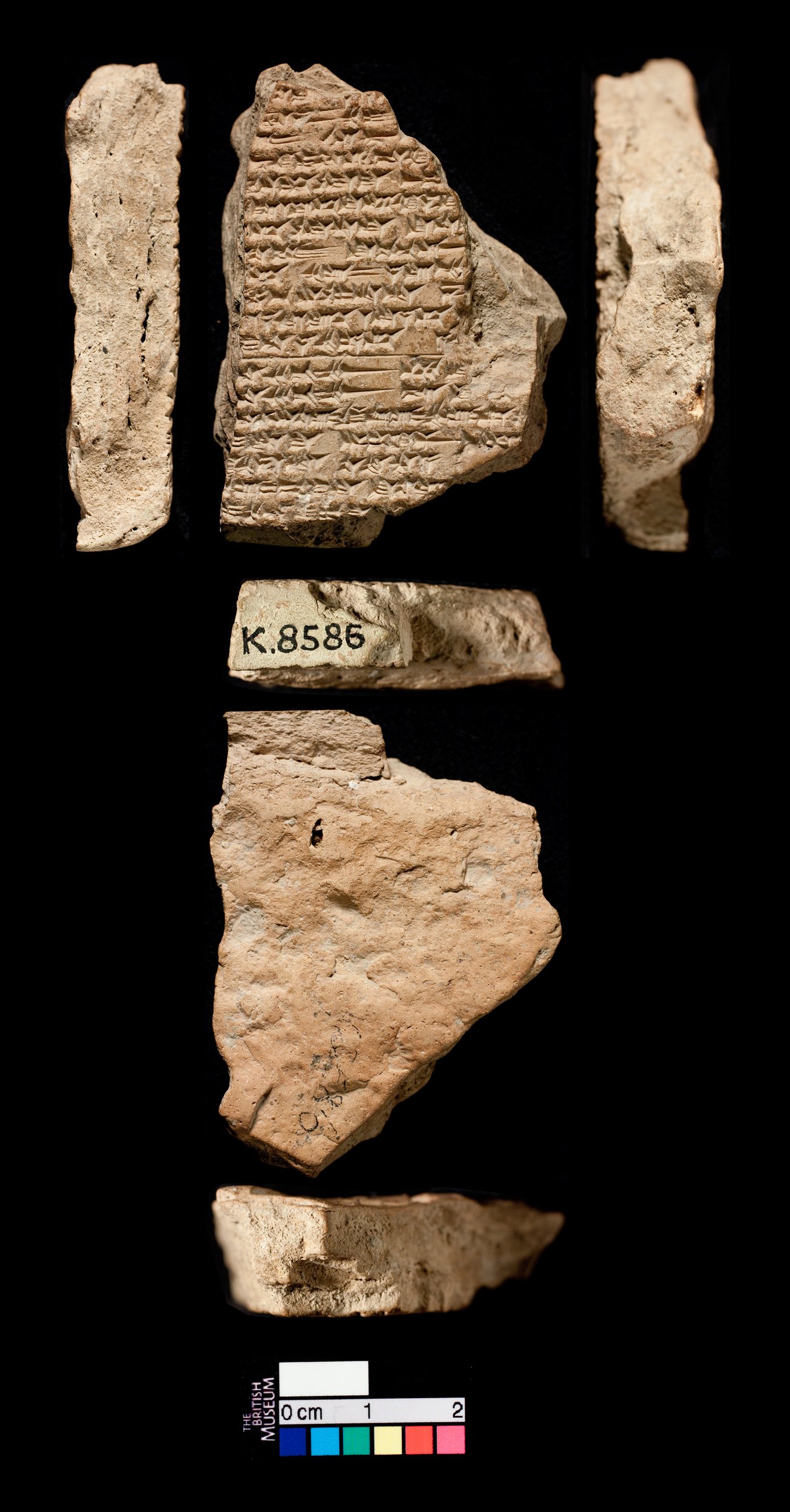
Where on the image
British Museum K.8586: column i, the tablet's own lines 1' to 12'. eBL's corpus edition (https://www.ebl.lmu.de/corpus/L/1/4/SB/IV) attributes SB IV 22-33 to this manuscript at these column and line numbers. Photograph checked: obverse, reverse and edges, ink number K.8586 on the edge; about 20 lines on one face, consistent with eBL's 20 lines of column i. On this tablet lines 22-33 are partly broken (square brackets and x in the Akkadian). The English of these lines translates eBL's composite text, so it includes words that are not preserved on this tablet but are restored from other manuscripts or by the editors. Square brackets in the English mark eBL's restorations in its composite text; words that survive on other tablets carry no brackets even where this tablet is broken.
22[u₃ šu]-ut-ta# ša₂# a#-m[u-ru ka-liš ša₂-ša₂-at]
23[ina sa]-pan-ni KUR-i [x x x x x x x x x]
24[KUR]-u₂# im-qut in[a x x x x x x x x]
25[u ni]-nu ki-i nim gi du ki [x x x x x x x x]
26[š]a₂ iʾ-al-dam-ma ina E[DIN mit-lu-ka i-le-ʾ-i]
27[M]U-ra ana ib-ri-šu {d}+en-ki-du₃ š[u-ut-ta-šu₂ u₂-šam-har-šu₂]
28[i]b-ri dam-qa-at šu-na-a[t-ka ba-ni x x x x]
29[š]u-ut-tu₄ šu-qu-rat [x x x x x x x]
30[i]b-ri KUR-u₂ ša₂ ta-mu-r[u x x x x x x x]
31[n]i-ṣab-bat {d}hum-ba-ba ni-[nar-raš-šu?]
32u₃# ša₂-lam-ta-šu₂ ana tu-ša₂-ri n[i-nad-di?]
33[u] i#-na ša₂ še-e-ri a-m[at {d}UTU SIG₅-ti₃ nim-mar]
22[and the] dream that I saw [was completely confused.]
23[we were standing on] a mountain slope,
24[the mountain] fell down [between us]
25[but] we like flies [flew clean over it]
26[The one who] was born in the [wild was able to give counsel,]
27Enkidu spoke to his friend, [making his dream meaningful to him:]
28‘My friend, [your] dream is favourable, [ … is fine,]
29the dream is precious [and bodes us well]
30My friend, the mountain that you saw [was … ,]
31[we] shall capture Ḫumbaba, we [shall slay him,]
32and we shall [cast down] his corpse on the field of battle.
33And in the morning [we shall see a favourable] message [from Šamaš.]’
Where on the image
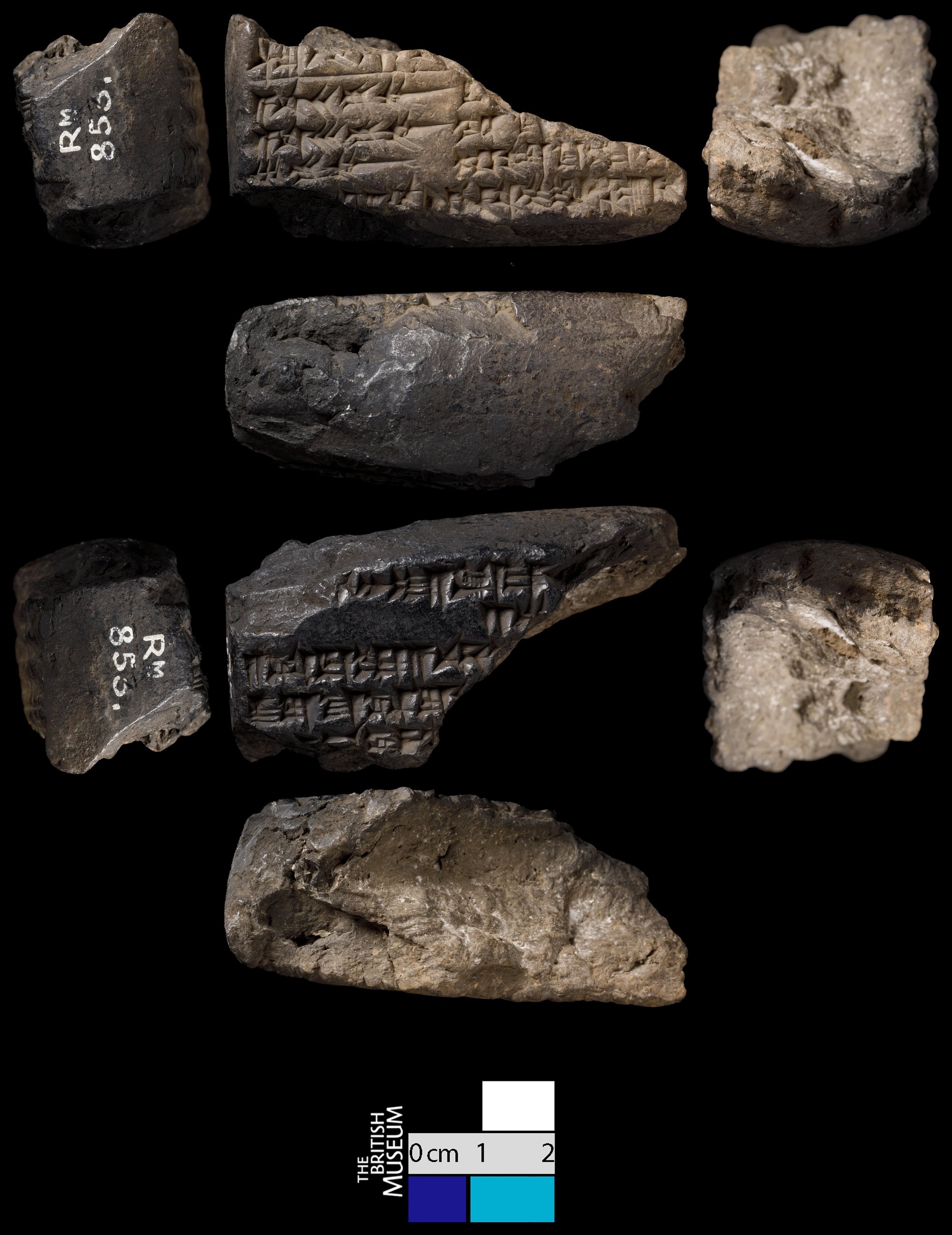
British Museum Rm.853: obverse, column i, the tablet's own lines 2' to 5'. eBL's corpus edition (https://www.ebl.lmu.de/corpus/L/1/4/SB/IV) attributes SB IV 34-37 to this manuscript at these column and line numbers. Photograph checked: obverse, reverse and edges, ink number Rm.853; a few lines on each face, consistent with eBL's attribution. On this tablet lines 34-37 are partly broken (square brackets and x in the Akkadian). The English of these lines translates eBL's composite text, so it includes words that are not preserved on this tablet but are restored from other manuscripts or by the editors. Square brackets in the English mark eBL's restorations in its composite text; words that survive on other tablets carry no brackets even where this tablet is broken.
34a-na 20 DANNA ik-[su-pu ku-sa-a-pu]
35a-na 30 DANNA iš-ku#-[nu nu-bat-tu₄]
3650 DANNA il-li-ku ka-la# [u₄-mu]
37[<ma-lak> ITI u] U₄#.15#.KAM!# ina šal-šu₂ u₄-mu iṭ-hu-u₂ ana kur [lab-na-nu]
34At twenty leagues they broke [bread,]
35at thirty leagues they pitched [camp.]
36Fifty leagues they travelled in the course of [a day,]
37a [month and] a half’s march by the third day, they drew near to Mount [Lebanon.]
Where on the image
British Museum K.8586: column i, the tablet's own lines 15'a to 19'. eBL's corpus edition (https://www.ebl.lmu.de/corpus/L/1/4/SB/IV) attributes SB IV 38-43 to this manuscript at these column and line numbers. Photograph checked: obverse, reverse and edges, ink number K.8586 on the edge; about 20 lines on one face, consistent with eBL's 20 lines of column i. On this tablet of line 39 only one to three signs survive and lines 38, 40-43 are partly broken (square brackets and x in the Akkadian). The English of these lines translates eBL's composite text, so it includes words that are not preserved on this tablet but are restored from other manuscripts or by the editors. Square brackets in the English mark eBL's restorations in its composite text; words that survive on other tablets carry no brackets even where this tablet is broken.
38[a-n]a IGI {d}UTU u₂-har-ru-u₂ bu-u₂-ru :
39A?#-[MEŠ? ... iš-ku-nu i-na ...-pa]
40i#-li-ma {d}GIŠ-gim₂-maš ina muh-[hi ša₂-di-i]
41[Z]I₃.MAD.GA₂-su ut-te-qa-a [ana hur-sa-a-ni]
42[K]UR-u₂ bi-i-la šu-ut-t[a a-mat {d}UTU SIG₅ lu-mur]
43i#-pu-ša₂-aš₂-šum-ma {d}+e[n-ki-du₃ a-na ša-a-šu₂? E₂? za-qi₂-qi₂]
38Facing the sun they dug a well,
39[in their waterskins they put fresh] water
40Gilgamesh went up on to the top [of the mountain,]
41he made his offerings of maṣḫatu-flour [to the hill.]
42‘O mountain, bring me a dream, [let me see a favourable message from Šamaš!]’
43Enkidu made for him [a ‘house of Zaqīqu’,]
Where on the image
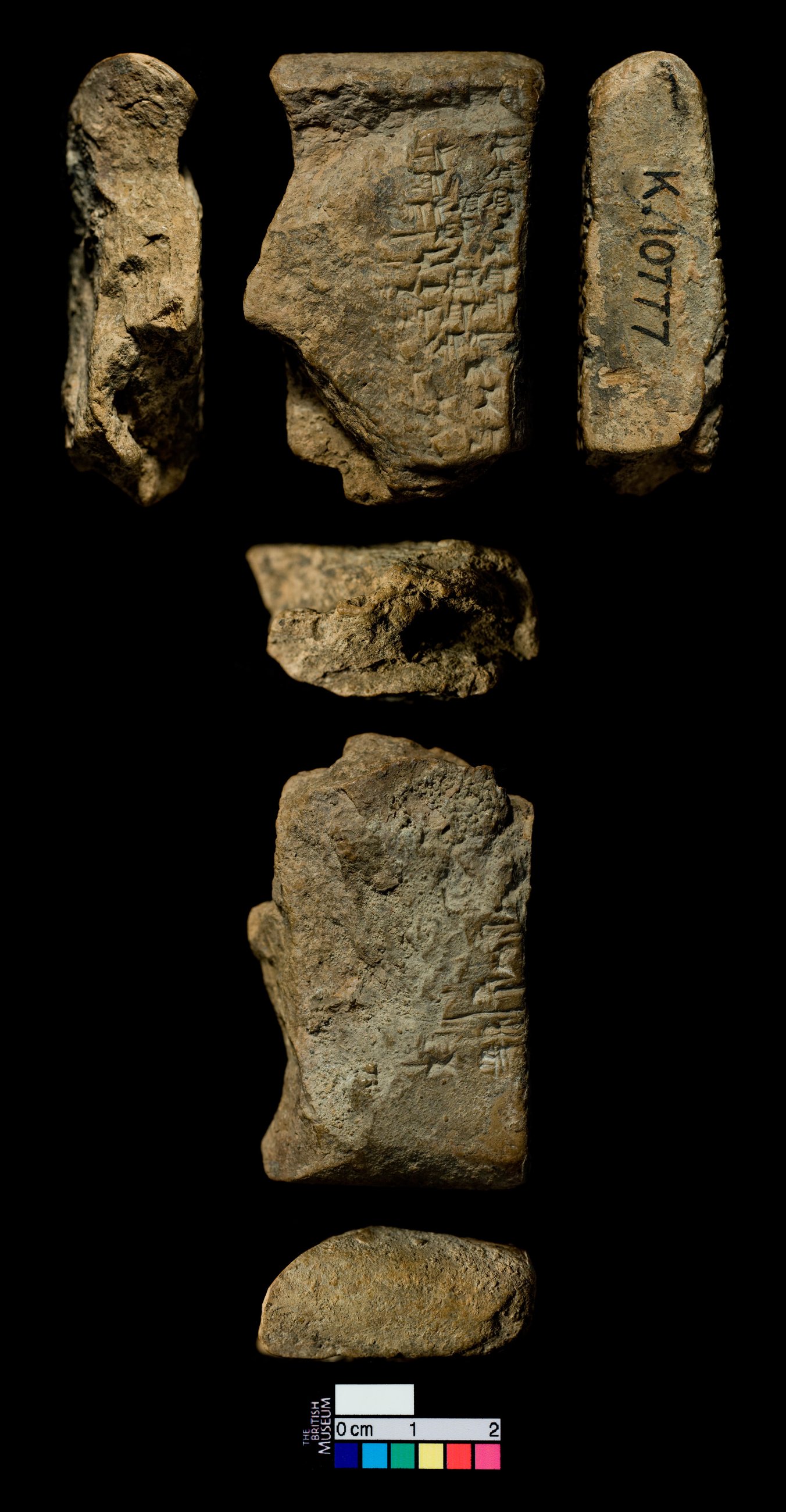
British Museum K.10777: column iii, the tablet's own lines 1 to 3. eBL's corpus edition (https://www.ebl.lmu.de/corpus/L/1/4/SB/IV) attributes SB IV 84-86 to this manuscript at these column and line numbers. Photograph checked: both faces and edges, ink number K.10777; a few lines on each face, consistent with eBL's columns iii (13 lines) and iv (6 lines). On this tablet of lines 84-86 only one to three signs survive. The English of these lines translates eBL's composite text, so it includes words that are not preserved on this tablet but are restored from other manuscripts or by the editors. Square brackets in the English mark eBL's restorations in its composite text; words that survive on other tablets carry no brackets even where this tablet is broken.
84[A-MEŠ? iš-ku-nu i-na x] x x x-pa
85[i-li-ma {d}GIŠ-gim₂-maš ina muh-hi] ša₂#-di#-i#
86[ZI₃.MAD.GA₂-su ut-te-qa-a ana hur-s]a-a-ni
84[in] their [waterskins they put fresh water]
85[Gilgamesh went up on to the top of] the mountain,
86[he made his offerings of maṣḫatu-flour to the] hill.
Where on the image
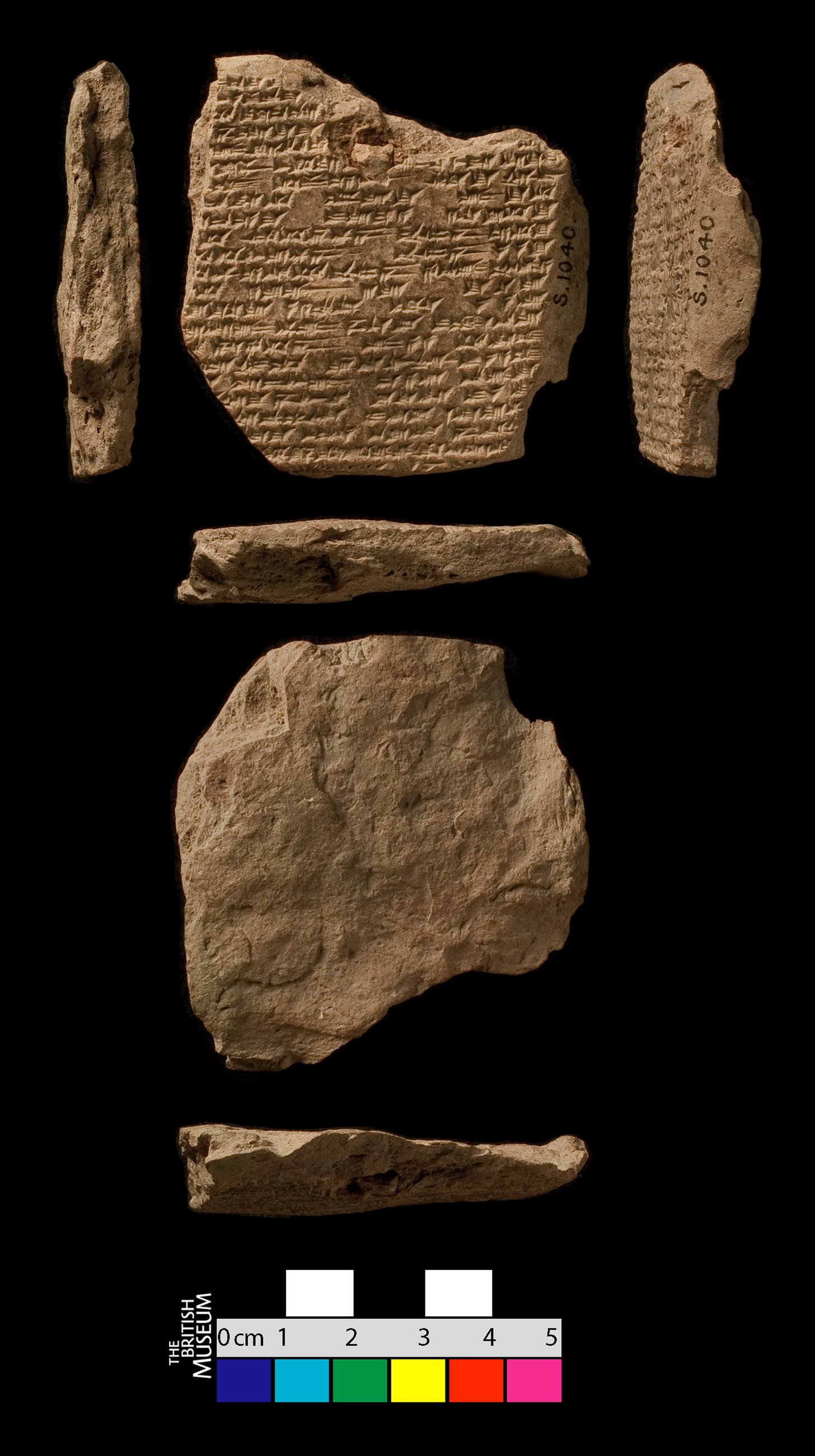
British Museum Sm.1040: column iii, the tablet's own lines 1 to 23. eBL's corpus edition (https://www.ebl.lmu.de/corpus/L/1/4/SB/IV) attributes SB IV 87-109 to this manuscript at these column and line numbers. Photograph checked: obverse, reverse and edges, ink number S.1040; one column of about 23 lines on the inscribed face, consistent with eBL's column iii. On this tablet lines 87-99, 101, 103-109 are partly broken (square brackets and x in the Akkadian). The English of these lines translates eBL's composite text, so it includes words that are not preserved on this tablet but are restored from other manuscripts or by the editors. Square brackets in the English mark eBL's restorations in its composite text; words that survive on other tablets carry no brackets even where this tablet is broken. Lines 100, 102 are complete on this tablet.
87[KUR]-u₂# bi-la šu#-u[t-ta x x x x x x]
88[i-p]u-ša₂-aš₂-šum-ma {d#}+[en-ki-du₃ x x x x x x x x x]
89[{giš}I]G šar-bi-il-l[i? x x x x x x]
90[u]š-ni-il-šu-ma [x x x x x x x]
91[u? š]u?-u₂ GIM še-še?#-e [x (x) x x x x x x in]a KA₂#-[šu]
92[{d}GI]Š-gim₂-maš ina kin-ṣi-š[u] u₂#-tam#-me-da zu-qat-su#
93[šit]-tu₄ re-hat UN-MEŠ UGU-šu im-qut
94[ina q]ab-li-ti šit-ta-šu u₂-qat-ti
95[i]t-be₂-e-ma i-ta-ma-a a-na ib-ri-šu
96[i]b-ri ul tal-sa-an-ni am-mi-ni e-re-ku
97[u]l tal-pu-tan{+an}-ni am-mi-ni ša₂-ša₂-ku
98[u]l ilu e-ti-iq am-mi-ni ha-mu-u₂ UZU-u₂-a
99[i]b-ri a-ta-mar 3-ta šu-ut-ta
100u₃# šu-ut-ta ša₂ a-mu-ru ka-liš ša₂-ša₂-at₂
101[i]l-su-u₂ AN-u₂ qaq-qa-ru i-ram-mu-um
102u₄#-mu uš-ha-ri-ir u₂-ṣa-a ek-le-tu₄
103[ib-r]iq bir-qu in-na-pi-ih i-ša₂-a-tu₄
104[nab-l]u iš-tap-pu-u₂ iz-za-nun mu-u₂-tu
105[id-ʾ]i-im-ma ne₂-bu-tu₂ ib-te-li i-ša₂-tu
106[x (x) x] im-taq-qu-tu i-tu-ur ana tu-um-ri
107[ta-ʾ-al-d]am-ma ina EDIN mit-lu-ka ni-le-ʾ#-[i]
108[iš-me zi-kir ib-ri-š]u₂? {d}+en-ki-du₃ šu-ut-ta-šu₂ u₂-šam-har-šu₂ MU-ra ana {d}GIŠ-[gim₂-maš]
109[ib-ri dam-qa-at] šu#-na#-at#-ka# ba?#-ni# x# x# [x x]
87‘[O mountain], bring me a dream, so I may see [a favourable message from Šamaš!]’
88[Enkidu] made for him [a] ‘house of Zaqīqu’,
89[he fixed] a storm-door in its doorway.
90[in the circle he had] drawn he made him lie down,
91[and falling flat] like a net lay himself in the doorway.
92Gilgamesh rested his chin on his knees,
93the sleep that spills over people fell upon him.
94[In the] middle watch (of the night) he reached his sleep’s end,
95he arose to talk to his friend:
96‘My friend, did you not call me? Why am I awake?
97Did you not touch me? Why am I in confusion?
98Did a god not pass by? Why is my flesh benumbed?
99My friend, I have seen a third dream,
100and the dream that I saw was completely confused.
101The heavens cried aloud, while the earth was rumbling,
102the day grew still, darkness went forth.
103Lightning flashed down, fire broke out,
104[flames] kept flaring up, death kept raining down.
105The fire so bright dimmed and went out,
106[the flames] diminished and turned into cinders.
107[You were] born in the wild, can we take counsel?’
108Enkidu [heard the words of his friend,] making his dream meaningful to him, he said to Gilgameš:
109‘[My friend,] your dream is good, [its message] is lucky.’
Where on the image
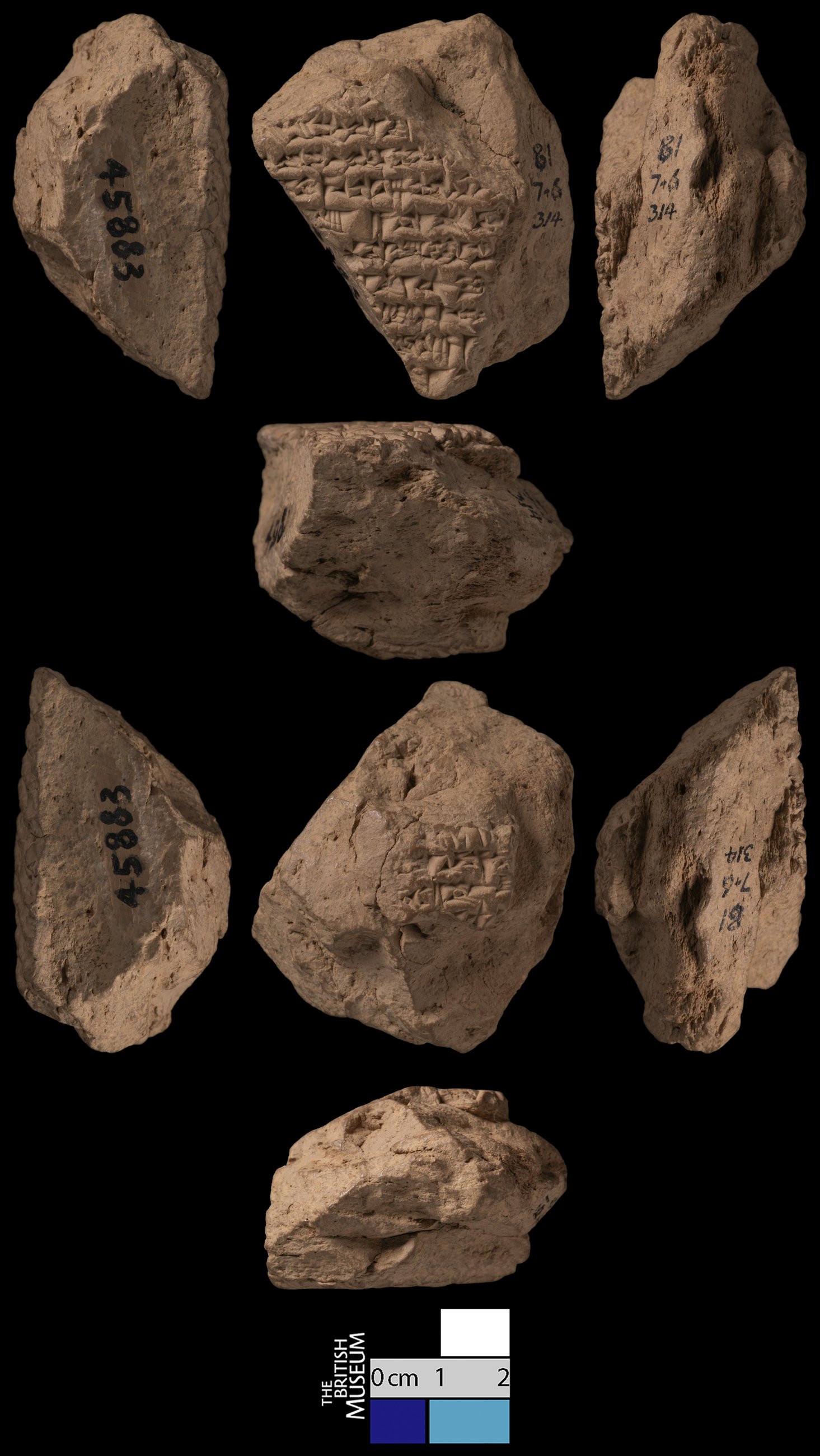
British Museum BM.45883: column iii, the tablet's own lines 1' to 10'. eBL's corpus edition (https://www.ebl.lmu.de/corpus/L/1/4/SB/IV) attributes SB IV 120-129 to this manuscript at these column and line numbers. Photograph checked: obverse, reverse and edges, ink number 45883 (81-7-6,314); a few lines on each face, consistent with eBL's columns iii and iv. On this tablet of lines 120, 129 only one to three signs survive and lines 121-128 are partly broken (square brackets and x in the Akkadian). The English of these lines translates eBL's composite text, so it includes words that are not preserved on this tablet but are restored from other manuscripts or by the editors. Square brackets in the English mark eBL's restorations in its composite text; words that survive on other tablets carry no brackets even where this tablet is broken.
120[a-na 20 DAN]NA i[k-su-pu ku-sa-a-pu]
121[ana 3]0 DANNA iš-ku#-[nu nu-bat-tu₄]
122[5]0 DANNA il-l[i-ku kal u₄-mi]
123[ma-la]k ITI u U₄.15.KAM ina šal#-š[u₂ u₄-mu]
124[iṭ-h]u-u₂ a-na KUR lib₃-[na-nu]
125[a-na IG]I {d}UTU u₂-har-r[u-u₂ bu-u₂-ru]
126[A-MEŠ? x x i]š-ku-nu i-[na x x x x]
127[i-li-ma {d}G]IŠ-gim₂-maš ana mu[h-hi ša₂-di-i]
128[ZI₃.MAD.GA₂-su ut-te]-eq-qa-a ana h[ur-sa-a-ni]
129[KUR-u₂ bi-la š]u-u[t-ta a-mat {d}UTU SIG₅ lu-mur]
120[At twenty] leagues they [broke bread,]
121[at thirty] leagues they pitched [camp.]
122[Fifty] leagues they travelled [in the course of a day,]
123a month and a half’s [march] by the third [day,]
124they drew near to Mount Lebanon.
125[Facing] the sun they dug [a well,]
126In [their waterskins] they put [fresh water.]
127Gilgamesh [went up] on to the top [of the mountain,]
128[he made his] offerings of [maṣḫatu-flour] to [the hill.]
129‘[O mountain, bring me a] dream, [let me see a favourable message from Šamaš!]’
Where on the image
British Museum K.10777: column iv, the tablet's own lines 1' to 6'. eBL's corpus edition (https://www.ebl.lmu.de/corpus/L/1/4/SB/IV) attributes SB IV 159-164 to this manuscript at these column and line numbers. Photograph checked: both faces and edges, ink number K.10777; a few lines on each face, consistent with eBL's columns iii (13 lines) and iv (6 lines). On this tablet of lines 159-164 only one to three signs survive. The English of these lines translates eBL's composite text, so it includes words that are not preserved on this tablet but are restored from other manuscripts or by the editors. Square brackets in the English mark eBL's restorations in its composite text; words that survive on other tablets carry no brackets even where this tablet is broken.
159[x x x x x x x x x x x i-d]i-šu₂
160[x x x x x x x x x x x x x]-ni
161[x x x x x x x x x x x x ṣe-r]i-šu₂
162[x x x x x x x x x x x x n]i-mar
163[x x x x x x x ku]-sa-pa
164[x x x x x x x n]u-bat-ta
159We shall bring about his [defeat, we shall] bind his arms,
160[…] … we shall …
161His […,] we shall stand there upon [him.]
162[And in the] morning we shall [see] a favourable message from Šamaš.’
163[At twenty leagues] they broke bread,
164[at thirty leagues] they pitched camp:
Where on the image
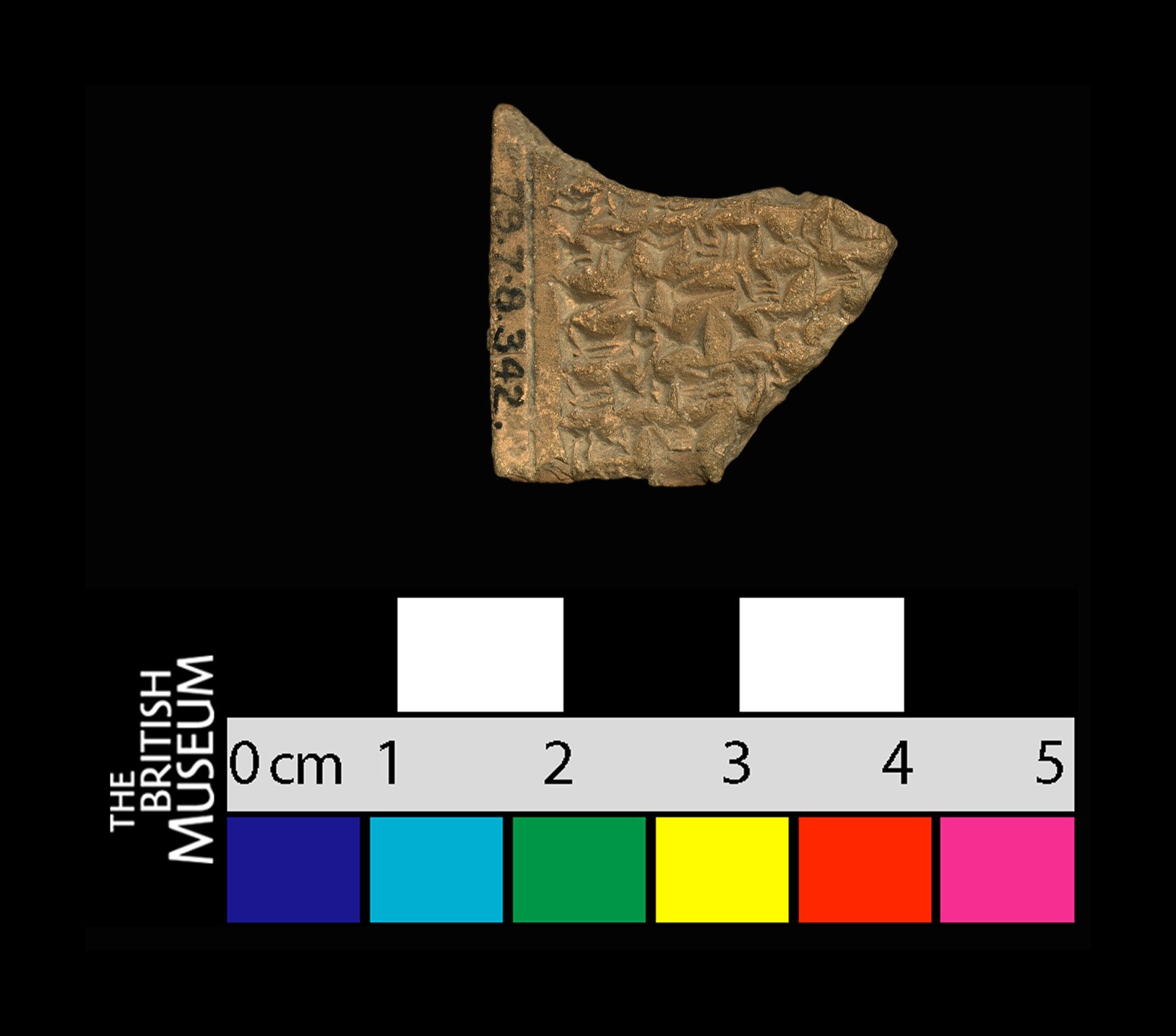
British Museum 1879,0708.342: reverse, column v, the tablet's own lines 1' to 7'. eBL's corpus edition (https://www.ebl.lmu.de/corpus/L/1/4/SB/IV) attributes SB IV b+1'-b+7' to this manuscript at these column and line numbers. Photograph checked: one face with the ink number 79-7-8,342 and about 7 lines, consistent with eBL's column v. On this tablet of line b+1' only illegible traces (x) survive, of line b+7' only one to three signs survive and lines b+2'-b+6' are partly broken (square brackets and x in the Akkadian). The English of these lines translates eBL's composite text, so it includes words that are not preserved on this tablet but are restored from other manuscripts or by the editors. Square brackets in the English mark eBL's restorations in its composite text; words that survive on other tablets carry no brackets even where this tablet is broken.
b+1'x [...]
b+2'ša₂ pi-i#-šu# x [...]
b+3'GURUŠ ša₂ ta-mu-ru [...]
b+4'ina u₄-me-šu-ma [...]
b+5'i-ṣab-bat kap-p[i-šu ...]
b+6'i-na-aš₂-ša₂-q[u ...]
b+7'a-na-ku x [...]
b+1'… […]
b+2'‘The one whose mouth […]
b+3'The man you saw [was …,]
b+4'at that time […]
b+5'He will take hold of [its] wings […,]
b+6'they will kiss […]
b+7'I […]’
Where on the image
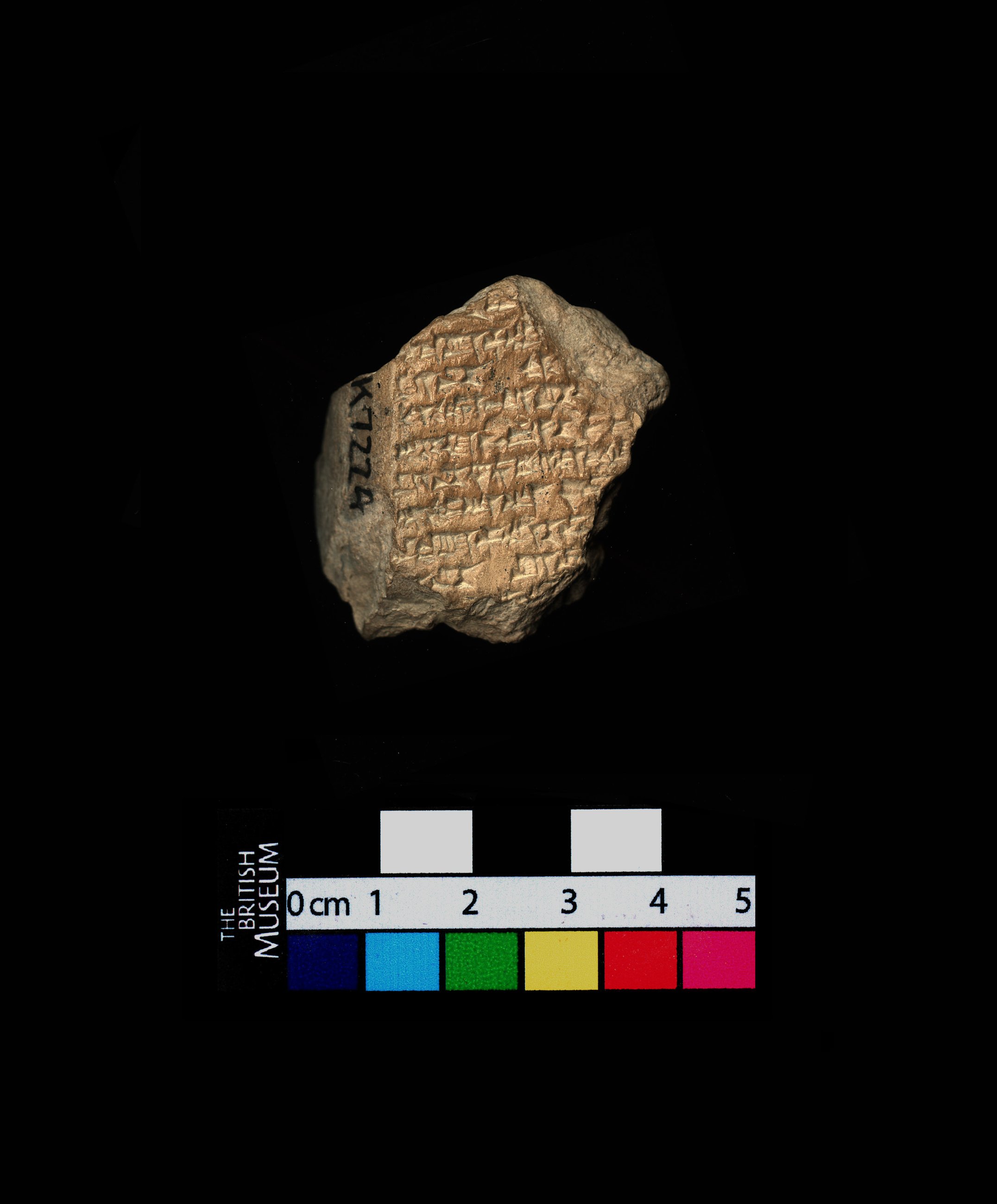
British Museum K.7224: reverse, column vi, the tablet's own lines 1' to 10'. eBL's corpus edition (https://www.ebl.lmu.de/corpus/L/1/4/SB/IV) attributes SB IV 210-219 to this manuscript at these column and line numbers. Photograph checked: one face with the ink number K.7224 and about 10 lines, consistent with eBL's column vi. On this tablet of lines 210, 212, 219 only one to three signs survive and lines 211, 213-218 are partly broken (square brackets and x in the Akkadian). The English of these lines translates eBL's composite text, so it includes words that are not preserved on this tablet but are restored from other manuscripts or by the editors. Square brackets in the English mark eBL's restorations in its composite text; words that survive on other tablets carry no brackets even where this tablet is broken.
210[e-t]al-du [...]
211{d}GIŠ-gim₂-maš KA-[šu₂ DU₃-ma DUG₄.GA MU-ra ana {d}+en-ki-du₃]
212ib-ri ul [...]
213ul DUMU-MEŠ e-tal-d[u ...]
214{d}+en-ki-du₃ pa-a-šu₂ DU₃-m[a DUG₄.GA MU-ra ana {d}GIŠ-gim₂-maš]
215ib-ri ša₂ ni-il-la-kaš-š[u x x x x x x]
216{d}hum-ba-ba ša₂# n[i-il-la-kaš-šu₂ x x x x x x]
217{d}GIŠ-gim₂-maš KA-šu₂ D[U₃-ma DUG₄.GA MU-ra ana {d}+en-ki-du₃]
218[i]b-ri lu-n[i-ir? x x x x x x x x (x x x x)]
219[x x] a#-n[a x x x x x x x x (x x x x)]
210‘[…] have been born […]’
211Gilgameš [opened his] mouth [to speak, saying to Enkidu:]
212‘My friend, [have they] not […?]
213Have they not sired sons […?]
214Enkidu opened his mouth [to speak, saying to Gilgameš:]
215My friend, the one to whom we are going, [he is something very strange!]
216Ḫumbaba, to whom we [are going, he is something very strange!]’
217Gilgameš opened his mouth [to speak, saying to Enkidu:]
218‘My friend, I would [slay …]
219[…] to […’]
Notes
- Akkadian: eBL transliteration of the signs on the photographed tablet (manuscript-level ATF), not a composite text.
- English: A. R. George's translation in the eBL edition; it renders eBL's composite text, including restorations from other tablets.
- Line numbers: eBL edition (based on A. R. George, The Babylonian Gilgamesh Epic, Oxford 2003). Each section also gives the tablet's own column and line numbers.
- Signs in the Akkadian: [ ] broken away; x illegible sign; # damaged sign; ? uncertain reading; ! sign corrected by the editor; ... broken signs of unknown number; ( ) signs perhaps broken away; { } determinative; {+ } phonetic gloss; < > sign omitted by the scribe, supplied by the editor; : divider sign written on the tablet.
Cite
Sources
- Source: British Museum tablet photographs + eBL manuscript transliterations (eBL corpus edition L I.4, Poem of Gilgamesh (ed. A. R. George, rev. G. Rozzi and E. Jiménez), SB IV) + English of the eBL edition (A. R. George (eBL edition)) (holding institution)
- Critical edition: electronic Babylonian Library, Poem of Gilgamesh (ed. A. R. George), manuscript transliterations
← previous · → next · v cycle view · l back to library