Epic of Gilgamesh, Tablet V: the killing of Humbaba
Introduction
The heroes enter the Forest of Cedar, confront Humbaba, and with the help of Shamash's winds overpower him. Humbaba pleads for his life and curses them; they kill him, fell the cedars, and float a great cedar door down the Euphrates to Nippur.
The Standard Babylonian version of the epic, traditionally ascribed to the scholar Sin-leqi-unninni, was written on twelve tablets. Most surviving copies come from the libraries of Ashurbanipal at Nineveh (7th century BCE) and from Babylon and other Babylonian cities (7th-2nd century BCE). This page gives Tablet V in the line numbering of the electronic Babylonian Library edition by A. R. George (2022 and later revisions).
How this page is built. Each section is a run of consecutive lines as written on one photographed clay tablet. For every line the eBL edition (https://www.ebl.lmu.de/corpus/L/1/4/SB/V) lists the manuscripts that carry it, with each tablet's own column and line numbers; the tablet chosen for each run is the photographed copy of the work with the most signs preserved there. Commentaries and texts that only quote a line are never chosen. School and excerpt tablets are used only for lines that no photographed library copy preserves as well, and only where they carry the line as text; their sections say so. The original text is eBL's transliteration of that tablet's signs (not a modern composite text): square brackets mark broken signs, x an illegible sign, # a damaged sign, ? an uncertain reading, and words in {braces} are determinatives; the notes give a key to every sign used on this page, and eBL's layout codes are written out in words (for example '(line break)' or '(blank space)'). Superscript numbers are the line numbers of the eBL edition, used in both the Akkadian and the English. The English is A. R. George's translation in the eBL edition (CC BY-NC-SA 4.0), one line of English per line of the poem; italics mark uncertain renderings, as in the source. Where the tablet is broken, the English still translates the whole line of eBL's composite text; each section's note names the lines that are broken on its tablet.
Finding a line on the photograph. Each section names the tablet, the face and column, and the tablet's own line numbers (a prime, as in 5', counts from the first preserved line of a broken column). On a tablet with six columns the obverse carries columns i-iii from left to right; the reverse, turned over from bottom to top, carries columns iv-vi from right to left. The photographs often show the obverse above the reverse with the edges around them; a fragment preserves only part of this layout.
This page shows 121 of the 274 lines of the eBL edition (44%), from 5 tablets in the British Museum: K.3252 (Nineveh), K.8591 (Nineveh), K.13525 (Nineveh), Sm.866 (Nineveh), Sm.209 (Nineveh).
Lines not shown. 153 of the 274 lines of the eBL edition are not shown, because no photographed copy of the work used here carries them: 20-27 (not in the eBL Fragmentarium (no photograph there): T.1447); 85-90 (not in the eBL Fragmentarium (no photograph there): T.1447); 115-135 (no photograph in eBL: IM.76985 (Iraq Museum)); 143-151 (no manuscript preserves it); 152-183 (no photograph in eBL: IM.76985 (Iraq Museum)); 184-187 (no manuscript preserves it); 190-194 (no photograph in eBL: IM.76985 (Iraq Museum)); 199 (no photograph in eBL: IM.76985 (Iraq Museum)); 202-204 (no photograph in eBL: IM.76985 (Iraq Museum)); 207 (no manuscript preserves it); 247-252 (not in the eBL Fragmentarium (no photograph there): T.1447); 253-267 (no photograph in eBL: IM.76985 (Iraq Museum); not in the eBL Fragmentarium (no photograph there): T.1447); 268 (not in the eBL Fragmentarium (no photograph there): T.1447); 269-270 (no photograph in eBL: IM.76985 (Iraq Museum); not in the eBL Fragmentarium (no photograph there): T.1447); 271-272 (no photograph in eBL: IM.76985 (Iraq Museum)); 273 (no photograph in eBL: IM.76985 (Iraq Museum); not in the eBL Fragmentarium (no photograph there): T.1447); 274-276 (not in the eBL Fragmentarium (no photograph there): T.1447); 284-285 (no photograph in eBL: IM.76985 (Iraq Museum)); 286 (no photograph in eBL: IM.76985 (Iraq Museum); not in the eBL Fragmentarium (no photograph there): T.1447); 287-298 (no photograph in eBL: IM.76985 (Iraq Museum)); 299-309a (not in the eBL Fragmentarium (no photograph there): T.1447); 309b (no photograph in eBL: IM.76985 (Iraq Museum)); 310-317 (no photograph in eBL: IM.76985 (Iraq Museum); not in the eBL Fragmentarium (no photograph there): T.1447); 323 (no photograph in eBL: IM.76985 (Iraq Museum); not in the eBL Fragmentarium (no photograph there): T.1447). A line is shown only on a photographed tablet that carries it as text. Commentaries and other texts that quote a line (letters, rituals, god lists) are not used as witnesses, because they carry it with explanations or inside another text; tablets without a photograph in eBL are not used, because the line could not be shown on its tablet.
How was this verified? (Provenance)
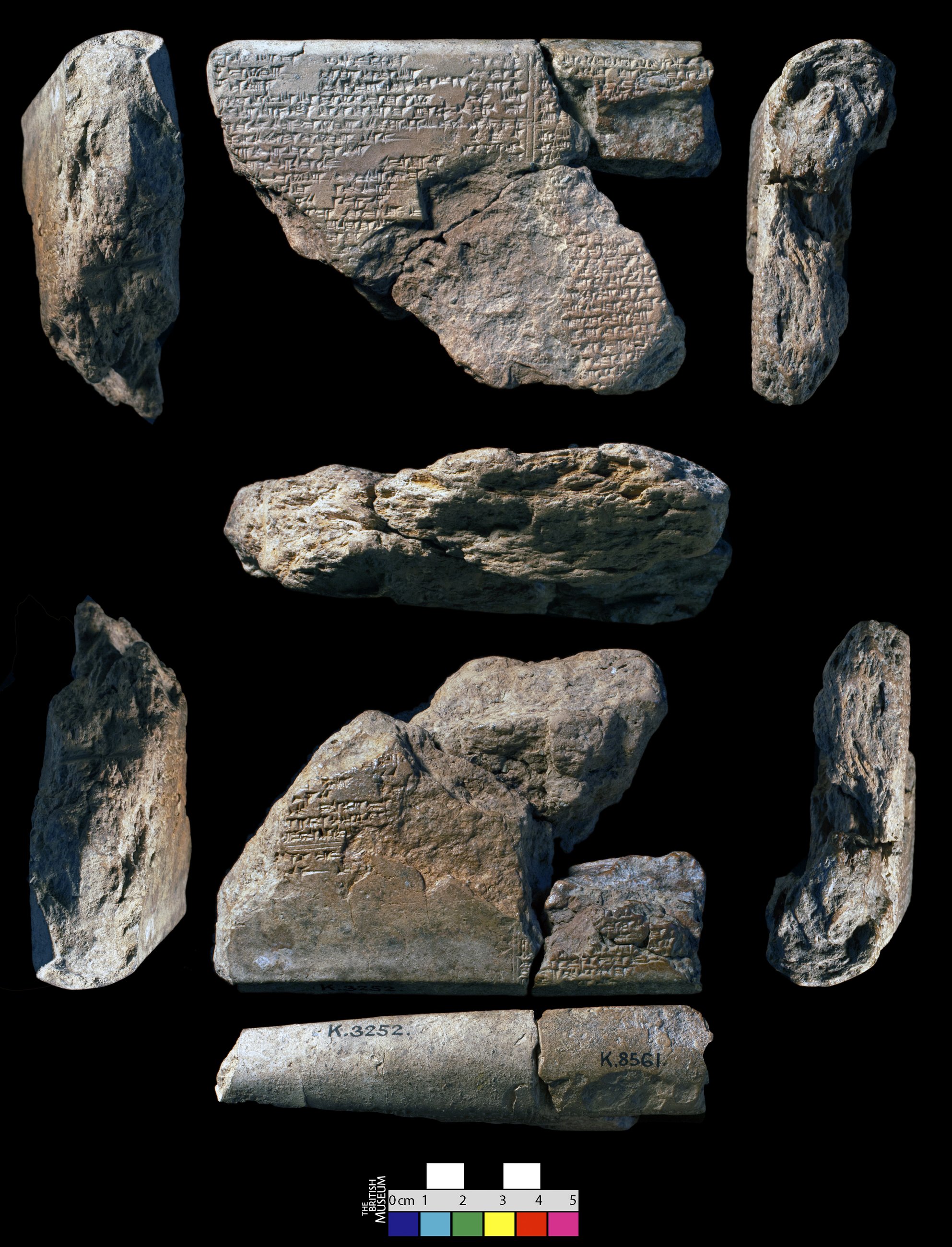
Where on the image
British Museum K.3252: obverse, column i, the tablet's own lines 1 to 18. eBL's corpus edition (https://www.ebl.lmu.de/corpus/L/1/4/SB/V) attributes SB V 1-19 to this manuscript at these column and line numbers. Photograph checked: obverse, reverse and edges of the join K.3252 + K.8561 (both ink numbers on the edge); text on both faces, consistent with eBL's columns i-ii and v-vi. On this tablet of lines 18-19 only illegible traces (x) survive, of lines 16-17 only one to three signs survive and lines 8-15 are partly broken (square brackets and x in the Akkadian). The English of these lines translates eBL's composite text, so it includes words that are not preserved on this tablet but are restored from other manuscripts or by the editors. Square brackets in the English mark eBL's restorations in its composite text; words that survive on other tablets carry no brackets even where this tablet is broken. Lines 1-7 are complete on this tablet.
1iz-zi#-zu-ma i-nap#-pa!-at-tu# {giš}TIR#
2ša₂ {giš}EREN it-ta-nap-la-su me₂-la-šu₂
3ša₂ {giš}TIR it-ta-nap-la-ZU ne₂-reb-šu₂
4a-šar {d}hum-ba-ba it-tal-la-ku ša₂-kin kib-su
5har-ra-na-a-tu šu-te-šu-ra-ma ṭu-ub-bat gir-ru
6e#-ma-ru KUR-u₂ {giš}EREN
7mu-šab DINGIR-MEŠ pa-rak {d}ir-ni-ni
8[ina p]a-an KUR-im-ma {giš}EREN na-ši hi-ṣib-šu₂
9[ṭ]a-a-bu ṣil-la-šu₂ ma-li ri-ša₂-a-ti
10[šu-te-l]u-up gi-iṣ-ṣu hi-it-lu-pat [{giš}T]IR
11[x x-p]u {giš}EREN {šim}MUG-ma ne₂#-re#-[bi x x x]
12[x x p]a-pal-la ana DANNA.AM₃ [x x]
13[x x x {giš}Š]UR.MIN₃ ana ši-ni-pat [x]
14[x x x x x me-l]e-e ki-iṣ-ru l[a-i-ib x x]
15[x x x] x-lu ki-ma zu-un#-[ni x x x x]
16[x x x ub-b]a*-lu [x x]
17[x x x x x x iṣ-ṣ]u-ru# [x x x x]
18[x x x x x] x [x x x x x x]
19[x x x x x] x [x x x x x x]
1They stood marvelling at the forest,
2gazing at the lofty cedars,
3gazing at the forest’s entrance –
4Where Ḫumbaba came and went there was a track,
5the paths were in good order and the way was well trodden.
6They were gazing at the Cedar Mountain,
7the dwelling of the gods, the throne-dais of the goddesses,
8[on the] very face of the mountain the cedar was proffering its abundance,
9sweet was its shade, full of delight.
10[Thick] tangled was the thorn, the forest a shrouding canopy,
11cedars and gum trees, [all entwined,] left no way in.
12For a league on all sides cedars [lifts up] saplings,
13cypresses [grew thick] for two-thirds of a league.
14Cedars scabbed with resin grew sixty cubits high,
15the resin [oozed] forth, drizzling down like rain,
16[flowing freely] for ravines to bear away.
17[Through] all the forest a bird began to sing,
18[hen birds] gave answer, a constant din was the noise.
19[A solitary] tree-cricket set off a noisy chorus,
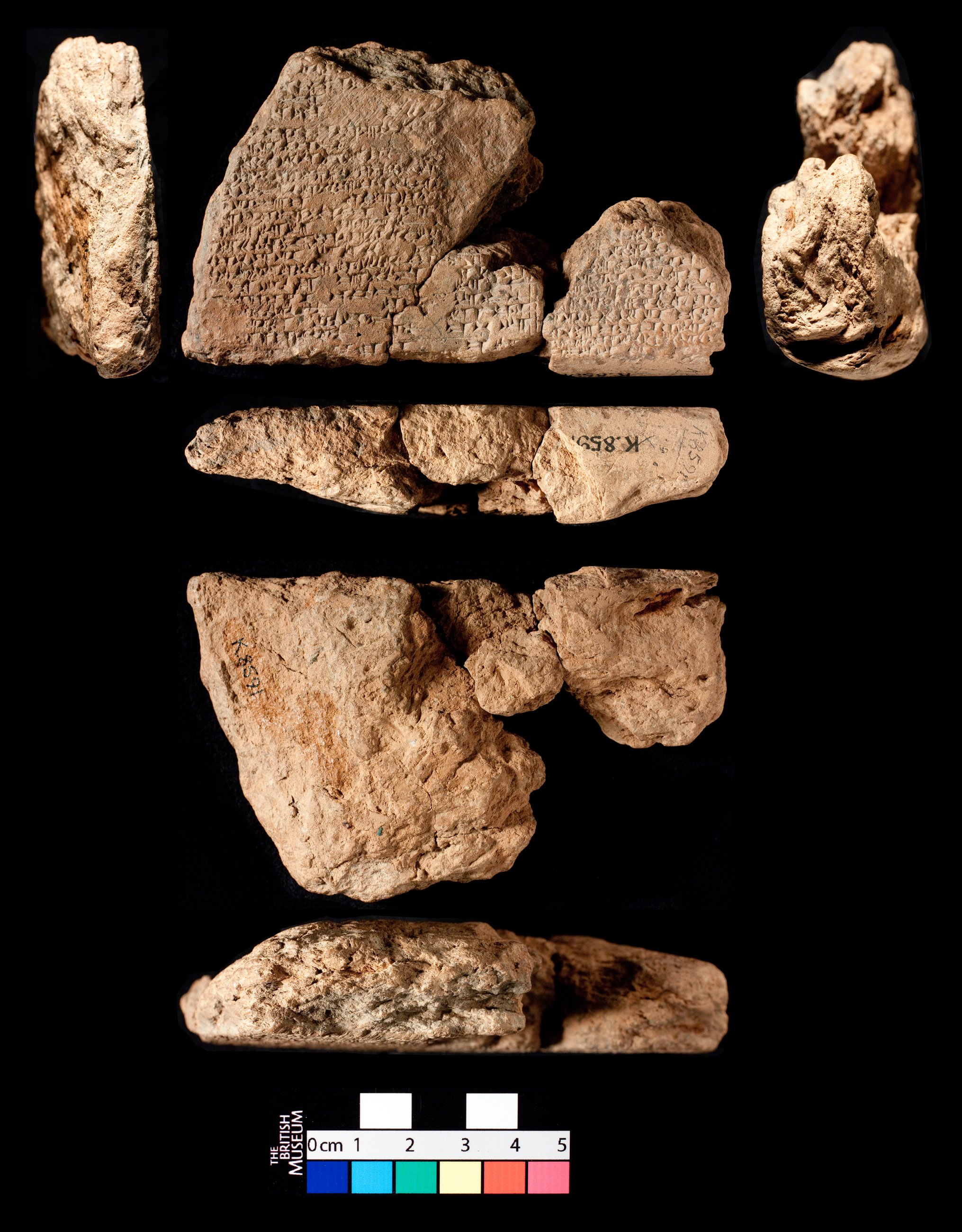
Where on the image
British Museum K.8591: column i, the tablet's own lines 1' to 23'. eBL's corpus edition (https://www.ebl.lmu.de/corpus/L/1/4/SB/V) attributes SB V 28-54 to this manuscript at these column and line numbers. Photograph checked: obverse, reverse and edges; text on the obverse in two columns, consistent with eBL's columns i and ii. On this tablet line 54 is entirely broken, of line 28 only illegible traces (x) survive, of lines 29-30, 32 only one to three signs survive and lines 31, 33-53 are partly broken (square brackets and x in the Akkadian). The English of these lines translates eBL's composite text, so it includes words that are not preserved on this tablet but are restored from other manuscripts or by the editors. Square brackets in the English mark eBL's restorations in its composite text; words that survive on other tablets carry no brackets even where this tablet is broken.
28[x x x] x x [x x x x x x]
29[x x x x i-d]i-šu₂ :
30lu-u₂#-[tu x x x x x x x]
31[{d}+en-ki-du₃ pa-a]-šu₂ DU₃-uš-ma i-q[ab-bi x x x x x x x]
32[x nit]-tar-da i[na? x x x x]
33[x x pi]-te-e-ma i niš-k[un x x]
34[{d}GIŠ-gim₂-ma]š pa-a-šu₂ DU₃-ma DUG₄.GA MU-ra# [x x x x x]
35[am-me-ni i]b-ri pi-is-nu-qiš n[i-šub-ba-am-ma]
36[x (x) x ni]-te-et-ti-qa ka#-li#-šu-nu hur#-[sa-a-ni]
37[x (x) x] x x x x x x ina pa-ni-ni :
38la#-ma ni-it#-tah#-su [x x x x]
39[ib-r]i mu-du-u tu-qu-un-tu :
40ša₂ ME₃ et-m[u-ru x x x x x]
41[da-m]e tal-tap-pit-ma ul ta-ad-da[r x x]
42[ki-m]il-ma ki-i a-pil-lim-ma šu-un-n[i x x x]
43[ki-m]a li-li-su lu-u₂ ša₂-pu r[i-gim-ka]
44[l]i-ṣi man-gu ša₂ i-di-ka u lu-ʾ-tu₂ lit-ba-a [ina bir-ki-ka]
45[t]i-iṣ-bat ib-ri iš-te-niš nit-[x x]
46[lid-b]u-ub lib₃-ba!-ka!# tu-qu-un#-tu :
47mu-u-tu₂ mi-ši-ma ba#-la#-ṭu# [še-ʾ-i?]
48[ša₂ i]na A₂ pal-lu pit-qu-du a-me#-lu#
49[ša₂ ina] IGI# DU-ku pa-gar-šu₂ iṣ-ṣur tap-pa-a li-šal-lim
50[ana u₄-me r]u-qu-ti šu₂-nu šu-ma iš-tak-nu
51[x (x) x] re-qi₂ ik-šu-du ki-lal-la-an
52[u₂-gam-me-r]u a-ma-ti!-šu₂-nu šu₂-nu iz-ziz-zu
53[iz-zi-zu]-ma# i#-na#-pa#-at-tu# {giš}TI[R]
54[x x x x x x x x x x x (x x x)]
28[terror] fell on Gilgameš.
29[Stiffness took] a grip on his arms,
30and tremors beset his legs.
31[Enkidu] opened his mouth to speak, saying to Gilgameš:
32‘[Let us go deep] into the midst of the forest,
33[let us get] going and raise a loud cry!’
34[Gilgameš] opened his mouth to speak, saying to Enkidu:
35‘[Why,] my friend, do we tremble like cowards,
36[we who] came across all the mountains?
37‘[Shall] … before us?
38Before we have withdrawn…
39‘My [friend] is one who is tested in combat,
40one who has been in battle has no fear of death.
41‘You have been splashed in blood, so you need not fear death:
42[go] berserk, like a dervish fall into a frenzy.
43Let [your shout] boom loud [like] a kettle drum,
44may stiffness leave your arms, the tremors depart from your legs!’
45‘Take my hand, friend, and we shall go [on] together,
46[let] your thoughts dwell on combat!
47Forget death and [seek] life!
48[The one who] walks alongside is the prudent man.
49‘“[Let him who] goes first be on guard for himself and bring his comrade to safety!”
50It is they made a name [for days] long in the future!’
51[At the] distant … they both arrived,
52[they ceased] their talking and came to a halt.
53They stood marvelling at the forest,
54[…]
Where on the image
British Museum K.3252: obverse, column ii, the tablet's own lines 1 to 28. eBL's corpus edition (https://www.ebl.lmu.de/corpus/L/1/4/SB/V) attributes SB V 55-84 to this manuscript at these column and line numbers. Photograph checked: obverse, reverse and edges of the join K.3252 + K.8561 (both ink numbers on the edge); text on both faces, consistent with eBL's columns i-ii and v-vi. On this tablet lines 65, 83 are entirely broken, of line 64 only illegible traces (x) survive, of lines 59-63, 66-70, 82, 84 only one to three signs survive and lines 55-58, 71-81 are partly broken (square brackets and x in the Akkadian). The English of these lines translates eBL's composite text, so it includes words that are not preserved on this tablet but are restored from other manuscripts or by the editors. Square brackets in the English mark eBL's restorations in its composite text; words that survive on other tablets carry no brackets even where this tablet is broken.
55u[l]-tu ul-la-nu-um-ma nam-ṣa-ri x [x x x x x x (x)]
56u₃# ul-tu ta-ka#-la-a-tu [x x x x x x (x)]
57ha-[ṣi-i]n-nu lit-pu-tu [x x x x x x (x)]
58pa-a#-[šu₂ u₃] nam-ṣa-ru ina#? x [x x x x x x (x)]
59iš-t[en₂ (x)] x [x x x x x x x x x (x)]
60ih-lu#-[pu x x x x x x x x x x x x]
61{d}hum-ba-[ba x x x x x x x x x x x x x x]
62ul il-l[ik x x x x x x x x x x x (x)]
63ul i[l-lik x x x x x x x x x x (x)]
64[x] x [x x x x x x x x x x]
65[x x x x x x x x x x x x x]
66[ina u]t-t[u-ti? x x x x x x x x x x x (x)]
67x-du [...]
68[ina] {giš}[NU₂-ia-ma x x x x x x x x x (x)]
69[min₃]-de#-[e-ma x x x x x x x x x x x x (x)]
70[ina d]u[m?]-q[i₂ x x x x x x x x x x (x)]
71[šum-m]a a-ma#-t[u? x x x x x x x x (x)]
72[x] {d#}+en#-lil₂ li-[iz-zur-šu? x x x x x x (x)]
73[{d}+e]n-ki-du₃ pa-a#-šu₂ [x x x x x x x x x x x x]
74[ib-r]i? {d}hum-ba-ba x [x x x x x x x (x)]
75[ib-ri?] iš-ten₂ iš-ten₂-ma š[i-na ši-na-ma]
76[2] lu-ba-ra-tu-ma [x x x x x x x (x)]
77[lu m]uš-hal-ṣi-tum₃-ma u[l x x x x x x (x)]
78[ši]t-ta# taš-ka-a-ta x [x x x x x x x x]
79x aš₂#-lu šu-uš-lu-šu₂ [x x x x x x x x (x)]
80[1 UR.G]I₇ dan-nu 2 mi-ra#-[nu-šu₂ x x x x x x (x)]
81[iš-da]-a-ka ki-i[n-ma x x x x x x (x)]
82[x x šil-t]a-hu u[ṣ-ṣu x x x x x x x (x)]
83[x x x x x x x x x x x x (x)]
84[x x ni]t-tah#-[su x x x x x x x x x]
55At once the swords…,
56and from the scabbards […].
57The axes were smeared […],
58hatchets [and] dirks in […]
59One […],
60They crept [into …]
61Ḫumbaba [talked with himself, speaking a word:]
62“Did not a … go … […?]
63Did not go … […]?
64Why are … perturbed and …?
65‘Why are my own … […]?
66In terror for … […]
67How indeed, … […]?
68In my very bed … […]
69‘It must be Enkidu … […],
70in goodwill he … […],
71If a word to … […]
72may Enlil curse him …!’
73Enkidu [opened] his mouth [to speak, saying to Gilgameš:]
74‘My friend, Ḫumbaba … […]
75One friend is one alone, but [two are two!]
76‘Though they be weak, two … […],
77[though one alone cannot climb] a sloping rampart, two [will succeed!]
78Two triplets … […]
79a three-ply rope [is not easily broken.]
80‘A strong dog’s two pups [will overcome it]
81Fix firm your stance […]
82My friend, an arrow’s dart … […],
83the journey that you are making…
84‘When we have departed […]
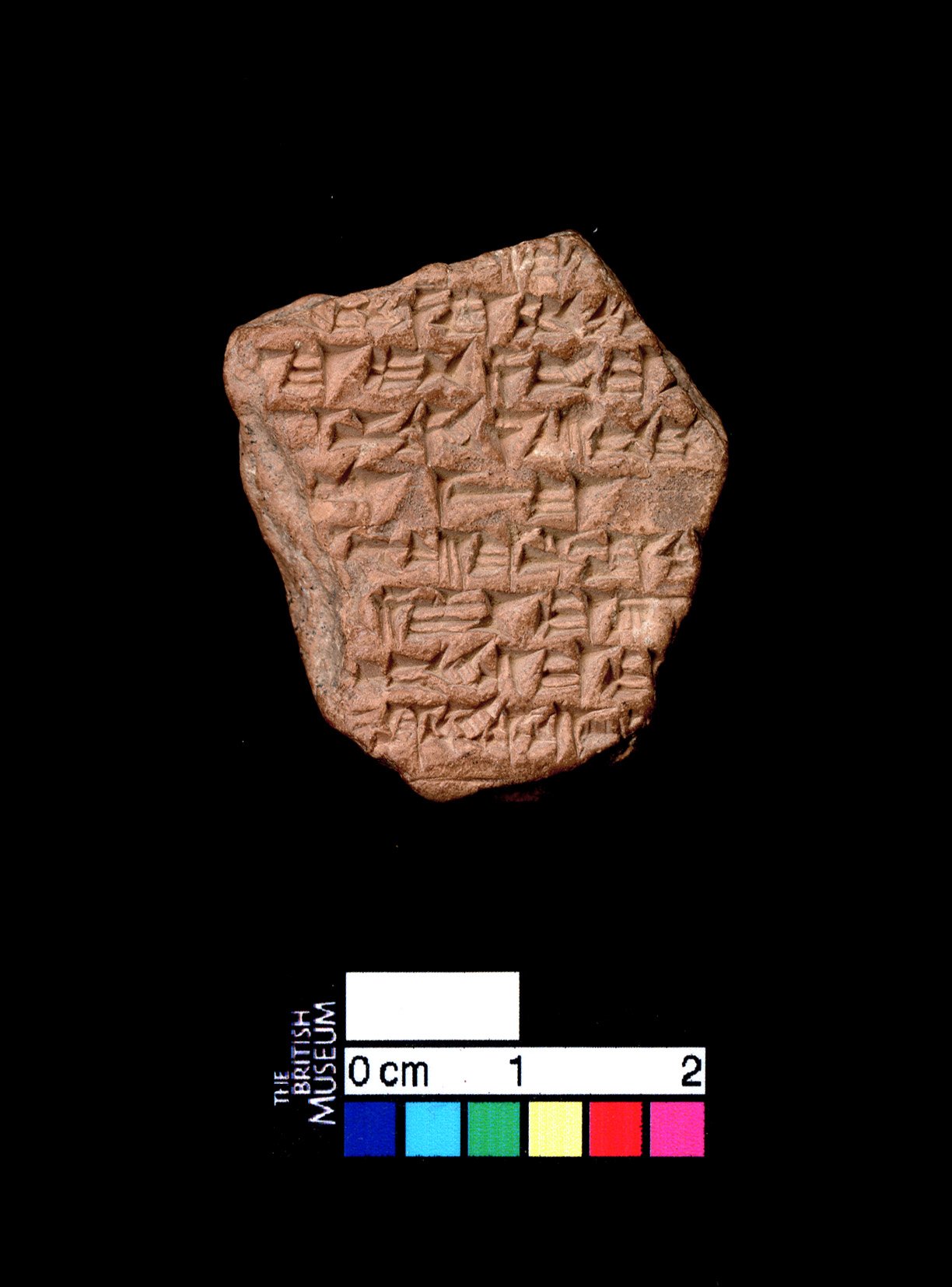
Where on the image
British Museum K.13525: the inscribed face, the tablet's own lines 1' to 6'. eBL's corpus edition (https://www.ebl.lmu.de/corpus/L/1/4/SB/V) attributes SB V 91-96 to this manuscript at these column and line numbers. Photograph checked: one face with about 9 lines; eBL gives no column for this fragment. On this tablet of lines 91, 95 only one to three signs survive and lines 92-94, 96 are partly broken (square brackets and x in the Akkadian). The English of these lines translates eBL's composite text, so it includes words that are not preserved on this tablet but are restored from other manuscripts or by the editors. Square brackets in the English mark eBL's restorations in its composite text; words that survive on other tablets carry no brackets even where this tablet is broken.
91[x x x x x x x x x x i]l-la#-k[a di-ma-a-šu₂]
92[ia-ši ša₂ lib₃-b]i UNUG{ki} taq-bu-[ni x x x]
93[e-nin-n]a-ma i-ziz-za-am-ma x [x x x x (x)]
94[x {d}GIŠ-g]im₂-maš NUNUZ ša₂ lib₃-bi UNU[G{ki} ṣil-la-ka šu-kun]
95[{d}UTU] iš-me-ma [x x x x x]
96[ul-tu ul-l]a-nu-um-ma tuk-ku u[l-tu AN-e il-ta-na-sa-aš₂-šu₂]
91[his tears] flowing under the rays of the sun:
92‘[Do not forget the day that] you spoke [to me] in Uruk!’
93Now come to my aid and … […]
94Upon Gilgameš, offshoot sprung from Uruk’s midst, [place your protection!]’
95Šamaš heard what he had spoken,
96straight away [from the sky there cried out] a voice:
Where on the image
British Museum K.8591: column ii, the tablet's own lines 4' to 11'. eBL's corpus edition (https://www.ebl.lmu.de/corpus/L/1/4/SB/V) attributes SB V 97-106 to this manuscript at these column and line numbers. Photograph checked: obverse, reverse and edges; text on the obverse in two columns, consistent with eBL's columns i and ii. On this tablet of lines 101, 105 only one to three signs survive and lines 97-100, 102-104, 106 are partly broken (square brackets and x in the Akkadian). The English of these lines translates eBL's composite text, so it includes words that are not preserved on this tablet but are restored from other manuscripts or by the editors. Square brackets in the English mark eBL's restorations in its composite text; words that survive on other tablets carry no brackets even where this tablet is broken.
97[e tap-l]a!-ah i-ziz-za-aš₂-šu₂ la ir#-[ru-ub ana {giš}TIR-šu₂]
98[la ur]-rad a-na hal-bi-im-ma l[a x x x x x x]
99[la i]h-hal-lip₂ 7 {tug₂}GU₂.E₃-M[EŠ-šu x x x x]
100[1-e]t ha-lip₂-ma 6 ša₂-hi-iṭ :
101šu-nu [x x x x x x (x)]
102GIM# ri-i-mu kad₃-ri it-ku-p[u x x x x x (x)]
103[i]t-til-ta is-si-ma ma-li pi-[rit-ta (x x x)]
104[m]a-aṣ-ṣar qi₂-ša₂-ti i-šas-si :
105s[i?-x x x x x x]
106{d#}hum-ba-ba GIM {d#}IŠKUR# i#-[rag-gu-um]
97‘Fear not, stand against him! Ḫumbaba must not [enter his forest,]
98he must not go down to the grove, he must not put on his auras.]’
99‘He [must not] wrap himself in his seven cloaks…!
100[One] he is wrapped in, six he has shed.’
101They […]
102like a fierce wild bull, ready to charge […]
103He bellowed once, a bellow full of terror,
104the guardian of the forests was bellowing,
105… […]
106Ḫumbaba was [thundering] like the God of the Storm.
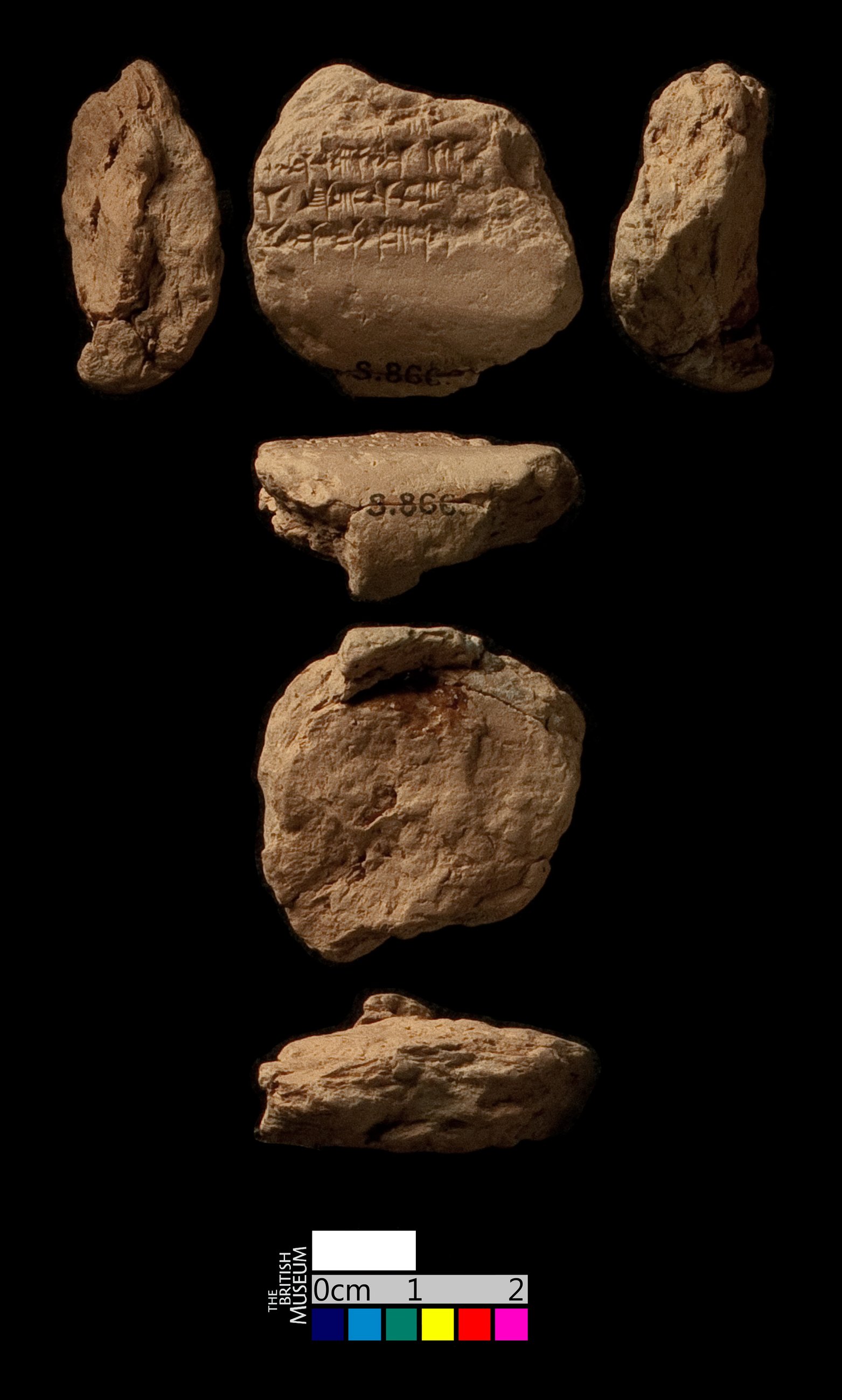
Where on the image
British Museum Sm.866: column iii, the tablet's own lines 1' to 4'b. eBL's corpus edition (https://www.ebl.lmu.de/corpus/L/1/4/SB/V) attributes SB V 136-142 to this manuscript at these column and line numbers. Photograph checked: obverse, reverse and edges, ink number S.866; about 7 lines on one face, consistent with eBL's column iii. On this tablet line 141 is entirely broken, of lines 138-139 only one to three signs survive and lines 136-137, 140, 142 are partly broken (square brackets and x in the Akkadian). The English of these lines translates eBL's composite text, so it includes words that are not preserved on this tablet but are restored from other manuscripts or by the editors. Square brackets in the English mark eBL's restorations in its composite text; words that survive on other tablets carry no brackets even where this tablet is broken.
136[x] tas#-su#-uh GI[R₃.MIN-ka x x x x x x x x]
137[x x x x x x x mi-hi-i]ṣ-ka dun-nin
138a-a x [x x x x x x x x x x x x]
139[x x x x x x x (x x x x)-k]a :
140šu-u₂-tu₂ liṭ-ṭu#-[ul x x x x x x]
141[x x x x x x x x x x : ]
142[M]AŠ₂.GI₆-MEŠ ma-la ta-tam-ma-ru# x [x x x x x]
136[Do not] pull back your foot, do not make a retreat!
137Make your blow mighty, [like that of a] lion!
138Let not … […]
139[…] you.
140And as for him, let him look […]
141‘Be mindful of your god Lugalbanda,
142keep in your thoughts all the dreams that you had!’
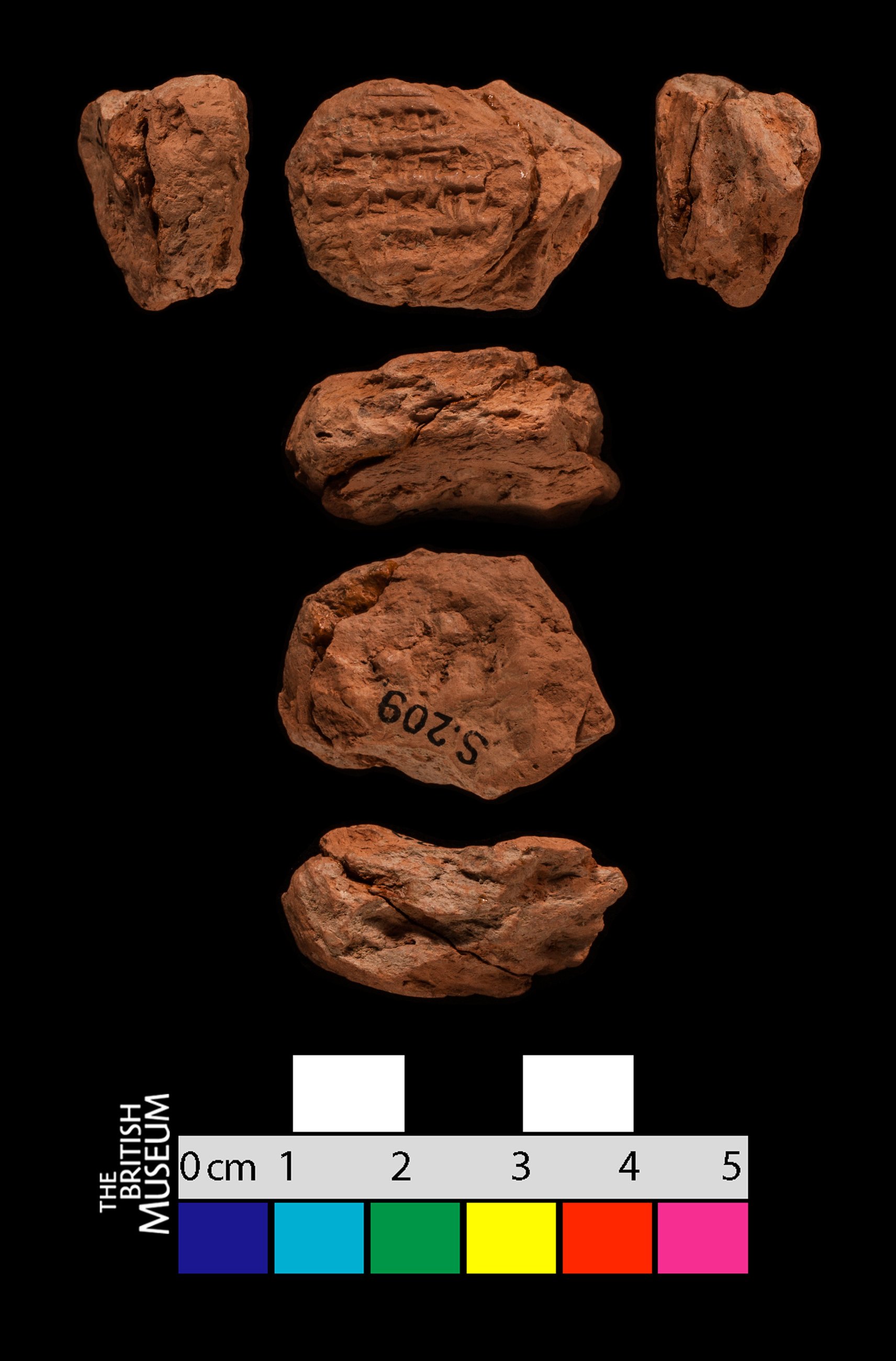
Where on the image
British Museum Sm.209: the inscribed face, the tablet's own lines 1' to 6'. eBL's corpus edition (https://www.ebl.lmu.de/corpus/L/1/4/SB/V) attributes SB V 195-206 to this manuscript at these column and line numbers. Photograph checked: obverse, reverse and edges, ink number S.209; about 8 lines on one face; eBL gives no column for this fragment. On this tablet lines 197, 201 are entirely broken, of line 195 only illegible traces (x) survive, of line 206 only one to three signs survive and lines 196, 198, 200, 205 are partly broken (square brackets and x in the Akkadian). The English of these lines translates eBL's composite text, so it includes words that are not preserved on this tablet but are restored from other manuscripts or by the editors. Square brackets in the English mark eBL's restorations in its composite text; words that survive on other tablets carry no brackets even where this tablet is broken. eBL line(s) 199, 202, 203, 204 fall within this run but are not on this tablet (they are listed among the lines not shown).
195[x x x] x [...]
196[{d}+e]n-ki-du₃ KA-šu₂ DU₃-m[a x x x x x x x x x : ]
197[x x x x x x x x x x x x]
198gum₂-mir-šu₂ ne₂-er-šu-m[a x x x x x]
200[la]-am iš-mu-u₂ a-ša₂-r[e-du x x x : ]
201[x x x x x x x x x x x x]
205[iš-me-e] {d#}hum-ba-ba# [x x x x x x x x x]
206[x x x re]-ši#?-šu₂# {d?#}[hum-ba-ba x x x x x x x x]
195speak to Gilgameš so he spares my life.’
196Enkidu opened his mouth to speak, saying to Gilgameš:
197‘My friend, Ḫumbaba, guardian of the Forest of [Cedar,]
198finish him, slay him, do away with his power!
200before Enlil the foremost has learned (about it)!
201The [great] gods could be angry with us,
205Ḫumbaba heard [how Enkidu abused him.]
206Ḫumbaba [lifted] his head, [weeping before Šamaš.]
Where on the image
British Museum K.3252: reverse, column v, the tablet's own lines 1' to 2'a. eBL's corpus edition (https://www.ebl.lmu.de/corpus/L/1/4/SB/V) attributes SB V 276'-277 to this manuscript at these column and line numbers. Photograph checked: obverse, reverse and edges of the join K.3252 + K.8561 (both ink numbers on the edge); text on both faces, consistent with eBL's columns i-ii and v-vi. On this tablet of lines 276'-277 only one to three signs survive. The English of these lines translates eBL's composite text, so it includes words that are not preserved on this tablet but are restored from other manuscripts or by the editors. Square brackets in the English mark eBL's restorations in its composite text; words that survive on other tablets carry no brackets even where this tablet is broken.
276'[x x x x] x hu [...]
277x [x x x x] x la la l[i ...]
276'… […]
277… […]
Where on the image
British Museum K.3252: the inscribed face, the tablet's own line 2'b. eBL's corpus edition (https://www.ebl.lmu.de/corpus/L/1/4/SB/V) attributes SB V 278 to this manuscript at these column and line numbers. Photograph checked: obverse, reverse and edges of the join K.3252 + K.8561 (both ink numbers on the edge); text on both faces, consistent with eBL's columns i-ii and v-vi. On this tablet line 278 is entirely broken. The English of this line translates eBL's composite text, so it includes words that are not preserved on this tablet but are restored from other manuscripts or by the editors. Square brackets in the English mark eBL's restorations in its composite text; words that survive on other tablets carry no brackets even where this tablet is broken.
278[...]
278May they not […]
Where on the image
British Museum K.3252: reverse, column v, the tablet's own lines 3' to 7'. eBL's corpus edition (https://www.ebl.lmu.de/corpus/L/1/4/SB/V) attributes SB V 279-283 to this manuscript at these column and line numbers. Photograph checked: obverse, reverse and edges of the join K.3252 + K.8561 (both ink numbers on the edge); text on both faces, consistent with eBL's columns i-ii and v-vi. On this tablet lines 279-283 are partly broken (square brackets and x in the Akkadian). The English of these lines translates eBL's composite text, so it includes words that are not preserved on this tablet but are restored from other manuscripts or by the editors. Square brackets in the English mark eBL's restorations in its composite text; words that survive on other tablets carry no brackets even where this tablet is broken.
279a-a# [u₂-lab]-bi#-ru ki-l[a-(al)-la-an]
280UG[U i]b-ri#-šu₂# {d}GIŠ-gim₂-maš# {d}+en-k[i-du₃ x x x x x x x x]
281{d}+e[n-k]i-du₃ pa-a-šu₂ du₃-ma i-qab#-[bi x x x x x x x]
282i[b-r]i a-qab-bak-kam-ma [x x x x x x]
283a-[d]i ar#-rat [x x x x x x x x]
279May the pair of them not grow old,
280apart from his friend Gilgameš, may Enkidu have nobody to bury him!’
281Enkidu opened his mouth to speak, saying to Gilgameš:
282‘My friend, I speak to you but you do not listen to me!
283Until the curses … […] … […]
Where on the image
British Museum K.3252: reverse, column vi, the tablet's own lines 1' to 6'. eBL's corpus edition (https://www.ebl.lmu.de/corpus/L/1/4/SB/V) attributes SB V 318-324 to this manuscript at these column and line numbers. Photograph checked: obverse, reverse and edges of the join K.3252 + K.8561 (both ink numbers on the edge); text on both faces, consistent with eBL's columns i-ii and v-vi. On this tablet of line 319 only one to three signs survive and lines 318, 320-322, 324 are partly broken (square brackets and x in the Akkadian). The English of these lines translates eBL's composite text, so it includes words that are not preserved on this tablet but are restored from other manuscripts or by the editors. Square brackets in the English mark eBL's restorations in its composite text; words that survive on other tablets carry no brackets even where this tablet is broken. eBL line(s) 323 fall within this run but are not on this tablet (they are listed among the lines not shown).
318[x x x x x x x NIB]RU#{ki#} li-b[il x x x x]
319[lih-du-u₂-m]a at₂-man [x x]
320[x x x] x ŠUR.MIN₃ a-di [x x x]
321[x x x a]-mu it-ta-du-u₂# [x x x x]
322[x x x-l]i? MIN uš-GEN₃/mat {d}+en-ki-d[u₃ x x x x]
324[x x x x x] SAG.DU {d}hum-ba-ba# ra-[kib-ma x x x]
318To the house of Enlil in Nippur the Euphrates shall bear it,
319[let rejoice] the sanctuary [of Nippur].
320They fashioned a raft of logs [of cedar and] cypress,
321they bound together a raft, they laid [cedar on it.]
322[…] … Enkidu […]
324and Gilgameš rode [too, bearing] the head of Ḫumbaba.
Notes
- Akkadian: eBL transliteration of the signs on the photographed tablet (manuscript-level ATF), not a composite text.
- English: A. R. George's translation in the eBL edition; it renders eBL's composite text, including restorations from other tablets.
- Line numbers: eBL edition (based on A. R. George, The Babylonian Gilgamesh Epic, Oxford 2003). Each section also gives the tablet's own column and line numbers.
- Signs in the Akkadian: [ ] broken away; x illegible sign; # damaged sign; ? uncertain reading; ! sign corrected by the editor; * collated sign; ... broken signs of unknown number; ( ) signs perhaps broken away; { } determinative; / alternative readings; : divider sign written on the tablet.
Cite
Sources
- Source: British Museum tablet photographs + eBL manuscript transliterations (eBL corpus edition L I.4, Poem of Gilgamesh (ed. A. R. George, rev. G. Rozzi and E. Jiménez), SB V) + English of the eBL edition (A. R. George (eBL edition)) (holding institution)
- Critical edition: electronic Babylonian Library, Poem of Gilgamesh (ed. A. R. George), manuscript transliterations
← previous · → next · v cycle view · l back to library