Epic of Gilgamesh, Tablet IX: Gilgamesh's wandering
Introduction
Afraid of death, Gilgamesh roams the wild in search of Uta-napishti, the survivor of the Flood. He passes the scorpion-people guarding the mountains of sunrise and walks the dark path of the sun to a garden of jewelled trees.
The Standard Babylonian version of the epic, traditionally ascribed to the scholar Sin-leqi-unninni, was written on twelve tablets. Most surviving copies come from the libraries of Ashurbanipal at Nineveh (7th century BCE) and from Babylon and other Babylonian cities (7th-2nd century BCE). This page gives Tablet IX in the line numbering of the electronic Babylonian Library edition by A. R. George (2022 and later revisions).
How this page is built. Each section is a run of consecutive lines as written on one photographed clay tablet. For every line the eBL edition (https://www.ebl.lmu.de/corpus/L/1/4/SB/IX) lists the manuscripts that carry it, with each tablet's own column and line numbers; the tablet chosen for each run is the photographed copy of the work with the most signs preserved there. Commentaries and texts that only quote a line are never chosen. School and excerpt tablets are used only for lines that no photographed library copy preserves as well, and only where they carry the line as text; their sections say so. The original text is eBL's transliteration of that tablet's signs (not a modern composite text): square brackets mark broken signs, x an illegible sign, # a damaged sign, ? an uncertain reading, and words in {braces} are determinatives; the notes give a key to every sign used on this page, and eBL's layout codes are written out in words (for example '(line break)' or '(blank space)'). Superscript numbers are the line numbers of the eBL edition, used in both the Akkadian and the English. The English is A. R. George's translation in the eBL edition (CC BY-NC-SA 4.0), one line of English per line of the poem; italics mark uncertain renderings, as in the source. Where the tablet is broken, the English still translates the whole line of eBL's composite text; each section's note names the lines that are broken on its tablet.
Finding a line on the photograph. Each section names the tablet, the face and column, and the tablet's own line numbers (a prime, as in 5', counts from the first preserved line of a broken column). On a tablet with six columns the obverse carries columns i-iii from left to right; the reverse, turned over from bottom to top, carries columns iv-vi from right to left. The photographs often show the obverse above the reverse with the edges around them; a fragment preserves only part of this layout.
This page shows 135 of the 137 lines of the eBL edition (99%), from 2 tablets in the British Museum: K.2360 (Nineveh), K.18183 (Nineveh).
Lines not shown. 2 of the 137 lines of the eBL edition are not shown, because no photographed copy of the work used here carries them: 146-147 (no manuscript preserves it). A line is shown only on a photographed tablet that carries it as text. Commentaries and other texts that quote a line (letters, rituals, god lists) are not used as witnesses, because they carry it with explanations or inside another text; tablets without a photograph in eBL are not used, because the line could not be shown on its tablet.
How was this verified? (Provenance)
Where on the image
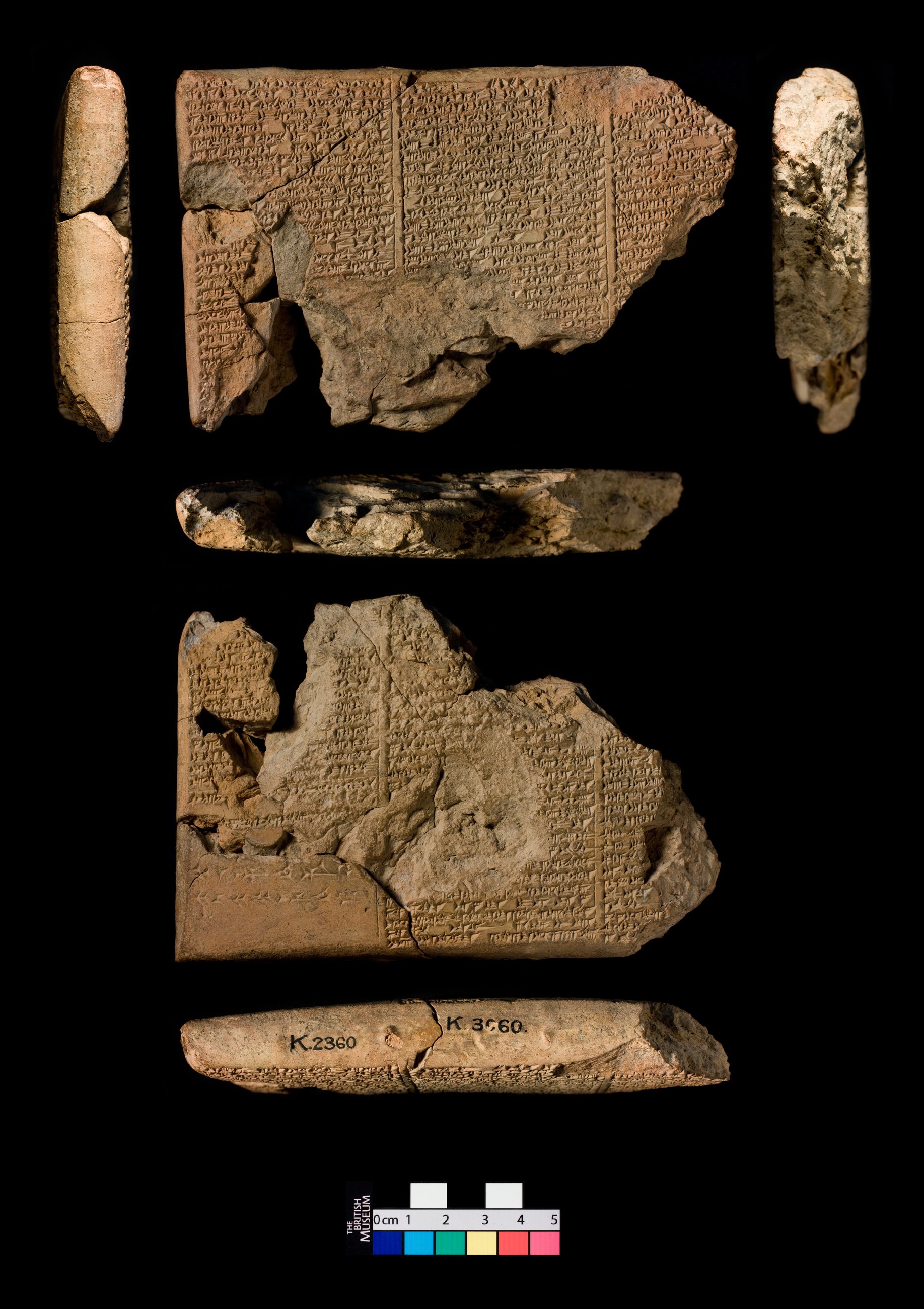
British Museum K.2360: obverse, column i, the tablet's own lines 1 to 29. eBL's corpus edition (https://www.ebl.lmu.de/corpus/L/1/4/SB/IX) attributes SB IX 1-29 to this manuscript at these column and line numbers. Photograph checked: obverse, reverse and edges of the join K.2360 + K.3060 (both ink numbers on the edge); three columns on each face, consistent with eBL's columns i-vi. On this tablet of lines 20-21, 24-29 only one to three signs survive and lines 8-19, 22-23 are partly broken (square brackets and x in the Akkadian). The English of these lines translates eBL's composite text, so it includes words that are not preserved on this tablet but are restored from other manuscripts or by the editors. Square brackets in the English mark eBL's restorations in its composite text; words that survive on other tablets carry no brackets even where this tablet is broken. Lines 1-7 are complete on this tablet.
1{d}GIŠ-gim₂-maš a-na {d}+en-ki-du₃ ib-ri-šu
2ṣar-piš i-bak-ki-ma i-rap-pu-ud EDIN
3a-na-ku a-mat-ma ul ki-i {d}+en-ki-du₃-ma-a
4ni-is-sa-a-tu₄ i-te-ru-ub ina kar-ši-ia
5mu-ta ap-lah₃-ma a-rap-pu-ud EDIN
6a-na le-et {m}UD-ZI DUMU {m}ubara-{d}tu-tu
7ur-ha ṣab-ta-ku-ma ha-an-tiš al-lak
8[a]-na# ne₂#-re-be₂-e-ti ša₂ KUR-i ak#-ta-šad mu-ši-tam
9[UR.MAH-ME]Š a-mur-ma ap-ta-lah₃ a-na-ku
10[x x re]-ši-ia# a-na {d}30 a-kar-rab
11[x x x x x na?]-mir#?-ti# DINGIR-MEŠ DU-ku su-pu-u-a
12[x x x x] x šul-li-ma-in-ni ia-a-ti
13[x x x x i]t-be ig#-gil₂-tu-ma šu-ut-tu₄
14[x x x x] mut#-[tiš₂] {d#}30 ih-te-du ba-la-ṭu
15iš#-ši# ha-a[ṣ-ṣi-in-na] a-na i-di-šu
16iš-lu-up [nam-ṣar] šib-bi-šu
17ki-ma šil-t[a-hi a-na b]i-ri-šu₂-nu im-qut
18im-ha-aṣ la-[ab-bi? i]-duk u₂-par-ri-ir
19u₃ bi-[x x x x x] x al#-lal#-lim#-ma
20id-di [x x x x x x x x x x]
21uṣ-ṣir x [x x x x x x x x]
22šu-um mah-r[i-i x x x x x x x x]
23šu-um ša₂-n[i-i x x x x x x x]
24iš-ši r[e-ši-šu x x x x x x x]
25a-na x [x x x x x x x x x x x]
26{d}[x x x x x x x x x]
27lu-[u₂ x x x x x x x x x x]
28k[i-i x x x x x x x (x)]
29{d#}[x x x x x x x]
1For his friend Enkidu Gilgameš
2was weeping bitterly as he roamed the wild:
3‘I shall die, and shall I not then be like Enkidu?
4Sorrow has entered my heart.
5I became afraid of death, so go roaming the wild,
6to Ūta-napišti, son of Ubār-Tutu,
7I am on the road and travelling swiftly.
8I arrived one night at the mountain passes,
9I saw some lions and grew afraid.
10I lifted my head, praying to Sîn,
11to [ … , the] light of the gods, my supplications went:
12“O [Sîn and …,] keep me safe!'"
13[Gilgameš] arose, he awoke with a start: it was a dream!
14[ … in the] presence of the moon he grew happy to be alive.
15He took up his axe in his hand,
16he drew forth [the dirk from] his belt.
17Like an arrow he fell among them,
18he smote the [lions, he] killed (them), he scattered (them).
19Then … […] …,
20he cast off [ …]
21He drew [two …,]
22the name of the first [was …,]
23the name of the second [was …]
24He lifted [his head, praying to Sîn,]
25to […, the light of the gods, his supplications went:]
26‘O [Sîn and …,]
27let […]
28How […?]'
29[Sîn …]
Where on the image
British Museum K.2360: obverse, column ii, the tablet's own lines 1 to 23. eBL's corpus edition (https://www.ebl.lmu.de/corpus/L/1/4/SB/IX) attributes SB IX 37-59 to this manuscript at these column and line numbers. Photograph checked: obverse, reverse and edges of the join K.2360 + K.3060 (both ink numbers on the edge); three columns on each face, consistent with eBL's columns i-vi. On this tablet of lines 58-59 only one to three signs survive and lines 37-40, 52-57 are partly broken (square brackets and x in the Akkadian). The English of these lines translates eBL's composite text, so it includes words that are not preserved on this tablet but are restored from other manuscripts or by the editors. Square brackets in the English mark eBL's restorations in its composite text; words that survive on other tablets carry no brackets even where this tablet is broken. Lines 41-51 are complete on this tablet.
37ša₂ ša-di-i še-mu-šu₂ ma-š[u-(um)-ma]
38ana ša-ad ma-a-ši i-na ka-š[a₂-di-šu]
39ša₂ u₄-mi-šam-ma i-na-aṣ-ṣa-ru a-ṣ[e-e {d}UTU-ši]
40e-lu-šu-nu šu-pu-uk AN-e i[n-du?]
41šap-liš a-ra-le-e i-rat-su-nu kaš#-da#-at₂#
42gir₂-tab-lu₂-u₁₈-lu i-na-aṣ-ṣa-ru KA₂-šu
43ša ra-aš₂-bat pu-ul-hat-su-nu-ma im-rat-su-nu mu-tu₂
44gal-tu mi-lam-mu-šu-nu sa-hi-ip hur-sa-a-ni
45ana a-ṣe-e# {d}UTU-ši u e-reb {d}UTU-ši i-na-aṣ-ṣa-ru {d}UTU-ši-ma
46i-mur-šu₂-nu-ti-ma {d}GIŠ-gim₂-maš pu-luh-ta (line break) (blank space) u ra-šub-ba-ta i-te-rim pa-ni-šu
47iṣ-bat ṭe₃-en-šu₂-ma iq-ru-ub ma-har-šu-un
48gir₂-tab-lu₂-u₁₈-lu a-na MUNUS-šu₂ i-šas-si
49ša₂ il-li-kan-na-ši UZU DINGIR-MEŠ zu-mur-šu
50gir₂-tab-lu₂-u₁₈-lu MUNUS-šu₂ ip-pal-šu
51šit-ta-šu DINGIR-ma šul-lul-ta-šu₂ a-me-lu-tu₂
52gi[r₂-tab-lu₂]-u₁₈#-lu# zi-ka-ru i-šas-si
53[x x x x x x U]ZU DINGIR-MEŠ a-ma-tu₂ i-zak-kar
54[x x x x x x x x] ru-qa-ta ur-ha
55[x x x x tas-ni-q]a a-di mah-ri-ia
56[x x x x x te-teb-bi-r]a ša₂ e-ber-ši-na pa-aš₂-qu
57[x x x x x x] x-ta-ka lul-mad
58[x x x x x x a-šar? pa-nu?-k]a šak-nu
59[x x x x x x x x x lu]l-mad
37The name of the mountain was Māšu.
38To Māšu’s twin mountains he came,
39which daily guard the rising [of the sun,] –
40their tops [abut] the fabric of the heavens,
41their bases reach down to Hades –
42there were scorpion-men guarding its gate,
43whose terror was dread and glance was death,
44whose radiance was terrifying, enveloping the uplands –
45at both sunrise and sunset they guard the sun –
46Gilgameš saw them and covered his face with fear and dread;
47he collected his wits and drew near their presence.
48The scorpion-man called to his female:
49‘He who has come to us, flesh of the gods is his body.’
50The scorpion-man’s female answered him:
51‘Two-thirds of him are god but a third of him is human.’
52The male scorpion-man called out,
53saying a word [to King Gilgameš,] flesh of the gods:
54'[How did you come here,] a far road?
55[how did you get] here, into my presence?
56[How did you ford the many rivers], whose crossing is perilous?
57[…] let me learn of your […]
58[… where] your [face] is set,
59[… let me] learn [of your journey.]'
Where on the image
British Museum K.2360: obverse, column iii, the tablet's own lines 3 to 22. eBL's corpus edition (https://www.ebl.lmu.de/corpus/L/1/4/SB/IX) attributes SB IX 74-93 to this manuscript at these column and line numbers. Photograph checked: obverse, reverse and edges of the join K.2360 + K.3060 (both ink numbers on the edge); three columns on each face, consistent with eBL's columns i-vi. On this tablet of lines 74, 93 only illegible traces (x) survive, of lines 88-92 only one to three signs survive and lines 75-87 are partly broken (square brackets and x in the Akkadian). The English of these lines translates eBL's composite text, so it includes words that are not preserved on this tablet but are restored from other manuscripts or by the editors. Square brackets in the English mark eBL's restorations in its composite text; words that survive on other tablets carry no brackets even where this tablet is broken.
74[x x x] x x [x x x x x x x x x]
75K[ASKAL?] {m}UD-ZI AD-ia x [x x x x x x x]
76ša₂ iz-zi-zu-ma ina UKKIN DI[NGIR-MEŠ x x x x x x]
77mu-ta u TI.LA [x x x x x x x x]
78gir₂-tab-lu₂-u₁₈-lu pa-a-šu₂ DU₃-u[š-ma x x x]
79i-zak-ka-ru a-n[a {d}GIŠ-gim₂-maš]
80ul ib-ši {d}GIŠ-gim₂-maš G[IM x x x]
81ša ša-di-i ma-am-ma du-x [x x x x x (x)]
82a-na 12 DANNA lib-ba-š[u x x x x x (x)]
83ša-pat ek-le-tum₃-ma ul i[b-ba-aš₂-ši nu-ru]
84a-na a-ṣe-e {d}UTU#-ši# i#-[x x x x x (x)]
85a-na e-reb {d}U[TU-ši x x x x x (x)]
86a-na e-reb {d}[UTU-ši x x x x x (x)]
87u₂-še-ṣu-u₂# [x x x x x x x x]
88u₂-her-ri-[x x x x x x x (x)]
89at-ta k[i-ki-i? x x x x x x (x)]
90ter-r[u-ub x x x x x x x x x x (x)]
91da[m-x x x x x x x x x x x x (x)]
92šuk-[x x x x x x x x x x x (x)]
93x [x x x x x x x x x x x x (x)]
74[…] … […]
75‘[I am seeking] the [road] of my forefather, Ūta-napišti.
76He who stood in the assembly of the gods, and [found life,]
77of death and life [he will tell me the secret.]'
78The scorpion-man opened his mouth [to speak,]
79saying to [Gilgameš:]
80‘There was not [ever], O Gilgameš, […] like [you,]
81never did anyone [travel the path] of the mountain.
82For twelve double-hours its interior [extends,]
83the darkness is dense and [light is] there none.
84For the rising of the sun […,]
85for the setting of the [sun …,]
86For the setting of the […,]
87they sent forth […]
88… […]
89and you, how [will you …?]
90Will you go [in …?]'
91… […]
92… […]
93… […]
Where on the image
British Museum K.2360: reverse, column iv, the tablet's own lines 1' to 17'. eBL's corpus edition (https://www.ebl.lmu.de/corpus/L/1/4/SB/IX) attributes SB IX 125-141 to this manuscript at these column and line numbers. Photograph checked: obverse, reverse and edges of the join K.2360 + K.3060 (both ink numbers on the edge); three columns on each face, consistent with eBL's columns i-vi. On this tablet of lines 133-134, 136, 139 only one to three signs survive and lines 125-132, 135, 137-138, 140-141 are partly broken (square brackets and x in the Akkadian). The English of these lines translates eBL's composite text, so it includes words that are not preserved on this tablet but are restored from other manuscripts or by the editors. Square brackets in the English mark eBL's restorations in its composite text; words that survive on other tablets carry no brackets even where this tablet is broken.
125ina ni-is-s[a-a-ti x x x x x x x x x x x (x x)]
126ina šar-bi u ṣ[e-e-ti qu-um-mu-u₂ pa-nu-u₂-a]
127ina ta-ne₂-hi [x x x x x x x x x x]
128e-nin-na t[a-x x x x x x x x x x]
129gir₂-tab-lu₂-u₁₈-l[u pa-a-šu₂ DU₃-uš-ma i-qab-bi?]
130ana {d}GIŠ-gim₂-maš ša[r-ri UZU DINGIR-MEŠ a-ma-tu₂ i-zak-kar?]
131a-lik {d}GIŠ-gi[m₂-maš x x x x x x x x x x]
132KUR-MEŠ ma-a-šu l[i?-x x x x x x x x x x]
133KUR-MEŠ hur-[sa-a-nu x x x x x x x x (x)]
134šal-meš l[i-x x x x x x x x x x (x x)]
135KA₂.GAL KUR Š[E-x x x x x x x x (x)]
136{d}GIŠ-g[im₂-maš x x x x x x x]
137ana zik-ri š[a₂ x x x x x x x x x x x x x (x)]
138KASKAL {d}UTU i[ṣ-bat x x x x x x x x x x]
1391 DANNA x [x x x x x x x x x (x)]
140ša₂-pat ek-le-t[um₃-ma x x x x x x x]
141ul i-nam#-d[i-in-šu₂-ma x x x x x x x x]
125‘Through sorrow […;]
126by frost and sunshine [my face is burnt.]
127Through exhaustion […:]
128now you [must …]’
129The scorpion-man [opened his mouth to speak,]
130[saying a word] to King Gilgameš, [flesh of the gods:]
131‘Go, Gilgameš! […,]
132May the mountains of Māšu [allow you to pass!]
133‘[May] the mountains and hills [watch over your going!]
134Let [them help you] in safety [to continue your journey]
135[May] the gate of the mountain [open before you!]'
136[When] Gilgameš [heard this,]
137to what [the scorpion-man] had told him […]
138he [took] the path of the sun […]
139One double-hour … […,]
140the darkness was dense, [and light was there none:]
141it did not [allow him to see what was behind him.]
Where on the image
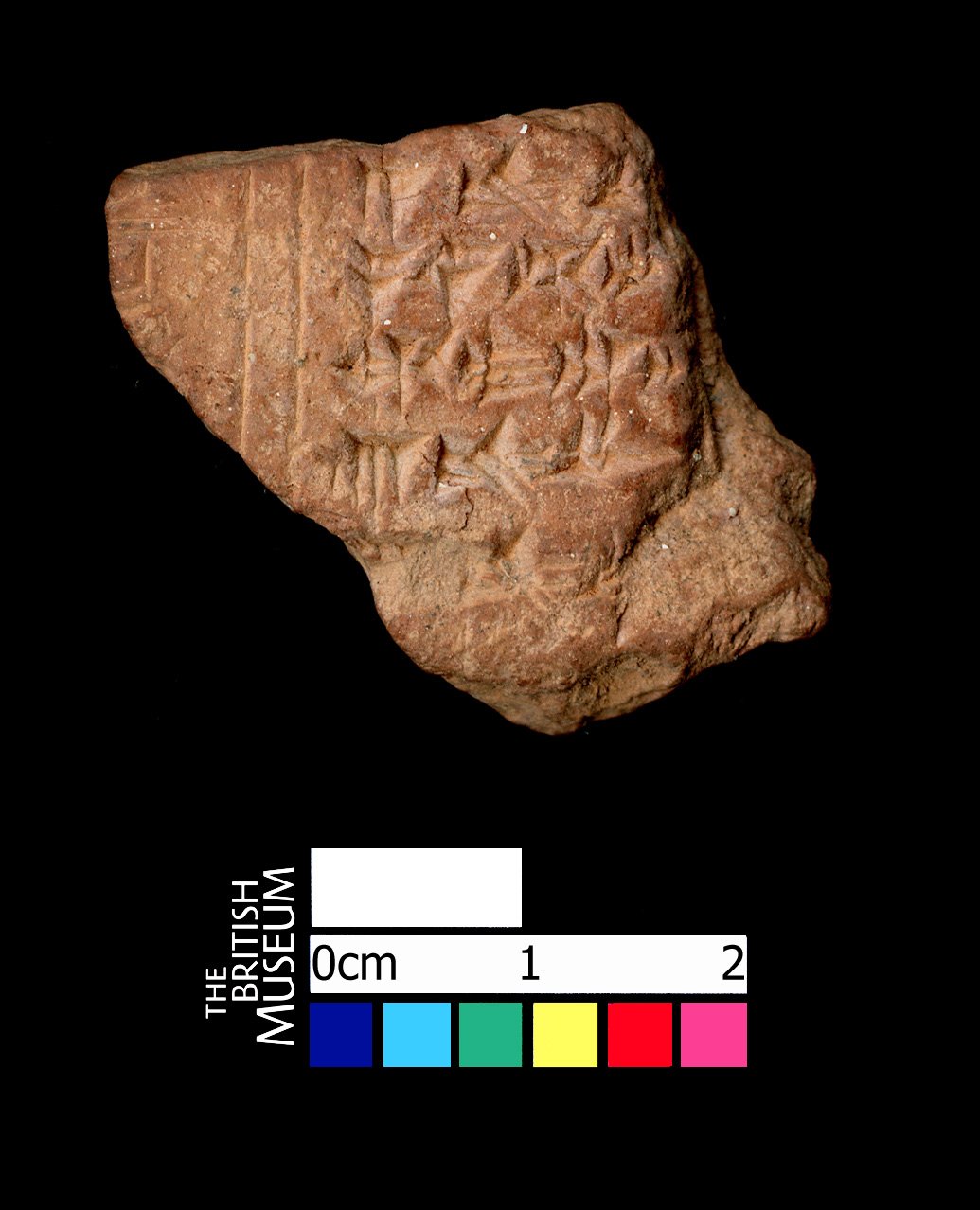
British Museum K.18183: column iv, the tablet's own lines 1' to 5'. eBL's corpus edition (https://www.ebl.lmu.de/corpus/L/1/4/SB/IX) attributes SB IX 142-148 to this manuscript at these column and line numbers. Photograph checked: one face with about 5 lines, consistent with eBL's column iv. On this tablet of lines 142, 145, 148 only one to three signs survive and lines 143-144 are partly broken (square brackets and x in the Akkadian). The English of these lines translates eBL's composite text, so it includes words that are not preserved on this tablet but are restored from other manuscripts or by the editors. Square brackets in the English mark eBL's restorations in its composite text; words that survive on other tablets carry no brackets even where this tablet is broken. eBL line(s) 146, 147 fall within this run but are not on this tablet (they are listed among the lines not shown).
1422 DANN[A x x x x x x x x x (x)]
143ša₂-pat ek-l[e-tum₃-ma x x x x x x x]
144ul i-na-a[n-di-in-šu₂-ma x x x x x x x]
1453 DANNA [x x x x x x x x x (x)]
1484 DANN[A x x x x x x x x x (x)]
142Two double-hours […,]
143the darkness was dense, [and light was there none:]
144it did not [allow him to see what was behind him.]
145Three double-hours […,]
148Four double-[hours …,]
Where on the image
British Museum K.2360: reverse, column v, the tablet's own lines 7 to 34. eBL's corpus edition (https://www.ebl.lmu.de/corpus/L/1/4/SB/IX) attributes SB IX 149-176 to this manuscript at these column and line numbers. Photograph checked: obverse, reverse and edges of the join K.2360 + K.3060 (both ink numbers on the edge); three columns on each face, consistent with eBL's columns i-vi. On this tablet of lines 149-151, 154, 167-169 only one to three signs survive and lines 152-153, 155-166, 170-172 are partly broken (square brackets and x in the Akkadian). The English of these lines translates eBL's composite text, so it includes words that are not preserved on this tablet but are restored from other manuscripts or by the editors. Square brackets in the English mark eBL's restorations in its composite text; words that survive on other tablets carry no brackets even where this tablet is broken. Lines 173-176 are complete on this tablet.
149ša₂-pat# [x x x x x x x x x x x]
150ul i-nam#-[di-in-šu₂-ma x x x x x x x]
1515 DANNA [x x x x x x x x x x x]
152ša₂#-pat# ek-l[e-tum₃-ma x x x x x x x]
153u[l] i#-nam-di-[in-šu₂-ma x x x x x x x]
1546# [DANN]A i-[x x x x x x x x]
155ša₂-pat# ek-le-tum₃-[ma x x x x x x x]
156ul# i#-nam-di-i[n-šu₂-ma x x x x x x x x]
1577# DANNA# ina ka-š[a₂-d]i x [x x x x x x (x)]
158ša₂-pat ek-le#-[tum₃-m]a ul i#-[ba-aš₂-ši x x]
159ul i-nam-[d]i-in#-šu₂#-ma# [a-n]a pa#-la-sa# EGIR#-[su]
1608 DANNA GIM#? [x x] i-ṣar-ra-a[h]
161ša₂-pat ek-l[e-tum₃-ma ul i-b]a-aš₂-ši nu-ru#
162ul i-na[m-di-in-šu₂-ma a-na p]a-la-sa EGIR-su
1639# DA[NNA x x x x x x] {im}SI.SA₂
164[x x x x x x x x]-ha pa-ni-šu
165[x x x x x x x i-ba-a]š₂-ši nu-ru
166[ul i-nam-di-in-šu₂-ma a-na p]a-la-sa EGIR-su
167[x x x x x x x x ina ka-ša₂]-di-šu
168[x x x x x x x x (x)] qit-ru-ub
169[x x x x x x x x (x)] ša₂ DANNA
170[x x x x x x it-t]a-ṣi la-am {d}UTU-ši
171x [x x x x x x (x) n]a-mir-tu₂ šak-na-at
172(gloss: KUR₂) a-x [x x] x x-hi iṣ-ṣi ša₂# DINGIR?#-MEŠ ina a-ma-ri i-ši-ir
173{na₄}GUG# na-ša₂-at i-ni-ib-ša₂
174is-hu#-un-na-tu₄ ul-lu-la-at a-na da-ga-la hi-pat
175{na₄}ZA#.GIN₃ na-ši ha-as-hal-ta
176in-ba na-ši-ma a-na a-ma-ri ṣa-a-a-ah
149[the darkness] was dense, [and light was there none:]
150it did not [allow him to see what was behind him.]
151Five double-hours [ …,]
152the darkness was dense, [and light was there none:]
153it did not allow [him to see what was behind him.]
154When [he reached] six double-hours,
155the darkness was dense, [and light was there none:]
156it did not allow [him to see what was behind him.]
157On reaching seven double-hours […,]
158the darkness was dense, and [light was there] none:
159it did not allow him [to] see what was behind [him.]
160At eight double-hours he was hurrying like […,]
161the darkness was dense, and light was [there none:]
162it did not [allow him to] see what was behind him.
163Nine double-[hours …] the north wind,
164[…] … his face;
165[the darkness was dense, and] light was [there none:]
166[it did not allow him to] see what was behind him.
167[When he] reached [ten double-hours,]
168[…] was very near.
169[on reaching eleven double-hours a journey remained] of one double-hour,
170[at twelve double-hours Gilgameš] emerged ahead of the Sun.
171[…] there was brilliance:
172he went straight, as soon as he saw them, to… the trees of the gods.
173A carnelian (tree) was in fruit,
174hung with bunches of grapes, lovely to behold.
175A lapis lazuli (tree) bore foliage,
176in full fruit and gorgeous to gaze on.
Where on the image
British Museum K.2360: reverse, column vi, the tablet's own lines 8 to 20. eBL's corpus edition (https://www.ebl.lmu.de/corpus/L/1/4/SB/IX) attributes SB IX 184-196 to this manuscript at these column and line numbers. Photograph checked: obverse, reverse and edges of the join K.2360 + K.3060 (both ink numbers on the edge); three columns on each face, consistent with eBL's columns i-vi. On this tablet of lines 184-185 only one to three signs survive and lines 186-196 are partly broken (square brackets and x in the Akkadian). The English of these lines translates eBL's composite text, so it includes words that are not preserved on this tablet but are restored from other manuscripts or by the editors. Square brackets in the English mark eBL's restorations in its composite text; words that survive on other tablets carry no brackets even where this tablet is broken.
184[x x] x ŠU[R.MIN₃? x x x x x x x]
185[x (x)] {giš}EREN [x x x x x x]
186zi#-nu-šu {na₄}BABBAR.[DIL x x x x x] ab#-ni
187la-ru-uš A.AB.BA# [x x x x x] {na₄#}NIR₂.ZIZ
188GIM {giš}DIH₃ u {giš}U₂.[GIR₂ x x x {na₄}]AN.ZA.GUL.ME
189ha-ru-bu il#-p[u-ut? {na₄}A]D-aš-mu#
190{na₄}ŠUBA {na₄}K[A.(GI.NA) x (x)] x-an-rat#?
191G[IM x-r]e-e u la-li-[x (x) x] x-u₂ EDI[N?]
192GIM x [x x x x x x {na₄}U]GU.AŠ₂.GI₄.GI₄
193ša₂ gi-x [x x x x {na₄}PE]Š₄ A.AB.BA
194i-šu me-[x x x x] x [g]a? li lul lum
195{d}GIŠ-gim₂-maš x [x x x x] x i#?-tal-lu-ki-šu₂
196i-š[i] r[e-ši-ša₂ i-n]a-ṭa[l-š]u šu-a-tu₄
184[…] cypress […]
185[…] cedar […,]
186its leaf-stems were of pappardilû [stone and …] …
187Sea coral […] sāsu-stone,
188instead of thorns and briar [there grew] crystal vials.
189He touched a carob, [(it was)] abašmu stone,
190šubû stone and haematite […] …
191Like […] and … […] … the plain,
192like […] turquoise.
193Of […] sea-shell,
194it had […] …
195As Gilgameš walked about [in wonder,]
196she lifted up [her head to] watch him.
Notes
- Akkadian: eBL transliteration of the signs on the photographed tablet (manuscript-level ATF), not a composite text.
- English: A. R. George's translation in the eBL edition; it renders eBL's composite text, including restorations from other tablets.
- Line numbers: eBL edition (based on A. R. George, The Babylonian Gilgamesh Epic, Oxford 2003). Each section also gives the tablet's own column and line numbers.
- Signs in the Akkadian: [ ] broken away; x illegible sign; # damaged sign; ? uncertain reading; ! sign corrected by the editor; ( ) signs perhaps broken away; { } determinative; (line break) the line runs on to the next line of the tablet; (blank space) a space left by the scribe; (gloss: ...) a note written by the scribe in small signs or in the margin.
Cite
Sources
- Source: British Museum tablet photographs + eBL manuscript transliterations (eBL corpus edition L I.4, Poem of Gilgamesh (ed. A. R. George, rev. G. Rozzi and E. Jiménez), SB IX) + English of the eBL edition (A. R. George (eBL edition)) (holding institution)
- Critical edition: electronic Babylonian Library, Poem of Gilgamesh (ed. A. R. George), manuscript transliterations
← previous · → next · v cycle view · l back to library