Epic of Gilgamesh, Tablet X: Shiduri, Ur-shanabi and Uta-napishti
Introduction
Gilgamesh meets the ale-wife Shiduri by the sea, then the boatman Ur-shanabi, who takes him across the Waters of Death. Uta-napishti speaks to him about the fate of mortals.
The Standard Babylonian version of the epic, traditionally ascribed to the scholar Sin-leqi-unninni, was written on twelve tablets. Most surviving copies come from the libraries of Ashurbanipal at Nineveh (7th century BCE) and from Babylon and other Babylonian cities (7th-2nd century BCE). This page gives Tablet X in the line numbering of the electronic Babylonian Library edition by A. R. George (2022 and later revisions).
How this page is built. Each section is a run of consecutive lines as written on one photographed clay tablet. For every line the eBL edition (https://www.ebl.lmu.de/corpus/L/1/4/SB/X) lists the manuscripts that carry it, with each tablet's own column and line numbers; the tablet chosen for each run is the photographed copy of the work with the most signs preserved there. Commentaries and texts that only quote a line are never chosen. School and excerpt tablets are used only for lines that no photographed library copy preserves as well, and only where they carry the line as text; their sections say so. The original text is eBL's transliteration of that tablet's signs (not a modern composite text): square brackets mark broken signs, x an illegible sign, # a damaged sign, ? an uncertain reading, and words in {braces} are determinatives; the notes give a key to every sign used on this page, and eBL's layout codes are written out in words (for example '(line break)' or '(blank space)'). Superscript numbers are the line numbers of the eBL edition, used in both the Akkadian and the English. The English is A. R. George's translation in the eBL edition (CC BY-NC-SA 4.0), one line of English per line of the poem; italics mark uncertain renderings, as in the source. Where the tablet is broken, the English still translates the whole line of eBL's composite text; each section's note names the lines that are broken on its tablet.
Finding a line on the photograph. Each section names the tablet, the face and column, and the tablet's own line numbers (a prime, as in 5', counts from the first preserved line of a broken column). On a tablet with six columns the obverse carries columns i-iii from left to right; the reverse, turned over from bottom to top, carries columns iv-vi from right to left. The photographs often show the obverse above the reverse with the edges around them; a fragment preserves only part of this layout.
This page shows 301 of the 325 lines of the eBL edition (93%), from 4 tablets in the British Museum and Iraq Museum: K.8589 (Nineveh), BM.34160, K.3382 (Nineveh), IM.67564 (Kalḫu).
Lines not shown. 24 of the 325 lines of the eBL edition are not shown, because no photographed copy of the work used here carries them: 47-60 (no manuscript preserves it); 126-130 (no manuscript preserves it); 257 (no photograph in eBL: Rm.751); 292'-295 (no photograph in eBL: Rm.751). A line is shown only on a photographed tablet that carries it as text. Commentaries and other texts that quote a line (letters, rituals, god lists) are not used as witnesses, because they carry it with explanations or inside another text; tablets without a photograph in eBL are not used, because the line could not be shown on its tablet.
How was this verified? (Provenance)
Where on the image
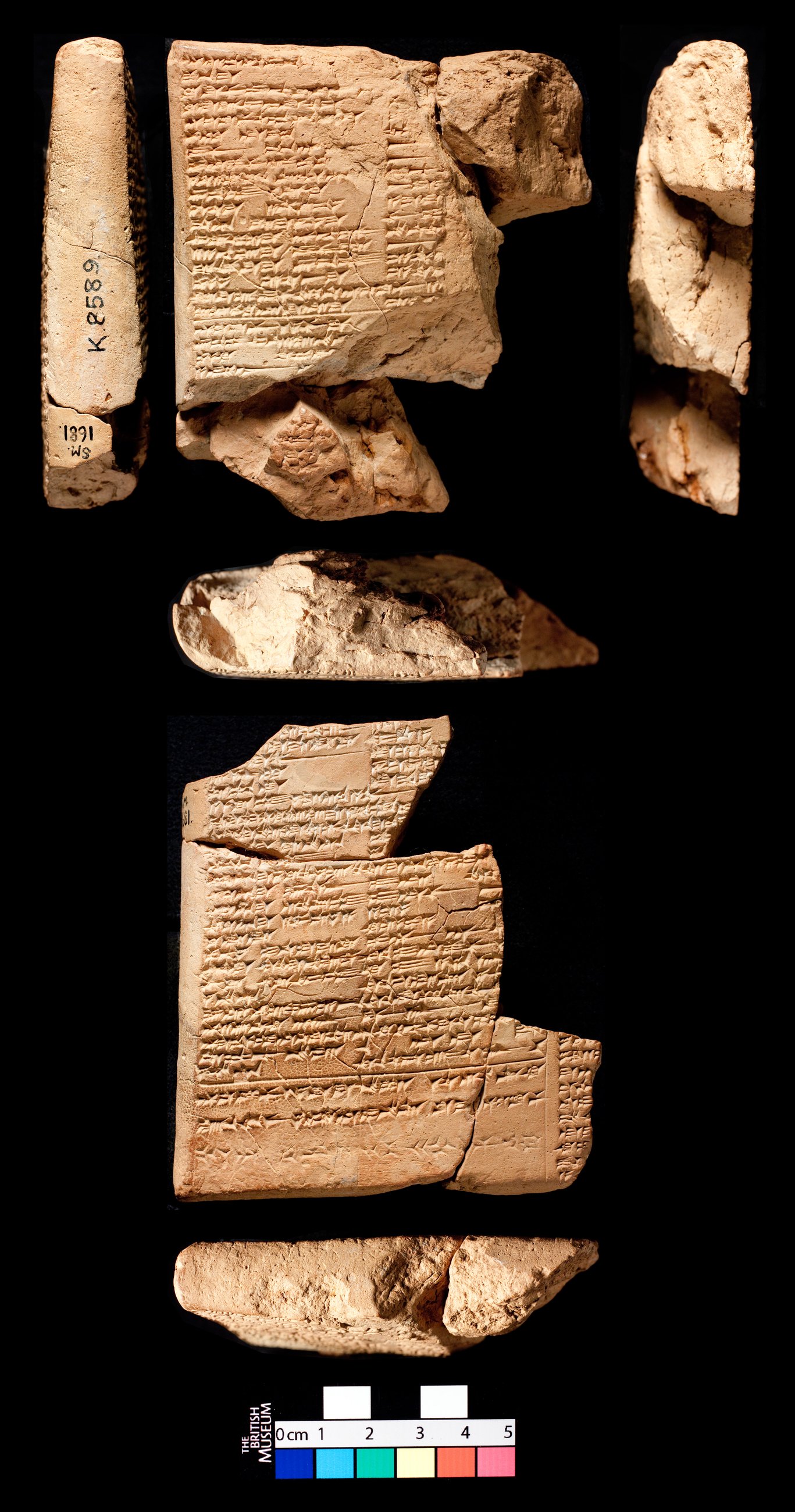
British Museum K.8589: obverse, column i, the tablet's own lines 1 to 22. eBL's corpus edition (https://www.ebl.lmu.de/corpus/L/1/4/SB/X) attributes SB X 1-22 to this manuscript at these column and line numbers. Photograph checked: obverse, reverse and edges of the join K.8589 + Sm.1681 (ink numbers on the edge); text on both faces, consistent with eBL's columns i and v-vi. On this tablet of line 2 only one to three signs survive and lines 1, 3-22 are partly broken (square brackets and x in the Akkadian). The English of these lines translates eBL's composite text, so it includes words that are not preserved on this tablet but are restored from other manuscripts or by the editors. Square brackets in the English mark eBL's restorations in its composite text; words that survive on other tablets carry no brackets even where this tablet is broken.
1{d}ši₂-du-ri sa-bi-t[u₄ | ša₂ ina sa-pan tam-ti aš₂-bat]
2aš₂-bat-ma | [x x x x (x)]
3ib-šu-ši kan-nu ib-šu-ši x [x x x]
4ku-tu-um-mi kut-tu-mat-ma | k[u?-lu?-li? x x x (x)]
5{d}GIŠ-gim₂-maš ut-tag-gi-ša[m]-ma | x [x x (x)]
6maš-ka la-biš | pu-l[uh?-tu₄? x (x) x]
7i-ši UZU DINGIR-M[E]Š | ina z[u-um-ri-šu?]
8i-ba-aš₂-ši SAG.PA.LAGAB | ina [kar-ši-šu₂]
9a-na a-lik ur-hi ru-qa (written over erased qu)-ti | pa-nu-šu₂ [maš-lu]
10sa-bi-tu₄ ana ru-qi₂ | ina-aṭ-ṭ[a-al?-šum?-ma?]
11uš-tam-ma a-na lib₃-bi-ša₂ | a-ma-t[a x x x]
12it-ti ra-ma-ni-ša₂-ma | ši-i [x x x]
13mi-in-de-e-ma an-nu-u₂ | mu-na-ʾ-[er x x]
14a-a-nu-um-ma i-ši-ra | ina [x x]
15e-mur-šu-ma sa-bi-tu₄ | e-te-d[il x x]
16KA₂-ša₂ e-te-dil-ma | e-te-l[a-a x x x x]
17u₃ šu-u₂ i-ši uz-na {d}GIŠ-gim₂-maš | a-n[a x x x x]
18u₂-šaq-qi₂ zu-qat-su-ma | iš-ta#-k[an?-ši x x]
19{d}GIŠ-gim₂-maš ana ša₂-ši-ma | [x x x x x]
20sa-bi-tu₄ mi-na-a ta-mu-ri-i[n-ni-ma | te-di-li x x]
21KA₂-ki te-di-l[i-ma | te-te-li-i x x x x]
22a-mah-haṣ da[l-ta | sik-ku-ri x x x]
1Šiduri was an ale-wife who lived by the sea-shore.
2there she lived, [in an inn by the sea-shore.]
3Potstands she had, and [vats of gold,]
4she was swathed in hoods and [veiled with] veils.
5Gilgameš came wandering, and […:]
6he was clothed in a pelt, and fearful [to look on.]
7He had the flesh of the gods in [his body,]
8but there was sorrow in [his heart.]
9His face was like one who had travelled a distant road;
10the ale-wife was watching him in the distance.
11Talking to herself she spoke a word,
12taking counsel in her own mind:
13‘For sure this man is a slayer of wild bulls;
14whence did he make straight for my gate?’
15The ale-wife saw him and barred her gate,
16barred her gate and went up on the roof.
17But he, Gilgameš, had (good) hearing … […,]
18he lifted his chin and turned [towards her.]
19Gilgameš [spoke] to her, [to the ale]-wife:
20‘Ale-wife, why when you saw [me did you bar] your [gate?]
21You barred your gate [and went up on the] roof.
22I shall strike the door, I shall [break the bolt.]
Where on the image
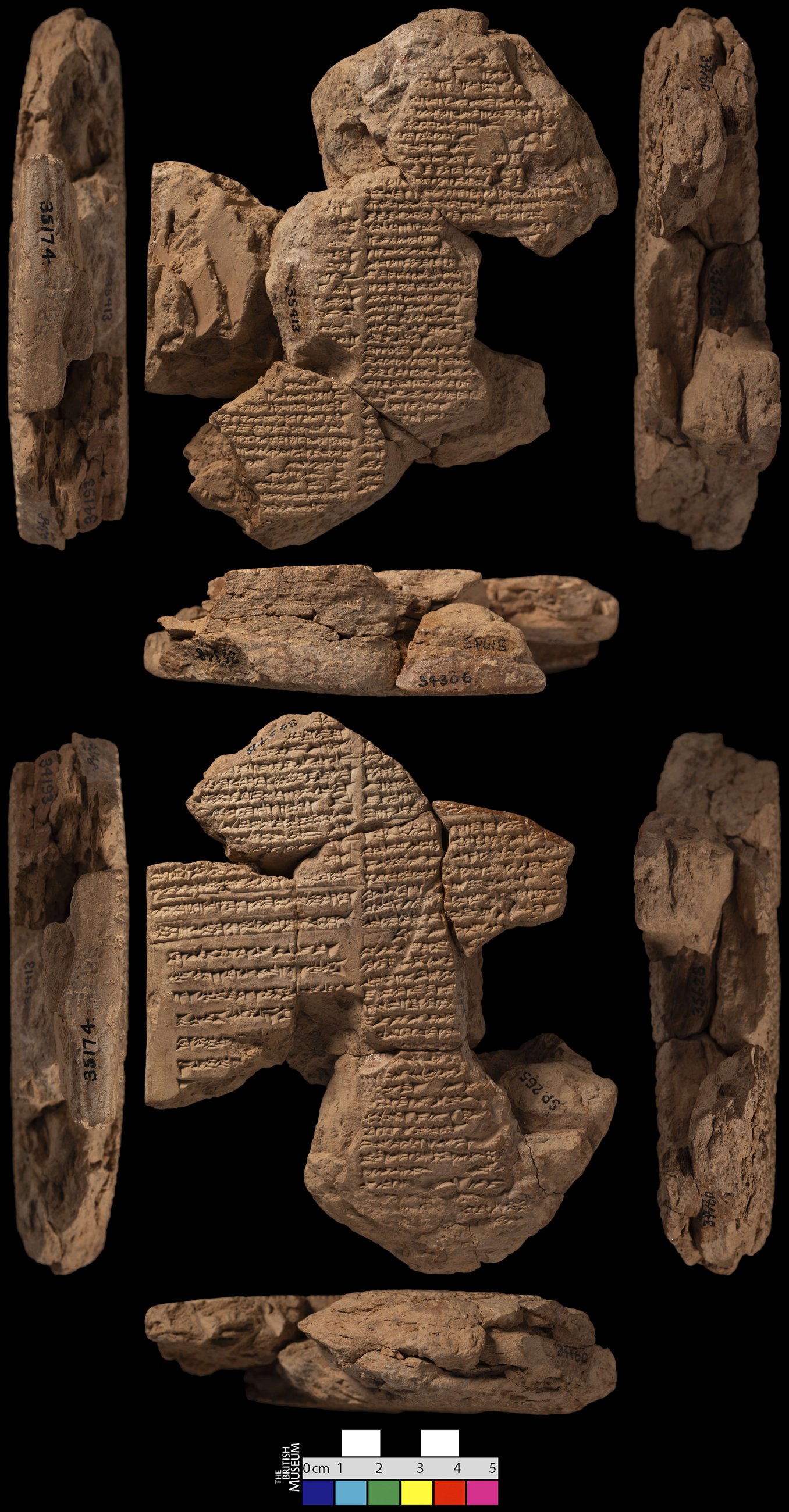
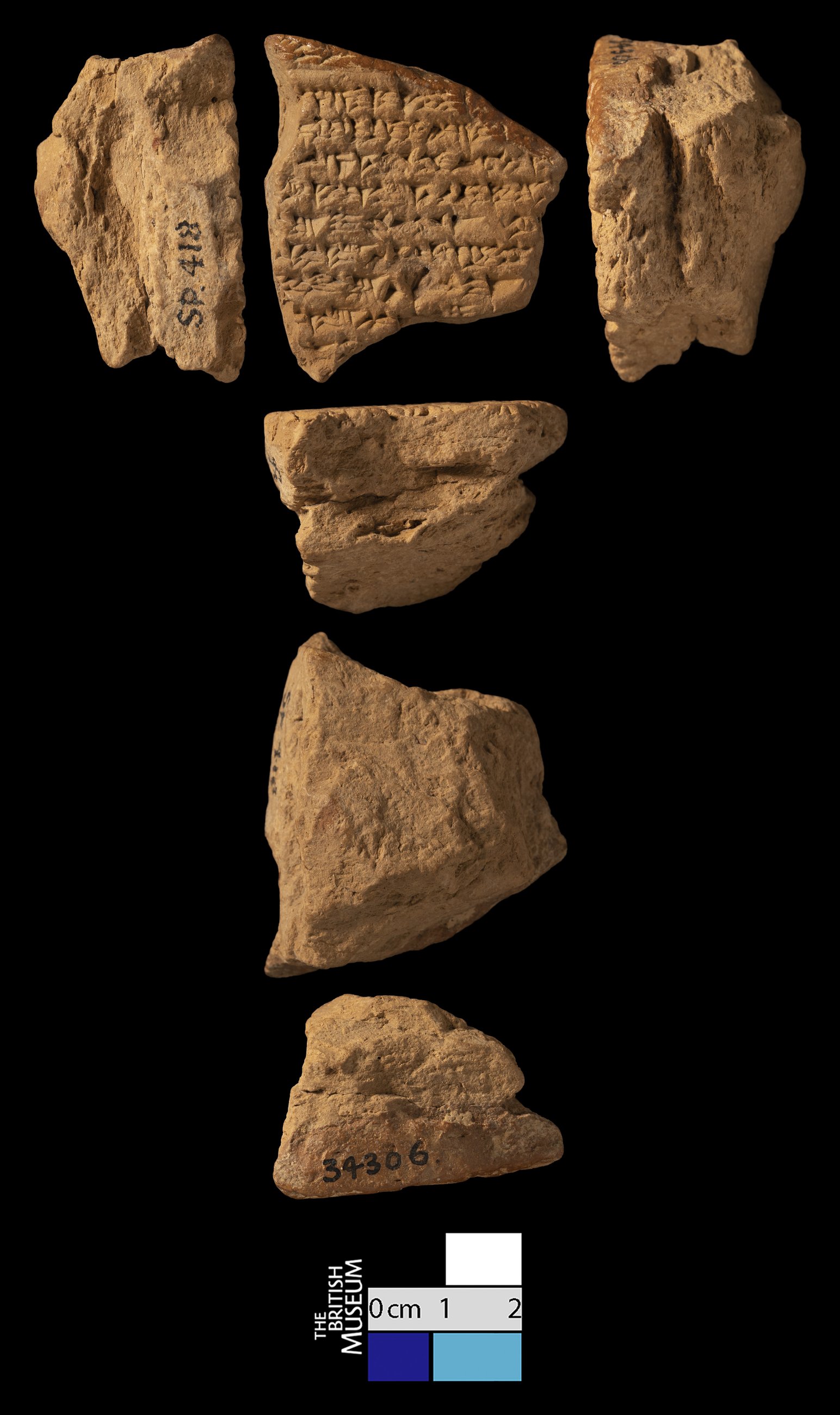
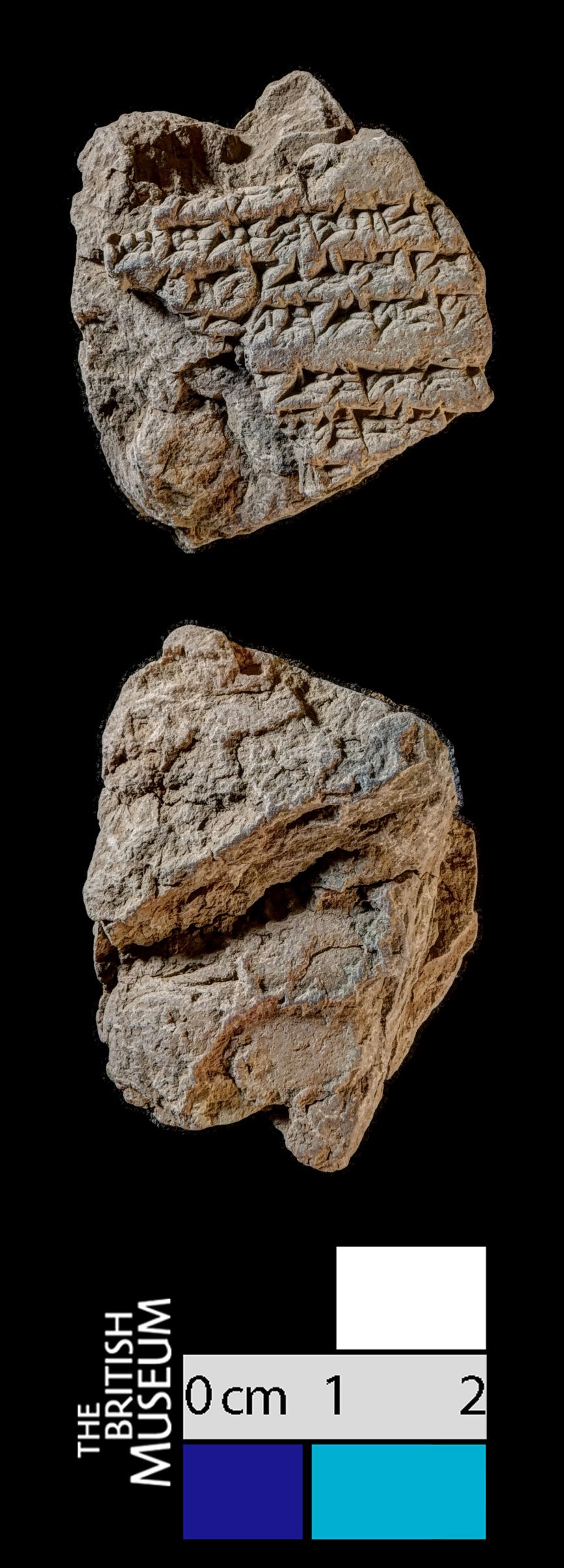
British Museum BM.34160: obverse, column i, the tablet's own lines 5' to 28'. eBL's corpus edition (https://www.ebl.lmu.de/corpus/L/1/4/SB/X) attributes SB X 23-46 to this manuscript at these column and line numbers. Photograph checked: obverse, reverse and edges of the large joined tablet (several pieces with plaster joins, ink numbers on the edges); two columns on each face, consistent with eBL's columns i-ii and v-vi. eBL treats BM.34160 + BM.34306 + BM.34499 + Sp.667 as one manuscript and holds a separate photograph of each of these pieces; it does not say which piece carries which line, so the photographs of BM.34160 + BM.34306 + Sp.667 are linked, and the lines are on one or more of them. On this tablet line 32 is entirely broken, of lines 23-31, 33 only one to three signs survive and lines 34-46 are partly broken (square brackets and x in the Akkadian). The English of these lines translates eBL's composite text, so it includes words that are not preserved on this tablet but are restored from other manuscripts or by the editors. Square brackets in the English mark eBL's restorations in its composite text; words that survive on other tablets carry no brackets even where this tablet is broken.
23[...] x-re-ba
24[x x x x x x x x x x in]a EDIN
25[x x x x x x x x x x x {d}GIŠ-g]im₂-maš
26[x x x x x x x x x x x e-di-i]l KA₂
27[x x x x x x x x x x x a-n]a u₂-ru
28[x x x x x x x] lul-mad
29[x x x x x x x x x x x x sa]-bi-tu₄
30[x x x x x x x x x-š]ir₃-ru
31[ša₂ nin-nem-du-ma ni-lu-u₂ KUR]-u₂#
32[a-la-a ni-iṣ-ba-tu-ma (a-la-a) ni-na-ru]
33[nu-šal-pi-tu {d}hum-ba-ba ša₂ ina {giš}TI]R {giš}ER[EN aš₂-bu]
34[ina ne₂-re-be₂-e-ti? ša₂ KUR-i ni-du]k UR.MAH-MEŠ
35[sa-bi-tu₄ a-na ša₂-šu₂ M]U-ar₂ a-na {d}GIŠ-gim₂-maš
36[x x x x x{d}en-ki-d]u₃ ša₂ ma-aṣ-ṣa-ru ta-na-ra
37[tu-šal-pi-ta {d}hum-b]a-ba ša₂ ina {giš}TIR {giš}EREN aš₂-ba
38[ina ne₂-re-be₂-e-ti? š]a₂ KUR-i ta-duk UR.MAH-MEŠ
39[a-la-a taṣ-ba-ta-ma a-l]a-a ta-na-ra ša₂ TA AN-e ur-du
40[am-me-ni ak-la le-t]a-a-ti qud-du-du pa-nu-ka
41[lum-mun lib₃-ba-ka qa-t]u-u₂ zi-mu-ka
42[i-ba-aš₂-ši SAG.PA.LAGAB] ina kar-ši-ka!(ŠU₂)
43[ana a-lik ur-hi ru-qa-ti] pa-nu-ka maš-lu
44[ina šar-bi u UD.DA q]u-um-mu-u₂ pa-nu-ka
45[u pa-an lab-bi šak-na-ta-m]a ta-rap-pu-ud EDI[N]
46[{d}GIŠ-gim₂-maš ana ša₂-ši-ma MU-ar₂] a#-na# {munus#}sa#-[bi-tu₄]
23[…] my […,]
24[…] in the wild.’
25[The ale-wife spoke to] him, [to] Gilgameš:
26‘[…] … […] I barred my gate,
27[…] … [… I went up on] the roof.
28[…] … […] let me learn of [your journey!]'
29[Gilgameš spoke to] her, [to the ale]-wife:
30‘[My friend Enkidu and I, …] …
31[We it was who joined forces and climbed the mountain] country,
32[seized the Bull of Heaven and killed the Bull of Heaven,]
33[destroyed Humbaba, who lived in the] Cedar [Forest,]
34[killed] lions [in the mountain passes.]’
35[The ale-wife] spoke [to him,] to Gilgameš:
36‘[If you and Enkidu were] the ones who killed the Guardian,
37[who destroyed] Humbaba, who lived in the Cedar Forest,
38[who] killed lions [in the] mountain [passes,]
39[who seized the Bull of Heaven and] killed [the Bull] of Heaven, that came down from the heavens–
40[why are your] cheeks [hollow,] your face sunken,
41[your mood wretched,] your features wasted?
42[(Why) is there sorrow] in your heart,
43your face like one [who has travelled a distant road?]
44[(Why is it)] your face is burnt [by frost and sunshine,]
45[and] you roam the wild [got up like a lion?]'
46[Gilgameš spoke to her,] to the ale-wife:
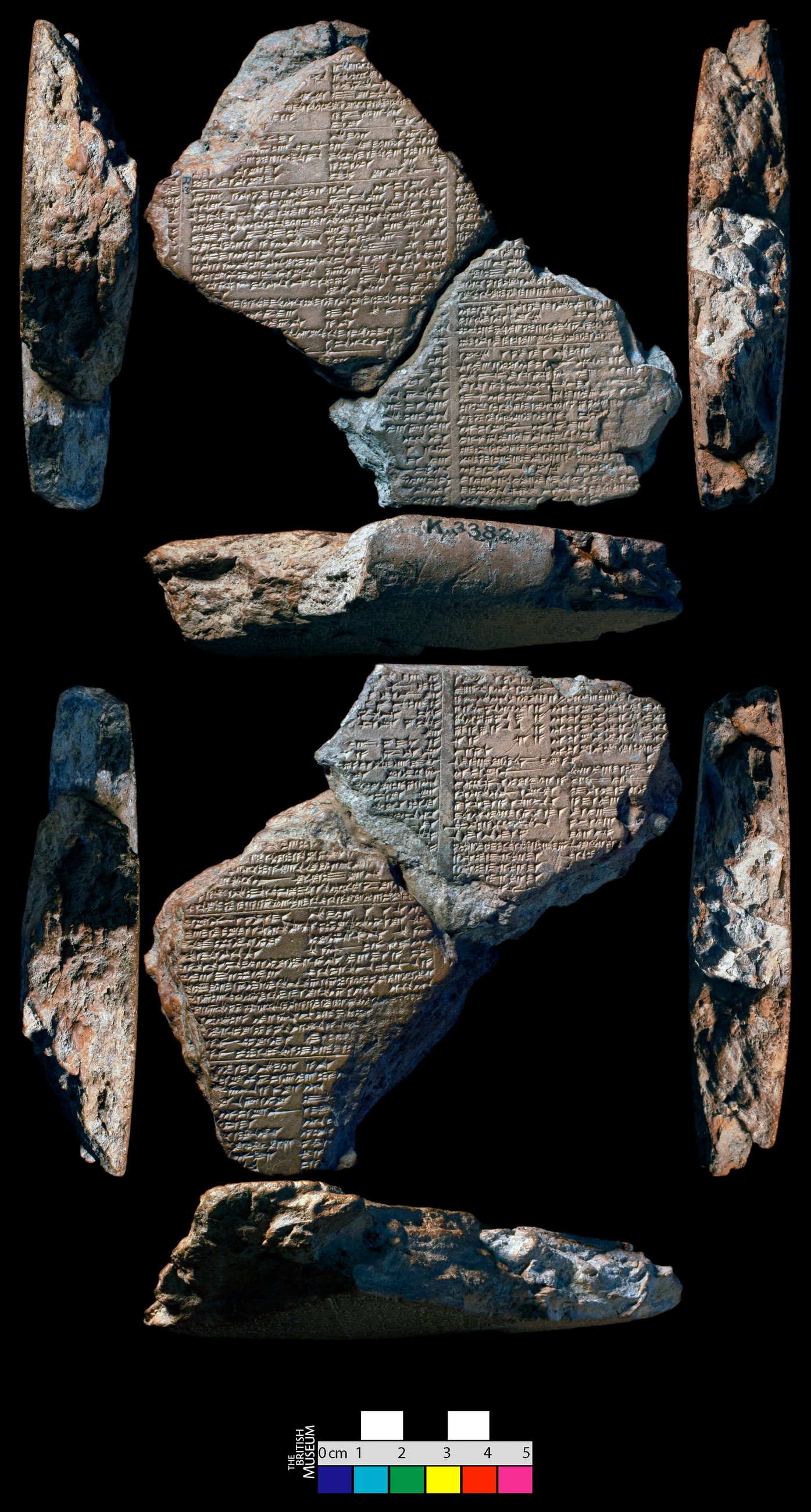
Where on the image
British Museum K.3382: obverse, column ii, the tablet's own lines 9 to 29. eBL's corpus edition (https://www.ebl.lmu.de/corpus/L/1/4/SB/X) attributes SB X 61-86 to this manuscript at these column and line numbers. Photograph checked: obverse, reverse and edges of the join K.3382 + Rm.621 (two large pieces, ink number K.3382 on the edge); text on both faces, consistent with eBL's columns i-iii and iv-v. K.3382 is joined to K.23050, photographed separately; eBL's own transliteration of the joined piece(s) does not include these lines, so only the photograph of K.3382 is linked. On this tablet line 62 is entirely broken, of lines 61, 64 only one to three signs survive and lines 63, 65-75 are partly broken (square brackets and x in the Akkadian). The English of these lines translates eBL's composite text, so it includes words that are not preserved on this tablet but are restored from other manuscripts or by the editors. Square brackets in the English mark eBL's restorations in its composite text; words that survive on other tablets carry no brackets even where this tablet is broken. Lines 76-86 are complete on this tablet.
61[a-dur] x-lu? [x x x]
62[mu-ta ap-lah-ma a-rap-pu-ud EDIN ( : )]
63a-mat ib-ri-i[a kab-ta-at? UGU-ia]
64[ur-ha ru-qa-ta a-rap-pu-ud EDI]N :
65a-mat {d}+en-ki-d[u₃ ib-ri-ia KIMIN]
66[har-ra-nu ru-qa-tu] | a-rap-pu-ud [EDIN]
67[ki-ki-i lu-us-ku]t ki-ki-i lu-qu-u[l ana-ku]
68[ib-ri ša₂ a-ram-mu i-te-m]i ṭi-iṭ-ṭiš :
69{d}+en-ki-du₃ ib-ri ša₂ a-ram-mu i-t[e-mi x x x]
70[x x x x x x ša₂-š]u-ma-a (line break) a-ne₂-el-lam-[ma]
71[ul a-te-eb-ba]-a | du-ur da-ar
72[x x x x x š]a₂-ši-ma | MU-ra ana sa-b[it]
73[e-nin-na-m]a sa-bit mi-nu-u₂ har-ra-an ša₂ UD-Z[I]
74[mi-nu-u₂ i]t-ta-ša₂ ia-a-ši id-ni :
75id-nim-ma it-ta-ša₂ ia-a-š[i]
76šum-ma na-ṭu-ma | A.AB.BA lu-bir
77šum-ma la na-ṭu-ma | EDIN lu-ur-pu-ud
78sa-bit a-na ša₂-šu-ma MU-ra a-na {d}GIŠ-gim₂-maš
79ul ib-ši {d}GIŠ-gim₂-maš ne₂-be₂-ru ma-ti-ma
80u ma-am-ma ša₂ ul-tu u₄-um ṣa-at <<KUR>> la ib-bi-ru tam-ta
81e-bir tam-ti {d}UTU qu-ra-du-um-mu < : >
82AK-la {d}UTU ib-bir man-nu
83pa-aš₂-qat ne₂-ber-tu₄ | šup-šu-qat u₂-ru-uh-ša₂
84u₃ bi-ra-a A-MEŠ mu-ti | ša₂ pa-na-as-sa par-ku
85a-hum-ma {d}GIŠ-gim₂-maš | te-te-bir tam-ta
86a-na A-MEŠ mu-u₂-ti ki-i tak-tal-du | te-ep-pu-uš mi-na
61[Then I was afraid …] … [… ,]
62[I grew fearful of death and so roam the wild.]
63The case of my friend was too [much] for me to bear,
64[so on a distant road I roam the] wild.
65The case of [my friend] Enkidu [was too much for] me to bear,
66[so on a distant path] I roam the wild.
67(For) I, [how could I stay silent?] How could I stay quiet?
68[My friend, whom I love, has turned] to clay,
69my friend Enkidu, whom I love, has [turned to] clay.
70[Shall not I be like] him and also lie down,
71[never to rise] again, through all eternity?'
72Gilgameš spoke to her, to the ale-wife:
73‘Now, ale-wife, what is the road to Ūta-napišti?
74What is its landmark? Give it to me!
75Do give me its landmark!
76If it may be done, I will cross the ocean!
77if it may not be done, I will roam the wild!’
78The ale-wife spoke to him, to Gilgameš:
79‘There never was, O Gilgameš, a way across,
80and since the days of old none who can cross the ocean.
81The one who crosses the ocean is the hero Šamaš:
82apart from Šamaš, who is there can cross the ocean?
83The crossing is perilous, its way full of hazard,
84and in between are the Waters of Death, that lie across the passage forward.
85So besides, Gilgameš, (once) you have crossed the ocean,
86when you reach the Waters of Death, what will you do?
Where on the image
British Museum K.3382: obverse, column ii, the tablet's own lines 30 to 52. eBL's corpus edition (https://www.ebl.lmu.de/corpus/L/1/4/SB/X) attributes SB X 87-111 to this manuscript at these column and line numbers. Photograph checked: obverse, reverse and edges of the join K.3382 + Rm.621 (two large pieces, ink number K.3382 on the edge); text on both faces, consistent with eBL's columns i-iii and iv-v. K.3382 is joined to K.23050, photographed separately; eBL's own transliteration of the joined piece(s) does not include these lines, so only the photograph of K.3382 is linked. On this tablet of lines 94, 97, 99-100, 102-103, 105-110 only one to three signs survive and lines 89-93, 95-96, 98, 101, 104, 111 are partly broken (square brackets and x in the Akkadian). The English of these lines translates eBL's composite text, so it includes words that are not preserved on this tablet but are restored from other manuscripts or by the editors. Square brackets in the English mark eBL's restorations in its composite text; words that survive on other tablets carry no brackets even where this tablet is broken. Lines 87-88 are complete on this tablet.
87{d}GIŠ-gim₂-maš i-ba-aš₂-ši {m}ur-50 (line break) {lu₂}MA₂.LAH₄ ša₂ {m}UD-ZI
88u# šu#-ut NA₄-MEŠ it-ti-šu₂ ina ŠA₃ {giš}TIR i-qa-tap ur-na
89[a-li]k-ma | li-mu-ru pa-ni-ka
90[šum-ma na-ṭ]u-ma e-bir it-ti-šu₂ < : >
91šum-ma la na-ṭu-ma i-hi-is EGIR-k[a]
92[{d}GIŠ-gim₂-m]aš an-ni-ta | i-na še-me-e#-[šu₂]
93[x x ha-ṣ]i-in-na | a-na A₂#-[š]u
94[x x x x x x x šib-bi-š]u₂ :
95ih-lu-ul-ma it-tar-da-a[š₂-šu₂-nu]-ti
96[ki-ma šil-ta-hi] | ana bi-ri-šu₂-nu [im]-qut
97[x x x x x x i-š]ep-pu [rig]-ma
98[x x x x x x na]m-<ri>-ra#-šu₂# i[t-tah]-lip₂
99[x x x x x x x ir-tu-ba-a]š₂-šu
100[x x x x x x x x x x {m}{d}]GIŠ#-gim₂-maš
101[x x x x x x x x-t]i ir-te-šu
102[x x x x x ip-te-hu]-u₂# {giš}MA₂
103[x x x x x x x A-MEŠ] mu-u₂-ti
104[x x x x ta]m-ta DAGAL-ta
105[x x (x x x x x)] ik-la
106[x x x x x x x x x x x] ana ID₂
107[x x x x x x x x x] x {giš}MA₂
108[x x x x x x x x i]na kib-ri
109[{d}GIŠ-gim₂-maš ana ša₂-šu-ma MU-ra ana {m}ur-šanabi₂] {lu₂#}MA₂.LAH₅
110[x x x x x x x x x x t]a-šub-ba
111[x x x x x x x x-k]a ka-a-ša₂
87O Gilgameš, there is Ur-šanabi, the boatman of Ūta-napišti,
88and the Stone Ones are with him as he strips a pine in the midst of the forest.
89Go then, and let him see your face!
90if it may be done, cross with him,
91if it may not be done, turn around (and go) back!'
92When Gilgameš heard this,
93he took up (his) axe in his hand,
94he drew forth the dirk [from] his [belt,]
95he crept up and rushed down on them.
96Like an arrow he fell among them,
97(his) shout booming through the midst of the forest.
98Ur-šanabi saw him and clad himself in his aura,
99he took up an axe, all atremble before him.
100But he, Gilgameš, struck his head [and grabbed his hair],
101he pinned his arm along his chest.
102And the Stone Ones had sealed the boat,
103who did not fear the Waters of Death.
104Gilgameš strode into the Ocean, the wide sea,
105in the water he halted the boat and the Stone Ones,
106He smashed the Stone Ones, he tipped them into the river,
107He tied up the boat with a rope,
108and then [… he sat] down on the bank.
109[Gilgameš spoke to him,] to the boatman Ur-šanabi:
110‘So, Ur-šanabi, you took up an axe, all atremble before me!
111The fight and the battle you sought I will not wage against you.’
Where on the image
British Museum K.3382: obverse, column iii, the tablet's own lines 1 to 14 and 20 to 30. eBL's corpus edition (https://www.ebl.lmu.de/corpus/L/1/4/SB/X) attributes SB X 112-144 to this manuscript at these column and line numbers. Photograph checked: obverse, reverse and edges of the join K.3382 + Rm.621 (two large pieces, ink number K.3382 on the edge); text on both faces, consistent with eBL's columns i-iii and iv-v. eBL numbers these lines on the tablet 1 to 14 and 20 to 30: its line numbers jump although the poem lines are consecutive. K.3382 is joined to K.23050, photographed separately; eBL's own transliteration of the joined piece(s) does not include these lines, so only the photograph of K.3382 is linked. On this tablet lines 136, 139, 142 are entirely broken, of lines 123, 125, 131-135, 137-138, 140 only one to three signs survive and lines 112-122, 124, 141, 143-144 are partly broken (square brackets and x in the Akkadian). The English of these lines translates eBL's composite text, so it includes words that are not preserved on this tablet but are restored from other manuscripts or by the editors. Square brackets in the English mark eBL's restorations in its composite text; words that survive on other tablets carry no brackets even where this tablet is broken. eBL line(s) 126, 127, 128, 129, 130 fall within this run but are not on this tablet (they are listed among the lines not shown).
112[{m}u]r-šanabi₂ ana ša₂-šu-ma MU-ra ana {d}[GIŠ-gim₂-maš]
113[a]m-me-ni ak-la le-ta-ka | qud-d[u-du pa-nu-ka]
114[lu]m-mun lib₃-ba-ka | q[a-tu-u₂ x x x x]
115i#-ba-aš₂-ši SAG.PA.LAGAB | [i]n[a x x x]
116[ana] a#-lik ur-hi ru-qa-ti | pa-[nu-ka maš-lu]
117[in]a A.<AN>{+šar-ba} u UD.DA qu-u[m-mu-u₂ pa-nu-ka]
118[u pa-a]n lab#-bi# šak#-na#-ta#-ma | ta-[rap-pu-ud x x]
119[x x x x x x x x] MU-ra a-n[a x x x x x x]
120[am-mi-ni la ak-la le]-ta-a-a | la [qud-du-du pa-nu-u₂-a]
121[x x x lib₃]-bi la qa-tu-[u₂ x x x x]
122[x x x x x S]AG.PA.LAGAB | ina [x x x]
123[x x x x x ru-qa-t]i | pa-n[u-u₂-a x x x]
124[x x x x x UD.D]A la qu-u[m-mu-u₂ pa-nu-u₂-a]
125[x x x x x x x šak-na]-ku#-ma# | la# [x x x x x]
131in[a x x x x x x x x x x x x x]
132ib-r[i x x x x x x x x x x x x x x x x x x x]
133{d}+en-k[i-du₃ x x x x x x x x x x x x x x x x x]
134ik-šu-d[a-aš₂-šu₂? x x x x?]
1356 ur-r[i x x x x x x x x x x x ( : )]
136[x x x x x x x x x]
137a-di [tul-tu im-qu-tam ina ap-pi-šu]
138a-du[r x x x x x x x x x x x x x ( : )]
139[x x x x x x x x x x x]
140a-m[at ib-ri-i]a [x x x x x]
141u[r-hu ru]-qa-tu a-[rap-pu-ud x ( : )]
142[x x x x x x x x x]
143[har-r]a-nu ru-q[a-tu x x x x x]
144[k]i-ki-i lu-u[s-kut ki-ki-i lu-qu-ul ana-ku]
112[Ur]-šanabi spoke to him, to Gilgameš:
113‘Why are your cheeks hollow, [your face] sunken,
114your mood wretched, [your features wasted?]
115(Why) is there sorrow [in your heart,]
116and [your face like one] who has travelled a distant road?
117[(Why is it) your face is] burnt [by] frost and sunshine,
118[and] you [roam the wild got up like a lion?]’
119[Gilgameš] spoke [to him,] to [the boatman Ur-šanabi:]
120‘[Why should] my cheeks [not be hollow, my face] not [sunken,]
121my [mood not wretched, my features] not wasted?
122[Should there not be] sorrow in [my heart,]
123[and my] face [not be like one who has travelled a distant road?]
124[Should] not [my face be] burnt [by frost and sunshine,]
125[and] should I not [roam the wild got up like a lion?]
131[killed lions] in [the mountain passes.]
132My friend [whom I love so deeply, who with me went through every danger,]
133[My friend] Enkidu, [whom I love so deeply, who with me went through every danger:]
134[the doom of mankind] overtook [him,]
135for six days [and seven nights I wept over him.]
136[I did not give him up for burial,]
137until [a maggot fell from his nostril.]
138Then I was afrai[d …,]
139[I grew fearful of death and so roam the wild.]
140The case of my [friend was too much for me to bear,]
141so on a distant road I [roam the wild.]
142[The case of my friend Enkidu was too much for me to bear,]
143so on a distant path [I roam the wild.]
144[(For) I,] how could I stay [silent? How could I stay quiet?]
Where on the image
British Museum K.3382: obverse, column iii, the tablet's own lines 31a to 51. eBL's corpus edition (https://www.ebl.lmu.de/corpus/L/1/4/SB/X) attributes SB X 145-172 to this manuscript at these column and line numbers. Photograph checked: obverse, reverse and edges of the join K.3382 + Rm.621 (two large pieces, ink number K.3382 on the edge); text on both faces, consistent with eBL's columns i-iii and iv-v. K.3382 is joined to K.23050, photographed separately; eBL's own transliteration of the joined piece(s) does not include these lines, so only the photograph of K.3382 is linked. On this tablet lines 146, 148 are entirely broken, of lines 152, 162, 165, 168 only one to three signs survive and lines 145, 147, 149-150, 154-160, 163, 166, 169-172 are partly broken (square brackets and x in the Akkadian). The English of these lines translates eBL's composite text, so it includes words that are not preserved on this tablet but are restored from other manuscripts or by the editors. Square brackets in the English mark eBL's restorations in its composite text; words that survive on other tablets carry no brackets even where this tablet is broken. Lines 151, 153, 161, 164, 167 are complete on this tablet.
145[i]b-ri ša₂ a-ram-mu e#-te#-[mi x x x ( : )]
146[{d}en-ki-du₃ ib-ri ša₂ a-ram-mu KIMIN]
147ana-ku ul ki-i ša₂-šu-ma-a a-ne₂-el-l[am-ma ( : )]
148[ul a-te-eb-ba-a du-ur da-ar]
149{d}GIŠ-gim₂-maš a-na ša₂-šu-ma MU-ar₂ a-na# {m#}u[r-šanabi₂ {lu₂}A₂.LAH₅]
150e-nin-na {m}ur-šanabi₂ | mi-nu-u₂# [har-ra-an ša₂ {m}UD-ZI]
151mi-nu-u₂ it-ta-ša₂ ia-a-ši id-ni :
152id-nam-m[a it-ta-ša₂ ia-a-ši]
153šum-ma na-ṭu₂-ma tam-ta lu-bir :
154šum-ma la na-ṭu#-m[a EDIN lu-ur-pu-ud]
155{m}ur-šanabi₂ ana ša₂-šu-ma MU-ra ana {d#}[GIŠ-gim₂-maš]
156qa-ta-a-ka {d}GIŠ-gim₂-maš ik#-la#-a [x x x]
157tuh-tap-pi šu-ut NA₄-MEŠ ta-at#-ta-ba[k x x x]
158šu-ut NA₄-MEŠ hu-up-pu-ma ur#-nu ul [qa-tip?]
159i-ši {d}GIŠ-gim₂-maš ha-ṣi-in-na ana i-[di-ka]
160e-rid ana {giš}TIR-ma pa-ri-si ša₂ 5 nindan-TA#.AM₃ [x x x x]
161ku-pur-ma šu-kun tu-la-a :
162bi-il-la?#-[aš₂-šu₂-nu-ti? x x x x (x)]
163{d}GIŠ-gim₂-maš an-ni-ta i[na še-me-e-šu₂]
164iš-ši ha-ṣi-in-na ana A₂-šu₂ :
165iš-l[u-up nam-ṣar (ina) šib-bi-šu₂]
166u₂-rid ana {giš}TIR-ma pa-ri-si ša₂ 5 nindan-TA#.[AM₃ 5.GIŠ₃ ik-kis]
167ik-pur-ma iš-ta-kan tu-la-a :
168u₂-bil-m[a x x x x (x) ...]
169{d}GIŠ-gim₂-maš u {m}ur-šanabi₂ ir-ka-bu [{giš}MA₂]
170{giš}ma₂-gi-il-la id-du-ma šu-nu [ir-tak-bu]
171ma-lak ITI u U₄.15.KAM ina šal-ši u₄-me it#-ta-al#-[ku x x]
172ik-šu-dam-ma {m}ur#-šanabi₂# A-MEŠ m[u-u₂-ti]
145My friend, whom I love, has [turned to clay,]
146[my friend Enkidu, whom I love, has turned to clay.]
147Shall not I be like him and also lie [down,]
148[never to rise again, through all eternity?]'
149Gilgameš said to him, to Ur-[sanabi, the boatman:]
150‘Now, Ur-šanabi, what [is the road to Ūta-napišti?]
151What is its landmark? Give it to me!
152Do give me [its landmark!]
153If it may be done, I will cross the ocean!
154if it may not be done, [I will roam the wild!]’
155Ur-šanabi spoke to him, to [Gilgameš:]
156‘Your own hands, Gilgameš, have prevented [your crossing.]
157You have smashed the Stone Ones, you have tipped [them in the river,]
158the Stone Ones are smashed and the cedar is not [stripped.]
159Take up, Gilgameš, the axe in [your] hand,
160go down to the forest and [cut me three hundred] punting-poles, each five rods long.
161Trim and furnish (each) with a boss,
162bring [them to …]’
163When Gilgameš [heard] this,
164he took up the axe in his hand,
165he drew [forth the dirk from his belt,]
166he went down to the forest and [cut him three hundred] punting-poles, each five rods long.
167He trimmed and furnished (each) with a boss,
168he took [them to …]
169Gilgameš and Ur-šanabi boarded [the boat,]
170they launched the craft and [crewed it] themselves.
171By the third day they had travelled a month and a half’s journey,
172then Ur-šanabi arrived at the Waters of [Death.]
Where on the image
British Museum K.3382: reverse, column iv, the tablet's own lines 1 to 22. eBL's corpus edition (https://www.ebl.lmu.de/corpus/L/1/4/SB/X) attributes SB X 173-195 to this manuscript at these column and line numbers. Photograph checked: obverse, reverse and edges of the join K.3382 + Rm.621 (two large pieces, ink number K.3382 on the edge); text on both faces, consistent with eBL's columns i-iii and iv-v. K.3382 is joined to K.23050, photographed separately; eBL's own transliteration of the joined piece(s) does not include these lines, so only the photograph of K.3382 is linked. On this tablet of line 195 only illegible traces (x) survive, of line 194 only one to three signs survive and lines 173-188, 190-193 are partly broken (square brackets and x in the Akkadian). The English of these lines translates eBL's composite text, so it includes words that are not preserved on this tablet but are restored from other manuscripts or by the editors. Square brackets in the English mark eBL's restorations in its composite text; words that survive on other tablets carry no brackets even where this tablet is broken. Line 189 is complete on this tablet. eBL gives no English for line(s) 195.
173{m}ur-šanabi₂ ana ša₂-šu-ma# M[U-ra ana {d}GIŠ-gim₂-maš]
174um-MEŠ TE {d}GIŠ-gim₂-maš | [l]i-qe₂# 1#-[en pa-ri-su]
175A-MEŠ mu-ti qat-ka a-a il-ta-pit tu-šam#-[x (x) x]
1762-a šal-ša₂ u re-ba-a {d}GIŠ-gim₂-maš li-qe₂ pa-r[i-su]
177ha-an-ša₂ 6-ša₂ u 7-a {d}GIŠ-gim₂-maš li-qe₂ pa-ri-[su]
1788-a 9-a u 10-a {d}GIŠ-gim₂-maš li-qe₂ pa-ri-s[u]
17911-a 12-a {d}GIŠ-gim₂-maš li-qe₂ pa-ri-s[u]
180ina 2.GIŠ₃ | {d}GIŠ-gim₂-maš ug-dam-me-ra pa-r[i-si]
181u šu-u₂ ip-ṭur MURUB₄-šu₂ | {m}[ur-50]
182{d}GIŠ-gim₂-maš | ih-ta-ma-aṣ TU[G₂-su]
183ina kap-pi-šu₂ ka-ra-a | u₂-šaq-[qi₂]
184{m}UD-ZI-ti₃ ana ru-qi₂ | i-na-aṭ-ṭa-l[a-aš₂-šum-ma]
185uš-tam-ma-a ana lib₃-bi-šu₂ | a-ma-ta i[z-zak-kar]
186it-ti ra-ma-ni-šu-ma | šu-u₂ i[m-tal-lik]
187(gloss: AŠ) mi-na-a hu-up-pu-u | ša₂ {giš}MA₂ [x x x x x]
188u la be-la-ša₂ | ra-kib [x x]
189ša₂ il-la-kam₂-ma ul ia-u₂ LU₂ :
190u₃ im-na nam/zi-[x x x (x)]
191a-na-aṭ-ṭa-lam-ma | ul ia-[u₂ LU₂]
192a-na-aṭ-ṭa-lam-ma | u[l ia-u₂ LU₂?]
193a-na#-aṭ#-ṭa-lam-ma | [x x x x (...)]
194[x x x i]a-ši x | [x x x x x x (x)]
195[x x x x] x [x x x x x x x]
173Ur-šanabi [spoke] to him, [to Gilgameš:]
174‘…, Gilgameš, take [the first punting-pole!]
175do not let your hand be touched by the Waters of Death, (for) you will [lame it]
176Take a second, a third and a fourth punting-pole, Gilgameš!
177take a fifth, a sixth and a seventh punting-pole, Gilgameš!
178Take an eighth, a ninth and a tenth punting-pole, Gilgameš!
179take an eleventh and a twelfth punting-pole, Gilgameš!’
180At one hundred and twenty double-furlongs Gilgameš ran out of punting-poles,
181Then he, [Ur-šanabi,] undid his clothing.
182Gilgameš stripped off [his] garment,
183out of his arms he made a high yard-arm.
184Ūta-napišti was watching [him] in the distance,
185talking to himself he [spoke] a word.
186He [was taking counsel] in his own mind:
187‘Why are the boat’s [Stone Ones] smashed,
188and aboard [it] one who is not its master?
189He who comes is no man of mine,
190but on the right … […]
191I am looking – he is no [man of] mine,
192I am looking – he is no [man of mine]
193I am looking – […]
194[…] me […]’
195(no English for this line in the eBL edition)
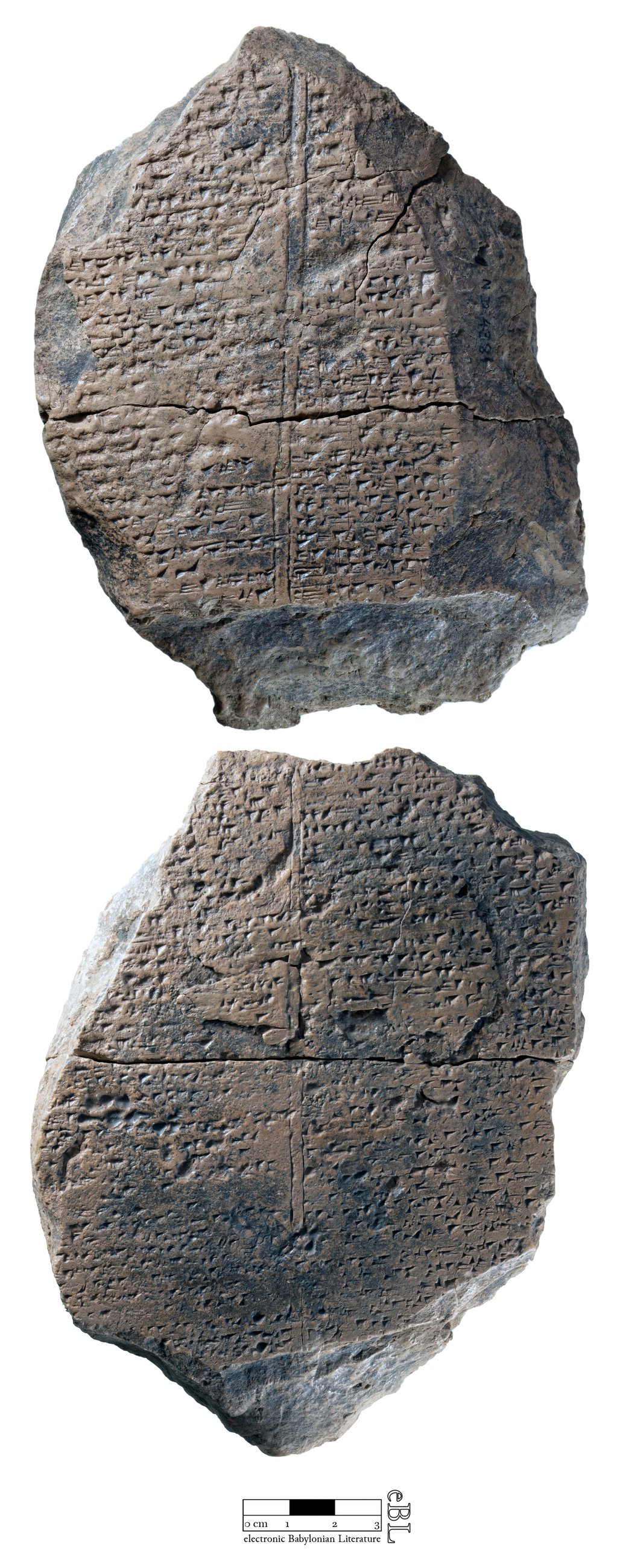
Where on the image
Iraq Museum IM.67564: obverse, column ii, the tablet's own lines 1' to 25'. eBL's corpus edition (https://www.ebl.lmu.de/corpus/L/1/4/SB/X) attributes SB X 196-220 to this manuscript at these column and line numbers. Photograph checked (eBL photograph of the Iraq Museum): two views of a fragment from Kalhu (Nimrud), each face with two columns divided by a vertical ruling and about 30 to 40 lines per column. The ink on the right part of the face shown first reads 'N.D. 4381', the Nimrud excavation number (not the Iraq Museum number). Consistent with eBL's columns i (tablet lines 1'b to 40') and ii (1' to 36') of Tablet X on the face shown first, and column vi of Tablet XI on the other. On this tablet of lines 198, 211 only one to three signs survive and lines 196-197, 199-210, 212-220 are partly broken (square brackets and x in the Akkadian). The English of these lines translates eBL's composite text, so it includes words that are not preserved on this tablet but are restored from other manuscripts or by the editors. Square brackets in the English mark eBL's restorations in its composite text; words that survive on other tablets carry no brackets even where this tablet is broken.
196ul a-ia-u₂# [x x x x x x x x]
197u₂-šar?-pa?-du [...]
198{lu₂#}MA₂#.LAH₅ [x x x x x (x)]
199a-me₂-lu ša# a-na!-[ṭal-la ul x x (x)]
200ša a-na-ṭal-la ul x [x x x x (x)]
201pi#-qa-ma-a EDIN x [x x x (x)]
202x x x ma x na-a u₂#-[x x x]
203u[r]-na [x x]-ma it-ta-x [x (x)]
204{m}{d}GIŠ-TUK a-na ka#-ri i[ṭ-he x x]
205u₂#-še-rid-ma u₂?-la-[x x (x)]
206u₃# [š]u-u₂ e-la-[m]a? it-ta-[x x (x)]
207{m}{d}GIŠ-TUK a-na ša-š[u-m]a MU-a[r₂ x x x x x x]
208[lib?]-lu#-uṭ {m}UD-ZI DUMU {m}[u]-bar-t[u-tu (x x)]
209[(x)] x lu EGIR a-bu-be# ša₂# ana# da-[...]
210a#-bu#-be mi-na-a ana# da-[x x (x)]
211[x x] x su me x ša x [x (x)]
212[x x x a]-n[a š]a-šu-m[a M]U-ra a-n[a x x x x]
213[am-mi-ni ak-la] le#-[ta]-ka qu₃-d[u-du pa-nu-ka]
214[l]u-[m]u-u[n Š]A₃-[ka q]a-tu-u₂ [zi-mu-u₂-ka]
215i#-ba-[š]i ni-is-[sa]-tu ina k[ar-ši-ka]
216[a]-na a-lik# ar-[h]i ru-qa-[ti pa-nu-ka maš-lu]
217i#-na A.[AN?{+šar-b]e} u ṣe#-te [qu-(um)-mu-u₂ pa-nu-ka]
218u pa-an la-be ša-ak-na-t[a-ma ta-rap-pu-ud EDIN]
219{m}{d}GIŠ-TUK a-na ša-šu-m[a x x x x x x x]
220am-mi-ni la ak-la TE-MEŠ-[a-a la qu₃-du-du pa-nu-u₂-a]
196‘No [man] of mine […,]
197caused to roam […]
198The boatman […,]
199the man that I am [watching is not …]
200that I am watching is not […]
201maybe the wilderness […]
202… […]
203the pine … […]'
204Gilgameš drew [near] to the quay […]
205he sent down … […]
206and he, he came up and he… […]
207Gilgameš said to him, [to Ūta-napišti:]
208[Long] live Ūta-napišti, son of Ubar-[Tutu (…)!]
209[…] … after the Deluge which for … […]
210the Deluge, what for … […?]
211[…] … […]
212[Ūta-napišti spoke] to him, to [Gilgameš:]
213‘[Why are] your cheeks [hollow, your face] sunken,
214[your mood] wretched, [your features] wasted?
215(Why) is there sorrow in [your heart,]
216[and your face like] one who has travelled a distant road?
217[(Why is it) your face is burnt] by frost and sunshine,
218and [you roam the wild] got up like a lion?’
219Gilgameš [spoke] to him, [to Ūta-napišti:]
220‘Why should [my] cheeks not be hollow, [my face not sunken,]
Where on the image
British Museum K.3382: reverse, column v, the tablet's own lines 1 to 21b. eBL's corpus edition (https://www.ebl.lmu.de/corpus/L/1/4/SB/X) attributes SB X 221-246 to this manuscript at these column and line numbers. Photograph checked: obverse, reverse and edges of the join K.3382 + Rm.621 (two large pieces, ink number K.3382 on the edge); text on both faces, consistent with eBL's columns i-iii and iv-v. K.3382 is joined to K.23050, photographed separately; eBL's own transliteration of the joined piece(s) does not include these lines, so only the photograph of K.3382 is linked. On this tablet lines 234, 238 are entirely broken, of lines 221-222, 227, 237 only one to three signs survive and lines 223-226, 228-233, 235-236, 239-246 are partly broken (square brackets and x in the Akkadian). The English of these lines translates eBL's composite text, so it includes words that are not preserved on this tablet but are restored from other manuscripts or by the editors. Square brackets in the English mark eBL's restorations in its composite text; words that survive on other tablets carry no brackets even where this tablet is broken.
221[x x x x x x x x x zi]-mu-u₂-a
222[x x x x x x x ina ka]r-ši-ia
223[x x x x x x x x x pa-nu-u₂]-a la maš-lu
224[x x x x x x x x qu-um-mu]-u₂# pa-nu-u₂-a
225[x x x x x x x x x x x la a-r]ap-pu-ud EDIN
226[x x x x x x x x x x x x x ak-kan-nu ša₂ KU]R nim-ru ša₂ EDIN
227[x x x x x x x x x] KIMIN
228[x x x x x x ni-l]u-u₂ ša₂-da-a
229[x x x x x x x x a]-la#-a ni-na-ru
230[nu-šal-pi-tu {d}hum-ba-ba ša₂ ina {giš}T]IR {giš}EREN aš₂-bu
231[ina ne₂-re-be₂-e-ti? ša₂ KUR-i ni-d]u-ku UR.MAH-MEŠ
232[ib-ri ša₂ a-ram-mu-šu₂ dan-niš it-ti-ia DU.DU-k]u ka-lu mar-ṣa-a-ti
233[{d}en-ki-du₃ ib-ri ša₂ a-ram-mu-šu₂ dan-niš it-ti-ia D]U.DU-ku KIMIN
234[ik-šu-da-aš₂-šu ši-mat? a-me-lu-ti? ( : )]
235[6 ur-ri u 7 mu-ša₂-a-ti] UGU-šu₂ ab-ki
236[ul ad-din-šu a-n]a qe₂-be₂-ri (gloss: x)
237[a-di tul-tu im-qu-tam ina ap-p]i-šu
238[a-dur x x x x x x (x)] :#
239mu-ta ap-l[ah-ma a-rap-pu-ud E]DIN
240[a-mat ib-ri-ia kab?-t]a?-at UGU-ia :
241ur-ha ru-qa-t[u a-rap-pu-ud EDI]N
242[a-mat {d}en-ki-du₃] ib-ri-ia KIMIN :
243har-ra-nu ru#-qa#-t[u KIMIN]
244[ki-ki-i l]u-us-kut ki-ki-i lu-qul [ana-ku?]
245[ib-ri š]a₂ a-ram-mu i-te-mi ṭi-iṭ-ṭiš :
246{d}+en-ki-du₃ ib-r[i KIMIN]
221my mood not wretched, my features not wasted?
222Should there not be sorrow [in] my heart,
223and my [face] not be like one who has travelled a distant road?
224[Should not] my face be [burnt] by frost and sunshine,
225and [should I not] roam the wild got up like a lion?
226My friend, a mule on the run, [donkey of the uplands,] panther of the wild,
227[my friend Enkidu,] a mule on the run, [donkey of the uplands, panther of the wild:]
228[we it was] who joined forces [and] climbed the mountain country,
229[seized] the Bull of Heaven [and] killed the Bull of Heaven,
230destroyed [Humbaba, who] lived [in the] Cedar Forest,
231killed lions [in the mountain passes.]
232[My friend, whom I love so deeply, who with me went through] every danger,
233[my friend Enkidu, whom I love so deeply, who with me] went through every danger:
234[the doom of mankind overtook him,]
235[for six days and seven nights] I wept over him.
236[I did not give him up for] burial,
237[until a maggot fell from] his [nostril.]
238[Then I was afraid that I too would die,]
239I grew [fearful] of death, [and so roam the] wild.
240The case of [my friend was too much] for me [to bear,]
241so on a distant road [I roam the] wild.
242The case of my friend Enkidu [was too much for me to bear,]
243so on a distant path [I roam the wild.]
244[(For) I,] how could I stay silent? How could I stay quiet?
245My friend, whom I love, has turned to clay,
246my friend Enkidu, [whom I love, has turned to clay.]
Where on the image
British Museum K.3382: reverse, column v, the tablet's own lines 22a to 43. eBL's corpus edition (https://www.ebl.lmu.de/corpus/L/1/4/SB/X) attributes SB X 247-273 to this manuscript at these column and line numbers. Photograph checked: obverse, reverse and edges of the join K.3382 + Rm.621 (two large pieces, ink number K.3382 on the edge); text on both faces, consistent with eBL's columns i-iii and iv-v. K.3382 is joined to K.23050, photographed separately; eBL's own transliteration of the joined piece(s) does not include these lines, so only the photograph of K.3382 is linked. On this tablet lines 247-251, 254-255, 258-259, 261-273 are partly broken (square brackets and x in the Akkadian). The English of these lines translates eBL's composite text, so it includes words that are not preserved on this tablet but are restored from other manuscripts or by the editors. Square brackets in the English mark eBL's restorations in its composite text; words that survive on other tablets carry no brackets even where this tablet is broken. Lines 252-253, 256, 260 are complete on this tablet. eBL line(s) 257 fall within this run but are not on this tablet (they are listed among the lines not shown).
247[ana-k]u ul ki-i ša₂-šu-ma-a a-ne₂-el-lam-ma :
248ul a-te-eb-ba-a du-ur d[a-ar]
249[{d}]GIŠ-gim₂-maš ana ša₂-šu-ma | MU-ra ana {m}UD-Z[I]
250[ana-ku] um-ma lul-lik-ma {m}UD-ZI ru-qa ša₂ i-dab-bu-bu-uš lu-mu[r]
251[a]s-hur al-li-ka | ka-li-ši-na KUR-MEŠ
252e#-te-et-ti-qa | KUR-MEŠ mar-ṣu-ti
253u# e-te-te-bi-ra ka-li-ši-na ta-ma-a-tu₄
254[š]it-ta ṭa-ab-ta | ul iš-bu-u pa-nu-u-a
255[u]š-te-ziq ra-ma-ni ina da-la-pu :
256ši-ir-a-ni-ia SAG.PA.LAGAB um-tal-li
258[ana le]-et sa-bit ul ak-šu-dam-ma lu-bu-uš-ti iq-ti
259[a-du-k]a a-sa bu-ṣa ne₂-ša₂ nim-ri min₃-di-na < : >
260a-a-la tu-ra-ha bu-la u nam#-maš#-ša₂#-a# ša₂# EDIN#
261[UZU-MEŠ]-šu₂-nu ak-kal KUŠ-MEŠ-šu₂-nu u₂-ṭa-ab-[ba-ah?]
262[x SAG.PA.LA]GAB li-di-lu KA₂-ša₂ :
263ina ESIR.HI.A u ESIR lip?#-[hu-u₂? KA₂-ša₂?]
264[x x ia]-a-ši mi-lu-la | la u₂#-x [x x x x (x)]
265[aš₂-šu₂ ia]-a-ši PA-ad-di-ʾ-i u₂-ma-a[l-x x]
266[x x x x a-n]a ša₂-šu-ma MU-ra | a-na [{d}GIŠ-gim₂-maš]
267[x x x] {d#}GIŠ-gim₂-maš ni-is-sa-ta DUMU {d#}[x x x (x x x)]
268[x x x DIN]GIR-MEŠ u a-me-lu-ti [x x x x x]
269[x x x AD-k]a u AMA-ka | i-pu-[šu-nik-ka?]
270[ma-ti-m]a {d}GIŠ-gim₂-maš | ana li[l-li x x x]
271[x x x x x i]d-du-ma | ti-š[ab x x x x]
272[na-ad-na-aš₂]-šu₂ ana lil-li | šur-šum-me [x x x x x x x x x x x]
273[x x] u₃# ku-uk-ku-ša₂?# | ša₂ GIM [x x x]
247[Shall] not I be like him and also lie down,
248never to rise again, through all [eternity?],
249Gilgameš said to him, to Ūta-napišti:
250‘I thought, “I will go and find Ūta-napišti the Far-Away, of whom people talk,”
251again I went journeying through all the lands.
252I passed time and again over arduous mountains,
253and I crossed time and again all the seas.
254My face did not have enough of sweet sleep,
255I scourged myself by going sleepless.
256I kept filling my sinews with pain;
258I had not reached as far as the ale-wife and my clothing was worn out.
259[I killed] bear, hyena, lion, panther, cheetah,
260deer, ibex, the animals and game of the wild,
261to eat their [meat] and flay their pelts.
262May they bar the gate of sorrow,
263may [they seal its doorway] with bitumen and asphalt!
264For my sake they shall [interrupt] the dancing no more,
265(because of) me, happy and carefree, they will… […]’
266Ūta-napišti spoke to him, to [Gilgameš:]
267Why, Gilgameš, […] sorrow, the daughter of Anu?
268[You], who are a mix of divine and human flesh,
269whom they [made] like your father and your mother!
270Did they ever, Gilgameš, build a [palace] for the fool,
271place a throne in the council, and tell [him,] “Sit!”?
272To a fool (only) the dreg of beer is given, instead of ghee, cheap oil.
273bran and grist instead of [best flour.]
Where on the image
British Museum BM.34160: reverse, column v, the tablet's own lines 16' to 36'. eBL's corpus edition (https://www.ebl.lmu.de/corpus/L/1/4/SB/X) attributes SB X 274-294 to this manuscript at these column and line numbers. Photograph checked: obverse, reverse and edges of the large joined tablet (several pieces with plaster joins, ink numbers on the edges); two columns on each face, consistent with eBL's columns i-ii and v-vi. eBL treats BM.34160 + BM.34306 + BM.34499 + Sp.667 as one manuscript and holds a separate photograph of each of these pieces; it does not say which piece carries which line, so the photographs of BM.34160 + BM.34306 + Sp.667 are linked, and the lines are on one or more of them. On this tablet of lines 280, 294 only one to three signs survive and lines 274-279, 281-293 are partly broken (square brackets and x in the Akkadian). The English of these lines translates eBL's composite text, so it includes words that are not preserved on this tablet but are restored from other manuscripts or by the editors. Square brackets in the English mark eBL's restorations in its composite text; words that survive on other tablets carry no brackets even where this tablet is broken. eBL gives no English for line(s) 280, 294.
274la-biš [m]aš-ha-an-d[a x x x x x]
275u₃ ša₂-a-šu₂ GIM ne₂-be₂-[eh x x x x]
276aš₂-šu₂ la i-šu-u₂ [x x x x x x x]
277a-mat mil-ki la i-š[u-u₂ x x x]
278i#-ši re-ši-šu₂ {d}GI[Š-gim₂-maš x x x x x]
279[x]-nu EN-šu-nu ma-la š[a₂? x x x x (x)]
280[x x] x x x AN# x [...]
281[x x] {d}30 u DINGIR-ME[Š x x x x (x)]
282[ina] GI₆# {d}30 il-lak# [x x x x]
283[da]l-pu-ma | DINGIR-MEŠ [x x x x]
284e#-ra# la sa-ki#-pu x [x x x (x)]
285ul-tu pa-an ša₂-kin x [x x x (x)]
286at-ta ku#-pu-ud-ma | x [x x x]
287tap-pu-ut-ka a pi# du# x [x x x]
288šum-ma {d}GIŠ-gim₂-maš E₂ DINGIR-MEŠ za-n[in-šu? x x x]
289E₂ {d}15!-MEŠ | ih-x [x x x]
290ši-na a-x (x) x-uš# DINGIR-MEŠ [x x x]
291a#-na# x x [x x] x x i-pu#-uš# x [x (x)]
292[x x x x] a#-na# qi₂-iš#-ti₃ i#-x [x (x) x]
293[x x x x] i#-nam-du-u₂# [x x]
294[x x x x x x] AN# [x x x (x)]
274‘He is clad in a rag, instead of [fine garments,]
275instead of a belt, he is girt [with old rope,]
276Because he has no advisers [to guide him,]
277(because) he has no words of counsel […,]
278Have thought for him, Gilgameš, […,]
279[who is] their master, as many as …?
280(no English for this line in the eBL edition)
281[…] the moon and the gods [of the night …]
282[At] night the moon travels […,]
283the gods stay awake and […]
284Wakeful, unsleeping, […,]
285from olden times it is established […]
286‘Now consider […]
287your support…
288If, Gilgameš, the temples of the gods [have no] provisioner,
289The temples of the goddesses … […]
290They […] …, the gods […,]
291for … […] he made […]
292[…] for a gift he […,]
293[…] they will throw down […]’
294(no English for this line in the eBL edition)
Where on the image
British Museum K.8589: reverse, column vi, the tablet's own lines 1' to 24'. eBL's corpus edition (https://www.ebl.lmu.de/corpus/L/1/4/SB/X) attributes SB X 296-322 to this manuscript at these column and line numbers. Photograph checked: obverse, reverse and edges of the join K.8589 + Sm.1681 (ink numbers on the edge); text on both faces, consistent with eBL's columns i and v-vi. On this tablet of line 303 only one to three signs survive and lines 296-301, 305-307, 309-321 are partly broken (square brackets and x in the Akkadian). The English of these lines translates eBL's composite text, so it includes words that are not preserved on this tablet but are restored from other manuscripts or by the editors. Square brackets in the English mark eBL's restorations in its composite text; words that survive on other tablets carry no brackets even where this tablet is broken. Lines 302, 304, 308, 322 are complete on this tablet.
296[x (x) x i]l-qu-u₂# | a#-na# [x x x]
297[x x t]a-ad-da-li-ip | mi-na-a [x x]
298[ina d]a-la-pi | tu-un-na-h[a (x x x)]
299SA#-MEŠ-ka | ni-is-sa-t[a x x x]
300ru-qu-tu | tu-qar-r[a-ab x x x]
301a-me-lu-tu₄ ša₂ GIM GI a-pi [x x x x x]
302eṭ-la dam-qa KI.SIKIL-ta da-me-eq-tu₄ :
303u[r-ru-hiš? x x x x x x x x]
304ul# ma#-am-ma mu-u₂-tu im-mar :
305ul ma-am-m[a ša mu-ti x x x x x x]
306ul# ma#-am#-ma# ša mu-ti | ri[g-ma-šu₂ i-šem-me]
307ag-gu mu#-tu₄# (blank space) ha-[ṣi-ip] a#-m[e-lu-ti]
308im#-ma#-ti-ma ni-ip-pu-ša₂ E₂ :
309im-ma-ti-ma ni-qan-n[a-nu x x]
310im#-ma-ti-ma ŠEŠ-MEŠ | i-zu-uz-[zu]
311im#-ma-ti#-ma ze-ru-tu₄ | i-ba-aš₂-ši ina [KUR?]
312im-ma-ti-ma ID₂ iš-ša₂-a | ILLU u[b-la]
313ku-li-li | <iq>-qe₂-lep-pa-a [x x]
314pa-nu-ša₂ i-na-aṭ-ṭa-lu | pa-an {d}UTU-[ši]
315ul#-tu ul-la-nu-um#-ma# | ul i-ba-aš₂-ši m[im-ma]
316SAL-lu u₃ mi-tu₄ | ki-i a-ha-meš-[ma]
317ša₂ mu-ti | ul iṣ-ṣi-ru ṣa-la[m-šu₂]
318LU₂.U₁₈.LU-u₂ LU₂ e-dil : ul-tu ik-ru-bu [x x]
319{d}a-nun-na-ki DINGIR-MEŠ | GAL-MEŠ pa[h-ru]
320{d}ma-am-me-tu₄ ba-na-at šim-ti KI-šu₂-nu ši-ma-tu₂ i-ši[m-ma]
321iš-tak-nu mu-ta | u ba-la-ṭ[a]
322ša₂ mu-ti | ul ud-du-u₂ UD-MEŠ-šu₂
296[Enkidu indeed] they took to his destiny.
297‘[But you,] you toiled away, and what did you achieve?
298You are exhausting [yourself with] ceaseless toil,
299you are filling your sinews with pain,
300bringing nearer the end of your life.
301Man is one whose progeny is snapped off like a reed in the canebrake:
302the comely young man, the pretty young woman,
303all [too soon in] their very [prime] death abducts (them).
304No one sees death,
305no one sees the face [of death,]
306no one [hears] the voice of death:
307(yet) savage death is the one who hacks man down.
308At some time we build a household,
309at some time we start a family,
310at some time the brothers divide,
311at some time feuds arise in the land.
312At some time the river rose (and) brought the flood,
313the mayfly floating on the river.
314Its countenance was gazing on the face of the sun,
315then all of a sudden nothing was there!
316The abducted and the dead, how alike they are!
317They cannot draw the picture of death.
318The dead do not greet man in the land.
319The Anunnaki, the great gods, were in assembly,
320Mammītum, who creates destiny, made a decree with them:
321death and life they did establish,
322the day of death they did not reveal.’
Notes
- Akkadian: eBL transliteration of the signs on the photographed tablet (manuscript-level ATF), not a composite text.
- English: A. R. George's translation in the eBL edition; it renders eBL's composite text, including restorations from other tablets.
- Line numbers: eBL edition (based on A. R. George, The Babylonian Gilgamesh Epic, Oxford 2003). Each section also gives the tablet's own column and line numbers.
- Signs in the Akkadian: [ ] broken away; x illegible sign; # damaged sign; ? uncertain reading; ! sign corrected by the editor; ... broken signs of unknown number; ( ) signs perhaps broken away; { } determinative; {+ } phonetic gloss; < > sign omitted by the scribe, supplied by the editor; << >> sign written in error by the scribe; / alternative readings; : divider sign written on the tablet; | division between the parts of a line written in separate columns on the tablet; (line break) the line runs on to the next line of the tablet; (blank space) a space left by the scribe; (gloss: ...) a note written by the scribe in small signs or in the margin.
Cite
Sources
- Source: British Museum and Iraq Museum tablet photographs + eBL manuscript transliterations (eBL corpus edition L I.4, Poem of Gilgamesh (ed. A. R. George, rev. G. Rozzi and E. Jiménez), SB X) + English of the eBL edition (A. R. George (eBL edition)) (holding institution)
- Critical edition: electronic Babylonian Library, Poem of Gilgamesh (ed. A. R. George), manuscript transliterations
← previous · → next · v cycle view · l back to library