Epic of Gilgamesh, Tablet VI: Ishtar and the Bull of Heaven
Introduction
The goddess Ishtar proposes marriage to Gilgamesh. He rejects her and lists the fates of her former lovers. She asks her father Anu for the Bull of Heaven, which ravages Uruk until Gilgamesh and Enkidu kill it.
The Standard Babylonian version of the epic, traditionally ascribed to the scholar Sin-leqi-unninni, was written on twelve tablets. Most surviving copies come from the libraries of Ashurbanipal at Nineveh (7th century BCE) and from Babylon and other Babylonian cities (7th-2nd century BCE). This page gives Tablet VI in the line numbering of the electronic Babylonian Library edition by A. R. George (2022 and later revisions).
How this page is built. Each section is a run of consecutive lines as written on one photographed clay tablet. For every line the eBL edition (https://www.ebl.lmu.de/corpus/L/1/4/SB/VI) lists the manuscripts that carry it, with each tablet's own column and line numbers; the tablet chosen for each run is the photographed copy of the work with the most signs preserved there. Commentaries and texts that only quote a line are never chosen. School and excerpt tablets are used only for lines that no photographed library copy preserves as well, and only where they carry the line as text; their sections say so. The original text is eBL's transliteration of that tablet's signs (not a modern composite text): square brackets mark broken signs, x an illegible sign, # a damaged sign, ? an uncertain reading, and words in {braces} are determinatives; the notes give a key to every sign used on this page, and eBL's layout codes are written out in words (for example '(line break)' or '(blank space)'). Superscript numbers are the line numbers of the eBL edition, used in both the Akkadian and the English. The English is A. R. George's translation in the eBL edition (CC BY-NC-SA 4.0), one line of English per line of the poem; italics mark uncertain renderings, as in the source. Where the tablet is broken, the English still translates the whole line of eBL's composite text; each section's note names the lines that are broken on its tablet.
Finding a line on the photograph. Each section names the tablet, the face and column, and the tablet's own line numbers (a prime, as in 5', counts from the first preserved line of a broken column). On a tablet with six columns the obverse carries columns i-iii from left to right; the reverse, turned over from bottom to top, carries columns iv-vi from right to left. The photographs often show the obverse above the reverse with the edges around them; a fragment preserves only part of this layout.
This page shows 182 of the 183 lines of the eBL edition (99%), from 7 tablets in the British Museum: K.3990 (Nineveh), K.231 (Nineveh), K.4579.A (Nineveh), Sm.2112 (Nineveh), K.5335 (Nineveh), K.15193 (Nineveh), K.14945 (Nineveh).
Lines not shown. 1 of the 183 lines of the eBL edition are not shown, because no photographed copy of the work used here carries them: 144 (no photograph in eBL: VAT.9667 (Vorderasiatisches Museum, Berlin)). A line is shown only on a photographed tablet that carries it as text. Commentaries and other texts that quote a line (letters, rituals, god lists) are not used as witnesses, because they carry it with explanations or inside another text; tablets without a photograph in eBL are not used, because the line could not be shown on its tablet.
How was this verified? (Provenance)
Where on the image
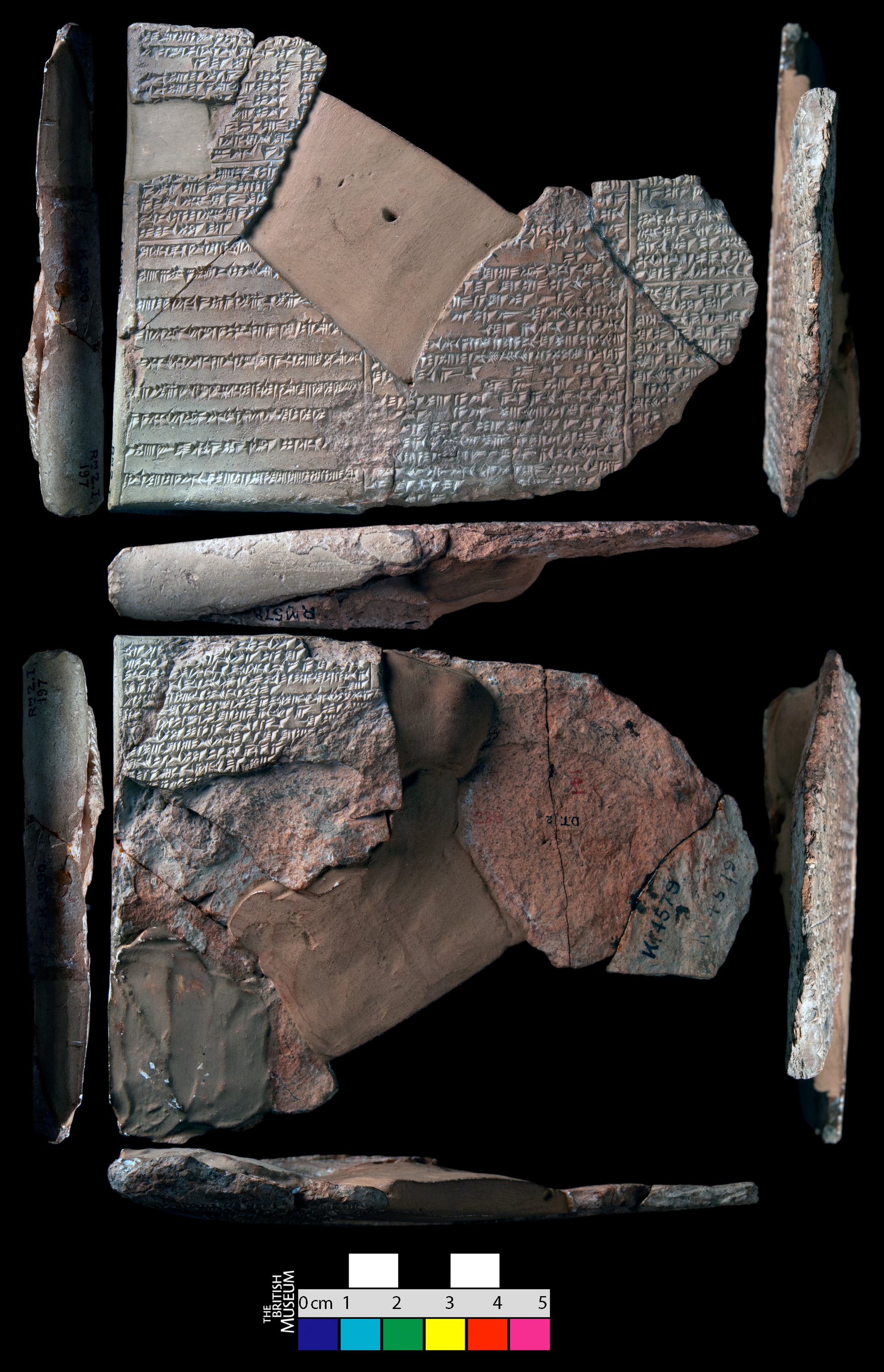
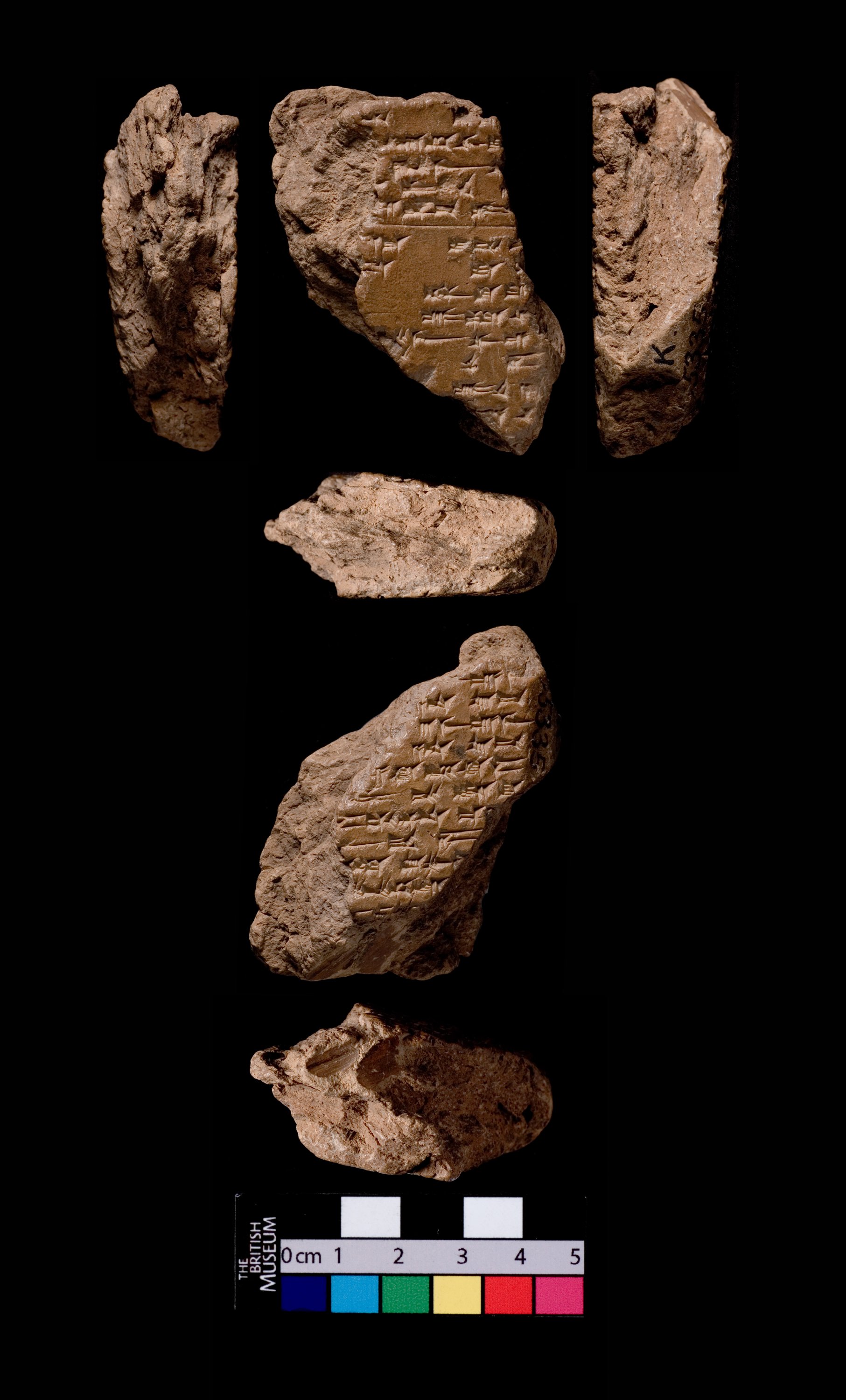
British Museum K.3990: obverse, column i, the tablet's own lines 1 to 4. eBL's corpus edition (https://www.ebl.lmu.de/corpus/L/1/4/SB/VI) attributes SB VI 1-4 to this manuscript at these column and line numbers. Photograph checked: obverse, reverse and edges of the join K.3990 + K.4579 + DT.2 + Rm.578 + Rm-II.197 (modern plaster fill, ink numbers on the pieces); text on both faces, consistent with eBL's columns i and iv-vi. On this tablet lines 1-3 are partly broken (square brackets and x in the Akkadian). The English of these lines translates eBL's composite text, so it includes words that are not preserved on this tablet but are restored from other manuscripts or by the editors. Square brackets in the English mark eBL's restorations in its composite text; words that survive on other tablets carry no brackets even where this tablet is broken. Line 4 is complete on this tablet.
1im-si [ma-le-š]u₂ ub-bi-ba t[il-le-e-šu]
2u₂-na-s[i!-i]s qim-mat-su e-lu ṣ[e-ri-šu]
3id-di m[a]r-šu-ti-šu₂ it-tal-bi-ša₂ za-ku-ti#-šu₂
4a-ṣa-a-ti# it-tah-li-pa-am-ma ra-ki-is a-gu-ha
1He washed his matted hair, he cleaned his equipment,
2he shook his locks down over his back.
3He cast aside his dirty things, he clothed himself with his clean things,
4He wrapped himself in cloaks, tied with a sash.
Where on the image
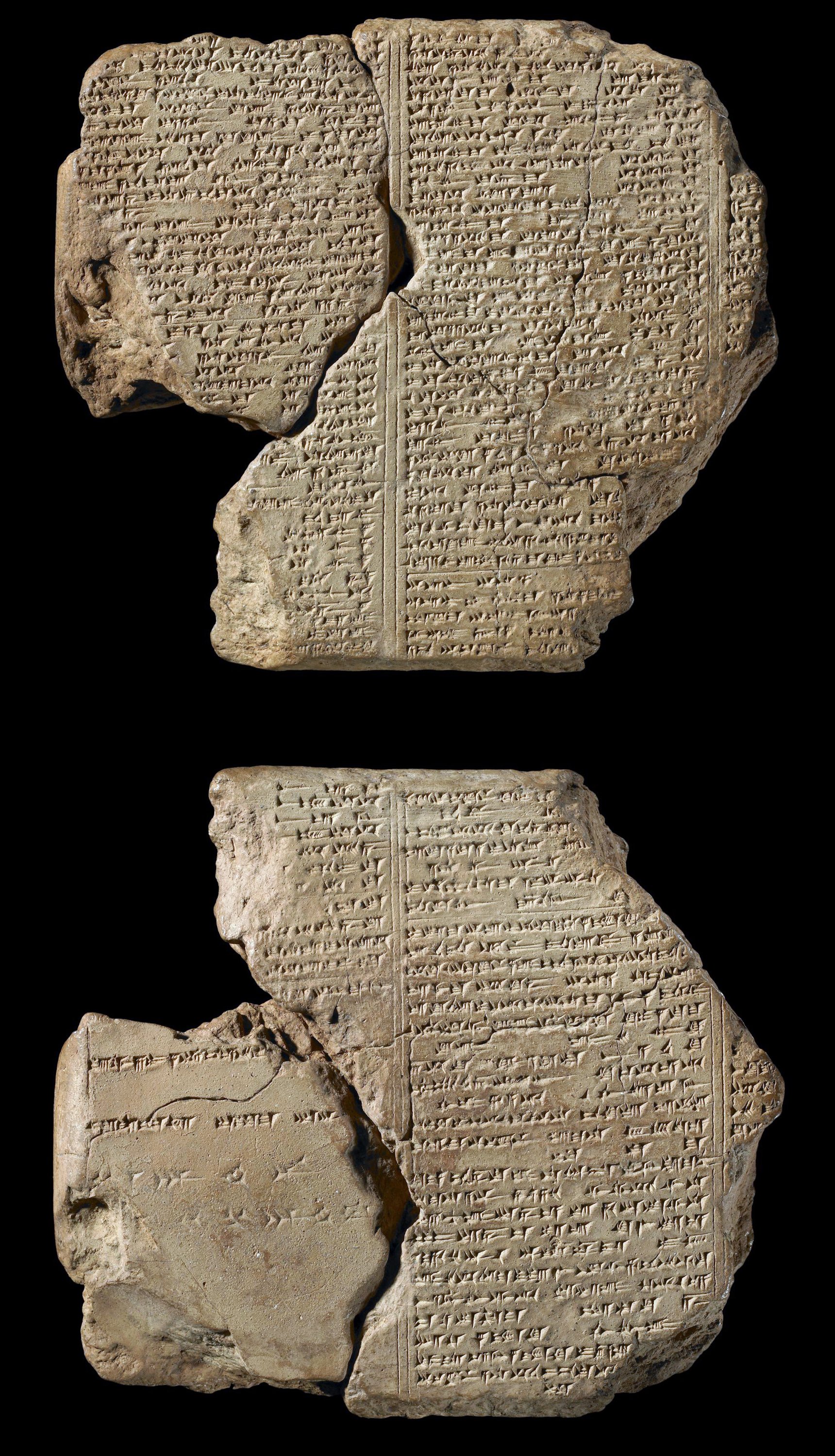
British Museum K.231: obverse, column i, the tablet's own lines 5 to 34. eBL's corpus edition (https://www.ebl.lmu.de/corpus/L/1/4/SB/VI) attributes SB VI 5-34 to this manuscript at these column and line numbers. Photograph checked: obverse and reverse of a large tablet, three columns on each face, consistent with eBL's columns i-vi. On this tablet lines 7-9, 14-34 are partly broken (square brackets and x in the Akkadian). The English of these lines translates eBL's composite text, so it includes words that are not preserved on this tablet but are restored from other manuscripts or by the editors. Square brackets in the English mark eBL's restorations in its composite text; words that survive on other tablets carry no brackets even where this tablet is broken. Lines 5-6, 10-13 are complete on this tablet.
5{d}GIŠ-gim₂-maš a-ga-šu₂ i-te-ep-ra-am-ma#
6a#-na du-un-qi₂ ša₂ {d}GIŠ-gim₂-maš i-na it-ta-ši ru-bu-tu₂ {d}15#
7[a]l-kam₂-ma {d}GIŠ-gim₂-maš lu-u₂ ha-ʾ-ir at-ta
8[i]n-bi-ka ia-a-ši qa-a-šu qi₂-šam-ma
9[a]t-ta lu-u₂ mu-te-ma ana-ku lu-u₂ aš₂-ša₂-at-ka
10lu-ša₂-aṣ-mid-ka {giš}GIGIR {na₄}ZA.GIN₃ u₃ KU₃.SIG₁₇
11ša₂ ma-gar-ru-ša₂ KU₃.SIG₁₇-ma el-mi-šu₂ qar-na-a-ša₂
12lu-u₂ ṣa-am-da-ta UD-MEŠ ku-da-nu GAL-MEŠ
13a#-na E₂-ni i-na sa-am-ma-ti {giš}EREN er-ba
14[a-n]a E₂-ni i-na e-re-bi-ka
15[x x] a-rat-tu-u₂ li-na-aš₂-ši-qu GIR₃+MIN-ka
16[lu kam-s]u ina šap-li-ka LUGAL-MEŠ IDIM-MEŠ NUN-MEŠ
17[x x x l]i-qit KUR-i u KUR lu-u na-šu-nik-ka bil-tu
18[UZ₃-MEŠ-k]a tak-ši-i U₈-MEŠ-ka tu-ʾ-a-mi li-li-da
19[x x x x b]il-ti {anše}KUNGA li-ba-ʾa
20[ANŠE.KUR.RA-k]a ina {giš#}GIGIR lu-u₂ ša₂-ru-uh la-sa-m[u]
21[x x i]na ni-i-ri ša₂-ni-na a-a ir-š[i]
22[{d}GIŠ-gim₂-maš] pa-a-šu₂ i-pu-uš-ma DUG₄.GA#
23[i-zak-ka-r]a a-na ru-bu-ti {d}iš#-tar
24[ul-tu-ma ana-k]u? a-na ka-a-ši ah-h[a-z]u-ki
25[x x x x-š]i? pag-ri u₃ ṣu#-ba-a-ti
26[x x x x x] ku-ru-um-ma-ti u₃ [b]u-bu-ti
27[x x x x x a]k-la si-ma[t DI]NGIR-u₂-ti
28[ku-ru-un-na ta-šaq-q]a-a si-m[at L]UGAL-u₂-ti
29[x x x x x x (x) l]u-u-ʾ-il
30[x x x x x x x x] lu#-u#-uš-pu-uk
31[... it-tah-l]i-pa na-ah-lap-tu
32[x x x x ka-a-š]i? ah-ha-az-ki
33[x x x x x ka-ṣi-ra]t šu-ri-pu
34[x x x x x x la i]-kal-lu-u₂ IM u zi-i-qa
5Gilgameš put on his crown.
6The lady Ištar looked covetously on the beauty of Gilgameš:
7‘Come, Gilgameš, you be the bridegroom!
8Grant me your fruits, I insist!
9You shall be my husband and I will be your wife!
10Let me harness for you a chariot of lapis lazuli and gold,
11whose wheels are gold and whose horns are amber.
12You shall have in harness “storm-lions”, huge mules.
13Come into our house with scents of cedar!
14When you come into our house,
15doorway and throne shall kiss your feet.
16Kings, courtiers and nobles shall be bowed down beneath you,
17Produce of mountain and lowland they shall bring you as tribute!
18Your nanny goats shall bear triplets and your ewes twins,
19your donkey foal under load shall outpace a mule.
20At the chariot your horse shall gallop majestically,
21at the yoke your ox shall acquire no rival.
22[Gilgameš] opened his mouth to speak,
23[saying] to the lady Ištar:
24‘[If indeed I were] to take you in marriage,
25[...] myself and my clothing,
26[whence will come] my food and my sustenance?
27[will you feed me] bread fit for a god?
28[will you pour me ale] fit for a king?
29[...] should I bind,
30[…] should I pile high?
31[Would…] wrap […] in a cloak?
32‘[Why] would I take you in marriage?
33[You, a frost] that congeals no ice,
34a slatted door [that does not] block breeze and draught,
Where on the image
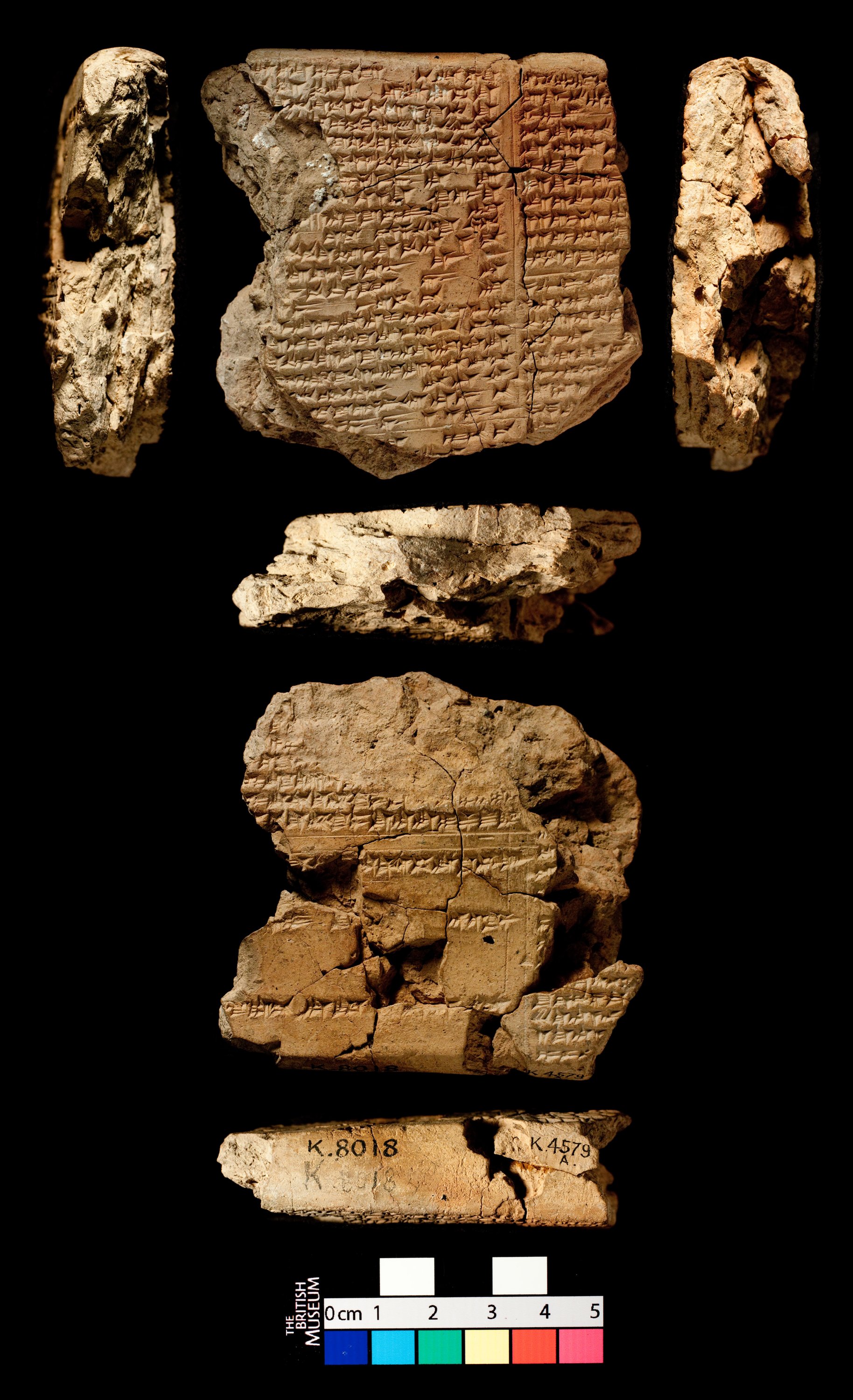
British Museum K.4579.A: obverse, column ii, the tablet's own lines 2 to 11. eBL's corpus edition (https://www.ebl.lmu.de/corpus/L/1/4/SB/VI) attributes SB VI 35-44 to this manuscript at these column and line numbers. Photograph checked: obverse, reverse and edges of the join K.4579.A + K.8018 (both ink numbers on the edge); text on both faces, consistent with eBL's columns i-ii and v-vi. On this tablet of line 36 only one to three signs survive and lines 35, 37-44 are partly broken (square brackets and x in the Akkadian). The English of these lines translates eBL's composite text, so it includes words that are not preserved on this tablet but are restored from other manuscripts or by the editors. Square brackets in the English mark eBL's restorations in its composite text; words that survive on other tablets carry no brackets even where this tablet is broken.
35E₂.GAL mu-nap-p[i-ṣa-at x x x]
36pi-i-ru [x x x x x x x x x x]
37it-tu-u₂ mu-ṭ[ap-pi-lat? (x x) x x x]
38{kuš}na-a-da m[u-ra-sa-at x x x]
39pi-i-lu m[u-x x x x x x]
40ia-šu-bu-u₂ [x x x x x x x x x]
41{kuš}E.SIR₂ mu-na-[ši-kat₃ x x x x]
42a-a-u₂ ha-me-r[a-ki x x x x x]
43a-a-u₂ al-lal-ki [x x x x x x x]
44al-kim-ma lu-up-pi-[iš x x x x x x x]
35a palace that massacres warriors,
36an elephant [that...] its coverings,
37pitch that [stains the hands] of its bearer,
38a waterskin that [sullies the hands] of its bearer,
39a boulder that [smashes] a wall of stone,
40a battering ram that destroys the [walls of] the enemy land,
41a shoe that bites the foot of its owner!
42What bridegroom of yours endured forever?
43What brave warrior of yours is there [who] went up [heaven?]
44Come, let me count [the number] of your lovers.
Where on the image
British Museum K.231: obverse, column ii, the tablet's own lines 1 to 20. eBL's corpus edition (https://www.ebl.lmu.de/corpus/L/1/4/SB/VI) attributes SB VI 45-64 to this manuscript at these column and line numbers. Photograph checked: obverse and reverse of a large tablet, three columns on each face, consistent with eBL's columns i-vi. On this tablet lines 45-49, 58-61 are partly broken (square brackets and x in the Akkadian). The English of these lines translates eBL's composite text, so it includes words that are not preserved on this tablet but are restored from other manuscripts or by the editors. Square brackets in the English mark eBL's restorations in its composite text; words that survive on other tablets carry no brackets even where this tablet is broken. Lines 50-57, 62-64 are complete on this tablet.
45ša₂ bu-di-im-ma x ta x [x x x]
46a-na {d}dumu-zi ha-mi-ri ṣ[u]-u[h-re-ti-ki]
47šat-ta a-na šat-ti bi-tak-ka-a tal#-ti-m[eš-šu]
48al-la-la₂ bit-ru-ma ta-ra-m[i-ma]
49tam-ha-ṣi-šu-ma kap-pa-šu tal-te-eb-[ri]
50iz-za-az ina qi₂-ša₂-tim i-šas-si kap-pi
51ta-ra-mi-ma UR.MAH ga-mi-ir e-mu-qi₂
52tu-uh-tar-ri-iš-šu₂ 7 u 7 šu-ut-ta-a-ti
53ta-ra-mi-ma ANŠE.KUR.RA na-ʾ-id qab-li
54iš-tuh-ha ziq-ti u dir-ra-ta tal-ti-meš-šu
557 DANNA la-sa-ma tal-ti-meš-šu
56da-la-hu u₃ ša₂-ta-a tal-ti-meš-šu
57a-na AMA-šu₂ {d}si-li-li bi-tak-ka-a tal-ti-me
58[t]a-ra-mi-ma {lu₂}SIPA TA BU LA
59[x k]a-a-a-nam-ma tu-um-ri iš-pu-kak-ki
60[u₄-m]i-šam-ma u₂-ṭa#-ba-ha-ak-ki u₂-ni-qe₂-ti
61[tam-h]a-ṣi-šu-ma a-na UR.BAR.RA tu-ut-ter-ri-šu
62u₂#-ṭa-ar-ra-du-šu# ka-par-ru ša₂ ram#-ni-šu
63u UR.GI₇-MEŠ-šu u₂-na-aš₂-ša₂-ku šap-ri-šu
64ta-ra-mi-ma i-šu-ul-la-nu {lu₂}NU.{giš}KIRI₆ AD-ki
45As for him of… […] his arm.
46To Dumuzi the husband of your youth,
47to him you have allotted perpetual weeping, year on year.
48You loved the speckled allallu-bird,
49you struck him and broke his wing,
50(now) he stands in the woods crying “My wing!”
51You loved the lion, perfect in strength,
52seven and seven pits you have dug for him.
53You loved the horse, famed in battle,
54to him you have allotted whip, spurs and lash.
55To him you have allotted a seven-league gallop,
56to him you have allotted muddy water to drink.
57To his mother Silili you have allotted perpetual weeping.
58You loved the shepherd, the grazier, the herdsman,
59who regularly piled up for you (bread baked in) embers,
60slaughtering kids for you every day.
61You struck him and turned him into a wolf,
62so his own shepherd boys drive him away,
63and his dogs take bites at his thighs.
64You loved Išullānu, your father’s gardener,
Where on the image
British Museum K.231: obverse, column ii, the tablet's own lines 21 to 39. eBL's corpus edition (https://www.ebl.lmu.de/corpus/L/1/4/SB/VI) attributes SB VI 65-83 to this manuscript at these column and line numbers. Photograph checked: obverse and reverse of a large tablet, three columns on each face, consistent with eBL's columns i-vi. On this tablet lines 71, 75-83 are partly broken (square brackets and x in the Akkadian). The English of these lines translates eBL's composite text, so it includes words that are not preserved on this tablet but are restored from other manuscripts or by the editors. Square brackets in the English mark eBL's restorations in its composite text; words that survive on other tablets carry no brackets even where this tablet is broken. Lines 65-70, 72-74 are complete on this tablet.
65ša ka-a-a-nam-ma šu-gu-ra-a na-šak-ki
66u₄-mi-šam-ma u₂-nam-ma-ru pa-aš₂-šur-ki
67i-na ta-at-ta-ši-šum-ma ta-tal-kiš-šu
68i-šu-ul-la-ni-ia kiš-šu-ta-ki i ni-kul
69u qat-ka liš-te-ṣa-am-ma lu-pu-ut hur-da-at-ni
70i-šu-ul-la-nu i-qab-bi-ki
71ia-a-ši mi-na#-a ter-re-ši-in-n[i]
72um-mi la te-pa-a a-na-ku la a-kul
73ša₂ ak-ka-lu NINDA-HI.A pi-ša₂-a-ti u er-re-e-ti
74ša₂ ku-uṣ-ṣi el-pe-tu ku-tum₃-mu-u₂-a#
75at-ti taš-mi-ma an-na-a qa#-[ba-a-šu]
76tam-ha-ṣi-šu a-na dal-la-li tu-ut-[ter-ri-šu]
77tu-še-ši-bi-šu-ma ina qa-bal ma-na-[ha-(a)-ti-šu]
78ul e-lu-u₂ mi-ih-ha ul a-rid da-l[u-x x x x]
79u ia-a-ši ta-ram-min₃-ni-ma ki-i ša₂-šu-nu t[u-tar-rin-ni?]
80{d}iš-tar an-na-a ina [še-me-e-ša₂]
81{d}iš-tar ug-gu-gat-ma a-na ša₂-ma-mi [i-li]
82il-lik-ma {d}iš-tar ana IGI {d}a-ni[m x x x x x]
83ana IGI an-tu₄ AMA-ša₂ il-l[a-ka x x x x]
65who regularly brought you a basket of dates,
66daily making your table gleam.
67you looked at him covetously and went up to him:
68“O my Išullānu, let us taste your power!”
69Put out your hand and stroke our vulva!”
70Išullānu spoke to you:
71“Me! What do you want of me?
72Did my mother not bake? Did I not eat?
73Am I to eat bread of insults and curses?
74Shall I let rushes be my covering against the cold?”
75You heard what [he had to] say,
76you struck him, you turned [him] into a dwarf.
77You sat him in the midst of his labours,
78he cannot go up to the …, he cannot go down to the … […]
79And you would love me and [change me] as (you did) them?’
80When Ištar [heard] this,
81Ištar was furious and [went up] to heaven.
82Ištar went [weeping] before her father, Anu,
83her tears flowing before Antu, her mother.
Where on the image
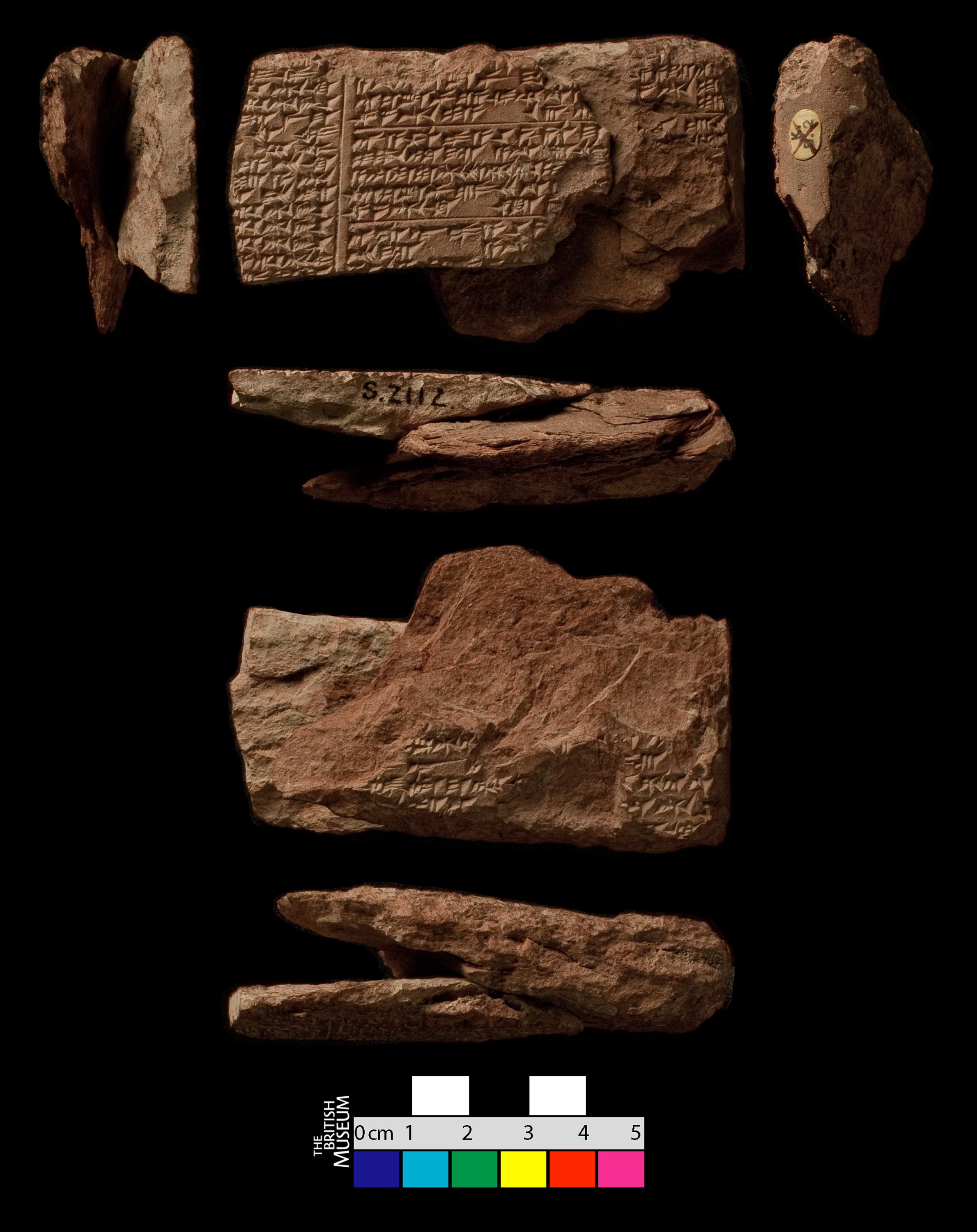
British Museum Sm.2112: column iii, the tablet's own lines 2' to 12'a. eBL's corpus edition (https://www.ebl.lmu.de/corpus/L/1/4/SB/VI) attributes SB VI 84-94 to this manuscript at these column and line numbers. Photograph checked: obverse, reverse and edges, ink number S.2112; text on both faces, consistent with eBL's columns ii-iii and iv. On this tablet lines 84-86, 88-94 are partly broken (square brackets and x in the Akkadian). The English of these lines translates eBL's composite text, so it includes words that are not preserved on this tablet but are restored from other manuscripts or by the editors. Square brackets in the English mark eBL's restorations in its composite text; words that survive on other tablets carry no brackets even where this tablet is broken. Line 87 is complete on this tablet.
84a-bi {d#}GIŠ#-gim₂-maš it#-ta#-[na-a]z-za-ra-an-n[i]
85{d}GIŠ-gim₂-maš un-de-en-na-a [p]i-ša₂-ti-ia
86pi-ša₂-ti-ia u er-r[e]-ti#-ia
87{d}a-num pa-a-šu₂ DU₃-uš-ma DUG₄.GA
88i-zak-ka-ra a-na ru-bu-t[i] {d}iš₈-tar₂
89a-ba la at-ti te-eg-ri-i LUGAL# [{d}GIŠ-gim₂]-maš#
90u {d}GIŠ-gim₂-maš u₂-man-na-a# pi#-[ša₂-ti-ki]
91pi-ša₂-ti-ki u₃ e[r-re-ti-ki]
92{d}iš-tar pa-a-šu₂ D[U₃-ma x x x]
93MU-ra a-na {d#}[x x x x]
94a#-bi# a-la-a bi#-n[am-ma]
84‘O father, Gilgameš has been heaping abuse on me,
85Gilgameš kept recounting things that insult me,
86things that insult and revile me.’
87Anum opened his mouth to speak,
88saying to the lady Ištar:
89‘Well, was it not you who provoked King Gilgameš,
90so then Gilgameš recounted things that insult you,
91things that insult and revile you?’
92Ištar opened her mouth to speak,
93saying to her father, Anu:
94‘O father, give me, please, the Bull of Heaven,
Where on the image
British Museum K.231: obverse, column iii, the tablet's own lines 4' to 10'. eBL's corpus edition (https://www.ebl.lmu.de/corpus/L/1/4/SB/VI) attributes SB VI 95-101 to this manuscript at these column and line numbers. Photograph checked: obverse and reverse of a large tablet, three columns on each face, consistent with eBL's columns i-vi. On this tablet of lines 95-101 only one to three signs survive. The English of these lines translates eBL's composite text, so it includes words that are not preserved on this tablet but are restored from other manuscripts or by the editors. Square brackets in the English mark eBL's restorations in its composite text; words that survive on other tablets carry no brackets even where this tablet is broken.
95{d}GIŠ-[gim₂-maš x x x x x x x]
96šum-m[a x x x x x x x x]
97a-mah-[haṣ? x x x x x x x x
98a-šak-[kan x x x x x x x x]
99u₂-š[el-lam-ma x x x x x x x x x]
100UGU [x x x x x x x x x]
101{d}a#-[num x x x x x x x x x]
95that I may slay Gilgameš in his dwelling.
96If you will not give me the Bull of Heaven,
97I shall smash the underworld together with its dwelling-place,
98to the world below I shall grant [manumission,]
99I shall bring up the dead to consume the living,
100I shall make the dead outnumber the living.’
101Anu opened his mouth to speak,
Where on the image
British Museum K.5335: column iii, the tablet's own lines 2' to 14'. eBL's corpus edition (https://www.ebl.lmu.de/corpus/L/1/4/SB/VI) attributes SB VI 102-112 to this manuscript at these column and line numbers. Photograph checked: obverse, reverse and edges; a few lines on each face, consistent with eBL's columns iii and iv. On this tablet of lines 102, 107-108, 111-112 only one to three signs survive and lines 103-106, 109-110 are partly broken (square brackets and x in the Akkadian). The English of these lines translates eBL's composite text, so it includes words that are not preserved on this tablet but are restored from other manuscripts or by the editors. Square brackets in the English mark eBL's restorations in its composite text; words that survive on other tablets carry no brackets even where this tablet is broken.
102[x x x x ru-bu]-ti {d#}iš#-[tar]
103[x x x x x] ter-ri-ši-i[n-ni]
104[x x x UNUG]{ki#} 7 MU-MEŠ p[e-e] (line break) [l]i-pa-hi-i[r]
105[{lu₂}ENGAR x x l]i-rab-bi U₂-H[I.A]
106[x x x x x DU₃-u]š-ma i-qab-b[i]
107[x x x x x {d}a-n]im AD-š[a₂]
108[x x x (x)] x ak-ku-um
109[x x (x)-ME]Š? u₂-šab-ši
110[al-mat-ti UNUG{ki} 7 M]U-MEŠ pe-e (line break) [up-ta]h?-hi-ir
111[x x x x x x x] U₂-HI.A
112[...] ša₂#-a-šu₂
102saying to the lady Ištar:
103‘If you will ask of me the Bull of Heaven,
104for seven years let the widow of Uruk gather chaff,
105[and the farmer of Uruk] grow hay.’
106[Ištar opened her mouth] to speak,
107[saying to] her father, Anu:
108[...] already I stored,
109[...] I made grow.
110[For seven] years the widow [of Uruk has] gathered chaff,
111the farmer [of Uruk has grown] hay.
112With the wrath of the Bull I shall [have vengeance!]
Where on the image
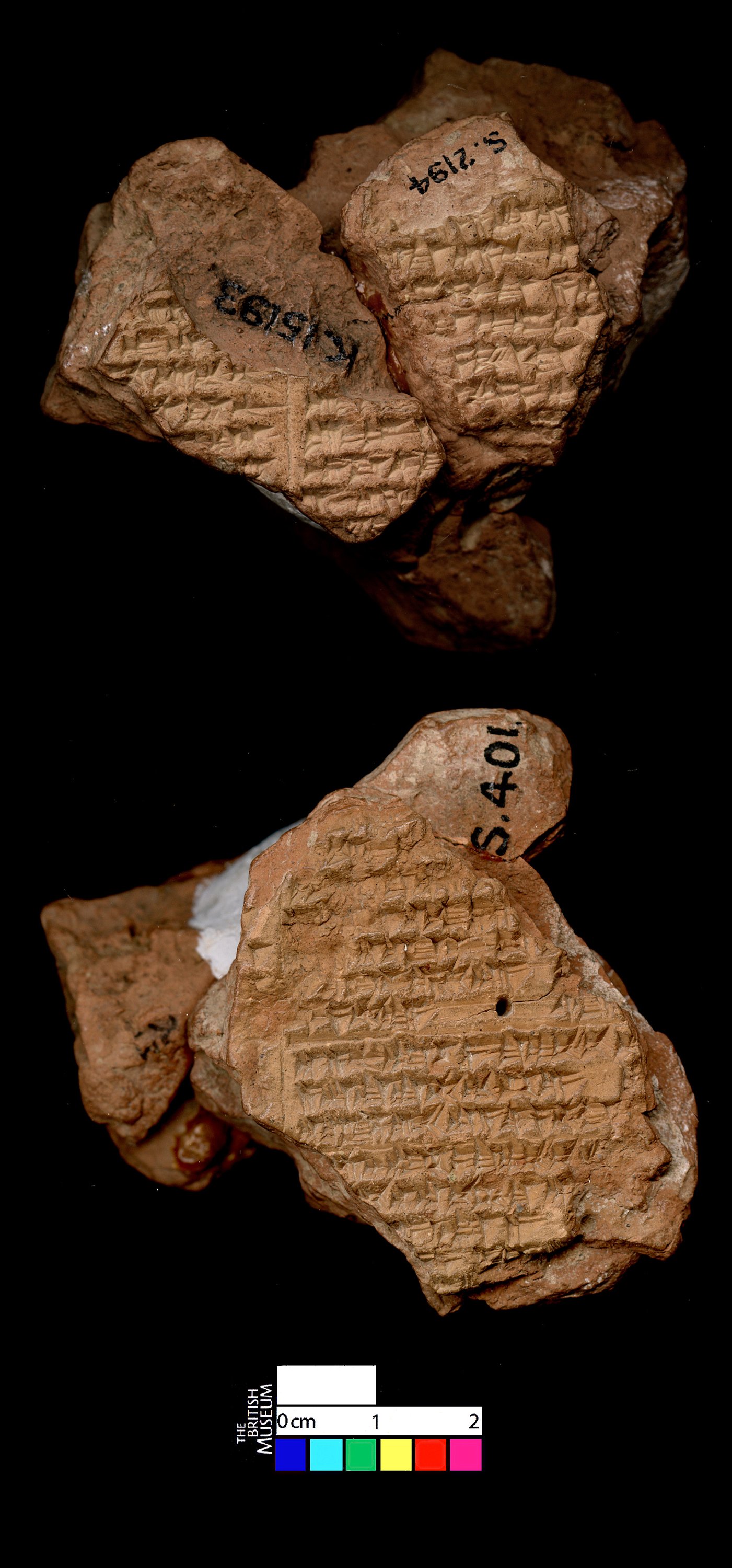
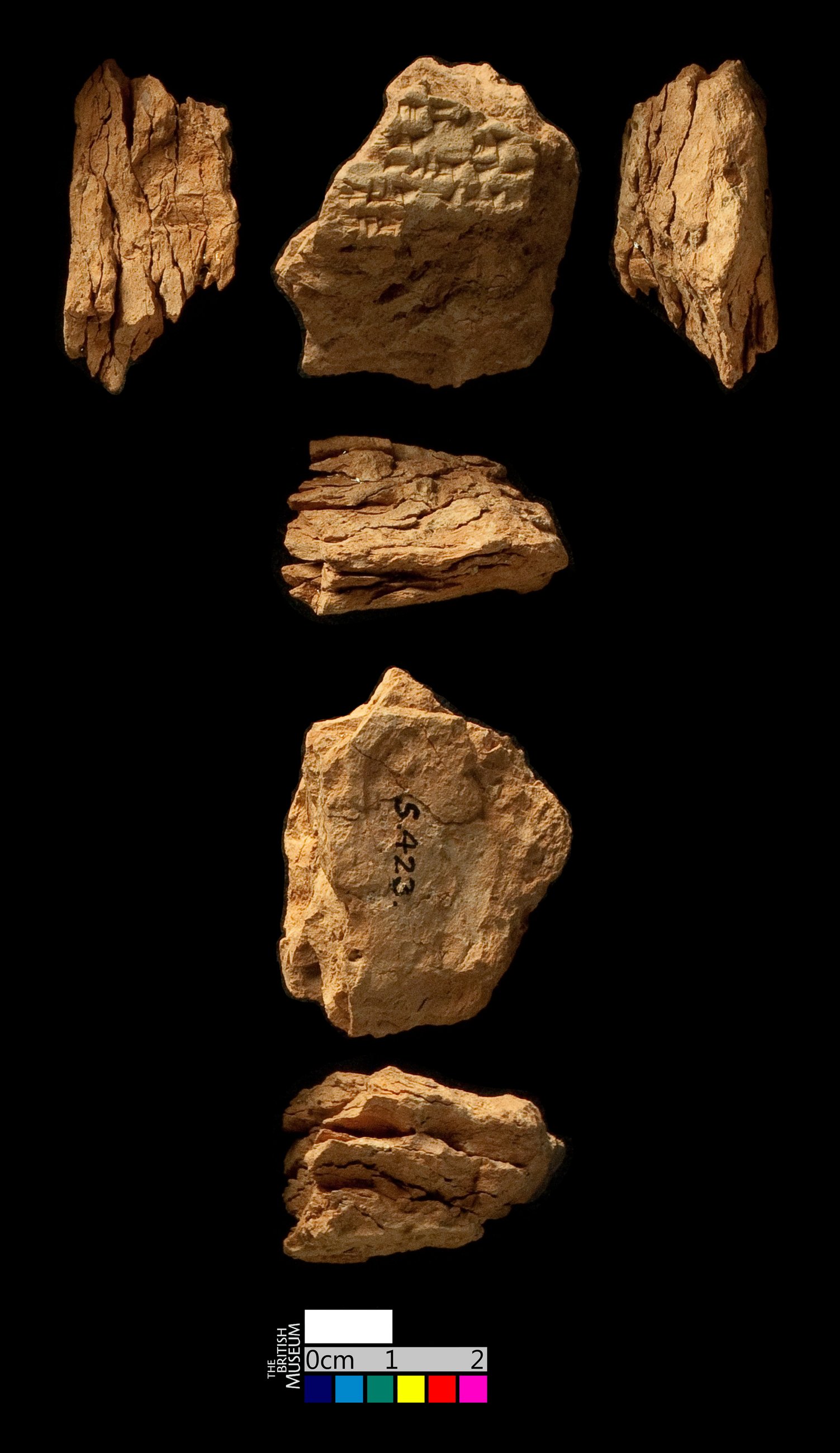
British Museum K.15193: reverse, column iv, the tablet's own lines 3' to 10'. eBL's corpus edition (https://www.ebl.lmu.de/corpus/L/1/4/SB/VI) attributes SB VI 113-120 to this manuscript at these column and line numbers. Photograph checked: obverse and reverse of the joined pieces K.15193, Sm.2194 and Sm.401 (ink numbers visible); text in two columns on each face. eBL treats K.15193 + Sm.423 as one manuscript and holds a separate photograph of each of these pieces; it does not say which piece carries which line, so the photographs of K.15193 + Sm.423 are linked, and the lines are on one or more of them. On this tablet lines 113-120 are partly broken (square brackets and x in the Akkadian). The English of these lines translates eBL's composite text, so it includes words that are not preserved on this tablet but are restored from other manuscripts or by the editors. Square brackets in the English mark eBL's restorations in its composite text; words that survive on other tablets carry no brackets even where this tablet is broken.
113[iš-me]-e#-ma {d}a-nu an-[na-a] qa#-[ba-a x x x]
114[x ṣer-r]et a-lim-ma a-n[a Š]U+MIN-ša₂ i[š-kun]
115[x (x) x]-ma i-red-da-[a]š₂-šu₂ {d#}[iš-tar]
116a-n[a? ma-t]u₄ ša₂ UNUG{ki} ina ka-ša₂-d[i-šu₂]
117u₂-tab#-bil# [{gi]š}TIR ap-pa-ra u qa-n[a-a]
118u₂-rid a-na# ID₂# [x 1.KU]Š₃ ID₂ [x x x]
119ina ni-ip-ši-š[u x x x x x x x x x x x x]
1201 me GURUŠ-MEŠ š[a₂ x x x x x x x x x]
113Anu heard this speech of Ištar,
114[and] he placed in her hands the nose-rope of the Bull of Heaven.
115[Down came] Ištar, leading it onward:
116when [it] reached the [land] of Uruk,
117it dried up the woodland, the marshland and the reeds,
118it went down to the river, (the level of) the river was reduced by seven cubits.
119At the snort of the Bull of Heaven a pit opened up,
120a hundred men of Uruk all fell into it.
Where on the image
British Museum K.3990: reverse, column iv, the tablet's own lines 1' to 12'. eBL's corpus edition (https://www.ebl.lmu.de/corpus/L/1/4/SB/VI) attributes SB VI 121-131 to this manuscript at these column and line numbers. Photograph checked: obverse, reverse and edges of the join K.3990 + K.4579 + DT.2 + Rm.578 + Rm-II.197 (modern plaster fill, ink numbers on the pieces); text on both faces, consistent with eBL's columns i and iv-vi. On this tablet lines 121-131 are partly broken (square brackets and x in the Akkadian). The English of these lines translates eBL's composite text, so it includes words that are not preserved on this tablet but are restored from other manuscripts or by the editors. Square brackets in the English mark eBL's restorations in its composite text; words that survive on other tablets carry no brackets even where this tablet is broken.
121ina# 2#-i# ni#-ip#-š[i-šu x x x x x x x x]
1222 me GURUŠ-ME[Š x x x x x x x] (line break) (blank space) [x x x]
123i-na šal-ši ni-ip-ši#-š[u₂ x x x x x x x x x]
124{d}+en-ki-du₃ im-ta-[qut x x x x]
125iš-hi-ṭam-ma {d}+en-k[i-du₃ x x x x x x x]
126GU₄.AN.NA ana pa-ni-šu₂ is-s[u-ka x x x x]
127ina ku-bur zib-ba-ti-šu₂ [x x x x x x]
128{d#}+en-ki-du₃ pa-a-šu₂ DU₃-[uš-ma x x x]
129i-[z]ak-ka-ra [x x x x x x]
130ib-ri nu-uš-tar-ri-i[h x x x]
131ki-i ni-ip-pa-l[a x x x x x]
121At its second snort a pit opened up,
122two hundred men of Uruk all fell into it.
123At its third snort a pit opened up,
124Enkidu fell in up to [his] waist.
125Enkidu sprang out and seized the Bull of Heaven by [its] horns;
126the Bull of Heaven spat slaver at his face,
127[flicking] its dung with the tuft of its tail.
128Enkidu opened his mouth [to speak,]
129saying to Gilgameš:
130‘My friend, we vaunted ourselves [in our] city,
131how shall we make amends for the piled-up people?
Where on the image
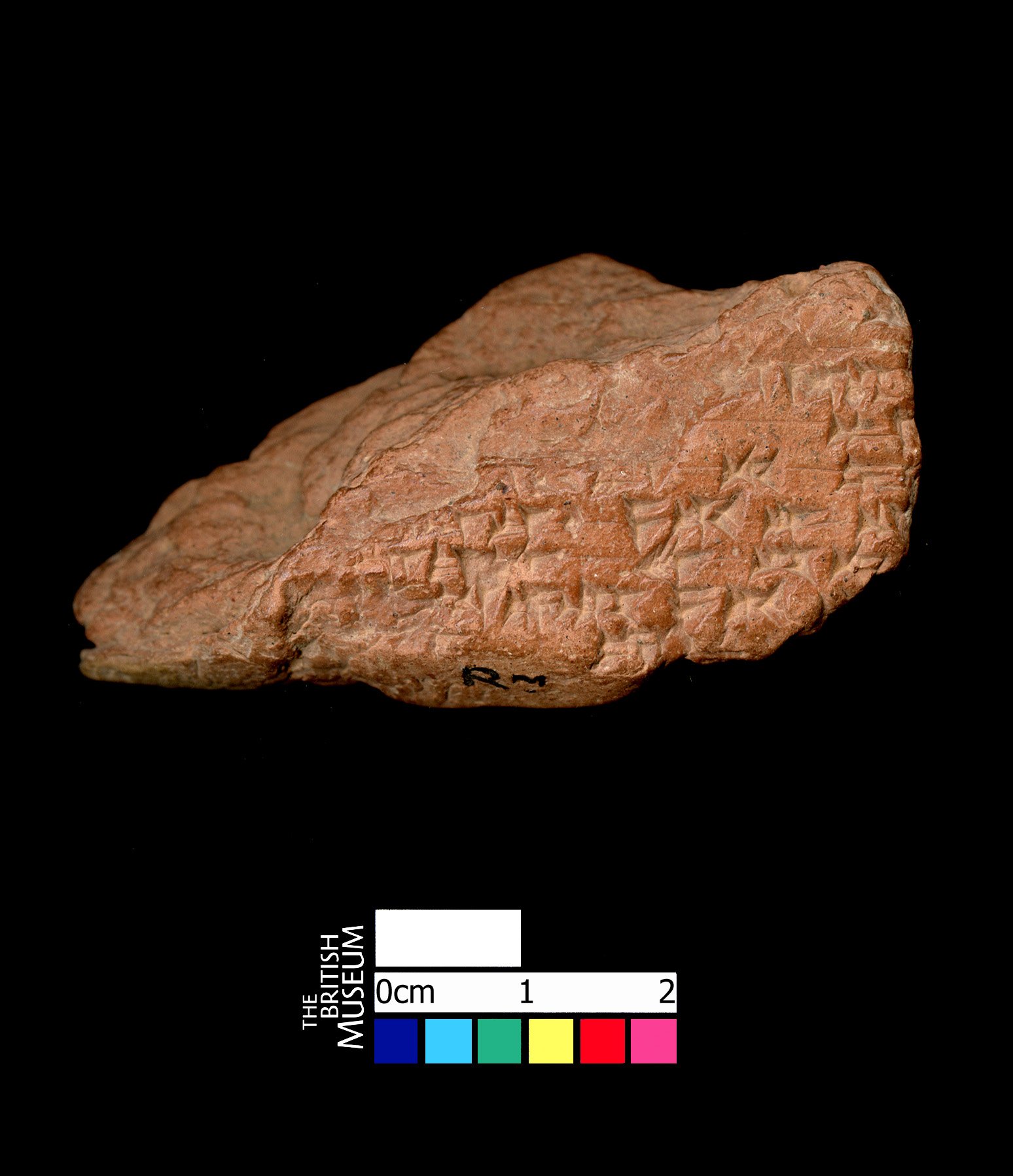
British Museum K.14945: column iv, the tablet's own lines 5' to 8'. eBL's corpus edition (https://www.ebl.lmu.de/corpus/L/1/4/SB/VI) attributes SB VI 132-135 to this manuscript at these column and line numbers. Photograph checked: one face of a fragment from the lower edge with about 8 lines (British Museum description: 8 lines), consistent with eBL's 9 lines of column iv. On this tablet of line 135 only one to three signs survive and lines 132-134 are partly broken (square brackets and x in the Akkadian). The English of these lines translates eBL's composite text, so it includes words that are not preserved on this tablet but are restored from other manuscripts or by the editors. Square brackets in the English mark eBL's restorations in its composite text; words that survive on other tablets carry no brackets even where this tablet is broken.
132[x x x x x du-u]n-na#-šu ša₂ GU₄.AN.NA-[e?]
133[x x x x x a]-lam-ma-du# te-re-ti-[šu₂? x x]
134[x x x x lu-mu]r? du-un-na-šu₂ ša₂ GU₄.A[N.NA-e?]
135[x x x x x GU.AN.N]A e-x [x x x]
132My friend, I have experienced the might of the Bull of Heaven,
133so learning [its] strength, [and knowing its] purpose.
134I will once again [experience] the might of the Bull of [Heaven,]
135I [shall get me] behind [the Bull of Heaven,]
Where on the image
British Museum Sm.2112: column iv, the tablet's own lines 17' to 6'. eBL's corpus edition (https://www.ebl.lmu.de/corpus/L/1/4/SB/VI) attributes SB VI 136-143 to this manuscript at these column and line numbers. Photograph checked: obverse, reverse and edges, ink number S.2112; text on both faces, consistent with eBL's columns ii-iii and iv. On this tablet of lines 136-139 only one to three signs survive and lines 140-143 are partly broken (square brackets and x in the Akkadian). The English of these lines translates eBL's composite text, so it includes words that are not preserved on this tablet but are restored from other manuscripts or by the editors. Square brackets in the English mark eBL's restorations in its composite text; words that survive on other tablets carry no brackets even where this tablet is broken.
136lu-uṣ-bat-[su-ma ina ku-bur zib-ba-ti-šu₂]
137lu-uš-k[un še-pi ina ar?-kat₃? siq-qi₂-šu₂]
138i#-na x [x x x x x x x x-hi-is-su]
139[x x x k]i-i#? [x x x x x x x x x x]
140[i-na bi]-rit ti-i[k-ki qa]r-ni u nap#-l[a-ki] (line break) [p]a-tar-k[a] um-[mi]d
141i#-ṣu-dam-ma {d}+en-k[i-du₃ ana ku-ta]l GU₄.AN.NA
142[i]ṣ-bat-su-ma in[a ku-bur zib]-ba-ti-šu₂
143[iš-kun š]e-e[p-šu₂ x x x] siq#-qi₂-š[u₂]
136I will seize [it by the tuft of its tail.]
137I will set [my foot on the back of its hock,]
138in... [... I will ...it.]
139Then [you] like a [butcher (…), brave and] skilful,
140press home your knife between the yoke of the horns and the slaughter-spot.’
141Enkidu circled round behind the Bull of Heaven,
142he seized it by the [tuft] of its tail.
143[He set] his foot on [the back of] its hock,
Where on the image
British Museum K.231: reverse, column v, the tablet's own lines 1-2 to 29. eBL's corpus edition (https://www.ebl.lmu.de/corpus/L/1/4/SB/VI) attributes SB VI 145-169 to this manuscript at these column and line numbers. Photograph checked: obverse and reverse of a large tablet, three columns on each face, consistent with eBL's columns i-vi. On this tablet lines 145-146, 148-154, 162-163, 169 are partly broken (square brackets and x in the Akkadian). The English of these lines translates eBL's composite text, so it includes words that are not preserved on this tablet but are restored from other manuscripts or by the editors. Square brackets in the English mark eBL's restorations in its composite text; words that survive on other tablets carry no brackets even where this tablet is broken. Lines 147, 155-161, 164-168 are complete on this tablet.
145u₃ {d}GIŠ-gim₂-maš ki-i {lu₂#}[GIR₂.LA₂ (x x)] (line break) (blank space) qar-di u₃# [le-ʾ-i]
146ina bi-rit ti-ik-ki qar-ni u₃ n[ap-la-ki x x x x]
147iš-tu a-la-a i-na-ru
148lib₃-b[a-šu₂ x x x x] (line break) (blank space) a-na IGI {d}UTU i[š-tak-nu]
149i-re-qu-nim-ma ana pa-an {d}UTU [x x x]
150it-taš-bu aha₂-meš ki-[lal-la-an]
151i-li-ma {d}iš-tar ina UGU BAD₃ ša₂ UNUG{ki} su#-[pu-ri]
152iš-hi-iṭ hup-pa it-ta-di a-ru-ru-[ta]
153al-lu-u₂ {d}GIŠ-gim₂-maš ša₂ u₂-ṭap-pil-an-ni GU₄.AN.NA id-d[uk]
154iš-me-ma {d}+en-ki-du₃ an-na-a qa-bi {d}iš-t[ar]
155iš-lu-uh i-mit-ti GU₄.AN.NA-ma ana IGI-ša₂ id-di
156u ak-ka-ši lu-u₂ ak-šu-ud-ki ki-i ša₂-šu-ma (line break) (blank space) lu-u₂ u₂-še-mi-ki
157er-ri-šu lu a-lu-la ina a-hi-ki
158up-tah-hi-ir {d}iš-tar ke-ez-re-e-ti (line break) (blank space) {munus}šam-ha-a-ti u {munus}KAR.KID-MEŠ
159ina UGU i-mit-ti GU₄.AN.NA bi-ki-ta iš-kun
160is-si-ma {d}GIŠ-gim₂-maš um-ma-na kiš-kat₃-te-e (line break) (blank space) ka-la-ma
161ku-bur qar-ni-šu u₂-na-ʾa-du DUMU-MEŠ um-ma-nu
162[3]0 ma-na.AM₃ {na₄}ZA.GIN₃ ši-pi-ik-ši-na
163[š]in-nu u₂-ba-ne₂-e ta-ha-ba-tu-ši-na
1646 GUR I₃.GIŠ ṣi-bit ki-lal-le-e
165ana piš-šat DINGIR-šu₂ {d}lugal-ban₃-da i-qiš
166u₂-še-ri-im-ma i-ta-lal ina ur-ši ha-am-mu-ti-šu
167ina {id₂}pu-rat-ti im-su-u₂ qa-ti-šu₂-un
168iṣ-ṣab-tu-nim-ma il-la-ku-ni
169su-qa ša₂ UNUG{ki} rak-bu-u₂-n[i]
145Then Gilgameš like a butcher [(…)], brave and skilful,
146[pressed home] his knife between the yoke of the horns and the slaughter-spot.
147After they had slain the Bull of Heaven,
148they took its heart and set it before Šamaš.
149They stepped back and prostrated themselves before Šamaš,
150both of them (then) sat down together.
151Ištar went up on to the wall of Uruk-the-Sheepfold,
152she hopped and stamped, she uttered a woeful wail:
153‘Woe to Gilgameš, who vilified me, (who) killed the Bull of Heaven!’
154Enkidu heard this speech of Ištar,
155he tore a haunch off the Bull of Heaven and threw it down before her.
156‘You too, had I caught you, I would have treated you like it!
157I would have draped its guts on your arms!’
158Ištar assembled the courtesans, prostitutes (and harlots),
159she instituted mourning over the Bull of Heaven’s haunch.
160Gilgameš summoned the craftsmen, all the smiths,
161for the craftsmen to praise the thickness of its horns.
162Thirty minas of lapis lazuli each was their mass,
163Two minas each their rims,
164six kor of oil was the capacity of both.
165He dedicated (them) for the anointing of his god, Lugalbanda,
166he took (them) in and hung (them) in his bed-chamber.
167They washed their hands in the River Euphrates,
168they took each other (by the hand) to go forward.
169As they drove along the street of Uruk,
Where on the image
British Museum K.3990: reverse, column vi, the tablet's own lines 1 to 15. eBL's corpus edition (https://www.ebl.lmu.de/corpus/L/1/4/SB/VI) attributes SB VI 170-183 to this manuscript at these column and line numbers. Photograph checked: obverse, reverse and edges of the join K.3990 + K.4579 + DT.2 + Rm.578 + Rm-II.197 (modern plaster fill, ink numbers on the pieces); text on both faces, consistent with eBL's columns i and iv-vi. On this tablet of line 178 only one to three signs survive and lines 170-177, 179-183 are partly broken (square brackets and x in the Akkadian). The English of these lines translates eBL's composite text, so it includes words that are not preserved on this tablet but are restored from other manuscripts or by the editors. Square brackets in the English mark eBL's restorations in its composite text; words that survive on other tablets carry no brackets even where this tablet is broken.
170pah-ru UN-MEŠ ša₂ UNUG{ki#} i#-dag#-ga#-l[u-šu-nu-ti]
171{d}GIŠ-gim₂-maš a-na mu-ṭap₃-pi-la ša₂ E₂?#.[GAL?-šu₂?] (line break) (blank space) a-ma-ta i-zak-[kar]
172man-nu-um-ma ba-ni i-na GURUŠ-[MEŠ]
173man-nu-um-ma ša₂-ru-uh i-na NIT[A-MEŠ]
174{d#}GIŠ#-gim₂#-maš# ba#-ni i-na GU[RUŠ-MEŠ]
175[{d}GIŠ-gim₂-maš ša₂-ru]-uh i-na N[ITA-MEŠ]
176[x x x x x n]i-du-u₂ i#-[na x x x]
177[x x x i-n]a su-qi₂ mu-ṭap₃-p[i-la x x x]
178[x x x a]-lak-ti ša₂ x [x x x x x]
179{d#}GIŠ#-gim₂#-maš# ina# E₂.GAL-šu₂ iš-t[a-kan x x x]
180ṣal-li GURUŠ-MEŠ ina ma-a-a-l[u? x x]
181ṣa-lil {d}+en-ki-du₃ šu-n[a-ta x x x x]
182it-be₂-e-ma {d}+en-ki-du₃ šu-n[a-ta x x x]
183i-zak-ka-ra a#-[na x x x]
170the people of Uruk were gathered to look [at them.]
171Gilgameš spoke a word to the serving girls of [his house:]
172‘Who is the finest among men?
173Who is the most glorious of fellows?’
174‘Gilgameš is the finest among men!
175[Gilgameš is the most] glorious of fellows!’
176‘[...whom] we knew in our fury!’
177‘[...in] the street he has none that defames him,
178[…] … […] way of his […!]’
179Gilgameš made merry in his palace.
180The men were lying down, that were asleep on beds for the night,
181Enkidu was lying down, seeing a dream.
182Enkidu arose to reveal the dream,
183saying to his friend:
Notes
- Akkadian: eBL transliteration of the signs on the photographed tablet (manuscript-level ATF), not a composite text.
- English: A. R. George's translation in the eBL edition; it renders eBL's composite text, including restorations from other tablets.
- Line numbers: eBL edition (based on A. R. George, The Babylonian Gilgamesh Epic, Oxford 2003). Each section also gives the tablet's own column and line numbers.
- Signs in the Akkadian: [ ] broken away; x illegible sign; # damaged sign; ? uncertain reading; ! sign corrected by the editor; ... broken signs of unknown number; ( ) signs perhaps broken away; { } determinative; (line break) the line runs on to the next line of the tablet; (blank space) a space left by the scribe.
Cite
Sources
- Source: British Museum tablet photographs + eBL manuscript transliterations (eBL corpus edition L I.4, Poem of Gilgamesh (ed. A. R. George, rev. G. Rozzi and E. Jiménez), SB VI) + English of the eBL edition (A. R. George (eBL edition)) (holding institution)
- Critical edition: electronic Babylonian Library, Poem of Gilgamesh (ed. A. R. George), manuscript transliterations
← previous · → next · v cycle view · l back to library