Epic of Gilgamesh, Tablet VII: the death of Enkidu
Introduction
Enkidu dreams that the gods have decided he must die. He curses the door he made from the cedar and the trapper and Shamhat, then relents at Shamash's word. He describes a dream of the Netherworld and dies after a long illness.
The Standard Babylonian version of the epic, traditionally ascribed to the scholar Sin-leqi-unninni, was written on twelve tablets. Most surviving copies come from the libraries of Ashurbanipal at Nineveh (7th century BCE) and from Babylon and other Babylonian cities (7th-2nd century BCE). This page gives Tablet VII in the line numbering of the electronic Babylonian Library edition by A. R. George (2022 and later revisions).
How this page is built. Each section is a run of consecutive lines as written on one photographed clay tablet. For every line the eBL edition (https://www.ebl.lmu.de/corpus/L/1/4/SB/VII) lists the manuscripts that carry it, with each tablet's own column and line numbers; the tablet chosen for each run is the photographed copy of the work with the most signs preserved there. Commentaries and texts that only quote a line are never chosen. School and excerpt tablets are used only for lines that no photographed library copy preserves as well, and only where they carry the line as text; their sections say so. The original text is eBL's transliteration of that tablet's signs (not a modern composite text): square brackets mark broken signs, x an illegible sign, # a damaged sign, ? an uncertain reading, and words in {braces} are determinatives; the notes give a key to every sign used on this page, and eBL's layout codes are written out in words (for example '(line break)' or '(blank space)'). Superscript numbers are the line numbers of the eBL edition, used in both the Akkadian and the English. The English is A. R. George's translation in the eBL edition (CC BY-NC-SA 4.0), one line of English per line of the poem; italics mark uncertain renderings, as in the source. Where the tablet is broken, the English still translates the whole line of eBL's composite text; each section's note names the lines that are broken on its tablet.
Finding a line on the photograph. Each section names the tablet, the face and column, and the tablet's own line numbers (a prime, as in 5', counts from the first preserved line of a broken column). On a tablet with six columns the obverse carries columns i-iii from left to right; the reverse, turned over from bottom to top, carries columns iv-vi from right to left. The photographs often show the obverse above the reverse with the edges around them; a fragment preserves only part of this layout.
This page shows 202 of the 219 lines of the eBL edition (92%), from 14 tablets in the British Museum: K.4579.A (Nineveh), K.3588 (Nineveh), Sm.2132 (Nineveh), Rm-II.399 (Nineveh), BM.46002, K.2589 (Nineveh), BM.34423, K.11659 (Nineveh), K.3389 (Nineveh), BM.35245, K.9196 (Nineveh), K.8590 (Nineveh), 1879,0708.335 (Nineveh), 1879,0708.320 (Nineveh).
Lines not shown. 17 of the 219 lines of the eBL edition are not shown, because no photographed copy of the work used here carries them: 51-55 (no photograph in eBL: SU-1951.129.A (Museum of Anatolian Civilizations, Ankara)); 82-90 (no photograph in eBL: SU-1951.129.A (Museum of Anatolian Civilizations, Ankara)); 124-125 (no manuscript preserves it); 298 (no manuscript preserves it). A line is shown only on a photographed tablet that carries it as text. Commentaries and other texts that quote a line (letters, rituals, god lists) are not used as witnesses, because they carry it with explanations or inside another text; tablets without a photograph in eBL are not used, because the line could not be shown on its tablet.
How was this verified? (Provenance)
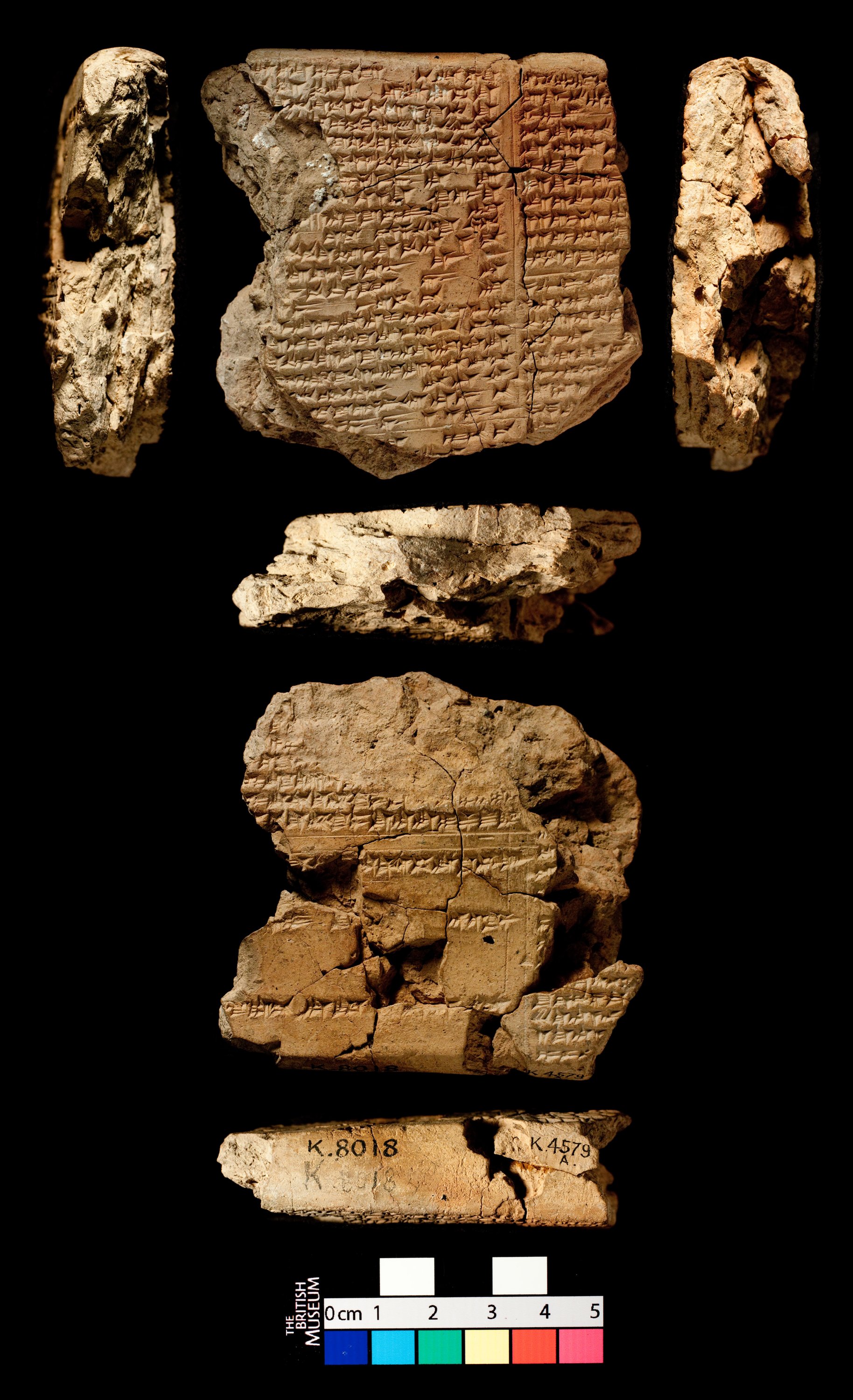
Where on the image
British Museum K.4579.A: reverse, column vi, the tablet's own line 8'. eBL's corpus edition (https://www.ebl.lmu.de/corpus/L/1/4/SB/VII) attributes SB VII 1 to this manuscript at these column and line numbers. Photograph checked: obverse, reverse and edges of the join K.4579.A + K.8018 (both ink numbers on the edge); text on both faces, consistent with eBL's columns i-ii and v-vi. K.4579.A, a copy of SB VI, carries this line as its catch-line: the opening of the next tablet of the series, copied at the end of the previous one (eBL lists catch-lines among its quotations; unlike commentaries and quotations in other texts, a catch-line is the line itself on a copy of the work). On this tablet line 1 is partly broken (square brackets and x in the Akkadian). The English of this line translates eBL's composite text, so it includes words that are not preserved on this tablet but are restored from other manuscripts or by the editors. Square brackets in the English mark eBL's restorations in its composite text; words that survive on other tablets carry no brackets even where this tablet is broken.
1[x x aš₂-š]u mi#-in#-na-ma im-tal-li-ku DINGIR-MEŠ GAL-MEŠ
1‘My friend, for what reason were the great gods taking counsel?’
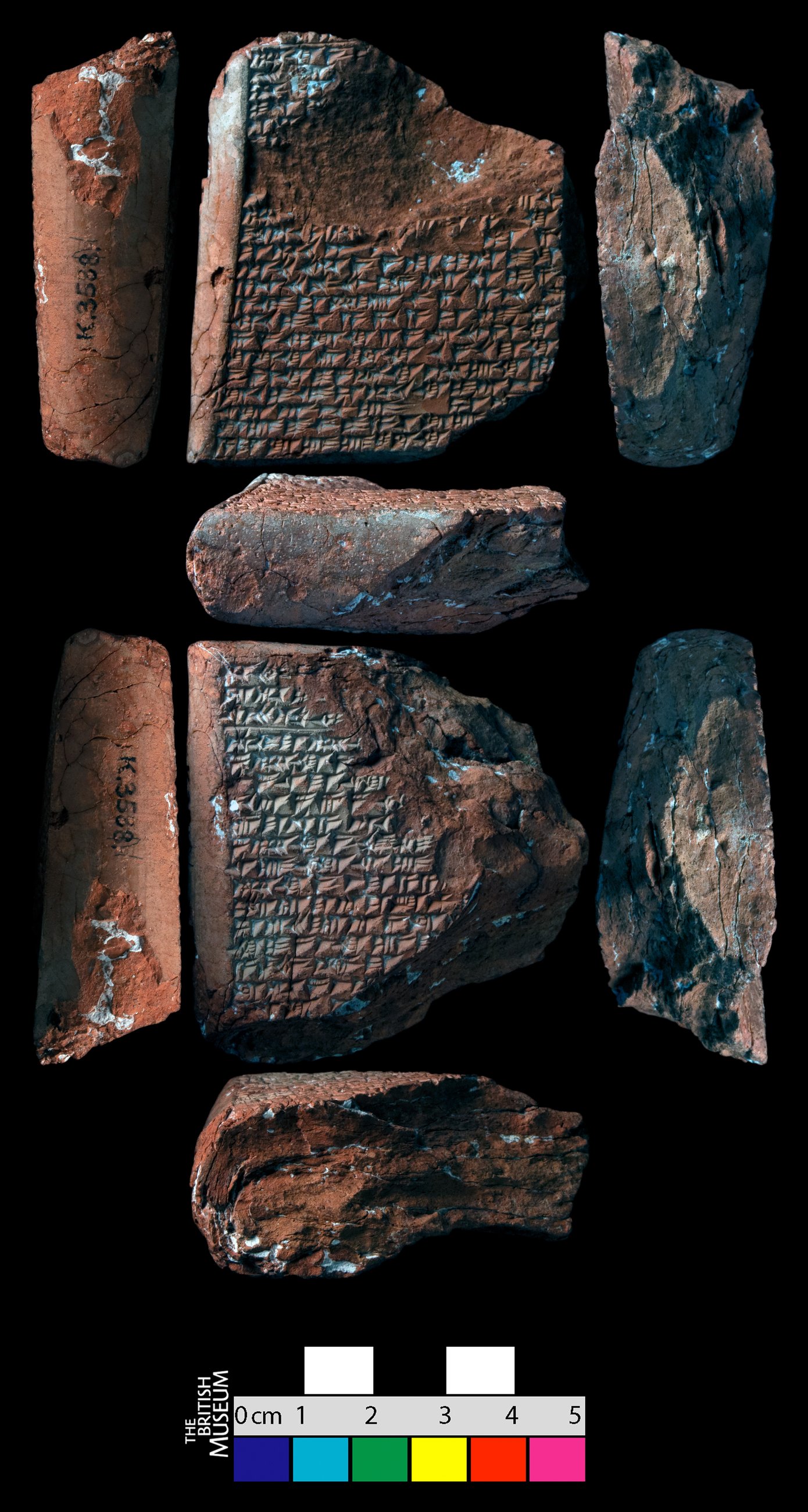
Where on the image
British Museum K.3588: obverse, column i, the tablet's own lines 1' to 24'. eBL's corpus edition (https://www.ebl.lmu.de/corpus/L/1/4/SB/VII) attributes SB VII 27-50 to this manuscript at these column and line numbers. Photograph checked: obverse, reverse and edges, ink number K.3588 on both side edges; one column on each face, consistent with eBL's columns i and vi. On this tablet line 34 is entirely broken, of lines 27, 35 only illegible traces (x) survive, of lines 29-33, 36 only one to three signs survive and lines 28, 37-50 are partly broken (square brackets and x in the Akkadian). The English of these lines translates eBL's composite text, so it includes words that are not preserved on this tablet but are restored from other manuscripts or by the editors. Square brackets in the English mark eBL's restorations in its composite text; words that survive on other tablets carry no brackets even where this tablet is broken. eBL gives no English for line(s) 34, 35.
27x x x [x x x x x x x (x)]
28{d}+en-ki-du₃ p[a-a-šu₂ īpuš-ma iqabbi]
29MU-ra [a-na {d}GIŠ-gim₂-maš]
30al-ka i[b-ri x x x x x x x x x]
31i-na NE#-[x x x x x x x x x x x x]
32{giš}IG [x x x x x x x x x]
33aš₂#-šu₂# x [x x x x x x x x x]
34[x x x x x x x x x x x x]
35x [x x x x x x x x x x x x]
36ina N[E-x x x x x x x]-bu# [x x x]
37{d}+en-k[i-du₃ x x x] it#-ta-ši [IGI+MIN-šu₂]
38it-ti {giš}IG# [i]-ta#-ma#-a ki-i# [x (x)]
39{giš}IG hal-bi# [in]a la ha-[x x x]
40ba-šat uz-ni ša₂ la i-ba-aš₂-šu-[u₂ x x x]
41a-na 20 DANNA as-su-qa i-ṣa-k[i x x x]
42a-di {giš}EREN ši-ha a-mu-r[u x x x]
43ul i-šu₂ a-ha-a iṣ-ṣu-ki [x x x x]
446 NINDA me₂-lu-ki 2 NINDA ru-pu-uš-ki 1 [KUŠ₃ u₂-bu-ki]
45šu-ku-ki sa-hir-ki u ša₂-gam-ma-ki [ša₂ 1-en-ma]
46DU₃-uš-ki aš₂-ša₂-ak-ki ina NIBRU{ki} i-l[a-niš x x x (x x)]
47lu-u i-de {giš}IG ki-i an-nu-u₂# [x x x x]
48KIMIN! (U₃) an-nu-u₂ du-mu[q-ki]
49lu-u₂ aš₂-ši pa-a-šu₂ lu-u₂# a[k-ki?-is? x x x]
50a-ma lu-u₂ u₂-šar-ki-b[a-ki x x x x x]
27… […]
28Enkidu [opened his mouth to speak,]
29saying [to Gilgameš:]
30‘Come, [my] friend, […]
31in … […]
32The door […]
33because … […]’
34(no English for this line in the eBL edition)
35(no English for this line in the eBL edition)
36in … […] … […]
37Enkidu […] raised [his eyes,]
38talking with the door like [… :]
39‘O door of the woodland, not being … [… ,]
40I have understanding, which [you] have not.
41For twenty leagues I sought for you the [finest] timber,
42until [in the forest] I found a tall cedar.
43‘Your tree had no rival [in the Forest of Cedar:]
44six rods is your height, two rods your breadth, one [cubit your] thickness,
45your pole, its top pivot and its bottom pivot are all of a piece;
46I made you, I raised you up, in Nippur I hung you upright.
47Had I but known, O door, that this would be your [reward,]
48had I but known, O door, that this would be your bounty,
49I would have picked up an axe, I would have cut you down,
50I would have shipped you by raft to E-babbarra.
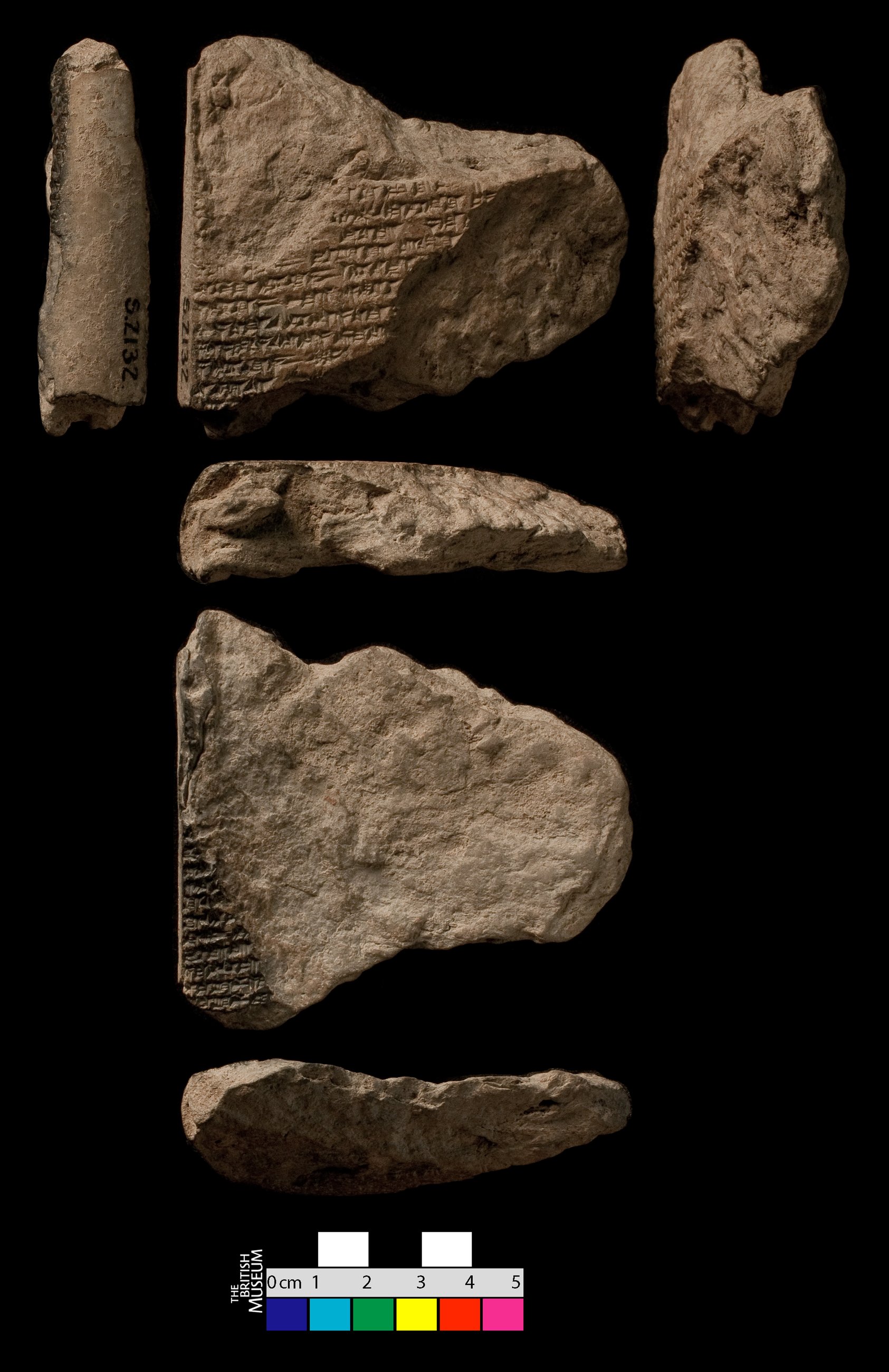
Where on the image
British Museum Sm.2132: column i, the tablet's own lines 1' to 11'. eBL's corpus edition (https://www.ebl.lmu.de/corpus/L/1/4/SB/VII) attributes SB VII 56-68 to this manuscript at these column and line numbers. Photograph checked: obverse, reverse and edges, ink number S.2132 on the left edge. The face shown above carries about 13 lines whose right ends are cut off by a diagonal break, consistent with eBL's column iv? (13 lines, VII 249-261); the face shown below keeps only the first two to four signs of about 11 lines along its left edge, consistent with eBL's column i (11 lines, VII 56-68). The photograph therefore shows the face with column iv? above the face with column i. On this tablet lines 58, 67 are entirely broken, of lines 56-57, 59-64 only one to three signs survive and lines 65-66, 68 are partly broken (square brackets and x in the Akkadian). The English of these lines translates eBL's composite text, so it includes words that are not preserved on this tablet but are restored from other manuscripts or by the editors. Square brackets in the English mark eBL's restorations in its composite text; words that survive on other tablets carry no brackets even where this tablet is broken.
56u₃# [x x x x x x x x x x x x x]
57aš₂-šu₂# [x x x x x x x x x x x ( : )]
58[x x x x x x x x x x x x x x x x x]
59e-nin-n[a x x x x x x x x x x x x x x]
60a-na-k[u x x x x x x x x x x x x x x]
61lu-u LUG[AL x x x x x x x x x x x x x x]
62lu-u AN x [x x x x x x x x x x x x x]
63šu-mi l[i-na-ak-ki-ir x x x x (x x x x x x)]
64it-ta-sah [x x x x x x x x x x (x x x x)]
65a-ma-ti-šu₂ iš-[te-nem-ma-a x x x x x x x x x x]
66{d}GIŠ-gim₂-maš a-m[a-ti x x x x x x x x x x x x x ( : )]
67[x x x x x x x x x x x x]
68{d#}GIŠ-gim₂-maš KA-[šu₂ x x x x x x x x x x x x]
56and in Uruk … […,]
57because Šamaš heard what I said,
58and in time of [peril] … he [gave] me a weapon.
59Now, O door, it was I who made you, I who raised [you] up!
60I [also can curse you, I also can] tear you down!
61May either a king who comes after me abhor you,
62or … hang you [where you cannot be seen,]
63May he remove my name and set up his own!’
64He ripped off [his garments,] cast [his finery] away,
65As he was listening to his words, swiftly and soon his [tears were flowing.]
66As Gilgameš was listening to the words of Enkidu, his friend,
67[swiftly and soon his] tears were [flowing.]
68Gilgameš opened his mouth to speak, saying to Enkidu:
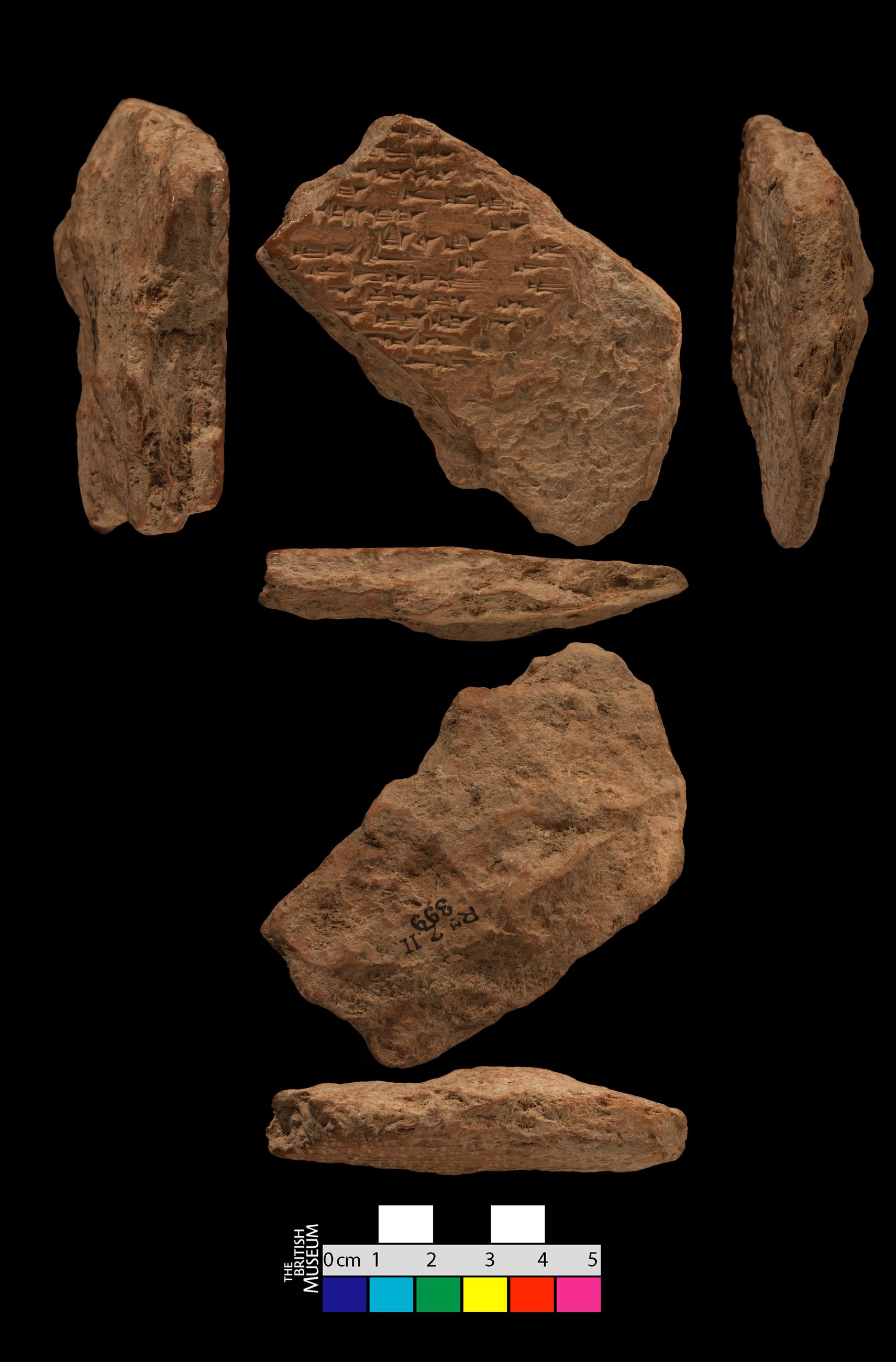
Where on the image
British Museum Rm-II.399: column ii, the tablet's own lines 1' to 13'. eBL's corpus edition (https://www.ebl.lmu.de/corpus/L/1/4/SB/VII) attributes SB VII 69-81 to this manuscript at these column and line numbers. Photograph checked: obverse, reverse and edges; about 13 lines on one face, consistent with eBL's column ii. On this tablet of lines 69, 81 only illegible traces (x) survive, of lines 70, 80 only one to three signs survive and lines 71-79 are partly broken (square brackets and x in the Akkadian). The English of these lines translates eBL's composite text, so it includes words that are not preserved on this tablet but are restored from other manuscripts or by the editors. Square brackets in the English mark eBL's restorations in its composite text; words that survive on other tablets carry no brackets even where this tablet is broken.
69[x x x x x] x x x [x x x x]
70[x x x x x x x]-u₂# ša₂-na-[ti x x x]
71[x x x x x x x x lib₃-b]a?-ka ša₂-na-ti# [x (x) x]
72[x x x šu-qu-rat]-ma pi-rit-tu₄ m[a-ʾ-da-at]
73[x x x x x x] ha#-ma-a ki-ma zu-u[b-bi]
74[x x ma-ʾ-d]u šu-ut-tu aq-[rat]
75[x x x] i-zi-bu na-sa-[sa]
76[x x x x ba]l-ṭi ni-is-sa-tu₄ i-[zib (x)]
77[lu-ṣal-li-m]a lu-sap-pa-a DINGIR-MEŠ [x x]
78[x x lu-uš-te-ʾ]-a i-lu-ka lu-u[š-hi-ir]
79[x x x x x x] x a-bi DINGIR-MEŠ x [x x]
80[x x x x x x x x x in]a IGI-ka [x x x x]
81[x x x x x x x x] x [x x x x]
69[‘My friend, …] … […] manifest,
70[do you, who] had understanding and reason, [now speak] madness?
71Why, my friend, did your heart talk profanities […?]
72[the dream] was precious and the apprehension was much.
73[your feverish lips] were buzzing like flies,
74[the misgivings were] great, the dream was rare.
75“To the one who survived grieving was left,
76the [deceased] left sorrow to the one who survived.”
77[I will] beseech the great gods and entreat them,
78I will seek out [Šamaš], I will appeal to your god.
79‘In [your presence] I will pray [to Anu,] father of the gods,
80[May] Enlil, the great counsellor, [hear my] prayers in your presence,
81may [my entreaty find favour with Ea!]
Where on the image
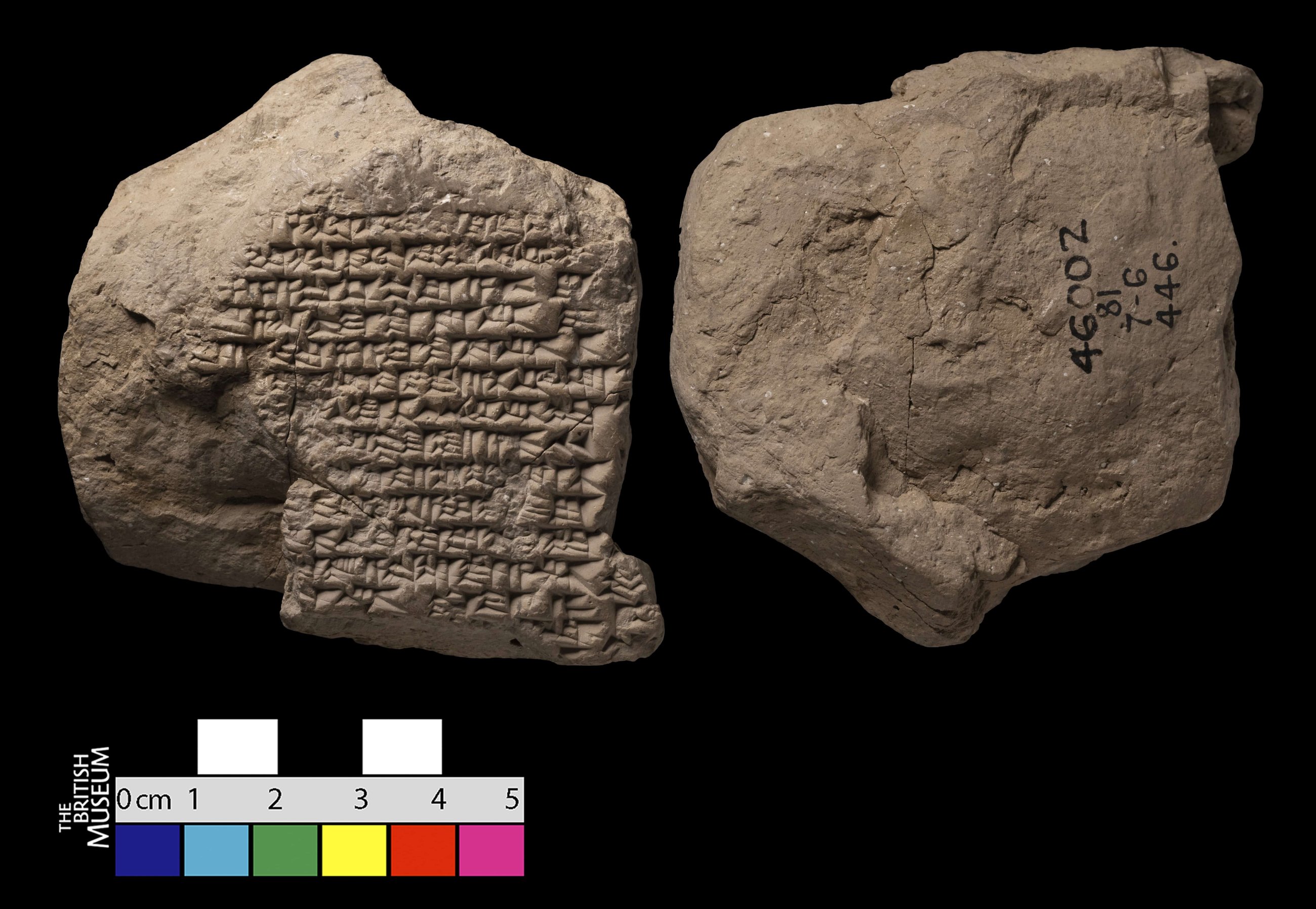
British Museum BM.46002: column ii, the tablet's own lines 1' to 12'. eBL's corpus edition (https://www.ebl.lmu.de/corpus/L/1/4/SB/VII) attributes SB VII 91-102 to this manuscript at these column and line numbers. Photograph checked: two views, ink number 46002 (81-7-6,446) on the back; the inscribed face shows two columns, consistent with eBL's columns ii and iii. On this tablet of line 91 only one to three signs survive and lines 92-102 are partly broken (square brackets and x in the Akkadian). The English of these lines translates eBL's composite text, so it includes words that are not preserved on this tablet but are restored from other manuscripts or by the editors. Square brackets in the English mark eBL's restorations in its composite text; words that survive on other tablets carry no brackets even where this tablet is broken.
91[x x x a-n]a IGI# [x x x x x]
92[ša₂-ru-r]u ša₂ {d}UTU-ši il-la-ku di-ma#-a#-[šu]
93[am-hu]r-ka {d}UTU aš₂-šu₂-ut aq-ra-ti ZI-ti₃#
94[šu-u₂?] ṣa-a-a-du hab-bi-lu a-me-lu
95[ša₂ la u₂]-šam-ṣa-an-nu ma-la ib-ri-i
96[ṣa-a]-a-du a-a im-ṣa-a ma-la ib-ri-šu₂
97[ne₂-me]l-šu# lu#-u₂ ha-liq-ma i-da-a-šu₂ muṭ-ṭu
98[lu-u₂ har-ṣa]-a[t H]A.LA-šu₂ ina mah-ri-ka
99[x x a-š]ar ir#-ru-ub šu-ṣi a-pa-niš
100[x x ṣa]-a#-du# iz-zu-ru ma-la# ŠA₃-šu₂
101[x x x {munus}ša]m-hat lib₃-ba!-šu₂ a-ra-a[r₂ u]b-lu
102[x x x x ša]m-hat ši-ma-at lu-š[i]m-ka
91Enkidu lifted up his head, lamenting before Šamaš,
92his tears flowing before the rays of the sun:
93‘[I appeal] to you, O Šamaš, on account of (my) life so precious!
94[As for him, that] hunter, the trapper-man,
95who did not let me be a match for my friend,
96may the hunter not be a match for his friend!
97Destroy his income, diminish his earnings!
98[May] his share of the profits be [cut] in your presence!
99[The house where he enters, may [its god] leave by the window!’
100[After] he had cursed the hunter to his heart’s content,
101he decided to curse [the harlot] Šamḫat [also:]
102‘Come, Šamḫat, I will determine a destiny for you,
Where on the image
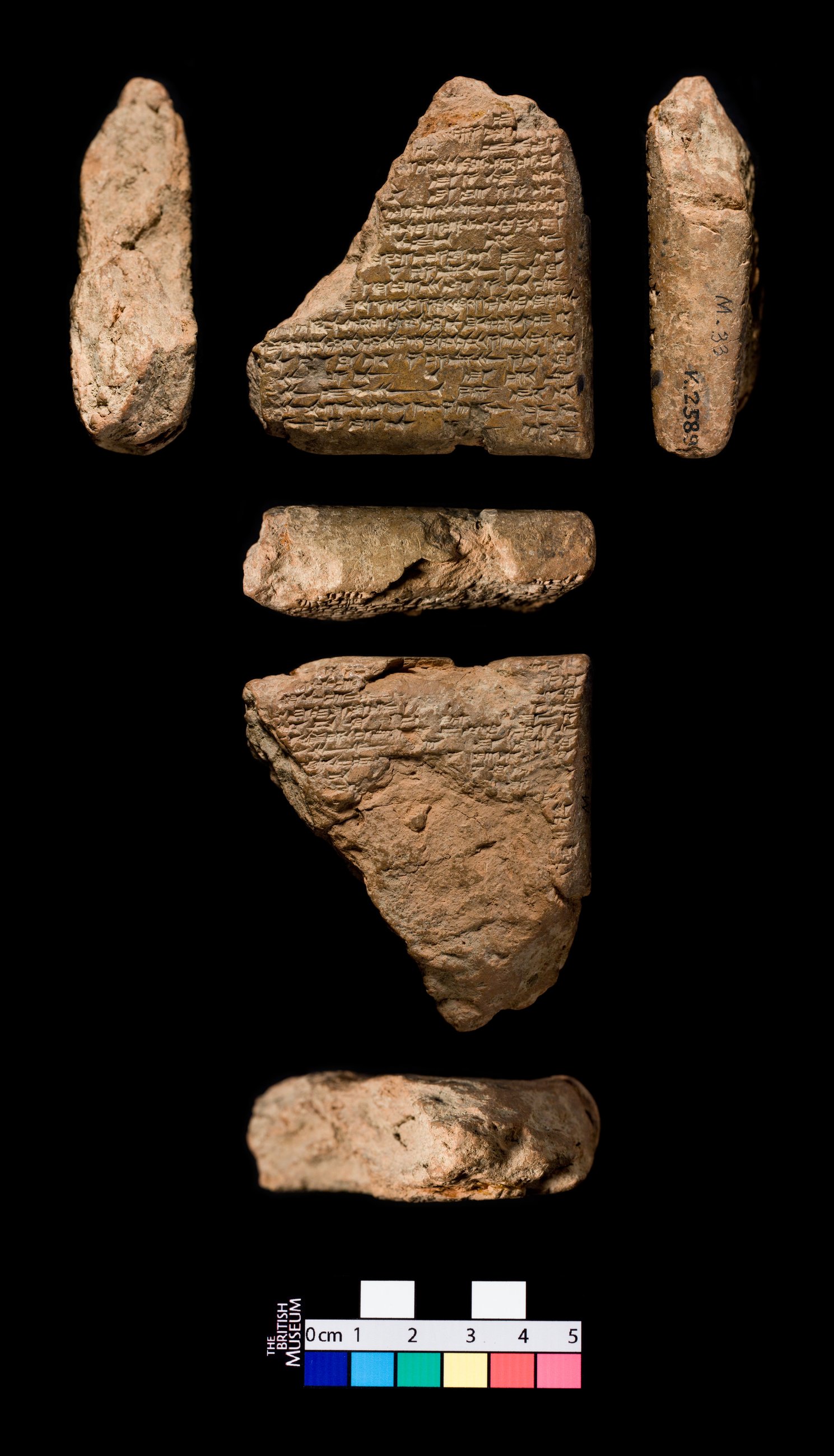
British Museum K.2589: column iii, the tablet's own lines 4 to 13. eBL's corpus edition (https://www.ebl.lmu.de/corpus/L/1/4/SB/VII) attributes SB VII 103-112 to this manuscript at these column and line numbers. Photograph checked: obverse, reverse and edges, ink number K.2589; one column on each face, consistent with eBL's columns iii and iv. On this tablet of lines 110-112 only one to three signs survive and lines 103-109 are partly broken (square brackets and x in the Akkadian). The English of these lines translates eBL's composite text, so it includes words that are not preserved on this tablet but are restored from other manuscripts or by the editors. Square brackets in the English mark eBL's restorations in its composite text; words that survive on other tablets carry no brackets even where this tablet is broken.
103[ši]-mat la i-qat-tu-u₂ ana du#-u[r da]-a-ar₂
104[lu-u]z-zur-ki iz-ra [G]AL-a
105[u₃? ha]ṭ-ṭiš har-piš iz-ru-u₂#-a# liṭ-hu-ki ka-a-ši
106[e t]e-pu-ši E₂# la-le-ki
107[x ta-r]am-mi-i x x x x ša₂ ta-hu-ti#-ki#
108[e tu-u]š-bi i[na x (x)] ša₂ KI.SIKI[L-ME]Š
109[ṣu-bat-ki d]am-q[u qaq-qa-ru? l]i-ša[h-h]i
110[lu-bar i-sin-na-ti-ki šak-ru ina tur-bu-ʾ-i li-ba]l-lil
111[x x x x x x x x x x x ba-n]a-te
112[x x x x x x x x x x pa-ha]-ri
103a destiny that will not end for all eternity:
104[I will] curse you with a great curse,
105[and] my curses shall afflict you swiftly and soon!
106[May you not] found a household to delight in,
107[never to] reside in the [midst] of a family!
108[May you not] sit in the young women’s chair!
109May the ground defile your fine-looking [garment!]
110May [the drunkard] smear [with dust your festive gown!]
111[May you not acquire a house with …] and lovely things,
112‘[For your home shall serve] a potter’s [clay pit!]
Where on the image
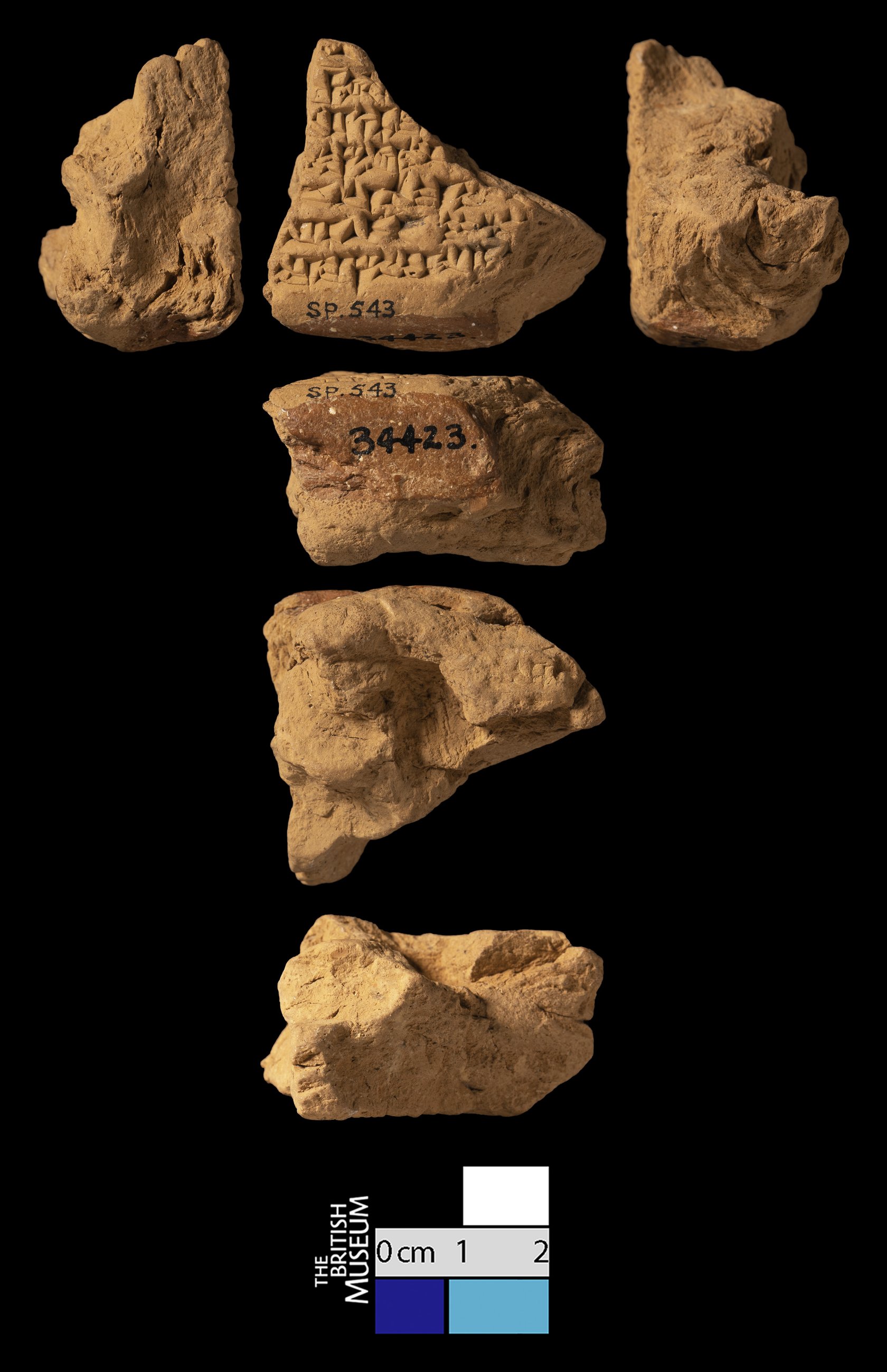
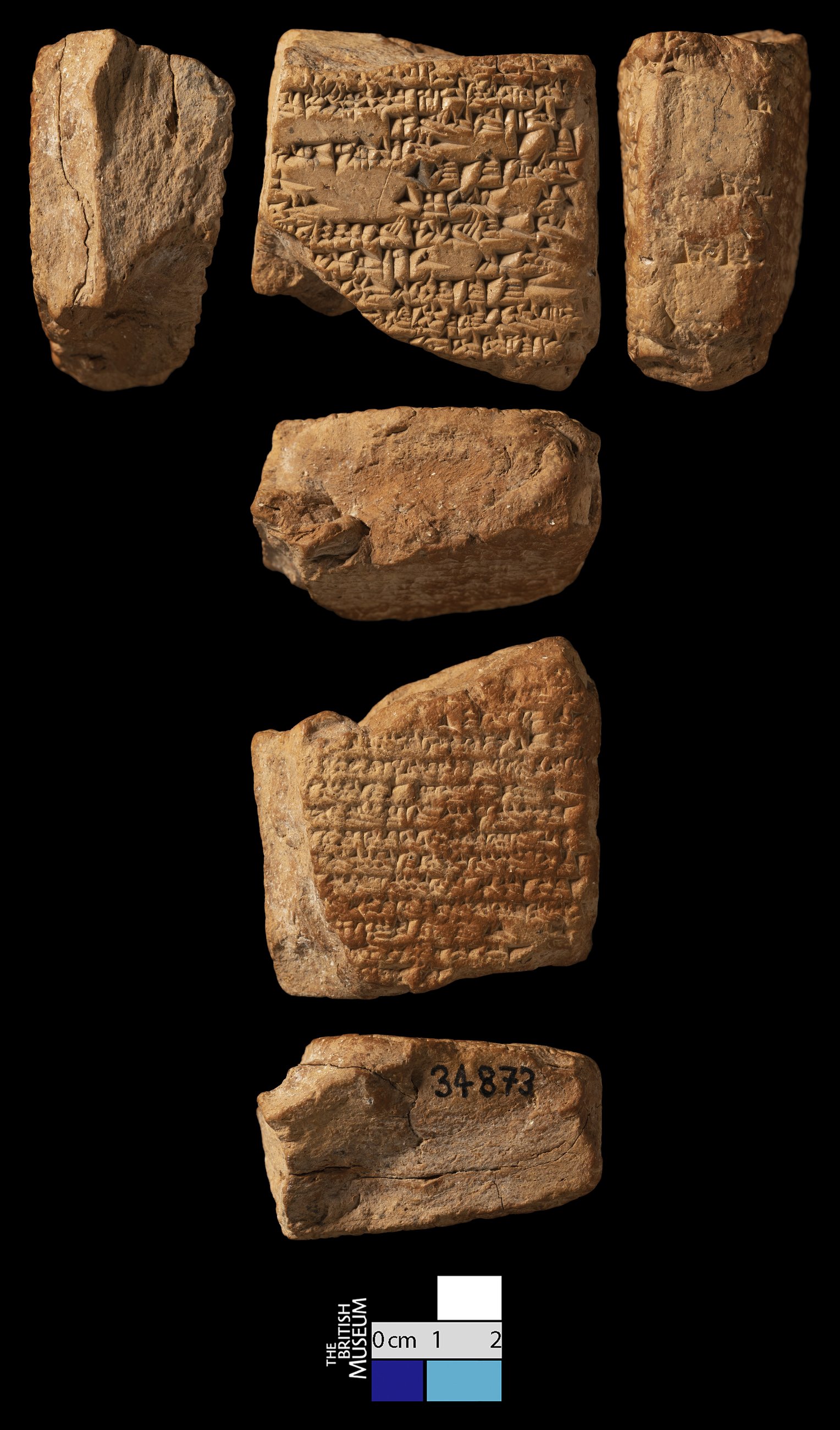
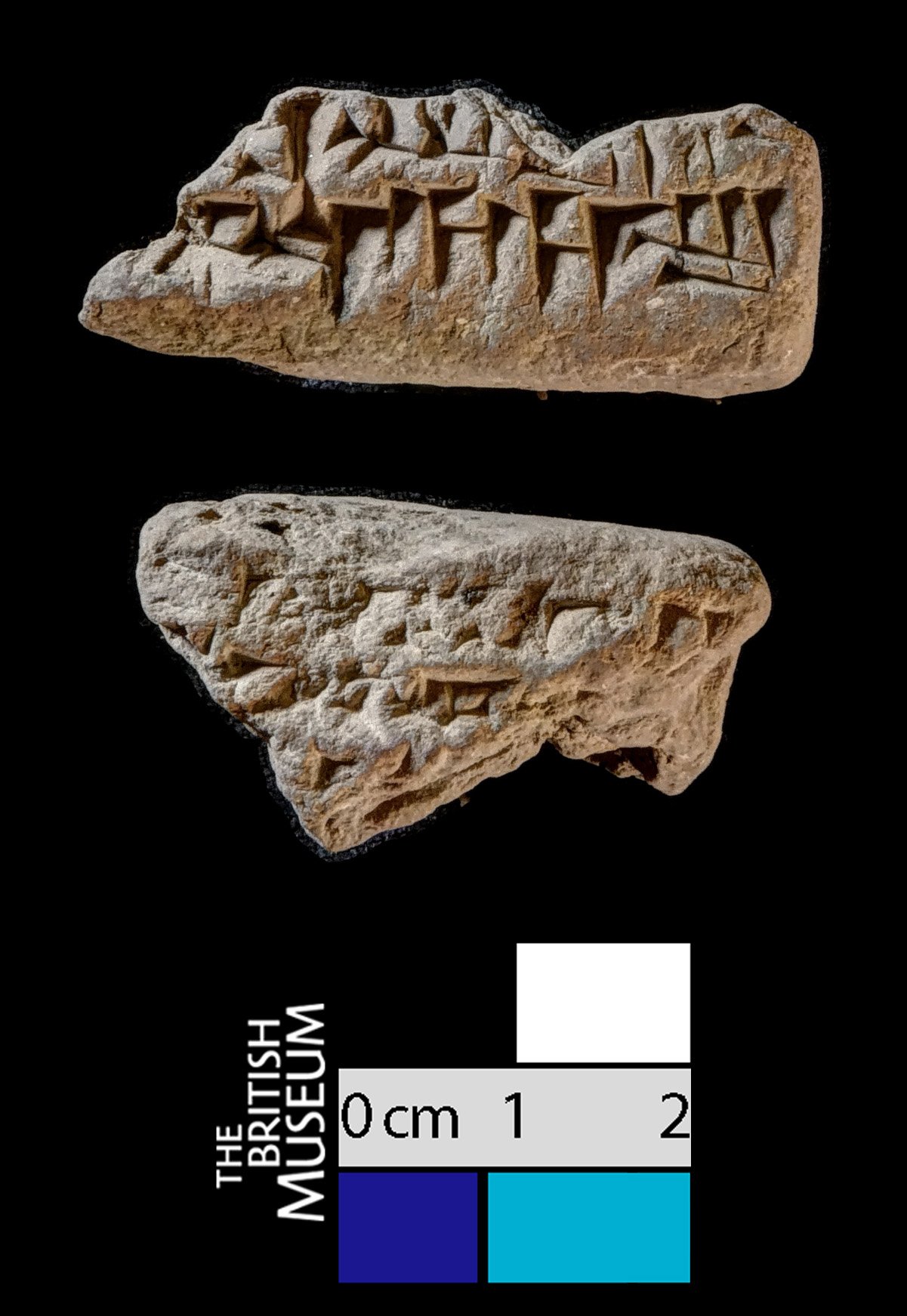
British Museum BM.34423: column iii, the tablet's own lines 7b to 17. eBL's corpus edition (https://www.ebl.lmu.de/corpus/L/1/4/SB/VII) attributes SB VII 113-123 to this manuscript at these column and line numbers. Photograph checked: obverse, reverse and edges, ink number 34423 (Sp.543). eBL treats BM.34423 + BM.34873 + Sp-III.895 as one manuscript and holds a separate photograph of each of these pieces; it does not say which piece carries which line, so the photographs of BM.34423 + BM.34873 + Sp-III.895 are linked, and the lines are on one or more of them. On this tablet lines 113-123 are partly broken (square brackets and x in the Akkadian). The English of these lines translates eBL's composite text, so it includes words that are not preserved on this tablet but are restored from other manuscripts or by the editors. Square brackets in the English mark eBL's restorations in its composite text; words that survive on other tablets carry no brackets even where this tablet is broken.
113[x x x] x ri bu ki? mim-ma e tar-ši-i
114[{giš}NA₂ {giš}G]U.ZA {giš}BANŠUR# ša₂-muh UG₃-MEŠ a-a in-na-di ina E₂-ka
115[x x x x x l]a-le-ma lu-u₂ dak-kan-nu
116[x x x x x š]a₂ KASKAL lu-u₂ mu-ša₂-bu-ka
117[x x x lu-u m]a-ṣal-lu-ka GISSU BAD₃ lu-u₂ man-za-zu-ka
118[x x x {giš}]U₂#.GIR₂ li-qal-li-pu GIR+MIN₃-ka
119[x x x ṣ]a-mu-u₂ li-im-haṣ TE-ka
120[x x x x x x lu]-u₂#? be-let di-ni-ma# e#-li-ka li-is-su
121[x x x x x x] a#!-a i-se-er i-tin-nu
122[x x x x x x x l]i-ir-bi-ṣi qa-du-u₂#
123[x x x x a-a iš-š]a₂-kin# qi₂#-re#-e#-[tu₄]
113You shall have [neither bedroom, nor family shrine, nor hearth!]
114No bed, chair or table, that people take pride in, shall be found in your chamber!
115May [the bed you] delight in be a bench!
116May [the junction] of the highway be where you sit!
117[May the ruined houses be] where you sleep! May the lee of the city wall be where you stand!
118May [thorn and] briar skin your feet!
119May [drunk and] sober strike your cheek!
120[May …] be plaintiff, may she claim against you!
121May the builder not plaster [the roof of your house!]
122[In your chamber] shall roost an owl!
123‘[Never in your house shall] banquet take place!
Where on the image
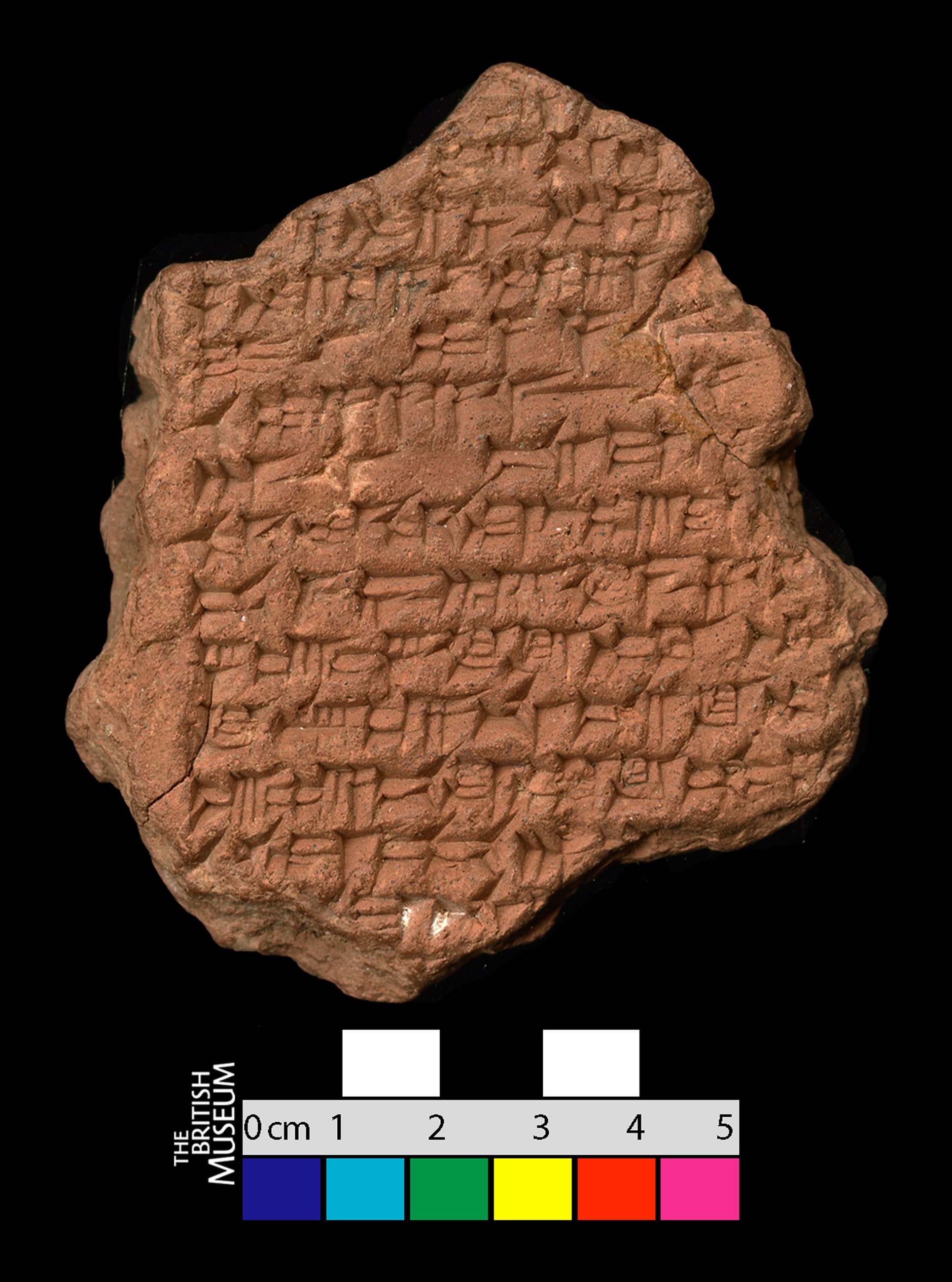
British Museum K.11659: column iii, the tablet's own lines 1' to 7'. eBL's corpus edition (https://www.ebl.lmu.de/corpus/L/1/4/SB/VII) attributes SB VII 126-132 to this manuscript at these column and line numbers. Photograph checked: one face with about 15 lines, consistent with eBL's column iii. On this tablet of line 126 only one to three signs survive and lines 127-132 are partly broken (square brackets and x in the Akkadian). The English of these lines translates eBL's composite text, so it includes words that are not preserved on this tablet but are restored from other manuscripts or by the editors. Square brackets in the English mark eBL's restorations in its composite text; words that survive on other tablets carry no brackets even where this tablet is broken.
126[x x x] e x [x x x x x x x x x]
127[x lu-b]ar ta#-kil-t[i x x x x x x x x]
128x-KAL su-ni šah-[x x x x x x x x]
129ša₂ su-un-šu₂ šah-x [x x x x x x x x]
130aš₂-šu₂ ia-a-ši [KU₃ tu-šam-ṭin-ni]
131u ia-a-a-ši KU₃# [tu-šam-ṭin-ni x x x]
132{d}UTU iš-ma-a# [x x x x x x x x]
126[…] … […]
127‘[…] purple raiment […]
128… of the defiled lap […]
129whose lap is defiled […]
130Because [you made] me [weak], me [who was pure!]
131And me who was pure, [you made] me [weak] when I was in the wild.’
132Šamaš heard [what] he had spoken,
Where on the image
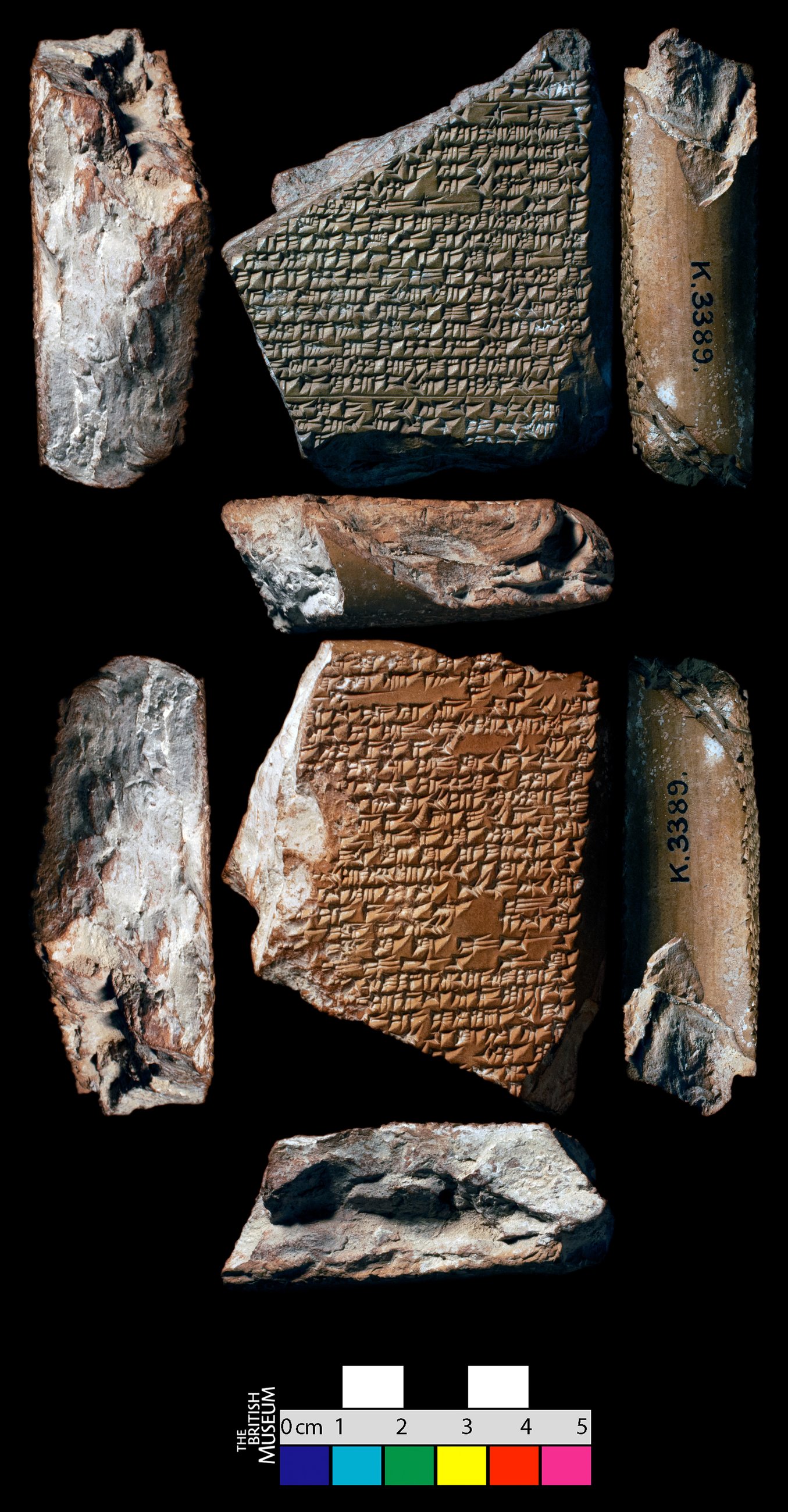
British Museum K.3389: column iii, the tablet's own lines 5' to 23'. eBL's corpus edition (https://www.ebl.lmu.de/corpus/L/1/4/SB/VII) attributes SB VII 133-151 to this manuscript at these column and line numbers. Photograph checked: obverse, reverse and edges, ink number K.3389; one column on each face, consistent with eBL's columns iii and iv. On this tablet of line 151 only one to three signs survive and lines 133-150 are partly broken (square brackets and x in the Akkadian). The English of these lines translates eBL's composite text, so it includes words that are not preserved on this tablet but are restored from other manuscripts or by the editors. Square brackets in the English mark eBL's restorations in its composite text; words that survive on other tablets carry no brackets even where this tablet is broken.
133[x x x x x x x x x x ul-t]u AN-e il-ta-na-sa-aš₂-šu₂
134[x x x x x x x ha-rim-t]i {munus}šam-hat ta-na-an-za-ar₂
135[x x x x x x NIN]DA-HI.A si-mat DINGIR-u₂-ti
136[x x x x iš-q]u-ka si-mat LUGAL-u₂-ti
137[u₂-lab-bi-š]u-ka lu-ub-ši ra-ba-a
138[x x x {d}G]IŠ-gim₂-maš tap-pa-a u₂-šar-šu-ka ka-a-ša₂
139[e-nin]-na#-a-ma {d}GIŠ-gim₂-maš ib-ri ta-li-me-ka
140[uš-n]a-al-ka-a-ma ina ma-a-a-li GAL-i
141[i-n]a ma-a-a-al tak-ni-i uš-na-al-ka-ma
142[u₂-še]š-šeb-ka šub-ta ne₂-eh-ta šu-bat šu-me-li
143[ma-al-k]a ša₂ qaq-qa-ri u₂-na-aš₂-ša₂-qu GIR+MIN₃-ka
144[u₂-šab-k]ak-ka UG₃-MEŠ ša₂ UNUG{ki} u₂-šad-ma-ma-ak-ka
145[šam-ha-ti] UG₃-MEŠ u₂-ma-al-lak-ka dul₆-la
146[u₃ šu]-u₂# ar-ki-ka u₂-ša₂-aš₂-ša₂-a ma-la-a pa-gar-šu₂#
147[il-tab-bi-i]š maš-ki lab-bi-im-ma i-rap-pu-ud E[DIN]
148[iš-me-ma {d}+e]n-ki-du₃ a-mat {d}UTU qu-ra-[di]
149[x x x x a]g-ga lib₃-ba-šu₂ i-nu-uh-[ma]
150[x x x x e]z-za [lib₃-ba-šu₂] i#-nu#-[uh]
151[al-ki {munus}]š[am?-hat ši-ma-ta lu-šim-ki]
133straight away a [voice] was crying to him [from] the heavens:
134‘Why, O Enkidu, do you curse the harlot Šamḫat,
135who gave you bread to eat, fit for a god,
136gave you beer to drink, fit for a king,
137clothed you in a great garment,
138and let you have for a comrade the fine Gilgameš?
139Now Gilgameš, your friend and brother,
140[will] lay you out on a great bed.
141[On] a bed of honour he will lay you out,
142[he will] set you on a restful seat, the seat to (his) left,
143[the princes] of the earth will kiss your feet.
144[He will make] weep for you the people of Uruk, he will make them sob for you,
145the people [so bonny] he will fill full of grief for you.
146[And] he, after you are gone he will have himself bear the matted locks of mourning,
147[he will don] the skin of a lion and go roaming the [wild.]’
148Enkidu [heard] the words of Šamaš the hero,
149[…] his angry heart grew calm,
150[… his] furious [heart grew] calm.
151‘Come, [Šamḫat, I shall determine a destiny for you,]
Where on the image
British Museum K.3389: column iv, the tablet's own lines 1 to 14. eBL's corpus edition (https://www.ebl.lmu.de/corpus/L/1/4/SB/VII) attributes SB VII 152-165 to this manuscript at these column and line numbers. Photograph checked: obverse, reverse and edges, ink number K.3389; one column on each face, consistent with eBL's columns iii and iv. On this tablet lines 152-165 are partly broken (square brackets and x in the Akkadian). The English of these lines translates eBL's composite text, so it includes words that are not preserved on this tablet but are restored from other manuscripts or by the editors. Square brackets in the English mark eBL's restorations in its composite text; words that survive on other tablets carry no brackets even where this tablet is broken.
152[x x x ša₂ iz-zu]-ru-ki li-tur# lik#-r[u-ub-ki]
153[šak-ka-nak-k]i u₃# NUN-MEŠ li-ir-a#-mu#-ki#
154[ša₂ 1 DANNA l]im-haṣ ša₂-par-šu₂
155[ša₂ 2 DANNA l]i-na-as-si-sa qim-mat-su
156[a-a ik-lak-k]i re-du-u₂ mi-ser₂-ra-šu₂ lip₂-ṭur-ki
157[lid-din-ki {n]a₄}ZU₂ {na₄}ZA.GIN₃ u KU₃.SIG₁₇
158[in-ṣa-ab-t]u tu#-tur-ru-u₂ lu-u nid-din-ki
159[x x x x] ku#-nu-nu-šu₂ iš-pik-ki-šu₂ šap-ku
160[x x x le-ʾ-a]t DINGIR-MEŠ lu-še-rib-ki ka-a-ši
161[x x x x li]-in-ne₂-zib AMA 7 hi-ir-tu₄
162[ša₂ {d}+en-ki-d]u₃ mar-ṣa-tu ka-ras-su
163[uš-ta-ba-a]l it-ta-lu e-da-nu-uš-šu₂
164[x x x x x mi]m-mu-u₂ kab-ta-ti-šu₂ ana ib-ri-šu₂
165[x x x x x š]u-na-ta aṭ-ṭul mu-ši-ti-ia
152[my] mouth [that] cursed you shall return and bless [you:]
153May [governors] and noblemen love you,
154may he [that is one league (distant)] slap his thigh!
155May he [that is two leagues (distant)] shake out his locks,
156may no soldier [be slow] to undo his belt for you!
157May he [give you] obsidian, lapis lazuli and gold,
158multiple earrings shall be your gift!
159To a man whose household [is well off], whose storage bins are heaped high,
160may Ištar, [the most able] of the gods, send you in!
161[On your account may] the first wife be deserted, the mother of seven!’
162[As for Enkidu], his mind was deranged.
163He was lying on his own [thinking,]
164what was on his mind he told to his friend:
165‘Quite something, my friend, (was) the dream I saw during the course of this night!
Where on the image
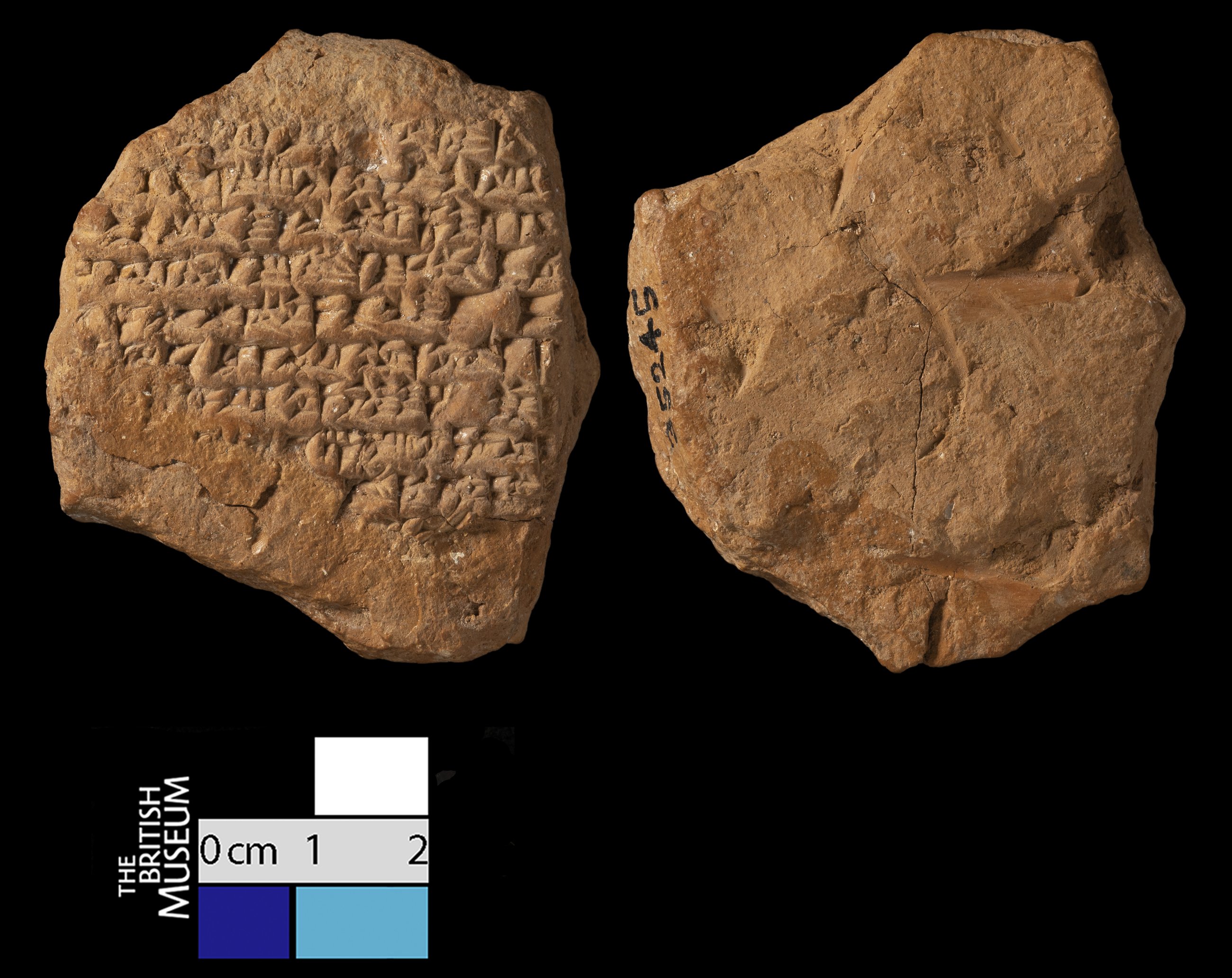
British Museum BM.35245: column iv, the tablet's own lines 2' to 8'. eBL's corpus edition (https://www.ebl.lmu.de/corpus/L/1/4/SB/VII) attributes SB VII 166-171 to this manuscript at these column and line numbers. Photograph checked: two views, the inscribed face with about 9 lines, consistent with eBL's column iv. On this tablet lines 166-171 are partly broken (square brackets and x in the Akkadian). The English of these lines translates eBL's composite text, so it includes words that are not preserved on this tablet but are restored from other manuscripts or by the editors. Square brackets in the English mark eBL's restorations in its composite text; words that survive on other tablets carry no brackets even where this tablet is broken.
166[i]l-su#-u₂ AN-e qaq-qa-ri i#-[pu?-ul?]
167[x] bi-ri-šu-nu az-za-zu a#-[na-ku]
168[š]a₂ 1-en eṭ-lu uk-ku-ul pa-n[i-šu₂]
169[a]na ša₂ an-ze-e pa-nu-šu maš-[lu]
170rit#-ti UR.MAH rit-ta-a#-[šu] (line break) [ṣu]-pur# a#-re-e ṣu-pur-ra-[šu]
171[x x qi]m-mat#-ti#-ia₂ {DIŠ} u₂-dan-ni-na-[an-ni x x x]
166the heavens thundered, the earth responded,
167with me standing (there) between them.
168There was a man, his expression was grim,
169his face was like that of an Anzû-bird.
170His hands were a lion’s paws, his claws an eagle’s talons,
171he took hold of my locks, he was too strong for me.
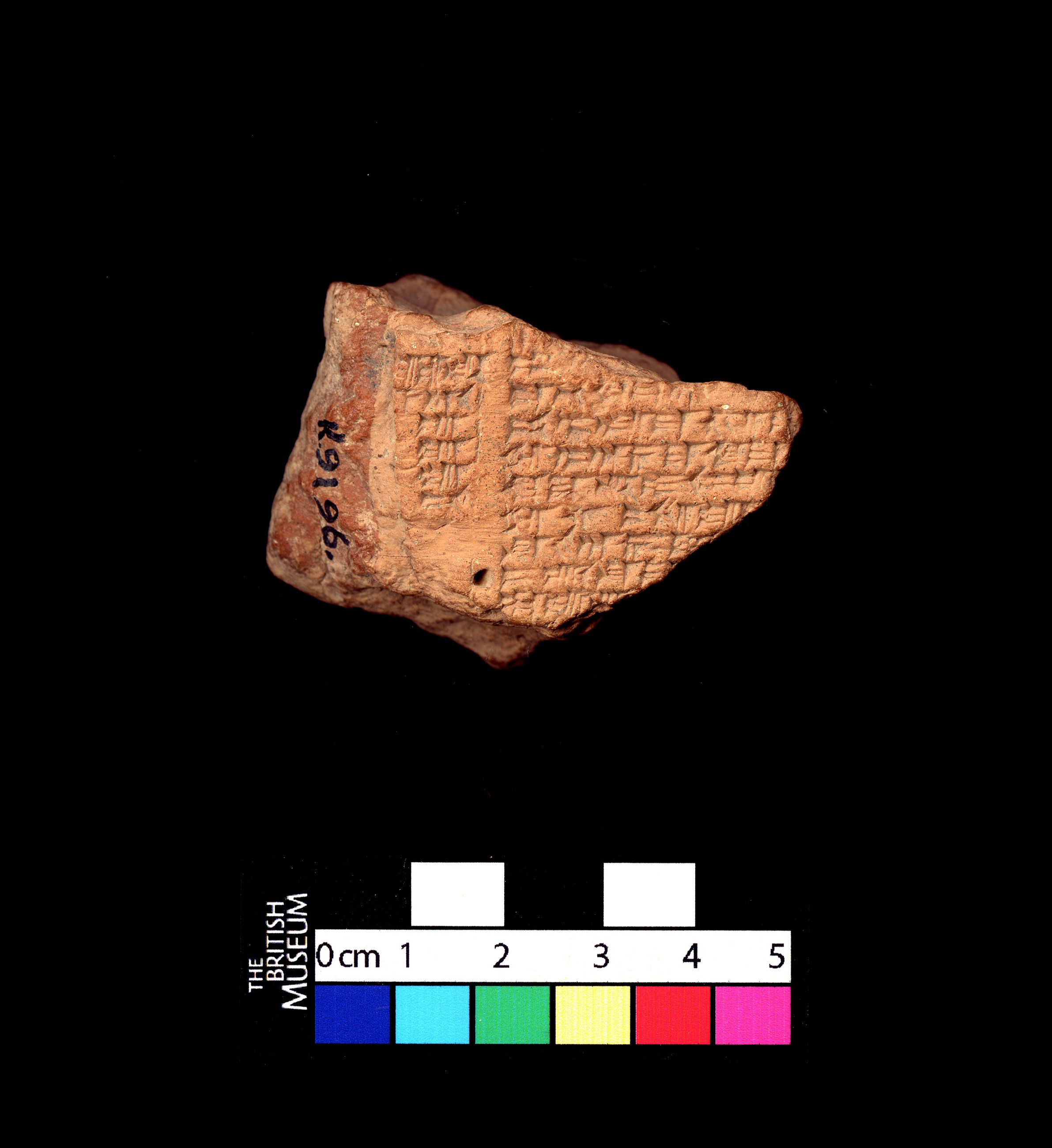
Where on the image
British Museum K.9196: reverse, column iv, the tablet's own lines 4' to 11'. eBL's corpus edition (https://www.ebl.lmu.de/corpus/L/1/4/SB/VII) attributes SB VII 172-179 to this manuscript at these column and line numbers. Photograph checked: one face with ink number K.9196 and two columns, consistent with eBL's columns iv and v. On this tablet of line 179 only illegible traces (x) survive, of line 178 only one to three signs survive and lines 172-177 are partly broken (square brackets and x in the Akkadian). The English of these lines translates eBL's composite text, so it includes words that are not preserved on this tablet but are restored from other manuscripts or by the editors. Square brackets in the English mark eBL's restorations in its composite text; words that survive on other tablets carry no brackets even where this tablet is broken.
172am-has-su-ma GIM k[ip-pe-e x x x x]
173im-haṣ-an-ni-ma ki-ma [x x x x x x x]
174ki-ma ri-i-mi dan-[ni x x x x x]
175im-tam il-ta-[x x x x x x x x]
176šu-zib-an-ni ib#-r[i x x x x x x x x]
177tap-lah-šu-m[a x x x x x x x x x x]
178at-ta ta[l-x x x x x x x x x x x]
179[x] x [x x x x x x x x x x x x]
172I struck him but he sprang back like a skipping-rope,
173he struck me and capsized me like a raft.
174Like a mighty wild bull he trampled over me,
175[drenching] my body with poisonous slaver.
176“Rescue me, my friend! […]”
177But you were afraid of him and […]
178You … […]’
179[…] … […]
Where on the image
British Museum K.2589: column iv, the tablet's own lines 1' to 2'. eBL's corpus edition (https://www.ebl.lmu.de/corpus/L/1/4/SB/VII) attributes SB VII 180-181 to this manuscript at these column and line numbers. Photograph checked: obverse, reverse and edges, ink number K.2589; one column on each face, consistent with eBL's columns iii and iv. On this tablet of line 180 only illegible traces (x) survive and of line 181 only one to three signs survive. The English of these lines translates eBL's composite text, so it includes words that are not preserved on this tablet but are restored from other manuscripts or by the editors. Square brackets in the English mark eBL's restorations in its composite text; words that survive on other tablets carry no brackets even where this tablet is broken.
180[x x x x x x x x x x x] x [x x]
181[x x x x x x x x x x] x i-[x x]
180[…] … […]
181[…] … […]
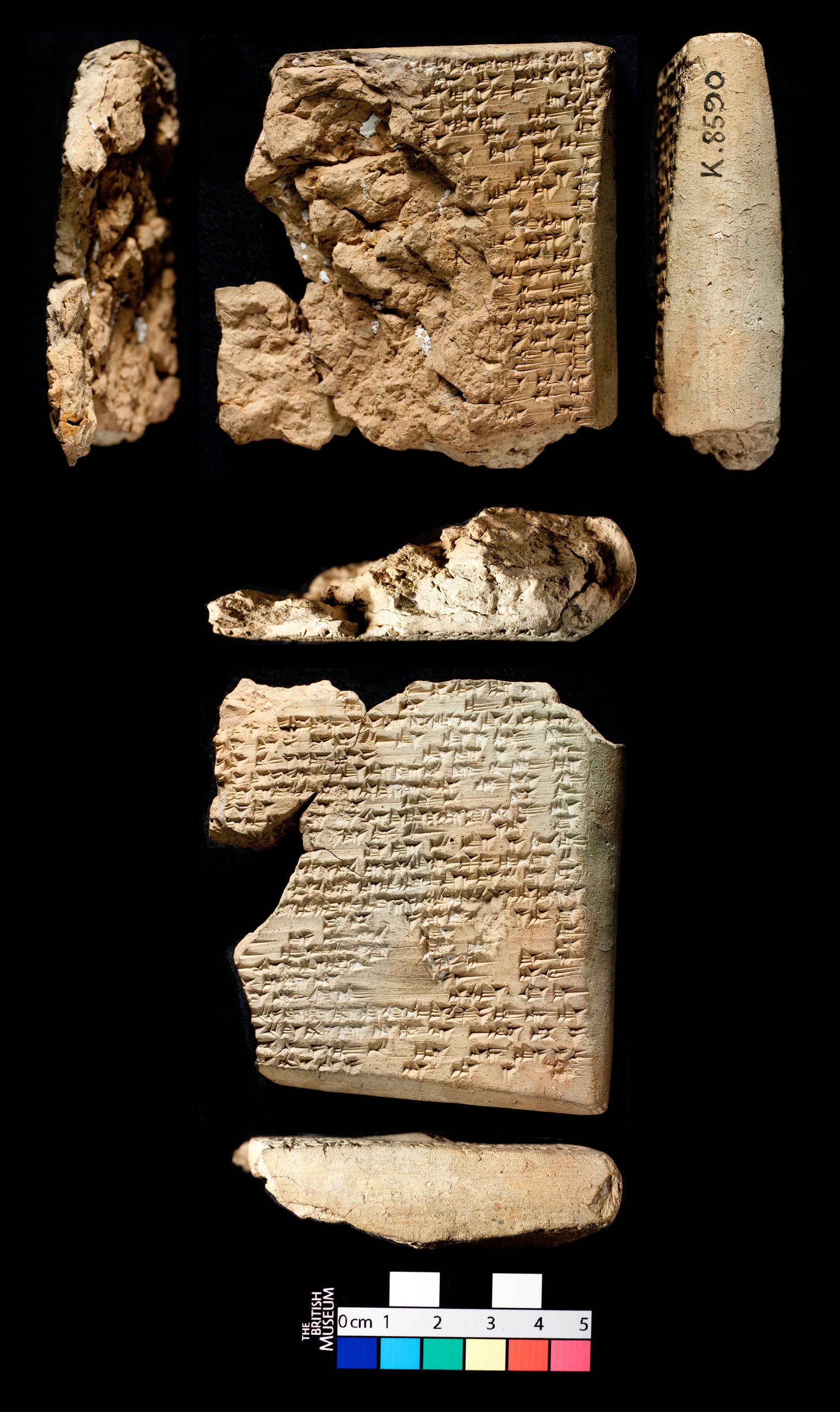
Where on the image
British Museum K.8590: column iv, the tablet's own lines 1' to 9'. eBL's corpus edition (https://www.ebl.lmu.de/corpus/L/1/4/SB/VII) attributes SB VII 182-190 to this manuscript at these column and line numbers. Photograph checked: obverse, reverse and edges, ink number K.8590; one column on each face, consistent with eBL's columns iii and iv. On this tablet lines 182-184, 188-189 are partly broken (square brackets and x in the Akkadian). The English of these lines translates eBL's composite text, so it includes words that are not preserved on this tablet but are restored from other manuscripts or by the editors. Square brackets in the English mark eBL's restorations in its composite text; words that survive on other tablets carry no brackets even where this tablet is broken. Lines 185-187, 190 are complete on this tablet.
182[x x x x GI]M su#-um#-[me ia]-a#-ši ut-ter-ra-an#-[ni]
183[x x-m]a GIM MUŠEN i-di-i[a]
184[ṣ]ab-tan-ni i#-red#-dan-ni a-na E₂ ek-le-ti šu-bat {d}ir-kal-l[a]
185a#-na E₂ ša₂ e-ri-bu-šu la a-ṣu-u₂
186a#-na KASKAL ša₂ a-lak-ta-ša₂ la ta-a-a-rat
187a#-na E₂ ša₂ a-ši-bu-šu zu-um-mu-u₂ nu-u₂-ra
188[a-š]ar ep-ru bu-bu-us-si-na-ma a-kal-ši-na ṭi-iṭ-ṭi
189[la]b-ša₂-ma GIM#! MUŠEN ṣu-bat kap-pi
190u₃# nu-u₂#-ra# la im-ma-ra-ma ina e-ṭu-ti aš₂-ba
182‘[He struck] me, he turned me into a dove.
183[He bound] my arms like (the wings of) a bird,
184to lead me captive to the house of darkness, the seat of Irkalla:
185to the house which those who enter cannot leave,
186on the journey whose way cannot be retraced;
187to the house whose residents are deprived of light,
188where dust is their sustenance, their food clay.
189They are clad like birds in coats of feathers,
190and they cannot see light (but) dwell in darkness.
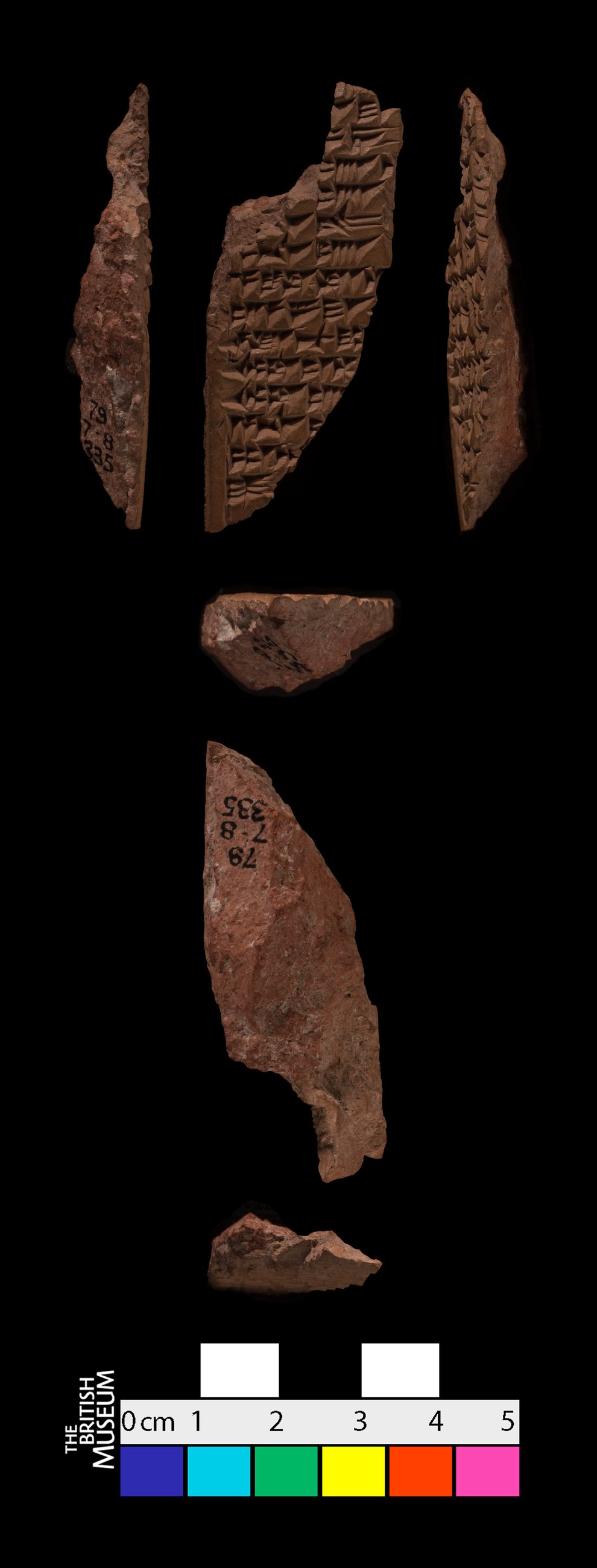
Where on the image
British Museum 1879,0708.335: column iv, the tablet's own lines 11' to 12'. eBL's corpus edition (https://www.ebl.lmu.de/corpus/L/1/4/SB/VII) attributes SB VII 191-192 to this manuscript at these column and line numbers. Photograph checked: obverse, reverse and edges, ink number 79-7-8,335; about 14 lines on one face, consistent with eBL's column iv. On this tablet of lines 191-192 only one to three signs survive. The English of these lines translates eBL's composite text, so it includes words that are not preserved on this tablet but are restored from other manuscripts or by the editors. Square brackets in the English mark eBL's restorations in its composite text; words that survive on other tablets carry no brackets even where this tablet is broken.
191UGU {giš}I[G u {giš}SAG.KUL ša₂-bu-uh ep-ru]
192UGU E₂# [x x x x x x x x x x x x]
191On the door [and the bolt the dust lies thick,]
192on the House [(of Dust) a deathly quiet is poured.]
Where on the image
British Museum K.8590: column iv, the tablet's own lines 10' to 24'. eBL's corpus edition (https://www.ebl.lmu.de/corpus/L/1/4/SB/VII) attributes SB VII 193-207 to this manuscript at these column and line numbers. Photograph checked: obverse, reverse and edges, ink number K.8590; one column on each face, consistent with eBL's columns iii and iv. On this tablet lines 193-207 are partly broken (square brackets and x in the Akkadian). The English of these lines translates eBL's composite text, so it includes words that are not preserved on this tablet but are restored from other manuscripts or by the editors. Square brackets in the English mark eBL's restorations in its composite text; words that survive on other tablets carry no brackets even where this tablet is broken.
193[a-na] E₂# [ep-r]i ša₂ e-ru-bu a-na-ku
194[ap-pal-sa-am-m]a ku-um-mu-su a-gu-u₂
195[x x x x x š]u-ut a-ge-e ša₂ ul-tu u₄-me pa-ni i-be-lu KUR
196[x x x {d}] a#-nim u {d}+en-lil₂ iš-tak-ka-nu šu-me-e še-e-ri
197[x x x] iš-tak-ka-nu ka-ṣa-a-ti iš-taq-qu-u# A#-MEŠ na-da-a-te
198[x (x) x] ep-ri ša₂ e-ru-bu# a-na-ku
199[aš₂-b]u e-nu u la-ga#-ru
200[aš₂-b]u i-šip-pu u₃ lu₂-mah-hu
201[aš₂-b]u GUDU₄.ABZU-MEŠ ša₂ DINGIR-MEŠ GAL-MEŠ
202[x x] {d#}e-ta-na a-šib {d}šakkan₂
203[aš₂-bat š]ar-rat KI-tu₄ {d}ereš-ki-gal
204[{d}be-let-E]DIN ṭup!(UM)-šar-ra-at KI-ti₃ ma-har-ša₂ kam₂-sa-at
205[ṭup-pa n]a-šat-ma il-ta-na-as-si ina mah-ri-ša₂
206[iš-ši r]e-ši-ša₂ <<DIŠ>> i-mu-ra-an-ni ia-a#-ši
207[man-num-m]a il-qa-a an-na-a LU₂#
193In the House of Dust that I entered,
194I looked and (saw) the crowns stowed away:
195there sat [kings], the crowned heads who ruled the land since days of old,
196who used to serve roasted meat [at the] tables of Anu and Enlil,
197who used to serve baked (bread), to pour chilled water from skins.
198In the House of Dust that I entered,
199there sat en-priests and lagar-priests;
200there sat purification priests and lumaḫḫu-priests,
201there sat the gudapsû-priests of the great gods;
202there sat Etana, there sat Šakkan,
203[there sat the] queen of the netherworld, Ereškigal
204Before her was squatting [Bēlet]-ṣēri, the scribe of the netherworld,
205holding [a tablet] and reading aloud in her presence.
206[She raised] her head, she saw me:
207“[Who was] it fetched this man here?
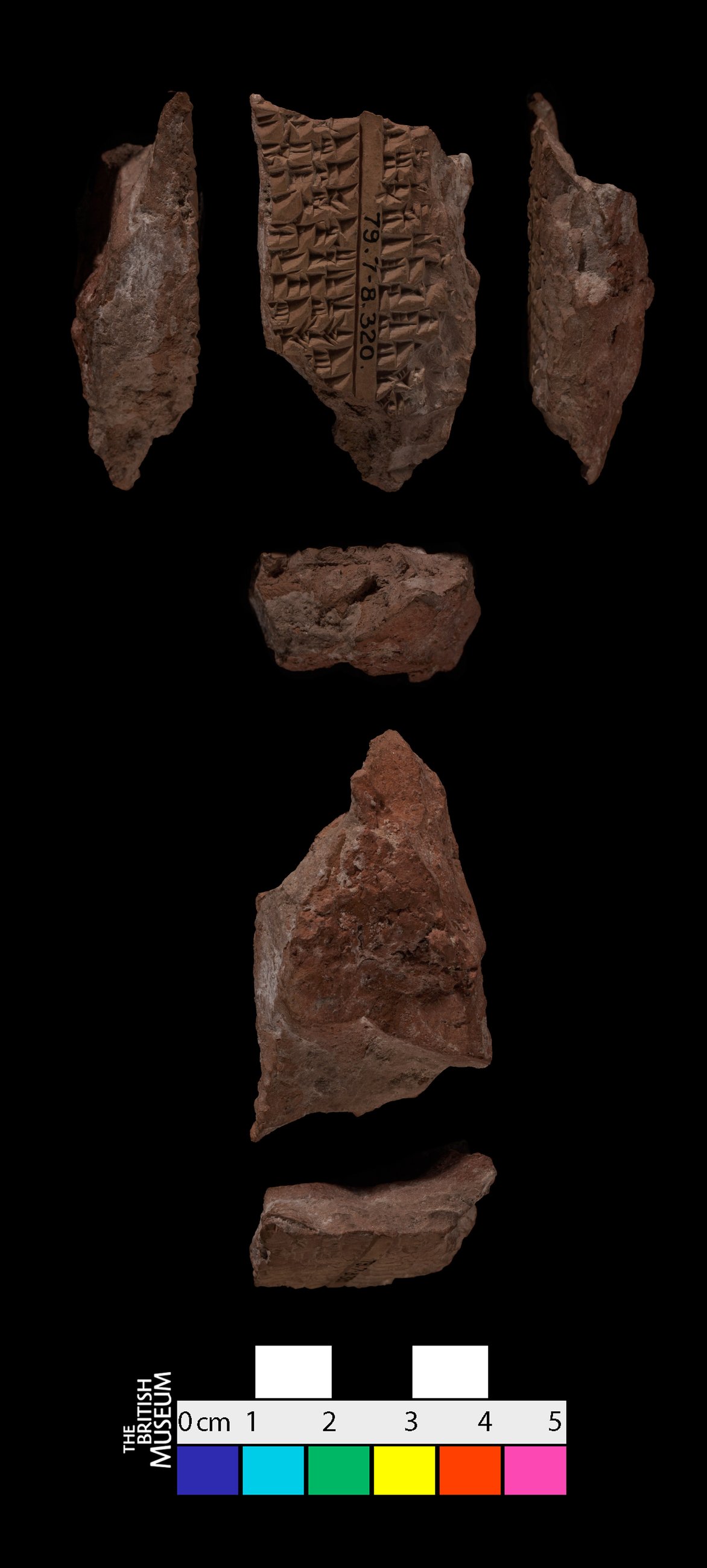
Where on the image
British Museum 1879,0708.320: reverse, column v, the tablet's own lines 3'b to 12'. eBL's corpus edition (https://www.ebl.lmu.de/corpus/L/1/4/SB/VII) attributes SB VII 208-217 to this manuscript at these column and line numbers. Photograph checked: obverse, reverse and edges, ink number 79-7-8,320; the inscribed face shows two columns, consistent with eBL's columns iv and v. On this tablet of line 217 only illegible traces (x) survive and of lines 208-216 only one to three signs survive. The English of these lines translates eBL's composite text, so it includes words that are not preserved on this tablet but are restored from other manuscripts or by the editors. Square brackets in the English mark eBL's restorations in its composite text; words that survive on other tablets carry no brackets even where this tablet is broken.
208[x x x x x x x x x x x x u]b-la
209[x x x x x x x x x x uš-t]e-er-si
210[x x x x x x x x x x x x K]I.MAH
211[x x x x x x x x x x x x].GUB.BA
212[x x x x x x x x x x x x]-a-ti₃
213[x x x x x x x x x x x] x-an-ni
214[x x x x x x x x x x {d}ereš-k]i-gal
215[x x x x x x x x x x x] a-bu-bu
216[x x x x x x x x x x x x x-a]t
217[x x x x x x x x x x x x x] x
208[Who was it] brought [this fellow] here?
209[…] made ready,
210[…] tomb.”
211[…] …
212[…] …
213‘[…] me,
214[…] Ereškigal.
215[…] the deluge.’
216[…] …
217[…] …
Where on the image
British Museum K.9196: reverse, column v, the tablet's own lines 1' to 7'. eBL's corpus edition (https://www.ebl.lmu.de/corpus/L/1/4/SB/VII) attributes SB VII 220-226 to this manuscript at these column and line numbers. Photograph checked: one face with ink number K.9196 and two columns, consistent with eBL's columns iv and v. On this tablet of line 220 only illegible traces (x) survive, of lines 222-226 only one to three signs survive and line 221 is partly broken (square brackets and x in the Akkadian). The English of these lines translates eBL's composite text, so it includes words that are not preserved on this tablet but are restored from other manuscripts or by the editors. Square brackets in the English mark eBL's restorations in its composite text; words that survive on other tablets carry no brackets even where this tablet is broken.
220[...] x x
221[... a-t]a-mar SU-šu₂
222[...]-a-ti
223[...] x-kit
224[...] x-ta
225[...] x-ta
226[...]-bi
220[…] …
221‘[…] I saw his person.’
222[…] …
223[…] …
224[…] …
225[…] …
226[…] …
Where on the image
British Museum Sm.2132: column iv?, the tablet's own lines 1' to 10'. eBL's corpus edition (https://www.ebl.lmu.de/corpus/L/1/4/SB/VII) attributes SB VII 249-258 to this manuscript at these column and line numbers. Photograph checked: obverse, reverse and edges, ink number S.2132 on the left edge. The face shown above carries about 13 lines whose right ends are cut off by a diagonal break, consistent with eBL's column iv? (13 lines, VII 249-261); the face shown below keeps only the first two to four signs of about 11 lines along its left edge, consistent with eBL's column i (11 lines, VII 56-68). The photograph therefore shows the face with column iv? above the face with column i. On this tablet of lines 249-250 only illegible traces (x) survive and lines 251-258 are partly broken (square brackets and x in the Akkadian). The English of these lines translates eBL's composite text, so it includes words that are not preserved on this tablet but are restored from other manuscripts or by the editors. Square brackets in the English mark eBL's restorations in its composite text; words that survive on other tablets carry no brackets even where this tablet is broken.
249x [...]
250x [...] x [...]
251š[a₂ it-ti-ka at-tal-l]a-ku ka#-lu# mar#-ṣa#-[a-ti]
252h[u-us-sa-an-ni ib-r]i mim-mu-u at-tal-la-ku e [x x x]
253i[b-ri i-ta-m]ar šu-ut-ta ša₂ la x [x (x) x]
254u₄-um# MAŠ₂#.GI₆# iṭ-ṭu-lu ga-mir [x x x x]
255na-di-ma {d}+en-ki-du₃ 1-en u₄-um ma#-r[u-uṣ x x x x x]
256ša₂# {d}+en-ki-du₃ ina ma-a-a-li-šu₂ [x x x x x x x x]
257šal-ša₂ u₄-ma u re-ba-a u₄-ma š[a₂ x x x x x x x x]
258ha-an-ša₂ šeš-ša₂ u se-ba-a sa-ma-na-a [x x x x x x x]
249… […]
250… […]
251‘(Me) who [endured] all hardships [with you,]
252remember [me,] my [friend,] lest [you forget] all I went through.’
253‘My friend saw a vision which will never [be equalled]’
254The day he saw the dream [his strength] was exhausted.
255Enkidu was cast down and (lay) sick for one day, [a second day.]
256Enkidu [lay] on his bed, [his sickness worsened,]
257A third day and a fourth day, [the sickness of Enkidu worsened]
258a fifth, a sixth and a seventh, an eighth, a ninth and a tenth (day).
Where on the image
British Museum K.3588: reverse, column vi, the tablet's own lines 9 to 17. eBL's corpus edition (https://www.ebl.lmu.de/corpus/L/1/4/SB/VII) attributes SB VII 259-267 to this manuscript at these column and line numbers. Photograph checked: obverse, reverse and edges, ink number K.3588 on both side edges; one column on each face, consistent with eBL's columns i and vi. On this tablet lines 259-267 are partly broken (square brackets and x in the Akkadian). The English of these lines translates eBL's composite text, so it includes words that are not preserved on this tablet but are restored from other manuscripts or by the editors. Square brackets in the English mark eBL's restorations in its composite text; words that survive on other tablets carry no brackets even where this tablet is broken.
259ša₂ {d}+en-ki-du₃ mur-ṣu [x x x x x x x x x]
26011-u₂ u₃ 12-u₂ [x x x x x x x x x x x x]
261{d}+en-ki-du₃ ina ma-a-a-l[i x x x x x]
262il-si-ma {d}GIŠ-gim₂-maš x [x x x x x x]
263iz-zi-ra-an-ni ib-r[i x x x x x x x]
264ki-i ša₂ ina qe₂-reb MU[RUB₄ x x x x x x x]
265a-dur ME₃-ma [x x x x x x x x x x]
266ib-ri ša₂ ina M[E₃ x x x x x x x x x]
267a#-na-ku ina M[E₃? x x x x x x x x x]
259the sickness of Enkidu worsened…
260an eleventh and a twelfth day, […]
261Enkidu on the bed […]
262he called to Gilgameš and […:]
263‘[My god] has spurned me, my friend, […]
264[I do not die] like one who [falls] in the midst of battle.
265I was afraid of combat […,]
266my friend, one who [falls] in combat [makes his name,]
267but I, [I do not fall] in [combat, and shall make not my name.]
Notes
- Akkadian: eBL transliteration of the signs on the photographed tablet (manuscript-level ATF), not a composite text.
- English: A. R. George's translation in the eBL edition; it renders eBL's composite text, including restorations from other tablets.
- Line numbers: eBL edition (based on A. R. George, The Babylonian Gilgamesh Epic, Oxford 2003). Each section also gives the tablet's own column and line numbers.
- Signs in the Akkadian: [ ] broken away; x illegible sign; # damaged sign; ? uncertain reading; ! sign corrected by the editor; ... broken signs of unknown number; ( ) signs perhaps broken away; { } determinative; << >> sign written in error by the scribe; : divider sign written on the tablet; (line break) the line runs on to the next line of the tablet.
Cite
Sources
- Source: British Museum tablet photographs + eBL manuscript transliterations (eBL corpus edition L I.4, Poem of Gilgamesh (ed. A. R. George, rev. G. Rozzi and E. Jiménez), SB VII) + English of the eBL edition (A. R. George (eBL edition)) (holding institution)
- Critical edition: electronic Babylonian Library, Poem of Gilgamesh (ed. A. R. George), manuscript transliterations
← previous · → next · v cycle view · l back to library