Epic of Gilgamesh, Tablet XI: the Flood
Introduction
Uta-napishti tells how the god Ea warned him of the Flood, how he built a boat, survived the deluge, sent out birds, and was granted eternal life. Gilgamesh fails a test of sleep, obtains a plant of rejuvenation, loses it to a snake, and returns to Uruk.
The Standard Babylonian version of the epic, traditionally ascribed to the scholar Sin-leqi-unninni, was written on twelve tablets. Most surviving copies come from the libraries of Ashurbanipal at Nineveh (7th century BCE) and from Babylon and other Babylonian cities (7th-2nd century BCE). This page gives Tablet XI in the line numbering of the electronic Babylonian Library edition by A. R. George (2022 and later revisions).
How this page is built. Each section is a run of consecutive lines as written on one photographed clay tablet. For every line the eBL edition (https://www.ebl.lmu.de/corpus/L/1/4/SB/XI) lists the manuscripts that carry it, with each tablet's own column and line numbers; the tablet chosen for each run is the photographed copy of the work with the most signs preserved there. Commentaries and texts that only quote a line are never chosen. School and excerpt tablets are used only for lines that no photographed library copy preserves as well, and only where they carry the line as text; their sections say so. The original text is eBL's transliteration of that tablet's signs (not a modern composite text): square brackets mark broken signs, x an illegible sign, # a damaged sign, ? an uncertain reading, and words in {braces} are determinatives; the notes give a key to every sign used on this page, and eBL's layout codes are written out in words (for example '(line break)' or '(blank space)'). Superscript numbers are the line numbers of the eBL edition, used in both the Akkadian and the English. The English is A. R. George's translation in the eBL edition (CC BY-NC-SA 4.0), one line of English per line of the poem; italics mark uncertain renderings, as in the source. Where the tablet is broken, the English still translates the whole line of eBL's composite text; each section's note names the lines that are broken on its tablet.
Finding a line on the photograph. Each section names the tablet, the face and column, and the tablet's own line numbers (a prime, as in 5', counts from the first preserved line of a broken column). On a tablet with six columns the obverse carries columns i-iii from left to right; the reverse, turned over from bottom to top, carries columns iv-vi from right to left. The photographs often show the obverse above the reverse with the edges around them; a fragment preserves only part of this layout.
This page shows 329 of the 329 lines of the eBL edition (100%), from 5 tablets in the British Museum: K.2252 (Nineveh), K.8517 (Nineveh), Sm.2131 (Nineveh), K.7752 (Nineveh), K.3375 (Nineveh).
How was this verified? (Provenance)
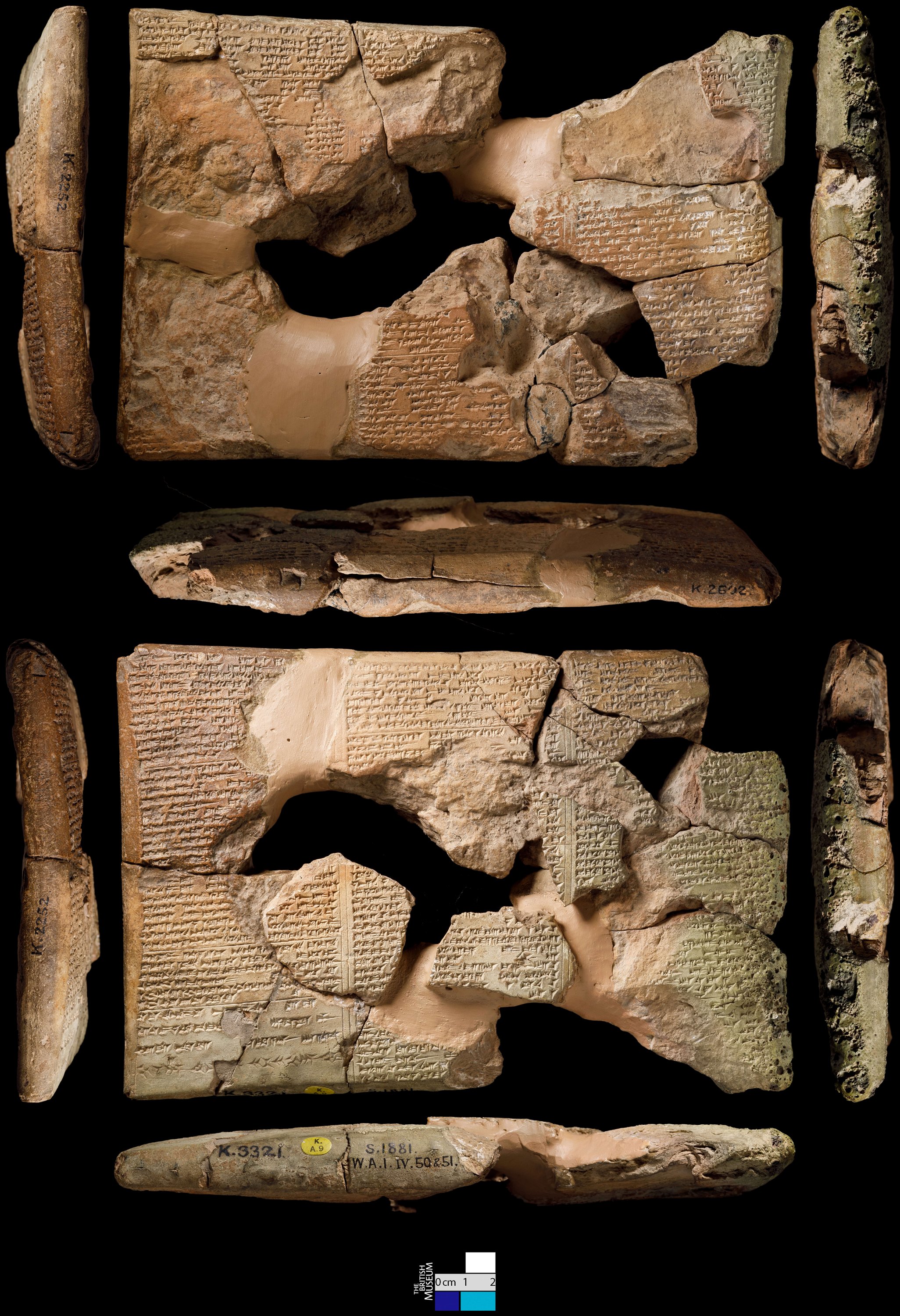
Where on the image
British Museum K.2252: obverse, column i, the tablet's own lines 1 to 4. eBL's corpus edition (https://www.ebl.lmu.de/corpus/L/1/4/SB/XI) attributes SB XI 1-4 to this manuscript at these column and line numbers. Photograph checked: obverse, reverse and edges of the join K.2252 + K.2602 + K.3321 + K.4486 + Sm.1881 (ink numbers K.3321 and S.1881 on the lower edge, plaster fill); three columns on each face, consistent with eBL's columns i-vi. On this tablet line 4 is partly broken (square brackets and x in the Akkadian). The English of this line translates eBL's composite text, so it includes words that are not preserved on this tablet but are restored from other manuscripts or by the editors. Square brackets in the English mark eBL's restorations in its composite text; words that survive on other tablets carry no brackets even where this tablet is broken. Lines 1-3 are complete on this tablet.
1{d}GIŠ-gim₂-maš a-na ša₂-šu#-ma MU-ra a-na {m}UD-ZI ru-u₂-qi₂
2a-na-aṭ-ṭa-la-kum₂-ma {m}UD-ZI
3mi-na-tu-ka ul ša₂#-na-a ki-i ia-ti-ma at-ta
4u₃ at-ta ul š[a₂-n]a-ta ki-i ia-ti-ma at-ta
1Gilgameš spoke to him, to Ūta-napišti the Far-Away.
2‘As I look at you, Ūta-napišti,
3your form is not different, you are just like me,
4you are not different at all, you are just like me.
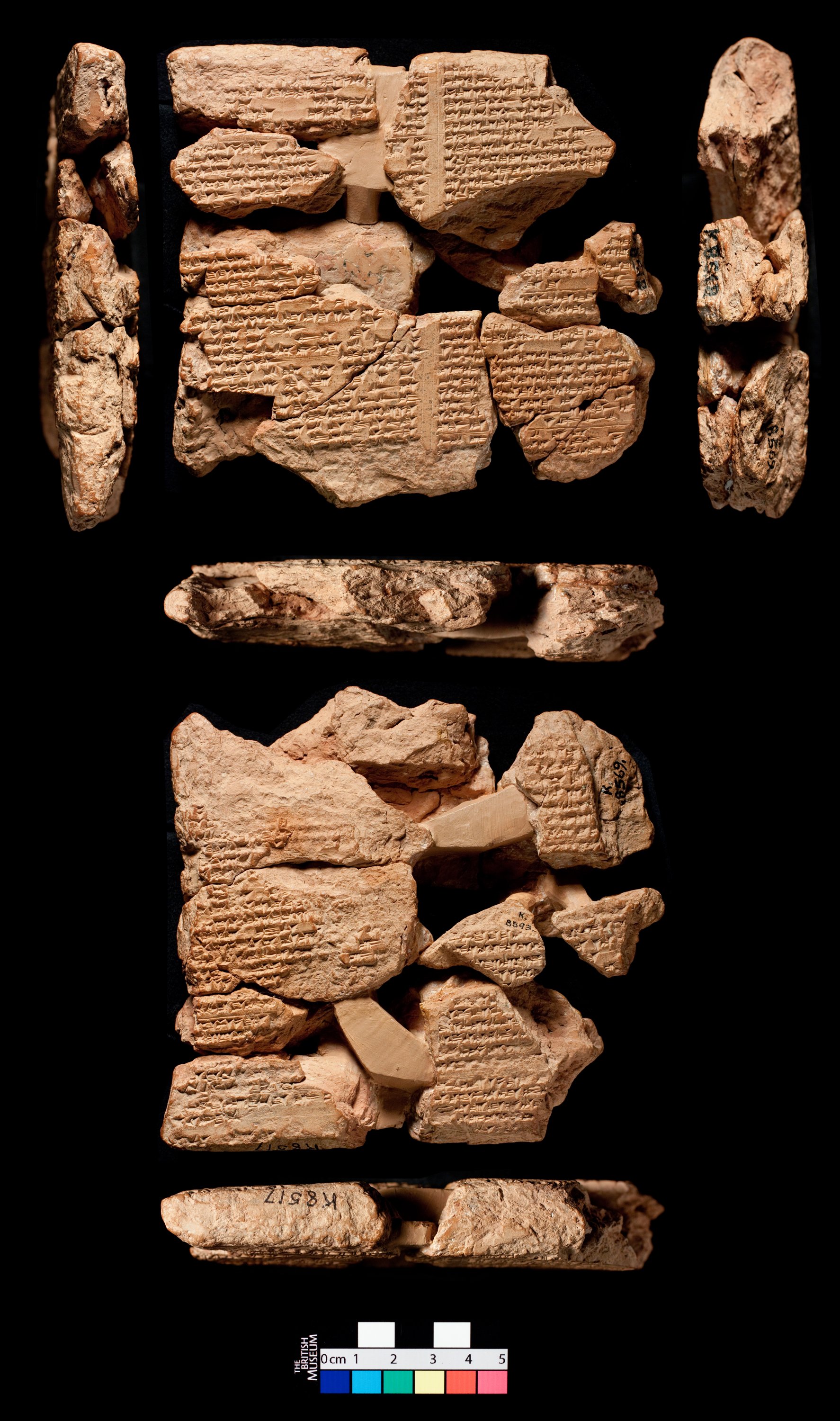
Where on the image
British Museum K.8517: obverse, column i, the tablet's own lines 5 to 28. eBL's corpus edition (https://www.ebl.lmu.de/corpus/L/1/4/SB/XI) attributes SB XI 5-33 to this manuscript at these column and line numbers. Photograph checked: obverse, reverse and edges of the join K.8517 + K.8518 + K.8569 + K.8593 + K.8595 (many pieces, plaster fill); text on both faces, consistent with eBL's columns i-ii and v-vi. On this tablet lines 15, 17, 21 are entirely broken, of lines 16, 18, 25 only one to three signs survive and lines 5-10, 12-14, 19-20, 22-24, 26-33 are partly broken (square brackets and x in the Akkadian). The English of these lines translates eBL's composite text, so it includes words that are not preserved on this tablet but are restored from other manuscripts or by the editors. Square brackets in the English mark eBL's restorations in its composite text; words that survive on other tablets carry no brackets even where this tablet is broken. Line 11 is complete on this tablet.
5[gum₂-m]u[r]-ku# lib₃-bi a-na e-peš t[u-q]u-un-tu₂ <tu₂> (written over erased x)
6[x x x x n]a-da#-at-ta e-li ṣe-[ri]-ka
7[x x k]i-ki#-i# ta#-az#-ziz#-ma# ina# UKKIN# DINGIR#-MEŠ# ba#-la#-[ṭa te]š₂-ʾ-u₁₆(UM)
8[{m}U]D-ZI-ti₃ ana ša₂-šu-ma MU-r[a a-na {d}GI]Š-gim₂-maš
9lu-up-te-ka {d}GIŠ-gim₂-maš [x x ni-ṣ]ir-ti
10u₃ pi-riš-ti ša₂ DINGIR-MEŠ ka-a-ša₂ l[u-uq-bi]-ka
11{uru}šu-ri-ip-pak URU ša₂ ti-du-šu at-ta :
12x [x x x x x pu-ra]t-ti šak-nu
13[UR]U šu-u₂ la-bir-ma [x x qer-bu]-šu
14[a-n]a ša₂#-kan# a#-bu#-bu# ub#-la# lib₃#-[ba-šu₂-nu x x GAL]-MEŠ
15[x x x x x x x x x : ]
16[x x x x x x x {d}en-l]il₂
17[x x x x x x x x ( : )]
18[x x x x x {d}en-nu-g]i
19[{d}]nin#-ši#-ku₃# {d#}e₂#-[a x x x x x x x]
20a#-mat-su-nu u₂-ša₂-an-na-a# ana# ki#-i[k-ki-ši ( : )]
21[x x x x x x x x x x x]
22[k]i-i[k-k]i-šu ši-me-ma i-ga-r[u x x x x]
23[{lu₂}šu-r]i-ip-pa-ku-u₂ DUMU {m}uba[ra-{d}tu-tu]
24[x x] E₃# bi-ni {giš}MA₂ :
25muš-šir₃ NIG₂#.[TUKU-ma x x x x x]
26[ma]-ak#-ku#-ra# ze#-er-ma na#-piš#-t[u₂?]
27[š]u-li-ma NUMUN nap-ša₂-a-ti ka-la-ma a-na lib₃-bi# {giš#}[MA₂]
28{giš#}MA₂ ša₂ ta-ban-nu-ši at-[ta]
29[l]u-u₂# min₃-du-da mi-na-tu-ša₂#
30[l]u-u₂# mit-hur ru-pu-us-sa u₃ mu-rak-ša₂
31[k]i-ma# ABZU ša₂-a-ši ṣu-ul-lil-ši
32[a]-na#-ku# i-de-ma MU-ra# a-na {d}e₂#-a be-li₂-ia
33[x x] be-li₂ ša₂ taq-ba-a at-ta ki-a-am
5I was fully intent on doing battle with you,
6[but] in your presence my hand is stayed.
7How was it you attended the gods’ assembly, and found life?’
8Ūta-napišti spoke to him, to Gilgameš:
9‘I will disclose to you, Gilgameš, a secret matter,
10and I will tell you a mistery of the gods.
11The city of Šuruppak – a city you yourself know,
12the [city that] is situated on the [banks] of the Euphrates–
13that city was old and the gods were within it,
14(when) the great gods decided to cause the Deluge.
15Their father Anu took the oath,
16their counsellor, the hero Enlil;
17their chamberlain, Ninurta,
18their inspector of waterways, Ennugi
19With them the Prince Ea was under oath likewise,
20(but) repeated their words to a reed fence:
21“Reed fence, reed fence! Brick wall, brick wall!
22Listen, O reed fence! Pay heed, O brick wall!
23O man of Šuruppak, son of Ubār-Tutu,
24demolish the house, build a boat!
25Abandon riches and seek survival!
26Spurn property and save life!
27Put on board the boat the seed of all living creatures!
28The boat that you are going to build,
29her dimensions should all be matching:
30her breadth and length should be the same,
31cover her with a roof, like the Apsû”.
32I understood and spoke to Ea my master:
33“I hereby concur, my lord, with what you told me thus.
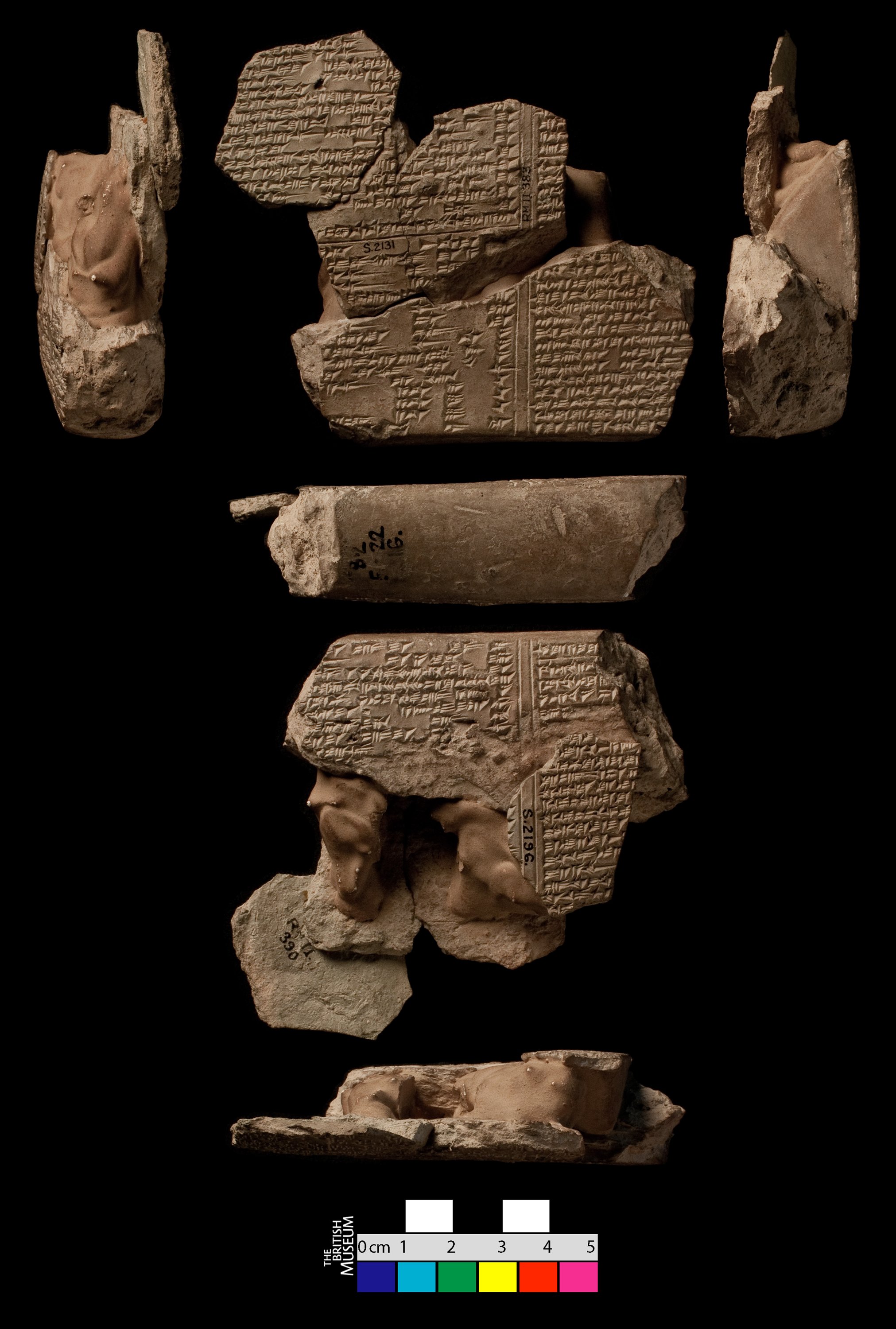
Where on the image
British Museum Sm.2131: column i, the tablet's own lines 6' to 26'. eBL's corpus edition (https://www.ebl.lmu.de/corpus/L/1/4/SB/XI) attributes SB XI 34-56 to this manuscript at these column and line numbers. Photograph checked: obverse, reverse and edges of the join Sm.2131 + Sm.2196 + Rm-II.383 + Rm-II.390 + 1882,0522.316 (several pieces with plaster); text on both faces, consistent with eBL's columns i-iii. On this tablet line 52 is entirely broken, of lines 37, 46, 55 only one to three signs survive and lines 34-36, 38-45, 47-51, 53-54, 56 are partly broken (square brackets and x in the Akkadian). The English of these lines translates eBL's composite text, so it includes words that are not preserved on this tablet but are restored from other manuscripts or by the editors. Square brackets in the English mark eBL's restorations in its composite text; words that survive on other tablets carry no brackets even where this tablet is broken.
34[at]-ta-ʾ-id a-na-k[u x x x]
35[ki-m]i lu-pu-ul URU um-ma-nu u₃# [x x x]
36[{d}]e₂#-a pa-a-šu₂ i-pu-uš-ma DUG₄.GA :
37MU-[ra x x x x x x]
38u₃# at-ta ki-a-am ta-qab-b[a-aš₂]-šu₂#-nu#-ti#
39[mi]n₃-de-ma ia-a-ši {d}+en-lil₂ i-[ze-er]-an-ni-ma
40[u]l uš-šab ina URU#-[ku]-nu-ma
41[ina] qaq-qar {d}+en-lil₂ ul a-šak-ka-n[a še-p]i-ia-a-ma
42[ur-r]ad-ma ana ABZU it-ti {d}e₂#-a [b]e-li₂-ia aš₂-ba-ku
43[ana k]a-a-šu₂-nu u₂-ša₂-az-na-[n]ak-ku-nu-ši nu-uh-šam-ma
44[x x] MUŠEN-MEŠ pu-zu-ur KU₆-MEŠ-ma
45[x x x x x] x x x x meš-ra-a e-bu-ra-am-ma
46[x x x] ku-uk-ki
47[x x x x x u₂]-ša₂-az-na-na-ku-nu-ši ša₂-mu-ut ki-ba-a-ti
48[x x x še]-e#-ri ina na-ma-a#-ri#
49[x x x x x x x] i-pa-ah-hur ma-a-[tu₄]
50[x x n]a-ši pa-a[s-su]
51[x x x n]a-ši a-b[a-an-šu]
52[x x x x x x x (x x x)] :#
53{lu₂}GURUŠ-MEŠ i#-x [x x x x x]
54[ši-bu-ti i-zab-b]i-lu# pi-til?# (written over an erasure)-ta#
55[x x x na]-ši# kup-ra
56[x x x x hi-š]ih-tu ub-la
34[I] have paid attention; I shall do it.
35(But) how should I answer the city, the crowd and elders?
36Ea opened his mouth to speak,
37saying to me, his servant:
38“Then also you will say to them as follows:
39For sure the god Enlil has conceived a hatred of me!
40I cannot dwell in your city!
41I cannot tread on Enlil’s ground!
42[I shall] go down to the Apsû, to live with Ea, my master;
43he will rain down on you plenty!
44[An abundance] of birds, a riddle of fishes!
45[…] … riches (at) harvest-time!
46In the morning he will rain down on you bread-cakes,
47in the evening, a torrent of wheat.’”
48At the very first light of dawn,
49the population began assembling at Atra-hasīs’s gate.
50The carpenter was carrying [his] axe,
51the reed-worker was carrying [his] stone,
52[the shipwright bearing his] heavyweight axe
53The young men were…[…,]
54the old men were bearing rope of palm-fibre.
55The rich man was carrying bitumen,
56the pauper brought the […] tackle.
Where on the image
British Museum K.8517: obverse, column ii, the tablet's own lines 1 to 11. eBL's corpus edition (https://www.ebl.lmu.de/corpus/L/1/4/SB/XI) attributes SB XI 57-69 to this manuscript at these column and line numbers. Photograph checked: obverse, reverse and edges of the join K.8517 + K.8518 + K.8569 + K.8593 + K.8595 (many pieces, plaster fill); text on both faces, consistent with eBL's columns i-ii and v-vi. On this tablet of line 62 only one to three signs survive and lines 57-60, 63-65, 67-69 are partly broken (square brackets and x in the Akkadian). The English of these lines translates eBL's composite text, so it includes words that are not preserved on this tablet but are restored from other manuscripts or by the editors. Square brackets in the English mark eBL's restorations in its composite text; words that survive on other tablets carry no brackets even where this tablet is broken. Lines 61, 66 are complete on this tablet.
57ina ha-an-ši u₄#-me# [x x x x x x]
581.IKU GUR₂-sa 10 NINDAN.TA.A[M₃ x x x x x x x]
5910 NINDAN.TA.AM₃ im-ta-hir [x x x x x]
60ad-di la-an-ši ša₂-a-ši [x x x]
61ur-tag-gi-ib-ši a-na 6-šu
62a[p-ta-ra-as-si x x x x]
63qer-bi-is-su₂ ap-ta-ra-as [x x x x]
64{giš}GAG-MEŠ A-MEŠ ina MURUB₄-ša₂ lu-u₂ [x x]
65a-mur pa-ri-su u₃ hi-ših-tu₄ [x x]
663 šar₂ ku-up-ri at-ta-bak ana ki-i-ri :
673 šar₂@v ESIR a[t?-ta-di x x x x]
683 šar₂@v ERIN₂-MEŠ na-aš₂ {giš}su-us-su-ul ša₂ i-zab-b[i-lu]
69e-zu-ub šar₂@v I₃.GIŠ ša₂# i#-ku#-lu# n[i-iq-qu]
57On the fifth day I set in place her (outer) surface:
58one “acre” was her area, ten rods each her sides stood high,
59ten rods all round was the diameter of her roof.
60I set in place her body, I drew up her design:
61I gave her six decks,
62I divided her into seven parts,
63I divided her interior into nine.
64I struck the water pegs into her belly,
65I found a punting pole and put the tackle in place.
66Three myriad measures of bitumen I poured into the furnace,
67three myriad of tar I tipped inside,
68three times a myriad was the oil that the workforce of porters was fetching,
69apart from the myriad of oil that libation consumed,
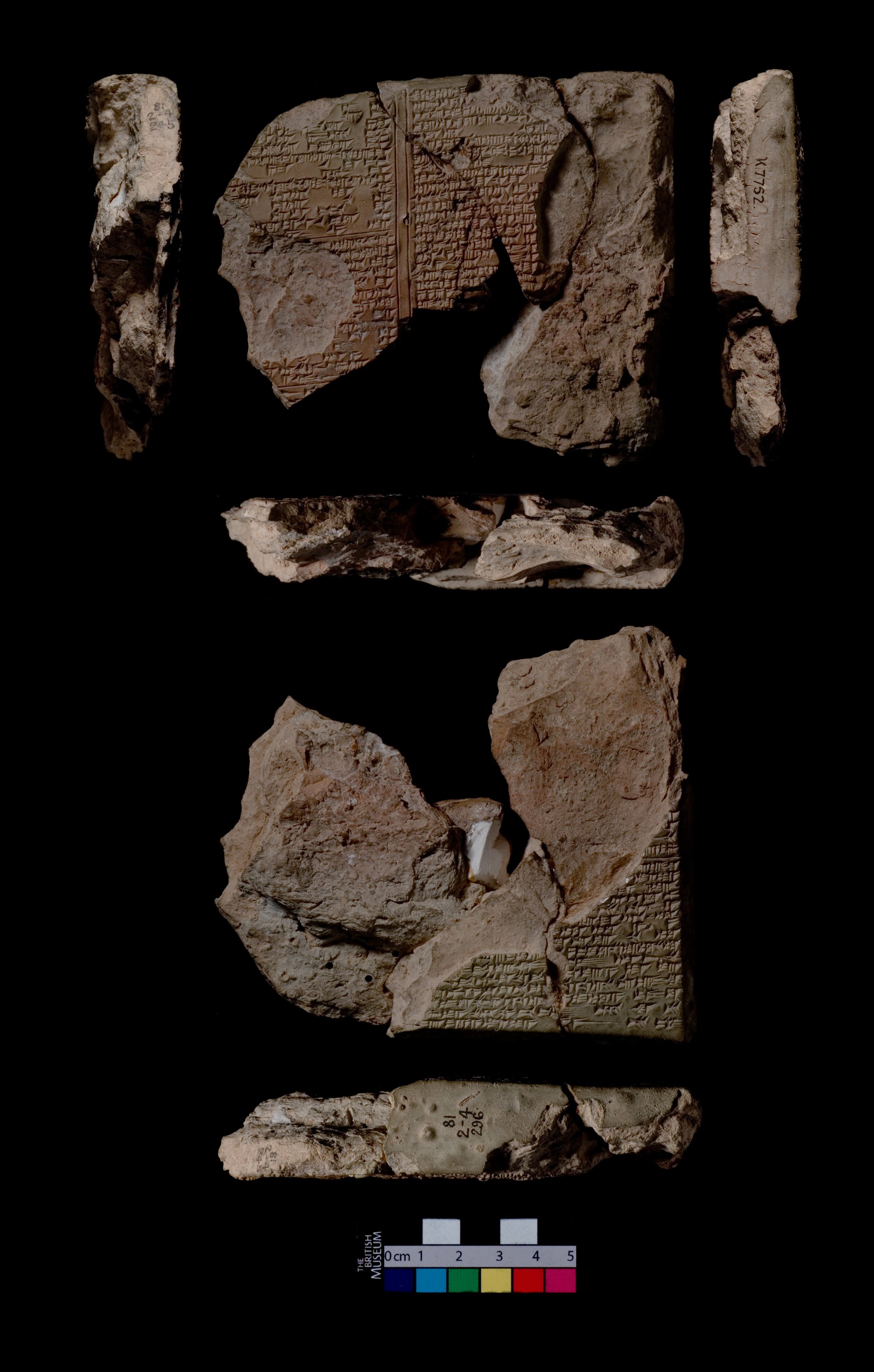
Where on the image
British Museum K.7752: obverse, column ii, the tablet's own lines 6 to 13. eBL's corpus edition (https://www.ebl.lmu.de/corpus/L/1/4/SB/XI) attributes SB XI 70-78 to this manuscript at these column and line numbers. Photograph checked: obverse, reverse and edges of the join K.7752 + 1881,0204.245 + .296 + .460 (ink numbers on the pieces); text on both faces, consistent with eBL's columns ii-iii and iv-vi. On this tablet of lines 71, 74a only one to three signs survive and lines 70, 73-74, 76-78 are partly broken (square brackets and x in the Akkadian). The English of these lines translates eBL's composite text, so it includes words that are not preserved on this tablet but are restored from other manuscripts or by the editors. Square brackets in the English mark eBL's restorations in its composite text; words that survive on other tablets carry no brackets even where this tablet is broken. Lines 72, 75 are complete on this tablet. eBL gives no English for line(s) 74a.
70[x x x u₂-pa-a]z-zi-ru {lu₂}MA₂.LAH₄
71[x x G]U₄-MEŠ :
72aš₂-gi-iš UDU.NITA₂-MEŠ u₄-mi-šam-ma
73[x x x x x x x] I+GIŠ₃ u GEŠTIN
74[x x x x x x x x x] A#-MEŠ# ID₂-ma
74a[x x x x (x)]-ri :
75i-sin-na ip-pu-šu₂ ki-i u₄-mi a-ki-tim-ma
76[x x x x x x piš-š]a₂-ti qa-ti ad-di
77[x x x x ra-be₂]-e# {giš}MA₂ gam-rat
78[x x x x x x x x] šup-šu-qu-ma
70there were two myriads of oil [that] the shipwright stowed away.
71I slaughtered countless oxen,
72every day I slaughtered sheep.
73Beer, ale, oil and wine
74I lavished on my workforce like the waters of a river
74a(no English for this line in the eBL edition)
75They were celebrating as on the feast-days of the New Year itself!
76At sun-rise I set my hand to the oiling;
77[before] sundown the boat was finished.
78[...] were very difficult:
Where on the image
British Museum K.8517: obverse, column ii, the tablet's own lines 18b to 33. eBL's corpus edition (https://www.ebl.lmu.de/corpus/L/1/4/SB/XI) attributes SB XI 79-98 to this manuscript at these column and line numbers. Photograph checked: obverse, reverse and edges of the join K.8517 + K.8518 + K.8569 + K.8593 + K.8595 (many pieces, plaster fill); text on both faces, consistent with eBL's columns i-ii and v-vi. On this tablet lines 79-98 are partly broken (square brackets and x in the Akkadian). The English of these lines translates eBL's composite text, so it includes words that are not preserved on this tablet but are restored from other manuscripts or by the editors. Square brackets in the English mark eBL's restorations in its composite text; words that survive on other tablets carry no brackets even where this tablet is broken.
79gi#-ir#.MA₂.DU₃-MEŠ# nit#-tab-ba-lu [x x x x x]
80[x x x x il-l]i-ku [š]i-ni-[pat-su]
81[mim-ma i-šu-u₂] e#-ṣe#-en-ši :
82mim-ma i-šu-[u₂ e-ṣ]e-en#-[ši x x]
83mim#-ma# i#-š[u-u₂] e#-ṣe#-en#-ši KU₃.SIG₁₇ :
84mim-ma i-š[u-u₂ KIMIN NUMU]N Z[I-MEŠ x x x]
85uš-te-li a-[na] ŠA₃! {giš}MA₂ k[a-la kim-t]i-ia# u₃# [x x x]
86bu-ul EDI[N] u₂#-ma-am EDIN DUMU#-MEŠ# um#-ma-nu# ka#-li#-šu#-n[u x x x]
87a-dan-na# {d}UTU iš-ku-[nam-ma]
88ina še-er ku-u[k-k]i ina li-la-a-ti u₂!-ša₂-az-na-nu ša₂-mu-t[u x x x x]
89e-ru-ub ana [li]b₃-bi {giš}MA₂-ma pi-he {giš}MA₂ :
90a-dan-nu šu-u₂ [x x x]
91ina še-er ku-u[k-k]i ina li-la-a-ti i-za-an-na-nu ša₂-mu-tu k[i-ba-a-ti]
92ša₂ u₄-mi at-t[a-ṭa]l bu-na-šu :
93u₄-mu a-na i-tap-lu-si pu-lu[h-ta x x]
94e-ru-u[b] a#-na {giš}MA₂-ma ap-ti#-hi# ba-[a-bi]
95a-na pe-he-e# [ša₂] {giš#}MA₂ a-na pu-zu-<ur>-{d#}KUR#.GAL {lu₂}[MA₂.LAH₄]
96E₂.GAL at-[ta]-din# a-di bu-še-e#-[šu₂]
97mim-mu-u₂ še-e-ri ina n[a-ma-ri]
98i#-lam#-ma# u[l-tu i-ši]d AN-e ur-pa-tu₄! ṣa-[lim-tu₄]
79Poles for the slipway we kept moving from back to front,
80[until] two thirds of [the boat had entered the water].
81[Everything I had] I loaded aboard it,
82I loaded aboard it whatever silver I had,
83I loaded aboard it whatever gold I had,
84I loaded aboard it whatever seed I had of living things, each and every one.
85All my kith and kin I sent aboard the boat,
86I sent aboard animals of the wild, creatures of the wild, persons of every skill and craft.
87Šamaš had set me a deadline–
88“In the morning he will rain down bread-cakes on us, in the evening a torrent of wheat.
89Go into the boat and seal your hatch!”–
90“That time had arrived:
91“In the morning he will rain down bread-cakes, in the evening, a torrent of wheat.”
92I watched the look of the weather:
93The weather was frightening to behold;
94I went into the boat and sealed my hatch.
95To the man who sealed the boat, to the ship-wright Puzur-Enlil,
96I gave the palace with all its goods.
97At the very first light of dawn–
98there came up from the horizon a black cloud,
Where on the image
British Museum K.2252: obverse, column ii, the tablet's own lines 8' to 17'. eBL's corpus edition (https://www.ebl.lmu.de/corpus/L/1/4/SB/XI) attributes SB XI 99-108 to this manuscript at these column and line numbers. Photograph checked: obverse, reverse and edges of the join K.2252 + K.2602 + K.3321 + K.4486 + Sm.1881 (ink numbers K.3321 and S.1881 on the lower edge, plaster fill); three columns on each face, consistent with eBL's columns i-vi. On this tablet lines 99-108 are partly broken (square brackets and x in the Akkadian). The English of these lines translates eBL's composite text, so it includes words that are not preserved on this tablet but are restored from other manuscripts or by the editors. Square brackets in the English mark eBL's restorations in its composite text; words that survive on other tablets carry no brackets even where this tablet is broken.
99{d}IŠKUR ina lib₃-bi-ša₂ [x x x x x]
100{d}šullat₂ u {d}haniš₂ il-la#-[ku x x x]
101il-la-ku GU.ZA.LA₂-MEŠ KUR-u₂ [x x x x]
102tar#-kul-li {d}er₃-ra-kal u₂-n[a-as-sah]
103il-lak {d}nin-urta# mi-ih-ra [x x x]
104{d}a-nun-na-ki iš-šu-u₂ di-pa-[ra-a-ti]
105ina nam-ri-ir-ri-šu₂-nu u₂-ha-am-ma-ṭu m[a-a-tu₄]
106[š]a₂ {d}IŠKUR šu-har-ra-as-su# i-ba-ʾ-u# [x x]
107[mi]m-ma nam-ru ana da#-[ʾ-u]m-[mat] ut-te[r-ru]
108[ir-h]i-iṣ KUR GIM G[U₄ x x x] x ih-p[i-ši]
99within it did Adad bellow continually.
100Šullat and Haniš were going at the fore,
101“throne-bearers” travelling over mountain and land.
102Errakal was ripping out the mooring poles;
103Ninurta, as he went, made the weirs overflow.
104The Anunnaki bore torches aloft,
105setting the land aglow with their brilliance.
106The still calm of the storm-god passed against the sky,
107all that was bright was turned into gloom.
108[He] charged the land like a bull [on the rampage,] he smashed [it] in pieces [like a vessel of clay]
Where on the image
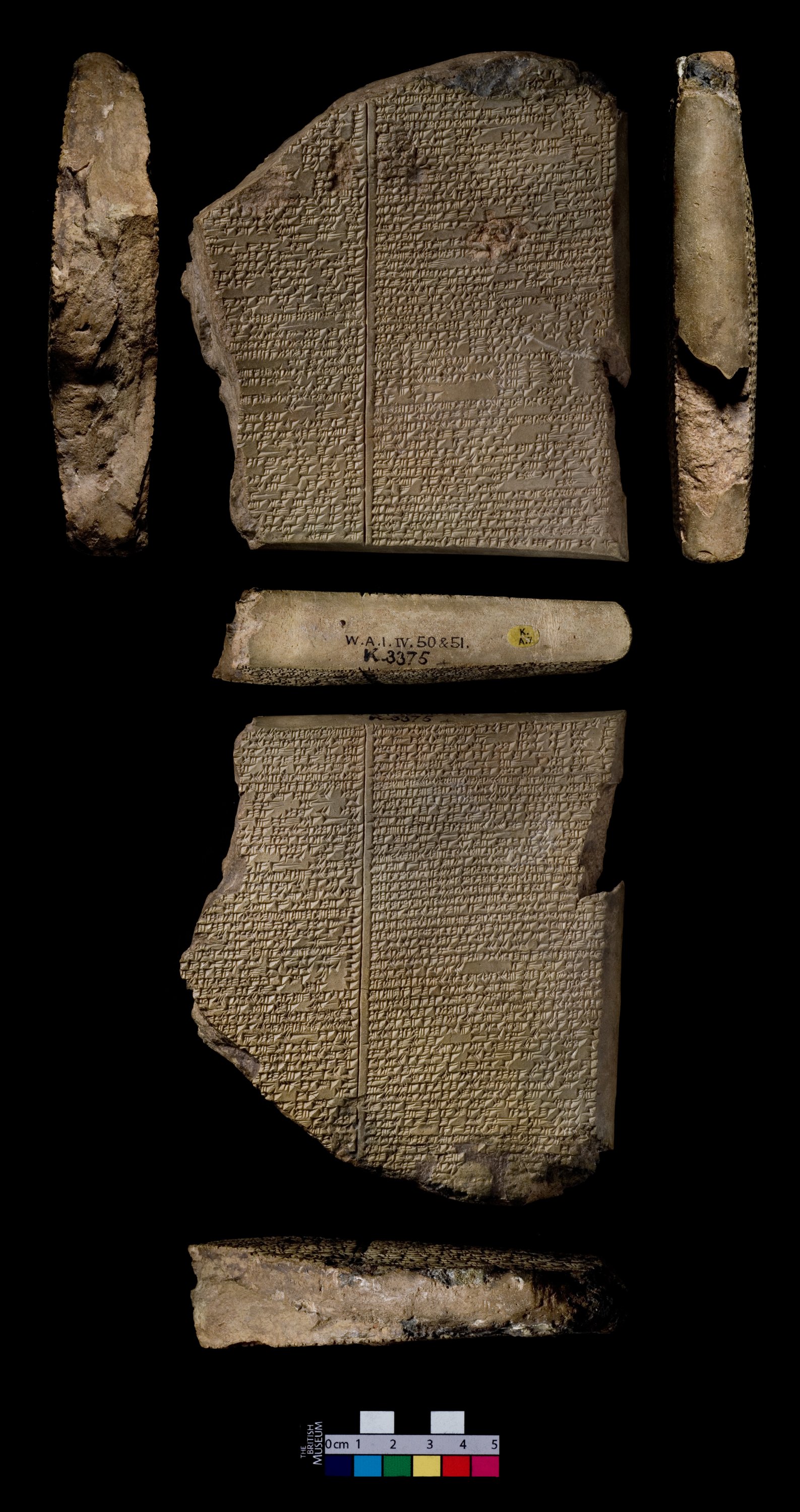
British Museum K.3375: obverse, column iii, the tablet's own lines 2 to 28. eBL's corpus edition (https://www.ebl.lmu.de/corpus/L/1/4/SB/XI) attributes SB XI 109-137 to this manuscript at these column and line numbers. Photograph checked: obverse, reverse and edges, ink number K.3375 and 'W.A.I. IV 50 & 51' on the edge; two columns on each face, consistent with eBL's columns ii-iii (obverse) and iv-v (reverse). On this tablet of line 109 only one to three signs survive and lines 110-111, 113-114, 122-123, 130 are partly broken (square brackets and x in the Akkadian). The English of these lines translates eBL's composite text, so it includes words that are not preserved on this tablet but are restored from other manuscripts or by the editors. Square brackets in the English mark eBL's restorations in its composite text; words that survive on other tablets carry no brackets even where this tablet is broken. Lines 112, 115-121, 124-129, 131-137 are complete on this tablet.
109[x x x x x x x] a-bu-bu x [x x]
110[x x x] i#-zi#-[qam-ma x x-š]i KUR-a a#-[bu-bu?]
111[ki-m]a qab-li UGU# UN-MEŠ u₂-ba-ʾ-u₂ [ka-šu₂-šu₂]
112ul# im-mar a-hu a-ha-šu₂ :
113ul# u₂#-ta#-ad#-da#-a# UN#-MEŠ# ina A[N-e]
114DINGIR.DINGIR ip-tal-hu a-bu-ba#-am-[ma]
115it-te-eh-su i-te-lu-u₂ ana AN-e ša₂ {d}a-nim
116DINGIR-MEŠ ki-ma UR.GI₇ kun-nu-nu ina ka-ma-a-ti rab-ṣu
117i-šas-si {d}iš-tar ma-li-ti
118u₂-nam-bi DINGIR.MAH | ṭa-bat rig-ma
119u₄-mu ul-lu-u₂ a-na ṭi-iṭ-ṭi lu-u₂ i-tur-ma
120ša₂# a#-na#-ku ina ma-har DINGIR.DINGIR aq-bu-u₂ {munus}HUL
121ki#-i aq#-bi ina ma-har | DINGIR.DINGIR {munus}HUL
122ana hul-l[u]-uq UN-MEŠ-ia qab-la aq-bi-ma
123a-na-ku-[u]m-ma ul-la-da ni-šu-u₂-a-a-ma
124ki-i DUMU-MEŠ KU₆.HA₂ u₂-ma-al-la-a tam-ta-am-ma
125DINGIR.DINGIR šu-ut {d}a-nun-na-ki ba-ku-u₂ it-ti-ša₂
126DINGIR-MEŠ aš-ru aš₂-bi i-na bi-ki-ti
127kat₃-ma šap-ta-šu₂-nu le#-qa#-a bu-uh-re-e-ti
1286 ur-ra u₃# mu-ša₂-a-ti
129il-lak ša₂-a-ru a-bu-bu# me#-hu-u₂ i-sap-pan KUR
130se-bu-u₂ u₄-mu i-na ka-ša₂-a-di# [( : )]
131te#-riq# šu-u₂ a-bu-bu qab-la
132-133aša₂ im-tah-ṣu ki-ma ha-a-a-al-ti (line break) i-nu-uh A.AB.BA
133buš-ha-ri-ir-ma im-hul!(U₃)-lu a-bu-bu ik-la
134ap-pa-al-sa ta-ma-ta ša₂-kin qu-lu
135u₃ kul-lat te-ne₂-še-e-ti i-tu-ra a-na ṭi-iṭ-ṭi
136ki-ma u₂-ri mit-hu-rat u₂-šal-lu
137ap-te nap-pa-ša₂-am-ma UD.DA im-ta-qut UGU BAD₃ ap-pi-ia
109for one day the gale (and) the flood [flattened the country,]
110Quickly it blew, and [then came] the [Deluge.]
111like a battle [the cataclysm] passed over(!) the people.
112One person could not see another,
113Nor people recognize each other in the destruction.
114Even the gods took fright at the Deluge!
115They withdrew, they went up to the heaven of Anu.
116The gods curled up like dogs, lying out in the open.
117The goddess, screaming like a woman in childbirth,
118Bēlet-ilī, the sweet-voiced, wailed aloud:
119“Indeed the past has truly turned to clay,
120because I spoke evil in the assembly of the gods.
121How was it I spoke evil in the assembly of the gods,
122(and) declared a war to destroy my people?
123It is I that gave birth (to them)! They are my people!
124(Now) like so many fish they fill the sea.”
125The gods, the Anunnaki, were weeping with her,
126wet-faced with sorrow, they were weeping [with her],
127their lips were parched, being stricken with fever.
128For six days and (seven) nights,
129was blowing the wind, the Deluge, the gale laying flat the land.
130When the seventh day arrived,
131the gale relented, [the Deluge ended].
132-133a(133a) The sea grew calm, (132) that had fought like a woman in labour,
133bthe tempest grew still, the Deluge ended.
134I looked at the weather, and there was quiet,
135but all the people had turned to clay.
136The flood plain was level like a roof.
137I opened a vent, and sunlight fell on the side of my face.
Where on the image
British Museum K.3375: obverse, column iii, the tablet's own lines 29 to 54. eBL's corpus edition (https://www.ebl.lmu.de/corpus/L/1/4/SB/XI) attributes SB XI 138-166 to this manuscript at these column and line numbers. Photograph checked: obverse, reverse and edges, ink number K.3375 and 'W.A.I. IV 50 & 51' on the edge; two columns on each face, consistent with eBL's columns ii-iii (obverse) and iv-v (reverse). On this tablet lines 142-147, 149-150, 152, 160, 162 are partly broken (square brackets and x in the Akkadian). The English of these lines translates eBL's composite text, so it includes words that are not preserved on this tablet but are restored from other manuscripts or by the editors. Square brackets in the English mark eBL's restorations in its composite text; words that survive on other tablets carry no brackets even where this tablet is broken. Lines 138-141, 148, 151, 153-159, 161, 163-166 are complete on this tablet.
138uk-tam-mi-is-ma at-ta-šab a-bak-ki
139UGU BAD₃ ap-pi-ia il-la-ka di-ma-a-a
140ap-pa-li-is kib-ra-a-ti pa-tu A.AB.BA
141a-na 12.TA.AM₃ i-te-la-a na-gu-u₂#
142a-na KUR ni-muš i-te-mid {giš}M[A₂]
143KUR-u₂ {kur}ni-muš {giš}MA₂ iṣ-bat-ma a-na na-a-ši ul i[d-din]
1441-en u₄-mu 2-a u₄-mu KUR-u₂ ni-muš K[IMIN]
145šal-ša₂ u₄-mu re-ba-a u₄-mu KUR-u₂ ni-muš KI[MIN]
1465-šu₂ 6-ša₂ KUR-u₂ ni-muš KI[MIN]
1477-a u₄-ma i-na ka-ša₂-d[i]
148u₂-še-ṣi-ma TU{mušen} u₂-maš-šar :
149il-lik TU{mušen} i-tu-ram-m[a]
150man-za-zu ul i-pa-aš₂-šum-ma is-sah-r[a]
151u₂-še-ṣi-ma SIM{mušen} u₂-maš-šar!(ŠIR₃) :
152il-lik SIM{mušen} i-tu-ram-m[a]
153man-za-zu ul i-pa-aš₂-šum-ma is-sah-ra
154u₂-še-ṣi-ma a-re-bi u₂-maš-šar!(ŠIR₃)
155il-lik a-re-bi-ma qa-ru-ra ša₂ A-MEŠ i-mur-ma
156ik-kal i-ša₂-ah-hi i-tar-ri ul is-sah-ra
157u₂-še-ṣi-ma a-na 4 IM-MEŠ at-ta-qi₂ ni-qa-a
158aš₂-kun sur-qin-nu ina UGU ziq-qur-rat KUR-i
1597 u 7 {dug}A.DA.GUR₅ uk-tin
160i-na šap-li-šu₂-nu at-ta-bak GI {giš}EREN u {šim}GI[R₂]
161DINGIR-MEŠ i-ṣi-nu i-ri-ša₂ :
162DINGIR-MEŠ i-ṣi-nu i-ri-ša₂ DUG₃.G[A]
163DINGIR-MEŠ ki-ma zu-um-be₂-e UGU EN SISKUR₂ ip-tah-ru
164ul-tu ul-la-nu-um-ma DINGIR.MAH ina ka-ša₂-di-šu₂
165iš-ši NIM-MEŠ GAL-MEŠ ša₂ {d}a-num i-pu-šu₂ ki-i ṣu-hi-šu₂
166DINGIR-MEŠ an-nu-ti lu-u₂ {na₄}ZA.GIN₃ GU₂-ia <<a-a am-ši>>
138I fell to my knees and sat there weeping,
139the tears streaming down the side of my face.
140I scanned the shores, the edge of the sea,
141in fourteen places emerged a landmass.
142On Mount Nimuš the boat ran aground,
143Mount Nimuš held the boat fast and did not let it move.
144One day, a second day, Mount Nimuš held the boat fast and did not let it move,
145a third day, a fourth day, Mount Nimuš held the boat fast and did not let it move,
146a fifth, a sixth, day, Mount Nimuš held the boat fast and did not let it move.
147When the seventh day arrived —
148I brought out a dove, setting it free:
149Off went the dove, …
150No perch was available for it, so it came back to [me].
151I brought out a swallow, setting it free:
152Off went the swallow, …
153No perch was available for [it], so it came back to me.
154I brought out a raven, setting it free:
155Off went the raven and it saw the waters receding.
156So it could eat, scratch, peck (food), and did not come back to me.
157I brought out an offering and sacrificed to the four corners of the earth,
158I strewed incense on the peak of the mountain.
159Seven flasks and seven I set in position,
160below them I heaped up (sweet) reed, cedar and myrtle.
161The gods smelled the savour,
162the gods smelled the sweet savour,
163the gods gathered like flies round the sacrificer.
164As soon as Bēlet-ilī arrived,
165she lifted aloft the great flies that Anu had made when he wooed (her):
166“O gods, let these be lapis lazuli (beads) around my neck,
Where on the image
British Museum K.3375: reverse, column iv, the tablet's own lines 1 to 20a. eBL's corpus edition (https://www.ebl.lmu.de/corpus/L/1/4/SB/XI) attributes SB XI 167-194 to this manuscript at these column and line numbers. Photograph checked: obverse, reverse and edges, ink number K.3375 and 'W.A.I. IV 50 & 51' on the edge; two columns on each face, consistent with eBL's columns ii-iii (obverse) and iv-v (reverse). On this tablet lines 176, 178-180, 182-184, 186-187, 189, 191, 193 are partly broken (square brackets and x in the Akkadian). The English of these lines translates eBL's composite text, so it includes words that are not preserved on this tablet but are restored from other manuscripts or by the editors. Square brackets in the English mark eBL's restorations in its composite text; words that survive on other tablets carry no brackets even where this tablet is broken. Lines 167-175, 177, 181, 185, 188, 190, 192, 194 are complete on this tablet.
167U₄-MEŠ an-nu-ti ah-su-sa-am-ma ana da-riš a-a am-ši
168DINGIR-MEŠ lil-li-ku-ni a-na sur-qin-ni
169{d}en-lil₂ a-a il-li-ka a-na sur-qin-ni
170aš₂-šu₂ la im-tal-ku-ma iš-ku-nu a-bu-bu
171u₃ UN-MEŠ-ia im-nu-u₂ ana ka-ra-ši
172ul-tu ul-la-nu-um-ma {d}+en-lil₂ ina ka-ša₂-di-šu₂
173i-mur {giš}MA₂-ma i-te-ziz {d}+en-lil₂ :
174lib-ba-ti im-ta-li ša₂ DINGIR.DINGIR {d}i₂-gi₃-gi₃
175a-a-um-ma u₂-ṣi na-piš-ti :
176a-a ib-luṭ LU₂ ina ka-ra-š[i]
177{d}nin-urta pa-a-šu₂ DU₃-ma DUG₄.GA :
178MU-ar₂ ana qu-ra-di {d}+en-l[il₂]
179man-nu-um-ma ša₂ la {d}e₂-a a-ma-tu i-ban-n[i]
180u₃ {d}e₂-a i-de-e-ma ka-la šip-r[i]
181{d}e₂-a pa-a-šu₂ DU₃-ma DUG₄.GA :
182MU-ar₂ ana qu-ra-du {d}+en-[lil₂]
183at-ta ABGAL DINGIR-MEŠ qu-ra-[du]
184ki-i-ki-i la tam-ta-lik-ma a-bu-bu taš-k[un]
185be-el hi-ṭi e-mid hi-ṭa-a-šu₂ :
186be-el gil₂-la-ti e-mid gil₂-lat-[su]
187ru-um-me a-a ib-ba-ti-iq šu-du-ud a-a i[r-mu]
188am-ma-ku taš-ku-nu a-bu-ba :
189UR.MAH lit-ba-am-ma UN-MEŠ li-ṣa-a[h-hir]
190am-ma-ku taš-ku-nu a-bu-ba :
191UR.BAR.RA lit-ba-am-ma UN-MEŠ li-ṣa-[hi-ir]
192am-ma-ku taš-ku-nu a-bu-ba :
193hu-šah-hu liš-ša₂-kin-ma KUR liš-[giš]
194am-ma-ku taš-ku-nu a-bu-ba :
167so that I remember these days and never forget them!
168Let the gods come to the incense,
169(but) may Enlil not come to the incense,
170because he lacked counsel and caused the Deluge,
171and delivered my people into destruction.”
172As soon as Enlil arrived,
173Enlil saw the boat and grew angry.
174He was filled with rage against the Igigi gods:
175“[From] where escaped (this) living creature?
176No man should survive the destruction!”
177Ninurta opened his mouth to speak,
178saying to the hero Enlil:
179“Who, if not Ea, can accomplish (such) things?
180For Ea alone knows (how to do) all tasks,”
181Ea opened his mouth to speak,
182saying to the hero Enlil:
183“You, the sage of the gods, the hero,
184how could you lack counsel and cause the deluge?
185On him who commits a sin, inflict his crime!
186on him who does wrong, inflict [his] wrong-doing!
187Slack off, lest it be snapped! Pull taut, lest it become [slack!]
188Instead of the Deluge you caused,
189a lion could arise to diminish the people!
190Instead of the Deluge you caused,
191a wolf could arise to diminish the people!
192Instead of the Deluge you caused,
193a famine could happen to slaughter the land!
194Instead of the Deluge you caused,
Where on the image
British Museum K.3375: reverse, column iv, the tablet's own lines 20b to 46. eBL's corpus edition (https://www.ebl.lmu.de/corpus/L/1/4/SB/XI) attributes SB XI 195-222 to this manuscript at these column and line numbers. Photograph checked: obverse, reverse and edges, ink number K.3375 and 'W.A.I. IV 50 & 51' on the edge; two columns on each face, consistent with eBL's columns ii-iii (obverse) and iv-v (reverse). On this tablet lines 195, 222 are partly broken (square brackets and x in the Akkadian). The English of these lines translates eBL's composite text, so it includes words that are not preserved on this tablet but are restored from other manuscripts or by the editors. Square brackets in the English mark eBL's restorations in its composite text; words that survive on other tablets carry no brackets even where this tablet is broken. Lines 196-221 are complete on this tablet.
195{d}er₃-ra lit-ba-am-ma UN-MEŠ li[š]-giš#
196a-na-ku ul ap-ta-a pi-riš-ti DINGIR-MEŠ GAL-MEŠ
197at-ra-ha-sis šu-na-ta u₂-šab-ri-šum-ma pi-riš-ti DINGIR-MEŠ iš-me
198e-nin-na-ma mi-lik-šu₂ mil-ku :
199i-lam-ma {d}IDIM ana lib₃-bi {giš}MA₂
200iṣ-bat qa-ti-ia-ma ul-te-la-an-ni ia-a-ši
201uš-te-li uš-tak-mi-is sin-niš-ti ina i-di-ia
202il-pu-ut pu-ut-ni-ma iz-za-az ina bi-ri-in-ni i-kar-ra-ban-na-ši
203i-na pa-na {m}UD-ZI a-me-lu-tum₃-ma
204e-nin-na-ma {m}UD-ZI u MUNUS-šu₂ lu-u e-mu-u₂ ki-ma DINGIR-MEŠ na-ši-ma
205lu-u₂ a-šib-ma {m}UD-ZI ina ru-u₂-qi₂ ina pi-i ID₂-MEŠ
206il-qu-in-ni-ma ina ru-qi₂ ina KA ID₂-MEŠ uš-te-ši-bu-in-ni
207e-nin-na-ma ana ka-a-ša₂ man-nu DINGIR-MEŠ u₂-pah-ha-rak-kum₂-ma
208ba-la-ṭa ša₂ tu-ba-ʾ-u₂ tu-ut-ta-a at-ta
209ga-na e ta-at-til 6 ur-ri u₃ 7 mu-ša₂-a-ti
210ki-ma aš₂-bu-ma ina bi-rit pu-ri-di-šu₂
211šit-tu ki-ma im-ba-ri i-nap-pu-uš UGU-šu₂
212{m}UD-ZI ana ša₂-ši-ma MU-ar₂ ana mar-hi-ti-šu₂
213am-ri {lu₂}GURUŠ ša₂ i-ri-šu₂ ba-la-ṭu
214šit-tu ki-ma im-ba-ri i-nap-pu-uš UGU-šu₂
215mar-hi-is-su ana ša₂-šu-ma MU-ar₂ a-na {m}UD-ZI ru-qi₂
216lu-pu-us-su-ma li-ig-gel₂-ta-a LU₂
217har-ra-ni il-li-ka li-tur ina šul-me
218KA₂.GAL u₂-ṣa-a li-tur a-na ma-ti-šu₂
219{m}UD-ZI ana ša₂-ši-ma MU-ar₂ ana mar-hi-ti-šu₂
220rag-ga-at a-me-lut-tu i-rag-gi-ig-ki
221ga-na e-pi-i ku-ru-um-ma#-ti#-šu₂# ši-tak-ka-ni ina re-ši-šu₂
222u₃ u₄-mi ša₂ it-t[i-l]u ina i-ga-ri eṣ-r[i]
195Erra could arise to slaughter the land!
196I did not myself disclose the great gods’ secret;
197I let Atra-ḫasīs see a dream and so he heard the gods’ secret.
198And now, consider what is to be done with him.”
199Enlil came up into the boat,
200he took hold of my hands and brought me out.
201He brought out my woman, he made her kneel at my side,
202he touched our foreheads, standing between us to bless us:
203“In the past Ūta-napišti was (one of) mankind,
204but now Ūta-napišti and his woman shall be like us gods!
205Ūta-napišti shall dwell far away, at the mouth of the rivers!”
206They took me and settled me far away, at the mouth of the rivers.
207But now, who will bring the gods to assembly for you,
208so you can find the life you search for?
209Come, for six days and seven nights do not sleep!’
210As soon as he sat down on his haunches,
211sleep was wafting over him like a fog.
212Ūta-napišti spoke to her, to his wife:
213‘See the fellow who demanded life!
214sleep is wafting over him like a fog.’
215His wife spoke to him, to Ūta-napišti the Far-Away:
216‘Touch him, let the man awake!’
217(By) the road he came let him go back in safety,
218(by) the gate he came out let him return to his land!’
219Ūta-napišti spoke to her, to his wife:
220‘Being deceitful, mankind will deceive you.
221Go, bake his daily rounds of bread, line them up by his head,
222and mark on the wall the days that he slept.’
Where on the image
British Museum K.2252: reverse, column v, the tablet's own lines 3 to 12. eBL's corpus edition (https://www.ebl.lmu.de/corpus/L/1/4/SB/XI) attributes SB XI 223-234 to this manuscript at these column and line numbers. Photograph checked: obverse, reverse and edges of the join K.2252 + K.2602 + K.3321 + K.4486 + Sm.1881 (ink numbers K.3321 and S.1881 on the lower edge, plaster fill); three columns on each face, consistent with eBL's columns i-vi. On this tablet lines 223-225, 227, 229-234 are partly broken (square brackets and x in the Akkadian). The English of these lines translates eBL's composite text, so it includes words that are not preserved on this tablet but are restored from other manuscripts or by the editors. Square brackets in the English mark eBL's restorations in its composite text; words that survive on other tablets carry no brackets even where this tablet is broken. Lines 226, 228 are complete on this tablet.
223ši-i i-pi ku-ru-um-ma-ti-šu₂ iš-tak-ka-ni ina re-ši-š[u]
224u u₄-mi ša₂ it-ti-lu ina i-ga-ri ud-da-aš₂-š[u₂]
225iš-ta-at ša₂-bu-lat ku-ru-um-mat-s[u]
2262-tu₄ muš-šu-kat₃ 3-tu₄ raṭ-bat :
2274-tu₄ ip-te-ṣi ka-man-[šu₂]
2285-tu₄ ši-ba it-ta-di :
2296-tu₄ ba-aš-[lat]
230se-bu#-tu₄ ina pe-et-tim-ma il-pu-us-su-ma i-te#-gel₂-ta-a#-[(ma) L]U₂
231{d}GIŠ-gim₂-maš a-na ša₂-šu-ma MU-ra a-na {m}UD-ZI [ru-u₂]-qi₂
232an-ni-miš šit-tu₄ ir-hu#-u₂# e-l[i]-ia
233ha-an-ṭiš tal-tap-tan-ni-ma t[a-ad-da-kan-n]i [at]-ta
234{m}UD-ZI# a#-[na ša₂-šu-m]a [MU-ra] a#-na {d}G[IŠ-gi]m₂-maš
223She baked his daily rounds of bread, she lined them up by his head,
224and on the wall noted for him the days that he slept.
225His first round of bread was dried up,
226the second was leathery, the third was soggy;
227His fourth flour-cake had turned white,
228the fifth had produced a (mouldy) stain;
229the sixth was fresh-baked,
230the seventh was on the coals: he touched him and the man awoke.
231Gilgameš spoke to him, to Ūta-napišti the Far-Away:
232‘No sooner than sleep spilled over me,
233than forthwith you touched me and roused me!’
234Ūta-napišti [spoke to him,] to Gilgameš
Where on the image
British Museum K.7752: reverse, column iv, the tablet's own lines 10'-11' to 20'. eBL's corpus edition (https://www.ebl.lmu.de/corpus/L/1/4/SB/XI) attributes SB XI 235-245 to this manuscript at these column and line numbers. Photograph checked: obverse, reverse and edges of the join K.7752 + 1881,0204.245 + .296 + .460 (ink numbers on the pieces); text on both faces, consistent with eBL's columns ii-iii and iv-vi. On this tablet lines 235-238, 240-245 are partly broken (square brackets and x in the Akkadian). The English of these lines translates eBL's composite text, so it includes words that are not preserved on this tablet but are restored from other manuscripts or by the editors. Square brackets in the English mark eBL's restorations in its composite text; words that survive on other tablets carry no brackets even where this tablet is broken. Line 239 is complete on this tablet.
235[x x x {d}GIŠ-gim₂-ma]š mu-(erasure)-na-(erasure)-a (line break) [ku-ru-u]m-ma-ti-(erasure)-ka
236[x x x x x x x x x x e-da]k-ka ka-a-ša₂
237[x x x x x x] ku-ru-um-mat-ka
238[x x x muš-šu]-kat₃# 3#-tu₄# raṭ#-[ba]t ( : )
2394-tu₄ ip-te-ṣi ka-man-ka
240[x x ši-p]a it-ta-di 6#-[t]u₄ ba-aš-lat
241[7-tu₄ in]a pe#-et-tim-ma te-et-[te-g]el₂-ta-a at-ta
242[{d}GIŠ-g]im₂-maš ana ša₂-šu-ma MU-ra a#-na {m}UD-ZI ru-u₂-qi₂
243[ki-k]i-i lu-pu-uš {m}ut-Z[I a?]-a#-i-ka-a lul-lik
244[x (x)]-MEŠ-ia uṣ-ṣab-bi-tu₄ ek-ke-mu
245[ina] E₂ ma-a-a-li-ia a#-šib mu-tu₄
235Come, Gilgameš, count me your rounds of bread,
236and may [the time that you slept] be made known to you.
237Your [first round] of bread [was dried up]
238the second was leathery, the third was soggy;
239your fourth flour-cake had turned white,
240the fifth had produced a (moudly) stain, the sixth was fresh-baked;
241[the seventh was on] the coals, and then you awoke.’
242Gilgameš spoke to him, to Ūta-napišti the Far-Away:
243How should I go on, Uta-napisti? Where should I go?
244The Thief has taken hold of my [flesh.]
245In my bed-chamber Death abides,
Where on the image
British Museum K.3375: reverse, column v, the tablet's own lines 17 to 25b. eBL's corpus edition (https://www.ebl.lmu.de/corpus/L/1/4/SB/XI) attributes SB XI 246-256 to this manuscript at these column and line numbers. Photograph checked: obverse, reverse and edges, ink number K.3375 and 'W.A.I. IV 50 & 51' on the edge; two columns on each face, consistent with eBL's columns ii-iii (obverse) and iv-v (reverse). On this tablet of line 250 only one to three signs survive and lines 246-249, 252-255 are partly broken (square brackets and x in the Akkadian). The English of these lines translates eBL's composite text, so it includes words that are not preserved on this tablet but are restored from other manuscripts or by the editors. Square brackets in the English mark eBL's restorations in its composite text; words that survive on other tablets carry no brackets even where this tablet is broken. Lines 251, 256 are complete on this tablet.
246[x x x x x x lu-u]š-kun šu-u₂ mu-tum₃-ma
247[x x x x x x x x i-zak-ka-r]a a-na {m}ur-šanabi₂ ma-la-hi
248[x x x x x x lid]-di-ka ne₂-be₂-ru li-zer-ka
249[x x x x x DU.DU-M]EŠ-ku ah-ša₂ zu-um-me
250[x x x x x pa-n]a-as-su :
251ik-ta-su-u₂ ma-lu-u₂ pa-gar-šu₂
252[x x x uq-t]a-at-tu-u₂ du-muq UZU-MEŠ-šu₂
253[x x x {m}u]r-šanabi₂ ana nam-se-e bil-šu₂-ma
254[x x x x A-M]EŠ GIM el-li lim-si
255[x x x x x] li-bil tam-tu₄ :
256ṭa-a-bu lu ṣa-pu zu-mur-šu₂
246and wherever I might turn [my face], there too will be Death.’
247Ūta-napisti spoke to [him,] to the boatman Ur-šanābi:
248‘Ur-šanābi, may the quay reject you, may the ferry scorn you!
249You who used to walk on its shore, suffer absence from it!
250The man that you led here,
251whose body is tousled with matted hair,
252the beauty of whose flesh the hides have ruined,
253take him, Ur-šanābi, get him to the washtub,
254let him wash his matted hair as clean as can be!
255Let him cast off his hides and the sea carry (them away)!
256Soak his body so fair!
Where on the image
British Museum K.2252: reverse, column v, the tablet's own lines 31 to 47. eBL's corpus edition (https://www.ebl.lmu.de/corpus/L/1/4/SB/XI) attributes SB XI 257-278 to this manuscript at these column and line numbers. Photograph checked: obverse, reverse and edges of the join K.2252 + K.2602 + K.3321 + K.4486 + Sm.1881 (ink numbers K.3321 and S.1881 on the lower edge, plaster fill); three columns on each face, consistent with eBL's columns i-vi. On this tablet of lines 268, 270-272 only one to three signs survive and lines 257-258, 260-264, 266, 273-278 are partly broken (square brackets and x in the Akkadian). The English of these lines translates eBL's composite text, so it includes words that are not preserved on this tablet but are restored from other manuscripts or by the editors. Square brackets in the English mark eBL's restorations in its composite text; words that survive on other tablets carry no brackets even where this tablet is broken. Lines 259, 265, 267, 269 are complete on this tablet.
257lu-u₂ ud-du-u[š par₂-si-g]u ša₂ S[AG.D]U-šu₂
258te-di-qi₂ lu-u₂ l[a-biš x x bal-t]i-šu₂ :
259a-di il-la-ku ana URU-šu₂
260a-di i-kaš-ša₂-d[u ( : )]
261[t]e-di-qu ši-pa a-a id-di-ma e-de-šu₂ li-diš
262il-qe₂-šu-m[a x x x an]a nam-se-e u₂-bil-šu-ma
263ma-le-šu₂ ina [x x x i]l-li im#-si
264id-di KUŠ-[MEŠ-šu-ma t]am-tu₄ :
265ṭa-a-ba iṣ-ṣa-pi# SU-šu₂
266u₂-te-ed-di[š par₂-si-gu ša₂ SAG.DU-š]u₂ :
267te-di-qa la-biš ṣu-bat bal-ti-šu₂
268[a-di i]l-[la-ku ana URU-šu₂] :#
269i#-kaš#-ša₂#-du# ana ur-hi-šu₂
270[x x x x x x x x x x x x x] li-diš
271[x x x x x x x x x x x x] {giš#}MA₂#
272{giš}m[a₂-gi-il-la x x x x x x x x]
273mar-hi-is-s[u x x x x x x x x x]
274{d}GIŠ-gim₂-maš D[U?-ka x x x x x x]
275mi-na-a ta-at-tan-na#-aš₂#-š[um-ma x x x x x x]
276u šu-u₂ iš-ši pa-r[i-sa x x x x]
277{giš}MA₂ uṭ-ṭe₃-eh-ha-a# [x x x x]
278{m}UD-ZI a-na ša₂-šu-ma [MU-ar₂ x x x x x x]
257Let the kerchief of his head be renewed!
258Let him be clad in a royal robe, the attire befitting his dignity!
259Until he goes (home) to his city,
260until he arrives at (the end of) his road,
261let the robe show no stain but stay brand new!’
262Ur-šanābi took him and got him to the washtub.
263He washed his matted hair as clean as can be,
264He cast off his hides [and] the sea carried (them away).
265His body so fair was soaked,
266the [kerchief of] his head was renewed,
267he was clad in a royal robe, the attire befitting his dignity.
268‘Until he goes (home) [to his city,]
269until he arrives at (the end of) his road,
270let [the robe show no stain] but stay brand new!’
271Gilgames and Ur-šanābi boarded the boat,
272they launched the [craft,] they crewed it themselves.
273His wife spoke to him, to Uta-napišti the Far-Away:
274‘Gilgames came here, toiled, exerted himself,
275what have you given him as he goes back to his land?'
276And he, Gilgameš, raised the punting-pole,
277he brought the boat close to the shore
278Ūta-napišti [spoke] to him, to Gilgameš:
Where on the image
British Museum K.2252: reverse, column vi, the tablet's own lines 1 to 19a. eBL's corpus edition (https://www.ebl.lmu.de/corpus/L/1/4/SB/XI) attributes SB XI 279-301 to this manuscript at these column and line numbers. Photograph checked: obverse, reverse and edges of the join K.2252 + K.2602 + K.3321 + K.4486 + Sm.1881 (ink numbers K.3321 and S.1881 on the lower edge, plaster fill); three columns on each face, consistent with eBL's columns i-vi. On this tablet lines 286, 298 are entirely broken, of line 288 only one to three signs survive and lines 279-280, 282-285, 289-297, 299-301 are partly broken (square brackets and x in the Akkadian). The English of these lines translates eBL's composite text, so it includes words that are not preserved on this tablet but are restored from other manuscripts or by the editors. Square brackets in the English mark eBL's restorations in its composite text; words that survive on other tablets carry no brackets even where this tablet is broken. Lines 281, 287 are complete on this tablet.
279{d#}GIŠ-gim₂-maš tal-li#-ka ta-na-ha t[a-šu-ṭa]
280mi-na-a at-tan-nak-kum₂-ma ta-ta-ar₂ ana [x x]
281lu-u₂-up-te {d}GIŠ-gim₂-maš a-mat ni-ṣir-ti :
282u AD.HAL š[a₂ DINGIR-MEŠ x x x x x x x]
283šam-mu šu-u₂ ki-ma ed-de-et-t[i x x x x x]
284si-hi-il-šu₂ GIM a-mur-din-nim-ma u₂-sa[h-hal]
285šum-ma šam-ma ša₂-a-šu₂ i-kaš-ša₂-da qa-ta-a-k[a ( : )]
286[x x x x x x x x x (x)]
287{d}GIŠ-gim₂-maš an-ni-tu₂ ina še-me-šu₂ ( : )
288ip-ti r[a-a-ṭa x x x x x]
289u₂-rak-ki-is NA₄-MEŠ kab-tu-t[a x x x x]
290il-du-du-šu-[m]a ana ABZ[U x x x x x]
291šu-u₂ il-qe₂# šam-ma-ma is-s[u-uh-šu₂ x x x]
292u₂-bat-ti-iq NA₄#-MEŠ kab-tu-t[a x x x]
293tam#-tu₄ is-su#-kaš-šu₂ [x x x x x]
294{d}GIŠ-gim₂-maš a-na ša₂-šu-ma MU-r[a ana x x x ma-la-h]u
295{m}ur-šanabi₂ šam-mu an-nu-u₂ ša[m-mu x x x]
296ša₂ LU₂ ina lib₃-bi-šu₂ i-kaš-ša₂#-d[u x x]
297lu#-bil#-šu# ana lib₃-bi UNUG{ki} su-pu-r[i ( : )]
298[x x x x x x x x x x x]
299šum#-ma?# ši-i-bu iṣ-ṣa#-[hir x]
300a-na-ku lu-kul-ma lu-tur a-[na x x x x x x]
301a-na 20 DANNA ik-su-pu ku-sa-pu [( : )]
279‘You came here, Gilgameš, toiled, exerted yourself,
280what have I given you as you go back to your land?
281I will disclose, Gilgameš, a secret matter,
282and [I will] tell you a mystery of [the gods.]
283It is a plant, its [appearance] is like box-thorn,
284its thorn is like the dog-rose’s, it will [prick your hands.]
285If you can gain possession of that plant,
286[you’ll be again as you were in your youth.]’
287When Gilgameš heard this,
288he opened a [channel] …
289Heavy stones he tied [on his feet,]
290they dragged him down to the Apsû […]
291He pulled the plant, and pulled [it up and lifted it,]
292he cut loose the heavy stones [from his feet.]
293The sea cast him up on its shore.
294Gilgameš spoke to him, to Ur-šanābi the boatman:
295‘Ur-šanābi, this plant is the “plant of the heart-beat”,
296by which means a man can recapture his vitality.
297I will take it to Uruk the sheepfold,
298I will feed some to an old man and put the plant to the test.
299If the old man grows young (again),
300I will eat some myself and go back to how I was in my youth!'
301At twenty leagues they broke bread,
Where on the image
British Museum K.7752: reverse, column vi, the tablet's own lines 4b to 9. eBL's corpus edition (https://www.ebl.lmu.de/corpus/L/1/4/SB/XI) attributes SB XI 302-307 to this manuscript at these column and line numbers. Photograph checked: obverse, reverse and edges of the join K.7752 + 1881,0204.245 + .296 + .460 (ink numbers on the pieces); text on both faces, consistent with eBL's columns ii-iii and iv-vi. On this tablet lines 303-307 are partly broken (square brackets and x in the Akkadian). The English of these lines translates eBL's composite text, so it includes words that are not preserved on this tablet but are restored from other manuscripts or by the editors. Square brackets in the English mark eBL's restorations in its composite text; words that survive on other tablets carry no brackets even where this tablet is broken. Line 302 is complete on this tablet.
302a-na 30 DANNA iš-ku-nu nu-bat-ta
303[x x x x x {d}G]IŠ-gim₂-maš ša₂ ka-ṣu-u₂ A-MEŠ-ša₂
304[x x x lib₃-b]i-im-ma A-MEŠ i-ra-muk
305[x i-te-ṣi-i]n ni-piš šam-mu
306[x x x i-l]am-ma šam-ma i[š]-ši
307[x x x x i]t-ta-di qu#-[lip-t]i
302at thirty leagues they pitched camp.
303Gilgameš found a pool whose water was cool,
304he went down into it to bathe in the water.
305A snake smelled the fragrance of the plant,
306[silently] it came up and bore the plant off;
307as it turned away it sloughed a skin.
Where on the image
British Museum K.8517: reverse, column vi, the tablet's own lines 8' to 10'a. eBL's corpus edition (https://www.ebl.lmu.de/corpus/L/1/4/SB/XI) attributes SB XI 308-311 to this manuscript at these column and line numbers. Photograph checked: obverse, reverse and edges of the join K.8517 + K.8518 + K.8569 + K.8593 + K.8595 (many pieces, plaster fill); text on both faces, consistent with eBL's columns i-ii and v-vi. On this tablet of line 310 only one to three signs survive and lines 308-309, 311 are partly broken (square brackets and x in the Akkadian). The English of these lines translates eBL's composite text, so it includes words that are not preserved on this tablet but are restored from other manuscripts or by the editors. Square brackets in the English mark eBL's restorations in its composite text; words that survive on other tablets carry no brackets even where this tablet is broken.
308[ina] u₄#-me-šu#-ma# {d}GI[Š-gi]m₂-[maš x x x x x x]
309[UG]U BAD₃ ap-pi-šu₂ DU-ka di-ma-a#-šu₂# :#
310i?#-[x x x x x x x]
311[ana ma]n-ni#-ia₂ {m}ur-{d}šanabi₂ i-na-ha i-da-a-a :#
308Then Gilgameš sat down weeping,
309the tears streaming down the side of his face.
310… [He spoke] to Ur-šanābi the boatman:
311‘[For whom] of my (kind), Ur-šanābi, did my arms grow exhausted,
Where on the image
British Museum K.2252: reverse, column vi, the tablet's own lines 26 to 38. eBL's corpus edition (https://www.ebl.lmu.de/corpus/L/1/4/SB/XI) attributes SB XI 312-328 to this manuscript at these column and line numbers. Photograph checked: obverse, reverse and edges of the join K.2252 + K.2602 + K.3321 + K.4486 + Sm.1881 (ink numbers K.3321 and S.1881 on the lower edge, plaster fill); three columns on each face, consistent with eBL's columns i-vi. On this tablet lines 312-317, 319, 321, 327-328 are partly broken (square brackets and x in the Akkadian). The English of these lines translates eBL's composite text, so it includes words that are not preserved on this tablet but are restored from other manuscripts or by the editors. Square brackets in the English mark eBL's restorations in its composite text; words that survive on other tablets carry no brackets even where this tablet is broken. Lines 318, 320, 322-326 are complete on this tablet.
312a-na man-ni-ia i-b[a-al? x x l]ib₃-bi-ia
313ul aš₂-kun dum-qa ana ram-ni-i[a ( : )]
314[x x x x x x x du]m-qi₂ i-te-pu-uš
315e-nin-na a-na 20 DANNA [x x x] i#-na-aš-šam-ma
316ra-a-ṭa ki-i ap-tu-u₂# [at-t]a-bak u₂-nu-tu₂
317ut-ta a-a-i-ta ša₂ ana KI-ia i[š-šak-nu] ana-ku lu ah-hi-is
318u {giš}MA₂ e-te-zib ina kib-ri :
319ana 20 D[ANNA] ik-su-pu ku-sa-pa
320ana 30 DANNA iš-ku-nu nu-bat-ta :
321ik-šu-d[u-ni]m-ma ana lib₃-bi UNUG{ki} su-pu-ri
322{d}GIŠ-gim₂-maš a-na ša₂-šu-ma MU-ra a-na# {m}ur-šanabi₂ ma-la-hi
323e-li-ma {m}ur-šanabi₂ ina UGU BAD₃ ša₂ UNUG{ki#} i-tal-lak
324te-me-en-na hi-i-ṭi-ma SIG₄ ṣu-ub-bi < : >
325šum-ma SIG₄#-šu₂ la a-gur-rat
326u uš-ši-šu₂ la id-du-u₂ 7 mun#-tal-ki
3271.šar₂@v URU{ki} 1.šar₂@v {giš}KIRI₆-MEŠ 1.šar₂@v es-su-u₂# pi#-t[i-i]r E₂ {d}iš-tar
3283 šar₂@v u₃ pit-ru UNUG{ki} tam-[ši]-hu#
312for whom of my (kind) ran dry the blood of my heart?
313Not for myself did I establish a bounty,
314[for] the “Lion of the Earth” I have done a favour.
315Now for twenty leagues the tide has been rising!
316When I opened the channel I abandoned the tools:
317what thing would I find that was placed (to serve) for my landmark? Had I only turned away,
318and left the boat on the shore!'
319At twenty leagues they broke bread,
320at thirty leagues they pitched camp.
321They arrived in Uruk the Sheepfold.
322Gilgameš spoke to him, to Ur-šanābi the boatman:
323‘Go up, Ur-šanābi, on to the wall of Uruk and walk around,
324survey the foundation platform, inspect the brickwork!
325(See) if its brickwork is not kiln-fired brick,
326and if the Seven Sages did not lay its foundations!
327One šār is city, one šār date-grove, one šār is clay-pit, half a šār the temple of Ištar:
328three šār and a half (is) Uruk, (its) measurement.’
Notes
- Akkadian: eBL transliteration of the signs on the photographed tablet (manuscript-level ATF), not a composite text.
- English: A. R. George's translation in the eBL edition; it renders eBL's composite text, including restorations from other tablets.
- Line numbers: eBL edition (based on A. R. George, The Babylonian Gilgamesh Epic, Oxford 2003). Each section also gives the tablet's own column and line numbers.
- Signs in the Akkadian: [ ] broken away; x illegible sign; # damaged sign; ? uncertain reading; ! sign corrected by the editor; ( ) signs perhaps broken away; { } determinative; < > sign omitted by the scribe, supplied by the editor; << >> sign written in error by the scribe; : divider sign written on the tablet; @v and similar: variant or modified form of a sign; | division between the parts of a line written in separate columns on the tablet; (line break) the line runs on to the next line of the tablet.
Cite
Sources
- Source: British Museum tablet photographs + eBL manuscript transliterations (eBL corpus edition L I.4, Poem of Gilgamesh (ed. A. R. George, rev. G. Rozzi and E. Jiménez), SB XI) + English of the eBL edition (A. R. George (eBL edition)) (holding institution)
- Critical edition: electronic Babylonian Library, Poem of Gilgamesh (ed. A. R. George), manuscript transliterations
← previous · → next · v cycle view · l back to library