Herodotus, Histories 1.1-14: The causes of the war; Candaules and Gyges
Introduction
Herodotus of Halicarnassus wrote the Histories in the third quarter of the 5th century BCE, an inquiry into the deeds of Greeks and barbarians and the causes of the wars between them, later divided into nine books. Book 1 tells how the conflict between Greeks and barbarians began, the history of Lydia from Gyges to Croesus, the rise of the Medes and of Cyrus the Persian, the conquest of the Greeks of Asia, the capture of Babylon and the death of Cyrus.
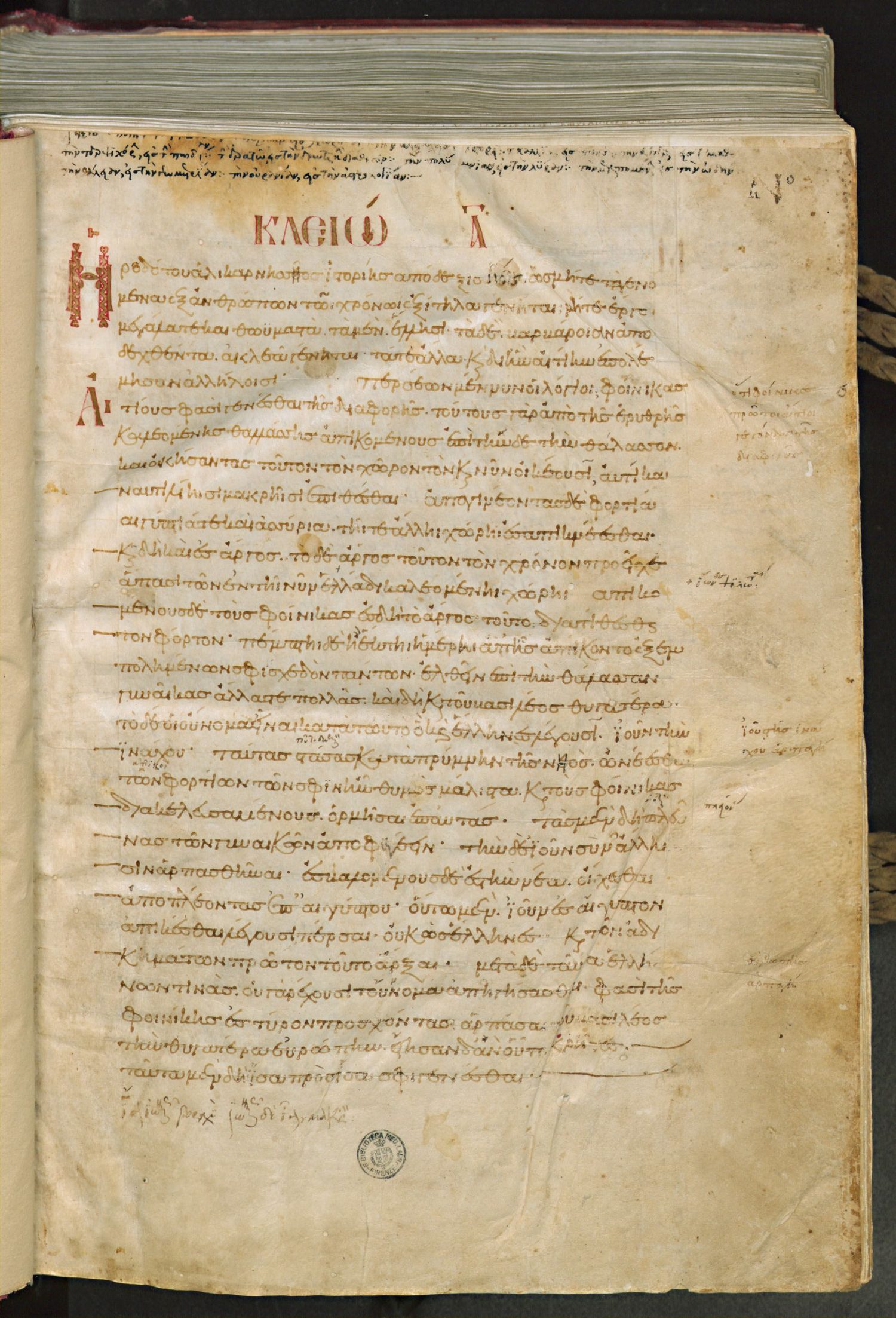
The photographs are of Florence, Biblioteca Medicea Laurenziana, Plut. 70.3 (parchment, 10th century, 374 folios, 31 lines a page), Herodotus, Histories (codex A of the editors), the oldest surviving manuscript of the complete Histories, from the Teca Digitale of the Biblioteca Medicea Laurenziana. Each section below is the text of one page, or of the part of a page that falls within these chapters. The first and last words of every page were read on the photograph and located in the Greek, and every page break was checked against the next page; the notes quote these words. Readers' notes in the margins are not part of the text and are mentioned where they occur.
The Greek is the text printed in A. D. Godley's Loeb edition (1920-1925), from Perseus; it is the edited text, not a transcription of the manuscript, whose wording differs in places. The English is Godley's translation as printed, from Wikisource. Godley's English carries only chapter numbers; the section numbers shown in it were placed by comparison with the Perseus version of his translation. Each page's English is cut at the end of one of Godley's sentences, so it can begin or end a few lines away from the Greek of the page; each note gives the exact ranges.
This entry covers chapters 1.1-14, on fol. 1r to 4r.
How was this verified? (Provenance)
Where on the image
Laur. Plut. 70.3, fol. 1r: Greek here 1.1.0 to 1.2.1. Checked on the image (first and last words read and located in the Greek; each break checked against the neighbouring page): fol. 1r begins ‹Ἡροδότου Ἁλικαρνησσέος ἱστορίης ἀπόδεξις› (1.1.0), ends ‹πρὸς ἴσα σφι γενέσθαι› (1.2.1). English here: 1.1.0 to 1.2.1 (Godley's sentences for the sections whose Greek lies mostly on this page).
1.1.0Ἡροδότου Ἁλικαρνησσέος ἱστορίης ἀπόδεξις ἥδε, ὡς μήτε τὰ γενόμενα ἐξ ἀνθρώπων τῷ χρόνῳ ἐξίτηλα γένηται, μήτε ἔργα μεγάλα τε καὶ θωμαστά, τὰ μὲν Ἕλλησι τὰ δὲ βαρβάροισι ἀποδεχθέντα, ἀκλεᾶ γένηται, τά τε ἄλλα καὶ διʼ ἣν αἰτίην ἐπολέμησαν ἀλλήλοισι. 1.1.1Περσέων μέν νυν οἱ λόγιοι Φοίνικας αἰτίους φασὶ γενέσθαι τῆς διαφορῆς. τούτους γὰρ ἀπὸ τῆς Ἐρυθρῆς καλεομένης θαλάσσης ἀπικομένους ἐπὶ τήνδε τὴν θάλασσαν, καὶ οἰκήσαντας τοῦτον τὸν χῶρον τὸν καὶ νῦν οἰκέουσι, αὐτίκα ναυτιλίῃσι μακρῇσι ἐπιθέσθαι, ἀπαγινέοντας δὲ φορτία Αἰγύπτιά τε καὶ Ἀσσύρια τῇ τε ἄλλῃ ἐσαπικνέεσθαι καὶ δὴ καὶ ἐς Ἄργος. 1.1.2τὸ δὲ Ἄργος τοῦτον τὸν χρόνον προεῖχε ἅπασι τῶν ἐν τῇ νῦν Ἑλλάδι καλεομένῃ χωρῇ. ἀπικομένους δὲ τούς Φοίνικας ἐς δὴ τὸ Ἄργος τοῦτο διατίθεσθαι τὸν φόρτον. 1.1.3πέμπτῃ δὲ ἢ ἕκτῃ ἡμέρῃ ἀπʼ ἧς ἀπίκοντο, ἐξεμπολημένων σφι σχεδόν πάντων, ἐλθεῖν ἐπὶ τὴν θάλασσαν γυναῖκας ἄλλας τε πολλάς καὶ δὴ καὶ τοῦ βασιλέος θυγατέρα· τὸ δέ οἱ οὔνομα εἶναι, κατὰ τὠυτὸ τὸ καὶ Ἕλληνές λέγουσι, Ἰοῦν τὴν Ἰνάχου· 1.1.4ταύτας στάσας κατά πρύμνην τῆς νεὸς ὠνέεσθαι τῶν φορτίων τῶν σφι ἦν θυμός μάλιστα· καὶ τοὺς Φοίνικας διακελευσαμένους ὁρμῆσαι ἐπʼ αὐτάς. τὰς μὲν δὴ πλεῦνας τῶν γυναικῶν ἀποφυγεῖν, τὴν δὲ Ἰοῦν σὺν ἄλλῃσι ἁρπασθῆναι. ἐσβαλομένους δὲ ἐς τὴν νέα οἴχεσθαι ἀποπλέοντας ἐπʼ Αἰγύπτου. 1.2.1οὕτω μὲν Ἰοῦν ἐς Αἴγυπτον ἀπικέσθαι λέγουσι Πέρσαι, οὐκ ὡς Ἕλληνές, καὶ τῶν ἀδικημάτων πρῶτον τοῦτο ἄρξαι. μετὰ δὲ ταῦτα Ἑλλήνων τινάς (οὐ γὰρ ἔχουσι τοὔνομα ἀπηγήσασθαι) φασὶ τῆς Φοινίκης ἐς Τύρον προσσχόντας ἁρπάσαι τοῦ βασιλέος τὴν θυγατέρα Εὐρώπην. εἴησαν δʼ ἄν οὗτοι Κρῆτες. ταῦτα μὲν δὴ ἴσα πρὸς ἴσα σφι γενέσθαι,
1.1.0What Herodotus the Halicarnassian has learnt by inquiry is here set forth: in order that so the memory of the past may not be blotted out from among men by time, and that great and marvellous deeds done by Greeks and foreigners and especially the reason why they warred against each other may not lack renown. 1.1.1The Persian learned men say that the Phoenicians were the cause of the feud. These (they say) came to our seas from the sea which is called Red, and having settled in the country which they still occupy, at once began to make long voyages. Among other places to which they carried Egyptian and Assyrian merchandise, they came to Argos, 1.1.2which was about that time preeminent in every way among the people of what is now called Hellas. The Phoenicians then came, as I say, to Argos, and set out their cargo. 1.1.3On the fifth or sixth day from their coming, their wares being now well-nigh all sold, there came to the sea shore among many other women the king’s daughter, whose name (according to Persians and Greeks alike) was Io, the daughter of Inachus. 1.1.4They stood about the stern of the ship: and while they bargained for such wares as they fancied, the Phoenicians heartened each other to the deed, and rushed to take them. Most of the women escaped: Io with others was carried off; the men cast her into the ship and made sail away for Egypt. 1.2.1This, say the Persians (but not the Greeks), was how Io came to Egypt, and this, according to them, was the first wrong that was done. Next, according to their tale, certain Greeks (they cannot tell who) landed at Tyre in Phoenice and carried off the king’s daughter Europe. These Greeks must, I suppose, have been Cretans. So far, then, the account between them stood balanced. But after this (say they) it was the Greeks who were guilty of the second wrong.
Where on the image
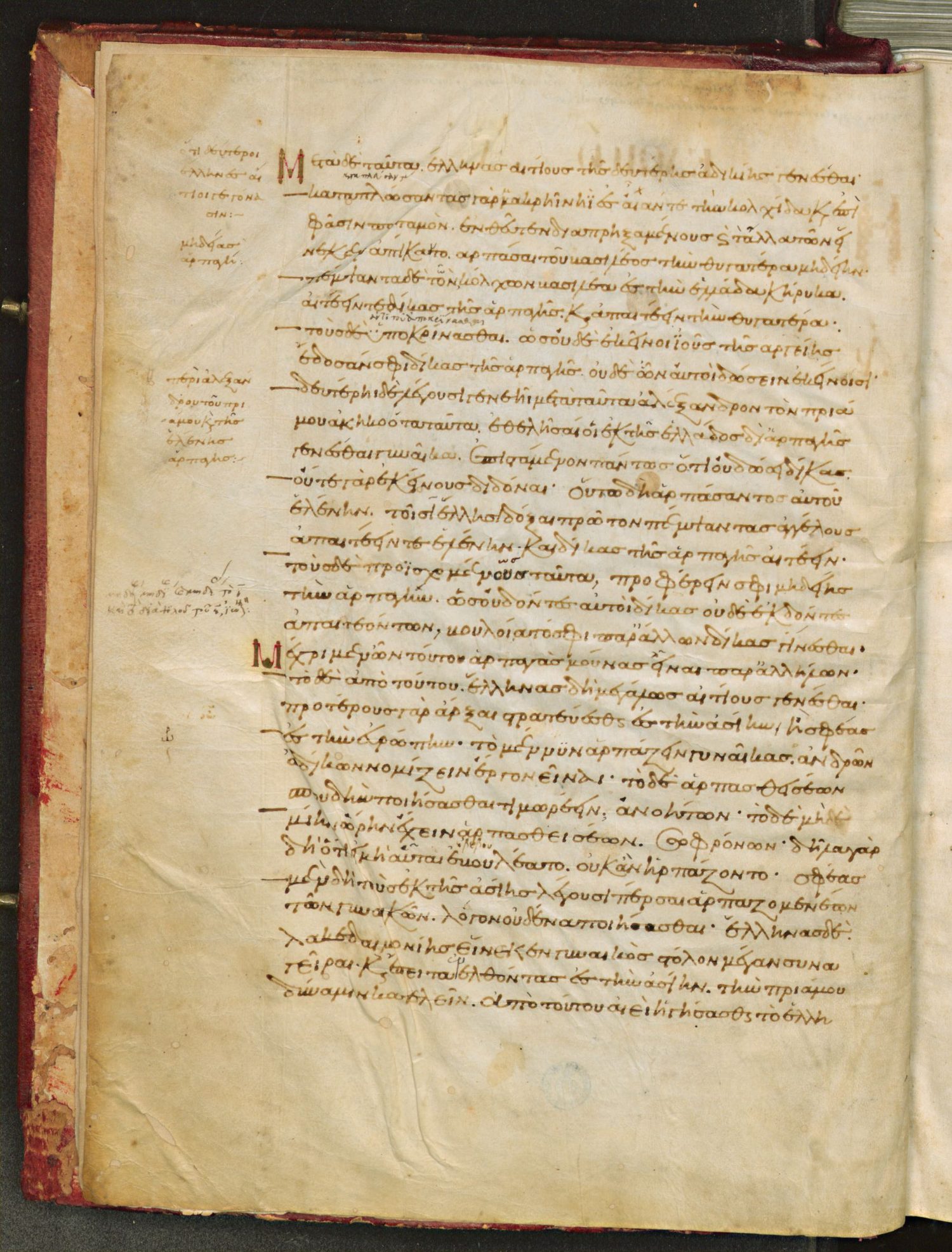
Laur. Plut. 70.3, fol. 1v: Greek here 1.2.1 to 1.4.4. Checked on the image (first and last words read and located in the Greek; each break checked against the neighbouring page): fol. 1v begins ‹μετὰ δὲ ταῦτα Ἕλληνας› (1.2.1), ends ‹αἰεὶ ἡγήσασθαι τὸ Ἑλλη-› (1.4.4). English here: 1.2.2 to 1.4.3 (Godley's sentences for the sections whose Greek lies mostly on this page).
1.2.1μετὰ δὲ ταῦτα Ἕλληνας αἰτίους τῆς δευτέρης ἀδικίης γενέσθαι· 1.2.2καταπλώσαντας γὰρ μακρῇ νηί ἐς Αἶαν τε τὴν Κολχίδα καὶ ἐπὶ Φᾶσιν ποταμόν, ἐνθεῦτεν, διαπρηξαμένους καὶ τἄλλα τῶν εἵνεκεν ἀπίκατο, ἁρπάσαι τοῦ βασιλέος τὴν θυγατέρα Μηδείην. 1.2.3πέμψαντά δὲ τὸν Κόλχων βασιλέα ἐς τὴν Ἑλλάδα κήρυκα αἰτέειν τε δίκας τῆς ἁρπαγῆς καὶ ἀπαιτέειν τὴν θυγατέρα. τοὺς δὲ ὑποκρίνασθαι ὡς οὐδὲ ἐκεῖνοι Ἰοῦς τῆς Ἀργείης ἔδοσάν σφι δίκας τῆς ἁρπαγῆς· οὐδὲ ὦν αὐτοὶ δώσειν ἐκείνοισι. 1.3.1δευτέρῃ δὲ λέγουσι γενεῇ μετὰ ταῦτα Ἀλέξανδρον τὸν Πριάμου, ἀκηκοότα ταῦτα, ἐθελῆσαί οἱ ἐκ τῆς Ἑλλάδος διʼ ἁρπαγῆς γενέσθαι γυναῖκα, ἐπιστάμενον πάντως ὅτι οὐ δώσει δίκας. οὐδὲ γὰρ ἐκείνους διδόναι. 1.3.2οὕτω δὴ ἁρπάσαντος αὐτοῦ Ἑλένην, τοῖσι Ἕλλησι δόξαι πρῶτὸν πέμψαντας ἀγγέλους ἀπαιτέειν τε Ἑλένην καὶ δίκας τῆς ἁρπαγῆς αἰτέειν. τοὺς δέ, προϊσχομένων ταῦτα, προφέρειν σφι Μηδείης τὴν ἁρπαγήν, ὡς οὐ δόντες αὐτοὶ δίκας οὐδὲ ἐκδόντες ἀπαιτεόντων βουλοίατό σφι παρʼ ἄλλων δίκας γίνεσθαι. 1.4.1μέχρι μὲν ὦν τούτου ἁρπαγάς μούνας εἶναι παρʼ ἀλλήλων, τὸ δὲ ἀπὸ τούτου Ἕλληνας δὴ μεγάλως αἰτίους γενέσθαι· προτέρους γὰρ ἄρξαι στρατεύεσθαι ἐς τὴν Ἀσίην ἢ σφέας ἐς τὴν Εὐρώπην. 1.4.2τὸ μέν νυν ἁρπάζειν γυναῖκας ἀνδρῶν ἀδίκων νομίζειν ἔργον εἶναι, τὸ δὲ ἁρπασθεισέων σπουδήν ποιήσασθαι τιμωρέειν ἀνοήτων, τὸ δὲ μηδεμίαν ὤρην ἔχειν ἁρπασθεισέων σωφρόνων· δῆλα γὰρ δὴ ὅτι, εἰ μὴ αὐταὶ ἐβούλοντο, οὐκ ἂν ἡρπάζοντο. 1.4.3σφέας μὲν δὴ τοὺς ἐκ τῆς Ἀσίης λέγουσι Πέρσαι ἁρπαζομενέων τῶν γυναικῶν λόγον οὐδένα ποιήσασθαι, Ἕλληνας δὲ Λακεδαιμονίης εἵνεκεν γυναικὸς στόλον μέγαν συναγεῖραι καὶ ἔπειτα ἐλθόντας ἐς τὴν Ἀσίην τὴν Πριάμου δύναμιν κατελεῖν. 1.4.4ἀπὸ τούτου αἰεὶ ἡγήσασθαι τὸ Ἑλληνικὸν
1.2.2They sailed in a long ship to Aea of the Colchians and the river Phasis: and when they had done the rest of the business for which they came, they carried off the king’s daughter Medea. 1.2.3When the Colchian king sent a herald to demand reparation for the robbery, and restitution of his daughter, the Greeks replied that as they had been refused reparation for the abduction of the Argive Io, neither would they make any to the Colchians. 1.3.1Then (so the story runs) in the second generation after this Alexandrus son of Priam, having heard this tale, was minded to win himself a wife out of Hellas by ravishment; for he was well persuaded that, as the Greeks had made no reparation, so neither would he. 1.3.2So he carried off Helen. The Greeks first resolved to send messengers demanding that Helen should be restored and atonement made for the rape; but when this proposal was made, the Trojans pleaded the rape of Medea, and reminded the Greeks that they asked reparation of others, yet had made none themselves, nor given up the plunder at request. 1.4.1Thus far it was a matter of mere robbery on both sides. But after this (the Persians say) the Greeks were greatly to blame; for they invaded Asia before the Persians attacked Europe. 1.4.2“We think,” say they, “that it is wrong to carry women off: but to be zealous to avenge the rape is foolish: wise men take no account of such things: for plainly the women would never have been carried away, had not they themselves wished it. 1.4.3We of Asia regarded the rape of our women not at all; but the Greeks, all for the sake of a Lacedaemonian woman, mustered a great host, came to Asia, and destroyed the power of Priam.
Where on the image
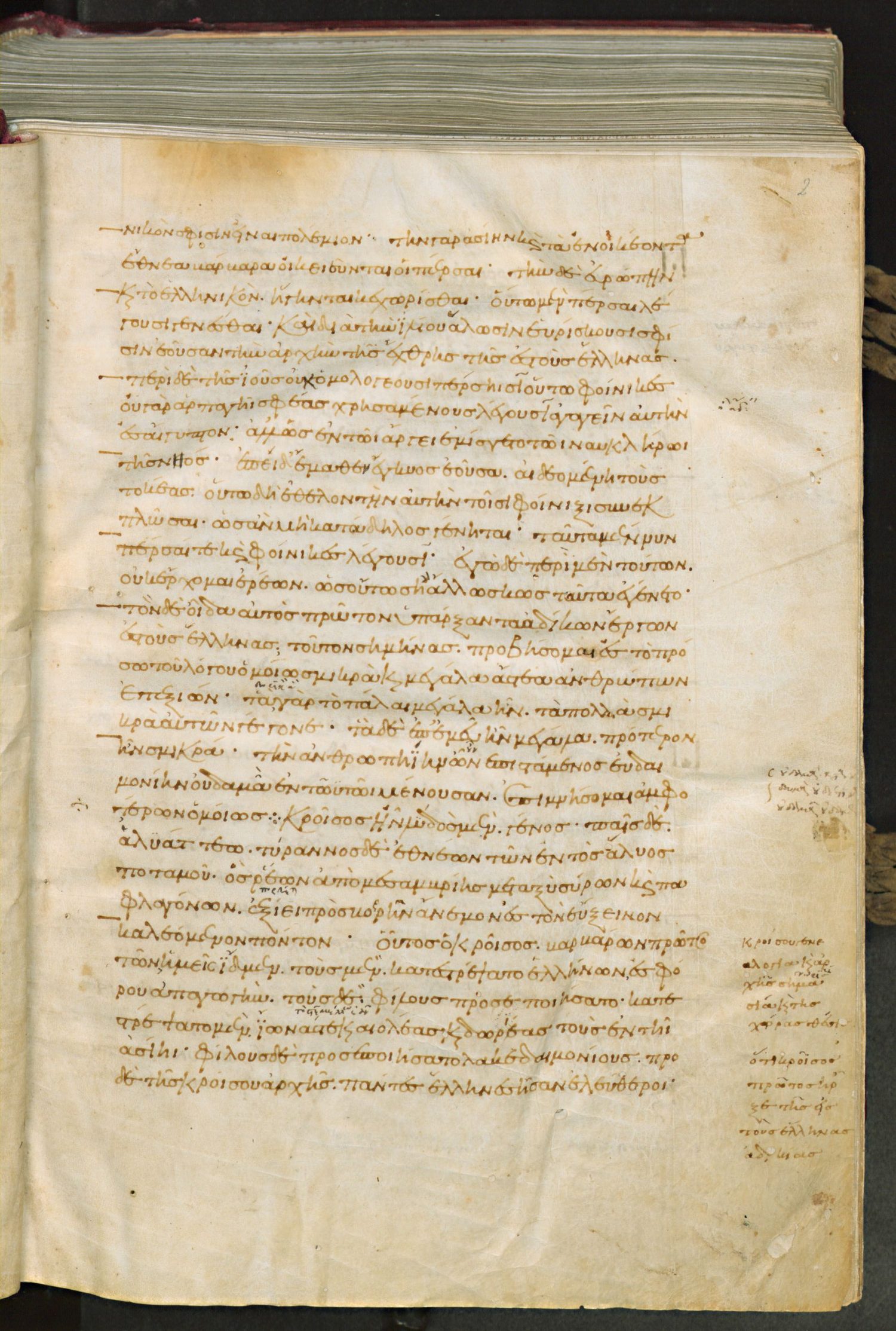
Laur. Plut. 70.3, fol. 2r: Greek here 1.4.4 to 1.6.3. Checked on the image (first and last words read and located in the Greek; each break checked against the neighbouring page): fol. 2r begins ‹-νικὸν σφίσι εἶναι πολέμιον.› (1.4.4), ends ‹πάντες Ἕλληνες ἦσαν ἐλεύθεροι› (1.6.3). The word ‹Ἑλληνικὸν› is divided between fol. 1v and fol. 2r; it is given with fol. 1v. English here: 1.4.4 to 1.6.2 (Godley's sentences for the sections whose Greek lies mostly on this page).
1.4.4σφίσι εἶναι πολέμιον. τὴν γὰρ Ἀσίην καὶ τὰ ἐνοικέοντα ἔθνεα βάρβαρα οἰκηιεῦνται οἱ Πέρσαι, τὴν δὲ Εὐρώπην καὶ τὸ Ἑλληνικόν ἥγηνται κεχωρίσθαι. 1.5.1οὕτω μὲν Πέρσαι λέγουσι γενέσθαι, καὶ διὰ τὴν Ἰλίου ἅλωσιν εὑρίσκουσι σφίσι ἐοῦσαν τὴν ἀρχήν τῆς ἔχθρης τῆς ἐς τοὺς Ἕλληνας. 1.5.2περὶ δὲ τῆς Ἰοῦς οὐκ ὁμολογέουσι Πέρσῃσι οὕτω Φοίνικες· οὐ γὰρ ἁρπαγῇ σφέας χρησαμένους λέγουσι ἀγαγεῖν αὐτήν ἐς Αἴγυπτον, ἀλλʼ ὡς ἐν τῷ Ἄργεϊ ἐμίσγετο τῷ ναυκλήρῳ τῆς νέος· ἐπεὶ δʼ ἔμαθε ἔγκυος ἐοῦσα, αἰδεομένη τοὺς τοκέας οὕτω δὴ ἐθελοντήν αὐτήν τοῖσι Φοίνιξι συνεκπλῶσαι, ὡς ἂν μὴ κατάδηλος γένηται. 1.5.3ταῦτα μέν νυν Πέρσαι τε καὶ Φοίνικες λέγουσι· ἐγὼ δὲ περὶ μὲν τούτων οὐκ ἔρχομαι ἐρέων ὡς οὕτω ἢ ἄλλως κως ταῦτα ἐγένετο, τὸν δὲ οἶδα αὐτὸς πρῶτον ὑπάρξαντα ἀδίκων ἔργων ἐς τοὺς Ἕλληνας, τοῦτον σημήνας προβήσομαι ἐς τὸ πρόσω τοῦ λόγου, ὁμοίως σμικρὰ καὶ μεγάλα ἄστεα ἀνθρώπων ἐπεξιών. 1.5.4τὰ γὰρ τὸ πάλαι μεγάλα ἦν, τὰ πολλὰ σμικρὰ αὐτῶν γέγονε· τὰ δὲ ἐπʼ ἐμεῦ ἦν μεγάλα, πρότερον ἦν σμικρά. τὴν ἀνθρωπηίην ὦν ἐπιστάμενος εὐδαιμονίην οὐδαμὰ ἐν τὠυτῷ μένουσαν, ἐπιμνήσομαι ἀμφοτέρων ὁμοίως. 1.6.1Κροῖσος ἦν Λυδὸς μὲν γένος, παῖς δὲ Ἀλυάττεω, τύραννος δὲ ἐθνέων τῶν ἐντός Ἅλυος ποταμοῦ, ὃς ῥέων ἀπὸ μεσαμβρίης μεταξὺ Συρίων τε καὶ Παφλαγόνων ἐξιεῖ πρὸς βορέην ἄνεμον ἐς τὸν Εὔξεινον καλεόμενον πόντον. 1.6.2οὗτος ὁ Κροῖσος βαρβάρων πρῶτος τῶν ἡμεῖς ἴδμεν τοὺς μὲν κατεστρέψατο Ἑλλήνων ἐς φόρου ἀπαγωγήν, τοὺς δὲ φίλους προσεποιήσατο. κατεστρέψατο μὲν Ἴωνάς τε καὶ Αἰολέας καὶ Δωριέας τοὺς ἐν τῇ Ἀσίῃ, φίλους δὲ προσεποιήσατο Λακεδαιμονίους. 1.6.3πρὸ δὲ τῆς Κροίσου ἀρχῆς πάντες Ἕλληνες ἦσαν ἐλεύθεροι·
1.4.4Ever since then we have regarded Greeks as our enemies.” The Persians claim Asia for their own, and the foreign nations that dwell in it; Europe and the Greek race they hold to be separate from them. 1.5.1Such is the Persian account of the matter: in their opinion, it was the taking of Troy which began their feud with the Greeks. 1.5.2But the Phoenicians do not tell the same story about Io as the Persians. They say that they did not carry her off to Egypt by force: she had intercourse in Argos with the captain of the ship: then, perceiving herself to be with child, she was ashamed that her parents should know it, and so, lest they should discover her condition, she sailed away with the Phoenicians of her own accord. 1.5.3These are the stories of the Persians and the Phoenicians. For my own part, I will not say that this or that story is true, but I will name him whom I myself know to have done unprovoked wrong to the Greeks, and so go forward with my history, and speak of small and great cities alike. 1.5.4For many states that were once great have now become small: and those that were great in my time were small formerly. Knowing therefore that human prosperity never continues in one stay, I will make mention alike of both kinds. 1.6.1Croesus was by birth a Lydian, son of Alyattes, and monarch of all the nations west of the river Halys, which flows from the south between Syria and Paphlagonia, and issues northward into the sea called Euxinus. 1.6.2This Croesus was as far as we know the first foreigner who subdued Greeks and took tribute of them, and won the friendship of others,—the former being the Ionians, the Aeolians, and the Dorians of Asia, and the latter the Lacedaemonians.
Where on the image
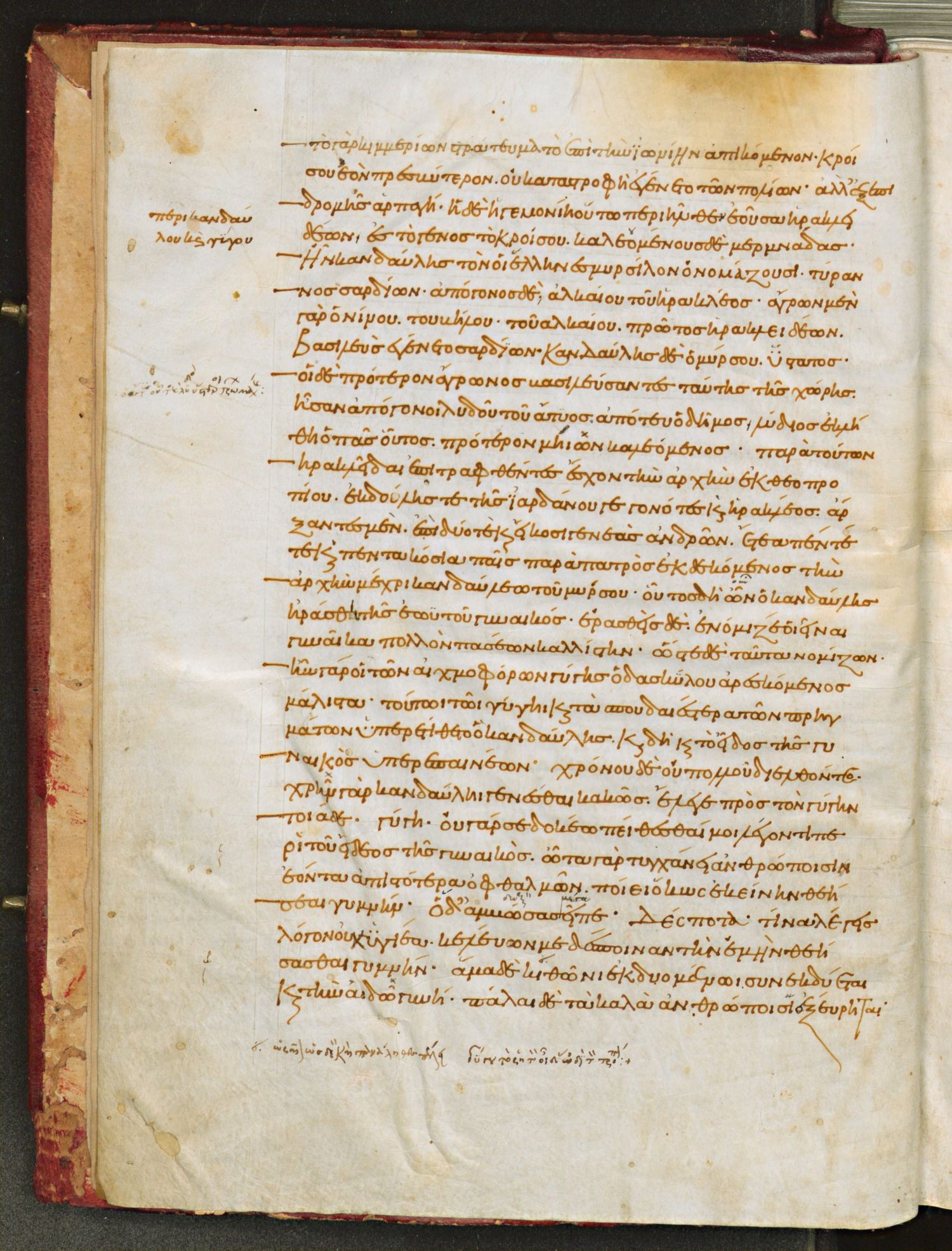
Laur. Plut. 70.3, fol. 2v: Greek here 1.6.3 to 1.8.4. Checked on the image (first and last words read and located in the Greek; each break checked against the neighbouring page): fol. 2v begins ‹τὸ γὰρ Κιμμερίων στράτευμα› (1.6.3), ends ‹τὰ καλὰ ἀνθρώποισι ἐξεύρηται› (1.8.4). Below the text, a reader's note in a later hand. English here: 1.6.3 to 1.8.3 (Godley's sentences for the sections whose Greek lies mostly on this page).
1.6.3τὸ γὰρ Κιμμερίων στράτευμα τὸ ἐπὶ τὴν Ἰωνίην ἀπικόμενον Κροίσου ἐὸν πρεσβύτερον οὐ καταστροφὴ ἐγένετο τῶν πολίων ἀλλʼ ἐξ ἐπιδρομῆς ἁρπαγή. 1.7.1ἡ δὲ ἡγεμονίη οὕτω περιῆλθε, ἐοῦσα Ἡρακλειδέων ἐς τὸ γένος τὸ Κροίσου, καλεομένους δὲ Μερμνάδας. 1.7.2ἦν Κανδαύλης, τὸν οἱ Ἕλληνές Μυρσίλον ὀνομάζουσι, τύραννος Σαρδίων, ἀπόγονος δὲ Ἀλκαίου τοῦ Ἡρακλέος. Ἄγρων μὲν γὰρ ὁ Νίνου τοῦ Βήλου τοῦ Ἀλκαίου πρῶτος Ἡρακλειδέων βασιλεὺς ἐγένετο Σαρδίων, Κανδαύλης δὲ ὁ Μύρσου ὕστατος. 1.7.3οἱ δὲ πρότερον Ἄγρωνος βασιλεύσαντες ταύτης τῆς χώρης ἦσαν ἀπόγονοὶ Λυδοῦ τοῦ Ἄτυος, ἀπʼ ὅτευ ὁ δῆμος Λύδιος ἐκλήθη ὁ πᾶς οὗτος, πρότερον Μηίων καλεόμενος. 1.7.4παρὰ τούτων Ἡρακλεῖδαι ἐπιτραφθέντες ἔσχον τὴν ἀρχήν ἐκ θεοπροπίου, ἐκ δούλης τε τῆς Ἰαρδάνου γεγονότες καὶ Ἡρακλέος, ἄρξαντες μὲν ἐπὶ δύο τε καὶ εἴκοσι γενεᾶς ἀνδρῶν ἔτεα πέντε τε καὶ πεντακόσια, παῖς παρὰ πατρὸς ἐκδεκόμενος τὴν ἀρχήν, μέχρι Κανδαύλεω τοῦ Μύρσου. 1.8.1οὗτος δὴ ὦν ὁ Κανδαύλης ἠράσθη τῆς ἑωυτοῦ γυναικός, ἐρασθεὶς δὲ ἐνόμιζέ οἱ εἶναι γυναῖκα πολλὸν πασέων καλλίστην. ὥστε δὲ ταῦτα νομίζων, ἦν γάρ οἱ τῶν αἰχμοφόρων Γύγης ὁ Δασκύλου ἀρεσκόμενος μάλιστα, τούτῳ τῷ Γύγῃ καὶ τὰ σπουδαιέστερα τῶν πρηγμάτων ὑπερετίθετο ὁ Κανδαύλης καὶ δὴ καὶ τὸ εἶδος τῆς γυναικὸς ὑπερεπαινέων. 1.8.2χρόνου δὲ οὐ πολλοῦ διελθόντος (χρῆν γὰρ Κανδαύλῃ γενέσθαι κακῶς) ἔλεγε πρὸς τὸν Γύγην τοιάδε. Γύγη, οὐ γὰρ σε δοκέω πείθεσθαι μοι λέγοντι περὶ τοῦ εἴδεος τῆς γυναικός (ὦτα γὰρ τυγχάνει ἀνθρώποισι ἐόντα ἀπιστότερα ὀφθαλμῶν), ποίεε ὅκως ἐκείνην θεήσεαι γυμνήν. 1.8.3ὃ δʼ ἀμβώσας εἶπε δέσποτα, τίνα λέγεις λόγον οὐκ ὑγιέα, κελεύων με δέσποιναν τὴν ἐμὴν θεήσασθαι γυμνήν; ἅμα δὲ κιθῶνι ἐκδυομένῳ συνεκδύεται καὶ τὴν αἰδῶ γυνή. 1.8.4πάλαι δὲ τὰ καλὰ ἀνθρώποισι ἐξεύρηται,
1.6.3Before the reign of Croesus all Greeks were free: for the Cimmerian host which invaded Ionia before his time did not subdue the cities but rather raided and robbed them. 1.7.1Now the sovereign power, which belonged to the descendants of Heracles, fell to the family of Croesus—the Mermnadae as they were called—in the following way. 1.7.2Candaules, whom the Greeks call Myrsilus, was the ruler of Sardis; he was descended from Alcaeus, son of Heracles; Agron, son of Ninus, son of Belus, son of Alcaeus, was the first Heraclid king of Sardis, and Candaules, son of Myrsus, was the last. 1.7.3The kings of this country before Agron were descendants of Lydus, son of Atys, from whom all this Lydian district took its name; before that it was called the land of the Meii. 1.7.4From these the Heraclidae, descendants of Heracles and a female slave of Iardanus, received the sovereignty and held it in charge, by reason of an oracle; and they ruled for two and twenty generations, or 50 years, son succeeding father, down to Candaules, son of Myrsus. 1.8.1This Candaules, then, fell in love with his own wife, so much that he supposed her to be by far the fairest woman in the world; and being persuaded of this, he raved of her beauty to Gyges, son of Dascylus, who was his favourite among his bodyguard; for it was to Gyges that he entrusted all his weightiest secrets. 1.8.2Then after a little while Candaules, being doomed to ill-fortune, spoke thus to Gyges: “I think, Gyges, that you do not believe what I tell you of the beauty of my wife; men trust their ears less than their eyes; do you, then, so contrive that you may see her naked.” Gyges exclaimed loudly at this. 1.8.3“Master,” said he, “what a pestilent command is this that you lay upon me! that I should see her who is my mistress naked! with the stripping off of her tunic a woman is stripped of the honour due to her.
Where on the image
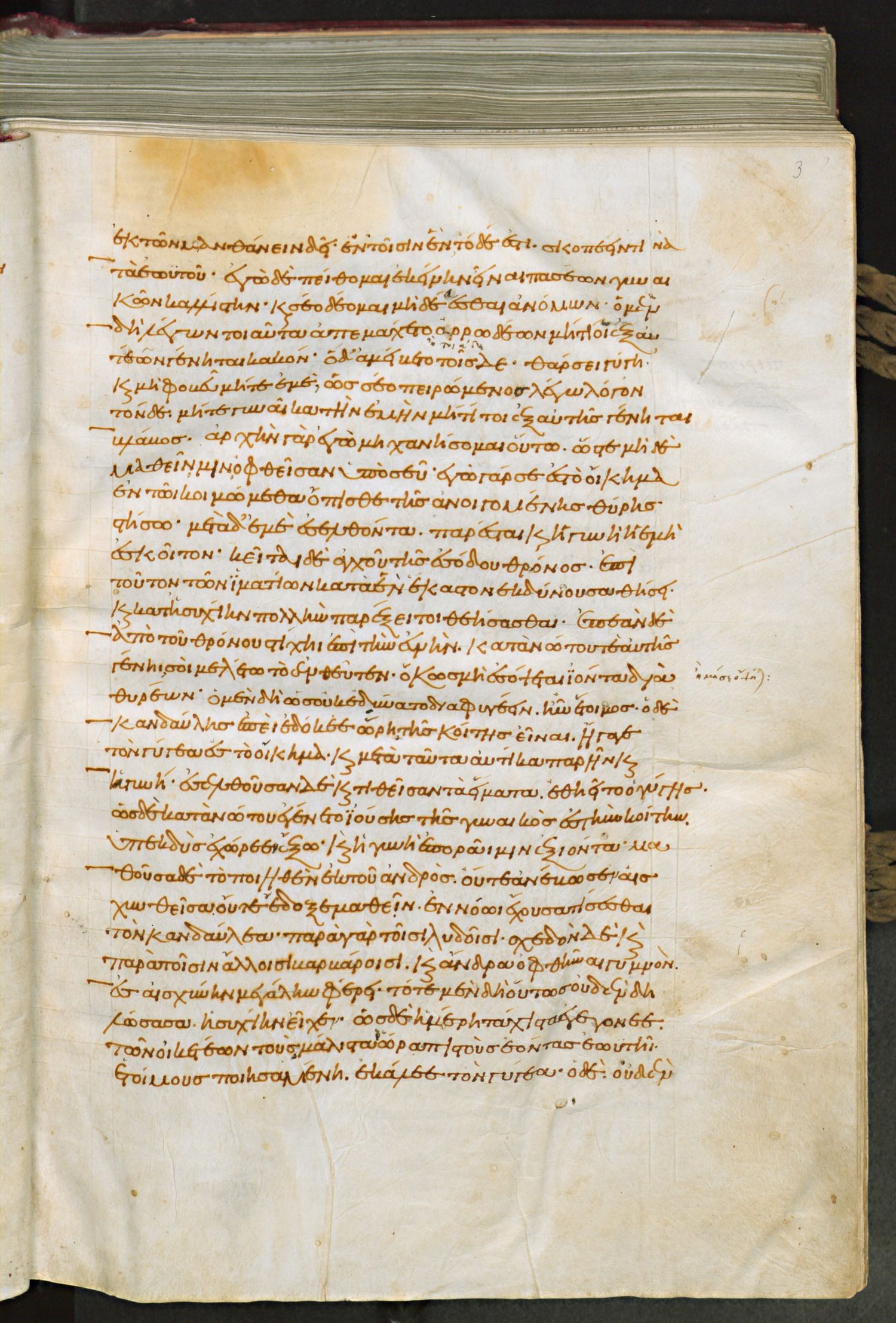
Laur. Plut. 70.3, fol. 3r: Greek here 1.8.4 to 1.11.1. Checked on the image (first and last words read and located in the Greek; each break checked against the neighbouring page): fol. 3r begins ‹ἐκ τῶν μανθάνειν δεῖ·› (1.8.4), ends ‹Γύγεα. ὁ δὲ οὐδὲν› (1.11.1). English here: 1.8.4 to 1.11.1 (Godley's sentences for the sections whose Greek lies mostly on this page).
1.8.4ἐκ τῶν μανθάνειν δεῖ· ἐν τοῖσι ἓν τόδε ἐστί, σκοπέειν τινὰ τὰ ἑωυτοῦ. ἐγὼ δὲ πείθομαι ἐκείνην εἶναι πασέων γυναικῶν καλλίστην, καὶ σέο δέομαι μὴ δέεσθαι ἀνόμων. 1.9.1ὃ μὲν δὴ λέγων τοιαῦτα ἀπεμάχετο, ἀρρωδέων μὴ τί οἱ ἐξ αὐτῶν γένηται κακόν, ὃ δʼ ἀμείβετο τοῖσιδε. θάρσεε, Γύγη, καὶ μὴ φοβεῦ μήτε ἐμέ, ὡς σέο πειρώμενος λέγω λόγον τόνδε, μήτε γυναῖκα τὴν ἐμήν, μὴ τὶ τοι ἐξ αὐτῆς γένηται βλάβος. ἀρχήν γὰρ ἐγὼ μηχανήσομαι οὕτω ὥστε μηδέ μαθεῖν μιν ὀφθεῖσαν ὑπὸ σεῦ. 1.9.2ἐγὼ γάρ σε ἐς τὸ οἴκημα ἐν τῷ κοιμώμεθα ὄπισθε τῆς ἀνοιγομένης θύρης στήσω. μετὰ δʼ ἐμὲ ἐσελθόντα παρέσται καὶ ἡ γυνὴ ἡ ἐμὴ ἐς κοῖτον. κεῖται δὲ ἀγχοῦ τῆς ἐσόδου θρόνος· ἐπὶ τοῦτον τῶν ἱματίων κατὰ ἕν ἕκαστον ἐκδύνουσα θήσει, καὶ κατʼ ἡσυχίην πολλὴν παρέξει τοι θεήσασθαι. 1.9.3ἐπεὰν δέ ἀπὸ τοῦ θρόνου στείχῃ ἐπὶ τὴν εὐνήν κατὰ νώτου τε αὐτῆς γένῃ, σοὶ μελέτω τὸ ἐνθεῦτεν ὅκως μὴ σε ὄψεται ἰόντα διὰ θυρέων. 1.10.1ὃ μὲν δὴ ὡς οὐκ ἐδύνατο διαφυγεῖν, ἦν ἕτοιμος· ὁ δὲ Κανδαύλης, ἐπεὶ ἐδόκεε ὥρη τῆς κοίτης εἶναι, ἤγαγε τὸν Γύγεα ἐς τὸ οἴκημα. καὶ μετὰ ταῦτα αὐτίκα παρῆν καὶ ἡ γυνή. ἐσελθοῦσαν δὲ καὶ τιθεῖσαν τὰ εἵματα ἐθηεῖτο ὁ Γύγης. 1.10.2ὡς δὲ κατὰ νώτου ἐγένετο ἰούσης τῆς γυναικός ἐς τὴν κοίτην, ὑπεκδὺς ἐχώρεε ἔξω, καὶ ἡ γυνὴ ἐπορᾷ μιν ἐξιόντα. μαθοῦσὰ δὲ τὸ ποιηθέν ἐκ τοῦ ἀνδρὸς οὔτε ἀνέβωσε αἰσχυνθεῖσα οὔτε ἔδοξε μαθεῖν, ἐν νοῶ ἔχουσα τίσεσθαι τὸν Κανδαύλεα. 1.10.3παρὰ γὰρ τοῖσι Λυδοῖσι, σχεδὸν δὲ καὶ παρὰ τοῖσι ἄλλοισι βαρβάροισι καὶ ἄνδρα ὀφθῆναι γυμνόν ἐς αἰσχύνην μεγάλην φέρει. 1.11.1τότε μὲν δὴ οὕτω οὐδέν δηλώσασα ἡσυχίην εἶχε. ὡς δὲ ἡμέρη τάχιστα ἐγεγόνεε, τῶν οἰκετέων τοὺς μάλιστα ὥρα πιστοὺς ἐόντας ἑωυτῇ, ἑτοίμους ποιησαμένη ἐκάλεε τὸν Γύγεα. ὁ δὲ οὐδὲν
1.8.4Men have long ago made wise rules for our learning; one of these is, that we, and none other, should see what is our own. As for me, I fully believe that your queen is the fairest of all women; ask not lawless acts of me, I entreat you.” 1.9.1Thus speaking Gyges sought to turn the king’s purpose, for he feared lest some ill to himself should come of it: but this was Candaules’ answer: “Take courage, Gyges: fear not that I say this to put you to the proof, nor that my wife will do you any harm. I will so contrive the whole business that she shall never know that you have seen her. 1.9.2I will bring you into the chamber where she and I lie and set you behind the open door; and after I have entered, my wife too will come to her bed. There is a chair set near the entrance of the room: on this she will lay each part of her raiment as she takes it off, and you will be able to gaze upon her at your leisure. 1.9.3Then, when she goes from the chair to the bed, turning her back upon you, do you look to it that she does not see you going out through the doorway.” 1.10.1As Gyges could not escape, he consented. Candaules, when he judged it to be bed time, brought Gyges into the chamber, his wife presently followed, and when she had come in and was laying aside her garments Gyges beheld her; and 1.10.2when she turned her back upon him, going to her bed, he slipped privily from the room. The woman saw him as he passed out, and perceived what her husband had done. But shamed though she was she never cried out nor let it be seen that she had perceived aught, for she had it in mind to punish Candaules; seeing 1.10.3that among the Lydians and most of the foreign peoples it is held great shame that even a man should be seen naked. 1.11.1For the nonce she made no sign and held her peace. But as soon as it was day, she assured herself of those of her household whom she perceived to be most faithful to her, and called Gyges: who, supposing that she knew nothing of what had been done, came at call; for he had always been wont to attend the queen whenever she bade him.
Where on the image
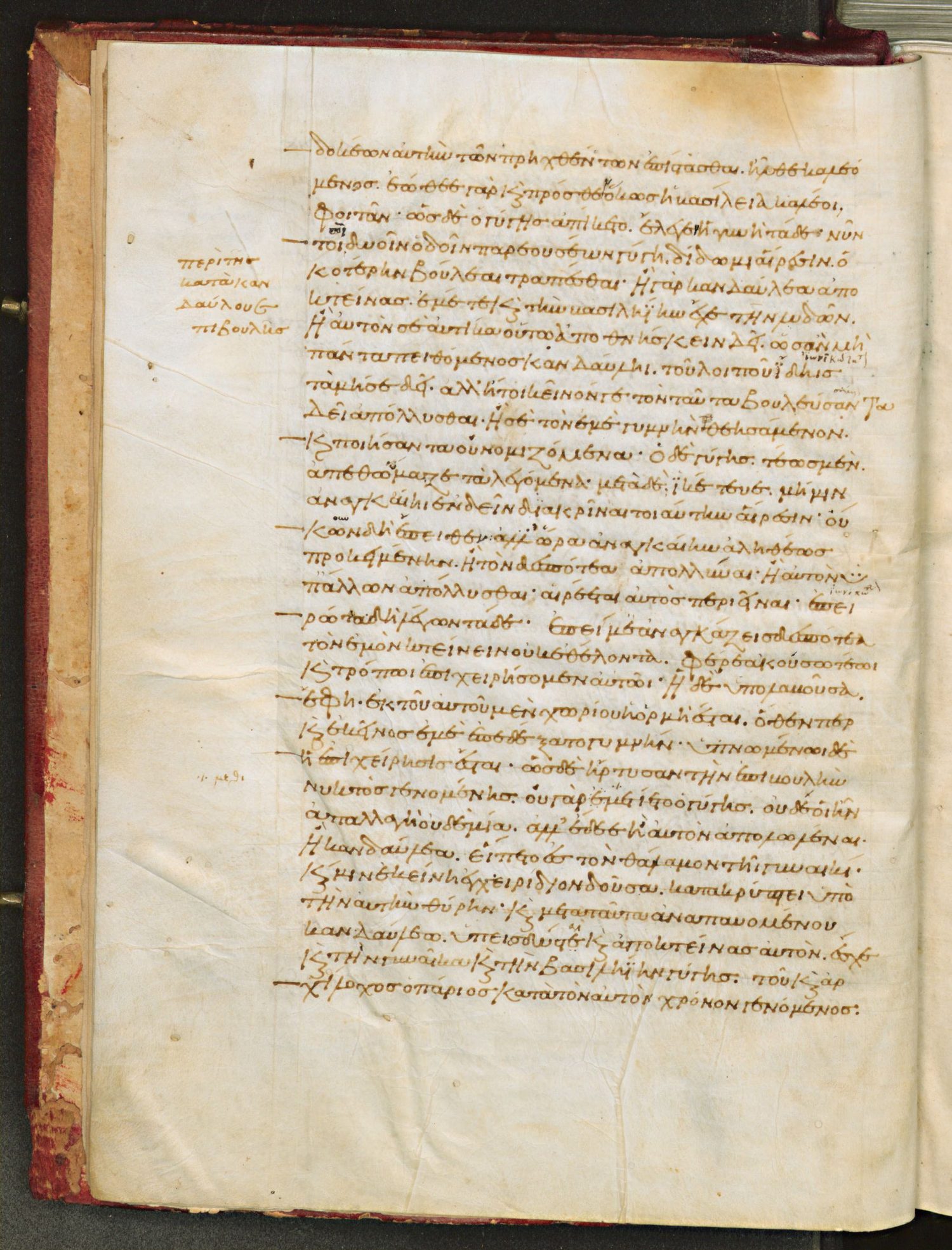
Laur. Plut. 70.3, fol. 3v: Greek here 1.11.1 to 1.12.2. Checked on the image (first and last words read and located in the Greek; each break checked against the neighbouring page): fol. 3v begins ‹δοκέων αὐτήν τῶν πρηχθέντων› (1.11.1), ends ‹τὸν αὐτὸν χρόνον γενόμενος› (1.12.2). English here: 1.11.2 to 1.12.2 (Godley's sentences for the sections whose Greek lies mostly on this page).
1.11.1δοκέων αὐτήν τῶν πρηχθέντων ἐπίστασθαι ἦλθε καλεόμενος· ἐώθεε γὰρ καὶ πρόσθε, ὅκως ἡ βασίλεια καλέοι, φοιτᾶν. 1.11.2ὡς δὲ ὁ Γύγης ἀπίκετο, ἔλεγε ἡ γυνὴ τάδε. νῦν τοί δυῶν ὁδῶν παρεουσέων Γύγη δίδωμί αἵρεσιν, ὁκοτέρην βούλεαι τραπέσθαι. ἢ γὰρ Κανδαύλεα ἀποκτείνας ἐμέ τε καὶ τὴν βασιληίην ἔχε τὴν Λυδῶν, ἢ αὐτόν σε αὐτίκα οὕτω ἀποθνήσκειν δεῖ, ὡς ἂν μὴ πάντα πειθόμενος Κανδαύλῃ τοῦ λοιποῦ ἴδῃς τὰ μὴ σε δεῖ. 1.11.3ἀλλʼ ἤτοι κεῖνόν γε τὸν ταῦτα βουλεύσαντα δεῖ ἀπόλλυσθαι, ἢ σε τὸν ἐμὲ γυμνήν θεησάμενον καὶ ποιήσαντα οὐ νομιζόμενα. ὁ δὲ Γύγης τέως μὲν ἀπεθώμαζε τὰ λεγόμενα, μετὰ δὲ ἱκέτευε μὴ μιν ἀναγκαίῃ ἐνδέειν διακρῖναι τοιαύτην αἵρεσιν. 1.11.4οὔκων δὴ ἔπειθε, ἀλλʼ ὥρα ἀναγκαίην ἀληθέως προκειμένην ἢ τὸν δεσπότεα ἀπολλύναι ἢ αὐτὸν ὑπʼ ἄλλων ἀπόλλυσθαι· αἱρέεται αὐτὸς περιεῖναι. ἐπειρώτα δὴ λέγων τάδε. ἐπεί με ἀναγκάζεις δεσπότεα τὸν ἐμὸν κτείνειν οὐκ ἐθέλοντα, φέρε ἀκούσω τέῳ καὶ τρόπῳ ἐπιχειρήσομεν αὐτῷ. 1.11.5ἣ δὲ ὑπολαβοῦσα ἔφη ἐκ τοῦ αὐτοῦ μὲν χωρίου ἡ ὁρμή ἔσται ὅθεν περ καὶ ἐκεῖνος ἐμέ ἐπεδέξατο γυμνήν, ὑπνωμένῳ δὲ ἡ ἐπιχείρησις ἔσται. 1.12.1ὡς δὲ ἤρτυσαν τὴν ἐπιβουλήν, νυκτὸς γενομένης (οὐ γὰρ ἐμετίετο ὁ Γύγης, οὐδέ οἱ ἦν ἀπαλλαγὴ οὐδεμία, ἀλλʼ ἔδεε ἤ αὐτὸν ἀπολωλέναι ἢ Κανδαύλεα) εἵπετο ἐς τὸν θάλαμον τῇ γυναικί, καί μιν ἐκείνη, ἐγχειρίδιον δοῦσα, κατακρύπτει ὑπὸ τὴν αὐτὴν θύρην. 1.12.2καὶ μετὰ ταῦτα ἀναπαυομένου Κανδαύλεω ὑπεκδύς τε καὶ ἀποκτείνας αὐτὸν ἔσχε καὶ τὴν γυναῖκα καὶ τὴν βασιληίην Γύγης τοῦ καὶ Ἀρχίλοχος ὁ Πάριος κατὰ τὸν αὐτὸν χρόνον γενόμενος
1.11.2So when he came, the lady thus addressed him: “Now, Gyges, you have two roads before you; choose which you will follow. You must either kill Candaules and take me for your own and the throne of Lydia, or yourself be killed now without more ado; that will prevent you from obeying all Candaules’ commands in the future and seeing what you should not see. 1.11.3One of you must die: either he, the contriver of this plot, or you, who have outraged all usage by looking on me unclad.” At this Gyges stood awhile astonished: presently he entreated her not to compel him to such a choice; 1.11.4but when he could not move her, and saw that dire necessity was in very truth upon him either to kill his master or himself be killed by others, he chose his own life. Then he asked the queen to tell him, since she forced him against his will to slay his master, how they were to attack the king: and 1.11.5she replied, “You shall come at him from the same place whence he made you see me naked; attack him in his sleep.” 1.12.1So when they had made ready this plot, and night had fallen, Gyges followed the lady into the chamber (for he could not get free or by any means escape, but either he or Candaules must die), and she gave him a dagger and hid him behind the same door; 1.12.2and presently he stole out and slew Candaules as he slept, and thus made himself master of the king’s wife and sovereignty. He is mentioned in the iambic verses of Archilochus of Parus who lived about the same time.
Where on the image
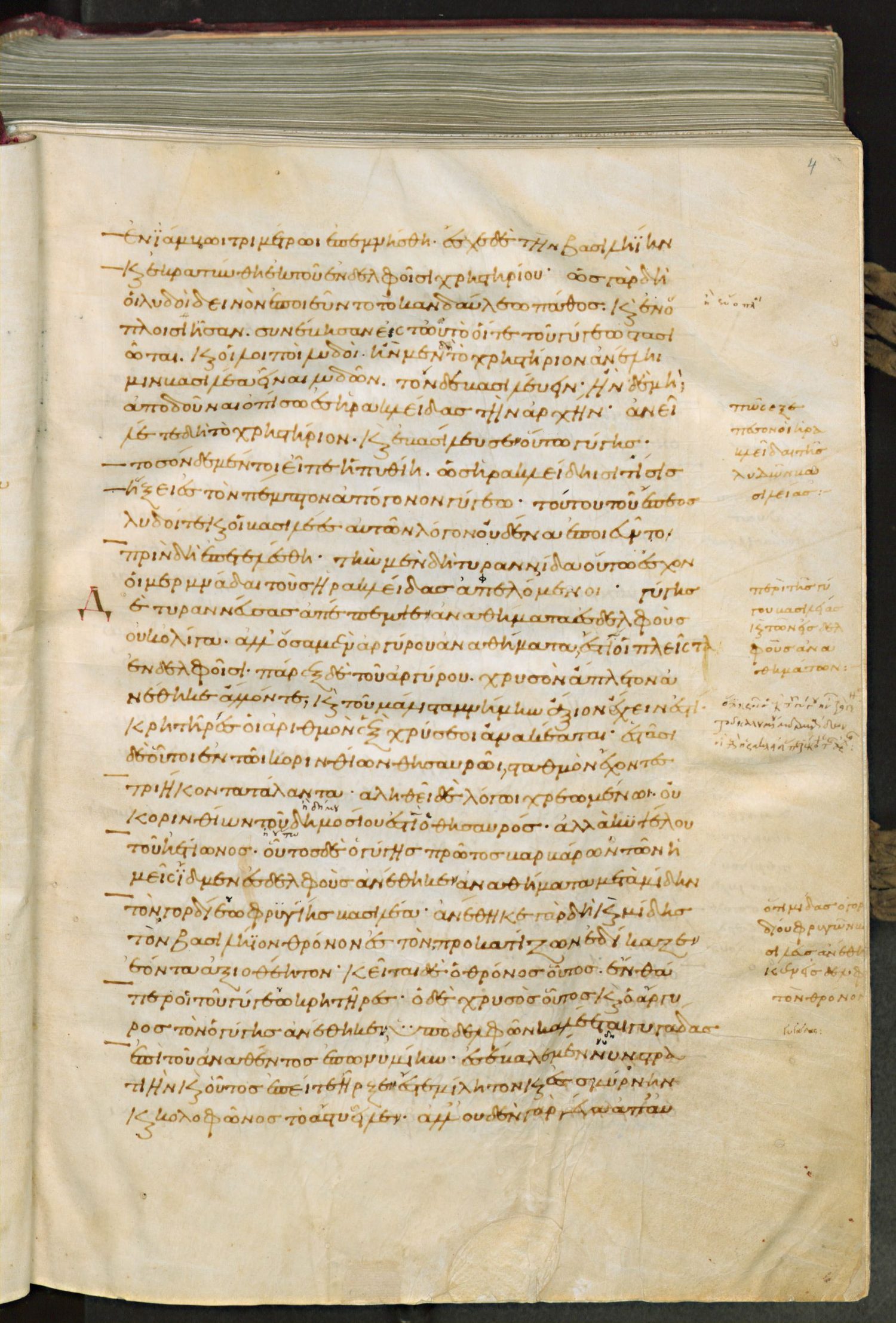
Laur. Plut. 70.3, fol. 4r: Greek here 1.12.2 to 1.14.3. Checked on the image (first and last words read and located in the Greek; each break checked against the neighbouring page): fol. 4r begins ‹ἐν ἰάμβῳ τριμέτρῳ ἐπεμνήσθη.ἔσχε› (1.12.2), ends ‹γὰρ μέγα ἀπʼ αὐ-› (1.15.1). English here: 1.13.1 to 1.14.3 (Godley's sentences for the sections whose Greek lies mostly on this page).
1.12.2ἐν ἰάμβῳ τριμέτρῳ ἐπεμνήσθη. 1.13.1ἔσχε δὲ τὴν βασιληίην καὶ ἐκρατύνθη ἐκ τοῦ ἐν Δελφοῖσι χρηστηρίου. ὡς γὰρ δὴ οἱ Λυδοὶ δεινόν ἐποιεῦντο τὸ Κανδαύλεω πάθος καὶ ἐν ὅπλοισι ἦσαν, συνέβησαν ἐς τὠυτὸ οἳ τε τοῦ Γύγεω στασιῶται καί οἱ λοιποὶ Λυδοί, ἤν μὲν τὸ χρηστήριον ἀνέλῃ μιν βασιλέα εἶναι Λυδῶν, τόν δὲ βασιλεύειν, ἤν δὲ μή, ἀποδοῦναι ὀπίσω ἐς Ἡρακλείδας τὴν ἀρχήν. 1.13.2ἀνεῖλέ τε δὴ τὸ χρηστήριον καὶ ἐβασίλευσε οὕτω Γύγης. τοσόνδε μέντοι εἶπε ἡ Πυθίη, ὡς Ἡρακλείδῃσι τίσις ἥξει ἐς τὸν πέμπτον ἀπόγονον Γύγεω. τούτου τοῦ ἔπεος Λυδοί τε καί οἱ βασιλέες αὐτῶν λόγον οὐδένα ἐποιεῦντο, πρὶν δὴ ἐπετελέσθη. 1.14.1τὴν μὲν δὴ τυραννίδα οὕτω ἔσχον οἱ Μερμνάδαι τοὺς Ἡρακλείδας ἀπελόμενοι, Γύγης δὲ τυραννεύσας ἀπέπεμψε ἀναθήματα ἐς Δελφοὺς οὐκ ὀλίγα, ἀλλʼ ὅσα μὲν ἀργύρου ἀναθήματα, ἔστι οἱ πλεῖστα ἐν Δελφοῖσι, πάρεξ δὲ τοῦ ἀργύρου χρυσὸν ἄπλετον ἀνέθηκε ἄλλον τε καὶ τοῦ μάλιστα μνήμην ἄξιον ἔχειν ἐστί, κρητῆρες οἱ ἀριθμὸν ἓξ χρύσεοι ἀνακέαται. 1.14.2ἑστᾶσι δὲ οὗτοι ἐν τῷ Κορινθίων θησαυρῷ, σταθμὸν ἔχοντες τριήκοντα τάλαντα· ἀληθέι δὲ λόγῳ χρεωμένῳ οὐ Κορινθίων τοῦ δημοσίου ἐστὶ ὁ θησαυρός, ἀλλὰ Κυψέλου τοῦ Ἠετίωνος. οὗτος δὲ ὁ Γύγης πρῶτος βαρβάρων τῶν ἡμεῖς ἴδμεν ἐς Δελφοὺς ἀνέθηκε ἀναθήματα μετὰ Μίδην τὸν Γορδίεω Φρυγίης βασιλέα. 1.14.3ἀνέθηκε γὰρ δὴ καὶ Μίδης τὸν βασιλήιον θρόνον ἐς τὸν προκατίζων ἐδίκαζε, ἐόντα ἀξιοθέητον· κεῖται δὲ ὁ θρόνος οὗτος ἔνθα περ οἱ τοῦ Γύγεω κρητῆρες. ὁ δὲ χρυσός οὗτος καὶ ὁ ἄργυρος τὸν ὁ Γύγης ἀνέθηκε, ὑπὸ Δελφῶν καλέεται Γυγάδας ἐπὶ τοῦ ἀναθέντος ἐπωνυμίην.
1.13.1So he took possession of the sovereign power, and was confirmed therein by the Delphic oracle. For when the Lydians were much angered by the fate of Candaules, and took up arms, the faction of Gyges and the rest of the people came to an agreement that if the oracle should ordain him to be king of the Lydians, then he should reign: but if not, then he should render back the kingship to the Heraclidae. 1.13.2The oracle did so ordain: and Gyges thus became king. Howbeit the Pythian priestess declared that the Heraclidae should have vengeance on Gyges’ posterity in the fifth generation: an utterance of which the Lydians and their kings took no account, till it was fulfilled. 1.14.1Thus did the Mermnadae rob the Heraclidae of the sovereignty and take it for themselves. Having gained it, Gyges sent not a few offerings to Delphi: there are very many silver offerings of his there: and besides the silver, he dedicated great store of gold: among which six golden bowls are the offerings chiefly worthy of record. 1.14.2These weigh 30 talents and stand in the treasury of the Corinthians: though in very truth it is the treasury not of the Corinthian people but of Cypselus son of Eetion. This Gyges then was the first foreigner (of our knowledge) who placed offerings at Delphi after the king of Phrygia, Midas son of Gordias. 1.14.3For Midas too made an offering, to wit, the royal seat whereon he sat to give judgment, and a marvellous seat it is; it is set in the same place as the bowls of Gyges. This gold and the silver offered by Gyges is called by the Delphians “Gygian” after its dedicator.
Notes
- Greek: the text printed in A. D. Godley's Loeb edition, via Perseus (tlg0016.tlg001.perseus-grc2). Square brackets mark words the editor considers later additions; [...] marks a gap the editor indicates. Perseus note markers are omitted.
- English: A. D. Godley, Herodotus vol. 1 (1920) (Loeb Classical Library), as transcribed on Wikisource. Godley's footnotes are omitted.
- Section numbers in the English were placed by comparing Godley's text with the Perseus version of his translation; where a section begins inside one of Godley's sentences, the English is kept with the page that holds the start of that sentence.
Cite
Sources
- Source: Florence, Laur. Plut. 70.3 (10th c.) via BML Teca Digitale + Greek of Godley's Loeb (Perseus) + English of A. D. Godley (Loeb, Wikisource) (holding institution)
- Critical edition: Greek of A. D. Godley's Loeb edition (1920-1925), via Perseus
← previous · → next · v cycle view · l back to library