Herodotus, Histories 1.15-25: Ardys, Sadyattes and Alyattes; Arion and the dolphin
Introduction
Herodotus of Halicarnassus wrote the Histories in the third quarter of the 5th century BCE, an inquiry into the deeds of Greeks and barbarians and the causes of the wars between them, later divided into nine books. Book 1 tells how the conflict between Greeks and barbarians began, the history of Lydia from Gyges to Croesus, the rise of the Medes and of Cyrus the Persian, the conquest of the Greeks of Asia, the capture of Babylon and the death of Cyrus.
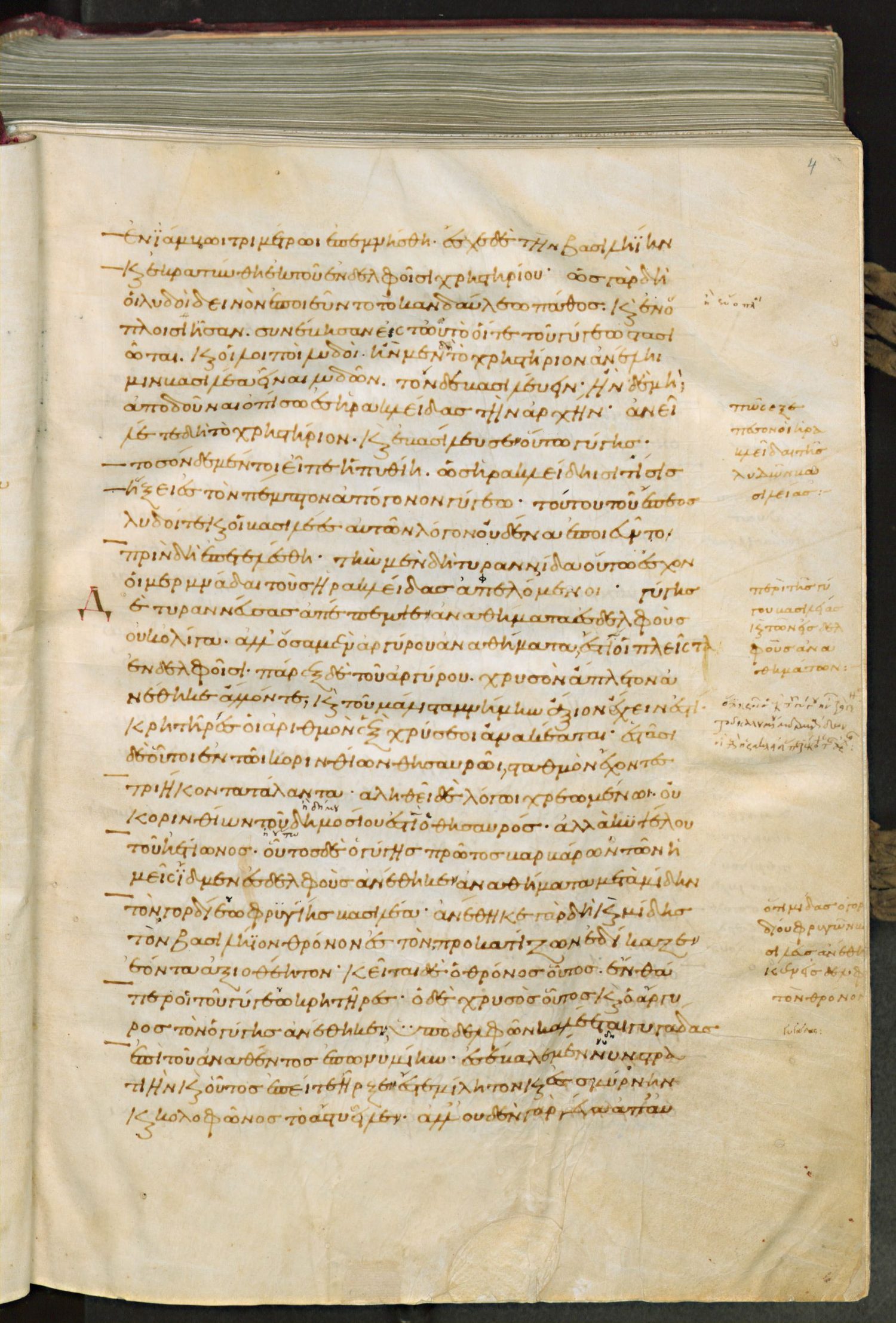
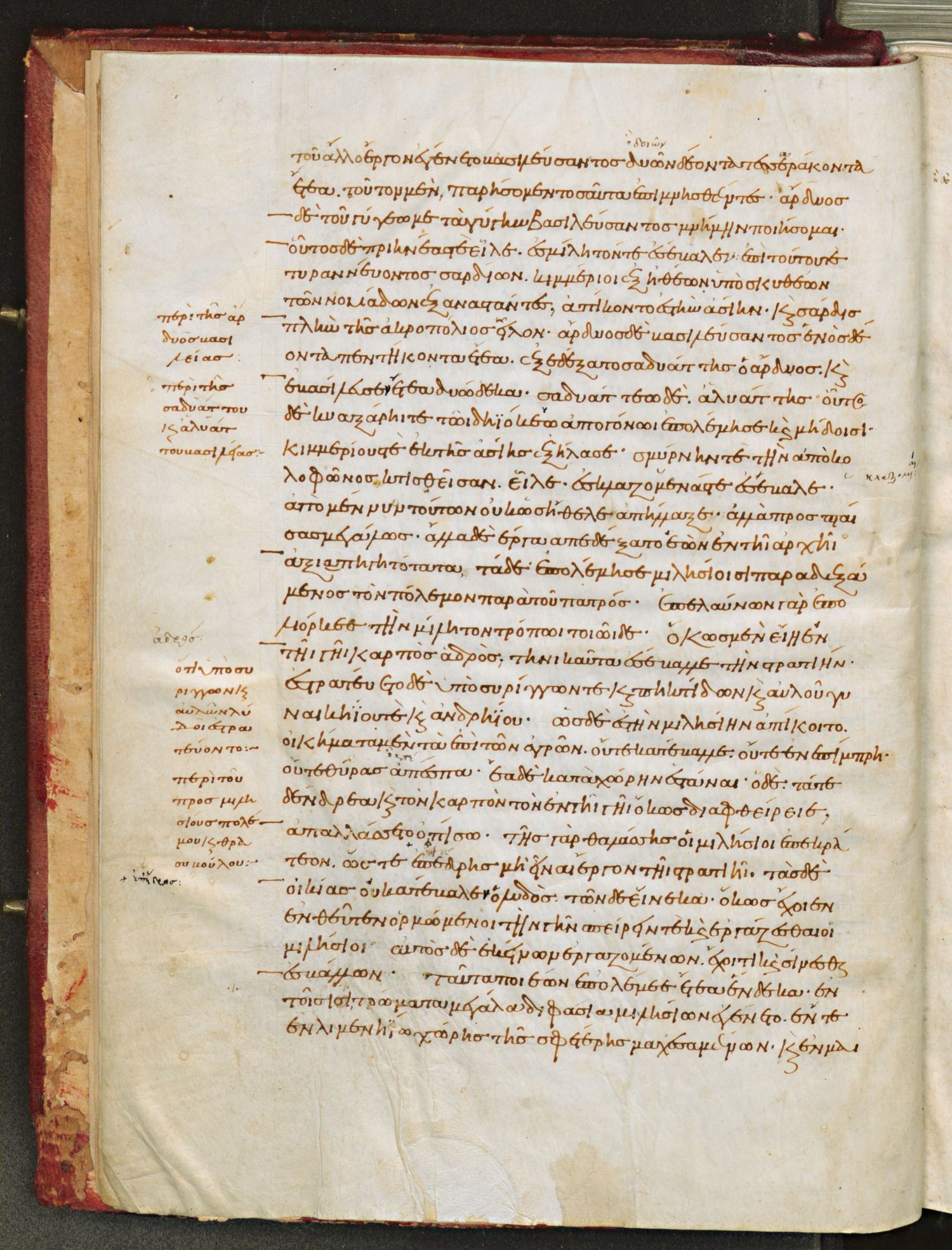
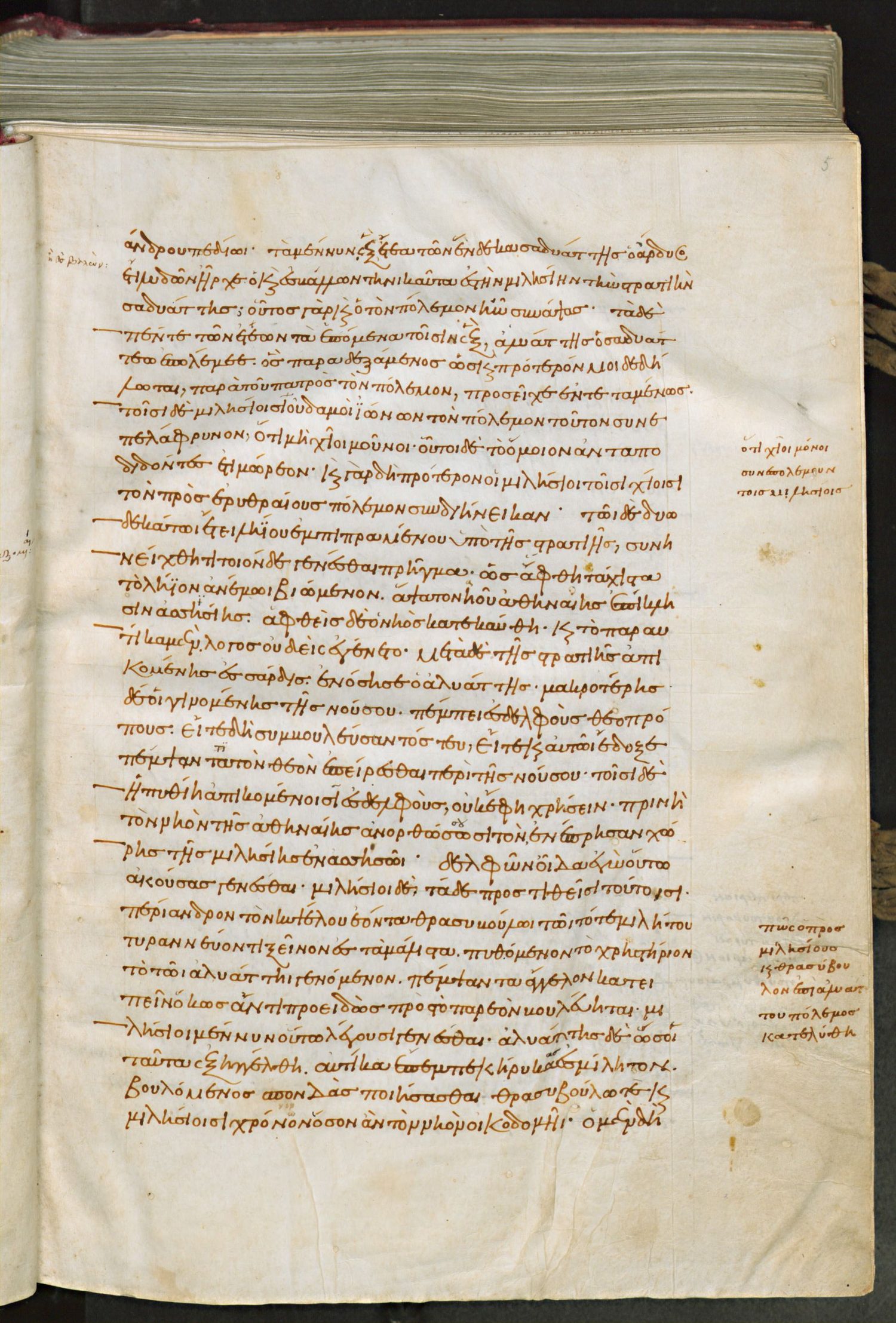
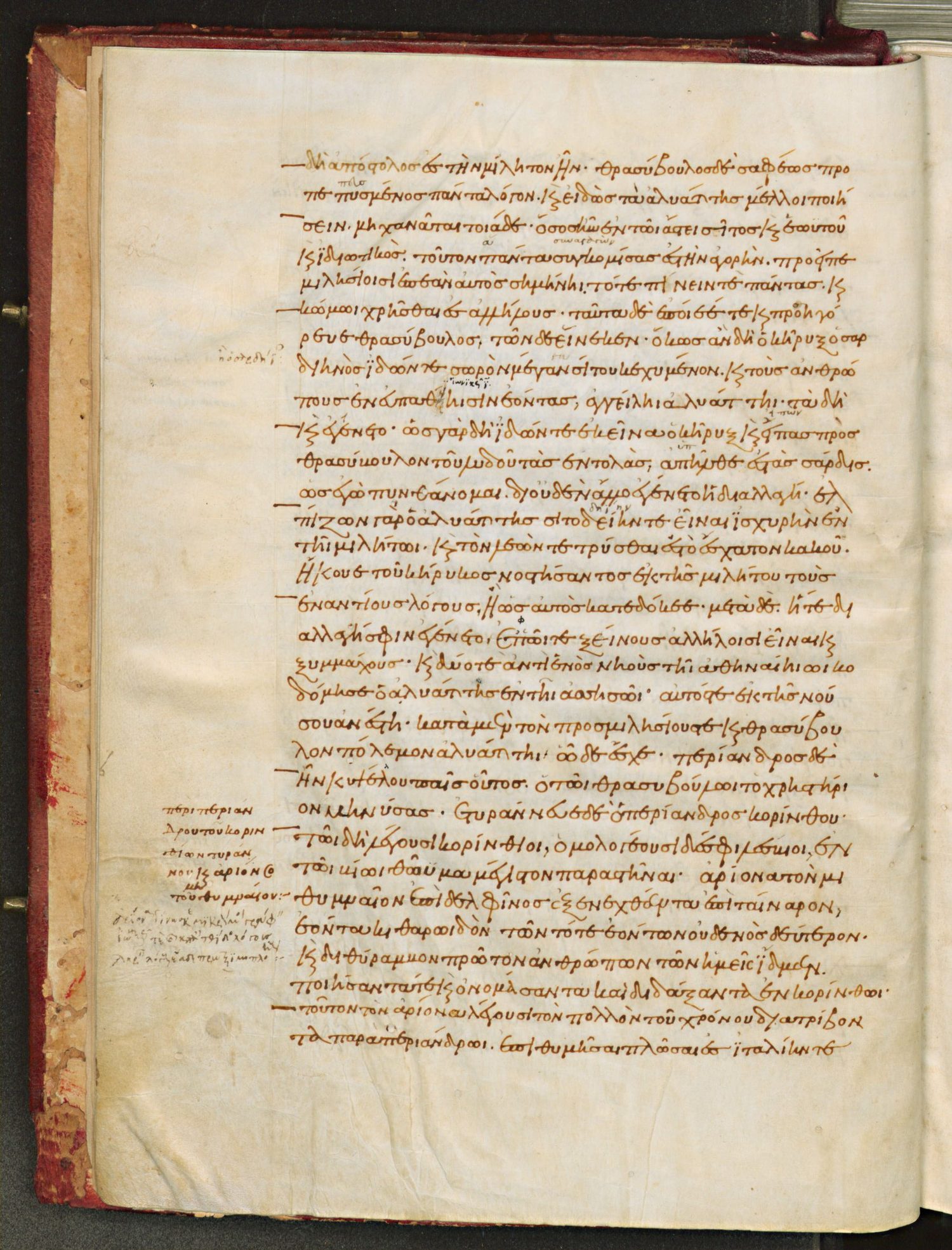
The photographs are of Florence, Biblioteca Medicea Laurenziana, Plut. 70.3 (parchment, 10th century, 374 folios, 31 lines a page), Herodotus, Histories (codex A of the editors), the oldest surviving manuscript of the complete Histories, from the Teca Digitale of the Biblioteca Medicea Laurenziana. Each section below is the text of one page, or of the part of a page that falls within these chapters. The first and last words of every page were read on the photograph and located in the Greek, and every page break was checked against the next page; the notes quote these words. Readers' notes in the margins are not part of the text and are mentioned where they occur.
The Greek is the text printed in A. D. Godley's Loeb edition (1920-1925), from Perseus; it is the edited text, not a transcription of the manuscript, whose wording differs in places. The English is Godley's translation as printed, from Wikisource. Godley's English carries only chapter numbers; the section numbers shown in it were placed by comparison with the Perseus version of his translation. Each page's English is cut at the end of one of Godley's sentences, so it can begin or end a few lines away from the Greek of the page; each note gives the exact ranges.
This entry covers chapters 1.15-25, on fol. 4r to 6v.
How was this verified? (Provenance)
Where on the image
Laur. Plut. 70.3, fol. 4r, 4v: Greek here 1.15.1 to 1.18.1. Checked on the image (first and last words read and located in the Greek; each break checked against the neighbouring page): fol. 4r begins ‹ἐν ἰάμβῳ τριμέτρῳ ἐπεμνήσθη.ἔσχε› (1.12.2), ends ‹γὰρ μέγα ἀπʼ αὐ-› (1.15.1). fol. 4v begins ‹-τοῦ ἄλλο ἔργον ἐγένετο› (1.15.1), ends ‹μαχεσαμένων καὶ ἐν Μαι-› (1.18.1). The word ‹αὐτοῦ› is divided between fol. 4r and fol. 4v; it is given with fol. 4r. This section joins the text of fol. 4r and 4v that belongs to these chapters, because the part on one of the pages is too short to carry any of Godley's sentences on its own. English here: 1.15.1 to 1.18.1 (Godley's sentences for the sections whose Greek lies mostly on this page).
1.15.1ἐσέβαλε μέν νυν στρατιὴν καὶ οὗτος ἐπείτε ἦρξε ἔς τε Μίλητον καὶ ἐς Σμύρνην, καὶ Κολοφῶνος τὸ ἄστυ εἷλε· ἀλλʼ οὐδὲν γὰρ μέγα ἀπʼ αὐτοῦ ἄλλο ἔργον ἐγένετο βασιλεύσαντος δυῶν δέοντα τεσσεράκοντα ἔτεα, τοῦτον μὲν παρήσομεν τοσαῦτα ἐπιμνησθέντες, Ἄρδυος δὲ τοῦ Γύγεω μετὰ Γύγην βασιλεύσαντος μνήμην ποιήσομαι. οὗτος δὲ Πριηνέας τε εἷλε ἐς Μίλητόν τε ἐσέβαλε, ἐπὶ τούτου τε τυραννεύοντος Σαρδίων Κιμμέριοι ἐξ ἠθέων ὑπὸ Σκυθέων τῶν νομάδων ἐξαναστάντες ἀπίκοντο ἐς τὴν Ἀσίην καὶ Σάρδις πλὴν τῆς ἀκροπόλιος εἷλον. 1.16.1Ἄρδυος δὲ βασιλεύσαντος ἑνὸς δέοντα πεντήκοντα ἔτεα ἐξεδέξατο Σαδυάττης ὁ Ἄρδυος, καὶ ἐβασίλευσε ἔτεα δυώδεκα, Σαδυάττεω δὲ Ἀλυάττης. 1.16.2οὗτος δὲ Κυαξάρῃ τε τῷ Δηιόκεω ἀπογόνῳ ἐπολέμησε καὶ Μήδοισι, Κιμμερίους τε ἐκ τῆς Ἀσίης ἐξήλασε, Σμύρνην τε τὴν ἀπὸ Κολοφῶνος κτισθεῖσαν εἷλε, ἐς Κλαζομενάς τε ἐσέβαλε. ἀπὸ μέν νυν τούτων οὐκ ὡς ἤθελε ἀπήλλαξε, ἀλλὰ προσπταίσας μεγάλως· ἄλλα δὲ ἔργα ἀπεδέξατο ἐὼν ἐν τῇ ἀρχῇ ἀξιαπηγητότατα τάδε. 1.17.1ἐπολέμησε Μιλησίοισι, παραδεξάμενος τὸν πόλεμον παρὰ τοῦ πατρός. ἐπελαύνων γὰρ ἐπολιόρκεε τὴν Μίλητον τρόπῳ τοιῷδε· ὅκως μὲν εἴη ἐν τῇ γῇ καρπὸς ἁδρός, τηνικαῦτα ἐσέβαλλε τὴν στρατιήν· ἐστρατεύετο δὲ ὑπὸ συρίγγων τε καὶ πηκτίδων καὶ αὐλοῦ γυναικηίου τε καὶ ἀνδρηίου. 1.17.2ὡς δὲ ἐς τὴν Μιλησίην ἀπίκοιτο, οἰκήματα μὲν τὰ ἐπὶ τῶν ἀγρῶν οὔτε κατέβαλλε οὔτε ἐνεπίμπρη οὔτε θύρας ἀπέσπα, ἔα δὲ κατὰ χώρην ἑστάναι· ὁ δὲ τὰ τε δένδρεα καὶ τὸν καρπὸν τὸν ἐν τῇ γῇ ὅκως διαφθείρειε, ἀπαλλάσσετο ὀπίσω. 1.17.3τῆς γὰρ θαλάσσης οἱ Μιλήσιοι ἐπεκράτεον, ὥστε ἐπέδρης μὴ εἶναι ἔργον τῇ στρατιῇ. τὰς δὲ οἰκίας οὐ κατέβαλλε ὁ Λυδὸς τῶνδε εἵνεκα, ὅκως ἔχοιεν ἐνθεῦτεν ὁρμώμενοι τὴν γῆν σπείρειν τε καὶ ἐργάζεσθαι οἱ Μιλήσιοι, αὐτὸς δὲ ἐκείνων ἐργαζομένων ἔχοι τι καὶ σίνεσθαι ἐσβάλλων. 1.18.1ταῦτα ποιέων ἐπολέμεε ἔτεα ἕνδεκα, ἐν τοῖσι τρώματα μεγάλα διφάσια Μιλησίων ἐγένετο, ἔν τε Λιμενηίῳ χώρης τῆς σφετέρης μαχεσαμένων καὶ ἐν Μαιάνδρου
1.15.1As soon as Gyges came to the throne, he too, like others, led an army into the lands of Miletus and Smyrna; and he took the city of Colophon. But he did nothing else great in his reign of thirty-eight years; I will therefore say no more of him, and will speak rather of Ardys the son of Gyges, who succeeded him. He took Priene and invaded the country of Miletus; and it was while he was monarch of Sardis that the Cimmerians, driven from their homes by the nomad Scythians, came into Asia, and took Sardis, all but the citadel. 1.16.1Ardys reigned for forty-nine years, and was succeeded by his son Sadyattes, who reigned for twelve years; and after Sadyattes came Alyattes, 1.16.2who waged war against Deioces’ descendant Cyaxares and the Medes, drove the Cimmerians out of Asia, took Smyrna (which was a colony from Colophon), and invaded the lands of Clazomenae. But here he came off not at all as he wished, but with great disaster. Of other deeds done by him in his reign these were most notable: 1.17.1He continued the war against the Milesians which his father had begun. This was the manner in which he attacked and laid siege to Miletus: he sent his invading army, marching to the sound of pipes and harps and flutes bass and treble, when the crops in the land were ripe: 1.17.2and whenever he came to the Milesian territory, the country dwellings he neither demolished nor burnt nor tore off their doors, but let them stand unharmed; but the trees and the crops of the land he destroyed, and so returned whence he came; 1.17.3for as the Milesians had command of the sea, it was of no avail for his army to besiege their city. The reason why the Lydian did not destroy the houses was this—that the Milesians might have homes whence to plant and cultivate their land, and that there might be the fruit of their toil for his invading army to lay waste. 1.18.1In this manner he waged war for eleven years, and in these years two great disasters befel the Milesians, one at the battle of Limeneion in their own territory, and the other in the valley of the Maeander.
Where on the image
Laur. Plut. 70.3, fol. 5r: Greek here 1.18.1 to 1.21.1. Checked on the image (first and last words read and located in the Greek; each break checked against the neighbouring page): fol. 5r begins ‹-άνδρου πεδίῳ.τὰ μέν νυν› (1.18.1), ends ‹οἰκοδομέῃ. ὃ μὲν δὴ› (1.21.1). The word ‹Μαιάνδρου› is divided between fol. 4v and fol. 5r; it is given with fol. 4v. English here: 1.18.2 to 1.21.2 (Godley's sentences for the sections whose Greek lies mostly on this page).
1.18.1πεδίῳ. 1.18.2τὰ μέν νυν ἓξ ἔτεα τῶν ἕνδεκα Σαδυάττης ὁ Ἄρδυος ἔτι Λυδῶν ἦρχε, ὁ καὶ ἐσβάλλων τηνικαῦτα ἐς τὴν Μιλησίην τὴν στρατιήν· Σαδυάττης οὗτος γὰρ καὶ ὁ τὸν πόλεμον ἦν συνάψας· τὰ δὲ πέντε τῶν ἐτέων τὰ ἑπόμενα τοῖσι ἓξ Ἀλυάττης ὁ Σαδυάττεω ἐπολέμεε, ὃς παραδεξάμενος, ὡς καὶ πρότερον μοι δεδήλωται, παρὰ τοῦ πατρὸς τὸν πόλεμον προσεῖχε ἐντεταμένως. 1.18.3τοῖσι δὲ Μιλησίοισι οὐδαμοὶ Ἰώνων τὸν πόλεμον τοῦτον συνεπελάφρυνον ὅτι μὴ Χῖοι μοῦνοι. οὗτοι δὲ τὸ ὅμοιον ἀνταποδιδόντες ἐτιμώρεον· καὶ γὰρ δὴ πρότερον οἱ Μιλήσιοι τοῖσι Χίοισι τὸν πρὸς Ἐρυθραίους πόλεμον συνδιήνεικαν. 1.19.1τῷ δὲ δυωδεκάτῳ ἔτεϊ ληίου ἐμπιπραμένου ὑπὸ τῆς στρατιῆς συνηνείχθη τι τοιόνδε γενέσθαι πρῆγμα· ὡς ἅφθη τάχιστα τὸ λήιον, ἀνέμῳ βιώμενον ἅψατο νηοῦ Ἀθηναίης ἐπίκλησιν Ἀσσησίης, ἁφθεὶς δὲ ὁ νηὸς κατεκαύθη. 1.19.2καὶ τὸ παραυτίκα μὲν λόγος οὐδεὶς ἐγένετο, μετὰ δὲ τῆς στρατιῆς ἀπικομένης ἐς Σάρδις ἐνόσησε ὁ Ἀλυάττης. μακροτέρης δέ οἱ γινομένης τῆς νούσου πέμπει ἐς Δελφοὺς θεοπρόπους, εἴτε δὴ συμβουλεύσαντός τευ, εἴτε καὶ αὐτῷ ἔδοξε πέμψαντα τὸν θεὸν ἐπειρέσθαι περὶ τῆς νούσου. 1.19.3τοῖσι δὲ ἡ Πυθίη ἀπικομένοισι ἐς Δελφοὺς οὐκ ἔφη χρήσειν πρὶν ἢ τὸν νηὸν τῆς Ἀθηναίης ἀνορθώσωσι, τὸν ἐνέπρησαν χώρης τῆς Μιλησίης ἐν Ἀσσησῷ. 1.20.1Δελφῶν οἶδα ἐγὼ οὕτω ἀκούσας γενέσθαι· Μιλήσιοι δὲ τάδε προστιθεῖσι τούτοισι, Περίανδρον τὸν Κυψέλου ἐόντα Θρασυβούλῳ τῷ τότε Μιλήτου τυραννεύοντι ξεῖνον ἐς τὰ μάλιστα, πυθόμενον τὸ χρηστήριον τὸ τῷ Ἀλυάττῃ γενόμενον, πέμψαντα ἄγγελον κατειπεῖν, ὅκως ἄν τι προειδὼς πρὸς τὸ παρεὸν βουλεύηται. 1.21.1Μιλήσιοι μέν νυν οὕτω λέγουσι γενέσθαι. Ἀλυάττης δέ, ὡς οἱ ταῦτα ἐξαγγέλθη, αὐτίκα ἔπεμπε κήρυκα ἐς Μίλητον βουλόμενος σπονδὰς ποιήσασθαι Θρασυβούλῳ τε καὶ Μιλησίοισι χρόνον ὅσον ἂν τὸν νηὸν οἰκοδομέῃ. ὃ μὲν δὴ
1.18.2For six of these eleven years Sadyattes son of Ardys was still ruler of Lydia, and he it was who invaded the lands of Miletus, for it was he who had begun the war; for the following five the war was waged by Sadyattes’ son Alyattes, who, as I have before shown, inherited the war from his father and carried it on vigorously. 1.18.3None of the Ionians helped to lighten this war for the Milesians, except only the Chians: these lent their aid for a like service done to themselves; for the Milesians had formerly helped the Chians in their war against the Erythraeans. 1.19.1In the twelfth year, when the Lydian army was burning the crops, it so happened that the fire set to the crops and blown by a strong wind caught the temple of Athene called Athene of Assesos1: and the temple was burnt to the ground. 1.19.2For the nonce no account Was taken of this. But presently after the army had returned to Sardis Alyattes fell sick; and, his sickness lasting longer than it should, he sent to Delphi to inquire of the oracle, either by someone’s counsel or by his own wish to question the god about his sickness: 1.19.3but when the messengers came to Delphi the Pythian priestess would not reply to them before they should restore the temple of Athene at Assesos in the Milesian territory, which they had burnt. 1.20.1Thus far I know the truth, for the Delphians told me. The Milesians add to the story, that Periander son of Cypselus, being a close friend of Thrasybulus who then was sovereign of Miletus, learnt what reply the oracle had given to Alyattes and sent a despatch to tell Thrasybulus, so that thereby his friend should be forewarned and make his plans accordingly. 1.21.1Such is the Milesian story. Then, when the Delphic reply was brought to Alyattes, straightway he sent a herald to Miletus, offering to make a truce with Thrasybulus and the Milesians during his building of the temple. So the envoy went to Miletus. But Thrasybulus, being exactly forewarned of the whole matter, and knowing what Alyattes meant to do, devised the following plan: 1.21.2he brought together into the market place all the food in the city, from private stores and his own, and bade the men of Miletus all drink and revel together when he should give the word.
Where on the image
Laur. Plut. 70.3, fol. 5v: Greek here 1.21.1 to 1.24.1. Checked on the image (first and last words read and located in the Greek; each break checked against the neighbouring page): fol. 5v begins ‹ἀπόστολος ἐς τὴν Μίλητον› (1.21.1), ends ‹πλῶσαι ἐς Ἰταλίην τε› (1.24.1). English here: 1.22.1 to 1.24.1 (Godley's sentences for the sections whose Greek lies mostly on this page).
1.21.1ἀπόστολος ἐς τὴν Μίλητον ἦν, Θρασύβουλος δὲ σαφέως προπεπυσμένος πάντα λόγον, καὶ εἰδὼς τὰ Ἀλυάττης μέλλοι ποιήσειν, μηχανᾶται τοιάδε· 1.21.2ὅσος ἦν ἐν τῷ ἄστεϊ σῖτος καὶ ἑωυτοῦ καὶ ἰδιωτικός, τοῦτον πάντα συγκομίσας ἐς τὴν ἀγορὴν προεῖπε Μιλησίοισι, ἐπεὰν αὐτὸς σημήνῃ, τότε πίνειν τε πάντας καὶ κώμῳ χρᾶσθαι ἐς ἀλλήλους. 1.22.1ταῦτα δὲ ἐποίεέ τε καὶ προηγόρευε Θρασύβουλος τῶνδε εἵνεκεν, ὅκως ἂν δὴ ὁ κῆρυξ ὁ Σαρδιηνὸς ἰδών τε σωρὸν μέγαν σίτου κεχυμένον καὶ τοὺς ἀνθρώπους ἐν εὐπαθείῃσι ἐόντας ἀγγείλῃ Ἀλυάττῃ· 1.22.2τὰ δὴ καὶ ἐγένετο. ὡς γὰρ δὴ ἰδών τε ἐκεῖνα ὁ κῆρυξ καὶ εἶπας πρὸς Θρασύβουλον τοῦ Λυδοῦ τὰς ἐντολὰς ἀπῆλθε ἐς τὰς Σάρδις, ὡς ἐγὼ πυνθάνομαι, διʼ οὐδὲν ἄλλο ἐγένετο ἡ διαλλαγή. 1.22.3ἐλπίζων γὰρ ὁ Ἀλυάττης σιτοδείην τε εἶναι ἰσχυρὴν ἐν τῇ Μιλήτῳ καὶ τὸν λεὼν τετρῦσθαι ἐς τὸ ἔσχατον κακοῦ, ἤκουε τοῦ κήρυκος νοστήσαντος ἐκ τῆς Μιλήτου τοὺς ἐναντίους λόγους ἢ ὡς αὐτὸς κατεδόκεε. 1.22.4μετὰ δὲ ἥ τε διαλλαγή σφι ἐγένετο ἐπʼ ᾧ τε ξείνους ἀλλήλοισι εἶναι καὶ συμμάχους, καὶ δύο τε ἀντὶ ἑνὸς νηοὺς τῇ Ἀθηναίῃ οἰκοδόμησε ὁ Ἀλυάττης ἐν τῇ Ἀσσησῷ, αὐτός τε ἐκ τῆς νούσου ἀνέστη. κατὰ μέν τὸν πρὸς Μιλησίους τε καὶ Θρασύβουλον πόλεμον Ἀλυάττῃ ὧδε ἔσχε. 1.23.1Περίανδρος δὲ ἦν Κυψέλου παῖς οὗτος ὁ τῷ Θρασυβούλῳ τὸ χρηστήριον μηνύσας· ἐτυράννευε δὲ ὁ Περίανδρος Κορίνθου· τῷ δὴ λέγουσι Κορίνθιοι (ὁμολογέουσι δέ σφι Λέσβιοι) ἐν τῷ βίῳ θῶμα μέγιστον παραστῆναι, Ἀρίονα τὸν Μηθυμναῖον ἐπὶ δελφῖνος ἐξενειχθέντα ἐπὶ Ταίναρον, ἐόντα κιθαρῳδὸν τῶν τότε ἐόντων οὐδενὸς δεύτερον, καὶ διθύραμβον πρῶτον ἀνθρώπων τῶν ἡμεῖς ἴδμεν ποιήσαντά τε καὶ ὀνομάσαντα καὶ διδάξαντα ἐν Κορίνθῳ. 1.24.1τοῦτον τὸν Ἀρίονα λέγουσι, τὸν πολλὸν τοῦ χρόνου διατρίβοντα παρὰ Περιάνδρῳ ἐπιθυμῆσαι πλῶσαι ἐς Ἰταλίην τε
1.22.1The intent of his so doing and commanding was, that when the herald from Sardis saw a great heap of food piled up, and the citizens making merry, he might bring word of it to Alyattes: and so it befell. 1.22.2The herald saw all this, gave Thrasybulus the message he was charged by the Lydian to deliver, and returned to Sardis; and this, as far as I can learn, was the single reason of the reconciliation. 1.22.3For Alyattes had supposed that there was great scarcity in Miletus and that the people were reduced to the last extremity of misery; but now on his herald’s return from the town he heard an account contrary to his expectations; 1.22.4so presently the Lydians and Milesians ended the war and agreed to be friends and allies, and Alyattes built not one but two temples of Athene at Assesos, and recovered of his sickness. Such is the story of Alyattes’ war against Thrasybulus and the Milesians. 1.23.1Periander, who disclosed the oracle’s answer to Thrasybulus, was the son of Cypselus, and sovereign lord of Corinth. As the Corinthians and Lesbians agree in relating, there happened to him a thing which was the most marvellous in his life, namely, the landing of Arion of Methymna on Taenarus, borne thither by a dolphin. This Arion was a lyre-player second to none in that age; he was the first man, as far as we know, to compose and name the dithyramb which he afterwards taught at Corinth. 1.24.1Thus then, the story runs: for the most part he lived at the court of Periander; then he formed the plan of voyaging to Italy and Sicily, whence, after earning much money, he was minded to return to Corinth.
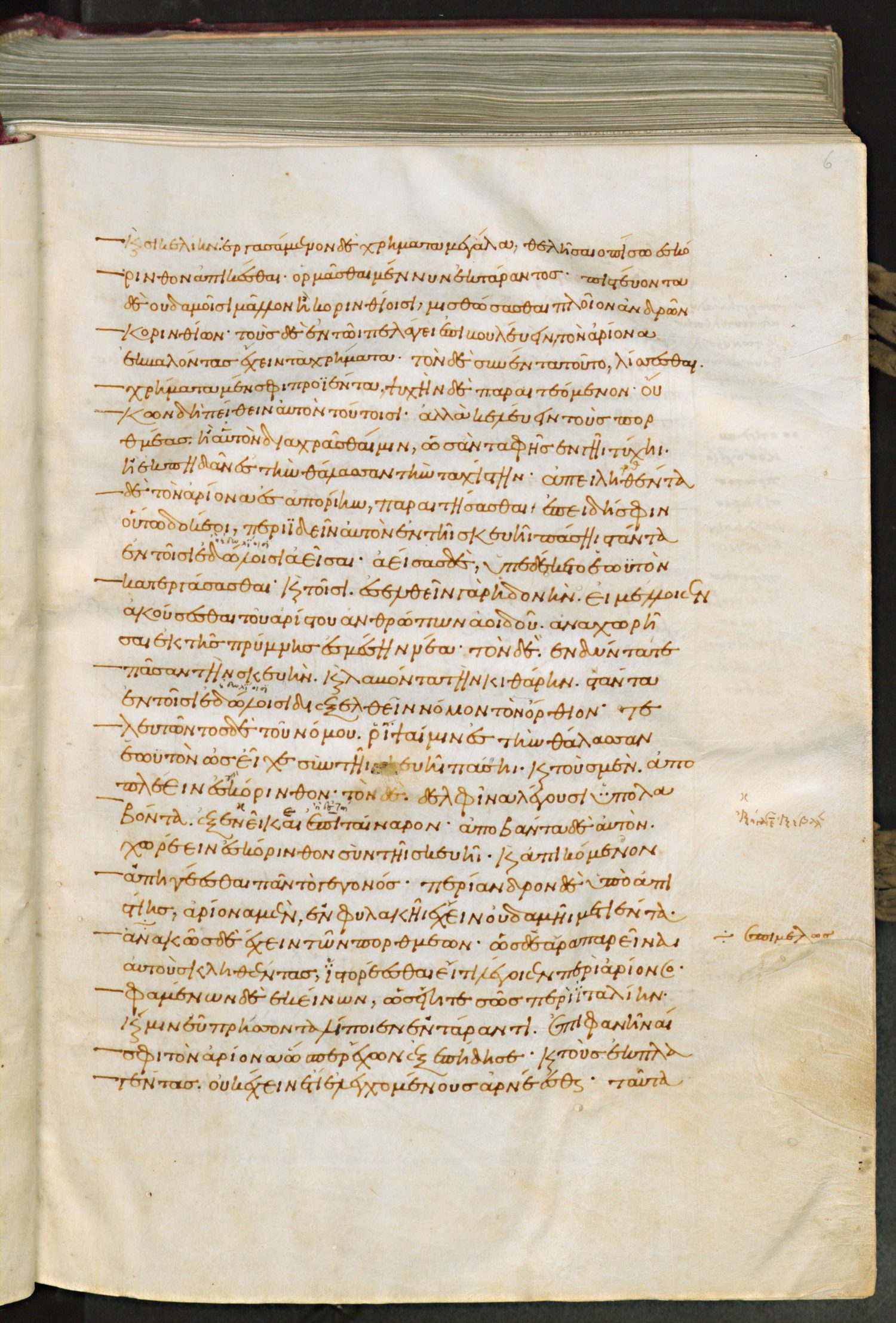
Where on the image
Laur. Plut. 70.3, fol. 6r: Greek here 1.24.1 to 1.24.8. Checked on the image (first and last words read and located in the Greek; each break checked against the neighbouring page): fol. 6r begins ‹καὶ Σικελίην, ἐργασάμενον δὲ› (1.24.1), ends ‹ἔχειν ἔτι ἐλεγχομένους ἀρνέεσθαι.ταῦτα› (1.24.8). English here: 1.24.2 to 1.24.7 (Godley's sentences for the sections whose Greek lies mostly on this page).
1.24.1καὶ Σικελίην, ἐργασάμενον δὲ χρήματα μεγάλα θελῆσαι ὀπίσω ἐς Κόρινθον ἀπικέσθαι. 1.24.2ὁρμᾶσθαι μέν νυν ἐκ Τάραντος, πιστεύοντα δὲ οὐδαμοῖσι μᾶλλον ἢ Κορινθίοισι μισθώσασθαι πλοῖον ἀνδρῶν Κορινθίων. τοὺς δὲ ἐν τῷ πελάγεϊ ἐπιβουλεύειν τὸν Ἀρίονα ἐκβαλόντας ἔχειν τὰ χρήματα. τὸν δὲ συνέντα τοῦτο λίσσεσθαι, χρήματα μὲν σφι προϊέντα, ψυχὴν δὲ παραιτεόμενον. 1.24.3οὔκων δὴ πείθειν αὐτὸν τούτοισι, ἀλλὰ κελεύειν τοὺς πορθμέας ἢ αὐτὸν διαχρᾶσθαί μιν, ὡς ἂν ταφῆς ἐν γῇ τύχῃ, ἢ ἐκπηδᾶν ἐς τὴν θάλασσαν τὴν ταχίστην· 1.24.4ἀπειληθέντα δὴ τὸν Ἀρίονα ἐς ἀπορίην παραιτήσασθαι, ἐπειδή σφι οὕτω δοκέοι, περιιδεῖν αὐτὸν ἐν τῇ σκευῇ πάσῃ στάντα ἐν τοῖσι ἑδωλίοισι ἀεῖσαι· ἀείσας δὲ ὑπεδέκετο ἑωυτὸν κατεργάσασθαι. 1.24.5καὶ τοῖσι ἐσελθεῖν γὰρ ἡδονὴν εἰ μέλλοιεν ἀκούσεσθαι τοῦ ἀρίστου ἀνθρώπων ἀοιδοῦ, ἀναχωρῆσαι ἐκ τῆς πρύμνης ἐς μέσην νέα. τὸν δὲ ἐνδύντα τε πᾶσαν τὴν σκευὴν καὶ λαβόντα τὴν κιθάρην, στάντα ἐν τοῖσι ἑδωλίοισι διεξελθεῖν νόμον τὸν ὄρθιον, τελευτῶντος δὲ τοῦ νόμου ῥῖψαί μιν ἐς τὴν θάλασσαν ἑωυτὸν ὡς εἶχε σὺν τῇ σκευῇ πάσῃ. 1.24.6καὶ τοὺς μὲν ἀποπλέειν ἐς Κόρινθον, τὸν δὲ δελφῖνα λέγουσι ὑπολαβόντα ἐξενεῖκαι ἐπὶ Ταίναρον. ἀποβάντα δέ αὐτὸν χωρέειν ἐς Κόρινθον σὺν τῇ σκευῇ, καὶ ἀπικόμενον ἀπηγέεσθαι πᾶν τὸ γεγονός. 1.24.7Περίανδρον δὲ ὑπὸ ἀπιστίης Ἀρίονα μὲν ἐν φυλακῇ ἔχειν οὐδαμῇ μετιέντα, ἀνακῶς δὲ ἔχειν τῶν πορθμέων. ὡς δὲ ἄρα παρεῖναι αὐτούς, κληθέντας ἱστορέεσθαι εἴ τι λέγοιεν περὶ Ἀρίονος. φαμένων δὲ ἐκείνων ὡς εἴη τε σῶς περὶ Ἰταλίην καί μιν εὖ πρήσσοντα λίποιεν ἐν Τάραντι, ἐπιφανῆναί σφι τὸν Ἀρίονα ὥσπερ ἔχων ἐξεπήδησε· καὶ τοὺς ἐκπλαγέντας οὐκ ἔχειν ἔτι ἐλεγχομένους ἀρνέεσθαι. 1.24.8ταῦτα
1.24.2Having especial trust in men of that city, he hired a Corinthian ship to carry him from Taras. But when they were out at sea, the crew plotted to cast Arion overboard and take his money. Discovering the plot, he earnestly entreated them, offering them all his money if they would but spare his life; 1.24.3but the sailors would not listen to him; he must, they said, either kill himself and so receive burial on land, or straightway cast himself into the sea. 1.24.4In this extremity Arion besought them, seeing that such was their will, that they would suffer him to stand on the poop with all his singing robes about him and sing; and after his song, so he promised, he would make away with himself. 1.24.5The men, well pleased at the thought of hearing the best singer in the world, drew away from the stern amidships; Arion, putting on all his adornment and taking his lyre, stood up on the poop and sang the “Shrill Strain,” and at its close threw himself without more ado into the sea, clad in his robes. 1.24.6So the crew sailed away to Corinth; but a dolphin (so the story goes) took Arion on his back and bore him to Taenarus. There he landed, went to Corinth in his singing robes, and when he came told all that had befallen him. 1.24.7Periander, not believing the tale, put him in close ward and kept careful watch for the coming of the sailors. When they came they were called and questioned, what news they brought of Arion, and they replied that he was safe in the parts of Italy, and that they had left him sound and well at Taras: when, behold, they were confronted with Arion, just as he was when he leapt from the ship; whereat they were amazed, and could no more deny what was proved against them.
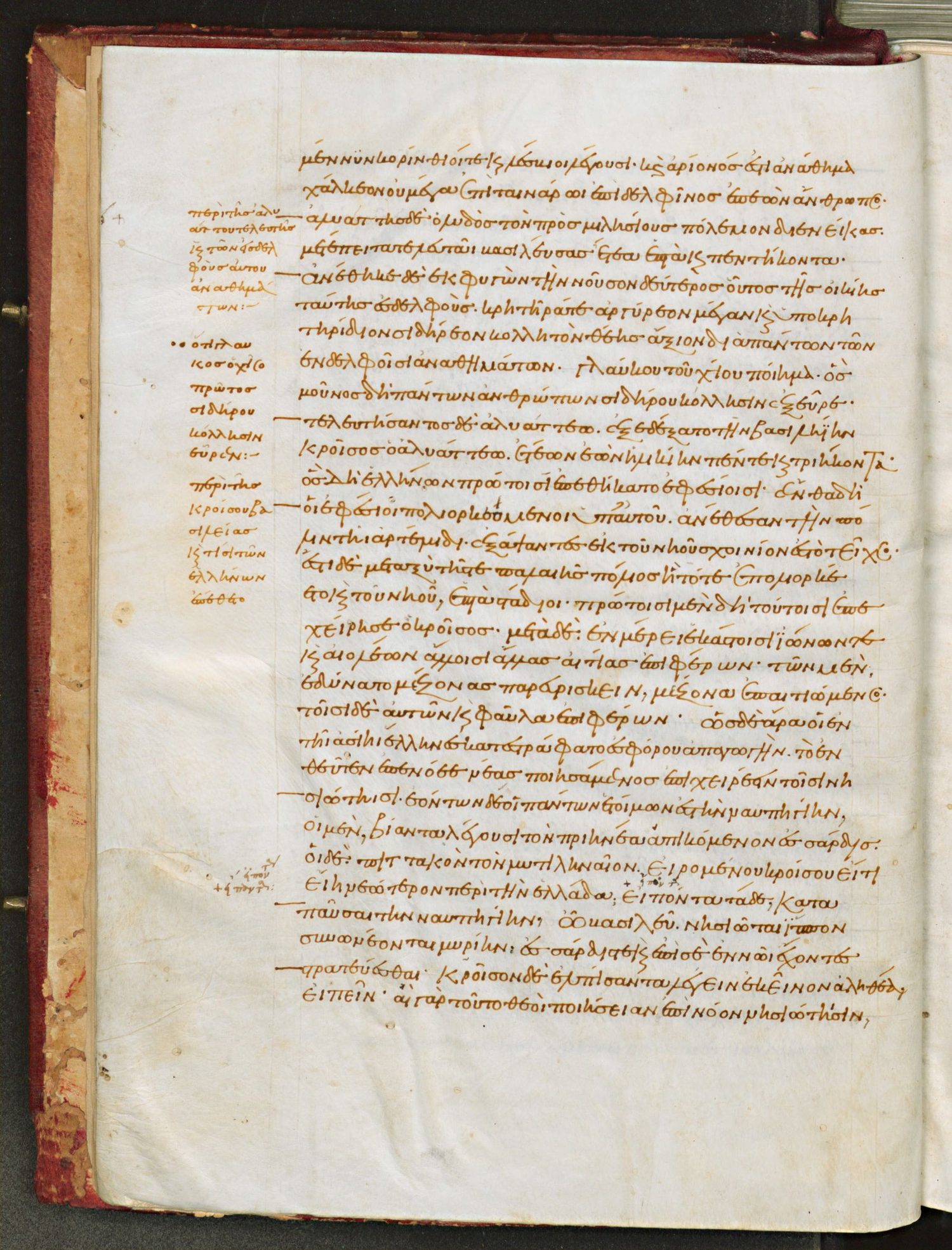
Where on the image
Laur. Plut. 70.3, fol. 6v: Greek here 1.24.8 to 1.25.2. Checked on the image (first and last words read and located in the Greek; each break checked against the neighbouring page): fol. 6v begins ‹μέν νυν Κορίνθιοί τε› (1.24.8), ends ‹ποιήσειαν ἐπὶ νόον νησιώτῃσι› (1.27.3). English here: 1.24.8 to 1.25.2 (Godley's sentences for the sections whose Greek lies mostly on this page).
1.24.8μέν νυν Κορίνθιοί τε καὶ Λέσβιοι λέγουσι, καὶ Ἀρίονος ἐστὶ ἀνάθημα χάλκεον οὐ μέγα ἐπὶ Ταινάρῳ, ἐπὶ δελφῖνος ἐπὲων ἄνθρωπος. 1.25.1Ἀλυάττης δὲ ὁ Λυδὸς τὸν πρὸς Μιλησίους πόλεμον διενείκας μετέπειτα τελευτᾷ, βασιλεύσας ἔτεα ἑπτὰ καὶ πεντήκοντα. 1.25.2ἀνέθηκε δὲ ἐκφυγὼν τὴν νοῦσον δεύτερος οὗτος τῆς οἰκίης ταύτης ἐς Δελφοὺς κρητῆρά τε ἀργύρεον μέγαν καὶ ὑποκρητηρίδιον σιδήρεον κολλητόν, θέης ἄξιον διὰ πάντων τῶν ἐν Δελφοῖσι ἀναθημάτων, Γλαύκου τοῦ Χίου ποίημα, ὃς μοῦνος δὴ πάντων ἀνθρώπων σιδήρου κόλλησιν ἐξεῦρε.
1.24.8Such is the story told by the Corinthians and Lesbians. There is moreover a little bronze monument to Arion on Taenarus, the figure of a man riding upon a dolphin. 1.25.1So Alyattes the Lydian, having finished his war with the Milesians, died after a reign of fifty-seven years. 1.25.2He was the second of his family to make an offering to Delphi—and this was a thank-offering for his recovery—of a great silver bowl on a stand of welded iron. This is the most notable among all the offerings at Delphi, and is the work of Glaucus the Chian, the only man of that age who discovered how to weld iron.
Notes
- Greek: the text printed in A. D. Godley's Loeb edition, via Perseus (tlg0016.tlg001.perseus-grc2). Square brackets mark words the editor considers later additions; [...] marks a gap the editor indicates. Perseus note markers are omitted.
- English: A. D. Godley, Herodotus vol. 1 (1920) (Loeb Classical Library), as transcribed on Wikisource. Godley's footnotes are omitted.
- Section numbers in the English were placed by comparing Godley's text with the Perseus version of his translation; where a section begins inside one of Godley's sentences, the English is kept with the page that holds the start of that sentence.
Cite
Sources
- Source: Florence, Laur. Plut. 70.3 (10th c.) via BML Teca Digitale + Greek of Godley's Loeb (Perseus) + English of A. D. Godley (Loeb, Wikisource) (holding institution)
- Critical edition: Greek of A. D. Godley's Loeb edition (1920-1925), via Perseus
← previous · → next · v cycle view · l back to library