Herodotus, Histories 6.125-140: The wooing of Agariste; Miltiades at Paros and Lemnos
Introduction
Herodotus of Halicarnassus wrote the Histories in the third quarter of the 5th century BCE, an inquiry into the deeds of Greeks and barbarians and the causes of the wars between them, later divided into nine books. Book 6 tells of the end of the Ionian revolt at Lade and Miletus, the first Persian expeditions against Greece under Mardonius and under Datis and Artaphrenes, the quarrels of Sparta, Athens and Aegina, and the battle of Marathon.
The photographs are of Florence, Biblioteca Medicea Laurenziana, Plut. 70.3 (parchment, 10th century, 374 folios, 31 lines a page), Herodotus, Histories (codex A of the editors), the oldest surviving manuscript of the complete Histories, from the Teca Digitale of the Biblioteca Medicea Laurenziana. Each section below is the text of one page, or of the part of a page that falls within these chapters. The first and last words of every page were read on the photograph and located in the Greek, and every page break was checked against the next page; the notes quote these words. Readers' notes in the margins are not part of the text and are mentioned where they occur.
The Greek is the text printed in A. D. Godley's Loeb edition (1920-1925), from Perseus; it is the edited text, not a transcription of the manuscript, whose wording differs in places. The English is Godley's translation as printed, from Wikisource. Godley's English carries only chapter numbers; the section numbers shown in it were placed by comparison with the Perseus version of his translation. Each page's English is cut at the end of one of Godley's sentences, so it can begin or end a few lines away from the Greek of the page; each note gives the exact ranges.
This entry covers chapters 6.125-140, on fol. 260r to 264v.
How was this verified? (Provenance)
Where on the image
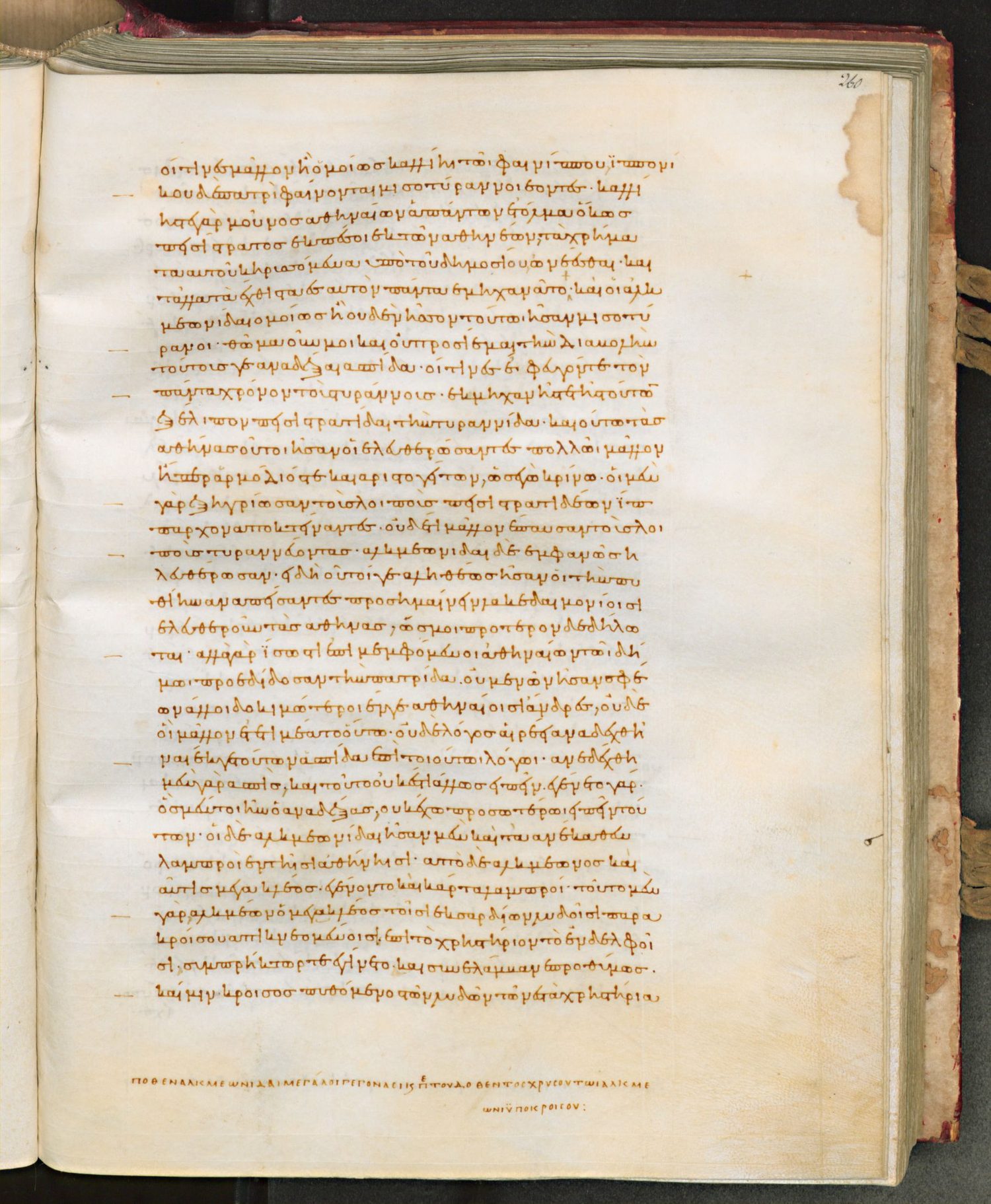
Laur. Plut. 70.3, fol. 260r: Greek here 6.125.1 to 6.125.2. Checked on the image (first and last words read and located in the Greek; each break checked against the neighbouring page): fol. 260r begins ‹οἵτινες μᾶλλον ἢ ὁμοίως› (6.121.1), ends ‹τῶν ἐς τὰ χρηστήρια› (6.125.2). Chapter 6.122, which the edition prints in square brackets as a later addition, is not in this manuscript: in line 7 the end of 6.121 (ἐμηχανᾶτο) is followed directly by 6.123 (καὶ οἱ Ἀλκμεωνίδαι). The Greek and English of 6.122 are shown with this page as the edition and Godley print them. English here: 6.125.1 to 6.125.2 (Godley's sentences for the sections whose Greek lies mostly on this page).
6.125.1οἱ δὲ Ἀλκμεωνίδαι ἦσαν μὲν καὶ τὰ ἀνέκαθεν λαμπροὶ ἐν τῇσι Ἀθήνῃσι, ἀπὸ δὲ Ἀλκμέωνος καὶ αὖτις Μεγακλέος ἐγένοντο καὶ κάρτα λαμπροί. 6.125.2τοῦτο μὲν γὰρ Ἀλκμέων ὁ Μεγακλέος τοῖσι ἐκ Σαρδίων Λυδοῖσι παρὰ Κροίσου ἀπικνεομένοισι ἐπὶ τὸ χρηστήριον τὸ ἐν Δελφοῖσι συμπρήκτωρ τε ἐγίνετο καὶ συνελάμβανε προθύμως, καί μιν Κροῖσος πυθόμενος τῶν Λυδῶν τῶν ἐς τὰ χρηστήρια
6.125.1The Alcmeonidae had been men of renown in old time at Athens, and from the days of Alcmeon and also Megacles their renown increased. 6.125.2For when the Lydians sent from Sardis came from Croesus to the Delphic oracle, Alcmeon son of Megacles wrought with and zealously aided them; so Croesus, hearing from the Lydians who visited the oracle of Alcmeon’s benefits to himself, sent for him to Sardis, and there made him a gift of as much gold as he could carry away at one time on his person.
Where on the image
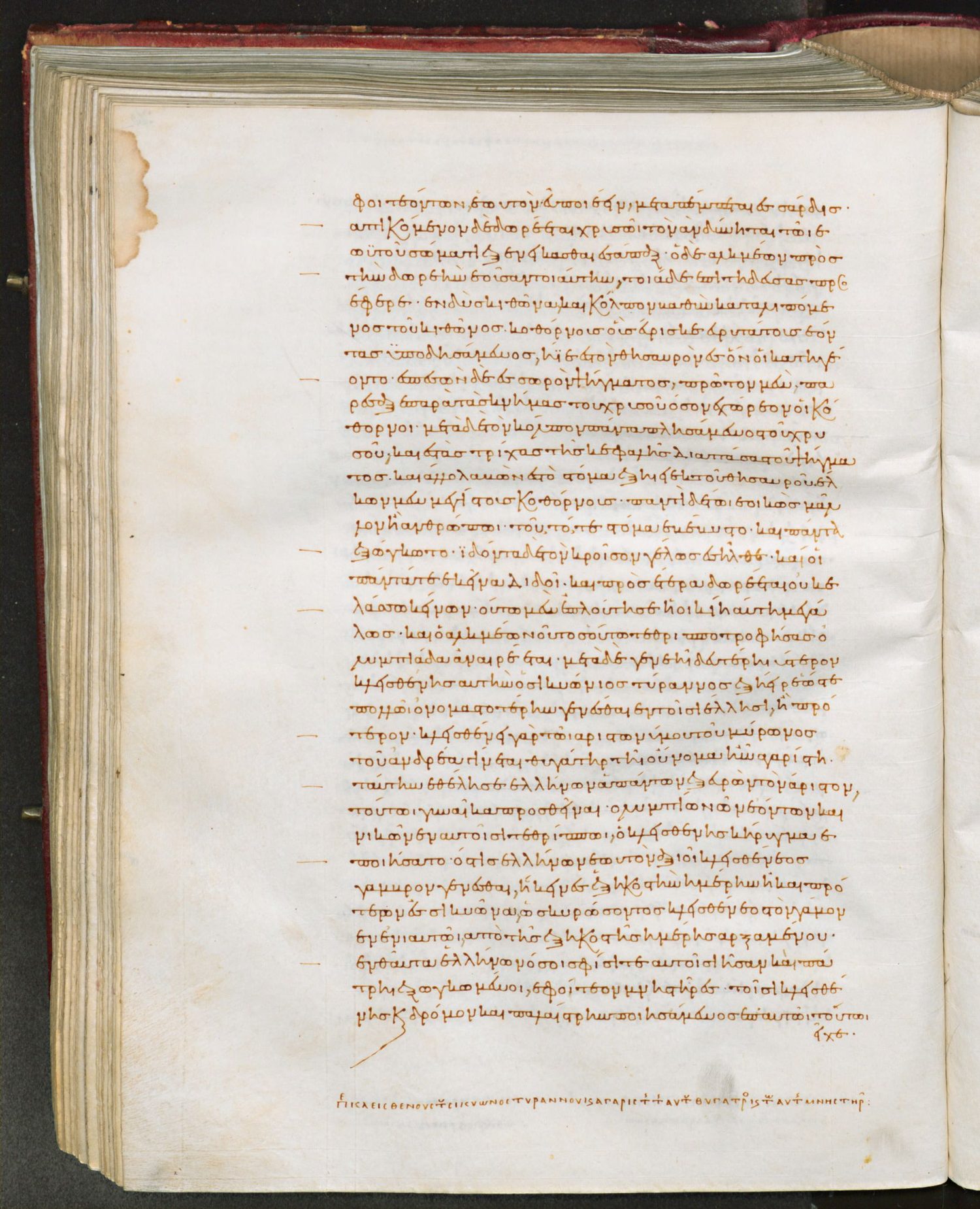
Laur. Plut. 70.3, fol. 260v: Greek here 6.125.2 to 6.126.3. Checked on the image (first and last words read and located in the Greek; each break checked against the neighbouring page): fol. 260v begins ‹φοιτεόντων ἑωυτὸν εὖ ποιέειν› (6.125.2), ends ‹ἐπʼ αὐτῷ τούτῳ εἶχε› (6.126.3). The last word (εἶχε) is written below the end of the last line. English here: 6.125.3 to 6.126.3 (Godley's sentences for the sections whose Greek lies mostly on this page).
6.125.2φοιτεόντων ἑωυτὸν εὖ ποιέειν μεταπέμπεται ἐς Σάρδις, ἀπικόμενον δὲ δωρέεται χρυσῷ τὸν ἂν δύνηται τῷ ἑωυτοῦ σώματι ἐξενείκασθαι ἐσάπαξ. 6.125.3ὁ δὲ Ἀλκμέων πρὸς τὴν δωρεὴν ἐοῦσαν τοιαύτην τοιάδε ἐπιτηδεύσας προσέφερε· ἐνδὺς κιθῶνα μέγαν καὶ κόλπον βαθὺν καταλιπόμενος τοῦ κιθῶνος, κοθόρνους τε τοὺς εὕρισκε εὐρυτάτους ἐόντας ὑποδησάμενος, ἤιε ἐς τὸν θησαυρὸν ἐς τόν οἱ κατηγέοντο. 6.125.4ἐσπεσὼν δὲ ἐς σωρὸν ψήγματος πρῶτα μὲν παρέσαξε παρὰ τὰς κνήμας τοῦ χρυσοῦ ὅσον ἐχώρεον οἱ κόθορνοι, μετὰ δὲ τὸν κόλπον πάντα πλησάμενος τοῦ χρυσοῦ καὶ ἐς τὰς τρίχας τῆς κεφαλῆς διαπάσας τοῦ ψήγματος καὶ ἄλλο λαβὼν ἐς τὸ στόμα, ἐξήιε ἐκ τοῦ θησαυροῦ ἕλκων μὲν μόγις τοὺς κοθόρνους, παντὶ δὲ τεῷ οἰκὼς μᾶλλον ἢ ἀνθρώπῳ· τοῦ τό τε στόμα ἐβέβυστο καὶ πάντα ἐξώγκωτο. 6.125.5ἰδόντα δὲ τὸν Κροῖσον γέλως ἐσῆλθε, καί οἱ πάντα τε ἐκεῖνα διδοῖ καὶ πρὸς ἕτερα δωρέεται οὐκ ἐλάσσω ἐκείνων. οὕτω μὲν ἐπλούτησε ἡ οἰκίη αὕτη μεγάλως, καὶ ὁ Ἀλκμέων οὗτος οὕτω τεθριπποτροφήσας Ὀλυμπιάδα ἀναιρέεται. 6.126.1μετὰ δὲ γενεῇ δευτέρῃ ὕστερον Κλεισθένης αὐτὴν ὁ Σικυώνιος τύραννος ἐξήειρε, ὥστε πολλῷ ὀνομαστοτέρην γενέσθαι ἐν τοῖσι Ἕλλησι ἢ πρότερον ἦν. Κλεισθένεϊ γὰρ τῷ Ἀριστωνύμου τοῦ Μύρωνος τοῦ Ἀνδρέω γίνεται θυγάτηρ τῇ οὔνομα ἦν Ἀγαρίστη. ταύτην ἠθέλησε, Ἑλλήνων ἁπάντων ἐξευρὼν τὸν ἄριστον, τούτῳ γυναῖκα προσθεῖναι. 6.126.2Ὀλυμπίων ὦν ἐόντων καὶ νικῶν ἐν αὐτοῖσι τεθρίππῳ ὁ Κλεισθένης κήρυγμα ἐποιήσατο, ὅστις Ἑλλήνων ἑωυτὸν ἀξιοῖ Κλεισθένεος γαμβρὸν γενέσθαι, ἥκειν ἐς ἑξηκοστὴν ἡμέρην ἢ καὶ πρότερον ἐς Σικυῶνα, ὡς κυρώσοντος Κλεισθένεος τὸν γάμον ἐν ἐνιαυτῷ, ἀπὸ τῆς ἑξηκοστῆς ἀρξαμένου ἡμέρης. 6.126.3ἐνθαῦτα Ἑλλήνων ὅσοι σφίσι τε αὐτοῖσι ἦσαν καὶ πάτρῃ ἐξωγκωμένοι, ἐφοίτεον μνηστῆρες· τοῖσι Κλεισθένης καὶ δρόμον καὶ παλαίστρην ποιησάμενος ἐπʼ αὐτῷ τούτῳ εἶχε.
6.125.3Such being the gift, Alcmeon planned and practised a device: he donned a wide tunic, leaving a deep fold in it, and shod himself with the most spacious buskins that he could find, and so entered the treasury whither he was guided. 6.125.4There, falling upon a heap of gold-dust, first he packed by his legs as much gold as his buskins would contain; then he filled the fold of his tunic all full of gold and strewed the dust among the hair of his head, and took more of it into his mouth; till when he came out of the treasury, hardly dragging the weight of his buskins, he was like anything rather than a human creature, with his mouth crammed full and all his body swollen. 6.125.5When Croesus saw him he fell a-laughing, and gave him all the gold he already had and as much more again. Thus that family grew very rich, and Alcmeon came to keep four-horse chariots, and won therewith at Olympia. 6.126.1In the next generation Cleisthenes the despot of Sicyon raised that house yet higher, so that it grew more famous in Hellas than it had formerly been. For Cleisthenes son of Aristonymus, who was the son of Myron, who was the son of Andreas, had one daughter, whose name was Agariste. 6.126.2He desired to wed her to the best man he could find in Hellas; wherefore, the Olympian games being then toward, wherein he was victor in a race of four-horse chariots, Cleisthenes made a proclamation, bidding whatever Greek thought himself worthy to be his son-in-law come on the sixtieth day from then or earlier to Sicyon, where (said Cleisthenes) he would make good his promise of marriage in a year from that sixtieth day. 6.126.3Then all the Greeks who were proud of themselves and their country came to ask the lady’s hand; whom, having that end in view, Cleisthenes made to contend in running and wrestling.
Where on the image
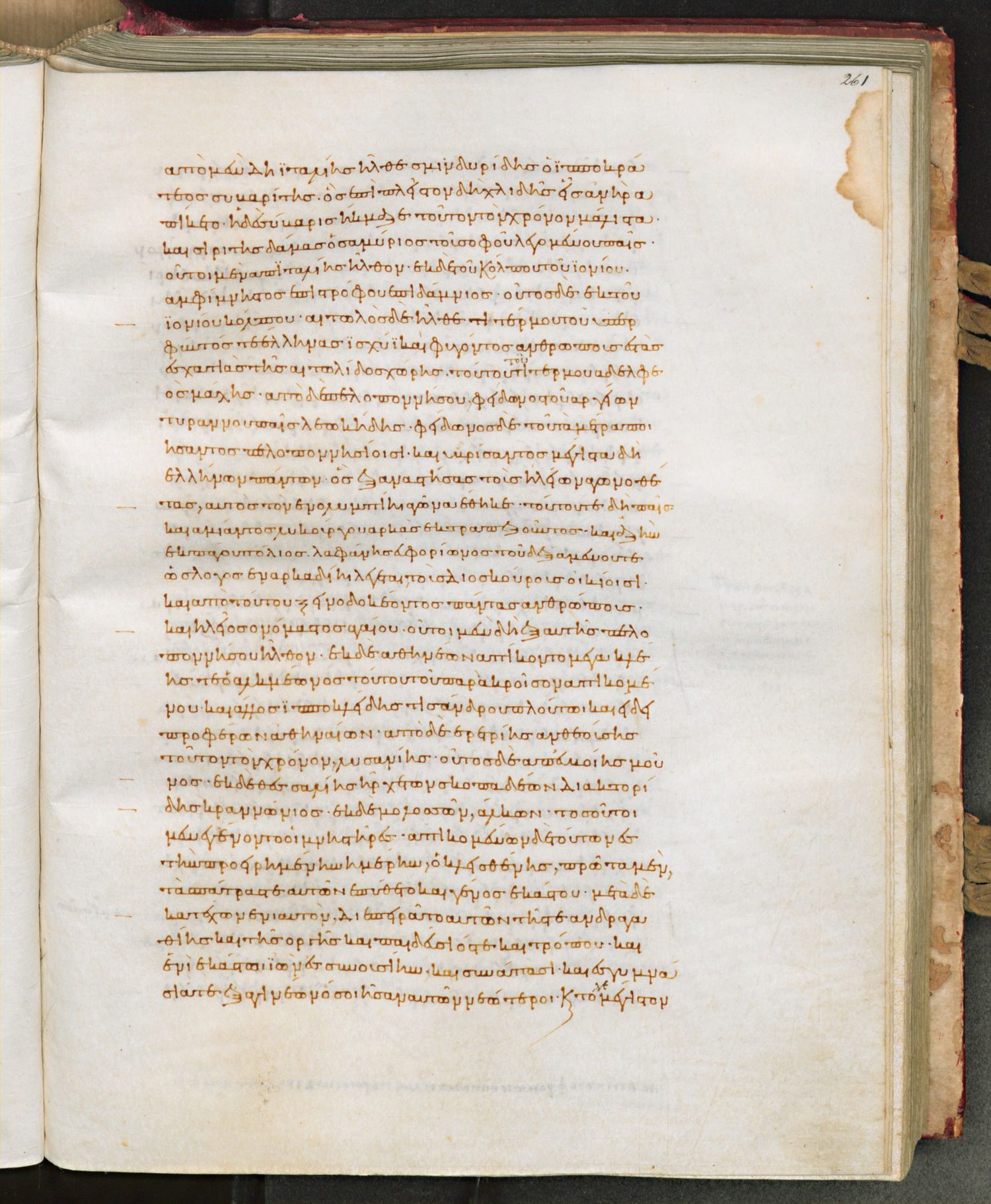
Laur. Plut. 70.3, fol. 261r: Greek here 6.127.1 to 6.128.1. Checked on the image (first and last words read and located in the Greek; each break checked against the neighbouring page): fol. 261r begins ‹ἀπὸ μὲν δὴ Ἰταλίης› (6.127.1), ends ‹καὶ τό γε μέγιστον› (6.128.1). English here: 6.127.1 to 6.128.1 (Godley's sentences for the sections whose Greek lies mostly on this page).
6.127.1ἀπὸ μὲν δὴ Ἰταλίης ἦλθε Σμινδυρίδης ὁ Ἱπποκράτεος Συβαρίτης, ὃς ἐπὶ πλεῖστον δὴ χλιδῆς εἷς ἀνὴρ ἀπίκετο (ἡ δὲ Σύβαρις ἤκμαζε τοῦτον τὸν χρόνον μάλιστα), καὶ Σιρίτης Δάμασος Ἀμύριος τοῦ σοφοῦ λεγομένου παῖς. 6.127.2οὗτοι μὲν ἀπὸ Ἰταλίης ἦλθον, ἐκ δὲ τοῦ κόλπου τοῦ Ἰονίου Ἀμφίμνηστος Ἐπιστρόφου Ἐπιδάμνιος· οὗτος δὲ ἐκ τοῦ Ἰονίου κόλπου. Αἰτωλὸς δὲ ἦλθε Τιτόρμου τοῦ ὑπερφύντος τε Ἕλληνας ἰσχύι καὶ φυγόντος ἀνθρώπους ἐς τὰς ἐσχατιὰς τῆς Αἰτωλίδος χώρης, τούτου τοῦ Τιτόρμου ἀδελφεὸς Μάλης. 6.127.3ἀπὸ δὲ Πελοποννήσου Φείδωνος τοῦ Ἀργείων τυράννου παῖς Λεωκήδης, Φείδωνος δὲ τοῦ τὰ μέτρα ποιήσαντος Πελοποννησίοισι καὶ ὑβρίσαντος μέγιστα δὴ Ἑλλήνων πάντων, ὃς ἐξαναστήσας τοὺς Ἠλείων ἀγωνοθέτας αὐτὸς τὸν ἐν Ὀλυμπίῃ ἀγῶνα ἔθηκε· τούτου τε δὴ παῖς καὶ Ἀμίαντος Λυκούργου Ἀρκὰς ἐκ Τραπεζοῦντος, καὶ Ἀζὴν ἐκ Παίου πόλιος Λαφάνης Εὐφορίωνος τοῦ δεξαμένου τε, ὡς λόγος ἐν Ἀρκαδίῃ λέγεται, τοὺς Διοσκούρους οἰκίοισι καὶ ἀπὸ τούτου ξεινοδοκέοντος πάντας ἀνθρώπους, καὶ Ἠλεῖος Ὀνόμαστος Ἀγαίου. 6.127.4οὗτοι μὲν δὴ ἐξ αὐτῆς Πελοποννήσου ἦλθον, ἐκ δὲ Ἀθηνέων ἀπίκοντο Μεγακλέης τε ὁ Ἀλκμέωνος τούτου τοῦ παρὰ Κροῖσον ἀπικομένου, καὶ ἄλλος Ἱπποκλείδης Τισάνδρου, πλούτῳ καὶ εἴδεϊ προφέρων Ἀθηναίων. ἀπὸ δὲ Ἐρετρίης ἀνθεύσης τοῦτον τὸν χρόνον Λυσανίης· οὗτος δὲ ἀπʼ Εὐβοίης μοῦνος. ἐκ δὲ Θεσσαλίης ἦλθε τῶν Σκοπαδέων Διακτορίδης Κραννώνιος, ἐκ δὲ Μολοσσῶν Ἄλκων. 6.128.1τοσοῦτοι μὲν ἐγένοντο οἱ μνηστῆρες. ἀπικομένων δὲ τούτων ἐς τὴν προειρημένην ἡμέρην, ὁ Κλεισθένης πρῶτα μὲν τὰς πάτρας τε αὐτῶν ἀνεπύθετο καὶ γένος ἑκάστου, μετὰ δὲ κατέχων ἐνιαυτὸν διεπειρᾶτο αὐτῶν τῆς τε ἀνδραγαθίης καὶ τῆς ὀργῆς καὶ παιδεύσιός τε καὶ τρόπου, καὶ ἑνὶ ἑκάστῳ ἰὼν ἐς συνουσίην καὶ συνάπασι, καὶ ἐς γυμνάσιά τε ἐξαγινέων ὅσοι ἦσαν αὐτῶν νεώτεροι, καὶ τό γε μέγιστον,
6.127.1From Italy came Smindyrides of Sybaris, son of Hippocrates, the most luxurious liver of his day (and Sybaris was then at the height of its prosperity), and Damasus of Siris, son of that Amyris who was called The Wise. 6.127.2These came from Italy; from the Ionian Gulf, Amphimnestus son of Epistrophus, an Epidamnian; he was of the Ionian Gulf. From Aetolia came Males, the brother of that Titormus who excelled all Greeks in strength, and fled from the sight of men to the farthest parts of the Aetolian land. 6.127.3From the Peloponnese came Leocedes, son of Phidon the despot of Argos, that Phidon who made weights and measures for the Peloponnesians, and dealt more high-handedly than any other Greek; for he drove out the Elean stewards of the lists, and ordered the contests at Olympia himself; this man’s son now came; and Amiantus an Arcadian from Trapezus, son of Lycurgus; and an Azenian from the town of Paeus, Laphanes son of that Euphorion who, as the Arcadian tale relates, gave lodging to the Dioscuri, and from that time forward kept open house for all men; and Onomastus from Elis, son of Agaeus. 6.127.4These came from the Peloponnese itself; from Athens, Megacles, son of that Alcmeon who visited Croesus, and beside him Hippoclides son of Tisandrus, the richest and goodliest man in Athens. From Eretria, which at that time was prosperous, Lysanias; he was the only man from Euboea; from Thessaly came a Scopad, Diactorides of Crannon; and from the Molossians, Alcon. 6.128.1Such was the roll of the suitors. When they were come on the day appointed, Cleisthenes first enquired the country and lineage of each; then he kept them with him for a year, making trial of their manly worth and temper and upbringing and manner of life; this he did by consorting with them alone and in company, putting the younger of them to contests of strength, but especially watching their demeanour at the common meal; for as long as he kept them with him he did all for them and entertained them with magnificence.
Where on the image
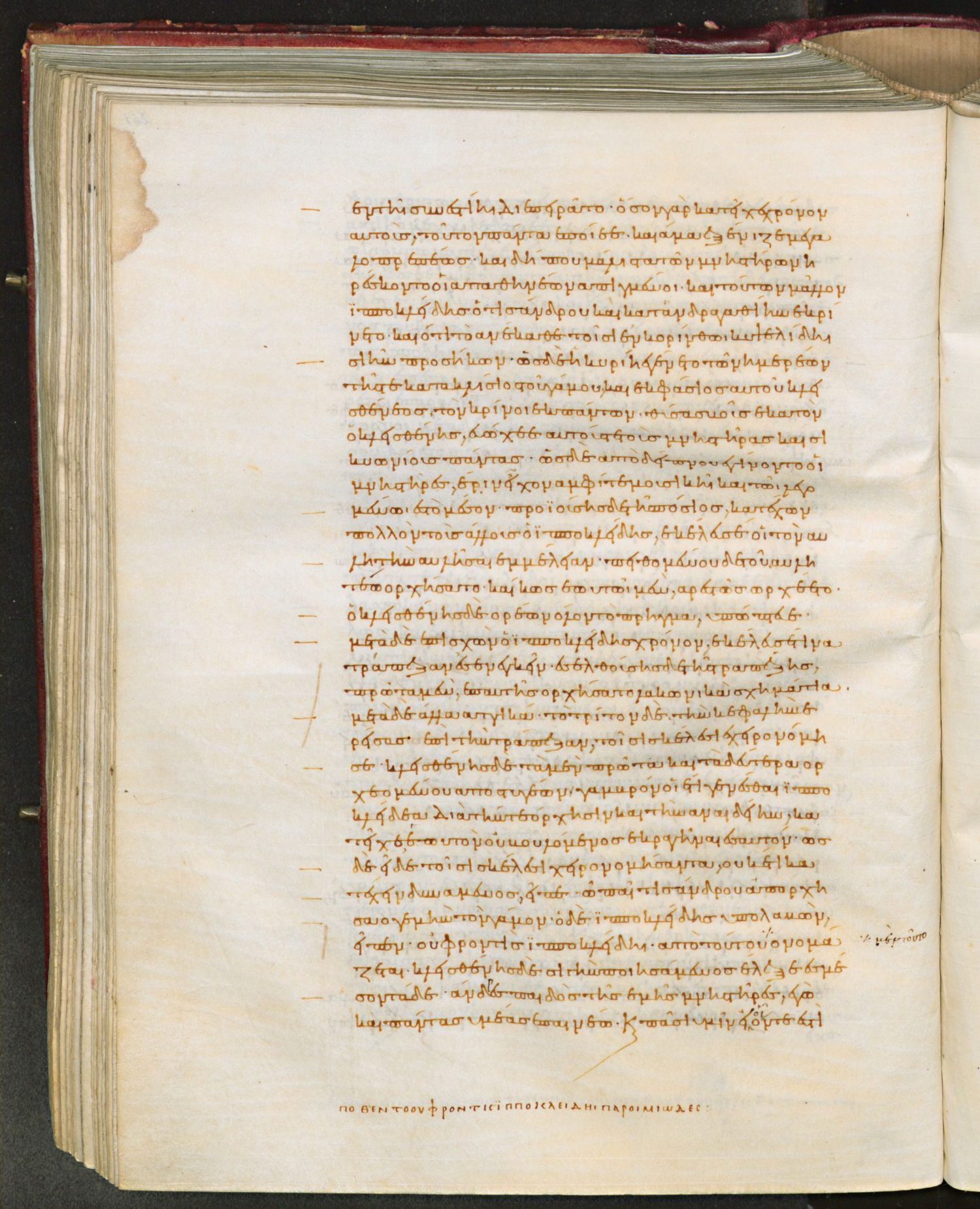
Laur. Plut. 70.3, fol. 261v: Greek here 6.128.1 to 6.130.1. Checked on the image (first and last words read and located in the Greek; each break checked against the neighbouring page): fol. 261v begins ‹ἐν τῇ συνεστίῃ διεπειρᾶτο·› (6.128.1), ends ‹εἰ οἷόν τε εἴη› (6.130.1). English here: 6.128.2 to 6.130.1 (Godley's sentences for the sections whose Greek lies mostly on this page).
6.128.1ἐν τῇ συνεστίῃ διεπειρᾶτο· ὅσον γὰρ κατεῖχε χρόνον αὐτούς, τοῦτον πάντα ἐποίεε καὶ ἅμα ἐξείνιζε μεγαλοπρεπέως. 6.128.2καὶ δή κου μάλιστα τῶν μνηστήρων ἠρέσκοντο οἱ ἀπʼ Ἀθηνέων ἀπιγμένοι, καὶ τούτων μᾶλλον Ἱπποκλείδης ὁ Τισάνδρου καὶ κατʼ ἀνδραγαθίην ἐκρίνετο καὶ ὅτι τὸ ἀνέκαθεν τοῖσι ἐν Κορίνθῳ Κυψελίδῃσι ἦν προσήκων. 6.129.1ὡς δὲ ἡ κυρίη ἐγένετο τῶν ἡμερέων τῆς τε κατακλίσιος τοῦ γάμου καὶ ἐκφάσιος αὐτοῦ Κλεισθένεος τὸν κρίνοι ἐκ πάντων, θύσας βοῦς ἑκατὸν ὁ Κλεισθένης εὐώχεε αὐτούς τε τοὺς μνηστῆρας καὶ Σικυωνίους πάντας. 6.129.2ὡς δὲ ἀπὸ δείπνου ἐγίνοντο, οἱ μνηστῆρες ἔριν εἶχον ἀμφί τε μουσικῇ καὶ τῷ λεγομένῳ ἐς τὸ μέσον. προϊούσης δὲ τῆς πόσιος κατέχων πολλὸν τοὺς ἄλλους ὁ Ἱπποκλείδης ἐκέλευσέ οἱ τὸν αὐλητὴν αὐλῆσαι ἐμμελείην, πειθομένου δὲ τοῦ αὐλητέω ὀρχήσατο. καί κως ἑωυτῷ μὲν ἀρεστῶς ὀρχέετο, ὁ Κλεισθένης δὲ ὁρέων ὅλον τὸ πρῆγμα ὑπώπτευε. 6.129.3μετὰ δὲ ἐπισχὼν ὁ Ἱπποκλείδης χρόνον ἐκέλευσε τινὰ τράπεζαν ἐσενεῖκαι, ἐσελθούσης δὲ τῆς τραπέζης πρῶτα μὲν ἐπʼ αὐτῆς ὀρχήσατο Λακωνικὰ σχημάτια, μετὰ δὲ ἄλλα Ἀττικά, τὸ τρίτον δὲ τὴν κεφαλὴν ἐρείσας ἐπὶ τὴν τράπεζαν τοῖσι σκέλεσι ἐχειρονόμησε. 6.129.4Κλεισθένης δὲ τὰ μὲν πρῶτα καὶ τὰ δεύτερα ὀρχεομένου, ἀποστυγέων γαμβρὸν ἄν οἱ ἔτι γενέσθαι Ἱπποκλείδεα διὰ τήν τε ὄρχησιν καὶ τὴν ἀναιδείην, κατεῖχε ἑωυτόν, οὐ βουλόμενος ἐκραγῆναι ἐς αὐτόν· ὡς δὲ εἶδε τοῖσι σκέλεσι χειρονομήσαντα, οὐκέτι κατέχειν δυνάμενος εἶπε ὦ παῖ Τισάνδρου, ἀπορχήσαό γε μὲν τὸν γάμον. ὁ δὲ Ἱπποκλείδης ὑπολαβὼν εἶπε οὐ φροντὶς Ἱπποκλείδῃ. ἀπὸ τούτου μὲν τοῦτο ὀνομάζεται. 6.130.1Κλεισθένης δὲ σιγὴν ποιησάμενος ἔλεξε ἐς μέσον τάδε. ἄνδρες παιδὸς τῆς ἐμῆς μνηστῆρες, ἐγὼ καὶ πάντας ὑμέας ἐπαινέω καὶ πᾶσι ὑμῖν, εἰ οἷόν τε εἴη,
6.128.2Now those of the suitors that best pleased him were they who came from Athens, and of these Hippoclides son of Tisandrus was judged the foremost, both for his manly worth and because by his lineage he was akin to the Cypselid family of Corinth. 6.129.1When the day appointed came for the marriage feast to be held and Cleisthenes himself to declare whom he chose out of all, Cleisthenes sacrificed a hundred oxen and gave a feast to the suitors themselves and the whole of Sicyon. 6.129.2After dinner the suitors vied with each other in music and social discourse. As they sat late drinking, Hippoclides, now far outdoing the rest, bade the flute-player play him music, and when the flute-player so did, he began to dance; and he pleased himself marvellous well with his dancing; but Cleisthenes saw the whole business with much disfavour. 6.129.3After a while, Hippoclides bade a table be brought; when it came he danced on it Laconian first and then Attic figures; last of all he rested his head on the table and made gestures with his legs in the air. 6.129.4Now Cleisthenes at the first and the second bout of dancing could no more bear to think of Hippoclides as his son-in-law, for his dancing and his shamelessness; yet he had held himself in check, not willing to vent his wrath on Hippoclides; but when he saw him making gestures with his legs, he could no longer keep silence, but cried, “’Tis very well, son of Tisandrus, but you have danced yourself out of your marriage.” Whereat quoth the other, “Hippoclides cares nought for that!” which is a byword from that day. 6.130.1Then Cleisthenes bade them all be silent, and spoke to the company at large. “Suitors for my daughter’s hand,” said he, “I thank you one and all; and were it possible I would grant each of you his wish, neither choosing out one to set him above another nor disparaging the rest.
Where on the image
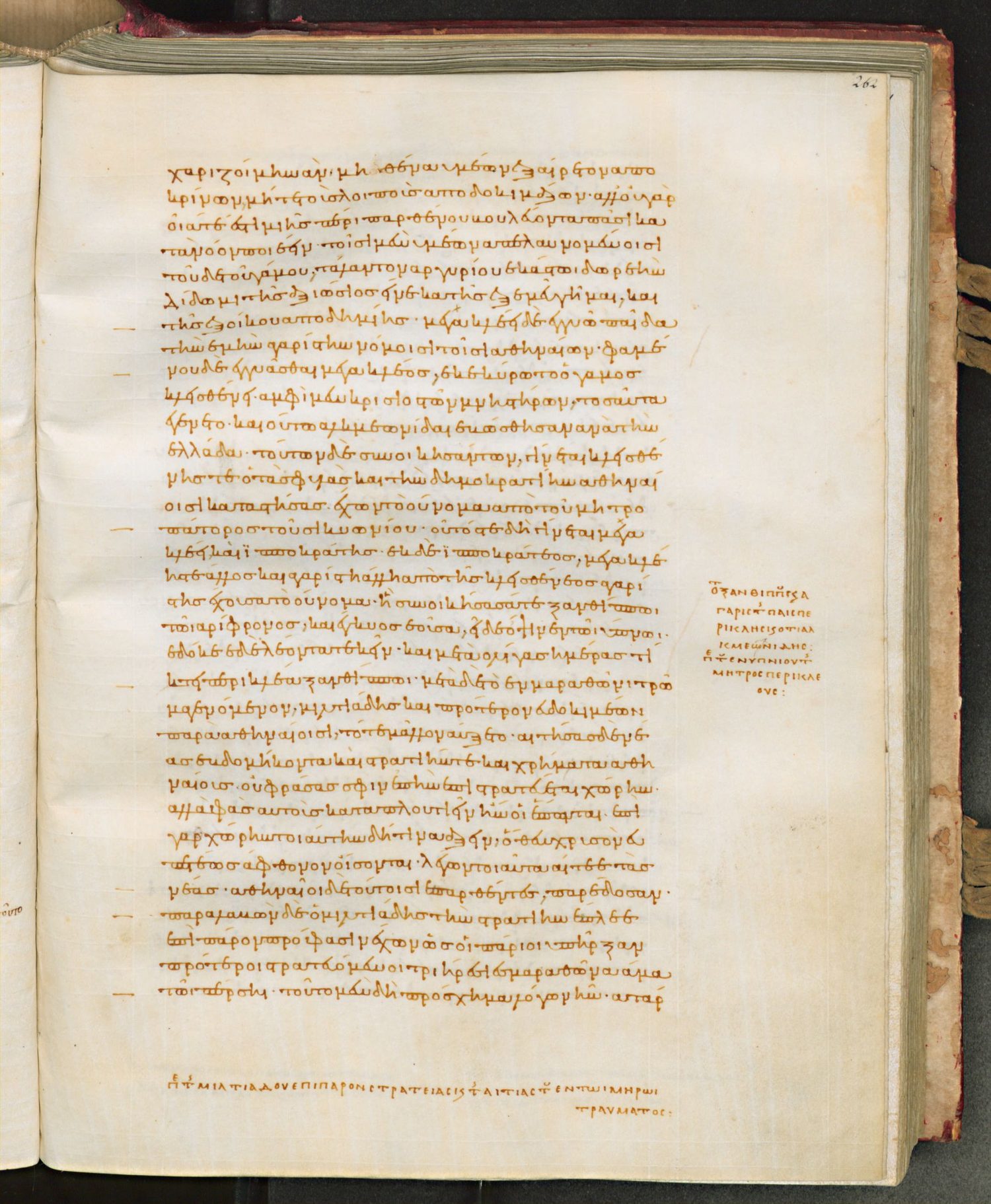
Laur. Plut. 70.3, fol. 262r: Greek here 6.130.1 to 6.133.1. Checked on the image (first and last words read and located in the Greek; each break checked against the neighbouring page): fol. 262r begins ‹χαριζοίμην ἄν, μήτʼ ἕνα› (6.130.1), ends ‹πρόσχημα λόγων ἦν, ἀτάρ› (6.133.1). English here: 6.130.2 to 6.133.1 (Godley's sentences for the sections whose Greek lies mostly on this page).
6.130.1χαριζοίμην ἄν, μήτʼ ἕνα ὑμέων ἐξαίρετον ἀποκρίνων μήτε τοὺς λοιποὺς ἀποδοκιμάζων. 6.130.2ἀλλʼ οὐ γὰρ οἷά τε ἐστὶ μιῆς πέρι παρθένου βουλεύοντα πᾶσι κατὰ νόον ποιέειν, τοῖσι μὲν ὑμέων ἀπελαυνομένοισι τοῦδε τοῦ γάμου τάλαντον ἀργυρίου ἑκάστῳ δωρεὴν δίδωμι τῆς ἀξιώσιος εἵνεκα τῆς ἐξ ἐμεῦ γῆμαι καὶ τῆς ἐξ οἴκου ἀποδημίης, τῷ δὲ Ἀλκμέωνος Μεγακλέι ἐγγυῶ παῖδα τὴν ἐμὴν Ἀγαρίστην νόμοισι τοῖσι Ἀθηναίων. φαμένου δὲ ἐγγυᾶσθαι Μεγακλέος ἐκεκύρωτο ὁ γάμος Κλεισθένεϊ. 6.131.1ἀμφὶ μὲν κρίσιος τῶν μνηστήρων τοσαῦτα ἐγένετο καὶ οὕτω Ἀλκμεωνίδαι ἐβώσθησαν ἀνὰ τὴν Ἑλλάδα. τούτων δὲ συνοικησάντων γίνεται Κλεισθένης τε ὁ τὰς φυλὰς καὶ τὴν δημοκρατίην Ἀθηναίοισι καταστήσας, ἔχων τὸ οὔνομα ἀπὸ τοῦ μητροπάτορος τοῦ Σικυωνίου· 6.131.2οὗτός τε δὴ γίνεται Μεγακλέϊ καὶ Ἱπποκράτης, ἐκ δὲ Ἱπποκράτεος Μεγακλέης τε ἄλλος καὶ Ἀγαρίστη ἄλλη ἀπὸ τῆς Κλεισθένεος Ἀγαρίστης ἔχουσα τὸ οὔνομα· ἣ συνοικήσασά τε Ξανθίππῳ τῷ Ἀρίφρονος καὶ ἔγκυος ἐοῦσα εἶδε ὄψιν ἐν τῷ ὕπνῳ, ἐδόκεε δὲ λέοντα τεκεῖν, καὶ μετʼ ὀλίγας ἡμέρας τίκτει Περικλέα Ξανθίππῳ. 6.132.1μετὰ δὲ τὸ ἐν Μαραθῶνι τρῶμα γενόμενον Μιλτιάδης, καὶ πρότερον εὐδοκιμέων παρὰ Ἀθηναίοισι, τότε μᾶλλον αὔξετο. αἰτήσας δὲ νέας ἑβδομήκοντα καὶ στρατιήν τε καὶ χρήματα Ἀθηναίους, οὐ φράσας σφι ἐπʼ ἣν ἐπιστρατεύσεται χώρην, ἀλλὰ φὰς αὐτοὺς καταπλουτιεῖν ἤν οἱ ἕπωνται· ἐπὶ γὰρ χώρην τοιαύτην δή τινα ἄξειν ὅθεν χρυσὸν εὐπετέως ἄφθονον οἴσονται· λέγων τοιαῦτα αἴτεε τὰς νέας. Ἀθηναῖοι δὲ τούτοισι ἐπαερθέντες παρέδοσαν. 6.133.1παραλαβὼν δὲ ὁ Μιλτιάδης τὴν στρατιὴν ἔπλεε ἐπὶ Πάρον, πρόφασιν ἔχων ὡς οἱ Πάριοι ὑπῆρξαν πρότεροι στρατευόμενοι τριήρεσι ἐς Μαραθῶνα ἅμα τῷ Πέρσῃ. τοῦτο μὲν δὴ πρόσχημα λόγων ἦν, ἀτάρ
6.130.2But seeing that I have but one damsel to plan for and so cannot please all of you, to those of you whose suit is rejected I make a gift of a talent of silver to each, for his desire to take a wife from my house and for his sojourn away from his home; and to Megacles son of Alcmeon do I betroth my daughter Agariste, as by Athenian law ordained.” Megacles accepted the betrothal, and so Cleisthenes made good his promise of the marriage. 6.131.1Such is the tale of the choice among the suitors; and thus the fame of the Alcmeonidae was noised abroad in Hellas. Of this marriage was born that Cleisthenes (so called after him of Sicyon, his mother’s father) who gave the Athenians their tribes and their democratic state; 6.131.2he and Hippocrates were born to Megacles; Hippocrates was father of another Megacles and another Agariste, called after Agariste who was Cleisthenes’ daughter; she, being wedded to Xanthippus son of Ariphron, and with child, saw a vision in her sleep whereby she thought she gave birth to a lion. In a few days she bore Xanthippus a son, Pericles. 6.132.1After the Persian disaster at Marathon, the fame of Miltiades, which had before been great at Athens, was increased. He asked of the Athenians seventy ships and an army and money, not telling them against what country he would lead them, but saying that he would make them rich men if they followed him; for he would bring them to a country whence they should easily carry away abundance of gold; so he promised when he asked for the ships; which the Athenians, being thus assured, gave him. 6.133.1Miltiades took his army and sailed for Paros, on the pretext that the Parians had brought this on themselves by first sending triremes with the Persian fleet to Marathon. Such was the pretext whereof he spoke; but he had a grudge against the Parians because Lysagoras son of Tisias, a man of Parian descent, had made ill blood between him and Hydarnes the Persian.
Where on the image
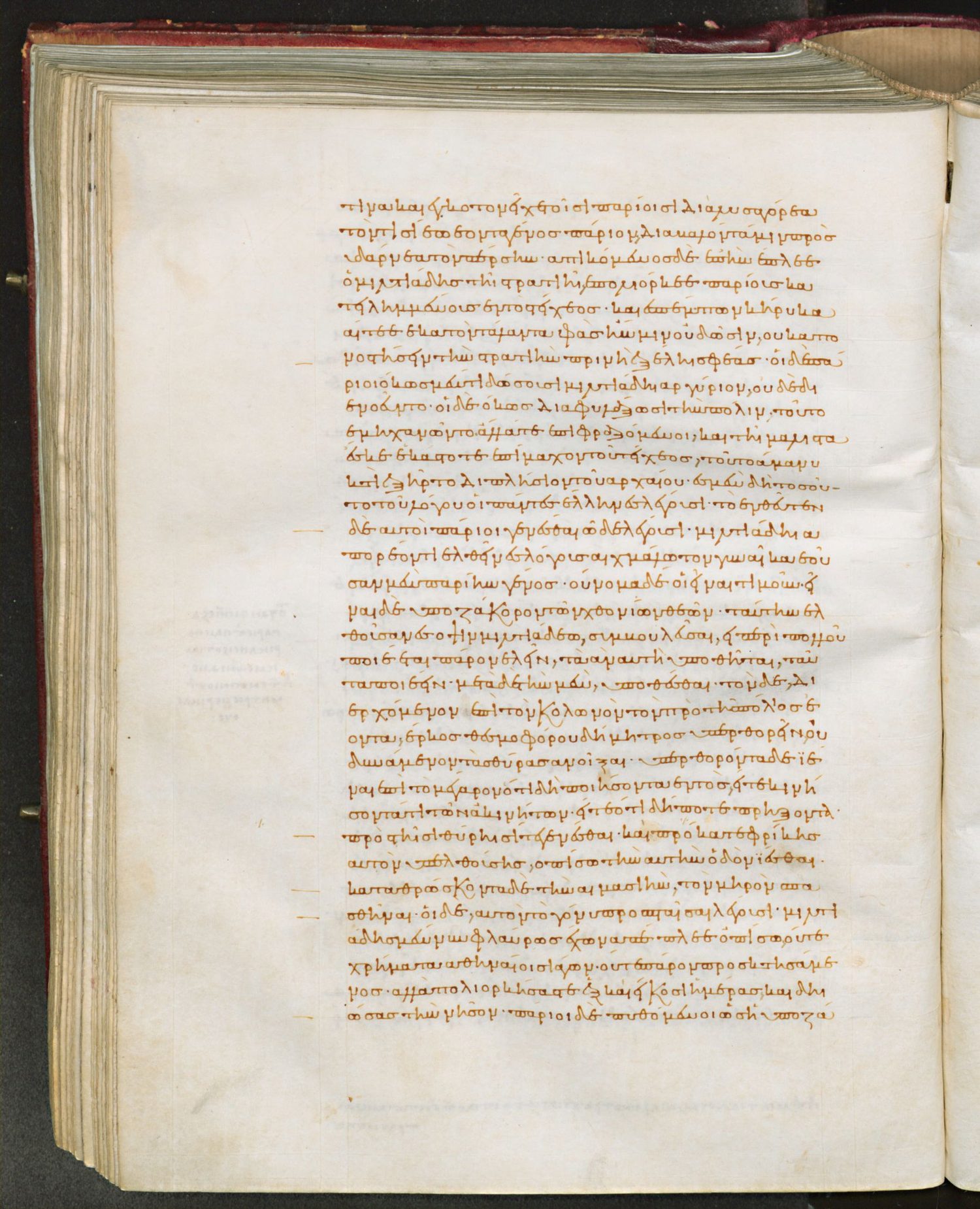
Laur. Plut. 70.3, fol. 262v: Greek here 6.133.1 to 6.135.2. Checked on the image (first and last words read and located in the Greek; each break checked against the neighbouring page): fol. 262v begins ‹τινα καὶ ἔγκοτον εἶχε› (6.133.1), ends ‹πυθόμενοι ὡς ἡ ὑποζά-› (6.135.2). English here: 6.133.2 to 6.135.1 (Godley's sentences for the sections whose Greek lies mostly on this page).
6.133.1τινα καὶ ἔγκοτον εἶχε τοῖσι Παρίοισι διὰ Λυσαγόρεα τὸν Τισίεω, ἐόντα γένος Πάριον, διαβαλόντα μιν πρὸς Ὑδάρνεα τὸν Πέρσην. 6.133.2ἀπικόμενος δὲ ἐπʼ ἣν ἔπλεε ὁ Μιλτιάδης τῇ στρατιῇ ἐπολιόρκεε Παρίους κατειλημένους ἐντὸς τείχεος, καὶ ἐσπέμπων κήρυκα αἴτεε ἑκατὸν τάλαντα, φάς, ἢν μιν οὐ δῶσι, οὐκ ἀπονοστήσειν τὴν στρατιὴν πρὶν ἢ ἐξέλῃ σφέας. 6.133.3οἱ δὲ Πάριοι ὅκως μέν τι δώσουσι Μιλτιάδῃ ἀργύριον οὐδὲ διενοεῦντο, οἳ δὲ ὅκως διαφυλάξουσι τὴν πόλιν τοῦτο ἐμηχανῶντο, ἄλλα τε ἐπιφραζόμενοι καὶ τῇ μάλιστα ἔσκε ἑκάστοτε ἐπίμαχον τοῦ τείχεος, τοῦτο ἅμα νυκτὶ ἐξηείρετο διπλήσιον τοῦ ἀρχαίου. 6.134.1ἐς μὲν δὴ τοσοῦτο τοῦ λόγου οἱ πάντες Ἕλληνες λέγουσι, τὸ ἐνθεῦτεν δὲ αὐτοὶ Πάριοι γενέσθαι ὧδε λέγουσι. Μιλτιάδῃ ἀπορέοντι ἐλθεῖν ἐς λόγους αἰχμάλωτον γυναῖκα, ἐοῦσαν μὲν Παρίην γένος, οὔνομα δέ οἱ εἶναι Τιμοῦν, εἶναι δὲ ὑποζάκορον τῶν χθονίων θεῶν· ταύτην ἐλθοῦσαν ἐς ὄψιν Μιλτιάδεω συμβουλεῦσαι, εἰ περὶ πολλοῦ ποιέεται Πάρον ἑλεῖν, τὰ ἂν αὐτὴ ὑποθῆται, ταῦτα ποιέειν. 6.134.2μετὰ δὲ τὴν μὲν ὑποθέσθαι, τὸν δὲ διερχόμενον ἐπὶ τὸν κολωνὸν τὸν πρὸ τῆς πόλιος ἐόντα ἕρκος θεσμοφόρου Δήμητρος ὑπερθορεῖν, οὐ δυνάμενον τὰς θύρας ἀνοῖξαι, ὑπερθορόντα δὲ ἰέναι ἐπὶ τὸ μέγαρον ὅ τι δὴ ποιήσοντα ἐντός, εἴτε κινήσοντά τι τῶν ἀκινήτων εἴτε ὅ τι δή κοτε πρήξοντα· πρὸς τῇσι θύρῃσί τε γενέσθαι καὶ πρόκατε φρίκης αὐτὸν ὑπελθούσης ὀπίσω τὴν αὐτὴν ὁδὸν ἵεσθαι, καταθρώσκοντα δὲ τὴν αἱμασιὴν τὸν μηρὸν σπασθῆναι· οἳ δὲ αὐτὸν τὸ γόνυ προσπταῖσαι λέγουσι. 6.135.1Μιλτιάδης μέν νυν φλαύρως ἔχων ἀπέπλεε ὀπίσω, οὔτε χρήματα Ἀθηναίοισι ἄγων οὔτε Πάρον προσκτησάμενος, ἀλλὰ πολιορκήσας τε ἓξ καὶ εἴκοσι ἡμέρας καὶ δηιώσας τὴν νῆσον. 6.135.2Πάριοι δὲ πυθόμενοι ὡς ἡ ὑποζάκορος
6.133.2Having come to the place to which he sailed, Miltiades with his army drove the Parians within their walls and there besieged them; and sending in a herald he demanded a hundred talents, which (said he) if they would not give him, his army should not return before it had stormed their city. 6.133.3The Parians had no thought at all of giving any money to Miltiades, and had no other purpose but to defend their city, which they did by building their wall at night to double its former height where it was most assailable, and also by other devices. 6.134.1As far as this all Greeks tell the same story; thenceforward this is the tale as it is told by the Parians themselves: Miltiades (they say) being in a quandary, a Parian slave woman named Timo, who was an under-priestess of the goddesses of the dead, had speech with him; 6.134.2coming before Miltiades, she counselled him, if he set great store by the taking of Paros, to do as she should advise him. Presently, at her advice, he passed through to the hill before the city, and there he climbed over the fence of the precinct of Demeter the Lawgiver,—not being able to open the door,—and having so done went to the shrine, whether to move something that should not be moved, or with some other intent; but when he was at the very door he was seized straightway by panic fear and returned by the same way; and in leaping down from the wall he twisted his thigh, or as some say took a blow on his knee. 6.135.1So Miltiades sailed back home in sorry plight; for he brought no wealth, nor had he won Paros; he had besieged the town for six-and-twenty days and laid waste the island.
Where on the image
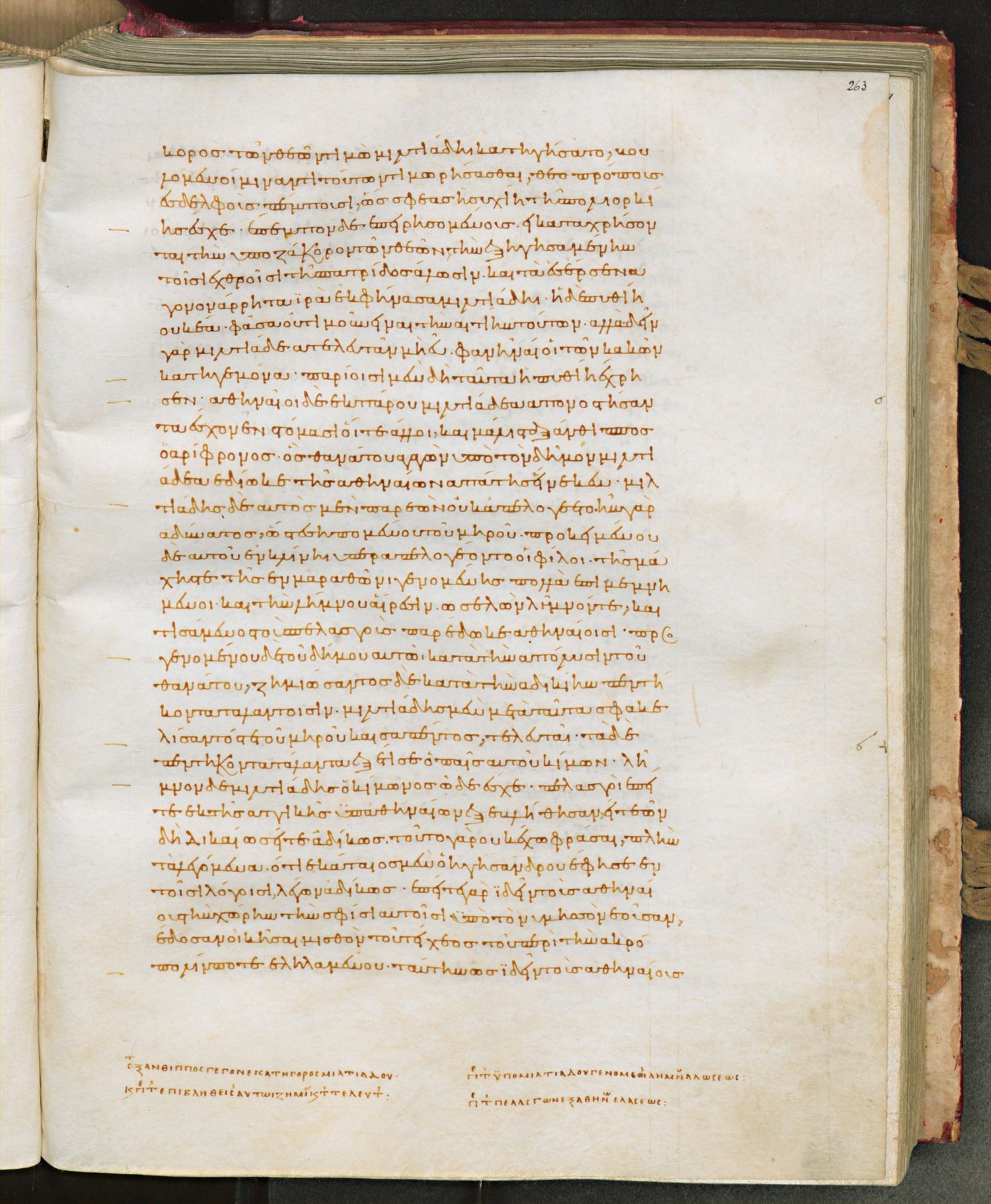
Laur. Plut. 70.3, fol. 263r: Greek here 6.135.2 to 6.137.2. Checked on the image (first and last words read and located in the Greek; each break checked against the neighbouring page): fol. 263r begins ‹-κορος τῶν θεῶν Τιμὼ› (6.135.2), ends ‹ὡς ἰδεῖν τοὺς Ἀθηναίους› (6.137.2). The word ‹ὑποζάκορος› is divided between fol. 262v and fol. 263r; it is given with fol. 262v. English here: 6.135.2 to 6.137.2 (Godley's sentences for the sections whose Greek lies mostly on this page).
6.135.2τῶν θεῶν Τιμὼ Μιλτιάδῃ κατηγήσατο, βουλόμενοί μιν ἀντὶ τούτων τιμωρήσασθαι, θεοπρόπους πέμπουσι ἐς Δελφούς ὥς σφεας ἡσυχίη τῆς πολιορκίης ἔσχε· ἔπεμπον δὲ ἐπειρησομένους εἰ καταχρήσωνται τὴν ὑποζάκορον τῶν θεῶν τὴν ἐξηγησαμένην τοῖσι ἐχθροῖσι τῆς πατρίδος ἅλωσιν καὶ τὰ ἐς ἔρσενα γόνον ἄρρητα ἱρὰ ἐκφήνασαν Μιλτιάδῃ. 6.135.3ἡ δὲ Πυθίη οὐκ ἔα, φᾶσα οὐ Τιμοῦν εἶναι τὴν αἰτίην τούτων, ἀλλὰ δεῖν γὰρ Μιλτιάδεα τελευτᾶν μὴ εὖ, φανῆναί οἱ τῶν κακῶν κατηγεμόνα. 6.136.1παρίοισι μὲν δὴ ταῦτα ἡ Πυθίη ἔχρησε· Ἀθηναῖοι δὲ ἐκ Πάρου Μιλτιάδεα ἀπονοστήσαντα ἔσχον ἐν στόμασι οἵ τε ἄλλοι καὶ μάλιστα Ξάνθιππος ὁ Ἀρίφρονος, ὃς θανάτου ὑπαγαγὼν ὑπὸ τὸν δῆμον Μιλτιάδεα ἐδίωκε τῆς Ἀθηναίων ἀπάτης εἵνεκεν. 6.136.2Μιλτιάδης δὲ αὐτὸς μὲν παρεὼν οὐκ ἀπελογέετο· ἦν γὰρ ἀδύνατος ὥστε σηπομένου τοῦ μηροῦ· προκειμένου δὲ αὐτοῦ ἐν κλίνῃ ὑπεραπελογέοντο οἱ φίλοι, τῆς μάχης τε τῆς ἐν Μαραθῶνι γενομένης πολλὰ ἐπιμεμνημένοι καὶ τὴν Λήμνου αἵρεσιν, ὡς ἑλὼν Λῆμνόν τε καὶ τισάμενος τοὺς Πελασγοὺς παρέδωκε Ἀθηναίοισι. 6.136.3προσγενομένου δὲ τοῦ δήμου αὐτῷ κατὰ τὴν ἀπόλυσιν τοῦ θανάτου, ζημιώσαντος δὲ κατὰ τὴν ἀδικίην πεντήκοντα ταλάντοισι, Μιλτιάδης μὲν μετὰ ταῦτα σφακελίσαντός τε τοῦ μηροῦ καὶ σαπέντος τελευτᾷ, τὰ δὲ πεντήκοντα τάλαντα ἐξέτισε ὁ παῖς αὐτοῦ Κίμων. 6.137.1Λῆμνον δὲ Μιλτιάδης ὁ Κίμωνος ὧδε ἔσχε. Πελασγοὶ ἐπείτε ἐκ τῆς Ἀττικῆς ὑπὸ Ἀθηναίων ἐξεβλήθησαν, εἴτε ὦν δὴ δικαίως εἴτε ἀδίκως· τοῦτο γὰρ οὐκ ἔχω φράσαι, πλὴν τὰ λεγόμενα, ὅτι Ἑκαταῖος μὲν ὁ Ἡγησάνδρου ἔφησε ἐν τοῖσι λόγοισι λέγων ἀδίκως· 6.137.2ἐπείτε γὰρ ἰδεῖν τοὺς Ἀθηναίους τὴν χώρην, τὴν σφίσι αὐτοῖσι ὑπὸ τὸν Ὑμησσὸν ἐοῦσαν ἔδοσαν Πελασγοῖσι οἰκῆσαι μισθὸν τοῦ τείχεος τοῦ περὶ τὴν ἀκρόπολιν κοτὲ ἐληλαμένου, ταύτην ὡς ἰδεῖν τοὺς Ἀθηναίους
6.135.2The Parians, learning that Timo the under-priestess of the goddesses had been Miltiades’ guide, desired to punish her for this, and having now rest from the siege sent messengers to Delphi to enquire if they should put the under-priestess to death for having compassed the taking of her country by guiding its enemies, and revealing to Miltiades the rites that no male should know. 6.135.3But the Pythian priestess forbade them; it was not Timo, she said, that was in fault, but Miltiades was doomed to make an ill end, and an apparition had guided him in these evil courses. 6.136.1Such was the priestess’ reply to the Parians; but when Miltiades returned back from Paros many tongues were let loose against him at Athens; and Xanthippus son of Ariphron impeached him before the people, calling for the penalty of death for the deceit which he had practised on the Athenians. 6.136.2Miltiades was present, but could not speak in his own defence, his thigh being mortified; but he was laid before the court on a bed, and his friends spoke for him, ever calling to mind the fight at Marathon and the conquest of Lemnos,—how Miltiades had punished the Pelasgians and taken Lemnos and delivered it to the Athenians. 6.136.3The people took his side in so far as they would not condemn him to death, but they fined him fifty talents for his wrong-doing. Presently Miltiades died of the gangrene and mortification of his thigh, and the fifty talents were paid by his son Cimon. 6.137.1Now this is how Miltiades son of Cimon won Lemnos. When the Pelasgians were cast out of Attica by the Athenians, whether justly or unjustly,—as to that I can say nothing, beyond what is recorded, namely, that Hecataeus the son of Hegesandrus declares in his history that the act was unjust; 6.137.2for (says Hecataeus) when the Athenians saw the land under Hymettus which, being their own, they had given to the Pelasgians as a dwelling-place in reward for the wall that had once been built round the acropolis,—when the Athenians saw how well this place was tilled which erewhile had been bad and worthless, they grudged and coveted the land, and so drove the Pelasgians out on this and no other pretext. But the Athenians themselves say that their reason for expelling the Pelasgians was just.
Where on the image
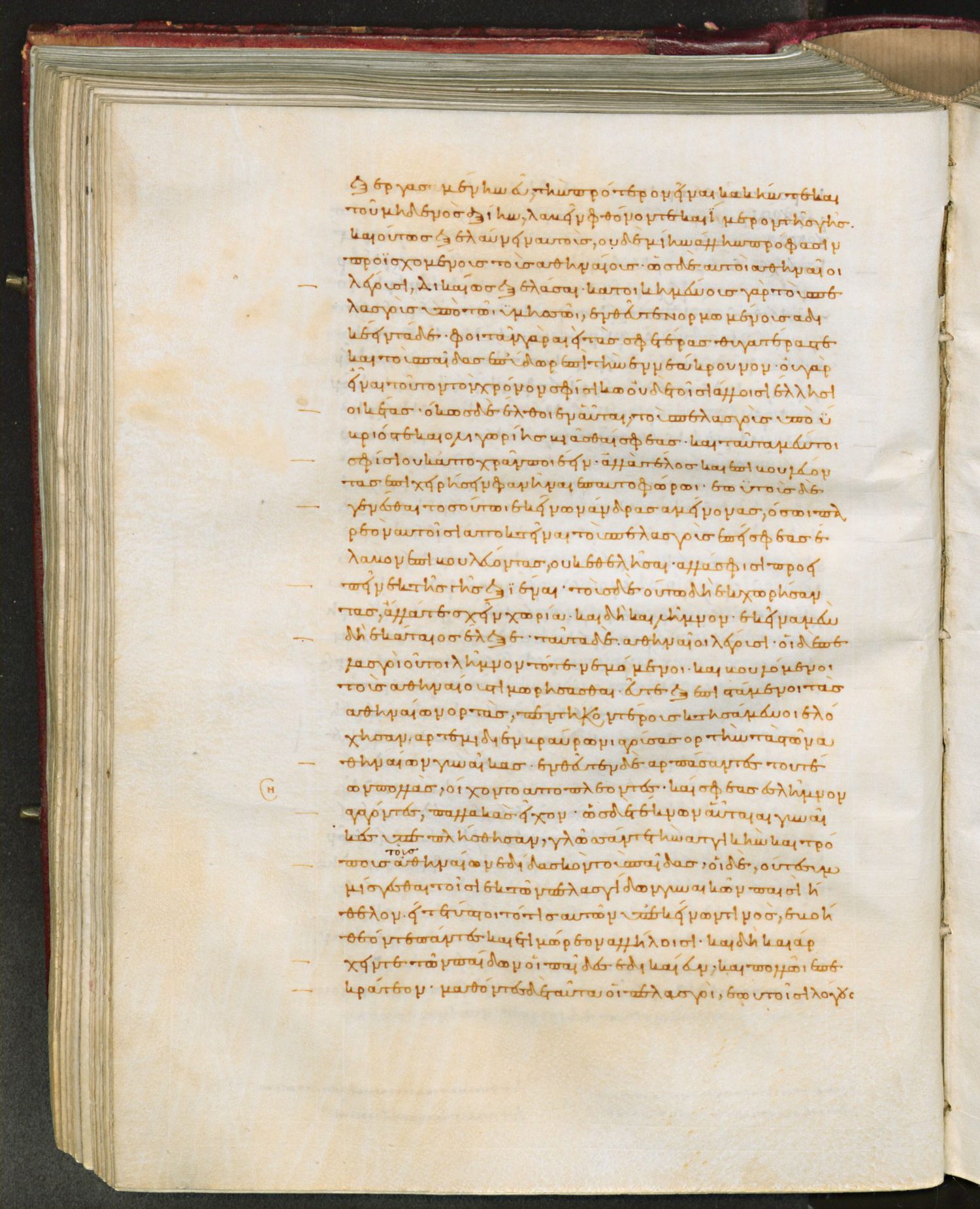
Laur. Plut. 70.3, fol. 263v: Greek here 6.137.2 to 6.138.3. Checked on the image (first and last words read and located in the Greek; each break checked against the neighbouring page): fol. 263v begins ‹ἐξεργασμένην εὖ, τὴν πρότερον› (6.137.2), ends ‹οἱ Πελασγοὶ ἑωυτοῖσι λόγους› (6.138.3). English here: 6.137.3 to 6.138.2 (Godley's sentences for the sections whose Greek lies mostly on this page).
6.137.2ἐξεργασμένην εὖ, τὴν πρότερον εἶναι κακήν τε καὶ τοῦ μηδενὸς ἀξίην, λαβεῖν φθόνον τε καὶ ἵμερον τῆς γῆς, καὶ οὕτω ἐξελαύνειν αὐτοὺς οὐδεμίαν ἄλλην πρόφασιν προϊσχομένους τοὺς Ἀθηναίους. 6.137.3ὡς δὲ αὐτοὶ Ἀθηναῖοι λέγουσι, δικαίως ἐξελάσαι. κατοικημένους γὰρ τοὺς Πελασγοὺς ὑπὸ τῷ Ὑμησσῷ, ἐνθεῦτεν ὁρμωμένους ἀδικέειν τάδε. φοιτᾶν γὰρ αἰεὶ τὰς σφετέρας θυγατέρας τε καὶ τοὺς παῖδας ἐπʼ ὕδωρ ἐπὶ τὴν Ἐννεάκρουνον· οὐ γὰρ εἶναι τοῦτον τὸν χρόνον σφίσι κω οὐδὲ τοῖσι ἄλλοισι Ἕλλησι οἰκέτας· ὅκως δὲ ἔλθοιεν αὗται, τοὺς Πελασγοὺς ὑπὸ ὕβριός τε καὶ ὀλιγωρίης βιᾶσθαι σφέας. καὶ ταῦτα μέντοι σφι οὐκ ἀποχρᾶν ποιέειν, ἀλλὰ τέλος καὶ ἐπιβουλεύοντας ἐπιχείρησιν φανῆναι ἐπʼ αὐτοφώρῳ. 6.137.4ἑωυτοὺς δὲ γενέσθαι τοσούτῳ ἐκείνων ἄνδρας ἀμείνονας, ὅσῳ, παρεὸν ἑωυτοῖσι ἀποκτεῖναι τοὺς Πελασγούς, ἐπεί σφεας ἔλαβον ἐπιβουλεύοντας, οὐκ ἐθελῆσαι, ἀλλά σφι προειπεῖν ἐκ τῆς γῆς ἐξιέναι. τοὺς δὲ οὕτω δὴ ἐκχωρήσαντας ἄλλα τε σχεῖν χωρία καὶ δὴ καὶ Λῆμνον. ἐκεῖνα μὲν δὴ Ἑκαταῖος ἔλεξε, ταῦτα δὲ Ἀθηναῖοι λέγουσι. 6.138.1οἱ δὲ Πελασγοὶ οὗτοι Λῆμνον τότε νεμόμενοι καὶ βουλόμενοι τοὺς Ἀθηναίους τιμωρήσασθαι, εὖ τε ἐξεπιστάμενοι τὰς Ἀθηναίων ὁρτάς, πεντηκοντέρους κτησάμενοι ἐλόχησαν Ἀρτέμιδι ἐν Βραυρῶνι ἀγούσας ὁρτὴν τὰς τῶν Ἀθηναίων γυναῖκας, ἐνθεῦτεν δὲ ἁρπάσαντες τουτέων πολλὰς οἴχοντο ἀποπλέοντες, καί σφεας ἐς Λῆμνον ἀγαγόντες παλλακὰς εἶχον. 6.138.2ὡς δὲ τέκνων αὗται αἱ γυναῖκες ὑπεπλήσθησαν, γλῶσσάν τε τὴν Ἀττικὴν καὶ τρόπους τοὺς Ἀθηναίων ἐδίδασκον τοὺς παῖδας. οἳ δὲ οὔτε συμμίσγεσθαι τοῖσι ἐκ τῶν Πελασγίδων γυναικῶν παισὶ ἤθελον, εἴ τε τύπτοιτό τις αὐτῶν τινός, ἐβοήθεόν τε πάντες καὶ ἐτιμώρεον ἀλλήλοισι· καὶ δὴ καὶ ἄρχειν τε τῶν παίδων οἱ παῖδες ἐδικαίευν καὶ πολλῷ ἐπεκράτεον. 6.138.3μαθόντες δὲ ταῦτα οἱ Πελασγοὶ ἑωυτοῖσι λόγους
6.137.3The Pelasgians, they say, issued out from their settlement at the foot of Hymettus and dealt wrongfully with the Athenians in this wise: neither the Athenians nor any other dwellers in Hellas had as yet servants at that time, and their sons and daughters resorted to the Nine Wells for water; and whenever they came, the Pelasgians maltreated them out of mere arrogance and pride. Nor yet were they content with so doing, but at last were caught in the act of planning to attack Athens. 6.137.4The Athenians, by their own showing, dealt so much more rightly than the Pelasgians, that when they might have killed them, caught plotting as they were, they would not so do but bade them depart out of the country. Thereupon the Pelasgians departed, and took Lemnos in possession, besides other places. This is the Athenian story; the other is told by Hecataeus. 6.138.1These Pelasgians, dwelling at that time in Lemnos and desiring vengeance on the Athenians, and well knowing the time of the Athenian festivals, got them fifty-oared ships and lay in ambush for the Athenian women when they were celebrating a festival for Artemis at Brauron; carrying off many of the women, they sailed away further with them and brought them to Lemnos to be their concubines. 6.138.2Now as these women bore more and more children, they taught their sons the speech of Attica and Athenian manners. These boys would not consort with the sons of the Pelasgian women; if one of themselves were beaten by one of the others, they would all run to his aid and help each other; nay, the Athenian-bred boys even claimed to rule the others, and were much the stronger than they.
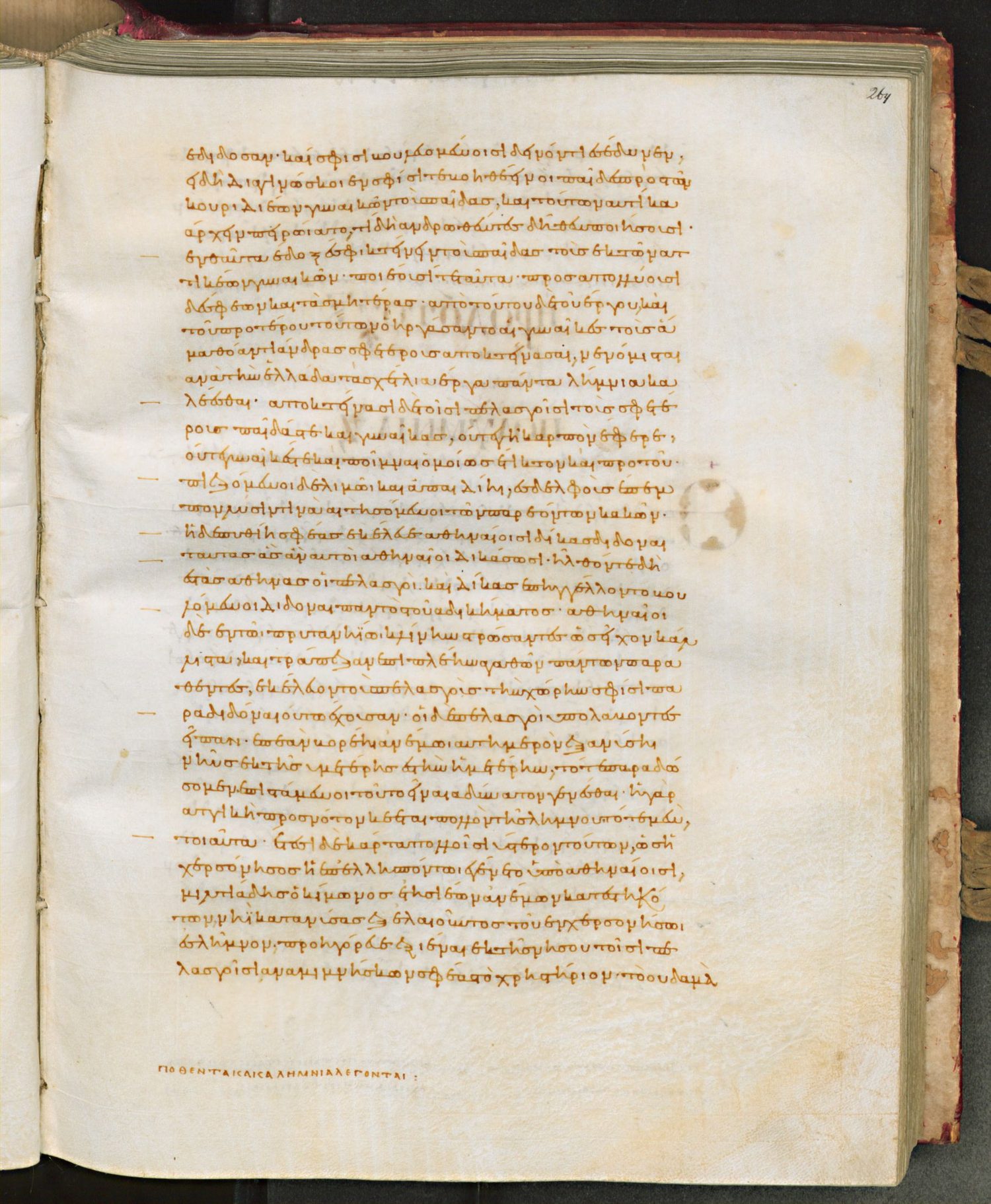
Where on the image
Laur. Plut. 70.3, fol. 264r: Greek here 6.138.3 to 6.140.1. Checked on the image (first and last words read and located in the Greek; each break checked against the neighbouring page): fol. 264r begins ‹ἐδίδοσαν· καί σφι βουλευομένοισι› (6.138.3), ends ‹τὸ χρηστήριον, τὸ οὐδαμὰ› (6.140.1). English here: 6.138.3 to 6.140.1 (Godley's sentences for the sections whose Greek lies mostly on this page).
6.138.3ἐδίδοσαν· καί σφι βουλευομένοισι δεινόν τι ἐσέδυνε, εἰ δὴ διαγινώσκοιεν σφίσι τε βοηθέειν οἱ παῖδες πρὸς τῶν κουριδιέων γυναικῶν τοὺς παῖδας καὶ τούτων αὐτίκα ἄρχειν πειρῴατο, τί δὴ ἀνδρωθέντες δῆθεν ποιήσουσι. 6.138.4ἐνθαῦτα ἔδοξέ σφι κτείνειν τοὺς παῖδας τοὺς ἐκ τῶν Ἀττικέων γυναικῶν. ποιεῦσι δὴ ταῦτα, προσαπολλύουσι δὲ σφέων καὶ τὰς μητέρας. ἀπὸ τούτου δὲ τοῦ ἔργου καὶ τοῦ προτέρου τούτων, τὸ ἐργάσαντο αἱ γυναῖκες τοὺς ἅμα Θόαντι ἄνδρας σφετέρους ἀποκτείνασαι, νενόμισται ἀνὰ τὴν Ἑλλάδα τὰ σχέτλια ἔργα πάντα Λήμνια καλέεσθαι. 6.139.1ἀποκτείνασι δὲ τοῖσι Πελασγοῖσι τοὺς σφετέρους παῖδάς τε καὶ γυναῖκας οὔτε γῆ καρπὸν ἔφερε οὔτε γυναῖκές τε καὶ ποῖμναι ὁμοίως ἔτικτον καὶ πρὸ τοῦ. πιεζόμενοι δὲ λιμῷ καὶ ἀπαιδίῃ ἐς Δελφοὺς ἔπεμπον λύσιν τινὰ αἰτησόμενοι τῶν παρεόντων κακῶν. 6.139.2ἡ δὲ Πυθίη σφέας ἐκέλευε Ἀθηναίοισι δίκας διδόναι ταύτας τὰς ἂν αὐτοὶ Ἀθηναῖοι δικάσωσι. ἦλθόν τε δὴ ἐς τὰς Ἀθήνας οἱ Πελασγοὶ καὶ δίκας ἐπαγγέλλοντο βουλόμενοι διδόναι παντὸς τοῦ ἀδικήματος. 6.139.3Ἀθηναῖοι δὲ ἐν τῷ πρυτανηίῳ κλίνην στρώσαντες ὡς εἶχον κάλλιστα καὶ τράπεζαν ἐπιπλέην ἀγαθῶν πάντων παραθέντες, ἐκέλευον τοὺς Πελασγοὺς τὴν χώρην σφίσι παραδιδόναι οὕτω ἔχουσαν. 6.139.4οἱ δὲ Πελασγοὶ ὑπολαβόντες εἶπαν ἐπεὰν βορέῃ ἀνέμῳ αὐτημερὸν ἐξανύσῃ νηῦς ἐκ τῆς ὑμετέρης ἐς τὴν ἡμετέρην, τότε παραδώσομεν, ἐπιστάμενοι τοῦτο εἶναι ἀδύνατον γενέσθαι. ἡ γὰρ Ἀττικὴ πρὸς νότον κεῖται πολλὸν τῆς Λήμνου. 6.140.1τότε μὲν τοιαῦτα· ἔτεσι δὲ κάρτα πολλοῖσι ὕστερον τούτων, ὡς ἡ Χερσόνησος ἡ ἐπʼ Ἑλλησπόντῳ ἐγένετο ὑπὸ Ἀθηναίοισι, Μιλτιάδης ὁ Κίμωνος ἐτησιέων ἀνέμων κατεστηκότων νηὶ κατανύσας ἐξ Ἐλαιοῦντος τοῦ ἐν Χερσονήσῳ ἐς Λῆμνον προηγόρευε ἐξιέναι ἐκ τῆς νήσου τοῖσι Πελασγοῖσι, ἀναμιμνήσκων σφέας τὸ χρηστήριον, τὸ οὐδαμὰ
6.138.3When the Pelasgians perceived that, they took counsel together; and it troubled them much in their counsels to think what the boys would do when they grew to man’s estate, if they were resolved to help each other against the sons of the lawful wives and essayed to rule them forthwith. 6.138.4Thereupon the Pelasgians judged it best to slay the sons of the Attic women; and this they did, and slew the boys’ mothers likewise. From this and the former deed which was done by the women, when they slew their own husbands who were Thoas’ companions, a “Lemnian crime” has been a proverb in Hellas for any deed of cruelty. 6.139.1But when the Pelasgians had slain their own sons and the women, their land brought forth no fruit, nor did their wives and their flocks and herds bear offspring as before. Under stress of hunger and childlessness they sent to Delphi to ask for some way of release from their present ills; and 6.139.2the Pythian priestess bidding them pay the Athenians whatsoever penalty the Athenians themselves should adjudge, the Pelasgians went to Athens and offered to pay the penalty for all their wrong-doing. 6.139.3The Athenians set in their town-hall a couch adorned to the best of their power, with a table thereby covered with all manner of good things, and said to the Pelasgians, “Deliver your land to us in a like state”; whereto 6.139.4the Pelasgians answered, “We will deliver it when a ship shall accomplish her voyage with a north wind from your country to ours in one day”; this they said, well assured that the thing was impossible; for Attica is far to the south of Lemnos. 6.140.1This and no more was then said. But a great many years afterward, when the Chersonese by the Hellespont was made subject to Athens, Miltiades son of Cimon did, by virtue of the Etesian winds then constantly blowing, accomplish the voyage from Elaeus on the Chersonese to Lemnos; which done, he issued a proclamation to the Pelasgians bidding them leave their island, reminding them of the oracular word which the Pelasgians thought they would never see fulfilled.
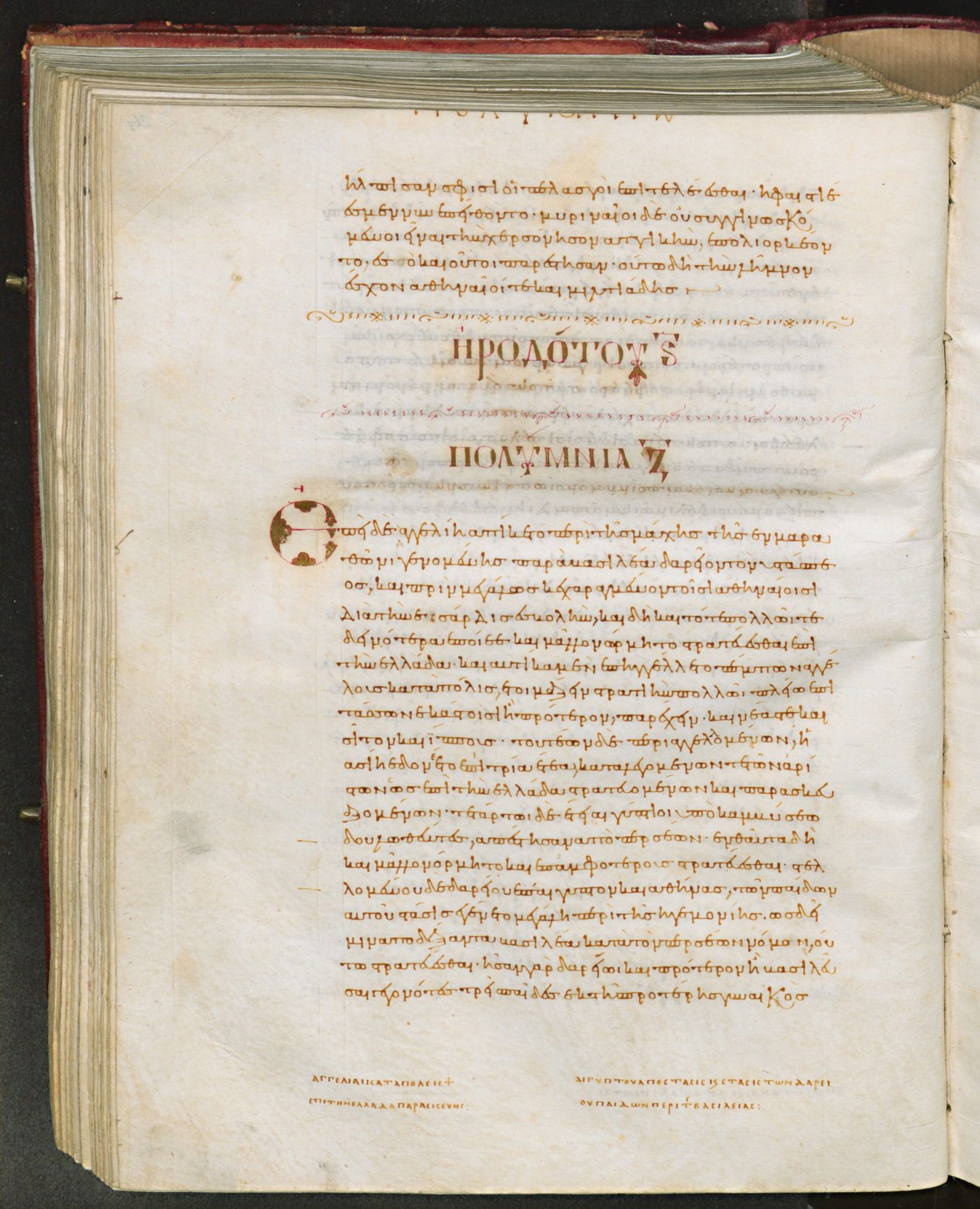
Where on the image
Laur. Plut. 70.3, fol. 264v: Greek here 6.140.1 to 6.140.2. Checked on the image (first and last words read and located in the Greek; each break checked against the neighbouring page): fol. 264v begins ‹ἤλπισαν σφίσι οἱ Πελασγοὶ› (6.140.1), ends ‹ἐκ τῆς προτέρης γυναικός› (7.2.2). Book 6 ends in the sixth line; below, the red title Ἡροδότου ζ´ Πολύμνια ζ´ between decorative lines, and Book 7 begins with a red initial Ε. Below the text, two readers' notes in capitals. English here: 6.140.2 (Godley's sentences for the sections whose Greek lies mostly on this page).
6.140.1ἤλπισαν σφίσι οἱ Πελασγοὶ ἐπιτελέεσθαι. 6.140.2Ἡφαιστιέες μέν νυν ἐπείθοντο, Μυριναῖοι δὲ οὐ συγγινωσκόμενοι εἶναι τὴν Χερσόνησον Ἀττικὴν ἐπολιορκέοντο, ἐς ὃ καὶ οὗτοι παρέστησαν. οὕτω δὴ τὴν Λῆμνον ἔσχον Ἀθηναῖοί τε καὶ Μιλτιάδης.
6.140.2The men of Hephaestia, then, obeyed him; but they of Myrina would not agree that the Chersonese was Attic land, and they stood a siege; but in the end they too submitted. Thus did Miltiades and the Athenians take Lemnos in possession.
Notes
- Greek: the text printed in A. D. Godley's Loeb edition, via Perseus (tlg0016.tlg001.perseus-grc2). Square brackets mark words the editor considers later additions; [...] marks a gap the editor indicates. Perseus note markers are omitted.
- English: A. D. Godley, Herodotus vol. 3 (1922) (Loeb Classical Library), as transcribed on Wikisource. Godley's footnotes are omitted.
- Section numbers in the English were placed by comparing Godley's text with the Perseus version of his translation; where a section begins inside one of Godley's sentences, the English is kept with the page that holds the start of that sentence.
Cite
Sources
- Source: Florence, Laur. Plut. 70.3 (10th c.) via BML Teca Digitale + Greek of Godley's Loeb (Perseus) + English of A. D. Godley (Loeb, Wikisource) (holding institution)
- Critical edition: Greek of A. D. Godley's Loeb edition (1920-1925), via Perseus
← previous · → next · v cycle view · l back to library