Herodotus, Histories 6.111-124: The battle of Marathon
Introduction
Herodotus of Halicarnassus wrote the Histories in the third quarter of the 5th century BCE, an inquiry into the deeds of Greeks and barbarians and the causes of the wars between them, later divided into nine books. Book 6 tells of the end of the Ionian revolt at Lade and Miletus, the first Persian expeditions against Greece under Mardonius and under Datis and Artaphrenes, the quarrels of Sparta, Athens and Aegina, and the battle of Marathon.
The photographs are of Florence, Biblioteca Medicea Laurenziana, Plut. 70.3 (parchment, 10th century, 374 folios, 31 lines a page), Herodotus, Histories (codex A of the editors), the oldest surviving manuscript of the complete Histories, from the Teca Digitale of the Biblioteca Medicea Laurenziana. Each section below is the text of one page, or of the part of a page that falls within these chapters. The first and last words of every page were read on the photograph and located in the Greek, and every page break was checked against the next page; the notes quote these words. Readers' notes in the margins are not part of the text and are mentioned where they occur.
The Greek is the text printed in A. D. Godley's Loeb edition (1920-1925), from Perseus; it is the edited text, not a transcription of the manuscript, whose wording differs in places. The English is Godley's translation as printed, from Wikisource. Godley's English carries only chapter numbers; the section numbers shown in it were placed by comparison with the Perseus version of his translation. Each page's English is cut at the end of one of Godley's sentences, so it can begin or end a few lines away from the Greek of the page; each note gives the exact ranges.
This entry covers chapters 6.111-124, on fol. 258r to 260r.
How was this verified? (Provenance)
Where on the image
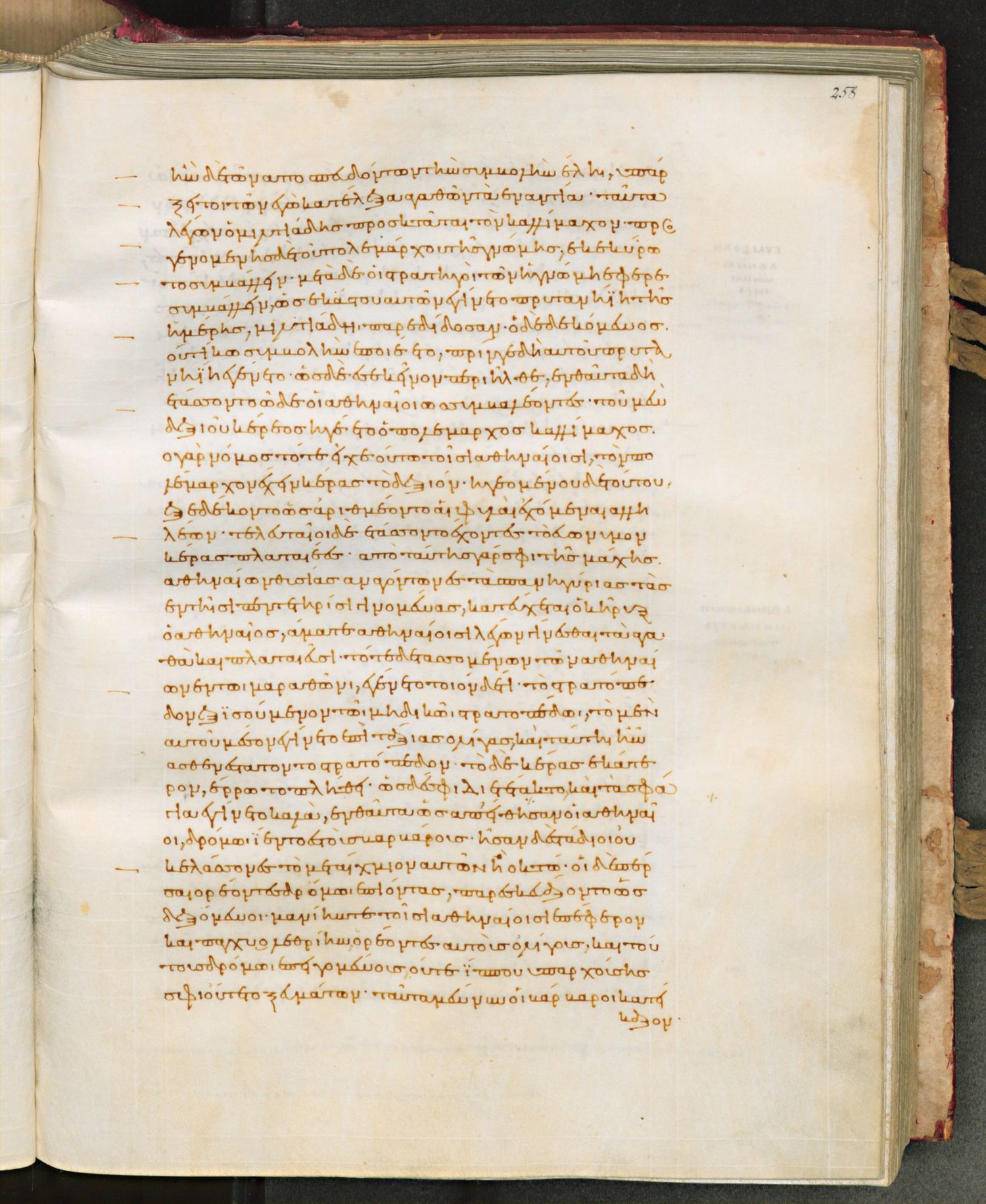
Laur. Plut. 70.3, fol. 258r: Greek here 6.111.1 to 6.112.3. Checked on the image (first and last words read and located in the Greek; each break checked against the neighbouring page): fol. 258r begins ‹ἢν δὲ τὴν τῶν› (6.109.6), ends ‹νυν οἱ βάρβαροι κατείκαζον› (6.112.3). The end of the last word (κατείκαζον) is written below the last line. English here: 6.111.1 to 6.112.2 (Godley's sentences for the sections whose Greek lies mostly on this page).
6.111.1ὡς δὲ ἐς ἐκεῖνον περιῆλθε, ἐνθαῦτα δὴ ἐτάσσοντο ὧδε οἱ Ἀθηναῖοι ὡς συμβαλέοντες· τοῦ μὲν δεξιοῦ κέρεος ἡγέετο ὁ πολέμαρχος Καλλίμαχος· ὁ γὰρ νόμος τότε εἶχε οὕτω τοῖσι Ἀθηναίοισι, τὸν πολέμαρχον ἔχειν κέρας τὸ δεξιόν· ἡγεομένου δὲ τούτου ἐξεδέκοντο ὡς ἀριθμέοντο αἱ φυλαὶ ἐχόμεναι ἀλληλέων, τελευταῖοι δὲ ἐτάσσοντο ἔχοντες τὸ εὐώνυμον κέρας Πλαταιέες. 6.111.2ἀπὸ ταύτης [γάρ] σφι τῆς μάχης, Ἀθηναίων θυσίας ἀναγόντων ἐς τὰς πανηγύριας τὰς ἐν τῇσι πεντετηρίσι γινομένας, κατεύχεται ὁ κῆρυξ ὁ Ἀθηναῖος ἅμα τε Ἀθηναίοισι λέγων γίνεσθαι τὰ ἀγαθὰ καὶ Πλαταιεῦσι. 6.111.3τότε δὲ τασσομένων τῶν Ἀθηναίων ἐν τῷ Μαραθῶνι ἐγίνετο τοιόνδε τι· τὸ στρατόπεδον ἐξισούμενον τῷ Μηδικῷ στρατοπέδῳ, τὸ μὲν αὐτοῦ μέσον ἐγίνετο ἐπὶ τάξιας ὀλίγας, καὶ ταύτῃ ἦν ἀσθενέστατον τὸ στρατόπεδον, τὸ δὲ κέρας ἑκάτερον ἔρρωτο πλήθεϊ. 6.112.1ὡς δέ σφι διετέτακτο καὶ τὰ σφάγια ἐγίνετο καλά, ἐνθαῦτα ὡς ἀπείθησαν οἱ Ἀθηναῖοι δρόμῳ ἵεντο ἐς τοὺς βαρβάρους. ἦσαν δὲ στάδιοι οὐκ ἐλάσσονες τὸ μεταίχμιον αὐτῶν ἢ ὀκτώ. 6.112.2οἱ δὲ Πέρσαι ὁρέοντες δρόμῳ ἐπιόντας παρεσκευάζοντο ὡς δεξόμενοι, μανίην τε τοῖσι Ἀθηναίοισι ἐπέφερον καὶ πάγχυ ὀλεθρίην, ὁρέοντες αὐτοὺς ὀλίγους καὶ τούτους δρόμῳ ἐπειγομένους, οὔτε ἵππου ὑπαρχούσης σφι οὔτε τοξευμάτων. 6.112.3ταῦτα μέν νυν οἱ βάρβαροι κατείκαζον·
6.111.1When his turn came, then were the Athenians arrayed for battle as I shall show: the right wing was commanded by Callimachus the polemarch; for it was then the Athenian custom, that the holder of that office should have the right wing. He being there captain, next to him came the tribes one after another in the order of their numbers; last of all the Plataeans were posted on the left wing. 6.111.2Ever since that fight, when the Athenians bring sacrifices to the assemblies that are held at the five-yearly festivals, the Athenian herald prays that all blessings may be granted to Athenians and Plataeans alike. 6.111.3But now, when the Athenians were arraying at Marathon, it so fell out that their line being equal in length to the Median, the middle part of it was but a few ranks deep, and here the line was weakest, each wing being strong in numbers. 6.112.1Their battle being arrayed and the omens of sacrifice favouring, straightway the Athenians were let go and charged the Persians at a run. There was between the armies a space of not less than eight furlongs. 6.112.2When the Persians saw them come running they prepared to receive them, deeming the Athenians frenzied to their utter destruction, who being (as they saw) so few were yet charging them at speed, albeit they had no horsemen nor archers.
Where on the image
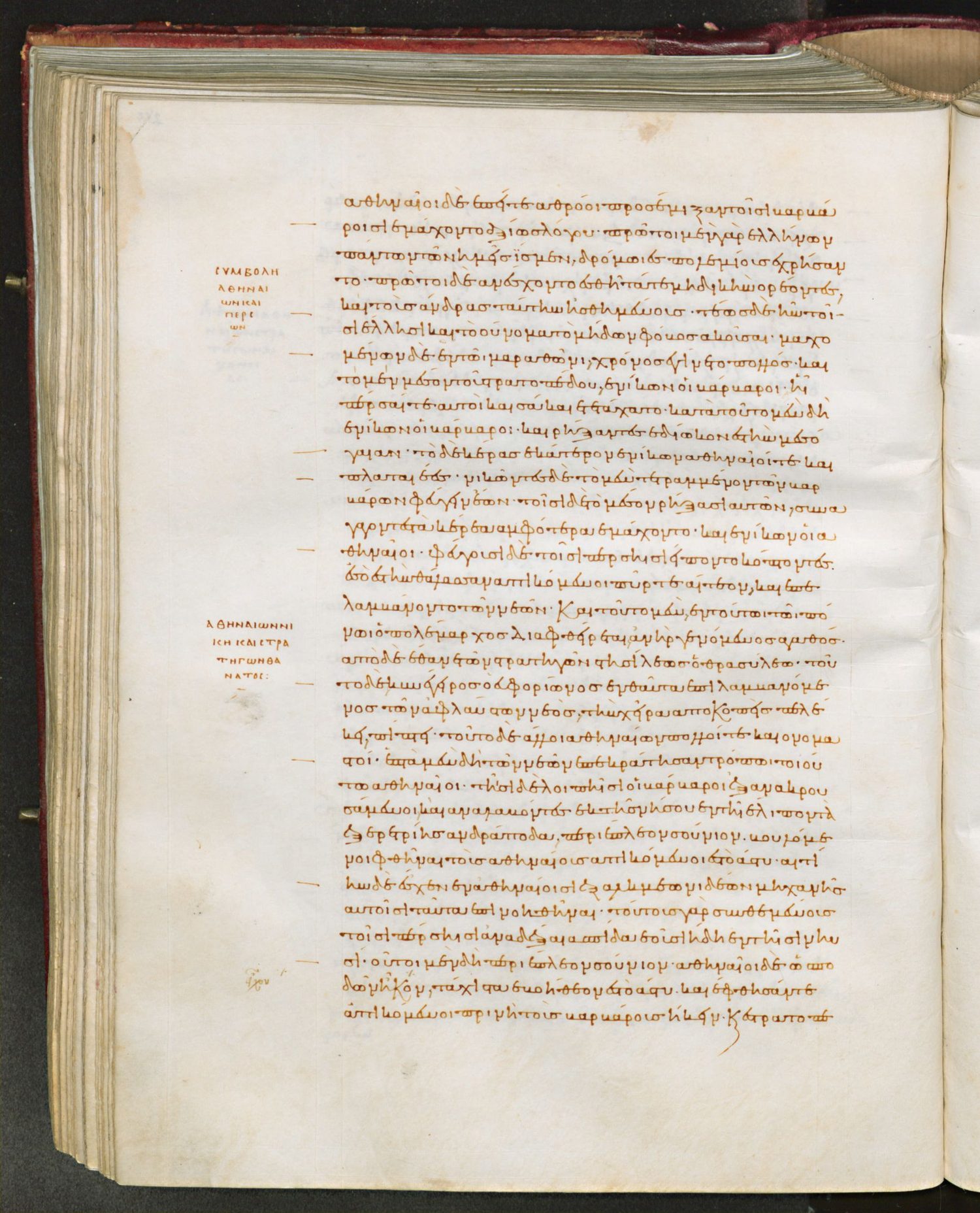
Laur. Plut. 70.3, fol. 258v: Greek here 6.112.3 to 6.116.1. Checked on the image (first and last words read and located in the Greek; each break checked against the neighbouring page): fol. 258v begins ‹Ἀθηναῖοι δὲ ἐπείτε ἀθρόοι› (6.112.3), ends ‹βαρβάρους ἥκειν, καὶ ἐστρατοπε-› (6.116.1). English here: 6.112.3 to 6.115.1 (Godley's sentences for the sections whose Greek lies mostly on this page).
6.112.3Ἀθηναῖοι δὲ ἐπείτε ἀθρόοι προσέμιξαν τοῖσι βαρβάροισι, ἐμάχοντο ἀξίως λόγου. πρῶτοι μὲν γὰρ Ἑλλήνων πάντων τῶν ἡμεῖς ἴδμεν δρόμῳ ἐς πολεμίους ἐχρήσαντο, πρῶτοι δὲ ἀνέσχοντο ἐσθῆτά τε Μηδικὴν ὁρέοντες καὶ τοὺς ἄνδρας ταύτην ἐσθημένους· τέως δὲ ἦν τοῖσι Ἕλλησι καὶ τὸ οὔνομα τὸ Μήδων φόβος ἀκοῦσαι. 6.113.1μαχομένων δὲ ἐν τῷ Μαραθῶνι χρόνος ἐγίνετο πολλός, καὶ τὸ μὲν μέσον τοῦ στρατοπέδου ἐνίκων οἱ βάρβαροι, τῇ Πέρσαι τε αὐτοὶ καὶ Σάκαι ἐτετάχατο· κατὰ τοῦτο μὲν δὴ ἐνίκων οἱ βάρβαροι καὶ ῥήξαντες ἐδίωκον ἐς τὴν μεσόγαιαν, τὸ δὲ κέρας ἑκάτερον ἐνίκων Ἀθηναῖοί τε καὶ Πλαταιέες· 6.113.2νικῶντες δὲ τὸ μὲν τετραμμένον τῶν βαρβάρων φεύγειν ἔων, τοῖσι δὲ τὸ μέσον ῥήξασι αὐτῶν συναγαγόντες τὰ κέρεα ἀμφότερα ἐμάχοντο, καὶ ἐνίκων Ἀθηναῖοι. φεύγουσι δὲ τοῖσι Πέρσῃσι εἵποντο κόπτοντες, ἐς ὃ ἐς τὴν θάλασσαν ἀπικόμενοι πῦρ τε αἴτεον καὶ ἐπελαμβάνοντο τῶν νεῶν. 6.114.1καὶ τοῦτο μὲν ἐν τούτῳ τῷ πόνῳ ὁ πολέμαρχος διαφθείρεται, ἀνὴρ γενόμενος ἀγαθός, ἀπὸ δʼ ἔθανε τῶν στρατηγῶν Στησίλεως ὁ Θρασύλεω· τοῦτο δὲ Κυνέγειρος ὁ Εὐφορίωνος ἐνθαῦτα ἐπιλαμβανόμενος τῶν ἀφλάστων νεός, τὴν χεῖρα ἀποκοπεὶς πελέκεϊ πίπτει, τοῦτο δὲ ἄλλοι Ἀθηναίων πολλοί τε καὶ ὀνομαστοί. 6.115.1ἑπτὰ μὲν δὴ τῶν νεῶν ἐπεκράτησαν τρόπῳ τοιῷδε Ἀθηναῖοι· τῇσι δὲ λοιπῇσι οἱ βάρβαροι ἐξανακρουσάμενοι, καὶ ἀναλαβόντες ἐκ τῆς νήσου ἐν τῇ ἔλιπον τὰ ἐξ Ἐρετρίης ἀνδράποδα, περιέπλεον Σούνιον βουλόμενοι φθῆναι τοὺς Ἀθηναίους ἀπικόμενοι ἐς τὸ ἄστυ. αἰτίην δὲ ἔσχε ἐν Ἀθηναίοισι ἐξ Ἀλκμεωνιδέων μηχανῆς αὐτοὺς ταῦτα ἐπινοηθῆναι· τούτους γὰρ συνθεμένους τοῖσι Πέρσῃσι ἀναδέξαι ἀσπίδα ἐοῦσι ἤδη ἐν τῇσι νηυσί. 6.116.1οὗτοι μὲν δὴ περιέπλεον Σούνιον· Ἀθηναῖοι δὲ ὡς ποδῶν εἶχον τάχιστα ἐβοήθεον ἐς τὸ ἄστυ, καὶ ἔφθησάν τε ἀπικόμενοι πρὶν ἢ τοὺς βαρβάρους ἥκειν, καὶ ἐστρατοπεδεύσαντο
6.112.3Such was the imagination of the foreigners; but the Athenians, closing all together with the Persians, fought in memorable fashion; for they were the first Greeks, within my knowledge, who charged their enemies at a run, and the first who endured the sight of Median garments and men clad therein; till then, the Greeks were affrighted by the very name of the Medes. 6.113.1For a long time they fought at Marathon; and the foreigners overcame the middle part of the line, against which the Persians themselves and the Sacae were arrayed; here the foreigners prevailed and broke the Greeks, pursuing them inland. But on either wing the Athenians and Plataeans were victorious; and 6.113.2being so, they suffered the routed of their enemies to fly, and drew their wings together to fight against those that had broken the middle of their line; and here the Athenians had the victory, and followed after the Persians in their flight, hewing them down, till they came to the sea. There they called for fire and laid hands on the ships. 6.114.1In this work was slain Callimachus the polemarch, after doing doughty deeds; there too died one of the generals, Stesilaus son of Thrasylaus; moreover, Cynegirus son of Euphorion fell there, his hand smitten off by an axe as he laid hold of a ship’s poop, and many other famous Athenians. 6.115.1Seven ships the Athenians thus won; with the rest the Persians pushed off from shore, and taking the Eretrian slaves from the island wherein they had left them, sailed round Sunium, hoping to win to the city before the Athenians’ coming. There was an accusation rife at Athens that this plan arose from a device of the Alcmeonidae, who, it was said, made a compact with the Persians and held up a shield for them to see when they were now on shipboard.
Where on the image
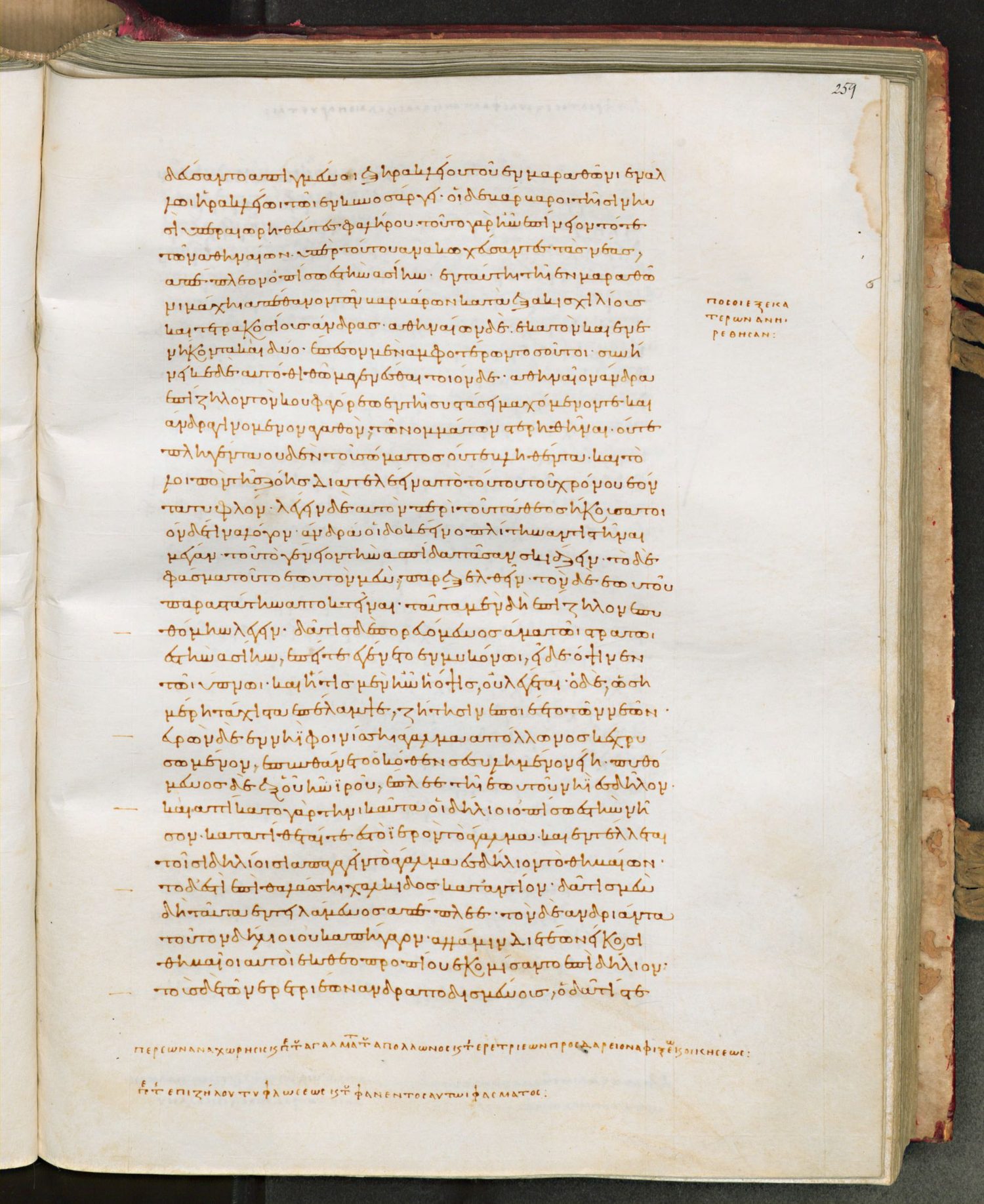
Laur. Plut. 70.3, fol. 259r: Greek here 6.116.1 to 6.119.1. Checked on the image (first and last words read and located in the Greek; each break checked against the neighbouring page): fol. 259r begins ‹-δεύσαντο ἀπιγμένοι ἐξ Ἡρακλείου› (6.116.1), ends ‹Ἐρετριέων ἀνδραποδισμένους Δᾶτίς τε› (6.119.1). The word ‹ἐστρατοπεδεύσαντο› is divided between fol. 258v and fol. 259r; it is given with fol. 258v. English here: 6.116.1 to 6.118.3 (Godley's sentences for the sections whose Greek lies mostly on this page).
6.116.1ἀπιγμένοι ἐξ Ἡρακλείου τοῦ ἐν Μαραθῶνι ἐν ἄλλῳ Ἡρακλείῳ τῷ ἐν Κυνοσάργεϊ. οἱ δὲ βάρβαροι τῇσι νηυσὶ ὑπεραιωρηθέντες Φαλήρου, τοῦτο γὰρ ἦν ἐπίνειον τότε τῶν Ἀθηναίων, ὑπὲρ τούτου ἀνακωχεύσαντες τὰς νέας ἀπέπλεον ὀπίσω ἐς τὴν Ἀσίην. 6.117.1ἐν ταύτῃ τῇ ἐν Μαραθῶνι μάχῃ ἀπέθανον τῶν βαρβάρων κατὰ ἑξακισχιλίους καὶ τετρακοσίους ἄνδρας, Ἀθηναίων δὲ ἑκατὸν καὶ ἐνενήκοντα καὶ δύο. ἔπεσον μὲν ἀμφοτέρων τοσοῦτοι. 6.117.2συνήνεικε δὲ αὐτόθι θῶμα γενέσθαι τοιόνδε, Ἀθηναῖον ἄνδρα Ἐπίζηλον τὸν Κουφαγόρεω ἐν τῇ συστάσι μαχόμενόν τε καὶ ἄνδρα γινόμενον ἀγαθὸν τῶν ὀμμάτων στερηθῆναι οὔτε πληγέντα οὐδὲν τοῦ σώματος οὔτε βληθέντα, καὶ τὸ λοιπὸν τῆς ζόης διατελέειν ἀπὸ τούτου τοῦ χρόνου ἐόντα τυφλόν. 6.117.3λέγειν δὲ αὐτὸν περὶ τοῦ πάθεος ἤκουσα τοιόνδε τινὰ λόγον, ἄνδρα οἱ δοκέειν ὁπλίτην ἀντιστῆναι μέγαν, τοῦ τὸ γένειον τὴν ἀσπίδα πᾶσαν σκιάζειν· τὸ δὲ φάσμα τοῦτο ἑωυτὸν μὲν παρεξελθεῖν, τὸν δὲ ἑωυτοῦ παραστάτην ἀποκτεῖναι. ταῦτα μὲν δὴ Ἐπίζηλον ἐπυθόμην λέγειν. 6.118.1Δᾶτις δὲ πορευόμενος ἅμα τῷ στρατῷ ἐς τὴν Ἀσίην, ἐπείτε ἐγένετο ἐν Μυκόνῳ, εἶδε ὄψιν ἐν τῷ ὕπνῳ. καὶ ἥτις μὲν ἦν ἡ ὄψις, οὐ λέγεται· ὁ δέ, ὡς ἡμέρη τάχιστα ἐπέλαμψε, ζήτησιν ἐποιέετο τῶν νεῶν, εὑρὼν δὲ ἐν νηὶ Φοινίσσῃ ἄγαλμα Ἀπόλλωνος κεχρυσωμένον ἐπυνθάνετο ὁκόθεν σεσυλημένον εἴη, πυθόμενος δὲ ἐξ οὗ ἦν ἱροῦ, ἔπλεε τῇ ἑωυτοῦ νηὶ ἐς Δῆλον· 6.118.2καὶ ἀπίκατο γὰρ τηνικαῦτα οἱ Δήλιοι ὀπίσω ἐς τὴν νῆσον, κατατίθεταί τε ἐς τὸ ἱρὸν τὸ ἄγαλμα καὶ ἐντέλλεται τοῖσι Δηλίοισι ἀπαγαγεῖν τὸ ἄγαλμα ἐς Δήλιον τὸ Θηβαίων· τὸ δʼ ἔστι ἐπὶ θαλάσσῃ Χαλκίδος καταντίον. 6.118.3Δᾶτις μὲν δὴ ταῦτα ἐντειλάμενος ἀπέπλεε, τὸν δὲ ἀνδριάντα τοῦτον Δήλιοι οὐκ ἀπήγαγον, ἀλλά μιν διʼ ἐτέων εἴκοσι Θηβαῖοι αὐτοὶ ἐκ θεοπροπίου ἐκομίσαντο ἐπὶ Δήλιον. 6.119.1τοὺς δὲ τῶν Ἐρετριέων ἀνδραποδισμένους Δᾶτίς τε
6.116.1So they sailed round Sunium; but the Athenians marched back with all speed to defend their city, and outstripped the foreigners in their coming; they came from one precinct of Heracles at Marathon, and encamped in another at Cynosarges. The foreign fleet lay a while off Phalerum, which was then the Athenians’ arsenal; there they anchored, and thence sailed away back to Asia. 6.117.1In this fight at Marathon there were slain of the foreigners about six thousand four hundred men, and of the Athenians a hundred and ninety-two. These are the numbers of them that fell on both sides. 6.117.2And it fell out that a marvellous thing happened: a certain Athenian, Epizelus son of Cuphagoras, while he fought doughtily in the mellay lost the sight of his eyes, albeit neither stabbed in any part nor shot, and for the rest of his life continued blind from that day. 6.117.3I heard that he told the tale of this mishap thus: a tall man-at-arms (he said) encountered him, whose beard spread all over his shield; this apparition passed Epizelus by, but slew his neighbour in the line. Such was the tale Epizelus told, as I heard. 6.118.1Datis journeyed with his army to Asia; and being arrived at Myconos he saw a vision in his sleep. What that vision was, no man says; but as soon as day broke, Datis made search through his ships; and finding in a Phoenician ship a gilt image of Apollo, he enquired whence this plunder had been taken. Learning from what temple it had come, he sailed in his own ship to Delos; where, 6.118.2the Delians being now returned to their island, Datis set the image in the temple, and charged the Delians to carry it away to the Theban place Delium, on the sea-coast over against Chalcis. 6.118.3This charge given, Datis sailed back. But the Delians never carried that statue away; twenty years after that, the Thebans brought it to Delium, being so commanded by an oracle.
Where on the image
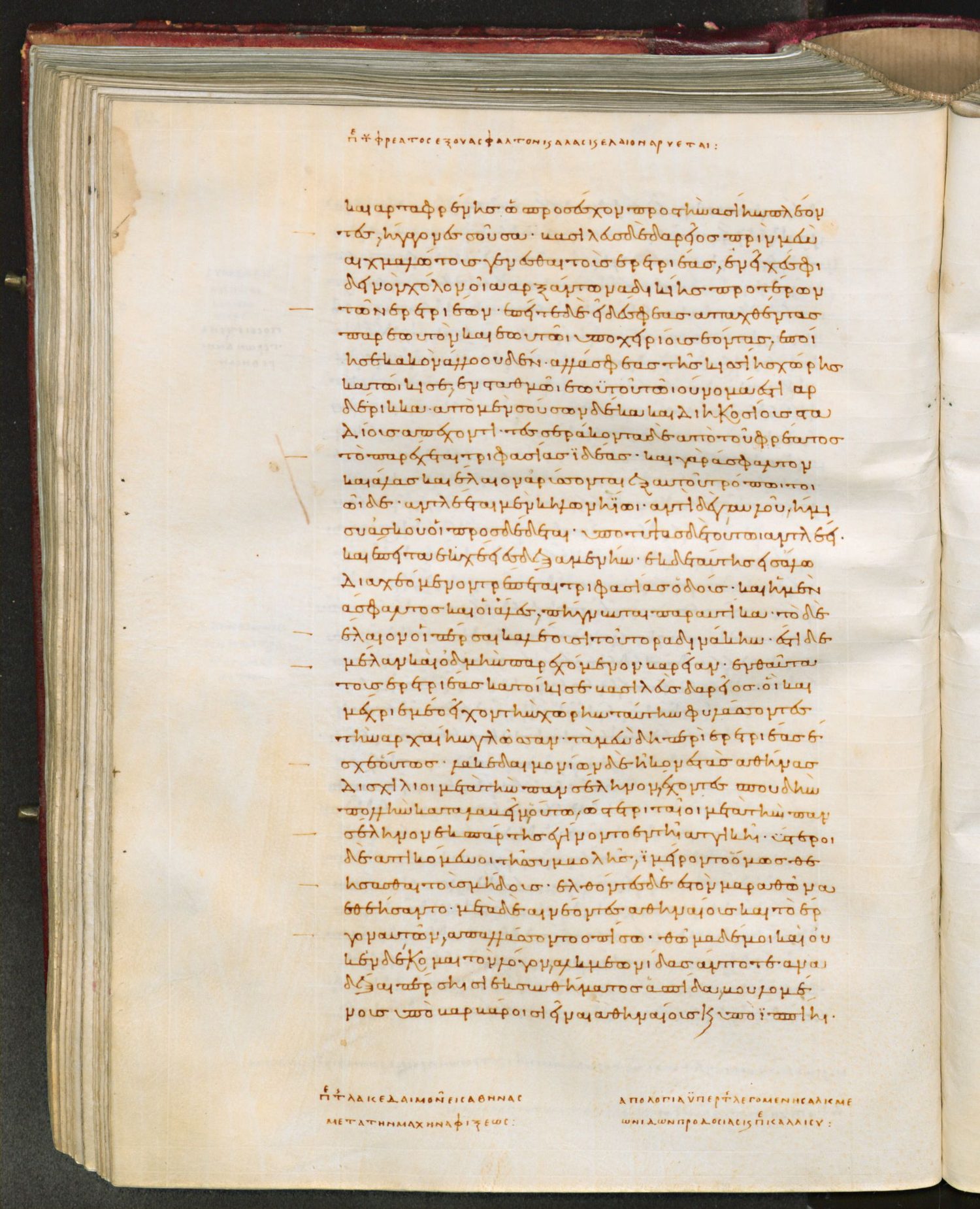
Laur. Plut. 70.3, fol. 259v: Greek here 6.119.1 to 6.121.1. Checked on the image (first and last words read and located in the Greek; each break checked against the neighbouring page): fol. 259v begins ‹καὶ Ἀρταφρένης, ὡς προσέσχον› (6.119.1), ends ‹Ἀθηναίους καὶ ὑπὸ Ἱππίῃ› (6.121.1). In the upper margin, a reader's note in capitals on the well from which asphalt, salt and oil are drawn (6.119). English here: 6.119.1 to 6.121.1 (Godley's sentences for the sections whose Greek lies mostly on this page).
6.119.1καὶ Ἀρταφρένης, ὡς προσέσχον πρὸς τὴν Ἀσίην πλέοντες, ἀνήγαγον ἐς Σοῦσα. βασιλεὺς δὲ Δαρεῖος, πρὶν μὲν αἰχμαλώτους γενέσθαι τοὺς Ἐρετριέας, ἐνεῖχέ σφι δεινὸν χόλον, οἷα ἀρξάντων ἀδικίης προτέρων τῶν Ἐρετριέων· 6.119.2ἐπείτε δὲ εἶδε σφέας ἀπαχθέντας παρʼ ἑωυτὸν καὶ ἑωυτῷ ὑποχειρίους ἐόντας, ἐποίησε κακὸν ἄλλο οὐδέν, ἀλλὰ σφέας τῆς Κισσίης χώρης κατοίκισε ἐν σταθμῷ ἑωυτοῦ τῷ οὔνομα ἐστὶ Ἀρδέρικκα, ἀπὸ μὲν Σούσων δέκα καὶ διηκοσίους σταδίους ἀπέχοντι, τεσσεράκοντα δὲ ἀπὸ τοῦ φρέατος τὸ παρέχεται τριφασίας ἰδέας· καὶ γὰρ ἄσφαλτον καὶ ἅλας καὶ ἔλαιον ἀρύσσονται ἐξ αὐτοῦ τρόπῳ τοιῷδε· 6.119.3ἀντλέεται μὲν κηλωνηίῳ, ἀντὶ δὲ γαυλοῦ ἥμισυ ἀσκοῦ οἱ προσδέδεται· ὑποτύψας δὲ τούτῳ ἀντλέει καὶ ἔπειτα ἐγχέει ἐς δεξαμενήν· ἐκ δὲ ταύτης ἐς ἄλλο διαχεόμενον τρέπεται τριφασίας ὁδούς. καὶ ἡ μὲν ἄσφαλτος καὶ οἱ ἅλες πήγνυνται παραυτίκα· τὸ δὲ ἔλαιον οἱ Πέρσαι καλέουσι τοῦτο ῥαδινάκην, ἔστι δὲ μέλαν καὶ ὀδμὴν παρεχόμενον βαρέαν. 6.119.4ἐνθαῦτα τοὺς Ἐρετριέας κατοίκισε βασιλεὺς Δαρεῖος, οἳ καὶ μέχρι ἐμέο εἶχον τὴν χώρην ταύτην, φυλάσοντες τὴν ἀρχαίην γλῶσσαν. τὰ μὲν δὴ περὶ Ἐρετριέας ἔσχε οὕτω. 6.120.1Λακεδαιμονίων δὲ ἧκον ἐς τὰς Ἀθήνας δισχίλιοι μετὰ τὴν πανσέληνον, ἔχοντες σπουδὴν πολλὴν καταλαβεῖν, οὕτω ὥστε τριταῖοι ἐκ Σπάρτης ἐγένοντο ἐν τῇ Ἀττικῇ. ὕστεροι δὲ ἀπικόμενοι τῆς συμβολῆς ἱμείροντο ὅμως θεήσασθαι τοὺς Μήδους· ἐλθόντες δὲ ἐς τὸν Μαραθῶνα ἐθεήσαντο. μετὰ δὲ αἰνέοντες Ἀθηναίους καὶ τὸ ἔργον αὐτῶν ἀπαλλάσσοντο ὀπίσω. 6.121.1θῶμα δέ μοι καὶ οὐκ ἐνδέκομαι τὸν λόγον Ἀλκμεωνίδας ἄν κοτε ἀναδέξαι Πέρσῃσι ἐκ συνθήματος ἀσπίδα, βουλομένους ὑπὸ βαρβάροισί τε εἶναι Ἀθηναίους καὶ ὑπὸ Ἱππίῃ·
6.119.1When Datis and Artaphrenes touched Asia in their voyage, they carried the enslaved Eretrians inland to Susa. 6.119.2Before the Eretrians were taken captive king Darius had been terribly wroth with them for doing him unprovoked wrong; but seeing them brought before him and subject to him, he did them no hurt, but gave them a domain of his own called Ardericca in the Cissian land to dwell in; this place is two hundred and ten furlongs distant from Susa, and forty from the well that is of three kinds, whence men bring up asphalt and salt and oil. 6.119.3This is the manner of their doing it:—a windlass is used in the drawing, with half a skin made fast to it in place of a bucket; therewith he that draws dips into the well, and then pours into a tank, whence what is drawn is poured into another tank, and goes three ways; the asphalt and the salt grow forthwith solid; the oil, which the Persians call rhadinace, is dark and evil-smelling. 6.119.4There king Darius planted the Eretrians, and they dwelt in that place till my time, keeping their ancient language. Such was the fate of the Eretrians. 6.120.1After the full moon two thousand Lacedaemonians came to Athens, making so great haste to reach it that they were in Attica on the third day from their leaving Sparta. Albeit they came too late for the battle, yet they desired to see the Medes; and they went to Marathon and saw them. Presently they departed back again, praising the Athenians and their achievement. 6.121.1It is to me a thing marvellous and incredible, that the Alcmeonidae could ever by agreement have held up a shield as a sign for the Persians, desiring to make Athens subject to foreigners and to Hippias; for it is plain to see that they were despot-haters as much as Callias (son of Phaenippus and father of Hipponicus), ay, and even more than he.
Where on the image
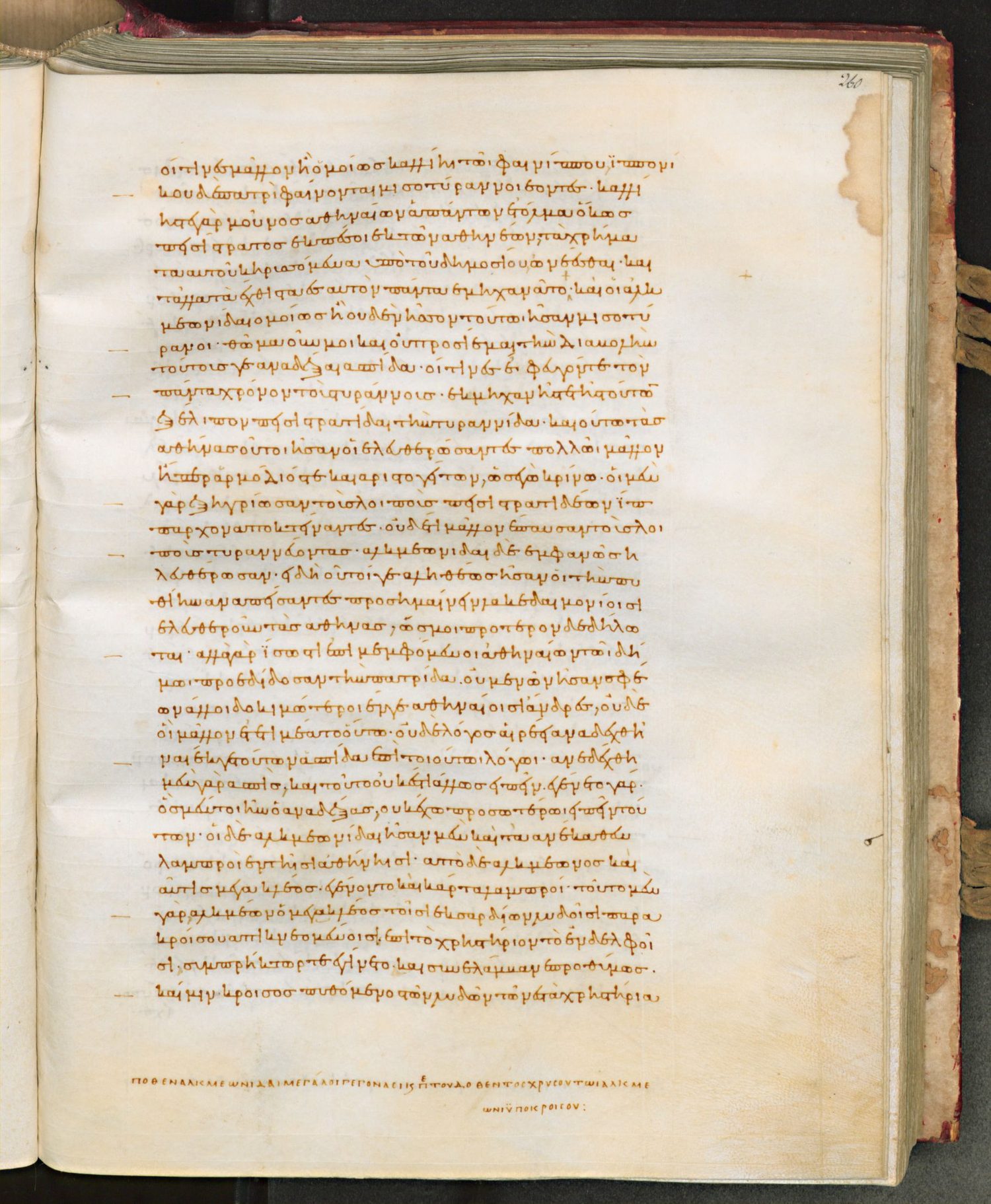
Laur. Plut. 70.3, fol. 260r: Greek here 6.121.1 to 6.124.2. Checked on the image (first and last words read and located in the Greek; each break checked against the neighbouring page): fol. 260r begins ‹οἵτινες μᾶλλον ἢ ὁμοίως› (6.121.1), ends ‹τῶν ἐς τὰ χρηστήρια› (6.125.2). Chapter 6.122, which the edition prints in square brackets as a later addition, is not in this manuscript: in line 7 the end of 6.121 (ἐμηχανᾶτο) is followed directly by 6.123 (καὶ οἱ Ἀλκμεωνίδαι). The Greek and English of 6.122 are shown with this page as the edition and Godley print them. English here: 6.121.2 to 6.124.2 (Godley's sentences for the sections whose Greek lies mostly on this page).
6.121.1οἵτινες μᾶλλον ἢ ὁμοίως Καλλίῃ τῷ Φαινίππου, Ἱππονίκου δὲ πατρί, φαίνονται μισοτύραννοι ἐόντες. 6.121.2Καλλίης τε γὰρ μοῦνος Ἀθηναίων ἁπάντων ἐτόλμα, ὅκως Πεισίστρατος ἐκπέσοι ἐκ τῶν Ἀθηνέων, τὰ χρήματα αὐτοῦ κηρυσσόμενα ὑπὸ τοῦ δημοσίου ὠνέεσθαι, καὶ τἆλλα τὰ ἔχθιστα ἐς αὐτὸν πάντα ἐμηχανᾶτο. 6.122.1[Καλλίεω δὲ τούτου ἄξιον πολλαχοῦ μνήμην ἐστὶ πάντα τινὰ ἔχειν. τοῦτο μὲν γὰρ τὰ προλελεγμένα, ὡς ἀνὴρ ἄκρος ἐλευθερῶν τὴν πατρίδα· τοῦτο δὲ τὰ ἐν Ὀλυμπίῃ ἐποίησε· ἵππῳ νικήσας, τεθρίππῳ δὲ δεύτερος γενόμενος, Πύθια δὲ πρότερον ἀνελόμενος, ἐφανερώθη ἐς τοὺς Ἕλληνας πάντας δαπάνῃσι μεγίστῃσι.] 6.122.2[τοῦτο δὲ κατὰ τὰς ἑωυτοῦ θυγατέρας ἐούσας τρεῖς οἷός τις ἀνὴρ ἐγένετο· ἐπειδὴ γὰρ ἐγίνοντο γάμου ὡραῖαι, ἔδωκέ σφι δωρεὴν μεγαλοπρεπεστάτην ἐκείνῃσί τε ἐχαρίσατο· ἐκ γὰρ πάντων τῶν Ἀθηναίων τὸν ἑκάστη ἐθέλοι ἄνδρα ἑωυτῇ ἐκλέξασθαι, ἔδωκε τούτῳ τῷ ἀνδρί.] 6.123.1καὶ οἱ Ἀλκμεωνίδαι ὁμοίως ἢ οὐδὲν ἧσσον τούτου ἦσαν μισοτύραννοι. θῶμα ὦν μοι καὶ οὐ προσίεμαι τὴν διαβολὴν τούτους γε ἀναδέξαι ἀσπίδα, οἵτινες ἔφευγόν τε τὸν πάντα χρόνον τοὺς τυράννους, ἐκ μηχανῆς τε τῆς τούτων ἐξέλιπον Πεισιστρατίδαι τὴν τυραννίδα, 6.123.2καὶ οὕτω τὰς Ἀθήνας οὗτοι ἦσαν οἱ ἐλευθερώσαντες πολλῷ μᾶλλον ἤ περ Ἁρμόδιός τε καὶ Ἀριστογείτων, ὡς ἐγὼ κρίνω. οἳ μὲν γὰρ ἐξηγρίωσαν τοὺς ὑπολοίπους Πεισιστρατιδέων Ἵππαρχον ἀποκτείναντες, οὐδέ τι μᾶλλον ἔπαυσαν τοὺς λοιποὺς τυραννεύοντας· Ἀλκμεωνίδαι δὲ ἐμφανέως ἠλευθέρωσαν, εἰ δὴ οὗτοί γε ἀληθέως ἦσαν οἱ τὴν Πυθίην ἀναπείσαντες προσημαίνειν Λακεδαιμονίοισι ἐλευθεροῦν τὰς Ἀθήνας, ὥς μοι πρότερον δεδήλωται. 6.124.1ἀλλὰ γὰρ ἴσως τι ἐπιμεμφόμενοι Ἀθηναίων τῷ δήμῳ προεδίδοσαν τὴν πατρίδα. οὐ μὲν ὦν ἦσαν σφέων ἄλλοι δοκιμώτεροι ἔν γε Ἀθηναίοισι ἄνδρες οὐδʼ οἳ μᾶλλον ἐτετιμέατο. 6.124.2οὕτω οὐδὲ λόγος αἱρέει ἀναδεχθῆναι ἔκ γε ἂν τούτων ἀσπίδα ἐπὶ τοιούτῳ λόγῳ. ἀνεδέχθη μὲν γὰρ ἀσπίς, καὶ τοῦτο οὐκ ἔστι ἄλλως εἰπεῖν· ἐγένετο γάρ· ὃς μέντοι ἦν ὁ ἀναδέξας, οὐκ ἔχω προσωτέρω εἰπεῖν τούτων.
6.121.2Callias was the only Athenian who dared buy Pisistratus’ possessions when they were put up to auction by the state after Pisistratus’ banishment from Athens; and he devised other acts of bitter enmity against him. 6.122.1[This Callias is worthy of all men’s remembrance for many reasons: firstly, because he so excellently freed his country, as I have said; secondly, for what he did at Olympia, where he won a horse-race, and was second in a four-horse chariot-race, having already won a Pythian prize, and was the cynosure of all Hellas for the lavishness of his spending; 6.122.2and thirdly, for his way of behaviour in the matter of his three daughters. For when they were of marriageable age, he gave them a most splendid gift and one very pleasant to them, promising that each of them should wed that husband whom she should choose for herself in all Athens.] 6.123.1The Alcmeonidae were despot-haters as much as ever was Callias. Therefore it is to me a strange and unbelievable accusation, that they of all men should have held up a shield; for at all times they shunned despots, and it was by their devising that the sons of Pisistratus were deposed from their despotism. 6.123.2Thus in my judgment it was they who freed Athens much more than did Harmodius and Aristogiton; for these did but enrage the rest of Pisistratus’ kin by killing Hipparchus, and did nought to end the rule of the rest of them; but the Alcmeonidae did most plainly set their country free, if indeed it was in truth they by whose persuasion the Pythian priestess signified to the Lacedaemonians that they should free Athens, as I have ere now made plain. 6.124.1Nay (one will say), but they bore perhaps some grudge against the Athenian commonalty, and therefore betrayed their country. But there were none at Athens that were of better repute or more honoured than they; 6.124.2wherefore plain reason forbids to believe that they of all men could have held the shield aloft for any such cause. Indeed a shield was held aloft, and that cannot be denied; for the thing was done; but who did it I know not, and can say no further.
Notes
- Greek: the text printed in A. D. Godley's Loeb edition, via Perseus (tlg0016.tlg001.perseus-grc2). Square brackets mark words the editor considers later additions; [...] marks a gap the editor indicates. Perseus note markers are omitted.
- English: A. D. Godley, Herodotus vol. 3 (1922) (Loeb Classical Library), as transcribed on Wikisource. Godley's footnotes are omitted.
- Section numbers in the English were placed by comparing Godley's text with the Perseus version of his translation; where a section begins inside one of Godley's sentences, the English is kept with the page that holds the start of that sentence.
Cite
Sources
- Source: Florence, Laur. Plut. 70.3 (10th c.) via BML Teca Digitale + Greek of Godley's Loeb (Perseus) + English of A. D. Godley (Loeb, Wikisource) (holding institution)
- Critical edition: Greek of A. D. Godley's Loeb edition (1920-1925), via Perseus
← previous · → next · v cycle view · l back to library