Herodotus, Histories 2.137-140: Anysis the blind and Sabacos the Ethiopian
Introduction
In the second book of his Histories (written c. 430 BCE) Herodotus reports what the priests of Hephaestus at Memphis told him of the kings of Egypt, from Min (Menes), who first ruled and founded Memphis, through 330 kings named from a papyrus roll, to Sesostris, Proteus, Rhampsinitus, the pyramid builders Cheops, Chephren and Mycerinus, and Sethos, priest-king in the time of Sennacherib. He ends with their chronology: 341 generations, 11,340 years, during which no god had reigned in human form and the sun had four times risen out of its usual place.
The manuscript is Florence, Biblioteca Medicea Laurenziana, Plut. 70.3, written in the 10th century, the oldest surviving manuscript of Herodotus (codex A of the editors). Chapters 2.99-146 run from fol. 78v to fol. 92v. Each section is one chapter (Godley's subdivisions of the Rhampsinitus story, 121a-f, are kept apart) and points at the page(s) that carry it; the page breaks were read on the images and are recorded in each note.
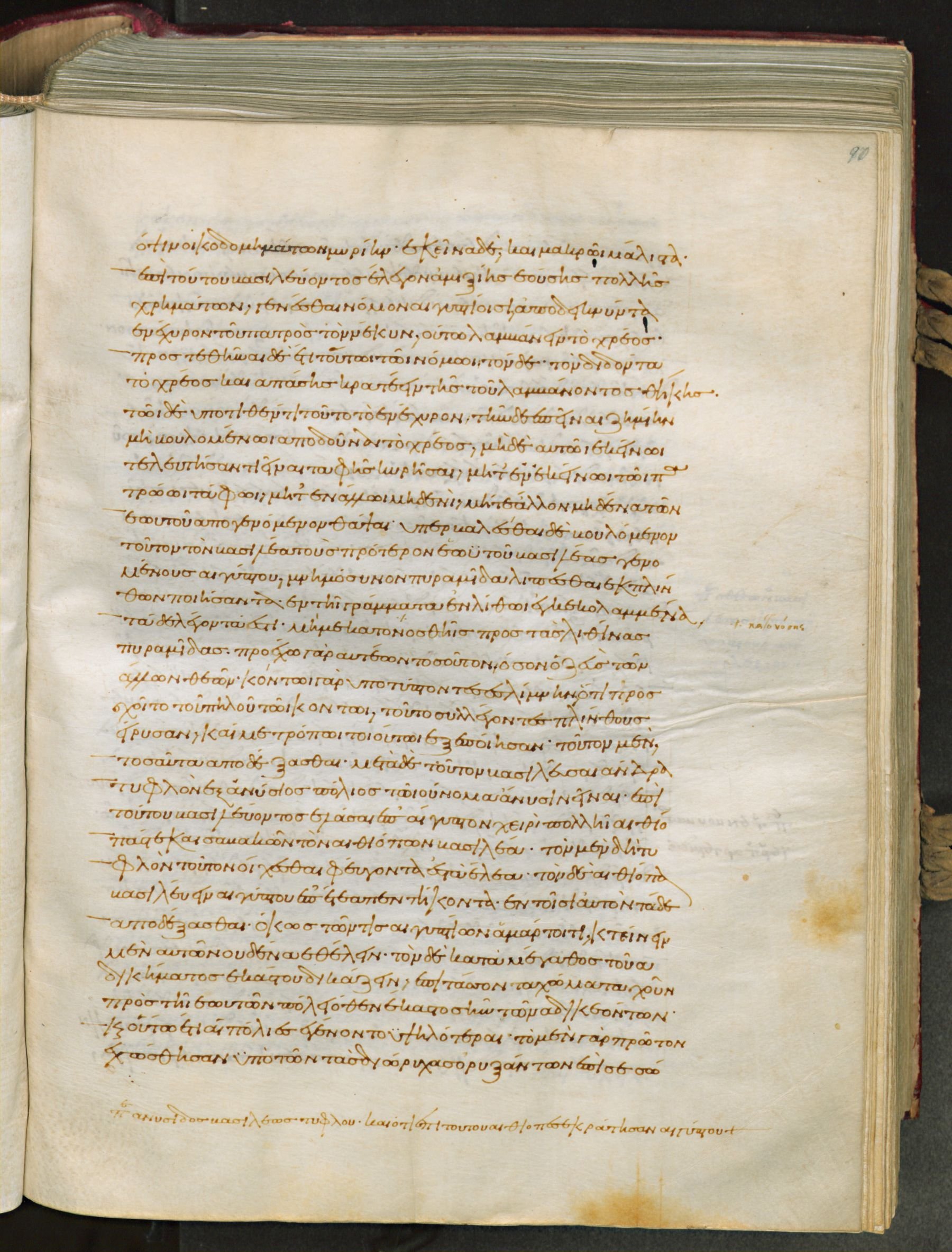
This entry covers 2.137 to 2.140, on fol. 90r to 91r.
How was this verified? (Provenance)
Where on the image
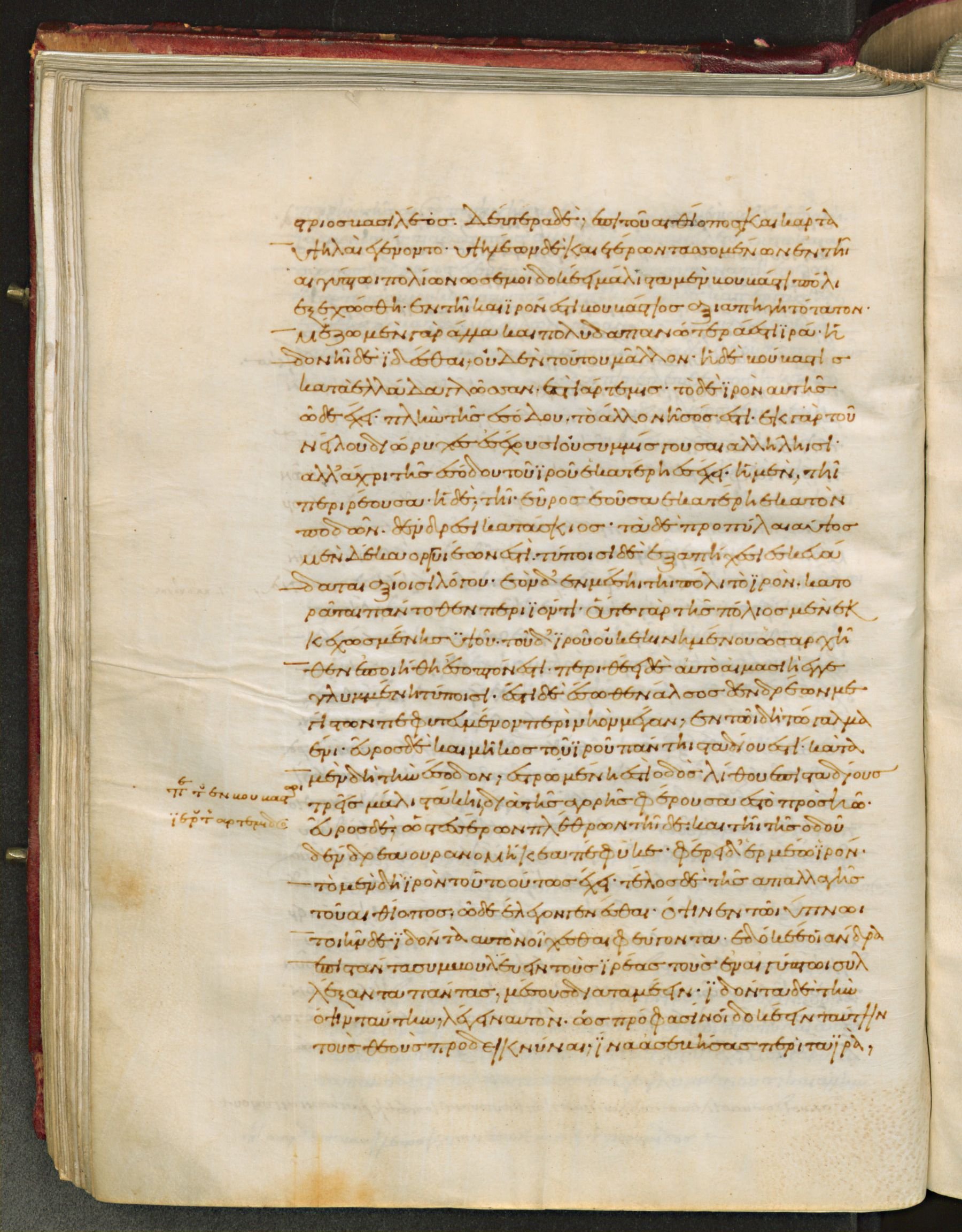
2.137 runs from fol. 90r to fol. 90v. Page breaks read on the images: fol. 90r begins 'ὄψιν οἰκοδομημάτων μυρίην' (2.136.1) and ends '...ὑπὸ τῶν τὰς διώρυχας ὀρυξάντων ἐπὶ Σεσώ-' (2.137.4; a note on Anysis stands in the lower margin); fol. 90v begins '-στριος βασιλέος, δεύτερα δὲ ἐπὶ τοῦ Αἰθίοπος' (2.137.4) and ends '...ἵνα ἀσεβήσας περὶ τὰ ἱρά' (2.139.2). Checked on the image. Viewer: https://tecabml.contentdm.oclc.org/digital/collection/plutei/id/1358114
2.137τοῦτον μὲν τοσαῦτα ἀποδέξασθαι. μετὰ δὲ τοῦτον βασιλεῦσαι ἄνδρα τυφλὸν ἐξ Ἀνύσιος πόλιος, τῷ οὔνομα Ἄνυσιν εἶναι. ἐπὶ τούτου βασιλεύοντος ἐλάσαι ἐπʼ Αἴγυπτον χειρὶ πολλῇ Αἰθίοπάς τε καὶ Σαβακῶν τὸν Αἰθιόπων βασιλέα.
τὸν μὲν δὴ τυφλὸν τοῦτον οἴχεσθαι φεύγοντα ἐς τὰ ἕλεα, τὸν δὲ Αἰθίοπα βασιλεύειν Αἰγύπτου ἐπʼ ἔτεα πεντήκοντα, ἐν τοῖσι αὐτὸν τάδε ἀποδέξασθαι·
ὅκως τῶν τις Αἰγυπτίων ἁμάρτοι τι, κτείνειν μὲν αὐτῶν οὐδένα ἐθέλειν, τὸν δὲ κατὰ μέγαθος τοῦ ἀδικήματος ἑκάστῳ δικάζειν ἐπιτάσσοντα χώματα χοῦν πρὸς τῇ ἑωυτῶν πόλι, ὅθεν ἕκαστος ἦν τῶν ἀδικεόντων. καὶ οὕτω ἔτι αἱ πόλιες ἐγένοντο ὑψηλότεραι·
τὸ μὲν γὰρ πρῶτον ἐχώσθησαν ὑπὸ τῶν τὰς διώρυχας ὀρυξάντων ἐπὶ Σεσώστριος βασιλέος, δεύτερα δὲ ἐπὶ τοῦ Αἰθίοπος καὶ κάρτα ὑψηλαὶ ἐγένοντο.
ὑψηλέων δὲ καὶ ἑτερέων γενομενέων ἐν τῇ Αἰγύπτῳ πολίων, ὡς ἐμοὶ δοκέει, μάλιστα ἡ ἐν Βουβάστιπόλις ἐξεχώσθη, ἐν τῇ καὶ ἱρόν ἐστι Βουβάστιος ἀξιαπηγητότατον· μέζω μὲν γὰρ ἄλλα καὶ πολυδαπανώτερα ἐστὶ ἱρά, ἡδονὴ δὲ ἰδέσθαι οὐδὲν τούτου μᾶλλον. ἡ δὲ Βούβαστις κατὰ Ἑλλάδα γλῶσσαν ἐστὶ Ἄρτεμις.
2.137These were the acts of Asuchis. After him reigned a blind man called Anysis, of the town of that name. In his reign Egypt was invaded by Sabacos king of Ethiopia and a great army of Ethiopians. The blind man fleeing away into the marshes, the Ethiopians ruled Egypt for fifty years. It is recorded in the history of his reign that he would never put to death any Egyptian wrongdoer, but sentenced all, according to the greatness of their offence, to raise embankments in the town of which each was a native. Thus the towns came to stand yet higher than before; for having been first built on embankments made by the diggers of the canals in the reign of Sesostris, they were yet further raised in the reign of the Ethiopian. Other Egyptian towns, to my thinking, were so dealt with, but the level of Bubastis was raised more than any. In this town there is a temple of Bubastis, and it is a building most worthy of note. Other temples are greater and more costly, but none pleasanter to the eye than this. Bubastis is, in the Greek language, Artemis.
Where on the image
2.138 is on fol. 90v. Page breaks read on the images: fol. 90v begins '-στριος βασιλέος, δεύτερα δὲ ἐπὶ τοῦ Αἰθίοπος' (2.137.4) and ends '...ἵνα ἀσεβήσας περὶ τὰ ἱρά' (2.139.2). Checked on the image. Viewer: https://tecabml.contentdm.oclc.org/digital/collection/plutei/id/1358114
2.138τὸ δʼ ἱρὸν αὐτῆς ὧδε ἔχει. πλὴν τῆς ἐσόδου τὸ ἄλλο νῆσος ἐστί· ἐκ γὰρ τοῦ Νείλου διώρυχες ἐσέχουσι οὐ συμμίσγουσαι ἀλλήλῃσι, ἀλλʼ ἄχρι τῆς ἐσόδου τοῦ ἱροῦ ἑκατέρη ἐσέχει, ἣ μὲν τῇ περιρρέουσα ἣ δὲ τῇ, εὖρος ἐοῦσα ἑκατέρη ἑκατὸν ποδῶν, δένδρεσι κατάσκιος.
τὰ δὲ προπύλαια ὕψος μὲν δέκα ὀργυιέων ἐστί, τύποισι δὲ ἑξαπήχεσι ἐσκευάδαται ἀξίοισι λόγου. ἐὸν δʼ ἐν μέσῃ τῇ πόλι τὸ ἱρὸν κατορᾶται πάντοθεν περιιόντι· ἅτε γὰρ τῆς πόλιος μὲν ἐκκεχωσμένης ὑψοῦ, τοῦ δʼ ἱροῦ οὐ κεκινημένου ὡς ἀρχῆθεν ἐποιήθη, ἔσοπτον ἐστί.
περιθέει δὲ αὐτὸ αἱμασιὴ ἐγγεγλυμμένη τύποισι, ἔστι δὲ ἔσωθεν ἄλσος δενδρέων μεγίστων πεφυτευμένον περὶ νηὸν μέγαν, ἐν τῷ δὴ τὤγαλμα ἔνι· εὖρος δὲ καὶ μῆκος τοῦ ἱροῦ πάντῃ σταδίου ἐστί.
κατὰ μὲν δὴ τὴν ἔσοδον ἐστρωμένη ἐστὶ ὁδὸς λίθου ἐπὶ σταδίους τρεῖς μάλιστά κῃ, διὰ τῆς ἀγορῆς φέρουσα ἐς τὸ πρὸς ἠῶ, εὖρος δὲ ὡς τεσσέρων πλέθρων· τῇ δὲ καὶ τῇ τῆς ὁδοῦ δένδρεα οὐρανομήκεα πέφυκε· φέρει δὲ ἐς Ἑρμέω ἱρόν. τὸ μὲν δὴ ἱρὸν τοῦτο οὕτω ἔχει.
2.138I will now show the form of her temple: save for the entrance, it stands on an island; two separate channels approach it from the Nile, and after coming up to the entry of the temple, they run round it on opposite sides; each of them is an hundred feet wide, and overshadowed by trees. The outer court has a height of ten fathoms, and is adorned with notable figures six cubits high. The temple is in the midst of the city, the whole circuit of which commands a view down into it; for the city’s level has been raised, but that of the temple has been left as it was from the first, so that it can be seen into from without. A stone wall, carven with figures, runs round it; within is a grove of very tall trees growing round a great shrine, wherein is the image of the goddess; the temple is a square, each side measuring a furlong. A road, paved with stone, of about three furlongs’ length leads to the entrance, running eastward through the market place, towards the temple of Hermes; this road is about four hundred feet wide, and bordered by trees reaching to heaven. Such is this temple.
Where on the image
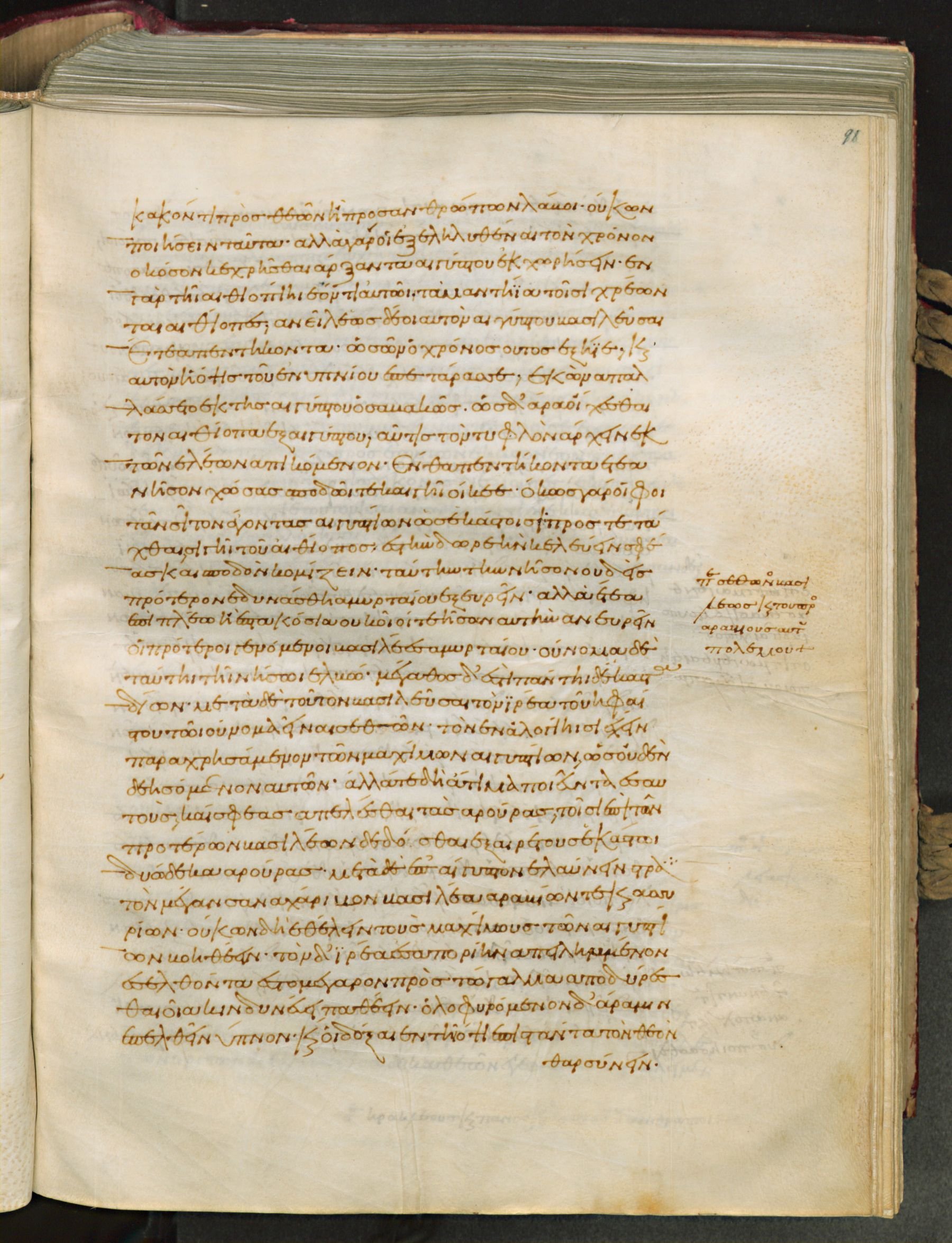
2.139 runs from fol. 90v to fol. 91r. Page breaks read on the images: fol. 90v begins '-στριος βασιλέος, δεύτερα δὲ ἐπὶ τοῦ Αἰθίοπος' (2.137.4) and ends '...ἵνα ἀσεβήσας περὶ τὰ ἱρά' (2.139.2); fol. 91r begins 'κακόν τι πρὸς θεῶν ἢ πρὸς ἀνθρώπων λάβοι' (2.139.2) and ends '...ἐπιστάντα τὸν θεὸν θαρσύνειν' (2.141.3). Checked on the image. Viewer: https://tecabml.contentdm.oclc.org/digital/collection/plutei/id/1358114
2.139τέλος δὲ τῆς ἀπαλλαγῆς τοῦ Αἰθίοπος ὧδε ἔλεγον γενέσθαι· ὄψιν ἐν τῷ ὕπνῳ τοιήνδε ἰδόντα αὐτὸν οἴχεσθαι φεύγοντα· ἐδόκέε οἱ ἄνδρα ἐπιστάντα συμβουλεύειν τοὺς ἱρέας τοὺς ἐν Αἰγύπτῳ συλλέξαντα πάντας μέσους διαταμεῖν.
ἰδόντα δὲ τὴν ὄψιν ταύτην λέγειν αὐτὸν ὡς πρόφασίν οἱ δοκέοι ταύτην τοὺς θεοὺς προδεικνύναι, ἵνα ἀσεβήσας περὶ τὰ ἱρὰ κακόν τι πρὸς θεῶν ἢ πρὸς ἀνθρώπων λάβοι· οὔκων ποιήσειν ταῦτα, ἀλλὰ γάρ οἱ ἐξεληλυθέναι τὸν χρόνον, ὁκόσον κεχρῆσθαι ἄρξαντα Αἰγύπτου ἐκχωρήσειν.
ἐν γὰρ τῇ Αἰθιοπίῃ ἐόντι αὐτῷ τὰ μαντήια, τοῖσι χρέωνται Αἰθίοπες, ἀνεῖλε ὡς δέοι αὐτὸν Αἰγύπτου βασιλεῦσαι ἔτεα πεντήκοντα. ὡς ὦν ὁ χρόνος οὗτος ἐξήιε καὶ αὐτὸν ἡ ὄψις τοῦ ἐνυπνίου ἐπετάρασσε, ἑκὼν ἀπαλλάσσετο ἐκ τῆς Αἰγύπτου ὁ Σαβακῶς.
2.139Now the departure of the Ethiopian (they said) was accomplished on this wise. He fled away from the country, having seen in a dream one who stood over him and counselled him to gather together all the priests in Egypt and cut them in sunder. Having seen this vision, he said that he supposed it to be a manifestation sent to him by the gods, that he might commit sacrilege and so be punished by gods or men; he would not (he said) act so, but otherwise, for the time foretold for his rule over Egypt, after which he was to depart, was now fulfilled: for when he was still in Ethiopia the oracles which are inquired of by the people of that country declared to him that he was fated to reign fifty years over Egypt. Seeing that this time was now completed and that he was troubled by what he saw in his dream, Sabacos departed from Egypt of his own accord.
Where on the image
2.140 is on fol. 91r. Page breaks read on the images: fol. 91r begins 'κακόν τι πρὸς θεῶν ἢ πρὸς ἀνθρώπων λάβοι' (2.139.2) and ends '...ἐπιστάντα τὸν θεὸν θαρσύνειν' (2.141.3). Checked on the image. Viewer: https://tecabml.contentdm.oclc.org/digital/collection/plutei/id/1358114
2.140ὡς δʼ ἄρα οἴχεσθαι τὸν Αἰθίοπα ἐξ Αἰγύπτου, αὖτις τὸν τυφλὸν ἄρχειν ἐκ τῶν ἑλέων ἀπικόμενον, ἔνθα πεντήκοντα ἔτεα νῆσον χώσας σποδῷ τε καὶ γῇ οἴκεε. ὅκως γάρ οἱ φοιτᾶν σῖτον ἄγοντας Αἰγυπτίων, ὡς ἑκάστοισι προστετάχθαι, σιγῇ τοῦ Αἰθίοπος, ἐς τὴν δωρεὴν κελεύειν σφέας καὶ σποδὸν κομίζειν.
ταύτην τὴν νῆσον οὐδεὶς πρότερον ἐδυνάσθη Ἀμυρταίου ἐξευρεῖν, ἀλλὰ ἔτεα ἐπὶ πλέω ἢ ἑπτακόσια οὐκ οἷοί τε ἦσαν αὐτὴν ἀνευρεῖν οἱ πρότεροι γενόμενοι βασιλέες Ἀμυρταίου. οὔνομα δὲ ταύτῃ τῇ νήσῳ Ἐλβώ, μέγαθος δʼ ἐστὶ πάντῃ δέκα σταδίων.
2.140The Ethiopian having left Egypt, the blind man (it is said) was king once more, returning from the marshes, where he had dwelt fifty years on an island which he built of ashes and earth; for the Egyptians, who were severally charged to bring him food without the Ethiopian’s knowledge, were bidden by the king to bring ashes whenever they came, as their gift. This island was never discovered before the time of Amyrtaeus; all the kings before him sought it in vain for more than seven hundred years. The name of it is Elbo, and it is ten furlongs long and of an equal breadth.
Notes
- Greek: the text printed in A. D. Godley's Loeb edition (1920), from Perseus. Square brackets mark words the editor considers later additions. The manuscript's wording differs from the edition in places; the Greek is the edition, not a transcription of the page.
- English: A. D. Godley's translation as printed in 1920 (Loeb Classical Library, Herodotus vol. 1), not the modernized version on Perseus. Godley's footnotes are omitted.
- Chapter 121 is divided into 121 and 121a-121f as in Godley's edition; the English is divided at the corresponding sentences.
Cite
Sources
- Source: Florence, Laur. Plut. 70.3 (10th c.) via BML Teca Digitale + Greek of Godley's Loeb (Perseus) + English of A. D. Godley (1920, Wikisource, checked against the printing) (holding institution)
- Critical edition: Greek of A. D. Godley's Loeb edition (1920), via Perseus
← previous · → next · v cycle view · l back to library