Herodotus, Histories 2.136: Asychis and the brick pyramid
Introduction
In the second book of his Histories (written c. 430 BCE) Herodotus reports what the priests of Hephaestus at Memphis told him of the kings of Egypt, from Min (Menes), who first ruled and founded Memphis, through 330 kings named from a papyrus roll, to Sesostris, Proteus, Rhampsinitus, the pyramid builders Cheops, Chephren and Mycerinus, and Sethos, priest-king in the time of Sennacherib. He ends with their chronology: 341 generations, 11,340 years, during which no god had reigned in human form and the sun had four times risen out of its usual place.
The manuscript is Florence, Biblioteca Medicea Laurenziana, Plut. 70.3, written in the 10th century, the oldest surviving manuscript of Herodotus (codex A of the editors). Chapters 2.99-146 run from fol. 78v to fol. 92v. Each section is one chapter (Godley's subdivisions of the Rhampsinitus story, 121a-f, are kept apart) and points at the page(s) that carry it; the page breaks were read on the images and are recorded in each note.
This entry covers 2.136, on fol. 89v to 90r.
How was this verified? (Provenance)
Where on the image
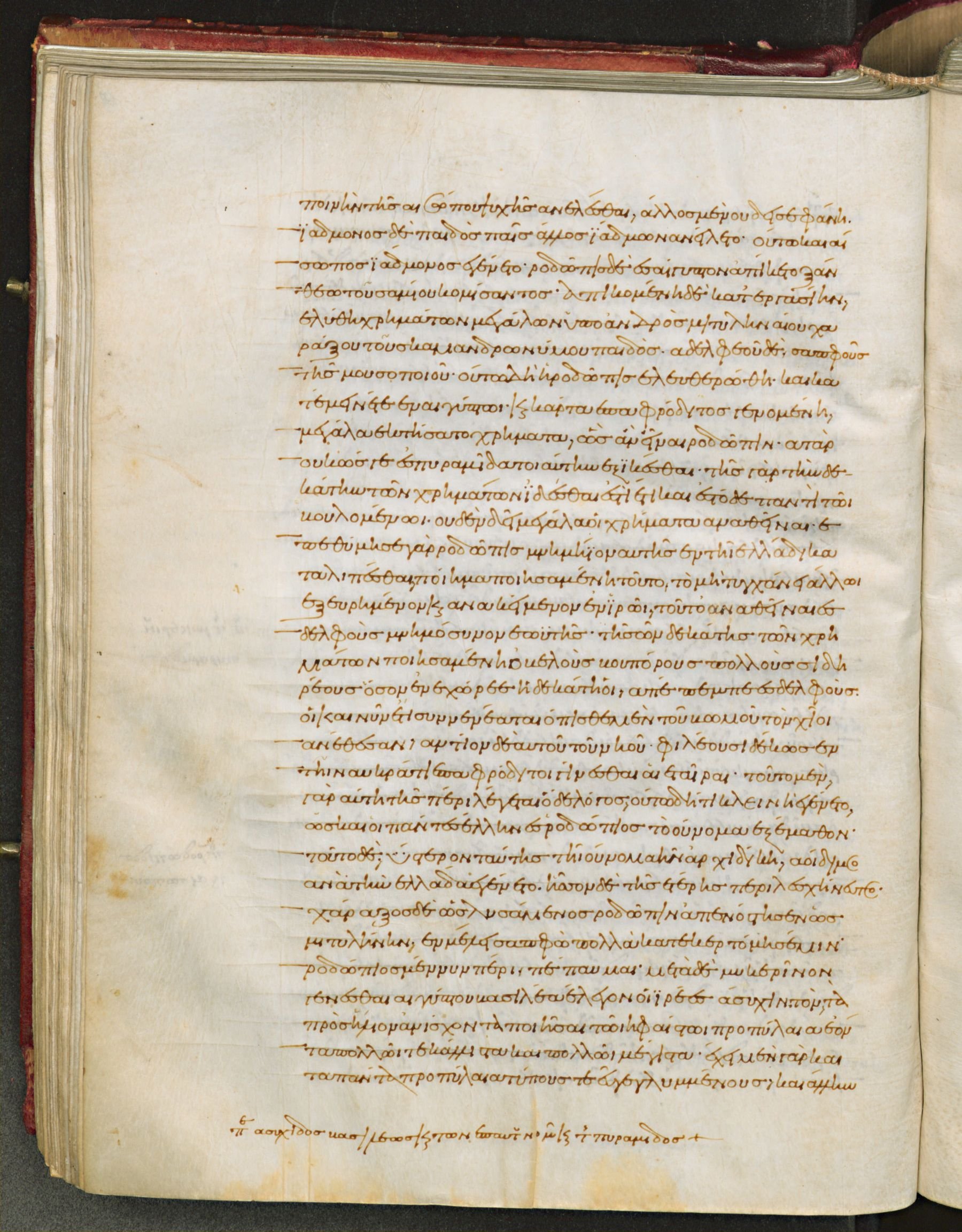
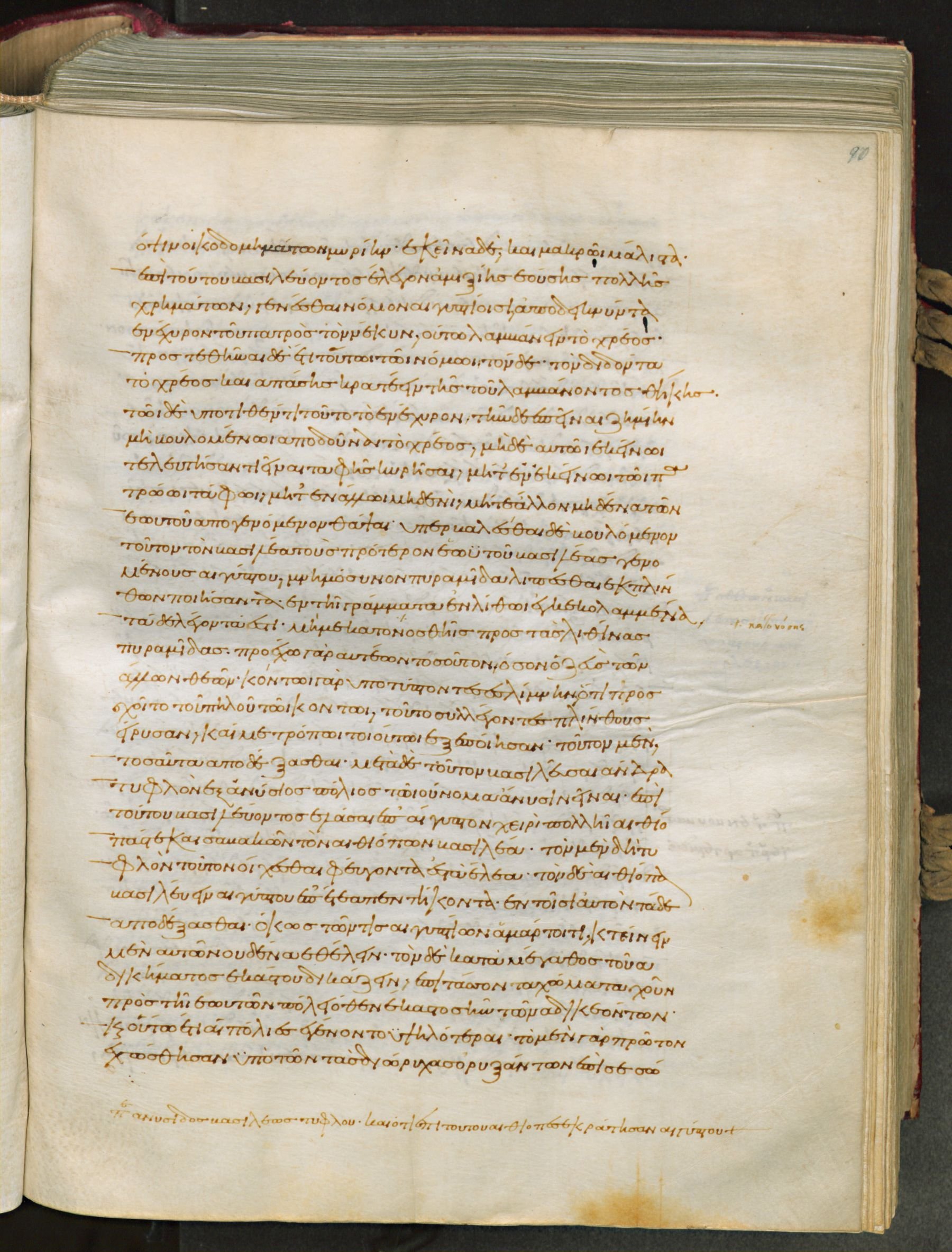
2.136 runs from fol. 89v to fol. 90r. Page breaks read on the images: fol. 89v begins 'ποινὴν τῆς Αἰσώπου ψυχῆς ἀνελέσθαι' (2.134.4) and ends '...τύπους τε ἐγγεγλυμμένους καὶ ἄλλην' (2.136.1; a note on Asychis stands in the lower margin); fol. 90r begins 'ὄψιν οἰκοδομημάτων μυρίην' (2.136.1) and ends '...ὑπὸ τῶν τὰς διώρυχας ὀρυξάντων ἐπὶ Σεσώ-' (2.137.4; a note on Anysis stands in the lower margin). Checked on the image. Viewer: https://tecabml.contentdm.oclc.org/digital/collection/plutei/id/1358114
2.136Ῥοδώπιος μέν νυν πέρι πέπαυμαι. μετὰ δὲ Μυκερῖνον γενέσθαι Αἰγύπτου βασιλέα ἔλεγον οἱ ἱρέες Ἄσυχιν, τὸν τὰ πρὸς ἥλιον ἀνίσχοντα ποιῆσαι τῷ Ἡφαίστῳ προπύλαια, ἐόντα πολλῷ τε κάλλιστα καὶ πολλῷ μέγιστα· ἔχει μὲν γὰρ καὶ τὰ πάντα προπύλαια τύπους τε ἐγγεγλυμμένους καὶ ἄλλην ὄψιν οἰκοδομημάτων μυρίην, ἐκεῖνα δὲ καὶ μακρῷ μάλιστα.
ἐπὶ τούτου βασιλεύοντος ἔλεγον, ἀμιξίης ἐούσης πολλῆς χρημάτων, γενέσθαι νόμον Αἰγυπτίοισι, ἀποδεικνύντα ἐνέχυρον τοῦ πατρὸς τὸν νέκυν οὕτω λαμβάνειν τὸ χρέος· προστεθῆναι δὲ ἔτι τούτῳ τῷ νόμῳ τόνδε, τὸν διδόντα τὸ χρέος καὶ ἁπάσης κρατέειν τῆς τοῦ λαμβάνοντος θήκης, τῷ δὲ ὑποτιθέντι τοῦτο τὸ ἐνέχυρον τήνδε ἐπεῖναι ζημίην μὴ βουλομένῳ ἀποδοῦναι τὸ χρέος, μήτε αὐτῷ ἐκείνῳ τελευτήσαντι εἶναι ταφῆς κυρῆσαι μήτʼ ἐν ἐκείνῳ τῷ πατρωίῳ τάφῳ μήτʼ ἐν ἄλλῳ μηδενί, μήτε ἄλλον μηδένα τῶν ἑωυτοῦ ἀπογενόμενον θάψαι.
ὑπερβαλέσθαι δὲ βουλόμενον τοῦτον τὸν βασιλέα τοὺς πρότερον ἑωυτοῦ βασιλέας γενομένους Αἰγύπτου μνημόσυνον πυραμίδα λιπέσθαι ἐκ πλίνθων ποιήσαντα, ἐν τῇ γράμματα ἐν λίθῳ ἐγκεκολαμμένα τάδε λέγοντα ἐστί.
μή με κατονοσθῇς πρὸς τὰς λιθίνας πυραμίδας· προέχω γὰρ αὐτέων τοσοῦτον ὅσον ὁ Ζεὺς τῶν ἄλλων θεῶν. κοντῷ γὰρ ὑποτύπτοντες ἐς λίμνην, ὅ τι πρόσσχοιτο τοῦ πηλοῦ τῷ κοντῷ, τοῦτο συλλέγοντες πλίνθους εἴρυσαν καί με τρόπῳ τοιούτῳ ἐξεποίησαν.
2.136Enough has been said of Rhodopis. After Mycerinus, said the priests, Asuchis became king of Egypt. He built the eastern outer court of Hephaestus’ temple; this is by much the fairest and largest of all the courts, for while all have carven figures and innumerable graces of architecture, this court has far more than any. In this king’s reign as they told me, money in Egypt passed not readily from hand to hand; wherefore a law was made that a man might borrow on the security of his father’s dead body; and the law provided also, that the lender should have a lien on the whole burial-vault of the borrower, and that the penalty for the giver of this security, should he fail to repay the debt, should be that he might neither himself be buried at death nor bury any deceased of his kin either in that tomb of his fathers nor in any other. Moreover, being desirous of excelling all who ruled Egypt before him, this king left a pyramid of brick to commemorate his name, on which is this writing, cut on a stone:—“Deem me not less than the pyramids of stone; for I am as much more excellent than they as Zeus is than the other gods; for they struck a pole down into a marsh and collected what mud clave to the pole; therewith they made bricks, and thus was I built.”
Notes
- Greek: the text printed in A. D. Godley's Loeb edition (1920), from Perseus. Square brackets mark words the editor considers later additions. The manuscript's wording differs from the edition in places; the Greek is the edition, not a transcription of the page.
- English: A. D. Godley's translation as printed in 1920 (Loeb Classical Library, Herodotus vol. 1), not the modernized version on Perseus. Godley's footnotes are omitted.
- Chapter 121 is divided into 121 and 121a-121f as in Godley's edition; the English is divided at the corresponding sentences.
Cite
Sources
- Source: Florence, Laur. Plut. 70.3 (10th c.) via BML Teca Digitale + Greek of Godley's Loeb (Perseus) + English of A. D. Godley (1920, Wikisource, checked against the printing) (holding institution)
- Critical edition: Greek of A. D. Godley's Loeb edition (1920), via Perseus
← previous · → next · v cycle view · l back to library