Herodotus, Histories 2.129-135: Mycerinus, the oracle of six years, and Rhodopis
Introduction
In the second book of his Histories (written c. 430 BCE) Herodotus reports what the priests of Hephaestus at Memphis told him of the kings of Egypt, from Min (Menes), who first ruled and founded Memphis, through 330 kings named from a papyrus roll, to Sesostris, Proteus, Rhampsinitus, the pyramid builders Cheops, Chephren and Mycerinus, and Sethos, priest-king in the time of Sennacherib. He ends with their chronology: 341 generations, 11,340 years, during which no god had reigned in human form and the sun had four times risen out of its usual place.
The manuscript is Florence, Biblioteca Medicea Laurenziana, Plut. 70.3, written in the 10th century, the oldest surviving manuscript of Herodotus (codex A of the editors). Chapters 2.99-146 run from fol. 78v to fol. 92v. Each section is one chapter (Godley's subdivisions of the Rhampsinitus story, 121a-f, are kept apart) and points at the page(s) that carry it; the page breaks were read on the images and are recorded in each note.
This entry covers 2.129 to 2.135, on fol. 88r to 89v.
How was this verified? (Provenance)
Where on the image
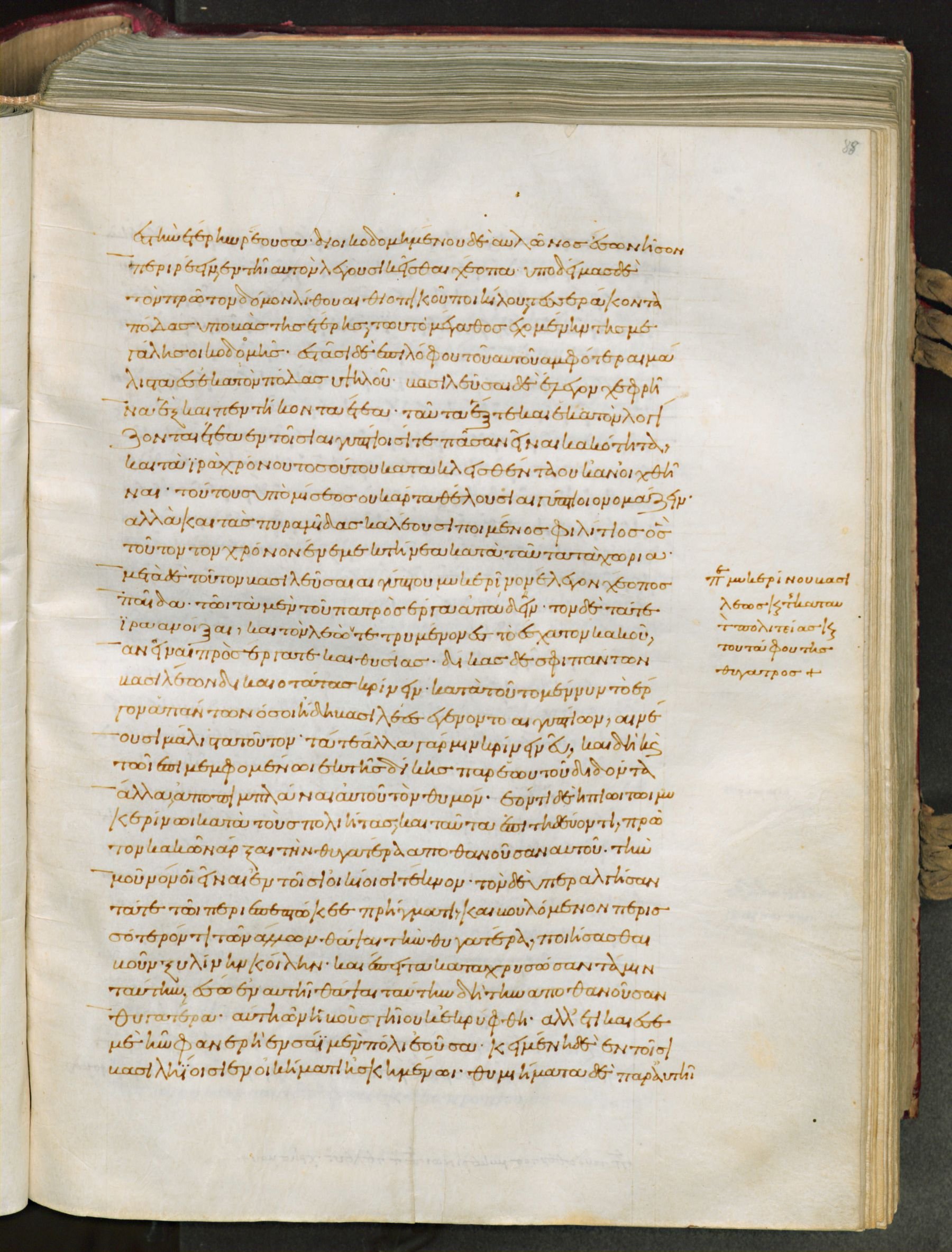
2.129 is on fol. 88r. Page breaks read on the images: fol. 88r begins 'ἐς τὴν ἑτέρην ῥέουσα' (2.127.2) and ends '...θυμιήματα δὲ παρ’ αὐτῇ' (2.130.1). Checked on the image. Viewer: https://tecabml.contentdm.oclc.org/digital/collection/plutei/id/1358114
2.129μετὰ δὲ τοῦτον βασιλεῦσαι Αἰγύπτου Μυκερῖνον ἔλεγον Χέοπος παῖδα· τῷ τὰ μὲν τοῦ πατρὸς ἔργα ἀπαδεῖν, τὸν δὲ τά τε ἱρὰ ἀνοῖξαι καὶ τὸν λεὼν τετρυμένον ἐς τὸ ἔσχατον κακοῦ ἀνεῖναι πρὸς ἔργα τε καὶ θυσίας, δίκας δέ σφι πάντων βασιλέων δικαιότατα κρίνειν.
κατὰ τοῦτο μέν νυν τὸ ἔργον ἁπάντων ὅσοι ἤδη βασιλέες ἐγένοντο Αἰγυπτίων αἰνέουσι μάλιστα τοῦτον. τά τε ἄλλα γάρ μιν κρίνειν εὖ, καὶ δὴ καὶ τῷ ἐπιμεμφομένῳ ἐκ τῆς δίκης παρʼ ἑωυτοῦ διδόντα ἄλλα ἀποπιμπλάναι αὐτοῦ τὸν θυμόν.
ἐόντι δὲ ἠπίῳ τῷ Μυκερίνῳ κατὰ τοὺς πολιήτας καὶ ταῦτα ἐπιτηδεύοντι πρῶτον κακῶν ἄρξαι τὴν θυγατέρα ἀποθανοῦσαν αὐτοῦ, τὴν μοῦνόν οἱ εἶναι ἐν τοῖσι οἰκίοισι τέκνον. τὸν δὲ ὑπεραλγήσαντά τε τῷ περιεπεπτώκεε πρήγματι, καὶ βουλόμενον περισσότερόν τι τῶν ἄλλων θάψαι τὴν θυγατέρα, ποιήσασθαι βοῦν ξυλίνην κοίλην, καὶ ἔπειτα καταχρυσώσαντά μιν ταύτην ἔσω ἐν αὐτῇ θάψαι ταύτην δὴ τὴν ἀποθανοῦσαν θυγατέρα.
2.129The next king of Egypt, they said, was Cheops’ son Mycerinus. He, being displeased with his father’s doings, opened the temples and suffered the people, now ground down to the depth of misery, to go to their business and their sacrifices; and he was the justest judge among all the kings. It is on this account that he is praised beyond all the rulers of Egypt; for not only were his judgments just, but if any were not contented with the sentence Mycerinus would give such an one a present out of his own estate to satisfy him for his loss. Such was his practice, and so he ruled his people with clemency, yet calamities befel him, of which the first was the death of his daughter, the only child of his household. Greatly grieving over this misfortune, he desired to give her a burial something more excellent than ordinary; he made therefore a hollow cow’s image of gilded wood and placed therein the body of his dead daughter.
Where on the image
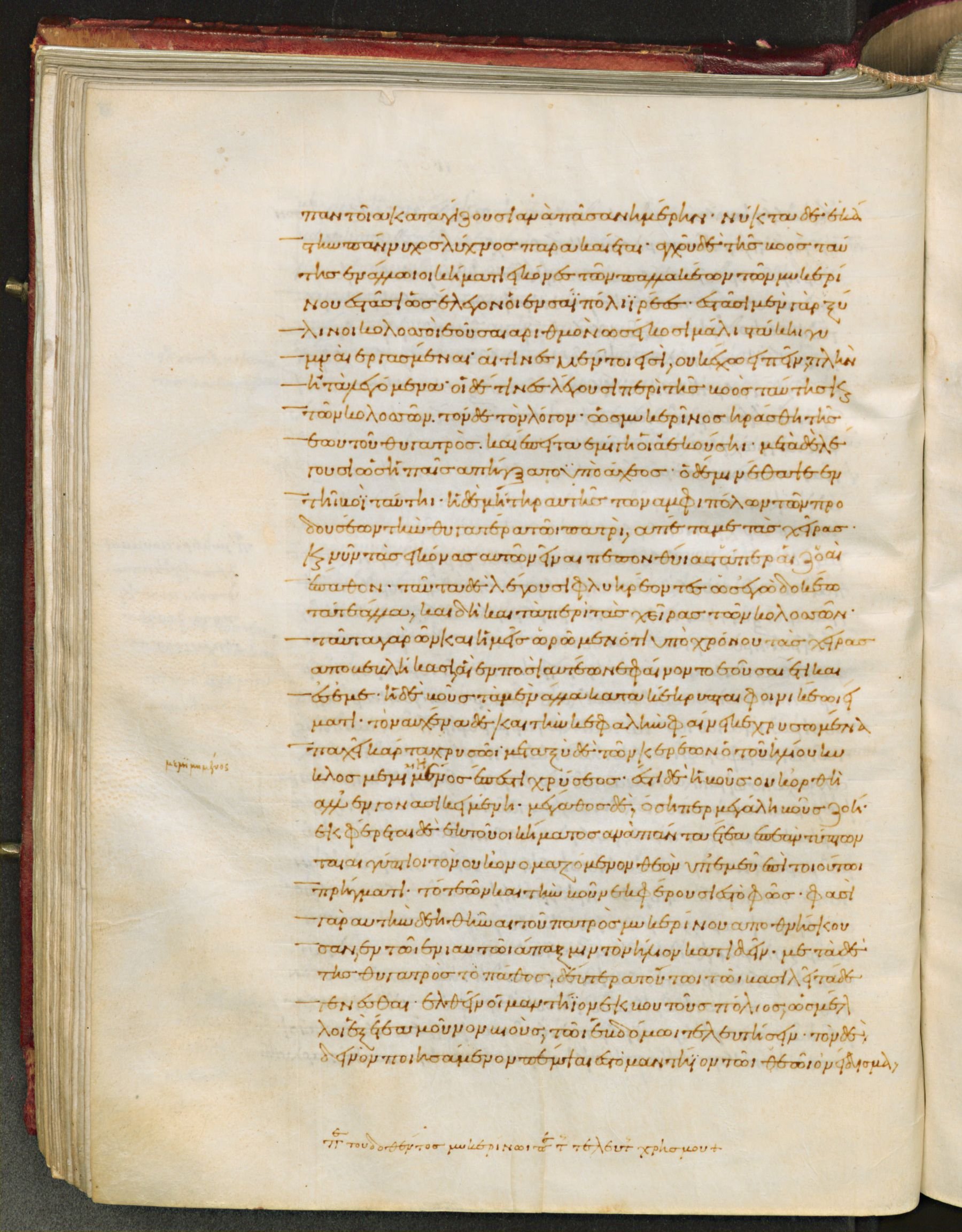
2.130 runs from fol. 88r to fol. 88v. Page breaks read on the images: fol. 88r begins 'ἐς τὴν ἑτέρην ῥέουσα' (2.127.2) and ends '...θυμιήματα δὲ παρ’ αὐτῇ' (2.130.1); fol. 88v begins 'παντοῖα καταγίζουσι ἀνὰ πᾶσαν ἡμέρην' (2.130.1) and ends '...πέμψαι ἐς τὸ μαντήιον τῷ θεῷ ὀνείδισμα' (2.133.2; a reader's note on the oracle stands in the lower margin). Checked on the image. Viewer: https://tecabml.contentdm.oclc.org/digital/collection/plutei/id/1358114
2.130αὕτη ὦν ἡ βοῦς γῇ οὐκ ἐκρύφθη, ἀλλʼ ἔτι καὶ ἐς ἐμὲ ἦν φανερή, ἐν Σάι μὲν πόλι ἐοῦσα, κειμένη δὲ ἐν τοῖσι βασιληίοισι ἐν οἰκήματι ἠσκημένῳ· θυμιήματα δὲ παρʼ αὐτῇ παντοῖα καταγίζουσι ἀνὰ πᾶσαν ἡμέρην, νύκτα δὲ ἑκάστην πάννυχος λύχνος παρακαίεται.
ἀγχοῦ δὲ τῆς βοὸς ταύτης ἐν ἄλλῳ οἰκήματι εἰκόνες τῶν παλλακέων τῶν Μυκερίνου ἑστᾶσι, ὡς ἔλεγον οἱ ἐν Σάι πόλι ἱρέες· ἑστᾶσι μὲν γὰρ ξύλιναι κολοσσοί, ἐοῦσαι ἀριθμὸν ὡς εἴκοσι μάλιστά κῃ, γυμναὶ ἐργασμέναι· αἵτινες μέντοι εἰσί, οὐκ ἔχω εἰπεῖν πλὴν ἢ τὰ λεγόμενα.
2.130This cow was not buried in the earth but was to be seen even in my time, in the town of Sais, where it lay in an adorned chamber of the palace; incense of all kinds is offered daily before it, and a lamp burns by it all through every night. There is another chamber near to this image, where stand the statues of Mycerinus’ concubines, as the priests of Sais told me; and indeed there are about twenty colossal wooden figures there, made like naked women, but I have only the priests’ word to show who they are.
Where on the image
2.131 is on fol. 88v. Page breaks read on the images: fol. 88v begins 'παντοῖα καταγίζουσι ἀνὰ πᾶσαν ἡμέρην' (2.130.1) and ends '...πέμψαι ἐς τὸ μαντήιον τῷ θεῷ ὀνείδισμα' (2.133.2; a reader's note on the oracle stands in the lower margin). Checked on the image. Viewer: https://tecabml.contentdm.oclc.org/digital/collection/plutei/id/1358114
2.131οἳ δὲ τινὲς λέγουσι περὶ τῆς βοὸς ταύτης καὶ τῶν κολοσσῶν τόνδε τὸν λόγον, ὡς Μυκερῖνος ἠράσθη τῆς ἑωυτοῦ θυγατρὸς καὶ ἔπειτα ἐμίγη οἱ ἀεκούσῃ·
μετὰ δὲ λέγουσι ὡς ἡ παῖς ἀπήγξατο ὑπὸ ἄχεος, ὁ δέ μιν ἔθαψε ἐν τῇ βοῒ ταύτῃ, ἡ δὲ μήτηρ αὐτῆς τῶν ἀμφιπόλων τῶν προδουσέων τὴν θυγατέρα τῷ πατρὶ ἀπέταμε τὰς χεῖρας, καὶ νῦν τὰς εἰκόνας αὐτέων εἶναι πεπονθυίας τά περ αἱ ζωαὶ ἔπαθον.
ταῦτα δὲ λέγουσι φλυηρέοντες, ὡς ἐγὼ δοκέω, τά τε ἄλλα καὶ δὴ καὶ τὰ περὶ τὰς χεῖρας τῶν κολοσσῶν· ταύτας γὰρ ὦν καὶ ἡμεῖς ὡρῶμεν ὅτι ὑπὸ χρόνου τὰς χεῖρας ἀποβεβλήκασι, αἳ ἐν ποσὶ αὐτέων ἐφαίνοντο ἐοῦσαι ἔτι καὶ ἐς ἐμέ.
2.131Some have a story about the cow and the statues, how Mycerinus conceived a passion for his own daughter and did her foul wrong, and she strangled herself for grief: then he buried her, they say, in this image of a cow; the girl’s mother cut off the hands of the attendants who had betrayed the daughter to her father, so that now (it is said) their statues are in the plight to which the living women were brought. But this I believe to be a foolish tale, especially as respects the hands of the figures. As we ourselves saw, it is time which has made the hands to drop away; they were to be seen even in my day lying on the ground before the statues.
Where on the image
2.132 is on fol. 88v. Page breaks read on the images: fol. 88v begins 'παντοῖα καταγίζουσι ἀνὰ πᾶσαν ἡμέρην' (2.130.1) and ends '...πέμψαι ἐς τὸ μαντήιον τῷ θεῷ ὀνείδισμα' (2.133.2; a reader's note on the oracle stands in the lower margin). Checked on the image. Viewer: https://tecabml.contentdm.oclc.org/digital/collection/plutei/id/1358114
2.132ἡ δὲ βοῦς τὰ μὲν ἄλλα κατακέκρυπται φοινικέῳ εἵματι, τὸν αὐχένα δὲ καὶ τὴν κεφαλὴν φαίνει κεχρυσωμένα παχέι κάρτα χρυσῷ· μεταξὺ δὲ τῶν κερέων ὁ τοῦ ἡλίου κύκλος μεμιμημένος ἔπεστι χρύσεος.
ἔστι δὲ ἡ βοῦς οὐκ ὀρθὴ ἀλλʼ ἐν γούνασι κειμένη, μέγαθος δὲ ὅση περ μεγάλη βοῦς ζωή. ἐκφέρεται δὲ ἐκ τοῦ οἰκήματος ἀνὰ πάντα ἔτεα, ἐπεὰν τύπτωνται Αἰγύπτιοι τὸν οὐκ ὀνομαζόμενον θεὸν ὑπʼ ἐμεῦ ἐπὶ τοιούτῳ πρήγματι·
τότε ὦν καὶ τὴν βοῦν ἐκφέρουσι ἐς τὸ φῶς· φασὶ γὰρ αὐτὴν δεηθῆναι τοῦ πατρὸς Μυκερίνου ἀποθνήσκουσαν ἐν τῷ ἐνιαυτῷ ἅπαξ μιν τὸν ἥλιον κατιδεῖν.
2.132As for the cow, it is covered with a purple robe, and shows only the head and neck, which are encrusted with a very thick layer of gold. Between its horns it bears the golden figure of the sun’s orb. It does not stand, but kneels; its stature is that of a live cow of great size. This image is carried out of the chamber once in every year, whenever the Egyptians make lamentation for the god whom I name not in speaking of these matters; it is then that the cow is brought out into the light, for Mycerinus’ daughter, they say, entreated him at her death that she might see the sun once a year.
Where on the image
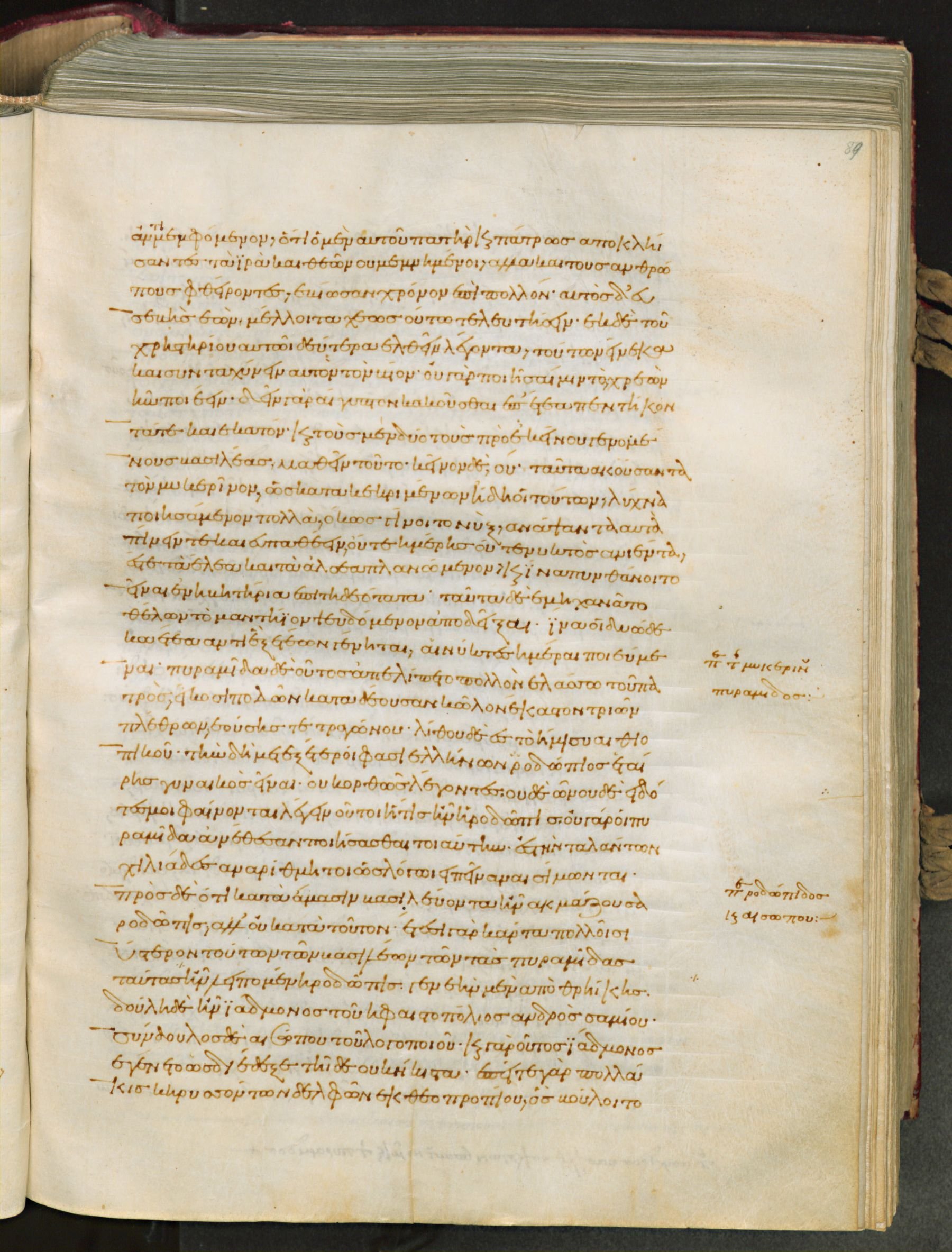
2.133 runs from fol. 88v to fol. 89r. Page breaks read on the images: fol. 88v begins 'παντοῖα καταγίζουσι ἀνὰ πᾶσαν ἡμέρην' (2.130.1) and ends '...πέμψαι ἐς τὸ μαντήιον τῷ θεῷ ὀνείδισμα' (2.133.2; a reader's note on the oracle stands in the lower margin); fol. 89r begins 'ἀντιμεμφόμενον, ὅτι ὁ μὲν αὐτοῦ πατὴρ' (2.133.2) and ends '...κηρυσσόντων Δελφῶν ἐκ θεοπροπίου ὃς βούλοιτο' (2.134.4). Checked on the image. Viewer: https://tecabml.contentdm.oclc.org/digital/collection/plutei/id/1358114
2.133μετὰ δὲ τῆς θυγατρὸς τὸ πάθος δεύτερα τούτῳ τῷ βασιλέι τάδε γενέσθαι· ἐλθεῖν οἱ μαντήιον ἐκ Βουτοῦς πόλιος ὡς μέλλοι ἓξ ἔτεα μοῦνον βιοὺς τῷ ἑβδόμῳ τελευτήσειν.
τὸν δὲ δεινὸν ποιησάμενον πέμψαι ἐς τὸ μαντήιον τῷ θεῷ ὀνείδισμα, ἀντιμεμφόμενον ὅτι ὁ μὲν αὐτοῦ πατὴρ καὶ πάτρως, ἀποκληίσαντες τὰ ἱρὰ καὶ θεῶν οὐ μεμνημένοι ἀλλὰ καὶ τοὺς ἀνθρώπους φθείροντες, ἐβίωσαν χρόνον ἐπὶ πολλόν, αὐτὸς δʼ εὐσεβὴς ἐὼν μέλλοι ταχέως οὕτω τελευτήσειν.
ἐκ δὲ τοῦ χρηστηρίου αὐτῷ δεύτερα ἐλθεῖν λέγοντα τούτων εἵνεκα καὶ συνταχύνειν αὐτὸν τὸν βίον· οὐ γὰρ ποιῆσαί μιν τὸ χρεὸν ἦν ποιέειν· δεῖν γὰρ Αἴγυπτον κακοῦσθαι ἐπʼ ἔτεα πεντήκοντά τε καὶ ἑκατόν, καὶ τοὺς μὲν δύο τοὺς πρὸ ἐκείνου γενομένους βασιλέας μαθεῖν τοῦτο, κεῖνον δὲ οὔ.
ταῦτα ἀκούσαντα τὸν Μυκερῖνον, ὡς κατακεκριμένων ἤδη οἱ τούτων, λύχνα ποιησάμενον πολλά, ὅκως γίνοιτο νύξ, ἀνάψαντα αὐτὰ πίνειν τε καὶ εὐπαθέειν, οὔτε ἡμέρης οὔτε νυκτὸς ἀνιέντα, ἔς τε τὰ ἕλεα καὶ τὰ ἄλσεα πλανώμενον καὶ ἵνα πυνθάνοιτο εἶναι ἐνηβητήρια ἐπιτηδεότατα.
ταῦτα δὲ ἐμηχανᾶτο θέλων τὸ μαντήιον ψευδόμενον ἀποδέξαι, ἵνα οἱ δυώδεκα ἔτεα ἀντὶ ἓξ ἐτέων γένηται, αἱ νύκτες ἡμέραι ποιεύμεναι.
2.133After the grievous death of his daughter, it next happened to Mycerinus that an oracle was sent to him from the city of Buto, declaring that he had but six years to live and must die in the seventh. The king deemed this unjust, and sent back to the oracle a message of reproach, blaming the god: why must he die so soon who was pious, whereas his father and his uncle had lived long, who shut up the temples, and regarded not the gods, and destroyed men? But a second utterance from the place of divination declared to him that his good deeds were the very cause of shortening his life; for he had done what was contrary to fate; Egypt should have been afflicted for an hundred and fifty years, whereof the two kings before him had been aware, but not Mycerinus. Hearing this, he knew that his doom was fixed. Therefore he caused many lamps to be made, and would light these at nightfall and drink and make merry; by day or night he never ceased from revelling, roaming to the marsh country and the groves and wherever he heard of the likeliest places of pleasure. Thus he planned, that by turning night into day he might make his six years into twelve and so prove the oracle false.
Where on the image
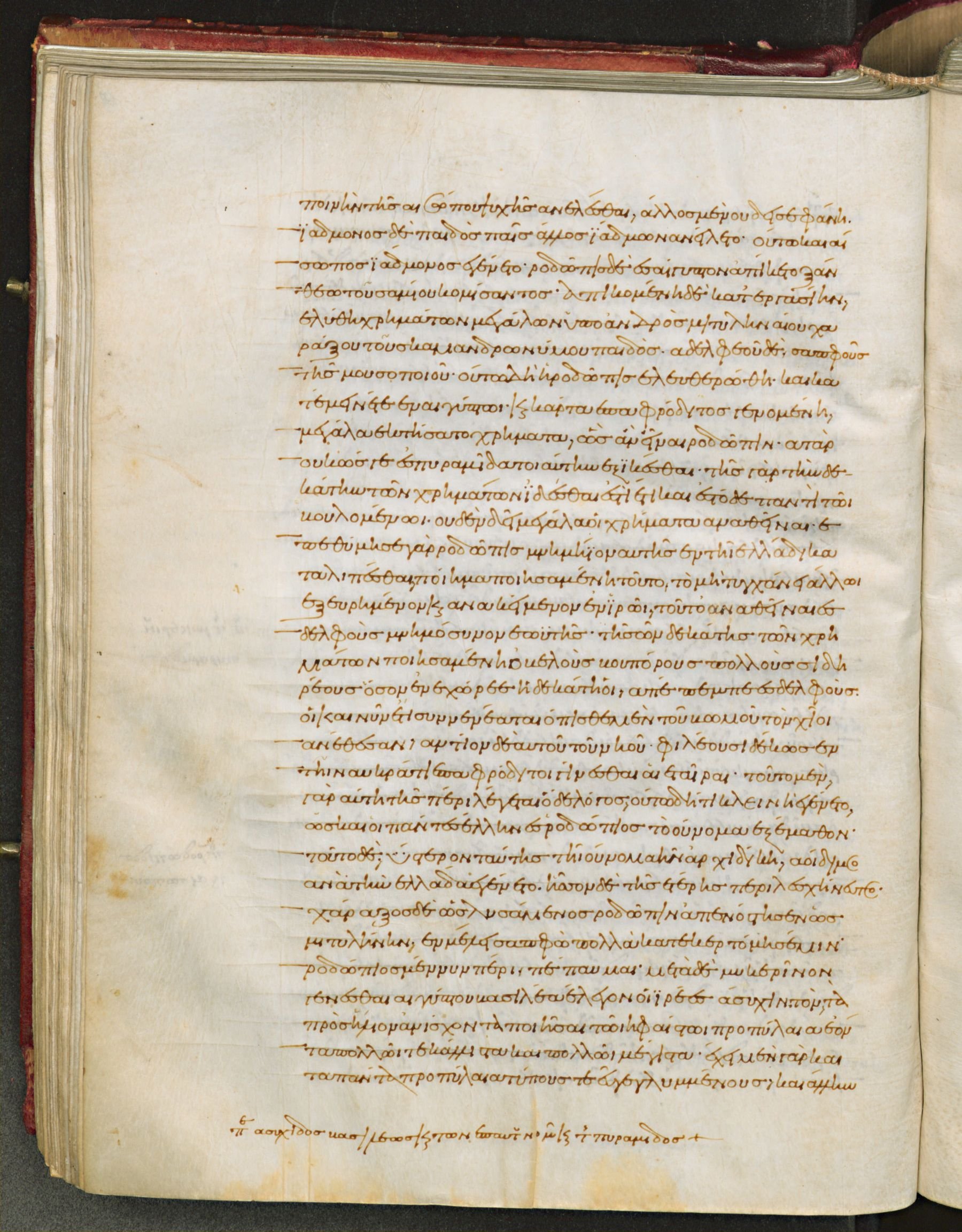
2.134 runs from fol. 89r to fol. 89v. Page breaks read on the images: fol. 89r begins 'ἀντιμεμφόμενον, ὅτι ὁ μὲν αὐτοῦ πατὴρ' (2.133.2) and ends '...κηρυσσόντων Δελφῶν ἐκ θεοπροπίου ὃς βούλοιτο' (2.134.4); fol. 89v begins 'ποινὴν τῆς Αἰσώπου ψυχῆς ἀνελέσθαι' (2.134.4) and ends '...τύπους τε ἐγγεγλυμμένους καὶ ἄλλην' (2.136.1; a note on Asychis stands in the lower margin). Checked on the image. Viewer: https://tecabml.contentdm.oclc.org/digital/collection/plutei/id/1358114
2.134πυραμίδα δὲ οὗτος ἀπελίπετο πολλὸν ἐλάσσω τοῦ πατρός, εἴκοσι ποδῶν καταδέουσαν κῶλον ἕκαστον τριῶν πλέθρων, ἐούσης τετραγώνου, λίθου δὲ ἐς τὸ ἥμισυ Αἰθιοπικοῦ· τὴν δὴ μετεξέτεροι φασὶ Ἑλλήνων Ῥοδώπιος ἑταίρης γυναικὸς εἶναι, οὐκ ὀρθῶς λέγοντες.
οὐδὲ ὦν οὐδὲ εἰδότες μοι φαίνονται λέγειν οὗτοι ἥτις ἦν ἡ Ῥοδῶπις· οὐ γὰρ ἄν οἱ πυραμίδα ἀνέθεσαν ποιήσασθαι τοιαύτην, ἐς τὴν ταλάντων χιλιάδες ἀναρίθμητοι ὡς λόγῳ εἰπεῖν ἀναισίμωνται· πρὸς δὲ ὅτι κατὰ Ἄμασιν βασιλεύοντα ἦν ἀκμάζουσα Ῥοδῶπις, ἀλλʼ οὐ κατὰ τοῦτον.
ἔτεσι γὰρ κάρτα πολλοῖσι ὕστερον τούτων τῶν βασιλέων τῶν τὰς πυραμίδας ταύτας ἦν λιπομένων Ῥοδῶπις, γενεὴν μὲν ἀπὸ Θρηίκης, δούλη δὲ ἦν Ἰάδμονος τοῦ Ἡφαιστοπόλιος ἀνδρὸς Σαμίου, σύνδουλος δὲ Αἰσώπου τοῦ λογοποιοῦ. καὶ γὰρ οὗτος Ἰάδμονος ἐγένετο, ὡς διέδεξε τῇδε οὐκ ἥκιστα·
ἐπείτε γὰρ πολλάκις κηρυσσόντων Δελφῶν ἐκ θεοπροπίου ὃς βούλοιτο ποινὴν τῆς Αἰσώπου ψυχῆς ἀνελέσθαι, ἄλλος μὲν οὐδεὶς ἐφάνη, Ἰάδμονος δὲ παιδὸς παῖς ἄλλος Ἰάδμων ἀνείλετο. οὕτω καὶ Αἴσωπος Ἰάδμονος ἐγένετο.
2.134This king too left a pyramid, but far smaller than his father’s; its sides form a square whereof each side is two hundred and eighty feet in length; as far as the half of its height it is of Ethiopian stone. Some Greeks say that it was built by Rhodopis, the courtesan, but they are in error; indeed it is clear to me that when they say this they do not know who Rhodopis was, else they would never have credited her with the building of a pyramid whereon what I may call an uncountable sum of talents must have been expended. And it is a further proof of their error that Rhodopis flourished in the reign of Amasis, not of Mycerinus, and thus very many years after these kings who built the pyramids. She was a Thracian by birth, slave to Iadmon, son of Hephaestopolis, a Samian, and fellow-slave of Aesopus the story-writer. For he also was owned by Iadmon; of which the chiefest proof is that when the Delphians, obeying an oracle, issued many proclamations inviting whosoever would to claim the penalty for the killing of Aesopus, none would undertake it but only another Iadmon, grandson of the first. Thus was Aesopus too shown to be the slave of Iadmon.
Where on the image
2.135 is on fol. 89v. Page breaks read on the images: fol. 89v begins 'ποινὴν τῆς Αἰσώπου ψυχῆς ἀνελέσθαι' (2.134.4) and ends '...τύπους τε ἐγγεγλυμμένους καὶ ἄλλην' (2.136.1; a note on Asychis stands in the lower margin). Checked on the image. Viewer: https://tecabml.contentdm.oclc.org/digital/collection/plutei/id/1358114
2.135Ῥοδῶπις δὲ ἐς Αἴγυπτον ἀπίκετο Ξάνθεω τοῦ Σαμίου κομίσαντος, ἀπικομένη δὲ κατʼ ἐργασίην ἐλύθη χρημάτων μεγάλων ὑπὸ ἀνδρὸς Μυτιληναίου Χαράξου τοῦ Σκαμανδρωνύμου παιδός, ἀδελφεοῦ δὲ Σαπφοῦς τῆς μουσοποιοῦ.
οὕτω δὴ ἡ Ῥοδῶπις ἐλευθερώθη, καὶ κατέμεινέ τε ἐν Αἰγύπτῳ καὶ κάρτα ἐπαφρόδιτος γενομένη μεγάλα ἐκτήσατο χρήματα ὡς ἂν εἶναι Ῥοδώπι, ἀτὰρ οὐκ ὥς γε ἐς πυραμίδα τοιαύτην ἐξικέσθαι.
τῆς γὰρ τὴν δεκάτην τῶν χρημάτων ἰδέσθαι ἐστὶ ἔτι καὶ ἐς τόδε παντὶ τῷ βουλομένῳ, οὐδὲν δεῖ μεγάλα οἱ χρήματα ἀναθεῖναι. ἐπεθύμησε γὰρ Ῥοδῶπις μνημήιον ἑωυτῆς ἐν τῇ Ἑλλάδι καταλιπέσθαι, ποίημα ποιησαμένη τοῦτο τὸ μὴ τυγχάνοι ἄλλῳ ἐξευρημένον καὶ ἀνακείμενον ἐν ἱρῷ, τοῦτο ἀναθεῖναι ἐς Δελφοὺς μνημόσυνον ἑωυτῆς.
τῆς ὦν δεκάτης τῶν χρημάτων ποιησαμένη ὀβελοὺς βουπόρους πολλοὺς σιδηρέους, ὅσον ἐνεχώρεε ἡ δεκάτη οἱ, ἀπέπεμπε ἐς Δελφούς· οἳ καὶ νῦν ἔτι συννενέαται ὄπισθε μὲν τοῦ βωμοῦ τὸν Χῖοι ἀνέθεσαν, ἀντίον δὲ αὐτοῦ τοῦ νηοῦ.
φιλέουσι δέ κως ἐν τῇ Ναυκράτι ἐπαφρόδιτοι γίνεσθαι αἱ ἑταῖραι. τοῦτο μὲν γὰρ αὕτη, τῆς πέρι λέγεται ὅδε ὁ λόγος, οὕτω δή τι κλεινὴ ἐγένετο ὡς καὶ οἱ πάντες Ἕλληνες Ῥοδώπιος τὸ οὔνομα ἐξέμαθον· τοῦτο δὲ ὕστερον ταύτης, τῇ οὔνομα ἦν Ἀρχιδίκη, ἀοίδιμος ἀνὰ τὴν Ἑλλάδα ἐγένετο, ἧσσον δὲ τῆς ἑτέρης περιλεσχήνευτος.
Χάραξος δὲ ὡς λυσάμενος Ῥοδῶπιν ἀπενόστησε ἐς Μυτιλήνην, ἐν μέλεϊ Σαπφὼ πολλὰ κατεκερτόμησέ μιν.
2.135Rhodopis was brought to Egypt by Xanthes of Samos, and on her coming was for a great sum of money freed for the practice of her calling by Charaxus of Mytilene, son of Scamandronymus and brother of Sappho the poetess. Thus Rhodopis was set free and abode in Egypt, where, her charms becoming well known, she grew wealthy enough for a lady of her profession, but not for the building of such a pyramid. Seeing that to this day anyone who wishes may know what was the tenth part of her possessions, she cannot be credited with great wealth. For Rhodopis desired to leave a memorial of herself in Greece, by having something made which no one else had contrived and dedicated in a temple and presenting this at Delphi to preserve her memory; so she spent the tenth part of her substance on the making of a great number of iron ox-spits, as many as the tithe would pay for, and sent them to Delphi; these lie in a heap to this day, behind the altar set up by the Chians and in front of the shrine itself. It seems that the courtesans of Naucratis ever have the art of pleasing, for the woman of whom this story is told became so famous that all Greeks knew the name of Rhodopis, and in later days one Archidice was the theme of song throughout Greece, albeit less spoken of than the other. Charaxus, after giving Rhodopis her freedom, returned to Mytilene and was bitterly attacked by Sappho in one of her poems.
Notes
- Greek: the text printed in A. D. Godley's Loeb edition (1920), from Perseus. Square brackets mark words the editor considers later additions. The manuscript's wording differs from the edition in places; the Greek is the edition, not a transcription of the page.
- English: A. D. Godley's translation as printed in 1920 (Loeb Classical Library, Herodotus vol. 1), not the modernized version on Perseus. Godley's footnotes are omitted.
- Chapter 121 is divided into 121 and 121a-121f as in Godley's edition; the English is divided at the corresponding sentences.
Cite
Sources
- Source: Florence, Laur. Plut. 70.3 (10th c.) via BML Teca Digitale + Greek of Godley's Loeb (Perseus) + English of A. D. Godley (1920, Wikisource, checked against the printing) (holding institution)
- Critical edition: Greek of A. D. Godley's Loeb edition (1920), via Perseus
← previous · → next · v cycle view · l back to library